The Respiratory System Emergency Medical Technician - Basic
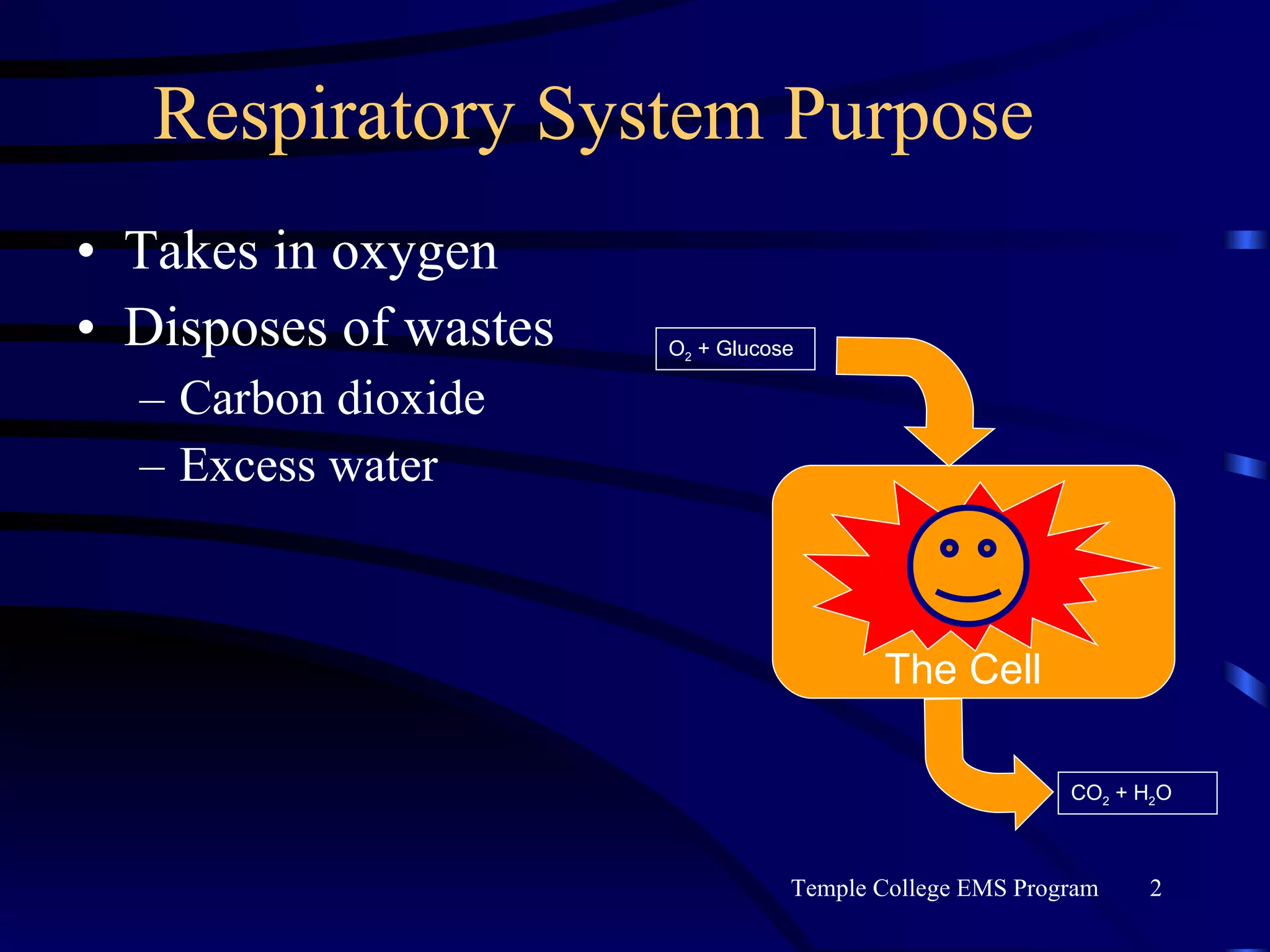
Respiratory System Purpose Takes in oxygen Disposes of wastes Carbon dioxide Excess water O 2  + Glucose CO 2  + H 2 O The Cell
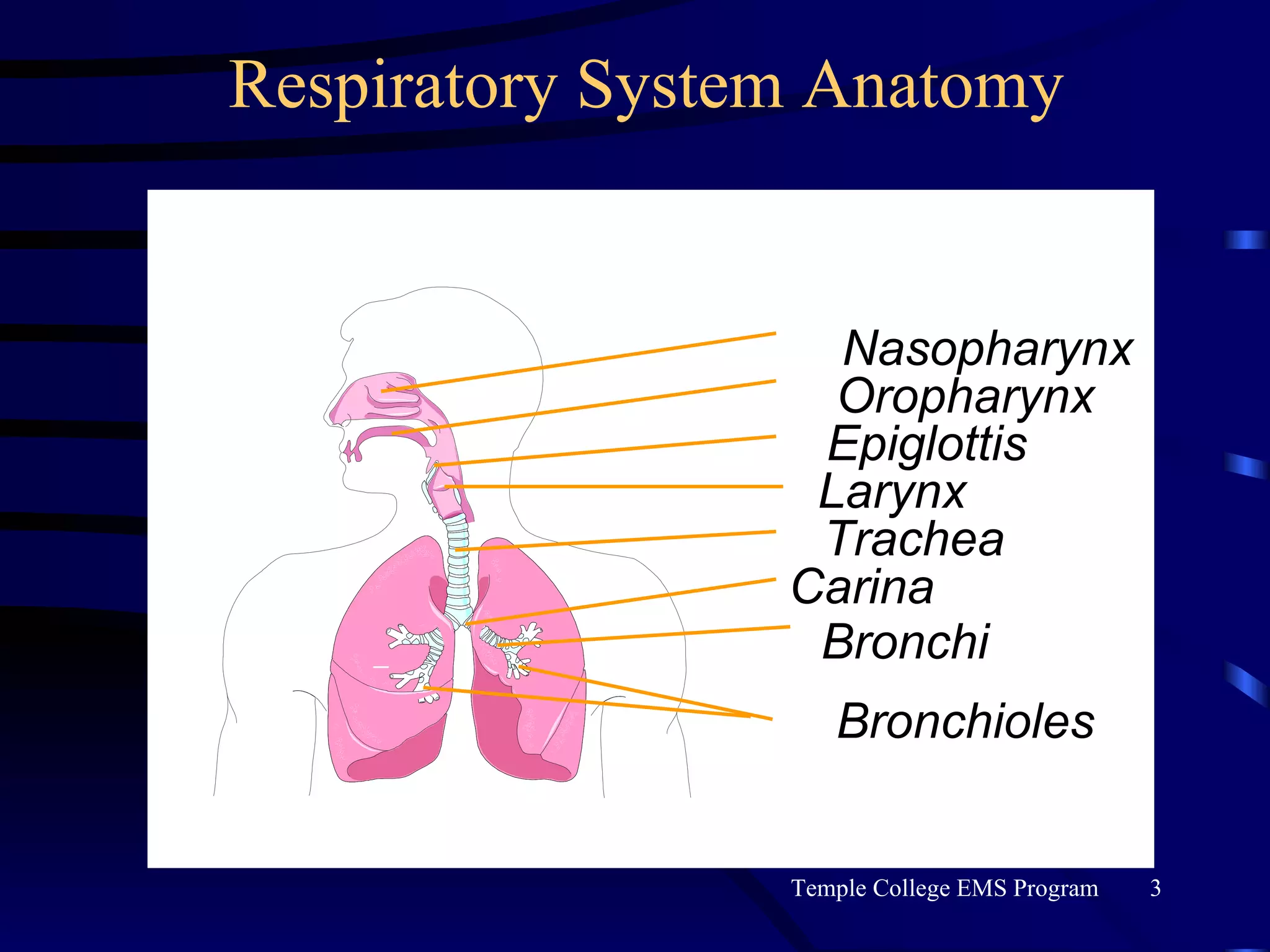
Respiratory System Anatomy Nasopharynx Oropharynx Epiglottis Larynx Trachea Bronchi Bronchioles Carina
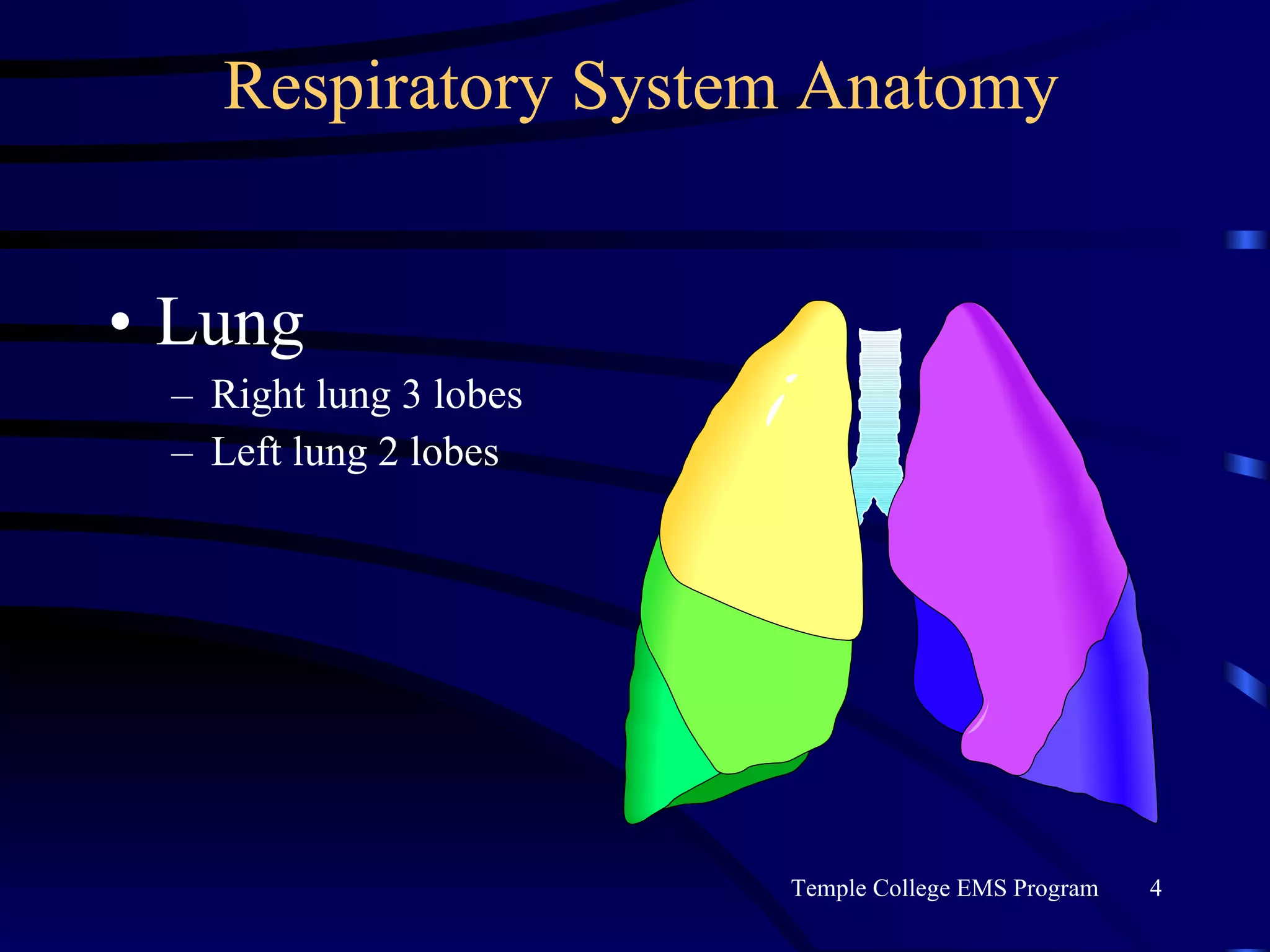
Respiratory System Anatomy Lung Right lung 3 lobes Left lung 2 lobes
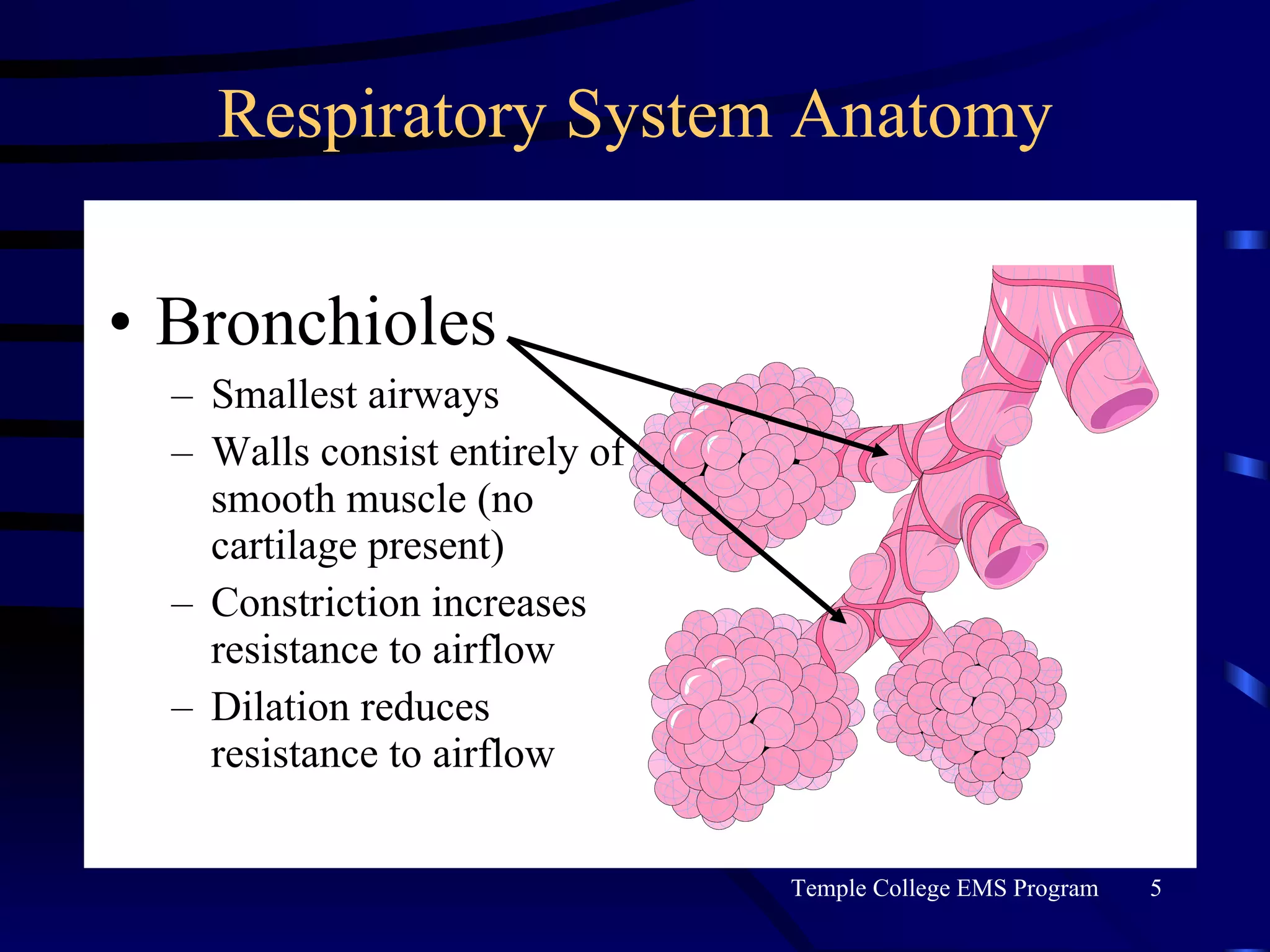
Respiratory System Anatomy Bronchioles Smallest airways Walls consist entirely of smooth muscle (no cartilage present) Constriction increases resistance to airflow Dilation reduces resistance to airflow
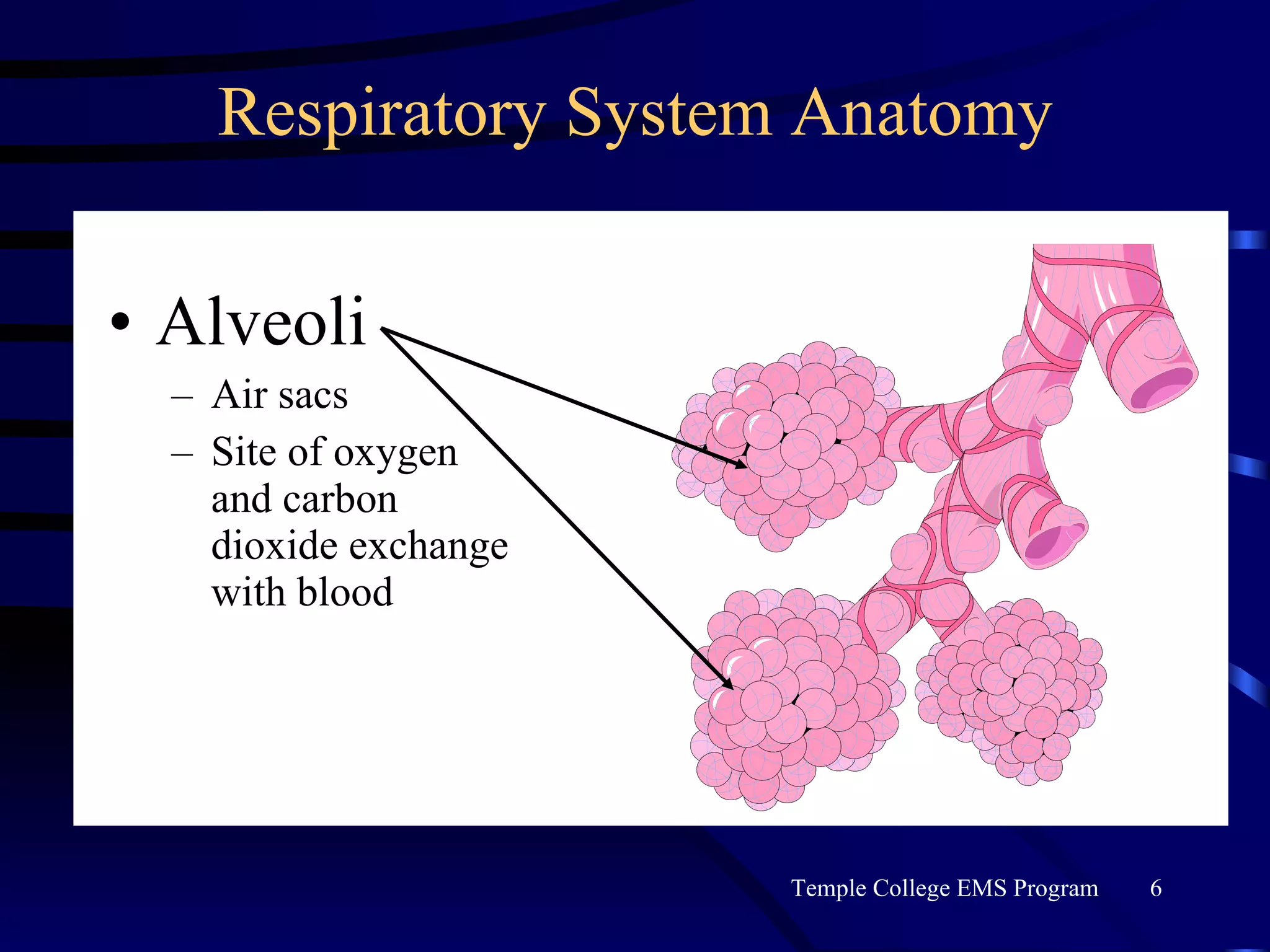
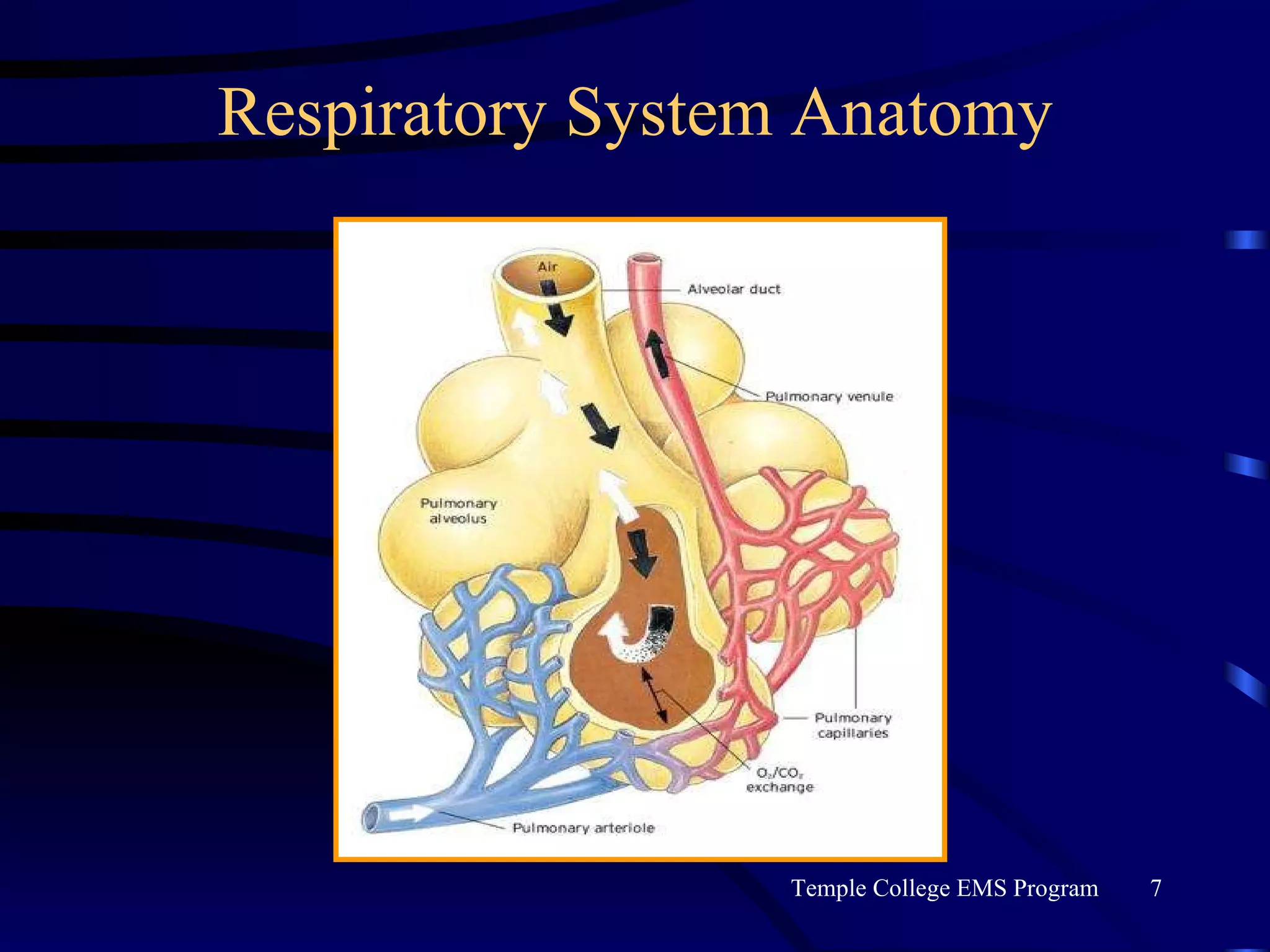
Respiratory System Anatomy Alveoli Air sacs Site of oxygen and carbon dioxide exchange with blood
Respiratory System Anatomy
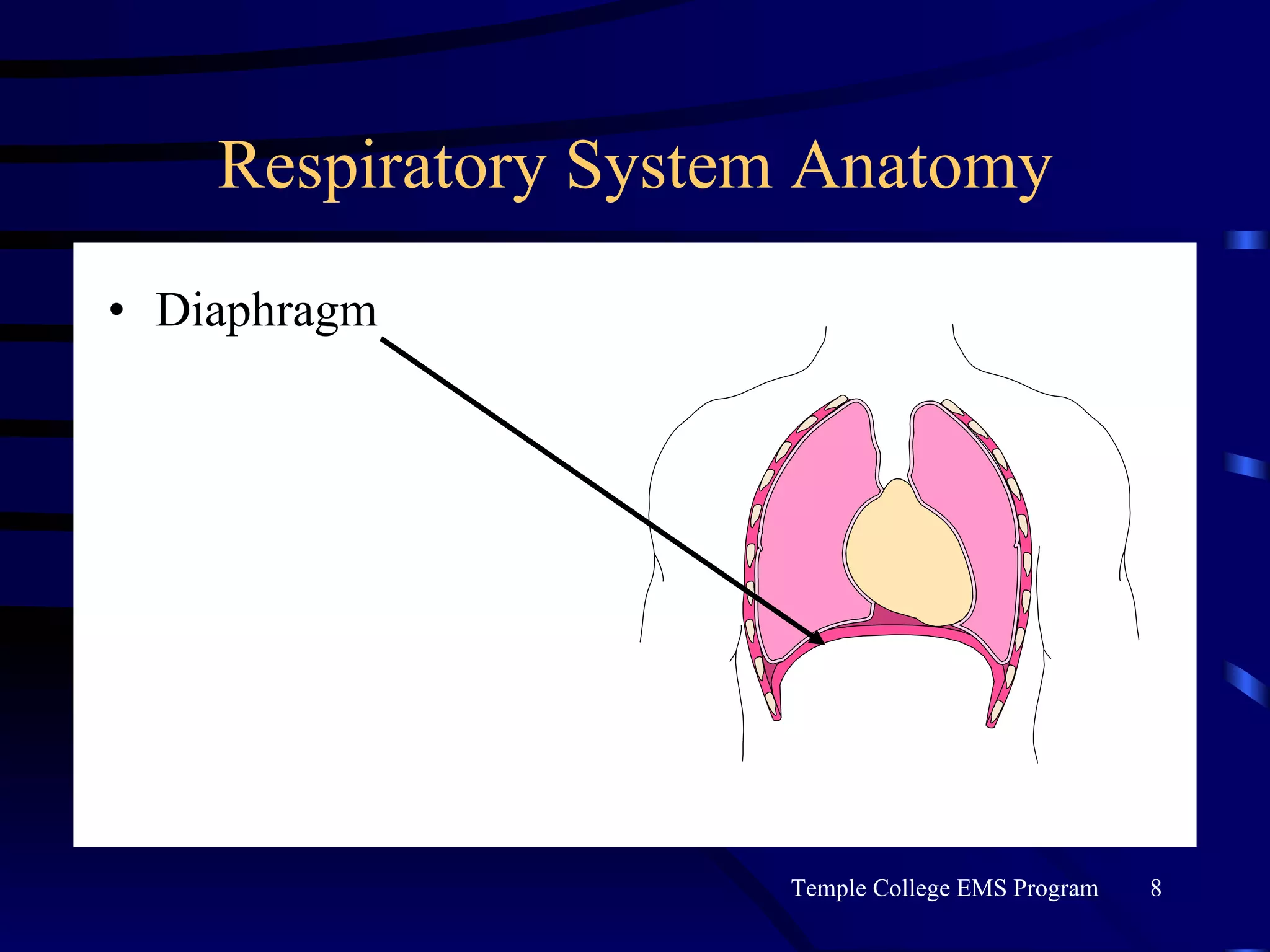
Respiratory System Anatomy Diaphragm
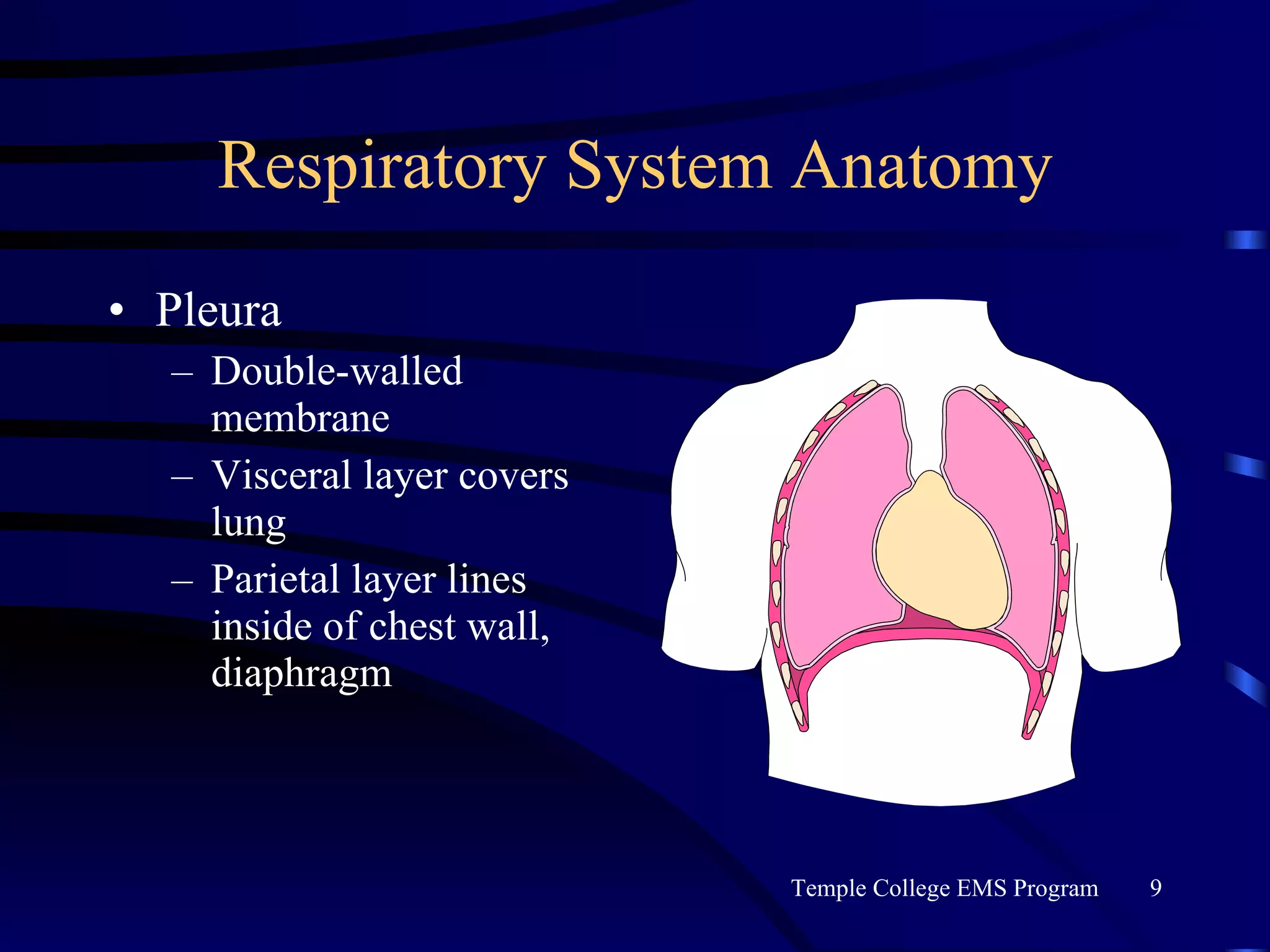
Respiratory System Anatomy Pleura Double-walled membrane Visceral layer covers lung Parietal layer lines inside of chest wall, diaphragm
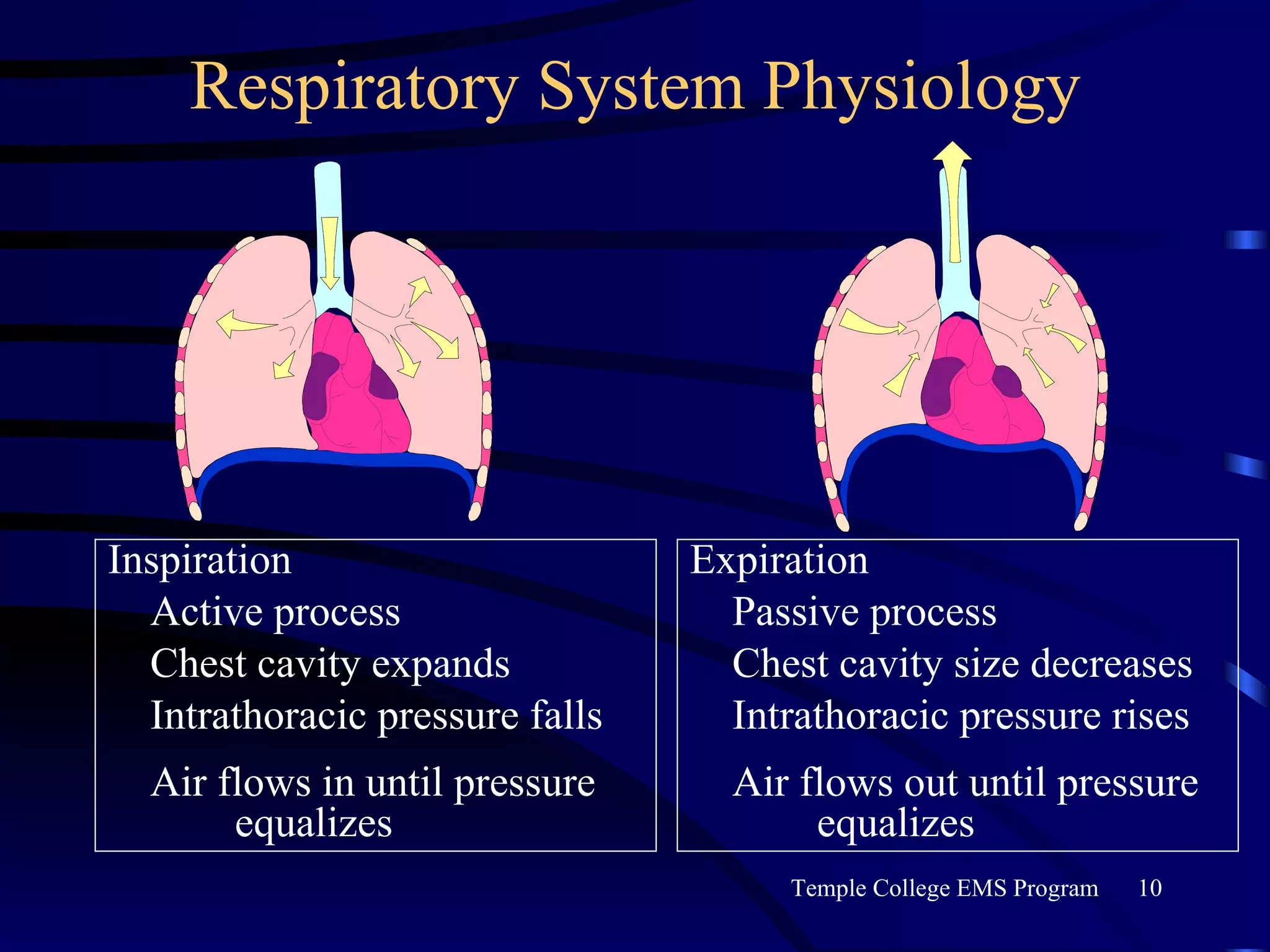
Respiratory System Physiology Inspiration Active process Chest cavity expands Intrathoracic pressure falls Air flows in until pressure  equalizes Expiration Passive process Chest cavity size decreases Intrathoracic pressure rises Air flows out until pressure  equalizes
Respiratory System Physiology Automatic Function Primary drive: increase in arterial CO 2 Secondary (hypoxic) drive: decrease in arterial O 2 Normally we breathe to remove CO 2  from the body,  NOT  to get oxygen in
Respiratory Pathophysiology Airway (Obstruction) Tongue Foreign body airway obstruction Anaphylaxis/angioedema Upper airway burn Maxillofacial/laryngeal/ tracheobronchial trauma Epiglottitis Croup Aspiration Asthma Chronic Obstructive Airway Disease Emphysema Chronic bronchitis
Respiratory Pathophysiology Gas Exchange Surface (Blood Flow or Gas Diffusion) Pulmonary Edema Left-sided heart failure Toxic inhalations Near drowning Pneumonia Pulmonary Embolism Blood clots Amniotic fluid Fat embolism
Respiratory Pathophysiology Thoracic Bellows (Ventilation) Chest Trauma Simple rib fractures Flail chest Pneumothorax Hemothorax Sucking chest wound Diaphragmatic hernia Pleural effusion Spinal cord trauma (High C-spine lesion) Morbid obesity Neurological/neuro-muscular disease Poliomyelitis Myasthenia gravis Muscular dystrophy Guillian-Barre syndrome
Respiratory Pathophysiology Control System (Decreased Respiratory Drive) Head trauma CVA Depressant drug toxicity Narcotics Sedative-hypnotics Ethyl alcohol
Respiratory Assessment Initial Assessment (A, B, C, D) Manage life threats Complete focused history and physical
Initial Assessment Airway Listen to patient breathe, talk Noisy breathing is obstructed breathing But all obstructed breathing is not noisy Snoring = Tongue blocking airway Stridor = “Tight” upper airway from partial obstruction
Initial Assessment Airway Anticipate airway problems with Decreased LOC Head trauma Maxillofacial trauma Neck trauma Chest trauma OPEN—CLEAR—MAINTAIN
Initial Assessment Breathing Is patient moving air? Is air moving adequately? Is the patient’s blood being oxygenated?
Initial Assessment Breathing LOOK Symmetry of chest expansion Increased respiratory effort Changes in skin color LISTEN Air movement at mouth, nose Air Movement in peripheral lung fields FEEL Air movement at mouth, nose Symmetry of chest expansion RATE Tachypnea Bradypnea POSITIONING Orthopnea Tripod position
Initial Assessment Breathing Signs of respiratory distress Nasal flaring Tracheal tugging Retractions Neck, pectoral muscle use on inhalation Abdominal muscle use on exhalation Skin Color Pale, cool moist skin (Early sign of hypoxia) Cyanosis  (Late, unreliable sign of hypoxia)
Initial Assessment Breathing If trauma patient has compromised breathing, bare chest, assess for: Open pneumothorax Flail chest Tension pneumothorax
Respiratory Assessment Circulation Is heart beating? Is there major external hemorrhage? Is patient perfusing? Effects of hypoxia: Adults (early): tachycardia Adults (late): bradycardia Children: bradycardia
Initial Assessment Circulation Don’t let respiratory failure distract you from assessing for circulatory failure Low oxygen or high carbon dioxide levels can depress cardiovascular function
Respiratory Assessment Disability Restlessness, anxiety, combativeness = hypoxia  Until proven otherwise Drowsiness, lethargy = hypercarbia  Until proven otherwise  Just because the patient stops fighting, he’s  not  necessarily getting better!!!
Initial Management Patient Responsive/Breathing Adequate Oxygen may be indicated Oxygenate  immediately  if patient has: Decreased level of consciousness Possible shock Possible severe hemorrhage Chest pain Chest trauma Respiratory distress or dyspnea History of  any  kind of hypoxia
Initial Management Patient responsive, breathing inadequate Open/maintain airway Place nasopharyngeal airway Assist ventilations Mouth to Mask 2-person Bag-valve Mask Manually Triggered Ventilator 1-person Bag-valve Mask
Initial Management Patient unresponsive, breathing adequate Open/maintain airway Place nasopharyngeal or oropharyngeal airway Suction airway as needed Provide oxygen by non-rebreather mask Frequently reassess
Initial Management Patient unresponsive, breathing inadequate Open/maintain airway Place nasopharyngeal or oropharyngeal airway Suction airway as needed Assist ventilations Mouth to Mask 2-person Bag-valve Mask Manually Triggered Ventilator 1-person Bag-valve Mask Frequently reassess
Initial Management Patient not breathing Open airway Place nasopharyngeal or oropharyngeal airway Ventilate patient Mouth-to-Mask 2-Person Bag-Valve Mask Manually Triggered Ventilator 1-Person Bag-Valve Mask Frequently reassess
Initial Management Golden Rules If you think about giving O 2 , give it!!! If you decide to give oxygen, give a lot of it!!! If you can’t tell whether a patient is breathing adequately, he isn’t ! If you’re thinking about assisting a patient’s breathing, you probably should be!
Focused History and Physical Chief Complaint Dyspnea   Subjective  sensation that breathing is excessive, difficult, or uncomfortable Respiratory Distress Objective  observations that indicate breathing is difficult or inadequate
Focused History and Physical History of Present Illness (OPQRST) Gradual or sudden onset? What aggravates or alleviates? How long has dyspnea been present? Coughing? Productive cough? What does sputum look/smell like? Pain present? What does pain feel like? How bad? Does it radiate? Where?
Focused History and Physical Past History If  Then??? Hypertension, MI, Diabetes  CHF with Pulmonary Edema Chronic Cough , Smoking,  COPD “ Recurrent” Flu Allergies, Acute Episodes of SOB  Asthma Lower Extremity Trauma, Pulmonary Embolism Recent Surgery,  Immobilization
Focused History and Physical Medications If    Then??? “ Breathing” Pills, Inhalers    Asthma or COPD Albuterol Montelukast Aminophylline Oxtriphylline Ipratropium Cromolyn Terbutaline Prednisone Salbumatol Zafirlukast
Focused History and Physical Medications   If  Then???   Lasix, hydrodiuril, digitalis  CHF   Coumadin, BCP’s  Pulmonary embolism
Focused History and Physical Exam Crackles (Rales) Fine, “crackling” Fluid in smaller airways, alveoli Rhonchi Coarse, “rumbling” Fluid, mucus in larger airways Stridor High pitched, “crowing” Upper airway restriction Wheezing “ Whistling” Usually more pronounced on exhalation Generalized: narrowing, spasm of the smaller airways Localized: foreign body aspiration
Mild Breathing Difficulty May be hypoxic Can move adequate tidal volume Can answer questions, speak in complete sentences, is alert High concentration O 2  by non-rebreather mask Consider  bronchodilators  if patient  wheezing
Moderate Breathing Difficulty May be hypoxic May be moving adequate tidal volume Having difficulty answering questions, speaks in choppy sentences, is restless/irritable High concentration O 2  by non-rebreather mask Get ready to assist ventilations if needed (patient may resist assistance at this time) Consider  bronchodilators  if patient  wheezing
Severe Breathing Difficulty Getting sleepy Not speaking or speaking with very few words Previously wild, now seems “cooperative” Assist ventilations with BVM and oxygen Time BVM ventilation with patient’s ventilatory efforts Interpose extra ventilations if necessary

Emt the respiratory system

  • 1.
    The Respiratory SystemEmergency Medical Technician - Basic
  • 2.
    Respiratory System PurposeTakes in oxygen Disposes of wastes Carbon dioxide Excess water O 2 + Glucose CO 2 + H 2 O The Cell
  • 3.
    Respiratory System AnatomyNasopharynx Oropharynx Epiglottis Larynx Trachea Bronchi Bronchioles Carina
  • 4.
    Respiratory System AnatomyLung Right lung 3 lobes Left lung 2 lobes
  • 5.
    Respiratory System AnatomyBronchioles Smallest airways Walls consist entirely of smooth muscle (no cartilage present) Constriction increases resistance to airflow Dilation reduces resistance to airflow
  • 6.
    Respiratory System AnatomyAlveoli Air sacs Site of oxygen and carbon dioxide exchange with blood
  • 7.
  • 8.
  • 9.
    Respiratory System AnatomyPleura Double-walled membrane Visceral layer covers lung Parietal layer lines inside of chest wall, diaphragm
  • 10.
    Respiratory System PhysiologyInspiration Active process Chest cavity expands Intrathoracic pressure falls Air flows in until pressure equalizes Expiration Passive process Chest cavity size decreases Intrathoracic pressure rises Air flows out until pressure equalizes
  • 11.
    Respiratory System PhysiologyAutomatic Function Primary drive: increase in arterial CO 2 Secondary (hypoxic) drive: decrease in arterial O 2 Normally we breathe to remove CO 2 from the body, NOT to get oxygen in
  • 12.
    Respiratory Pathophysiology Airway(Obstruction) Tongue Foreign body airway obstruction Anaphylaxis/angioedema Upper airway burn Maxillofacial/laryngeal/ tracheobronchial trauma Epiglottitis Croup Aspiration Asthma Chronic Obstructive Airway Disease Emphysema Chronic bronchitis
  • 13.
    Respiratory Pathophysiology GasExchange Surface (Blood Flow or Gas Diffusion) Pulmonary Edema Left-sided heart failure Toxic inhalations Near drowning Pneumonia Pulmonary Embolism Blood clots Amniotic fluid Fat embolism
  • 14.
    Respiratory Pathophysiology ThoracicBellows (Ventilation) Chest Trauma Simple rib fractures Flail chest Pneumothorax Hemothorax Sucking chest wound Diaphragmatic hernia Pleural effusion Spinal cord trauma (High C-spine lesion) Morbid obesity Neurological/neuro-muscular disease Poliomyelitis Myasthenia gravis Muscular dystrophy Guillian-Barre syndrome
  • 15.
    Respiratory Pathophysiology ControlSystem (Decreased Respiratory Drive) Head trauma CVA Depressant drug toxicity Narcotics Sedative-hypnotics Ethyl alcohol
  • 16.
    Respiratory Assessment InitialAssessment (A, B, C, D) Manage life threats Complete focused history and physical
  • 17.
    Initial Assessment AirwayListen to patient breathe, talk Noisy breathing is obstructed breathing But all obstructed breathing is not noisy Snoring = Tongue blocking airway Stridor = “Tight” upper airway from partial obstruction
  • 18.
    Initial Assessment AirwayAnticipate airway problems with Decreased LOC Head trauma Maxillofacial trauma Neck trauma Chest trauma OPEN—CLEAR—MAINTAIN
  • 19.
    Initial Assessment BreathingIs patient moving air? Is air moving adequately? Is the patient’s blood being oxygenated?
  • 20.
    Initial Assessment BreathingLOOK Symmetry of chest expansion Increased respiratory effort Changes in skin color LISTEN Air movement at mouth, nose Air Movement in peripheral lung fields FEEL Air movement at mouth, nose Symmetry of chest expansion RATE Tachypnea Bradypnea POSITIONING Orthopnea Tripod position
  • 21.
    Initial Assessment BreathingSigns of respiratory distress Nasal flaring Tracheal tugging Retractions Neck, pectoral muscle use on inhalation Abdominal muscle use on exhalation Skin Color Pale, cool moist skin (Early sign of hypoxia) Cyanosis (Late, unreliable sign of hypoxia)
  • 22.
    Initial Assessment BreathingIf trauma patient has compromised breathing, bare chest, assess for: Open pneumothorax Flail chest Tension pneumothorax
  • 23.
    Respiratory Assessment CirculationIs heart beating? Is there major external hemorrhage? Is patient perfusing? Effects of hypoxia: Adults (early): tachycardia Adults (late): bradycardia Children: bradycardia
  • 24.
    Initial Assessment CirculationDon’t let respiratory failure distract you from assessing for circulatory failure Low oxygen or high carbon dioxide levels can depress cardiovascular function
  • 25.
    Respiratory Assessment DisabilityRestlessness, anxiety, combativeness = hypoxia Until proven otherwise Drowsiness, lethargy = hypercarbia Until proven otherwise Just because the patient stops fighting, he’s not necessarily getting better!!!
  • 26.
    Initial Management PatientResponsive/Breathing Adequate Oxygen may be indicated Oxygenate immediately if patient has: Decreased level of consciousness Possible shock Possible severe hemorrhage Chest pain Chest trauma Respiratory distress or dyspnea History of any kind of hypoxia
  • 27.
    Initial Management Patientresponsive, breathing inadequate Open/maintain airway Place nasopharyngeal airway Assist ventilations Mouth to Mask 2-person Bag-valve Mask Manually Triggered Ventilator 1-person Bag-valve Mask
  • 28.
    Initial Management Patientunresponsive, breathing adequate Open/maintain airway Place nasopharyngeal or oropharyngeal airway Suction airway as needed Provide oxygen by non-rebreather mask Frequently reassess
  • 29.
    Initial Management Patientunresponsive, breathing inadequate Open/maintain airway Place nasopharyngeal or oropharyngeal airway Suction airway as needed Assist ventilations Mouth to Mask 2-person Bag-valve Mask Manually Triggered Ventilator 1-person Bag-valve Mask Frequently reassess
  • 30.
    Initial Management Patientnot breathing Open airway Place nasopharyngeal or oropharyngeal airway Ventilate patient Mouth-to-Mask 2-Person Bag-Valve Mask Manually Triggered Ventilator 1-Person Bag-Valve Mask Frequently reassess
  • 31.
    Initial Management GoldenRules If you think about giving O 2 , give it!!! If you decide to give oxygen, give a lot of it!!! If you can’t tell whether a patient is breathing adequately, he isn’t ! If you’re thinking about assisting a patient’s breathing, you probably should be!
  • 32.
    Focused History andPhysical Chief Complaint Dyspnea Subjective sensation that breathing is excessive, difficult, or uncomfortable Respiratory Distress Objective observations that indicate breathing is difficult or inadequate
  • 33.
    Focused History andPhysical History of Present Illness (OPQRST) Gradual or sudden onset? What aggravates or alleviates? How long has dyspnea been present? Coughing? Productive cough? What does sputum look/smell like? Pain present? What does pain feel like? How bad? Does it radiate? Where?
  • 34.
    Focused History andPhysical Past History If Then??? Hypertension, MI, Diabetes CHF with Pulmonary Edema Chronic Cough , Smoking, COPD “ Recurrent” Flu Allergies, Acute Episodes of SOB Asthma Lower Extremity Trauma, Pulmonary Embolism Recent Surgery, Immobilization
  • 35.
    Focused History andPhysical Medications If Then??? “ Breathing” Pills, Inhalers Asthma or COPD Albuterol Montelukast Aminophylline Oxtriphylline Ipratropium Cromolyn Terbutaline Prednisone Salbumatol Zafirlukast
  • 36.
    Focused History andPhysical Medications If Then??? Lasix, hydrodiuril, digitalis CHF Coumadin, BCP’s Pulmonary embolism
  • 37.
    Focused History andPhysical Exam Crackles (Rales) Fine, “crackling” Fluid in smaller airways, alveoli Rhonchi Coarse, “rumbling” Fluid, mucus in larger airways Stridor High pitched, “crowing” Upper airway restriction Wheezing “ Whistling” Usually more pronounced on exhalation Generalized: narrowing, spasm of the smaller airways Localized: foreign body aspiration
  • 38.
    Mild Breathing DifficultyMay be hypoxic Can move adequate tidal volume Can answer questions, speak in complete sentences, is alert High concentration O 2 by non-rebreather mask Consider bronchodilators if patient wheezing
  • 39.
    Moderate Breathing DifficultyMay be hypoxic May be moving adequate tidal volume Having difficulty answering questions, speaks in choppy sentences, is restless/irritable High concentration O 2 by non-rebreather mask Get ready to assist ventilations if needed (patient may resist assistance at this time) Consider bronchodilators if patient wheezing
  • 40.
    Severe Breathing DifficultyGetting sleepy Not speaking or speaking with very few words Previously wild, now seems “cooperative” Assist ventilations with BVM and oxygen Time BVM ventilation with patient’s ventilatory efforts Interpose extra ventilations if necessary