Airway Management Part 1 EMS Professions Temple College
Topics for Discussion Airway Maintenance Objectives Airway Anatomy & Physiology Review Causes of Respiratory Difficulty & Distress Assessing Respiratory Function Methods of Airway Management Methods of Ventilatory Management Common Out-of-Hospital Equipment Utilized Advanced Methods of Airway Management and Ventilation Risks to the Paramedic
Objectives of Airway Management & Ventilation Primary Objective: Ensure optimal ventilation Deliver oxygen to blood Eliminate carbon dioxide (C0 2 ) from body Definitions What is  airway management ? How does it differ from spontaneous, manual or assisted  ventilations ?
Objectives of Airway Management & Ventilation Why is this so important? Brain death occurs rapidly; other tissue follows EMS providers can reduce additional injury/disease by good airway, ventilation techniques EMS providers often neglect BLS airway, ventilation skills
Airway Anatomy Review Upper Airway Anatomy Lower Airway Anatomy Lung Capacities/Volumes Pediatric Airway Differences
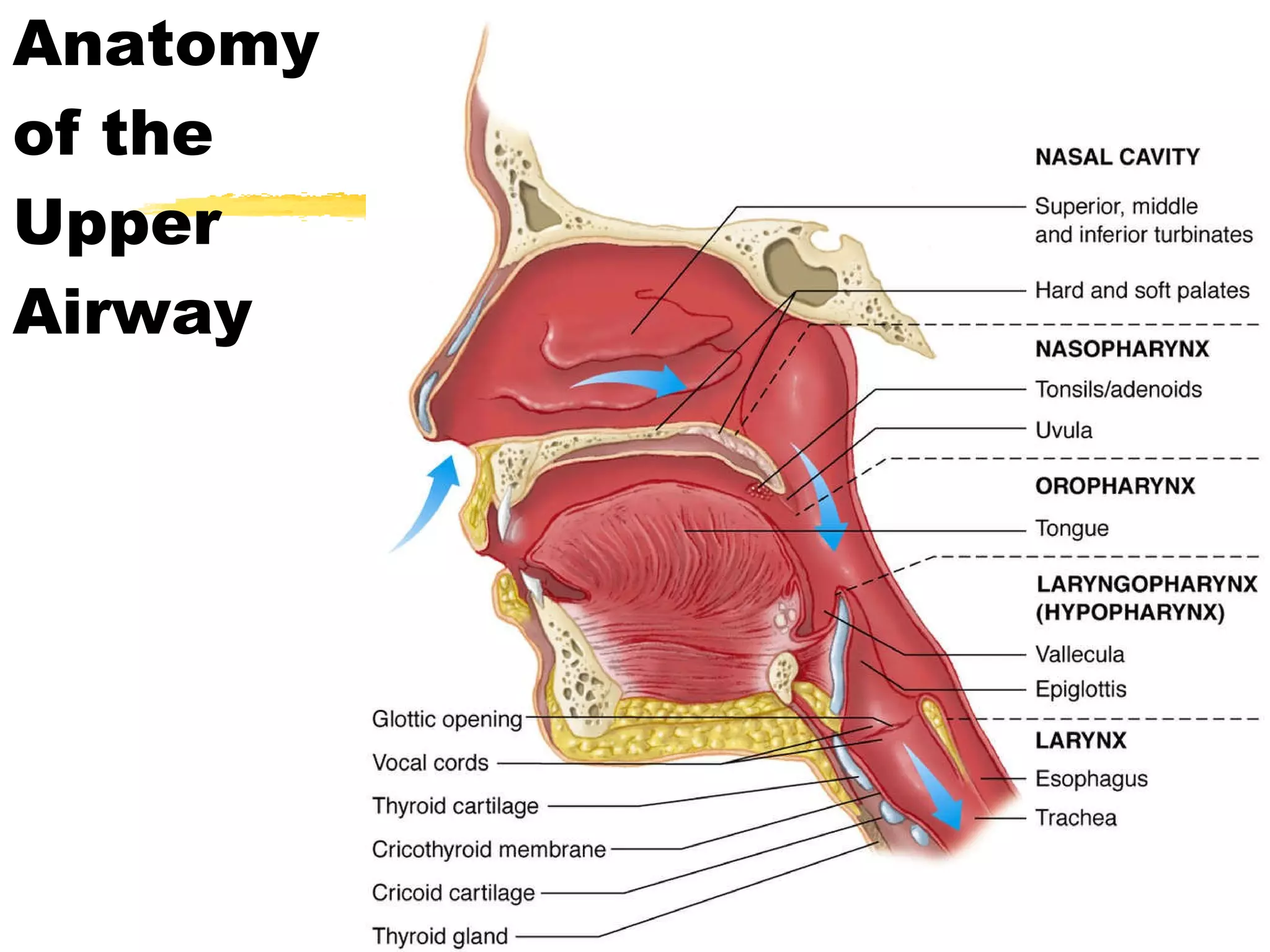
Anatomy of the Upper Airway
Upper Airway Anatomy Functions: warm, filter, humidify air Nasal cavity and nasopharynx Formed by union of facial bones Nasal floor towards ear not eye Lined with mucous membranes, cilia Tissues are delicate, vascular Adenoids Lymph tissue - filters bacteria Commonly infected
Upper Airway Anatomy Oral cavity and oropharynx Teeth Tongue Attached at mandible, hyoid bone Most common airway obstruction cause Palate Roof of mouth Separates oropharynx and nasopharynx Anterior= hard palate; Posterior= soft palate
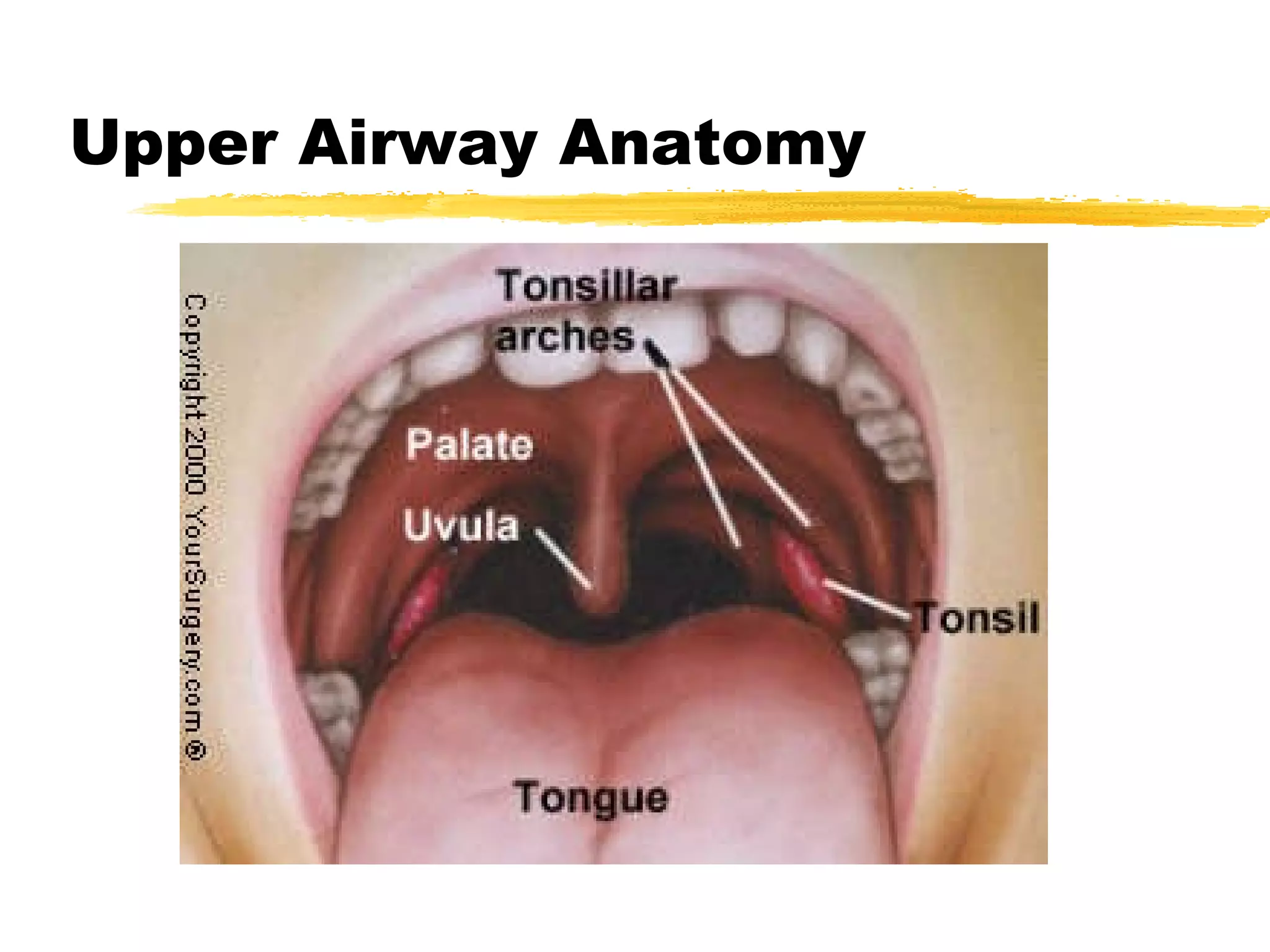
Upper Airway Anatomy Oral cavity and oropharynx Tonsils Lymph tissue - filters bacteria Commonly infected Epiglottis Leaf-like structure Closes during swallowing Prevents aspiration Vallecula “ Pocket” formed by  base of tongue, epiglottis
Upper Airway Anatomy
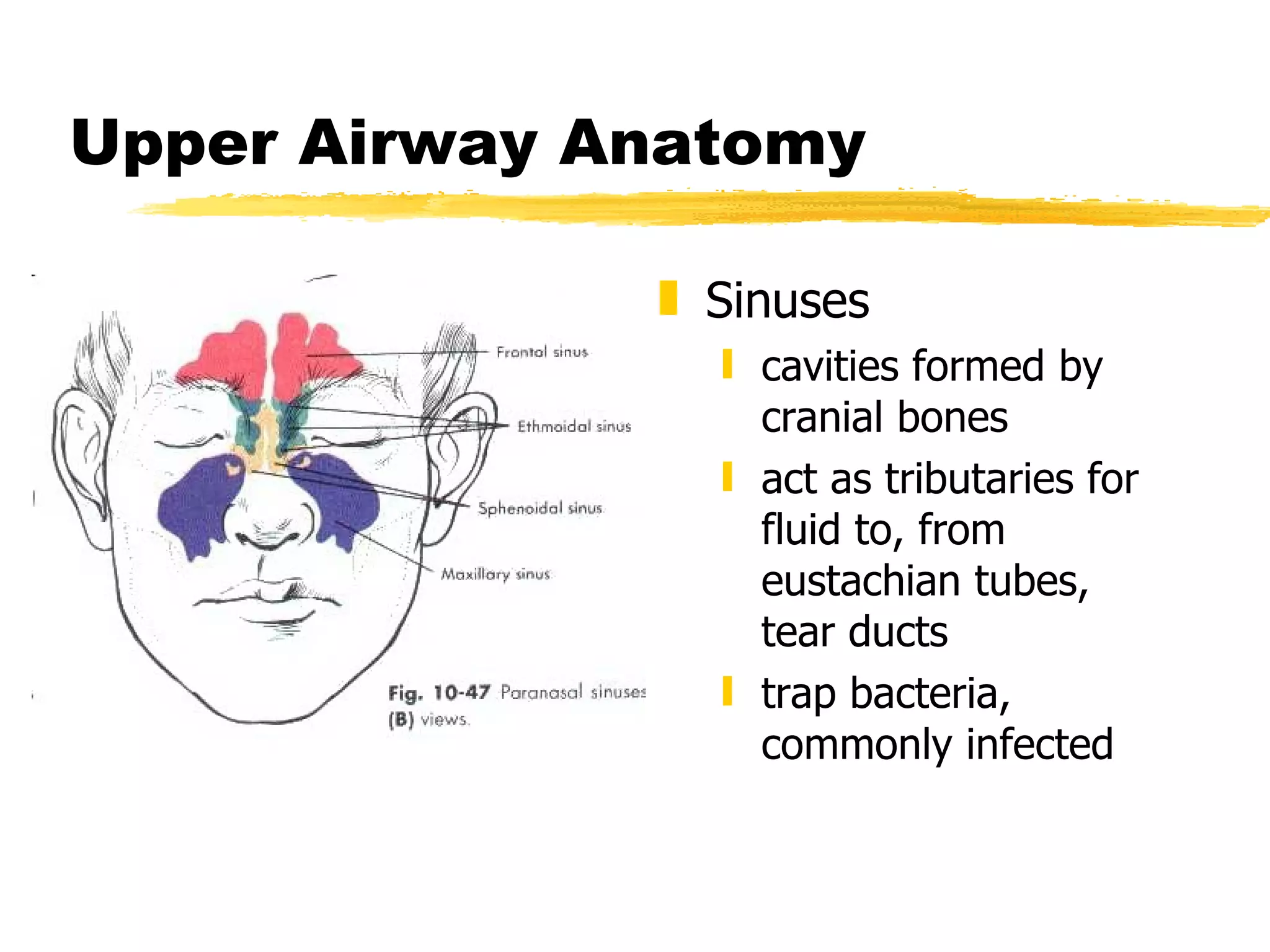
Upper Airway Anatomy Sinuses cavities formed by cranial bones act as tributaries for fluid to, from eustachian tubes,  tear ducts trap bacteria, commonly infected
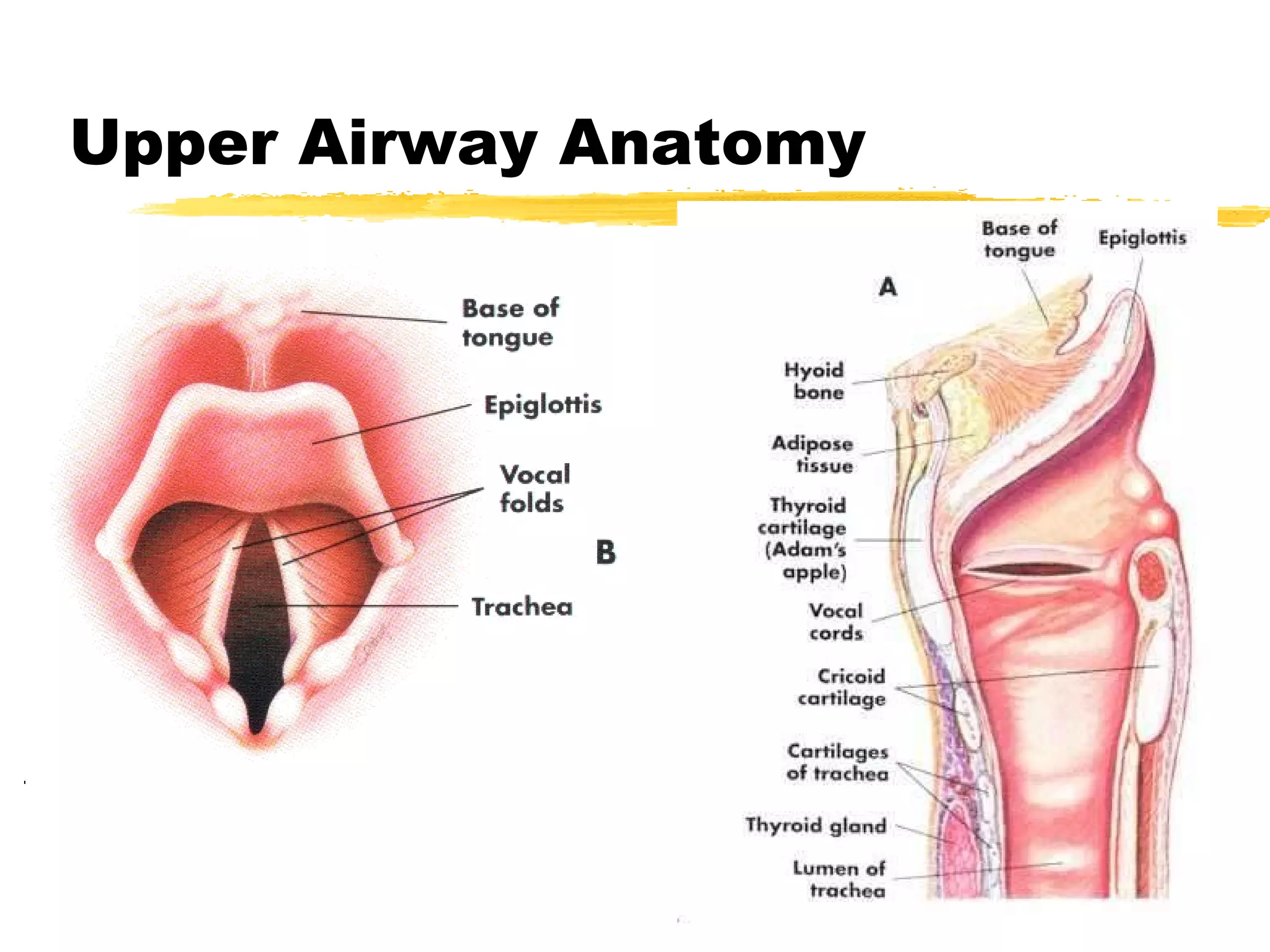
Upper Airway Anatomy Larynx Attached to hyoid bone Horseshoe shaped bone Supports trachea Thyroid cartilage Largest laryngeal cartilage Shield-shaped Cartilage anteriorly, smooth muscle posteriorly “ Adam’s Apple” Glottic opening directly behind
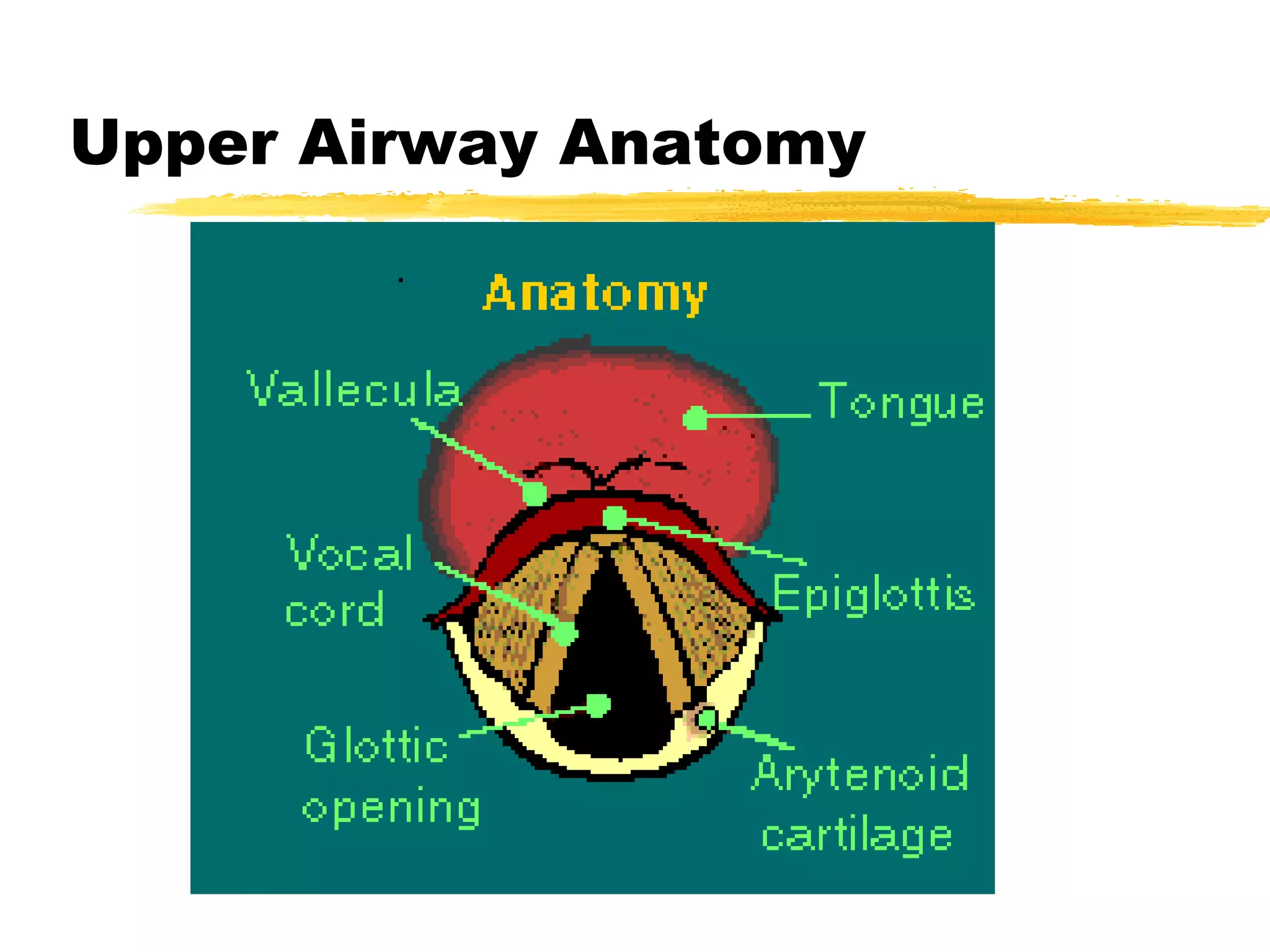
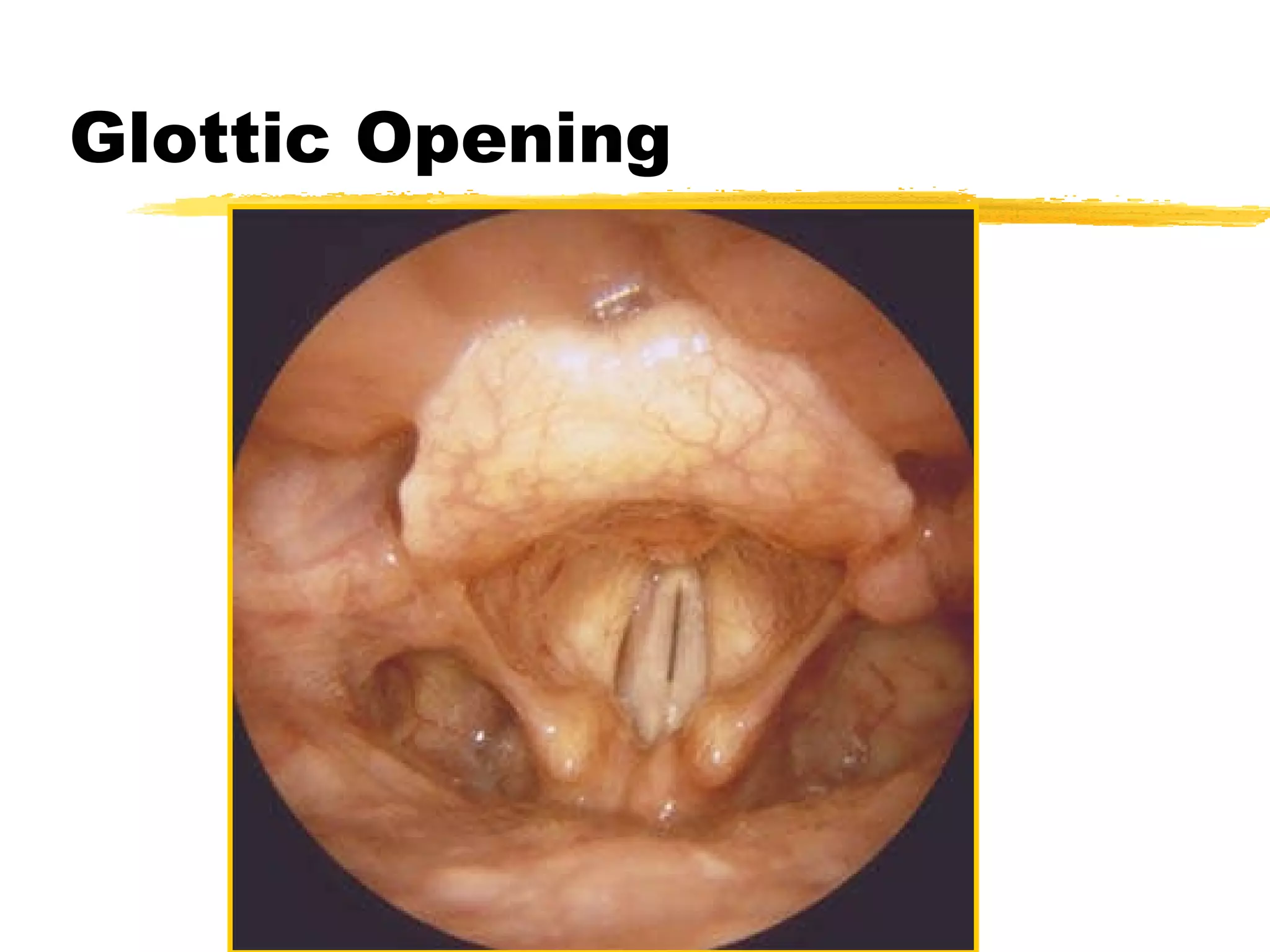
Upper Airway Anatomy Larynx Glottic opening Adult airway’s narrowest point Dependent on muscle tone Contains vocal bands Arytenoid cartilage Posterior attachment of vocal bands
Upper Airway Anatomy Larynx Cricoid ring First tracheal ring Completely cartilaginous Compression (Sellick maneuver) occludes esophagus Cricothyroid membrane Membrane between cricoid, thyroid cartilages Site for surgical, needle airway placement
Upper Airway Anatomy Larynx and Trachea Associated Structures Thyroid gland below cricoid cartilage lies across trachea, up both sides Carotid arteries branch across, lie closely alongside trachea Jugular veins branch across and lie close to trachea
Upper Airway Anatomy
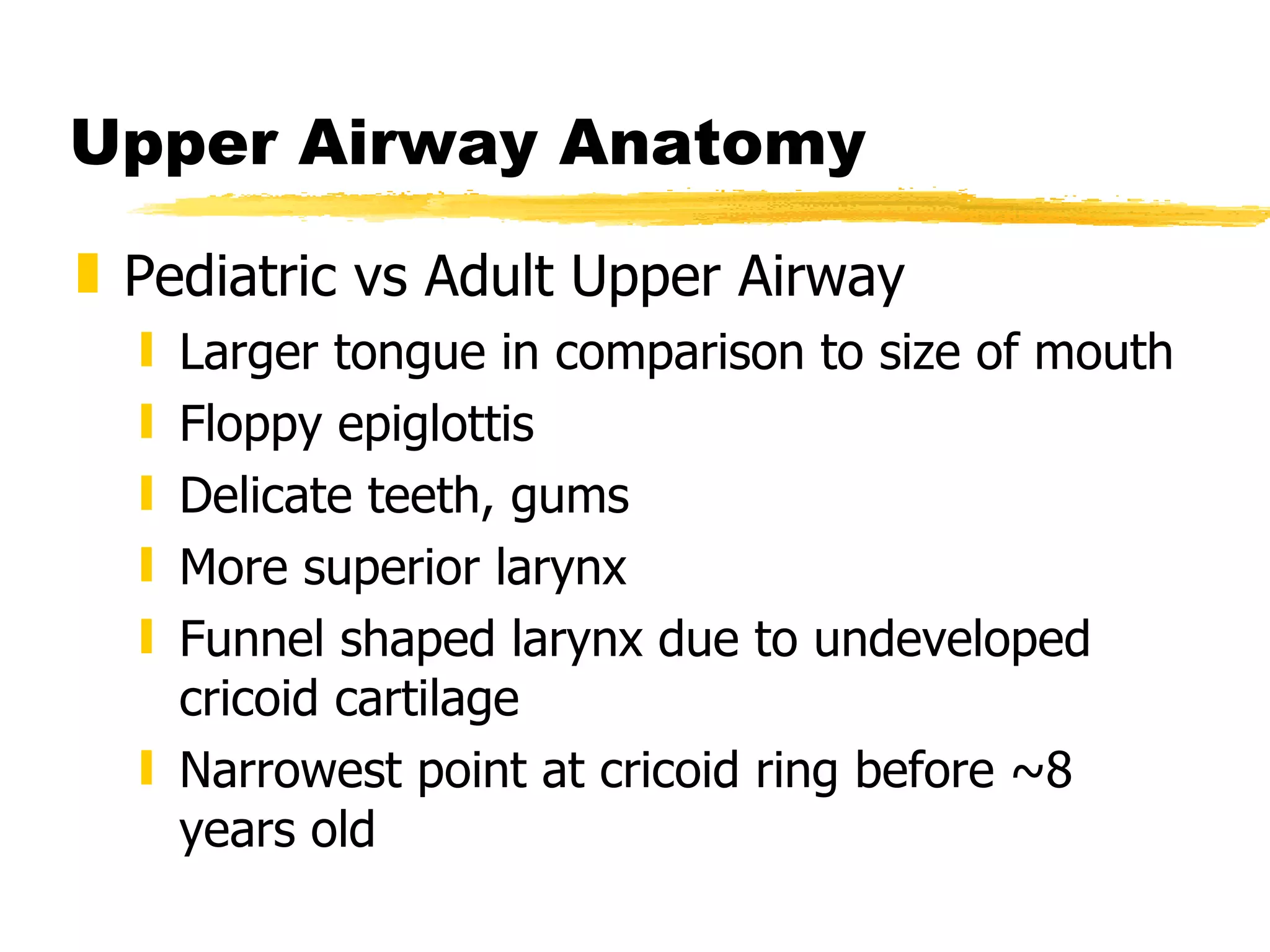
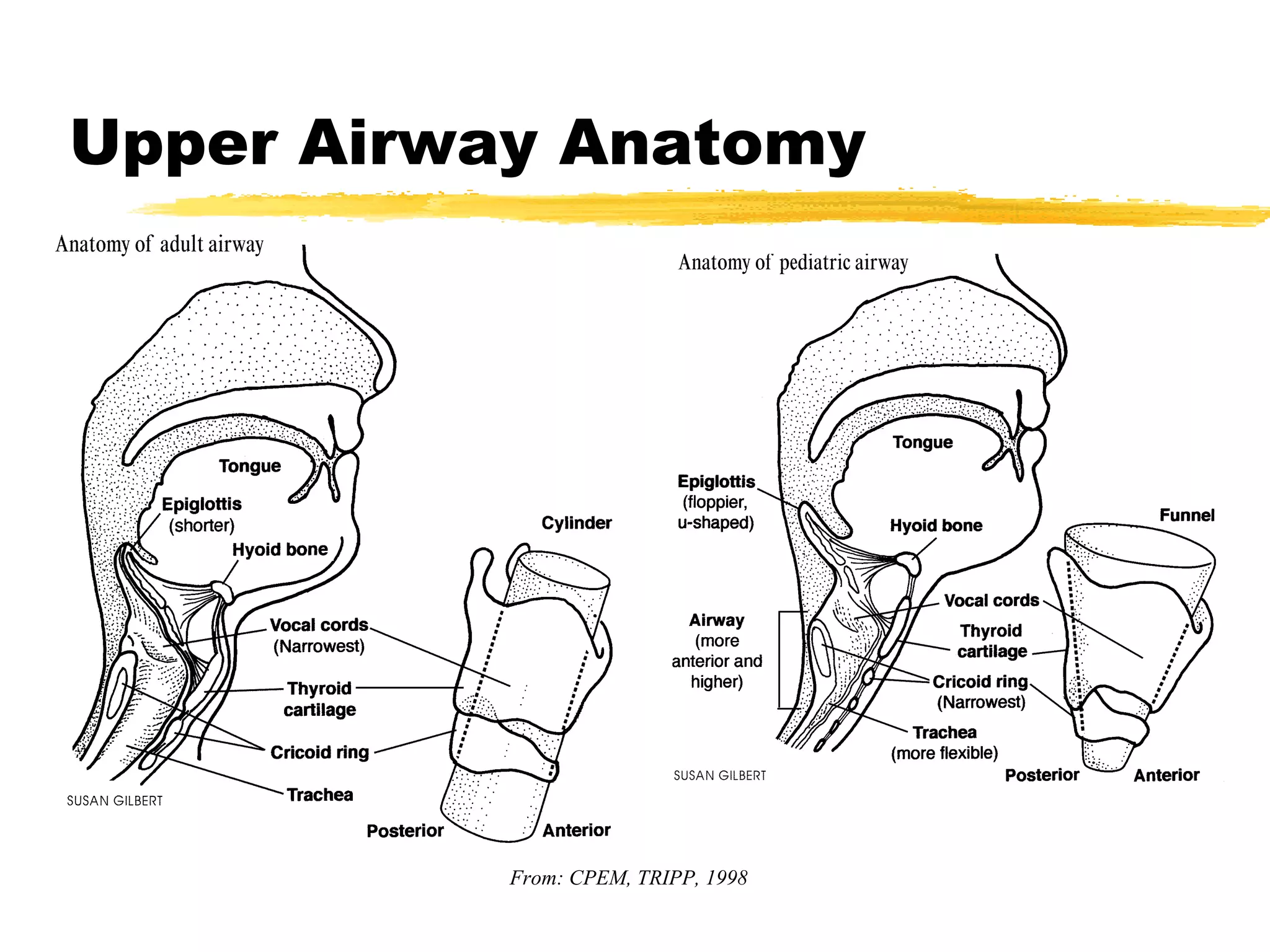
Upper Airway Anatomy Pediatric vs Adult Upper Airway Larger tongue in comparison to size of mouth Floppy epiglottis Delicate teeth, gums More superior larynx Funnel shaped larynx due to undeveloped cricoid cartilage Narrowest point at cricoid ring before ~8 years old
Upper Airway Anatomy From: CPEM, TRIPP, 1998
Upper Airway Anatomy
Glottic Opening
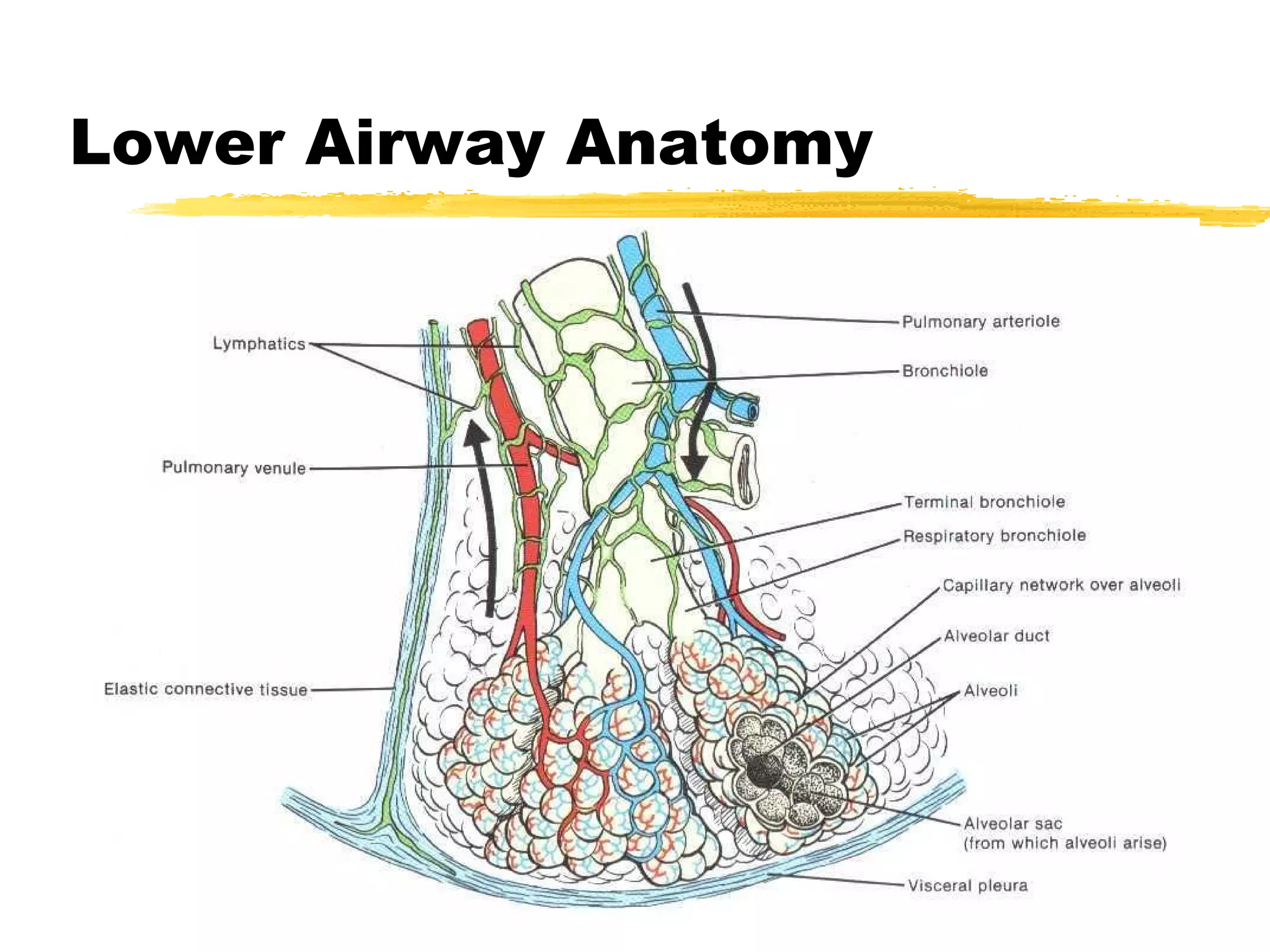
Lower Airway Anatomy Function Exchange O 2  , CO 2  with blood Location From glottic opening to alveolar-capillary membrane
Lower Airway Anatomy Trachea Bifurcates (divides) at carina Right, left mainstem bronchi Right mainstem bronchus shorter, straighter Lined with mucous cells, beta-2 receptors
Lower Airway Anatomy Bronchi Branch into secondary, tertiary bronchi that branch into bronchioles Bronchioles No cartilage in walls Small smooth muscle tubes Branch into alveolar ducts that end at alveolar sacs
Lower Airway Anatomy Alveoli “ Balloon-like” clusters Site of gas exchange Lined with  surfactant   Decreases surface tension    eases expansion    surfactant    atelectasis (focal collapse of alveoli0
Lower Airway Anatomy Lungs Right lung = 3 lobes; Left lung = 2 lobes Parenchymal tissue Pleura Visceral Parietal Pleural space
Lower Airway Anatomy
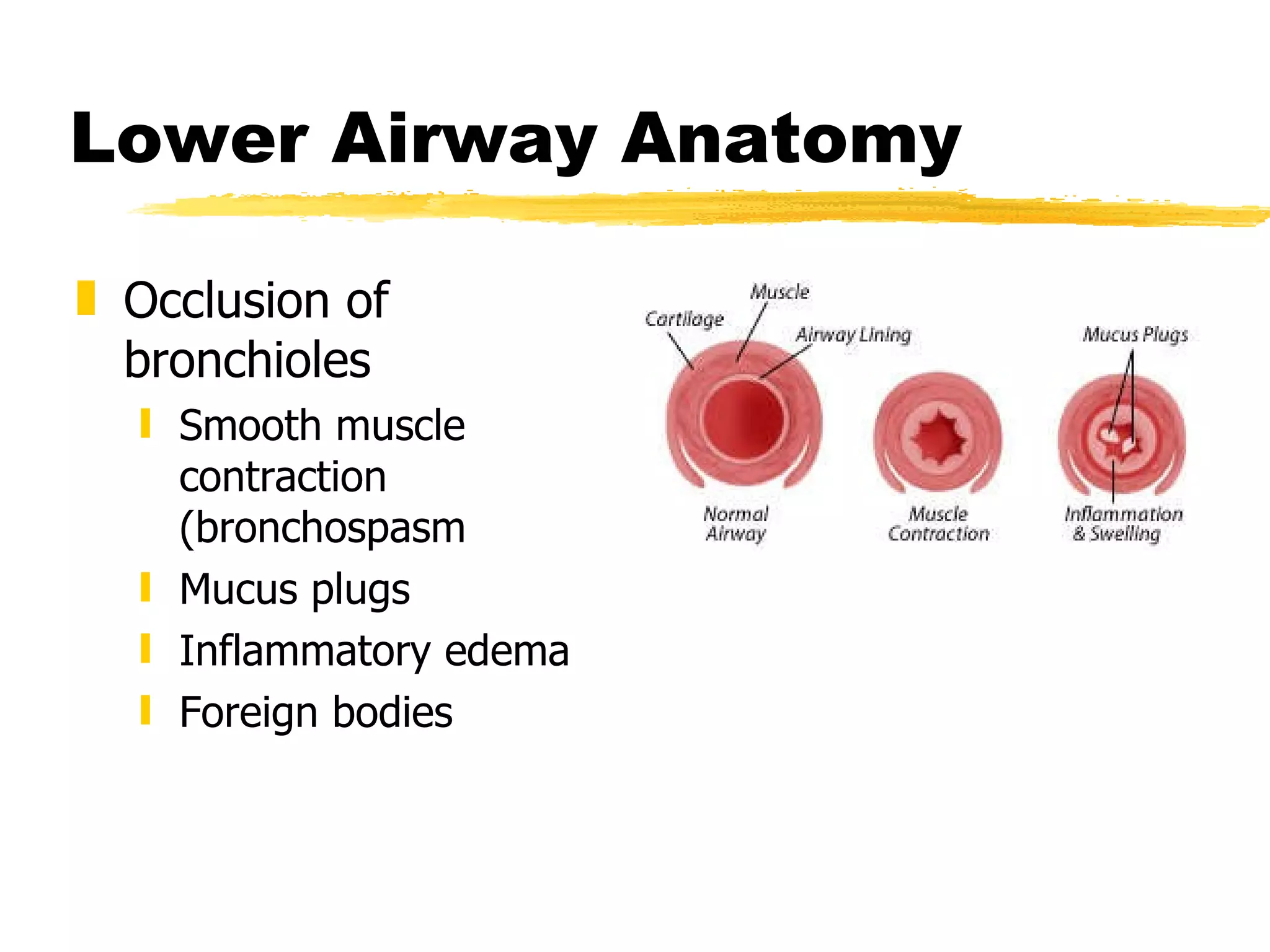
Lower Airway Anatomy Occlusion of bronchioles Smooth muscle contraction (bronchospasm Mucus plugs Inflammatory edema Foreign bodies
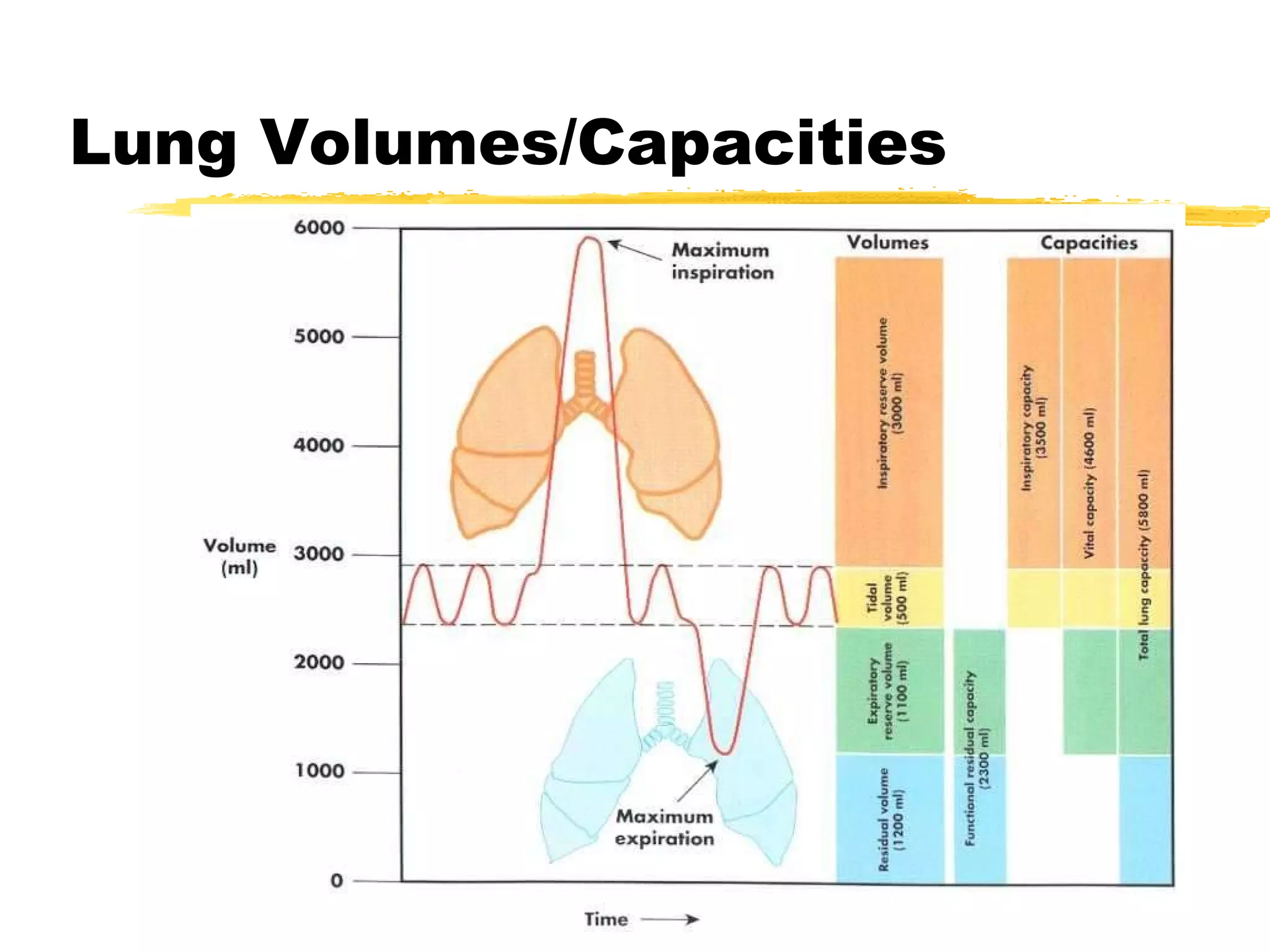
Lung Volumes/Capacities Typical adult male total lung capacity = 6 liters Tidal Volume (V T ) Gas volume inhaled or exhaled during single ventilatory cycle Usually 5-7 cc/kg (typically 500 cc)
Lung Volumes/Capacities Dead Space Air (V D ) Air unavailable for gas exchange
Lung Volumes/Capacities Dead Space Air (V D ) Anatomic dead space (~150cc) Trachea Bronchi Physiologic dead space Shunting Pathological dead space Formed by factors like disease or obstruction Examples: COPD
Lung Volumes/Capacities Alveolar Air (alveolar volume) [V A ] Air reaching alveoli for gas exchange Usually 350 cc
Lung Volumes/Capacities Minute Volume [V min ](minute ventilation) Amount of gas moved in, out of respiratory tract per minute Tidal volume  X RR Alveolar Minute Volume Amount of gas moved in, out of alveoli per minute (tidal volume - dead space volume) X RR
Lung Volumes/Capacities Functional Reserve Capacity (FRC) After optimal inspiration, amount of air that can be forced from lungs in single exhalation
Lung Volumes/Capacities Inspiratory Reserve Volume (IRV) Amount of gas that can be inspired in addition to tidal volume Expiratory Reserve Volume (ERV) Amount of gas that can be expired after passive (relaxed) expiration
Lung Volumes/Capacities
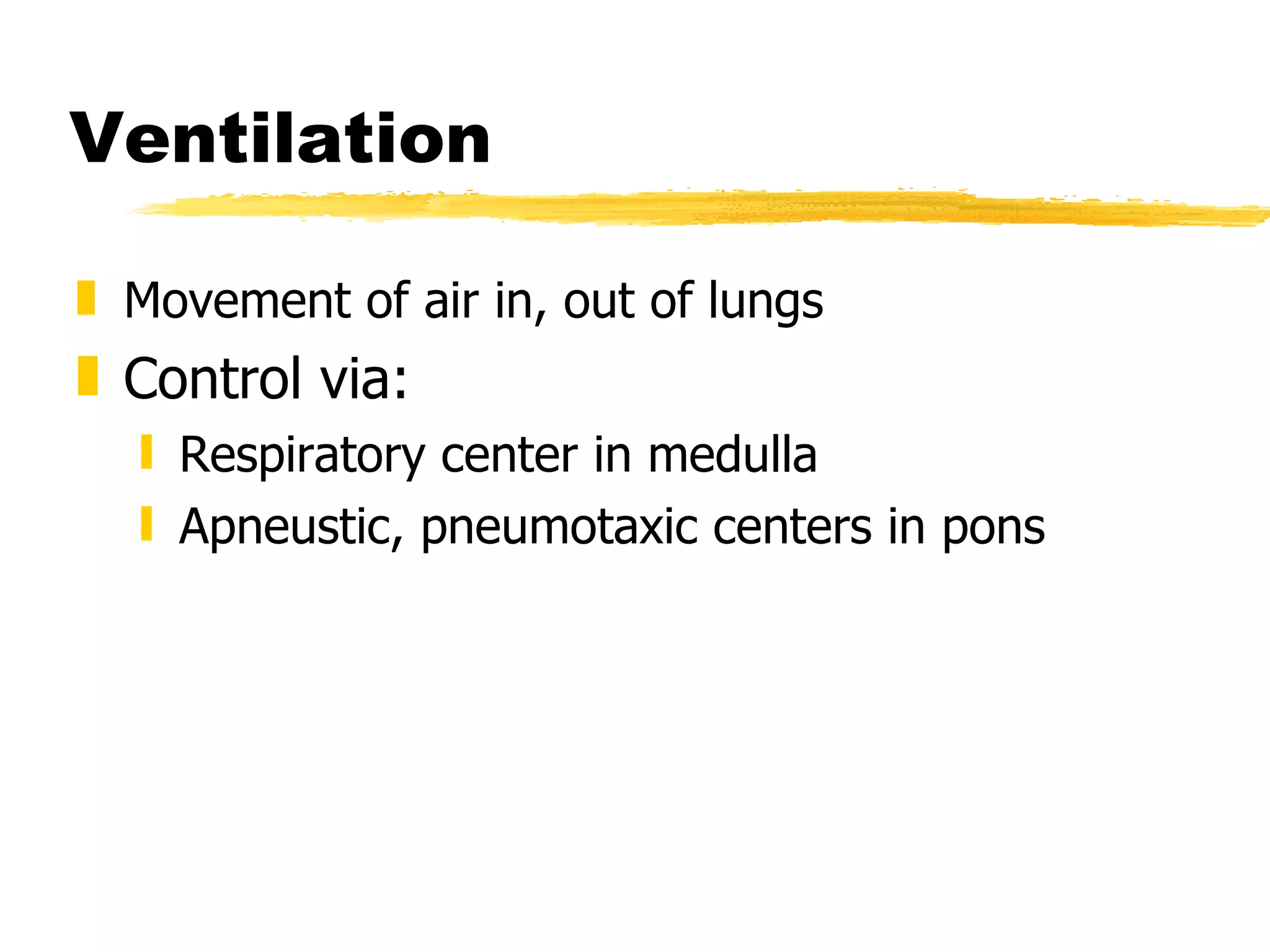
Ventilation Movement of air in, out of lungs Control via: Respiratory center in medulla Apneustic, pneumotaxic centers in pons
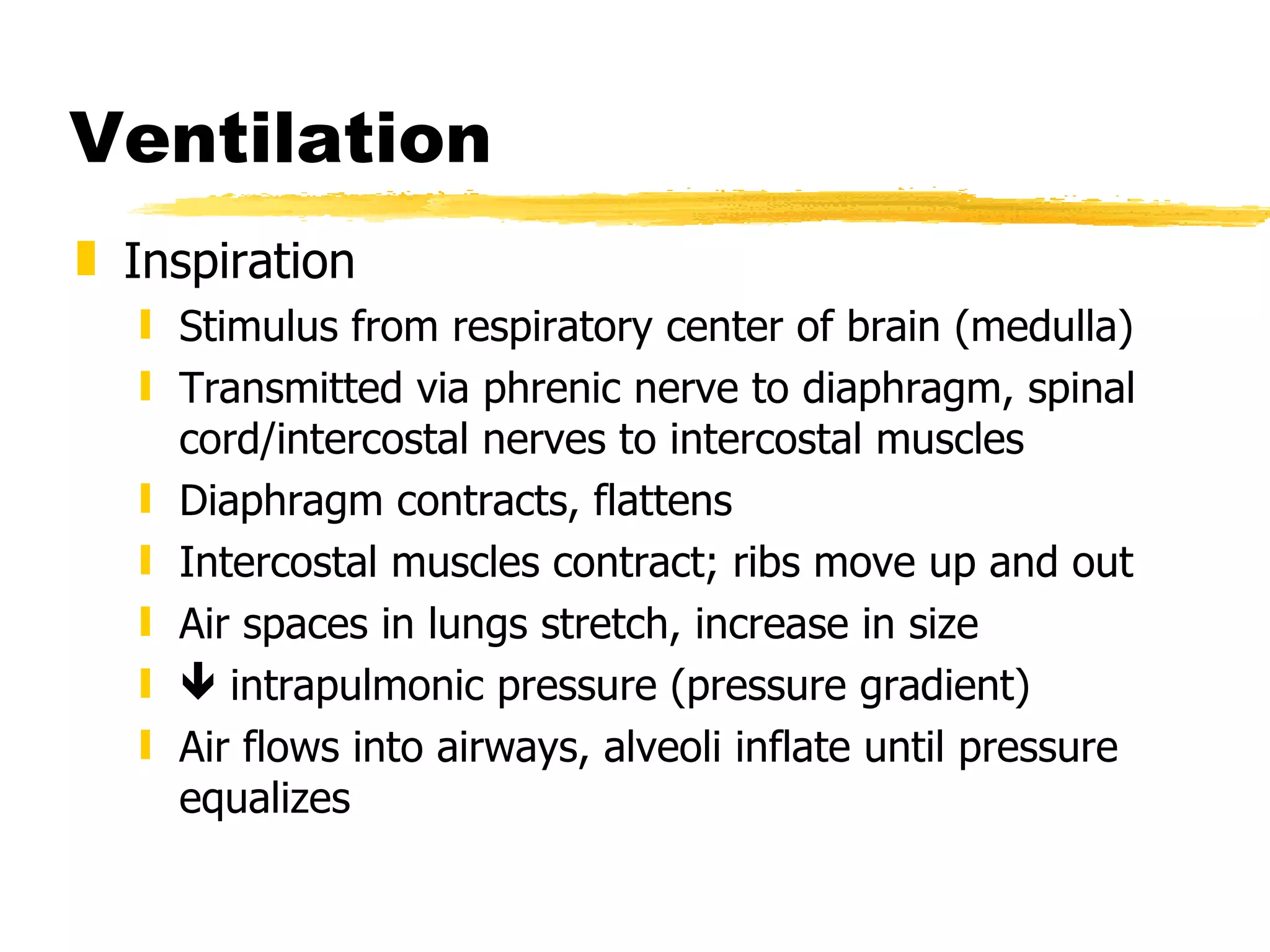
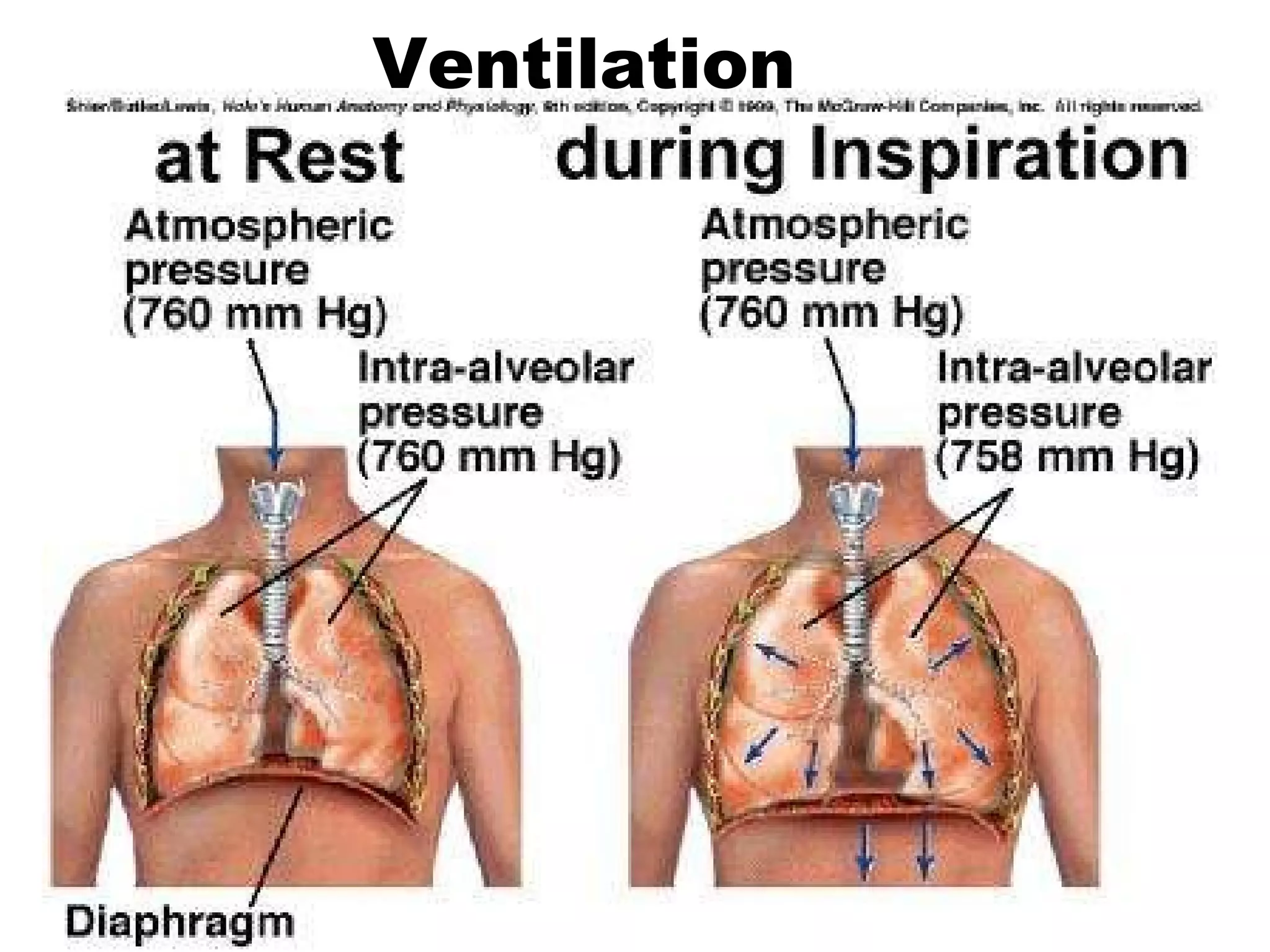
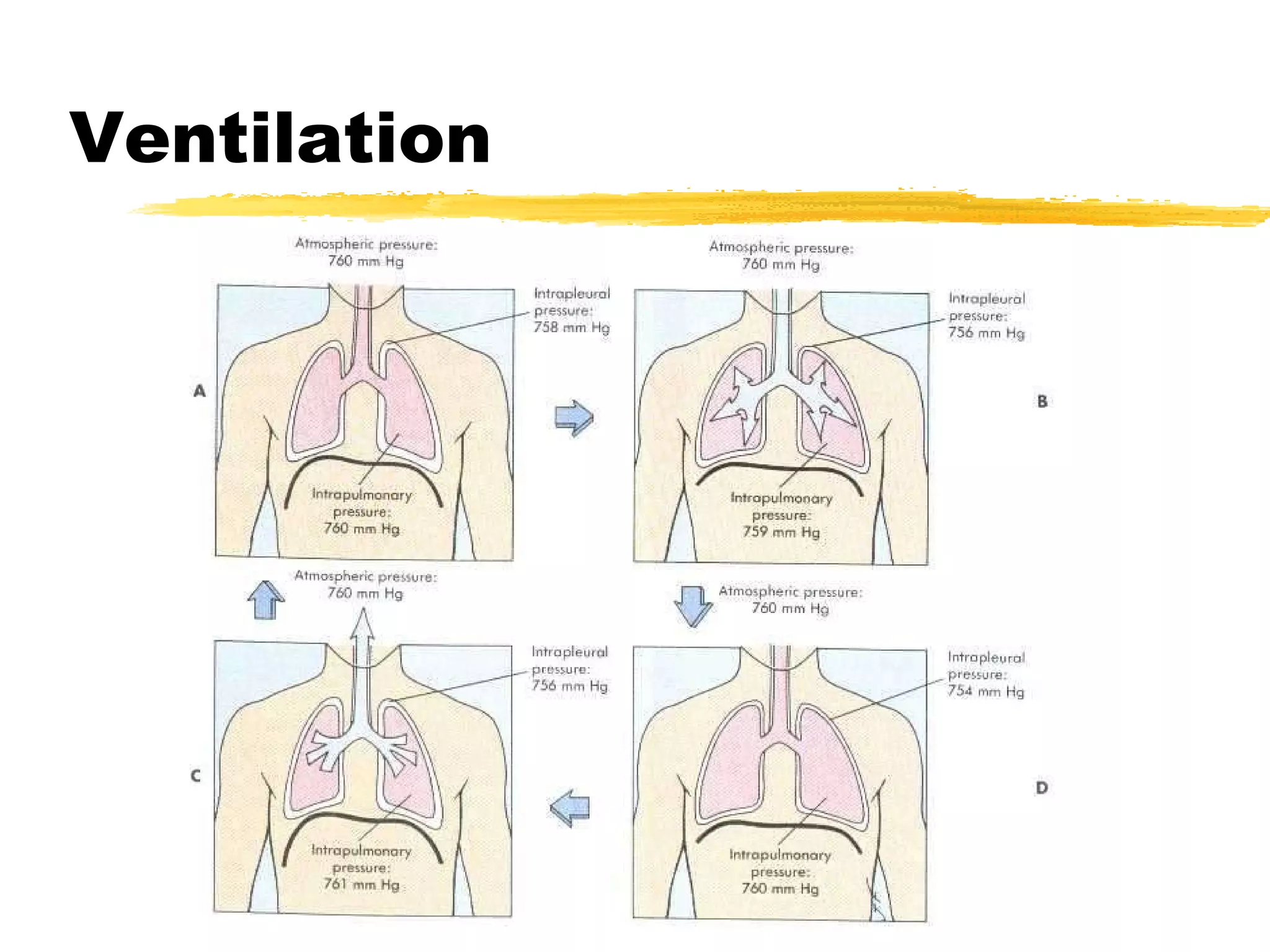
Ventilation Inspiration Stimulus from respiratory center of brain (medulla) Transmitted via phrenic nerve to diaphragm, spinal cord/intercostal nerves to intercostal muscles Diaphragm contracts, flattens Intercostal muscles contract; ribs move up and out Air spaces in lungs stretch, increase in size    intrapulmonic pressure (pressure gradient) Air flows into airways, alveoli inflate until pressure equalizes
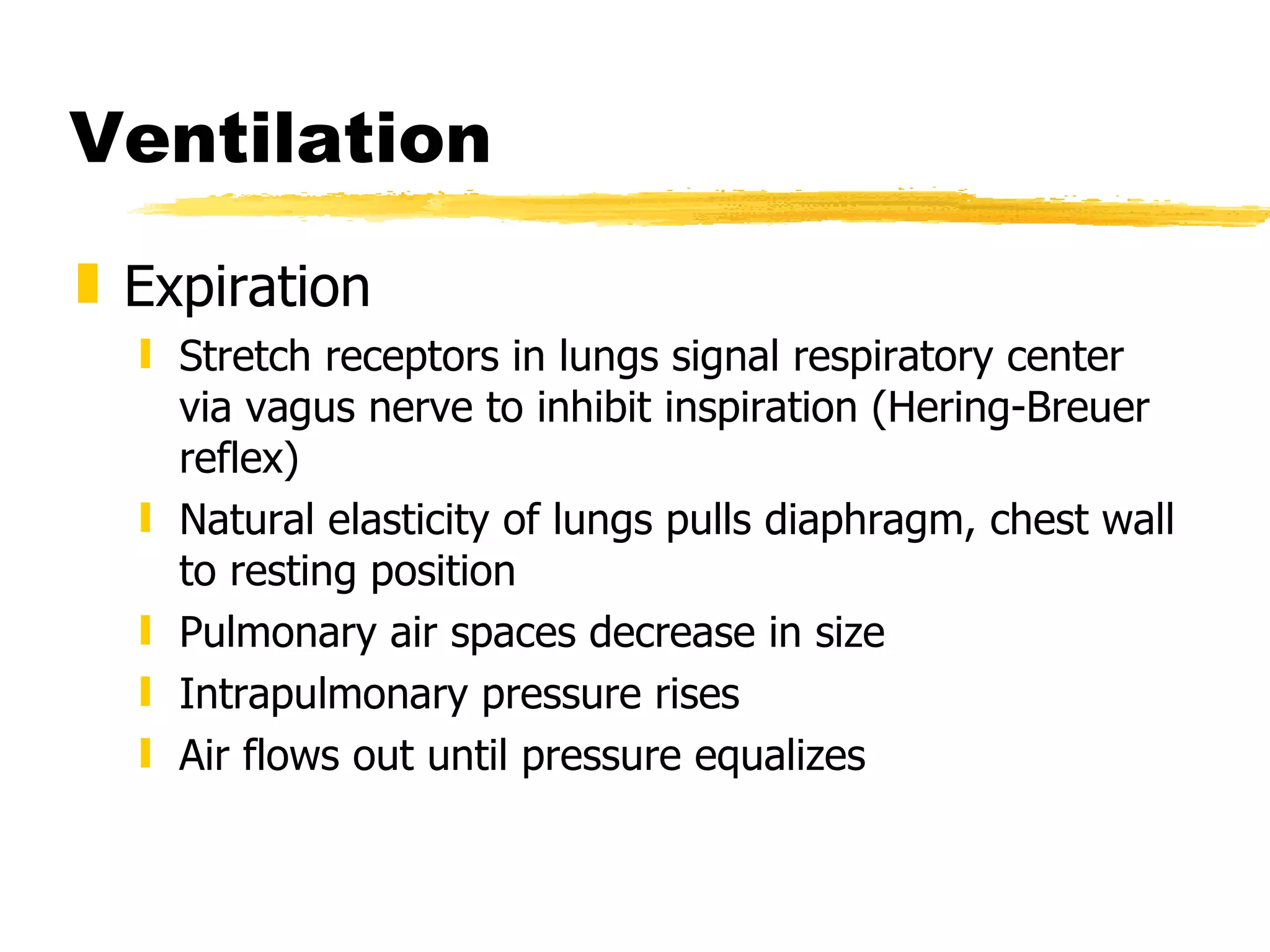
Ventilation Expiration Stretch receptors in lungs signal respiratory center via vagus nerve to inhibit inspiration (Hering-Breuer reflex) Natural elasticity of lungs pulls diaphragm, chest wall to resting position Pulmonary air spaces decrease in size Intrapulmonary pressure rises Air flows out until pressure equalizes
Ventilation
Ventilation
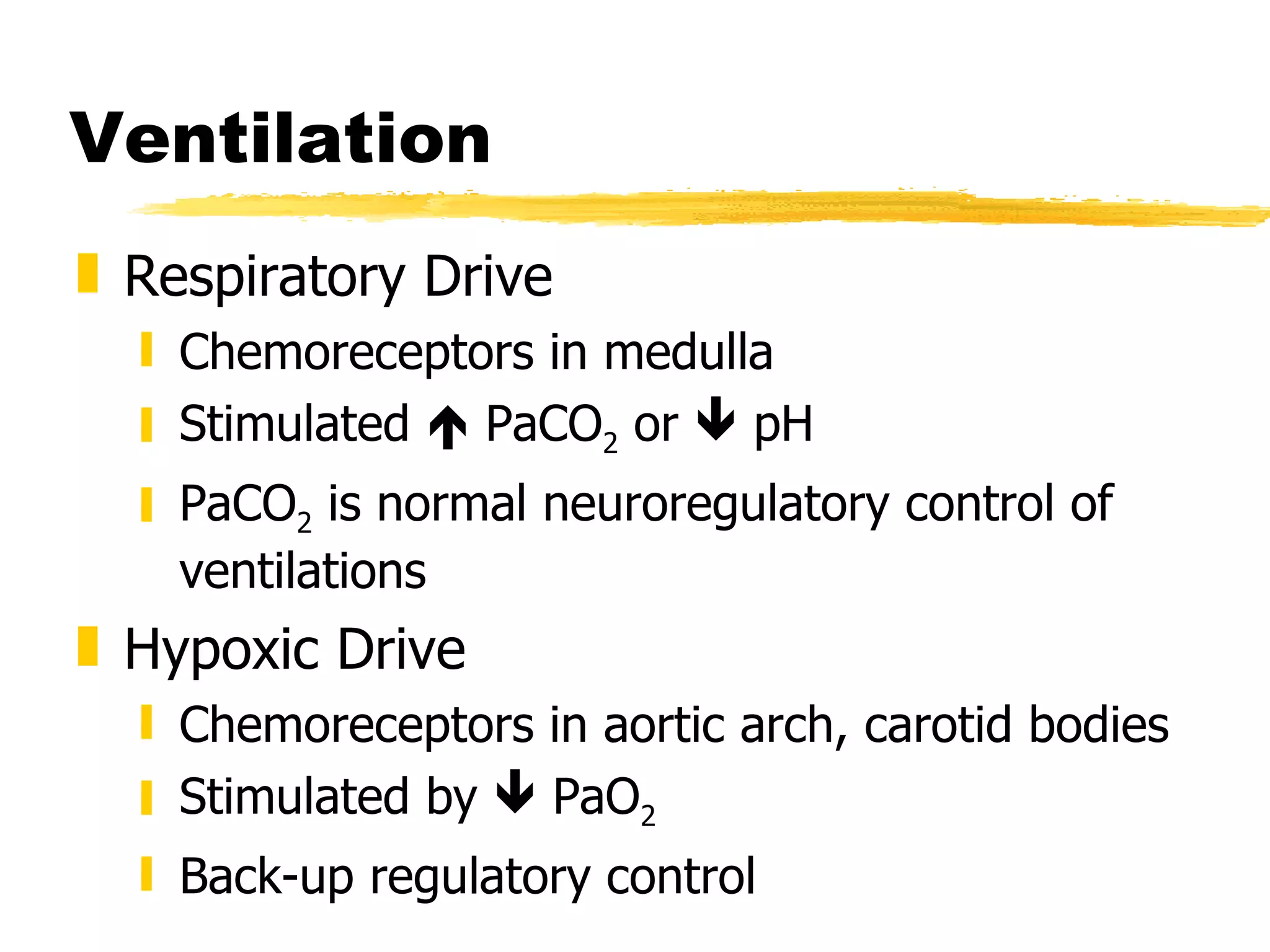
Ventilation Respiratory Drive Chemoreceptors in medulla Stimulated    PaCO 2  or    pH PaCO 2  is normal neuroregulatory control of ventilations Hypoxic Drive Chemoreceptors in aortic arch, carotid bodies Stimulated by    PaO 2 Back-up regulatory control
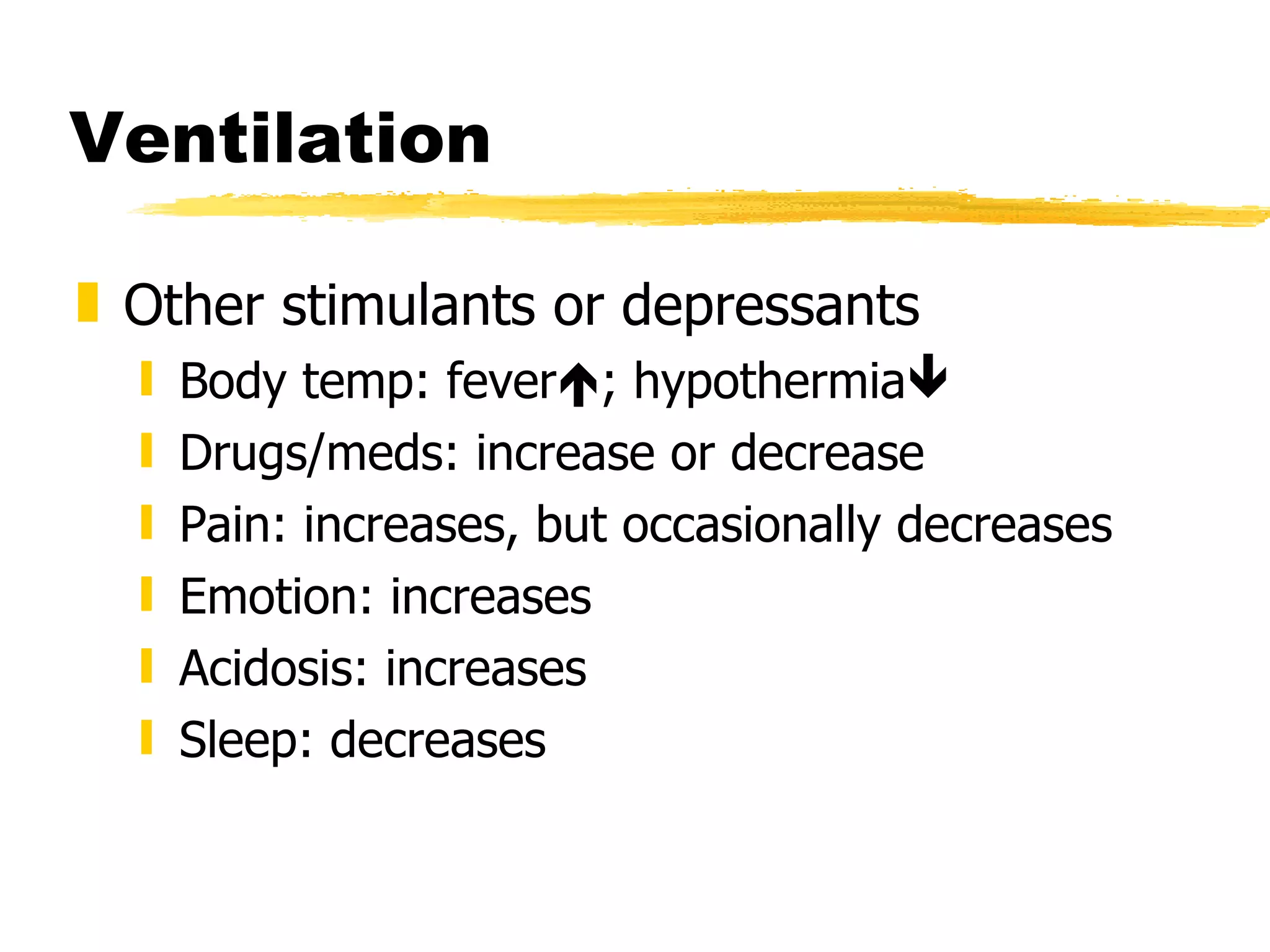
Ventilation Other stimulants or depressants Body temp: fever  ; hypothermia  Drugs/meds: increase or decrease Pain: increases, but occasionally decreases Emotion: increases Acidosis: increases Sleep: decreases
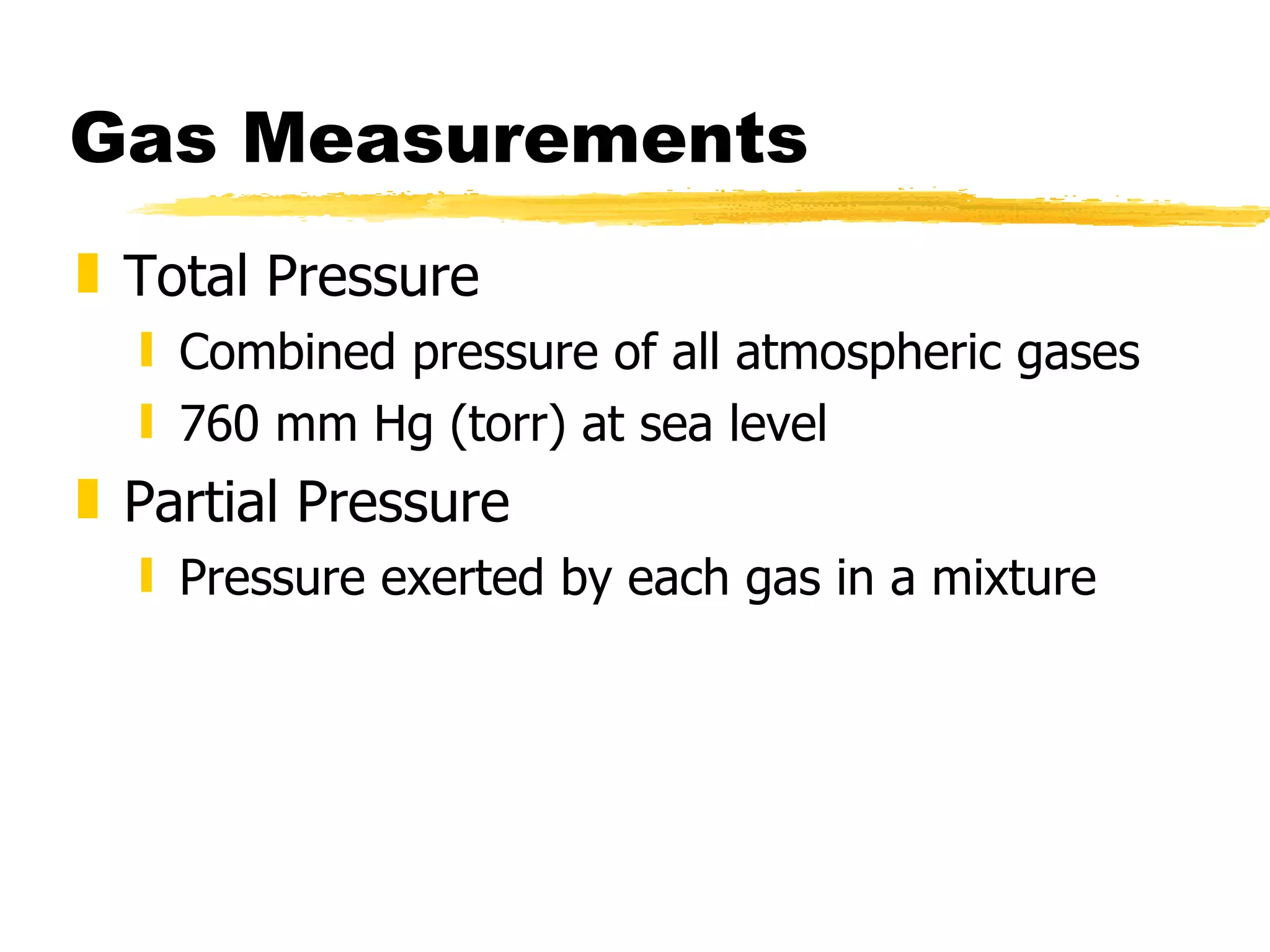
Gas Measurements Total Pressure Combined pressure of all atmospheric gases 760 mm Hg (torr) at sea level Partial Pressure Pressure exerted by each gas in a mixture
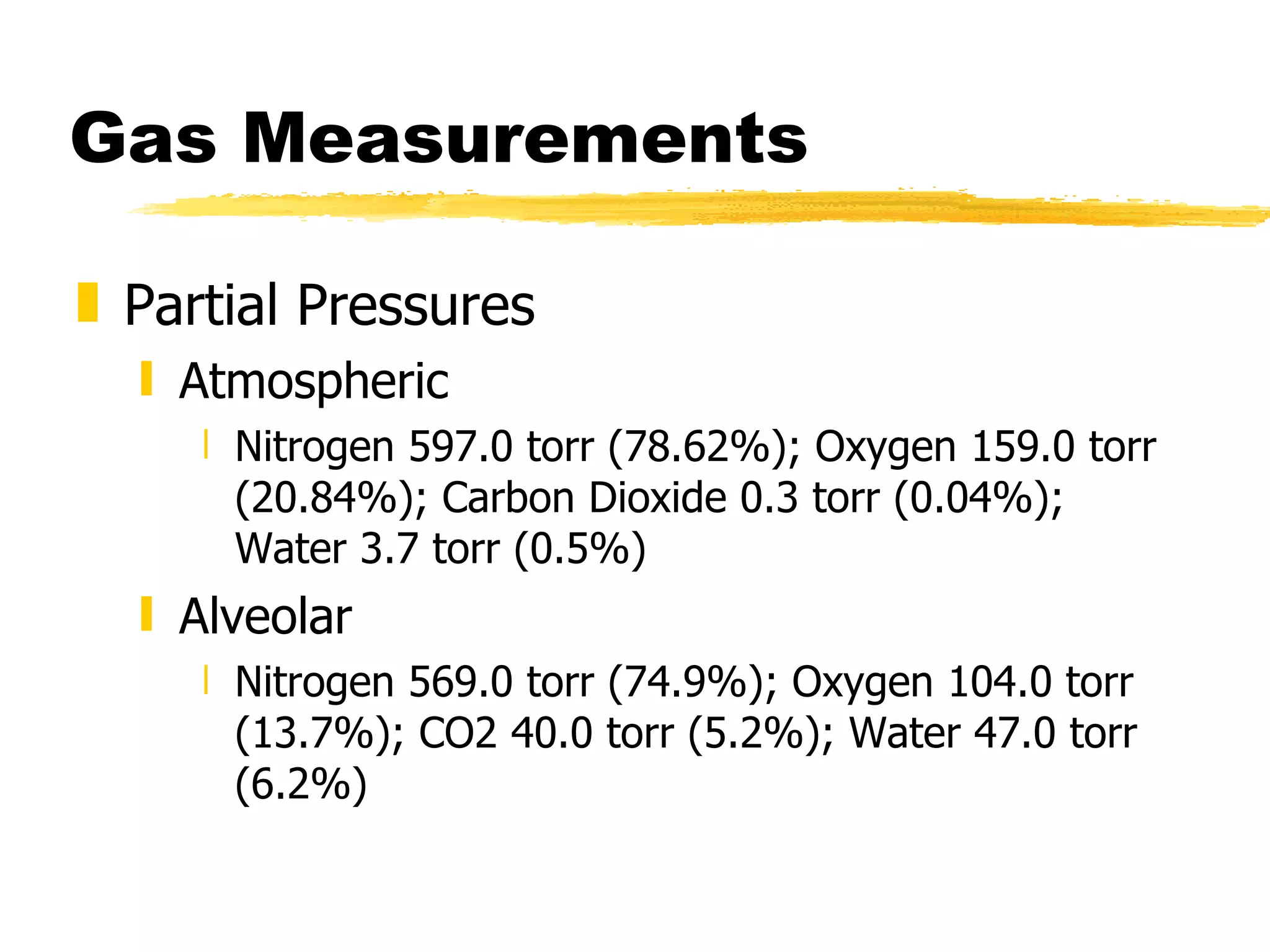
Gas Measurements Partial Pressures Atmospheric Nitrogen 597.0 torr (78.62%); Oxygen 159.0 torr (20.84%); Carbon Dioxide 0.3 torr (0.04%); Water 3.7 torr (0.5%) Alveolar  Nitrogen 569.0 torr (74.9%); Oxygen 104.0 torr (13.7%); CO2 40.0 torr (5.2%); Water 47.0 torr (6.2%)
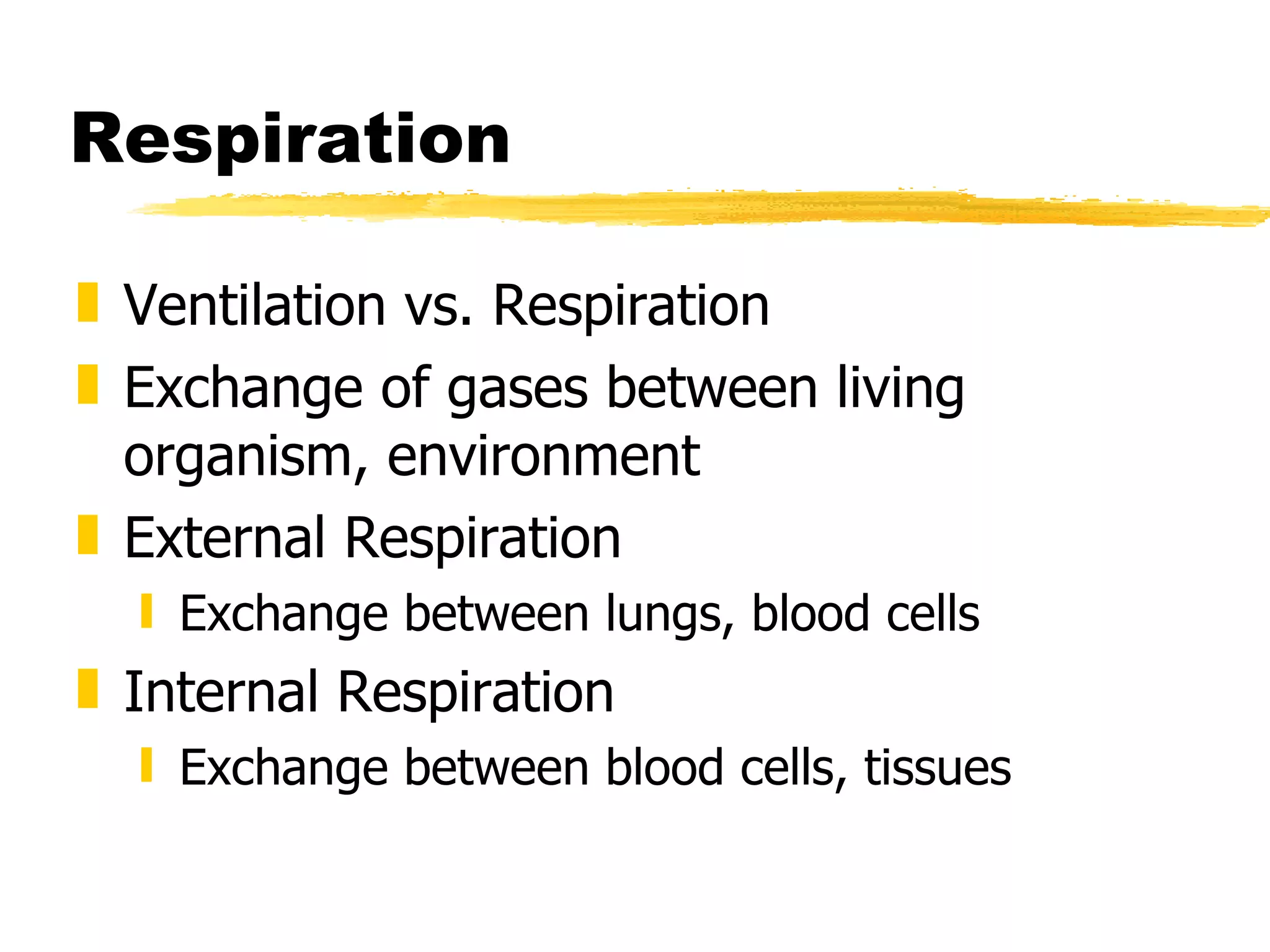
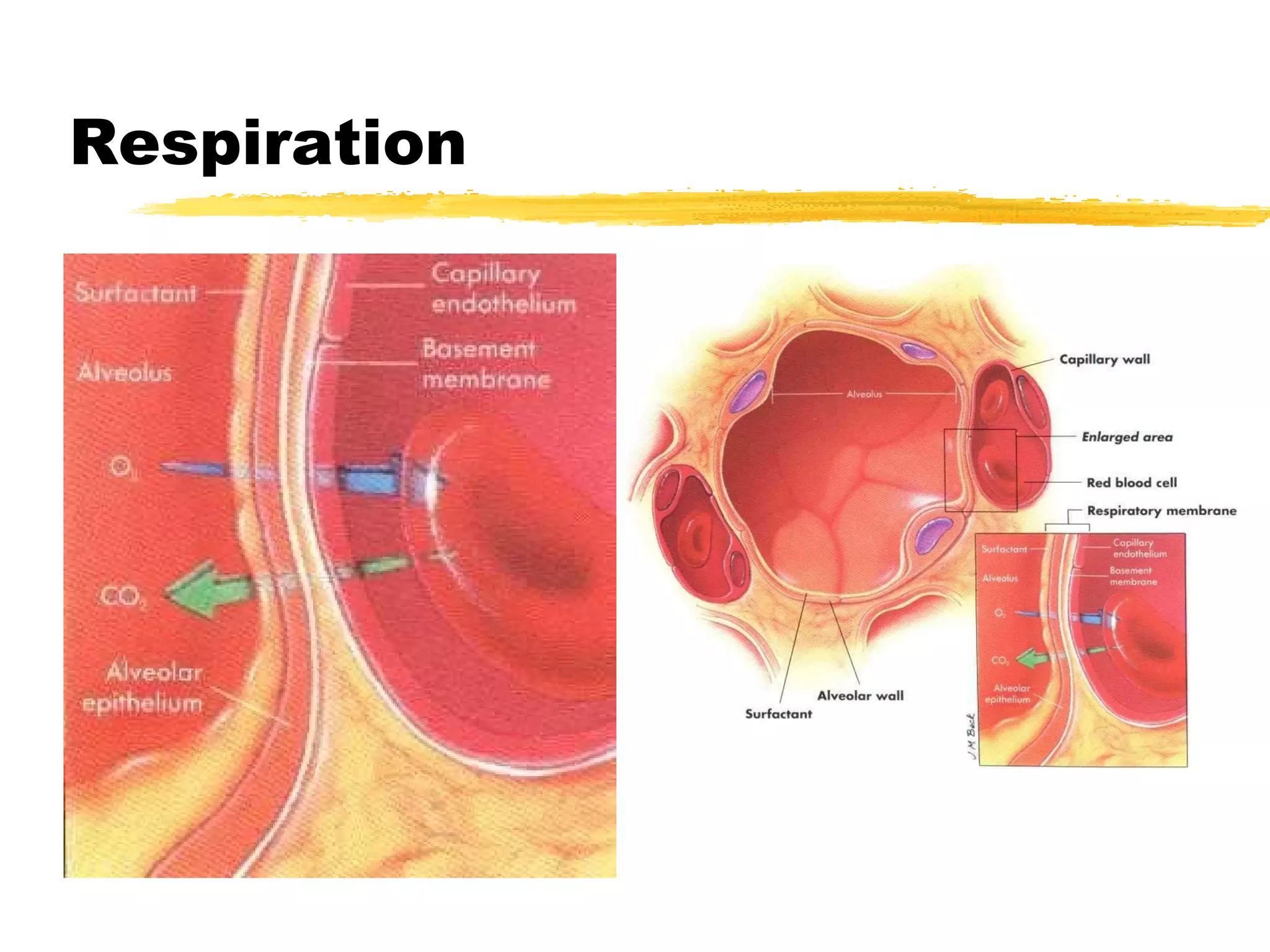
Respiration Ventilation vs. Respiration Exchange of gases between living organism, environment External Respiration Exchange between lungs, blood cells Internal Respiration Exchange between blood cells, tissues
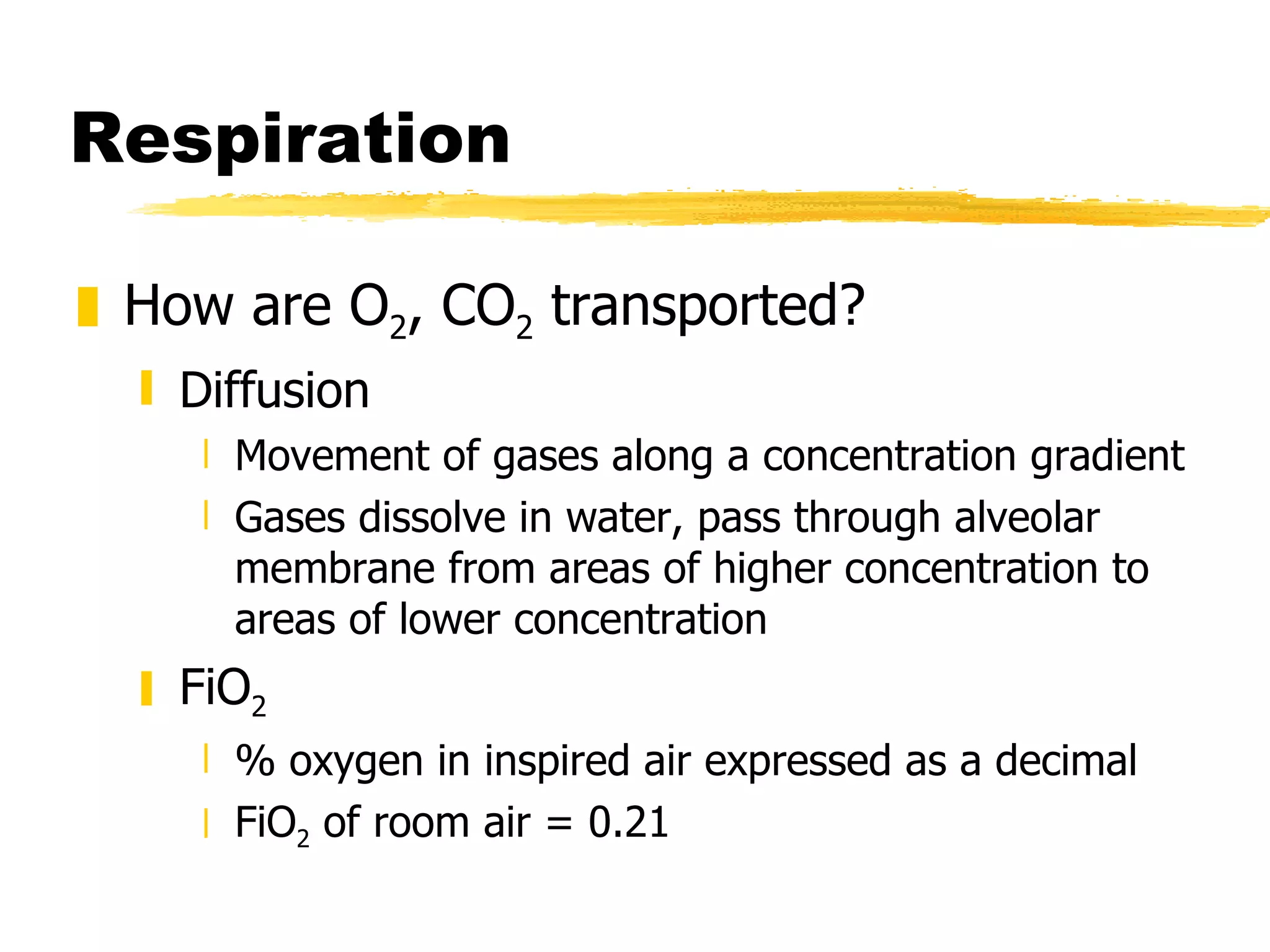
Respiration How are O 2 , CO 2  transported? Diffusion Movement of gases along a concentration gradient Gases dissolve in water, pass through alveolar membrane from areas of higher concentration to areas of lower concentration FiO 2 % oxygen in inspired air expressed as a decimal  FiO 2  of room air = 0.21
Respiration Blood Oxygen Content dissolved O 2  crosses capillary membrane,  binds to Hgb of RBC Transport = O 2  bound to hemoglobin (  97%) or dissolved in plasma O 2  Saturation % of hemoglobin saturated with oxygen (usually carries >96% of total) O 2  content divided by O 2  carrying capacity
Respiration Oxygen saturation affected by: Low Hgb (anemia, hemorrhage) Inadequate oxygen availability at alveoli Poor diffusion across pulmonary membrane (pneumonia, pulmonary edema, COPD) Ventilation/Perfusion (V/Q) mismatch  Blood moves past collapsed alveoli (shunting) Alveoli intact but blood flow impaired
Respiration Blood Carbon Dioxide Content Byproduct of work (cellular respiration) Transported as bicarbonate (HCO 3 -  ion)    20-30% bound to hemoglobin Pressure gradient causes CO 2  diffusion into alveoli from blood Increased level = hypercarbia
Respiration
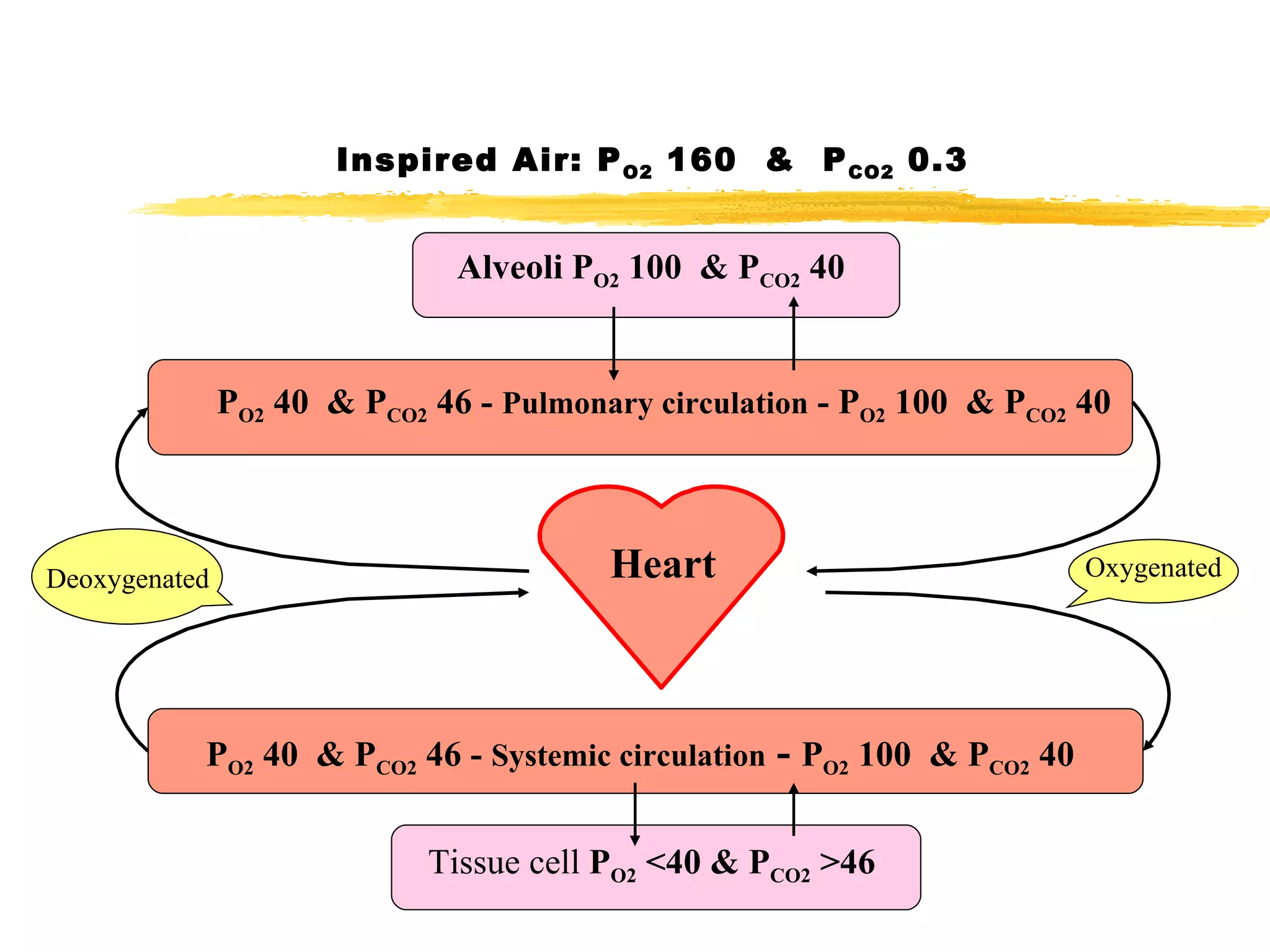
Inspired Air: P O2  160  &  P CO2  0.3 Alveoli P O2  100  & P CO2  40 P O2  40  & P CO2  46 -  Pulmonary circulation  - P O2  100  & P CO2  40  Heart P O2  40  & P CO2  46 -  Systemic circulation  -  P O2  100  & P CO2  40   Tissue cell  P O2  <40 & P CO2  >46  Oxygenated Deoxygenated
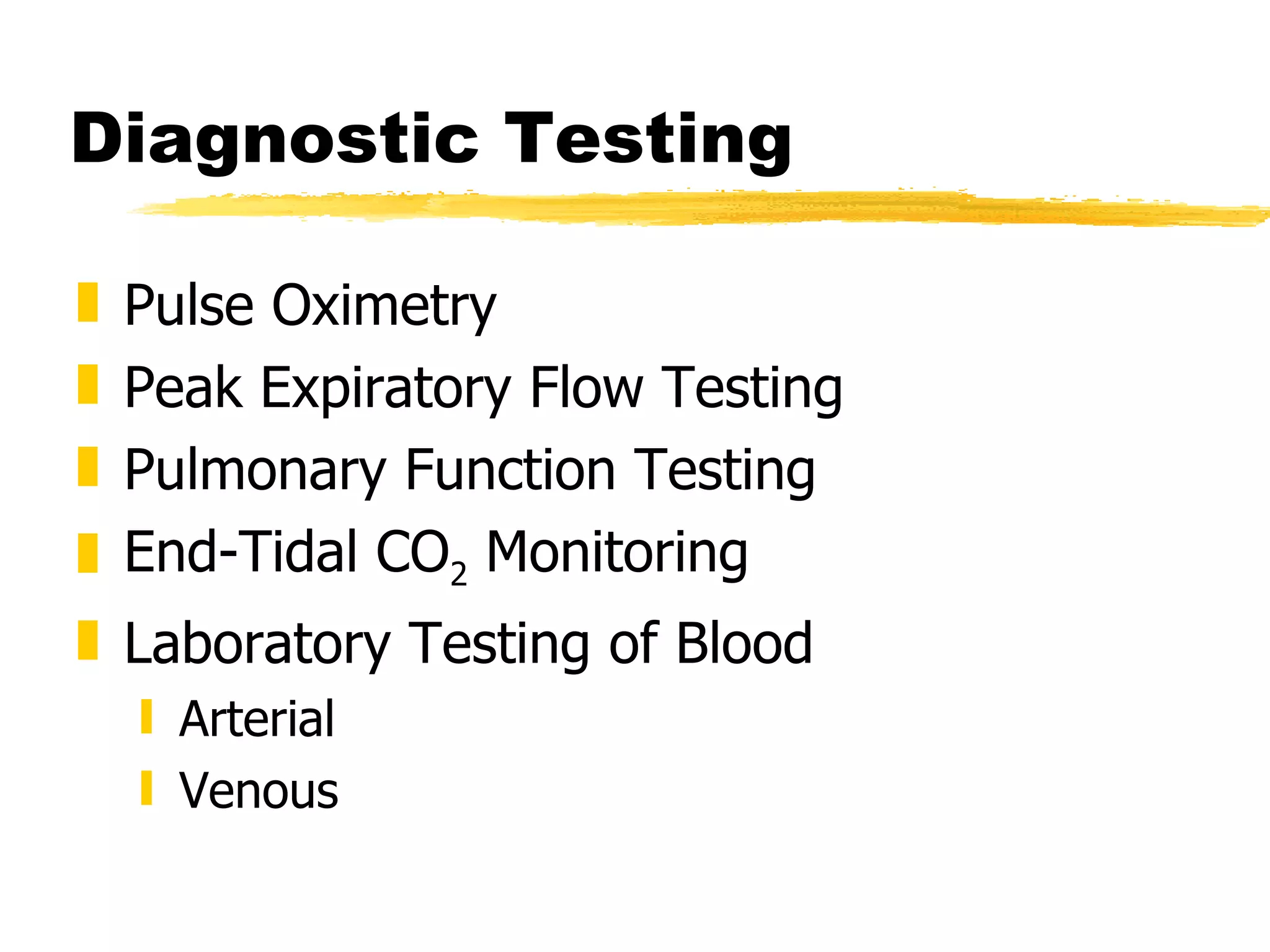
Diagnostic Testing Pulse Oximetry Peak Expiratory Flow Testing Pulmonary Function Testing End-Tidal CO 2  Monitoring Laboratory Testing of Blood Arterial Venous
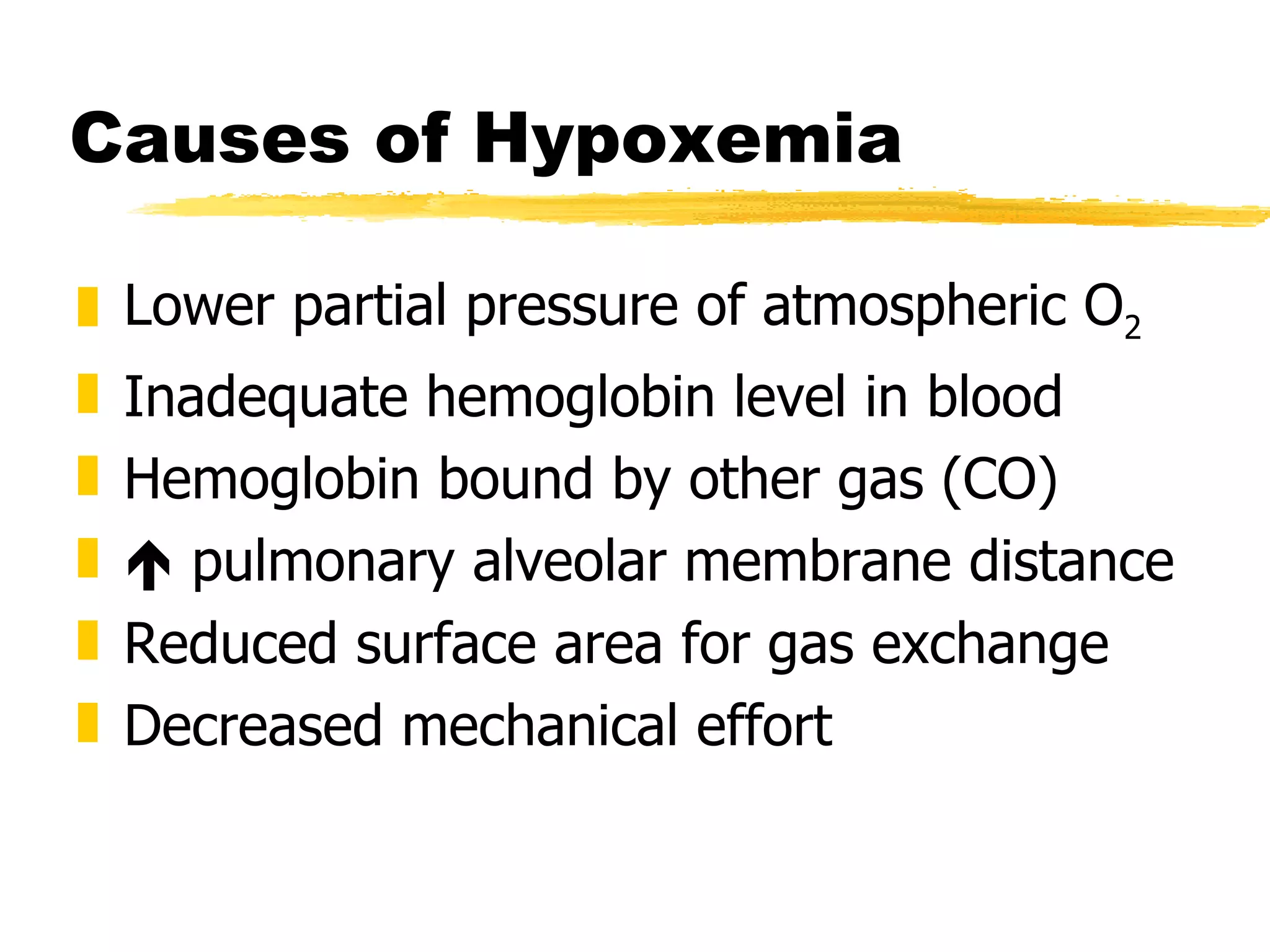
Causes of Hypoxemia Lower partial pressure of atmospheric O 2 Inadequate hemoglobin level in blood Hemoglobin bound by other gas (CO)   pulmonary alveolar membrane distance Reduced surface area for gas exchange Decreased mechanical effort
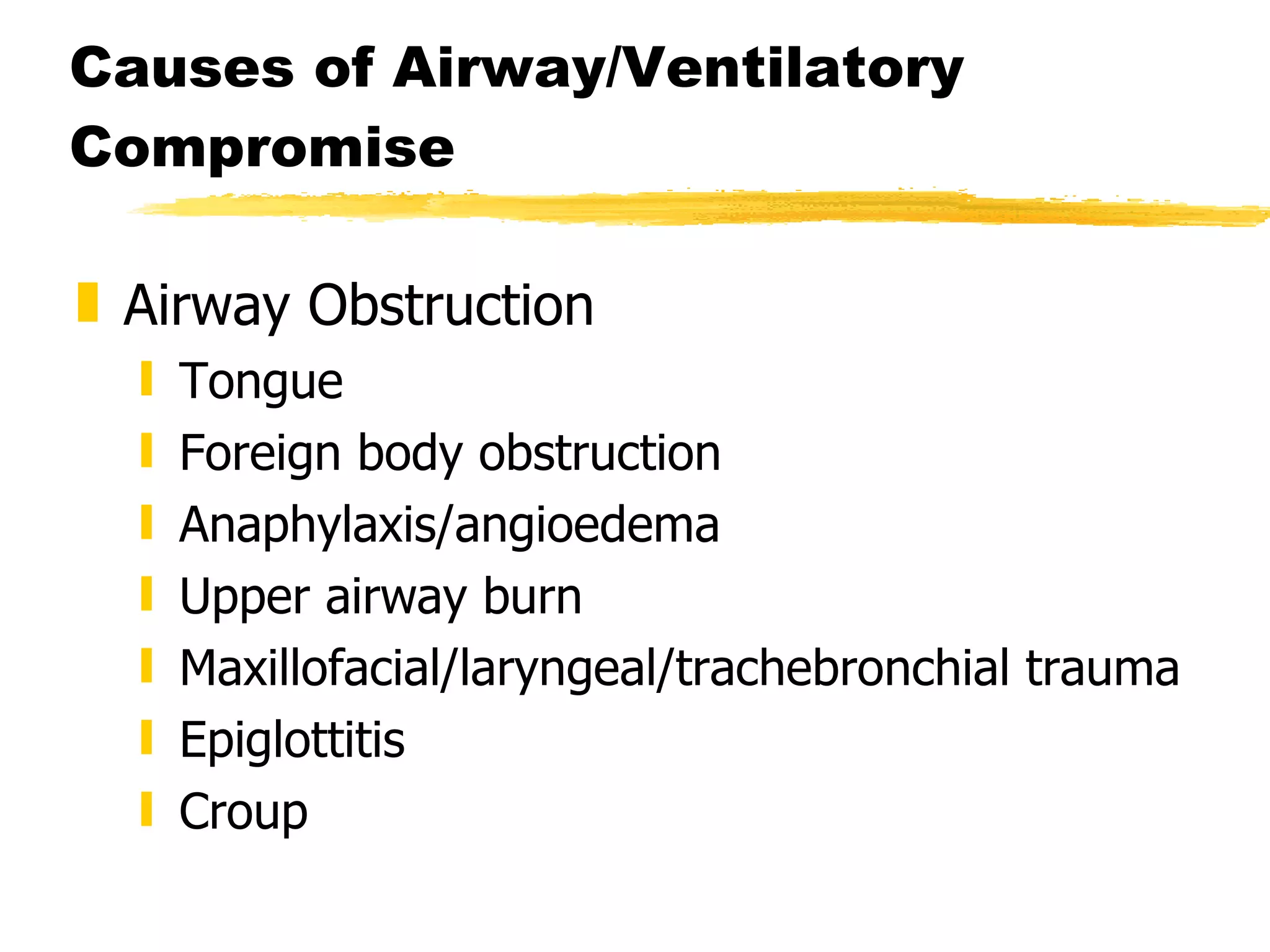
Causes of Airway/Ventilatory Compromise Airway Obstruction Tongue Foreign body obstruction Anaphylaxis/angioedema Upper airway burn Maxillofacial/laryngeal/trachebronchial trauma Epiglottitis Croup
Obstruction Tongue Most common cause Snoring respirations Corrected by positioning
Foreign Body Partial or Full Symptoms include Choking Gagging Stridor Dyspnea Aphonia Dysphonia
Laryngeal Spasm Spasmatic closure of vocal cords Frequently caused by Overly aggressive technique during intubation Immediately upon extubation
Laryngeal Edema Causes Angioedema Anaphylaxis Upper airway burns Epiglottitis Croup Trauma
Aspiration Significantly increases mortality Obstructs Airway Destroys bronchial tissue Introduces pathogens Decreases ability to ventilate Frequently occult
Obstructive Airway Disease Obstructive airway disease Asthma Emphysema Chronic Bronchitis
Gas Exchange Surface Pulmonary edema Left-sided heart failure Toxic inhalation Near drowning Pneumonia Pulmonary embolism Blood clots Amniotic fluid Fat embolism
Causes of Airway/Ventilatory Compromise Thoracic Bellows Chest trauma Fib fractures Flail chest Pneumothorax Hemothorax Sucking chest wound Diaphragmatic hernia
Causes of Airway/Ventilatory Compromise Thoracic Bellows Pleural effusion Spinal cord trauma Morbid obesity (Pickwickian Syndrome) Neurological/neuromuscular disease Poliomyelitis Myasthenia gravis Muscular dystrophy Gullian-Barre syndrome
Causes of Airway/Ventilatory Compromise Control System Head trauma Cerebrovascular accident Depressant drug toxicity Narcotics Sedative-Hypnotics Ethanol
Assessment of Airway/Ventilatory Compromise Respiratory Distress/Dyspnea =  Possible Life Threat Assess/Manage Simultaneously Priorities Airway Breathing Circulation Disability
Assessment of Airway/Ventilatory Compromise Airway Listen to patient talk/breathe Noisy breathing = Obstructed breathing But, all obstructed breathing is not noisy Adventitious sounds Snoring = Tongue Stridor = “Tight” Upper Airway
Assessment of Airway/Ventilatory Compromise Breathing Look Symmetry of Chest Expansion Signs of Increased Effort Skin Color Listen Mouth and Nose Lung Fields Feel Mouth and Nose Symmetry of Expansion
Assessment of Airway/Ventilatory Compromise Breathing Tachypnea Bradypnea Signs of distress Nasal flaring Tracheal tugging Retractions Accessory muscle use Tripod positioning Cyanosis
Assessment of Airway/Ventilatory Compromise Circulation Don’t let respiratory failure distract you!!! Tachycardia = Early hypoxia in adults Bradycardia = Early hypoxia in infants, children; Late hypoxia in adults
Assessment of Airway/Ventilatory Compromise Disability Restlessness, anxiety, combativeness = hypoxia until proven otherwise Drowsiness, lethargy = hypercarbia until proven otherwise When the fighting stops, a patient isn’t always getting better
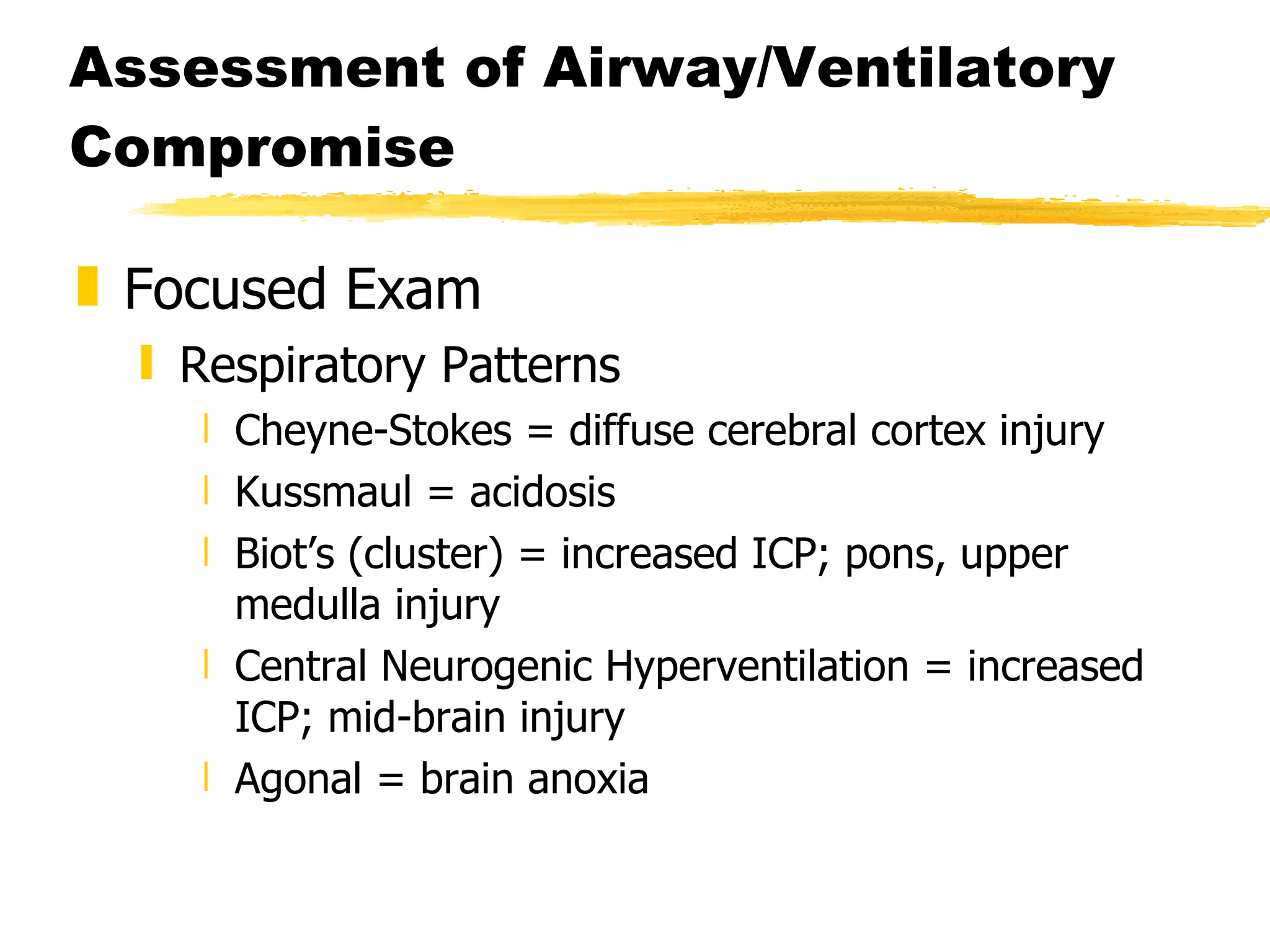
Assessment of Airway/Ventilatory Compromise Focused Exam Respiratory Patterns Cheyne-Stokes = diffuse cerebral cortex injury Kussmaul = acidosis Biot’s (cluster) = increased ICP; pons, upper medulla injury Central Neurogenic Hyperventilation = increased ICP; mid-brain injury Agonal = brain anoxia
Assessment of Airway/Ventilatory Compromise Focused Exam Neck Trachea mid-line? Jugular vein distension? Subcutaneous emphysema? Accessory muscle use?/hypertrophy?
Assessment of Airway/Ventilatory Compromise Focused Exam Chest Barrel chest? Deformity, discoloration, asymmetry? Flail segment, paradoxical movement? Adventitious breath sounds? Third heart sound? Subcutaneous emphysema? Fremitus? Dullness, hyperresonance to percussion?
Assessment of Airway/Ventilatory Compromise Focused Exam Extremities Edema? Nail bed color? Clubbing?
Assessment of Airway/Ventilatory Compromise Mechanical Ventilation Increased resistance Changing compliance
Assessment of Airway/Ventilatory Compromise Pulsus Paradoxus Systolic BP drops > 10 mm Hg w/inspiration May detect change in pulse quality COPD, asthma, pericardial tamponade
Assessment of Airway/Ventilatory Compromise History Onset gradual or sudden? What makes it worse, better? How long? Cough? Productive? Of what? Pain? What kind? Fever?
Assessment of Airway/Ventilatory Compromise Past History Hypertension, AMI, diabetes Chronic cough, smoking, recurrent “colds” Allergies, acute/seasonal SOB Lower extremity trauma, recent surgery, immobilization Interventions Past admission? Ever admitted to ICU? Medications? Frequency of prn medication use? Ever intubated before?
BLS Airway/Ventilation Methods Supplemental Oxygen Increased FiO 2  increases available oxygen Objective = Maximize hemoglobin saturation
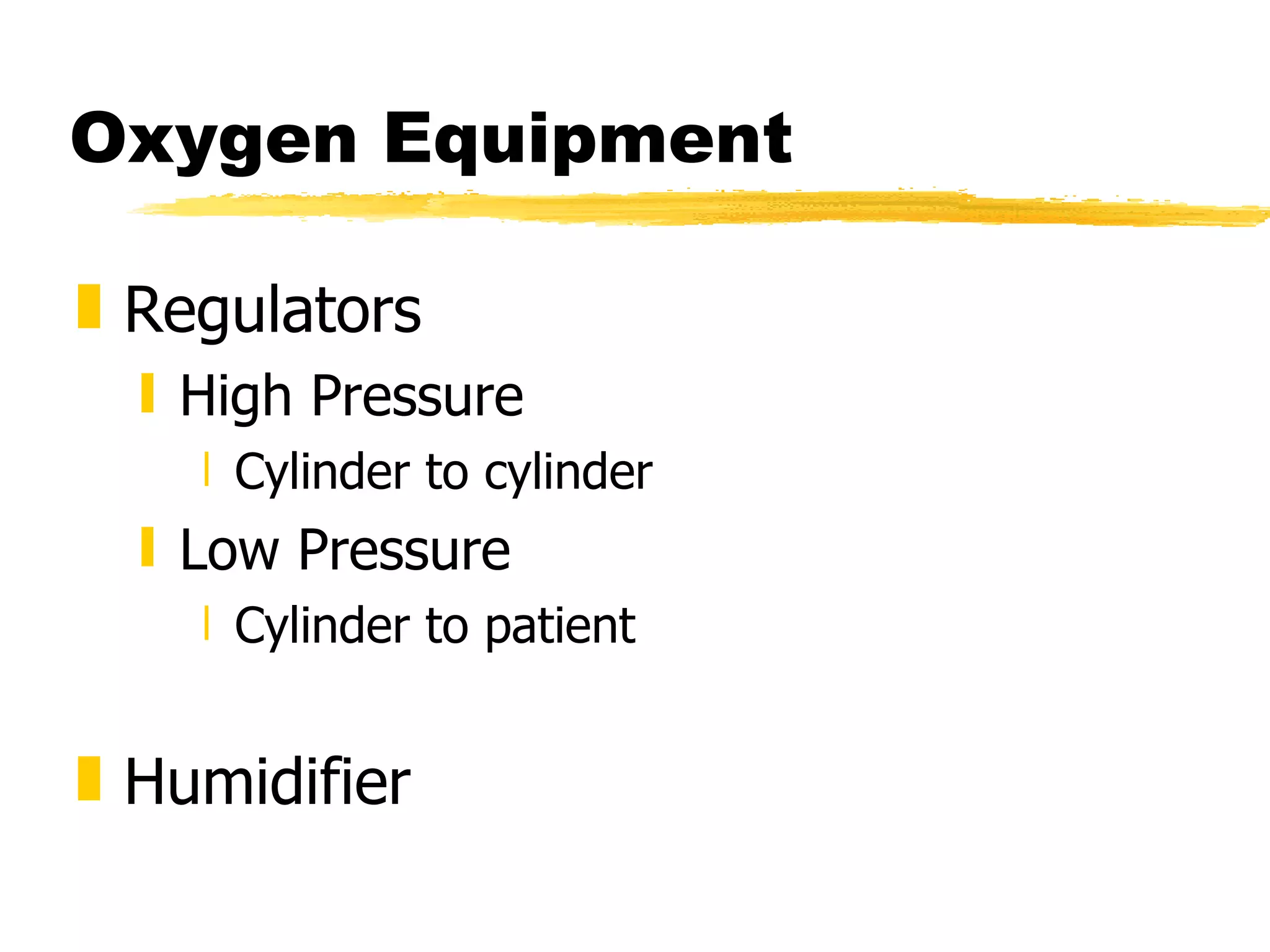
Oxygen Equipment Oxygen source Compressed gas Tank size D 400L E 660L M 3450 L Liquid oxygen
Oxygen Equipment Regulators High Pressure Cylinder to cylinder Low Pressure Cylinder to patient Humidifier
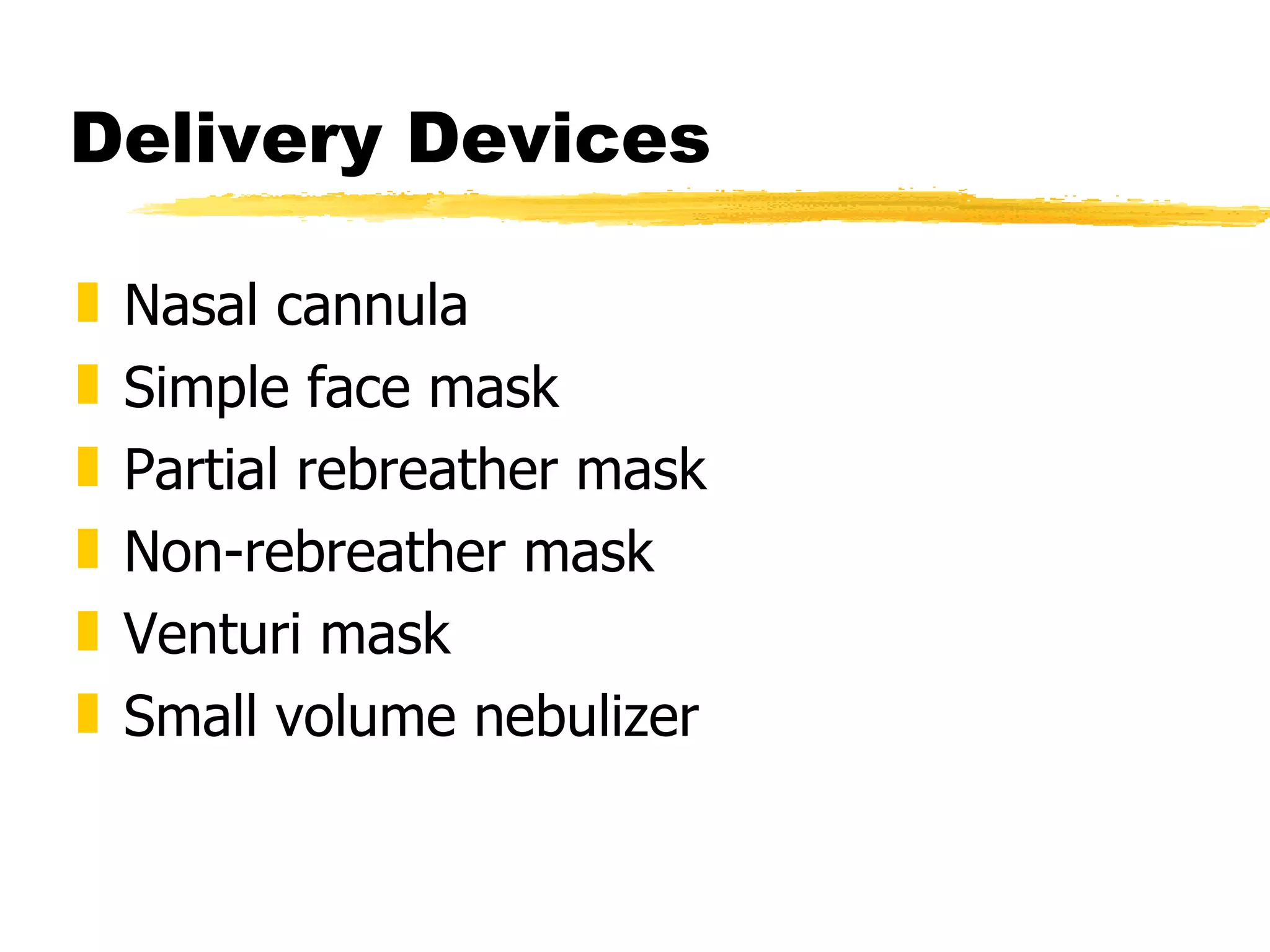
Delivery Devices Nasal cannula Simple face mask Partial rebreather mask Non-rebreather mask Venturi mask Small volume nebulizer
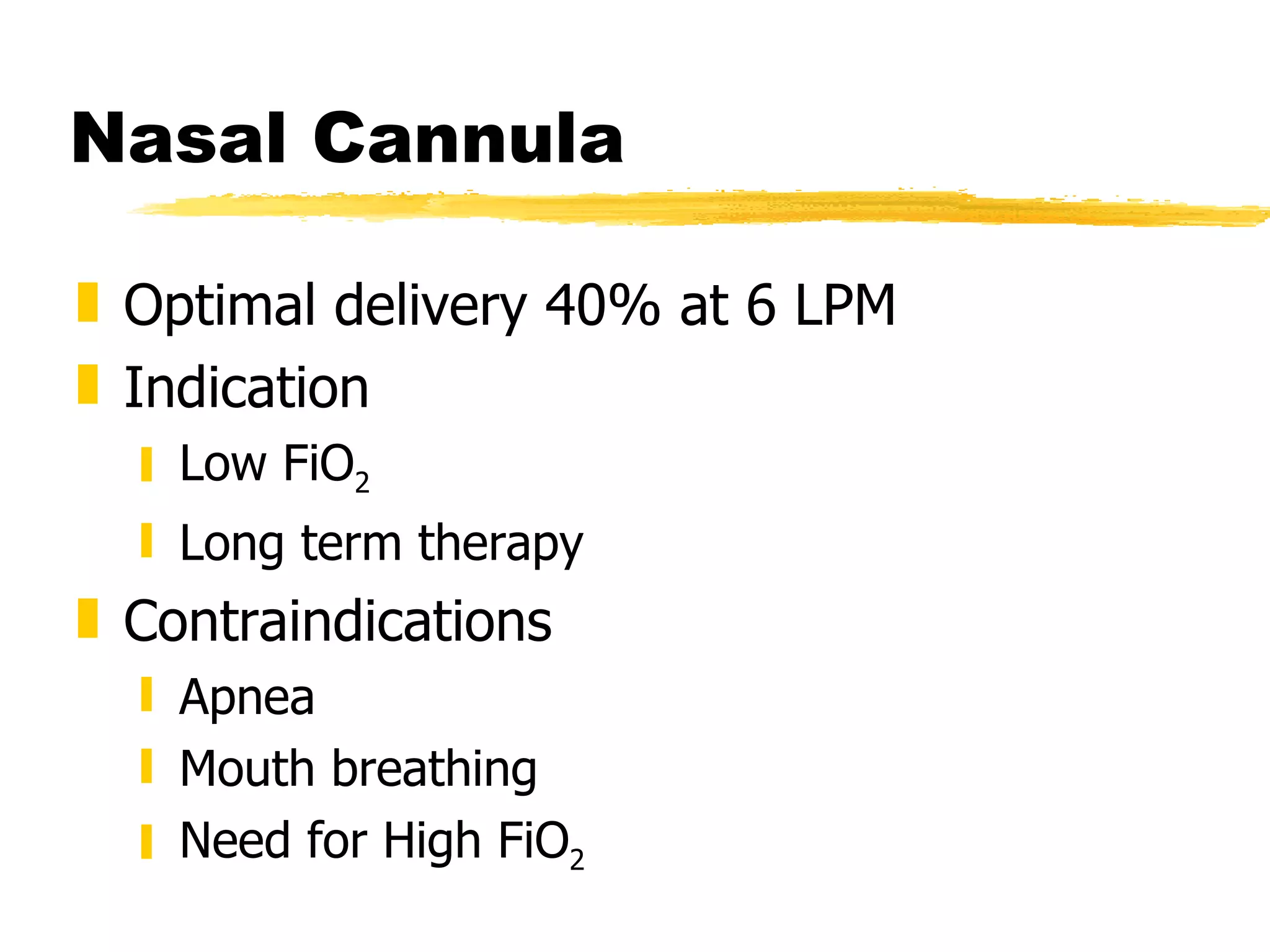
Nasal Cannula Optimal delivery 40% at 6 LPM Indication Low FiO 2 Long term therapy Contraindications Apnea Mouth breathing Need for High FiO 2
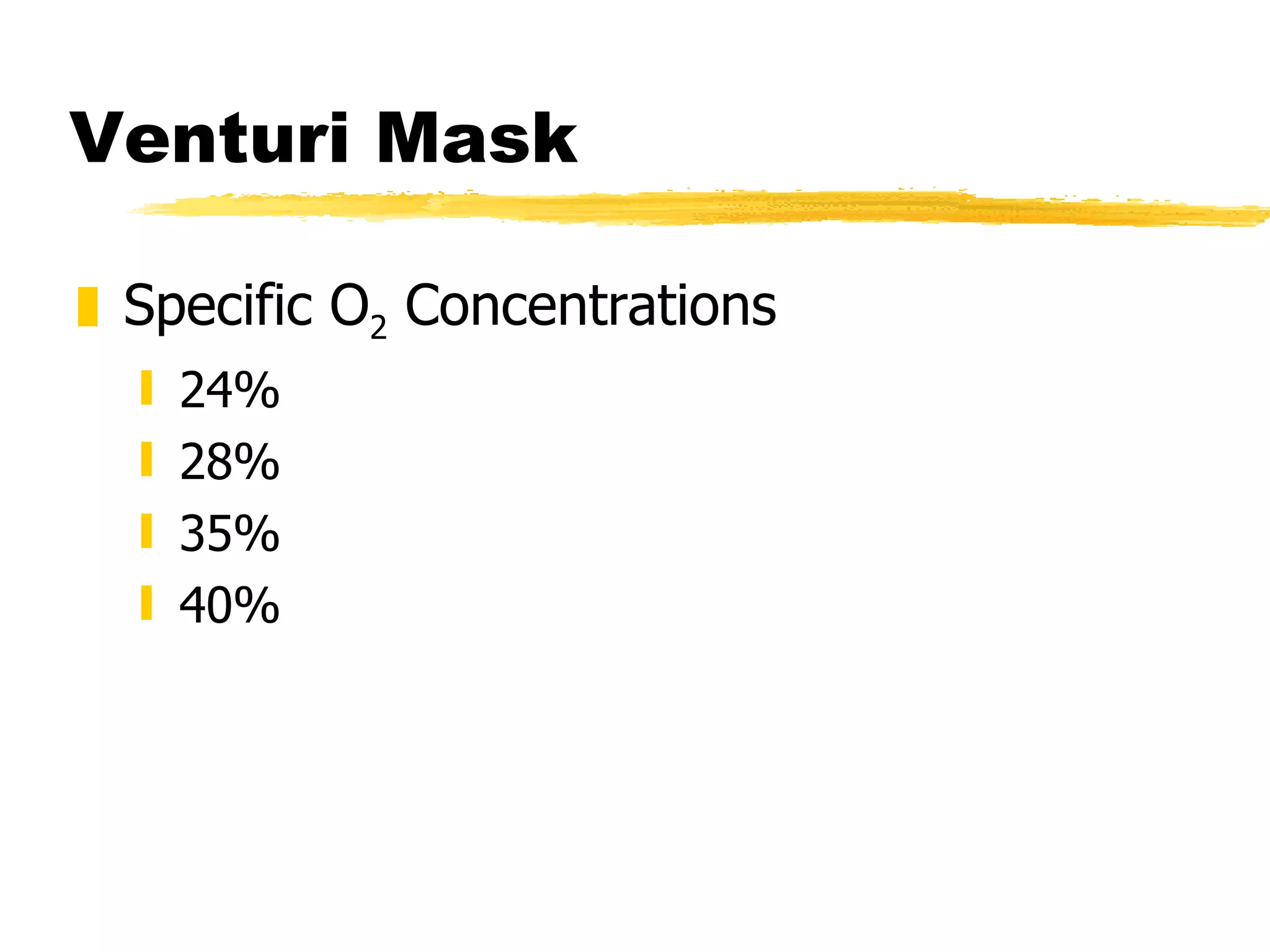
Venturi Mask Specific O 2  Concentrations 24% 28% 35% 40%
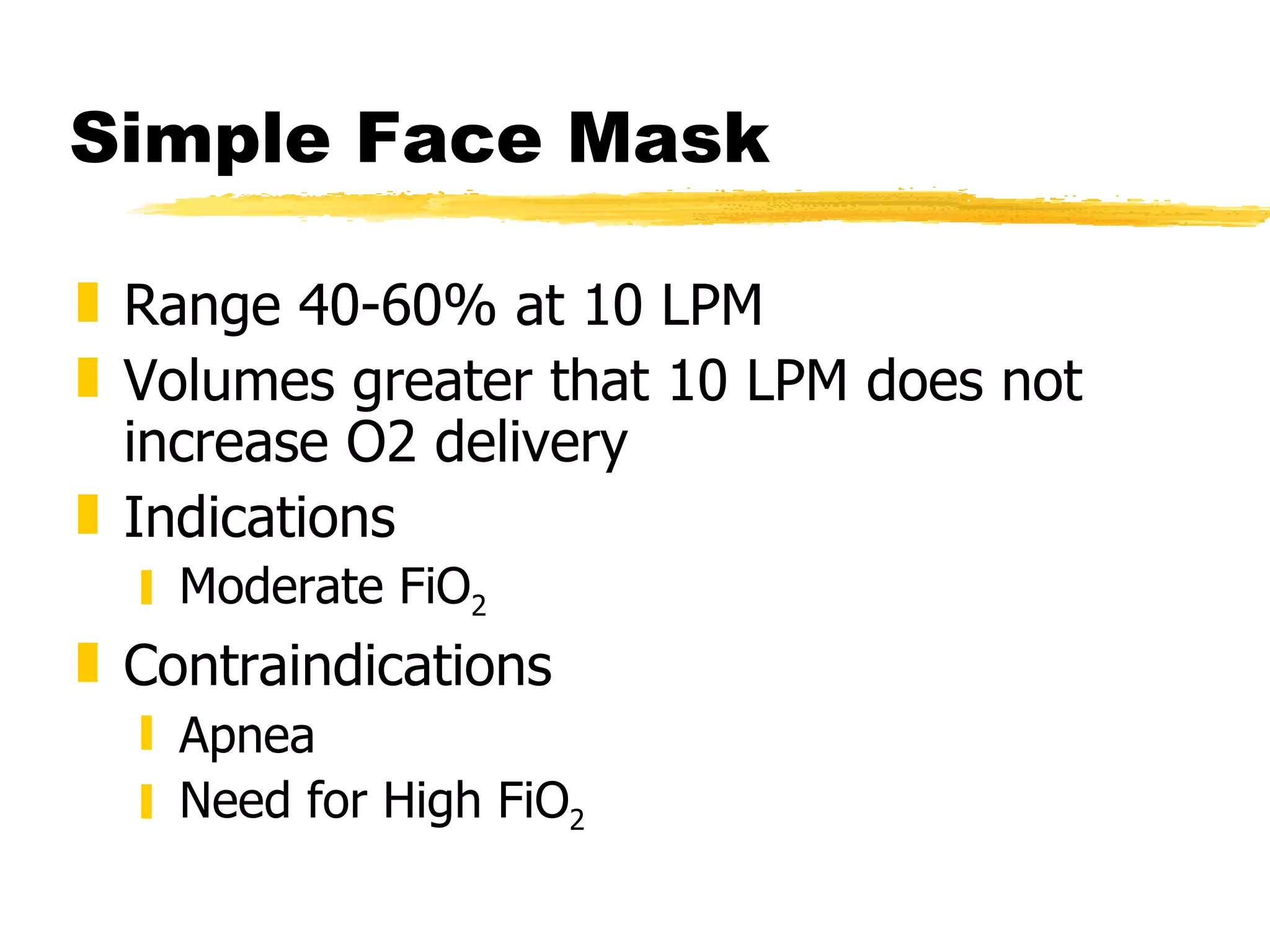
Simple Face Mask Range 40-60% at 10 LPM Volumes greater that 10 LPM does not increase O2 delivery Indications Moderate FiO 2 Contraindications Apnea Need for High FiO 2
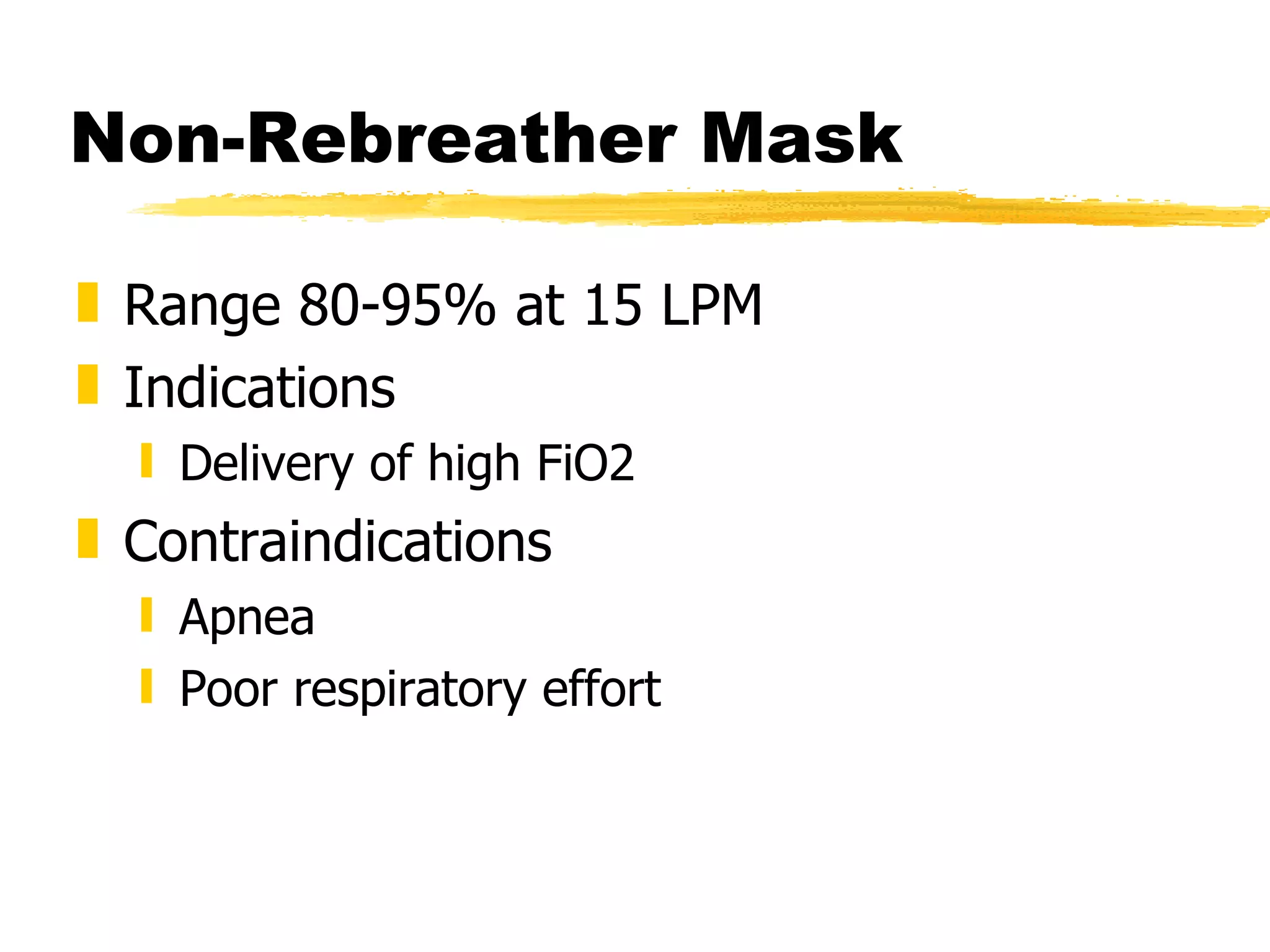
Non-Rebreather Mask Range 80-95% at 15 LPM Indications Delivery of high FiO2 Contraindications Apnea Poor respiratory effort
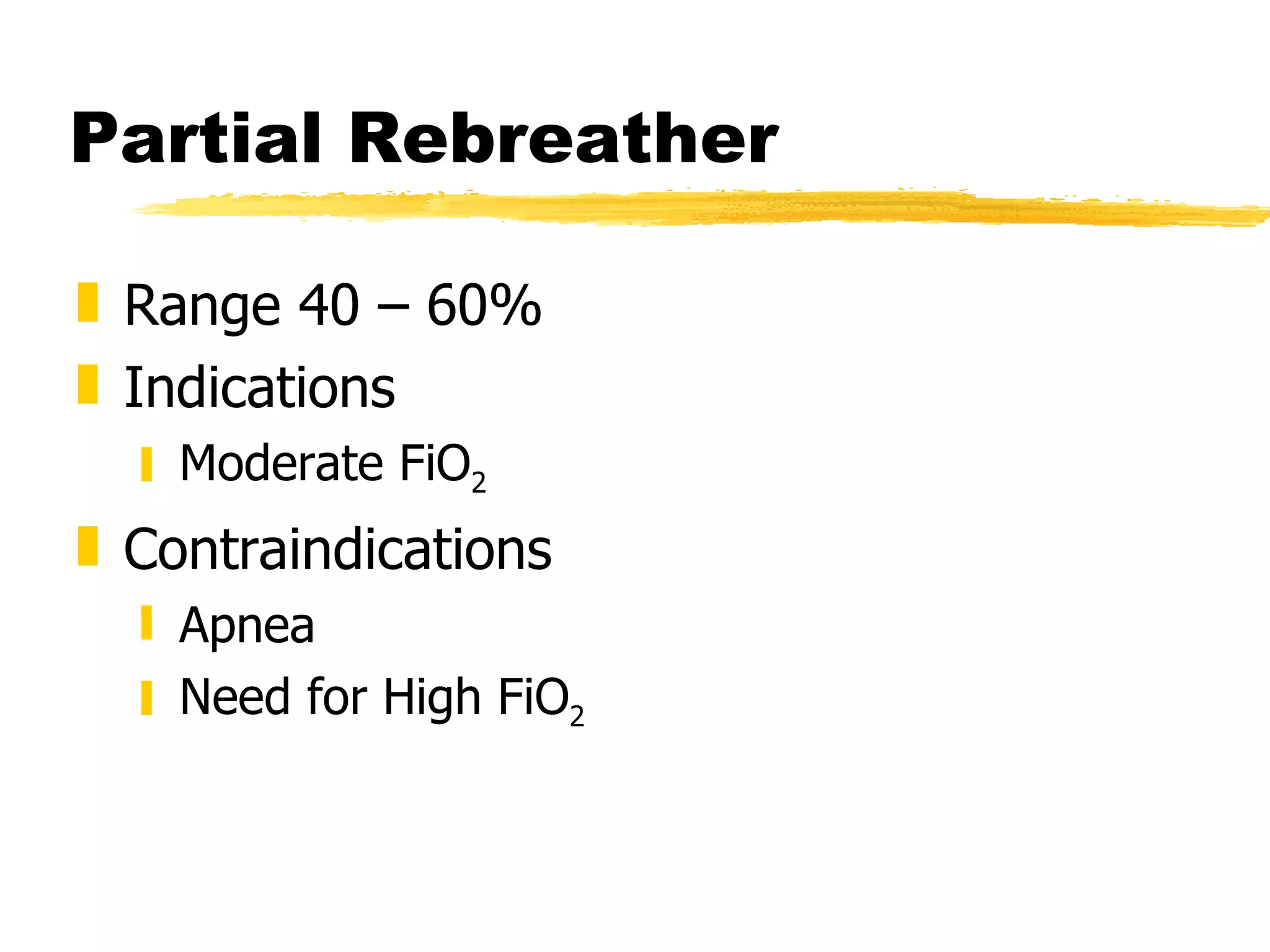
Partial Rebreather Range 40 – 60% Indications Moderate FiO 2 Contraindications Apnea Need for High FiO 2
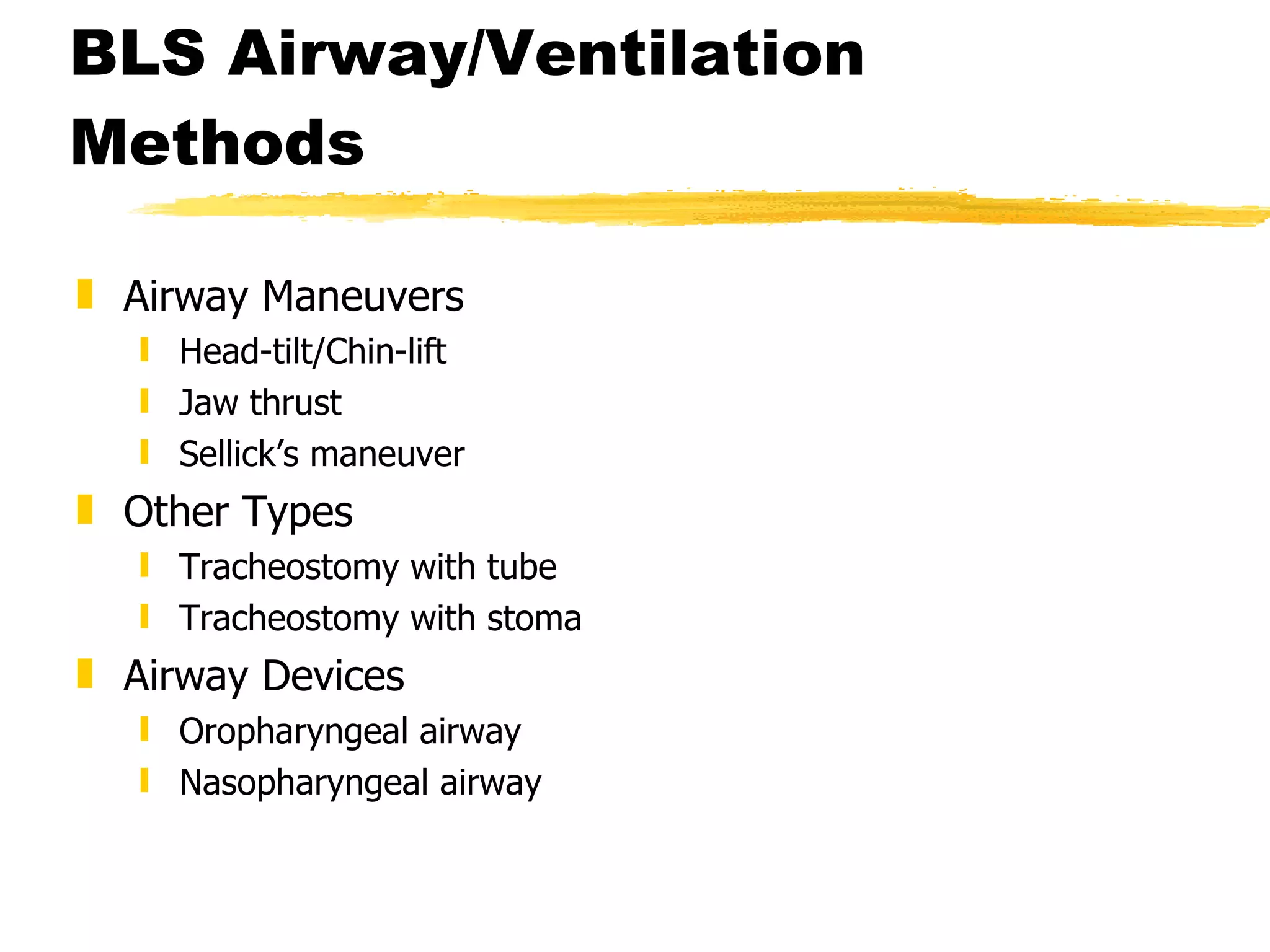
BLS Airway/Ventilation Methods Airway Maneuvers Head-tilt/Chin-lift Jaw thrust Sellick’s maneuver Other Types Tracheostomy with tube Tracheostomy with stoma Airway Devices Oropharyngeal airway Nasopharyngeal airway
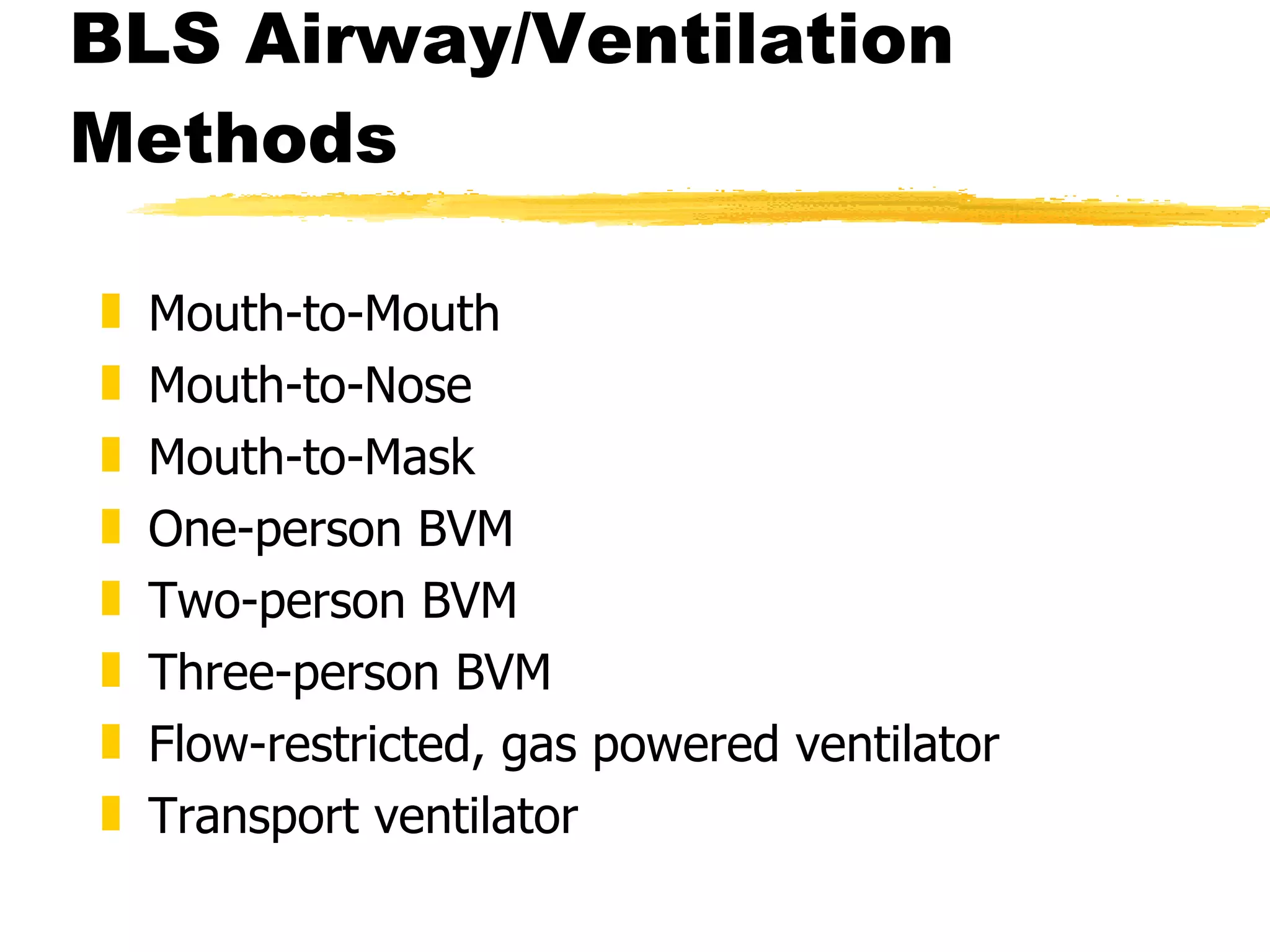
BLS Airway/Ventilation Methods Mouth-to-Mouth Mouth-to-Nose Mouth-to-Mask One-person BVM Two-person BVM Three-person BVM Flow-restricted, gas powered ventilator Transport ventilator
BLS Airway/Ventilation Methods Mouth to Mouth Mouth to Nose Mouth to Mask
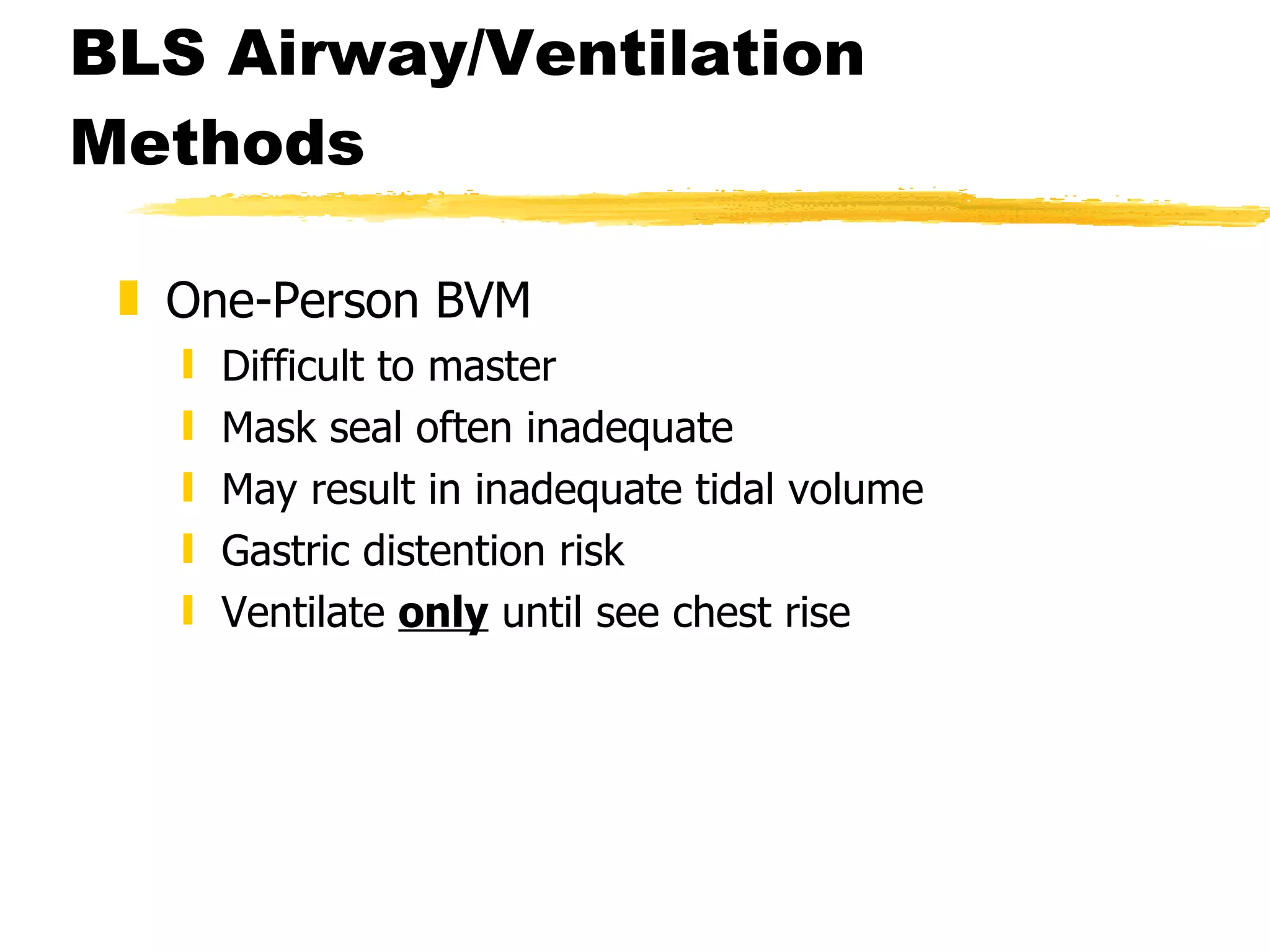
BLS Airway/Ventilation Methods One-Person BVM Difficult to master Mask seal often inadequate May result in inadequate tidal volume Gastric distention risk Ventilate  only  until see chest rise
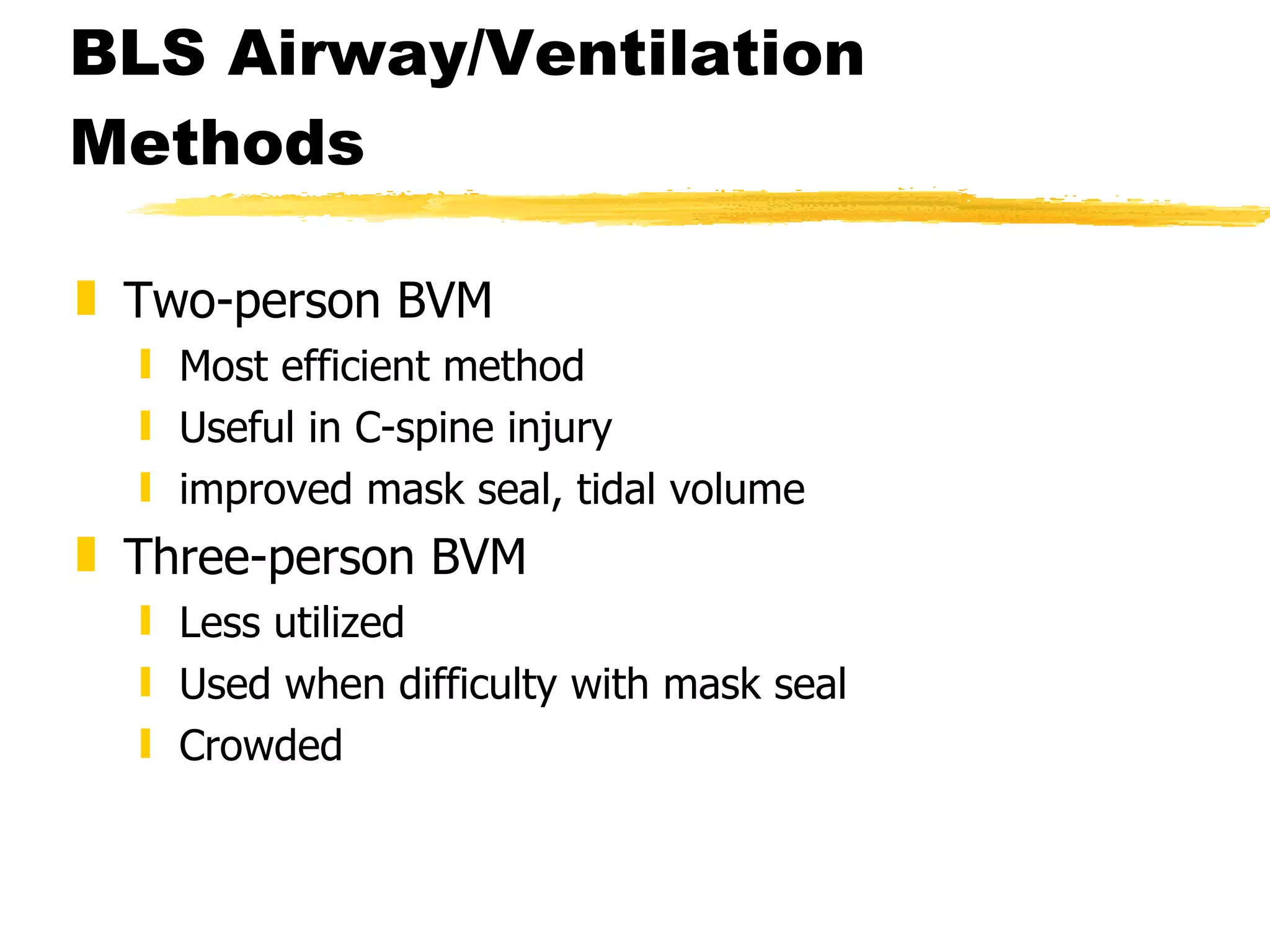
BLS Airway/Ventilation Methods Two-person BVM Most efficient method Useful in C-spine injury improved mask seal, tidal volume Three-person BVM Less utilized Used when difficulty with mask seal Crowded
BLS Airway/Ventilation Methods Flow-restricted, gas-powered ventilator Cardiac sphincter opens at 30 cm H 2 O High volume/high concentration Not recommended for children, poor pulmonary compliance, or poor tidal volume Oxygen delivered on inspiratory effort May cause barotrauma
BLS Airway/Ventilation Methods Automatic transport ventilators Not like “real” ventilator  Usually only controls volume, rate Useful during prolonged ventilation times Not useful in obstructed airway, increased airway resistance Frees personnel Cannot respond to changes in airway resistance, lung compliance
BLS Airway/Ventilation Methods Pediatric considerations Mask seal force may obstruct airway Best if used with jaw thrust BVM sizes: neonate, infant=450 ml + Children > 8 y.o. require adult BVM Just enough volume to see chest rise Squeeze - Release - Release
BLS Airway/Ventilation Methods Stoma patients Expose stoma Pocket mask BVM Seal around stoma site Seal mouth, nose if air leak is evident
BLS Airway/Ventilation Methods Airway obstruction techniques Positioning Finger sweep with caution Suctioning Oral airway/nasal airway (tongue) Heimlich maneuver Chest thrusts Chest thrust/back blows for infants Direct laryngoscopy
BLS Airway/Ventilation Methods Suctioning Manual or powered devices Suction catheters Rigid Soft
BLS Airway/Ventilation Methods Gastric Distention Common when ventilating without intubation Complications Pressure on diaphragm Resistance to BVM ventilation Vomiting, aspiration Increase BVM ventilation time

Airway management part 1

  • 1.
    Airway Management Part1 EMS Professions Temple College
  • 2.
    Topics for DiscussionAirway Maintenance Objectives Airway Anatomy & Physiology Review Causes of Respiratory Difficulty & Distress Assessing Respiratory Function Methods of Airway Management Methods of Ventilatory Management Common Out-of-Hospital Equipment Utilized Advanced Methods of Airway Management and Ventilation Risks to the Paramedic
  • 3.
    Objectives of AirwayManagement & Ventilation Primary Objective: Ensure optimal ventilation Deliver oxygen to blood Eliminate carbon dioxide (C0 2 ) from body Definitions What is airway management ? How does it differ from spontaneous, manual or assisted ventilations ?
  • 4.
    Objectives of AirwayManagement & Ventilation Why is this so important? Brain death occurs rapidly; other tissue follows EMS providers can reduce additional injury/disease by good airway, ventilation techniques EMS providers often neglect BLS airway, ventilation skills
  • 5.
    Airway Anatomy ReviewUpper Airway Anatomy Lower Airway Anatomy Lung Capacities/Volumes Pediatric Airway Differences
  • 6.
    Anatomy of theUpper Airway
  • 7.
    Upper Airway AnatomyFunctions: warm, filter, humidify air Nasal cavity and nasopharynx Formed by union of facial bones Nasal floor towards ear not eye Lined with mucous membranes, cilia Tissues are delicate, vascular Adenoids Lymph tissue - filters bacteria Commonly infected
  • 8.
    Upper Airway AnatomyOral cavity and oropharynx Teeth Tongue Attached at mandible, hyoid bone Most common airway obstruction cause Palate Roof of mouth Separates oropharynx and nasopharynx Anterior= hard palate; Posterior= soft palate
  • 9.
    Upper Airway AnatomyOral cavity and oropharynx Tonsils Lymph tissue - filters bacteria Commonly infected Epiglottis Leaf-like structure Closes during swallowing Prevents aspiration Vallecula “ Pocket” formed by base of tongue, epiglottis
  • 10.
  • 11.
    Upper Airway AnatomySinuses cavities formed by cranial bones act as tributaries for fluid to, from eustachian tubes, tear ducts trap bacteria, commonly infected
  • 12.
    Upper Airway AnatomyLarynx Attached to hyoid bone Horseshoe shaped bone Supports trachea Thyroid cartilage Largest laryngeal cartilage Shield-shaped Cartilage anteriorly, smooth muscle posteriorly “ Adam’s Apple” Glottic opening directly behind
  • 13.
    Upper Airway AnatomyLarynx Glottic opening Adult airway’s narrowest point Dependent on muscle tone Contains vocal bands Arytenoid cartilage Posterior attachment of vocal bands
  • 14.
    Upper Airway AnatomyLarynx Cricoid ring First tracheal ring Completely cartilaginous Compression (Sellick maneuver) occludes esophagus Cricothyroid membrane Membrane between cricoid, thyroid cartilages Site for surgical, needle airway placement
  • 15.
    Upper Airway AnatomyLarynx and Trachea Associated Structures Thyroid gland below cricoid cartilage lies across trachea, up both sides Carotid arteries branch across, lie closely alongside trachea Jugular veins branch across and lie close to trachea
  • 16.
  • 17.
    Upper Airway AnatomyPediatric vs Adult Upper Airway Larger tongue in comparison to size of mouth Floppy epiglottis Delicate teeth, gums More superior larynx Funnel shaped larynx due to undeveloped cricoid cartilage Narrowest point at cricoid ring before ~8 years old
  • 18.
    Upper Airway AnatomyFrom: CPEM, TRIPP, 1998
  • 19.
  • 20.
  • 21.
    Lower Airway AnatomyFunction Exchange O 2 , CO 2 with blood Location From glottic opening to alveolar-capillary membrane
  • 22.
    Lower Airway AnatomyTrachea Bifurcates (divides) at carina Right, left mainstem bronchi Right mainstem bronchus shorter, straighter Lined with mucous cells, beta-2 receptors
  • 23.
    Lower Airway AnatomyBronchi Branch into secondary, tertiary bronchi that branch into bronchioles Bronchioles No cartilage in walls Small smooth muscle tubes Branch into alveolar ducts that end at alveolar sacs
  • 24.
    Lower Airway AnatomyAlveoli “ Balloon-like” clusters Site of gas exchange Lined with surfactant Decreases surface tension  eases expansion  surfactant  atelectasis (focal collapse of alveoli0
  • 25.
    Lower Airway AnatomyLungs Right lung = 3 lobes; Left lung = 2 lobes Parenchymal tissue Pleura Visceral Parietal Pleural space
  • 26.
  • 27.
    Lower Airway AnatomyOcclusion of bronchioles Smooth muscle contraction (bronchospasm Mucus plugs Inflammatory edema Foreign bodies
  • 28.
    Lung Volumes/Capacities Typicaladult male total lung capacity = 6 liters Tidal Volume (V T ) Gas volume inhaled or exhaled during single ventilatory cycle Usually 5-7 cc/kg (typically 500 cc)
  • 29.
    Lung Volumes/Capacities DeadSpace Air (V D ) Air unavailable for gas exchange
  • 30.
    Lung Volumes/Capacities DeadSpace Air (V D ) Anatomic dead space (~150cc) Trachea Bronchi Physiologic dead space Shunting Pathological dead space Formed by factors like disease or obstruction Examples: COPD
  • 31.
    Lung Volumes/Capacities AlveolarAir (alveolar volume) [V A ] Air reaching alveoli for gas exchange Usually 350 cc
  • 32.
    Lung Volumes/Capacities MinuteVolume [V min ](minute ventilation) Amount of gas moved in, out of respiratory tract per minute Tidal volume X RR Alveolar Minute Volume Amount of gas moved in, out of alveoli per minute (tidal volume - dead space volume) X RR
  • 33.
    Lung Volumes/Capacities FunctionalReserve Capacity (FRC) After optimal inspiration, amount of air that can be forced from lungs in single exhalation
  • 34.
    Lung Volumes/Capacities InspiratoryReserve Volume (IRV) Amount of gas that can be inspired in addition to tidal volume Expiratory Reserve Volume (ERV) Amount of gas that can be expired after passive (relaxed) expiration
  • 35.
  • 36.
    Ventilation Movement ofair in, out of lungs Control via: Respiratory center in medulla Apneustic, pneumotaxic centers in pons
  • 37.
    Ventilation Inspiration Stimulusfrom respiratory center of brain (medulla) Transmitted via phrenic nerve to diaphragm, spinal cord/intercostal nerves to intercostal muscles Diaphragm contracts, flattens Intercostal muscles contract; ribs move up and out Air spaces in lungs stretch, increase in size  intrapulmonic pressure (pressure gradient) Air flows into airways, alveoli inflate until pressure equalizes
  • 38.
    Ventilation Expiration Stretchreceptors in lungs signal respiratory center via vagus nerve to inhibit inspiration (Hering-Breuer reflex) Natural elasticity of lungs pulls diaphragm, chest wall to resting position Pulmonary air spaces decrease in size Intrapulmonary pressure rises Air flows out until pressure equalizes
  • 39.
  • 40.
  • 41.
    Ventilation Respiratory DriveChemoreceptors in medulla Stimulated  PaCO 2 or  pH PaCO 2 is normal neuroregulatory control of ventilations Hypoxic Drive Chemoreceptors in aortic arch, carotid bodies Stimulated by  PaO 2 Back-up regulatory control
  • 42.
    Ventilation Other stimulantsor depressants Body temp: fever  ; hypothermia  Drugs/meds: increase or decrease Pain: increases, but occasionally decreases Emotion: increases Acidosis: increases Sleep: decreases
  • 43.
    Gas Measurements TotalPressure Combined pressure of all atmospheric gases 760 mm Hg (torr) at sea level Partial Pressure Pressure exerted by each gas in a mixture
  • 44.
    Gas Measurements PartialPressures Atmospheric Nitrogen 597.0 torr (78.62%); Oxygen 159.0 torr (20.84%); Carbon Dioxide 0.3 torr (0.04%); Water 3.7 torr (0.5%) Alveolar Nitrogen 569.0 torr (74.9%); Oxygen 104.0 torr (13.7%); CO2 40.0 torr (5.2%); Water 47.0 torr (6.2%)
  • 45.
    Respiration Ventilation vs.Respiration Exchange of gases between living organism, environment External Respiration Exchange between lungs, blood cells Internal Respiration Exchange between blood cells, tissues
  • 46.
    Respiration How areO 2 , CO 2 transported? Diffusion Movement of gases along a concentration gradient Gases dissolve in water, pass through alveolar membrane from areas of higher concentration to areas of lower concentration FiO 2 % oxygen in inspired air expressed as a decimal FiO 2 of room air = 0.21
  • 47.
    Respiration Blood OxygenContent dissolved O 2 crosses capillary membrane, binds to Hgb of RBC Transport = O 2 bound to hemoglobin (  97%) or dissolved in plasma O 2 Saturation % of hemoglobin saturated with oxygen (usually carries >96% of total) O 2 content divided by O 2 carrying capacity
  • 48.
    Respiration Oxygen saturationaffected by: Low Hgb (anemia, hemorrhage) Inadequate oxygen availability at alveoli Poor diffusion across pulmonary membrane (pneumonia, pulmonary edema, COPD) Ventilation/Perfusion (V/Q) mismatch Blood moves past collapsed alveoli (shunting) Alveoli intact but blood flow impaired
  • 49.
    Respiration Blood CarbonDioxide Content Byproduct of work (cellular respiration) Transported as bicarbonate (HCO 3 - ion)  20-30% bound to hemoglobin Pressure gradient causes CO 2 diffusion into alveoli from blood Increased level = hypercarbia
  • 50.
  • 51.
    Inspired Air: PO2 160 & P CO2 0.3 Alveoli P O2 100 & P CO2 40 P O2 40 & P CO2 46 - Pulmonary circulation - P O2 100 & P CO2 40 Heart P O2 40 & P CO2 46 - Systemic circulation - P O2 100 & P CO2 40 Tissue cell P O2 <40 & P CO2 >46 Oxygenated Deoxygenated
  • 52.
    Diagnostic Testing PulseOximetry Peak Expiratory Flow Testing Pulmonary Function Testing End-Tidal CO 2 Monitoring Laboratory Testing of Blood Arterial Venous
  • 53.
    Causes of HypoxemiaLower partial pressure of atmospheric O 2 Inadequate hemoglobin level in blood Hemoglobin bound by other gas (CO)  pulmonary alveolar membrane distance Reduced surface area for gas exchange Decreased mechanical effort
  • 54.
    Causes of Airway/VentilatoryCompromise Airway Obstruction Tongue Foreign body obstruction Anaphylaxis/angioedema Upper airway burn Maxillofacial/laryngeal/trachebronchial trauma Epiglottitis Croup
  • 55.
    Obstruction Tongue Mostcommon cause Snoring respirations Corrected by positioning
  • 56.
    Foreign Body Partialor Full Symptoms include Choking Gagging Stridor Dyspnea Aphonia Dysphonia
  • 57.
    Laryngeal Spasm Spasmaticclosure of vocal cords Frequently caused by Overly aggressive technique during intubation Immediately upon extubation
  • 58.
    Laryngeal Edema CausesAngioedema Anaphylaxis Upper airway burns Epiglottitis Croup Trauma
  • 59.
    Aspiration Significantly increasesmortality Obstructs Airway Destroys bronchial tissue Introduces pathogens Decreases ability to ventilate Frequently occult
  • 60.
    Obstructive Airway DiseaseObstructive airway disease Asthma Emphysema Chronic Bronchitis
  • 61.
    Gas Exchange SurfacePulmonary edema Left-sided heart failure Toxic inhalation Near drowning Pneumonia Pulmonary embolism Blood clots Amniotic fluid Fat embolism
  • 62.
    Causes of Airway/VentilatoryCompromise Thoracic Bellows Chest trauma Fib fractures Flail chest Pneumothorax Hemothorax Sucking chest wound Diaphragmatic hernia
  • 63.
    Causes of Airway/VentilatoryCompromise Thoracic Bellows Pleural effusion Spinal cord trauma Morbid obesity (Pickwickian Syndrome) Neurological/neuromuscular disease Poliomyelitis Myasthenia gravis Muscular dystrophy Gullian-Barre syndrome
  • 64.
    Causes of Airway/VentilatoryCompromise Control System Head trauma Cerebrovascular accident Depressant drug toxicity Narcotics Sedative-Hypnotics Ethanol
  • 65.
    Assessment of Airway/VentilatoryCompromise Respiratory Distress/Dyspnea = Possible Life Threat Assess/Manage Simultaneously Priorities Airway Breathing Circulation Disability
  • 66.
    Assessment of Airway/VentilatoryCompromise Airway Listen to patient talk/breathe Noisy breathing = Obstructed breathing But, all obstructed breathing is not noisy Adventitious sounds Snoring = Tongue Stridor = “Tight” Upper Airway
  • 67.
    Assessment of Airway/VentilatoryCompromise Breathing Look Symmetry of Chest Expansion Signs of Increased Effort Skin Color Listen Mouth and Nose Lung Fields Feel Mouth and Nose Symmetry of Expansion
  • 68.
    Assessment of Airway/VentilatoryCompromise Breathing Tachypnea Bradypnea Signs of distress Nasal flaring Tracheal tugging Retractions Accessory muscle use Tripod positioning Cyanosis
  • 69.
    Assessment of Airway/VentilatoryCompromise Circulation Don’t let respiratory failure distract you!!! Tachycardia = Early hypoxia in adults Bradycardia = Early hypoxia in infants, children; Late hypoxia in adults
  • 70.
    Assessment of Airway/VentilatoryCompromise Disability Restlessness, anxiety, combativeness = hypoxia until proven otherwise Drowsiness, lethargy = hypercarbia until proven otherwise When the fighting stops, a patient isn’t always getting better
  • 71.
    Assessment of Airway/VentilatoryCompromise Focused Exam Respiratory Patterns Cheyne-Stokes = diffuse cerebral cortex injury Kussmaul = acidosis Biot’s (cluster) = increased ICP; pons, upper medulla injury Central Neurogenic Hyperventilation = increased ICP; mid-brain injury Agonal = brain anoxia
  • 72.
    Assessment of Airway/VentilatoryCompromise Focused Exam Neck Trachea mid-line? Jugular vein distension? Subcutaneous emphysema? Accessory muscle use?/hypertrophy?
  • 73.
    Assessment of Airway/VentilatoryCompromise Focused Exam Chest Barrel chest? Deformity, discoloration, asymmetry? Flail segment, paradoxical movement? Adventitious breath sounds? Third heart sound? Subcutaneous emphysema? Fremitus? Dullness, hyperresonance to percussion?
  • 74.
    Assessment of Airway/VentilatoryCompromise Focused Exam Extremities Edema? Nail bed color? Clubbing?
  • 75.
    Assessment of Airway/VentilatoryCompromise Mechanical Ventilation Increased resistance Changing compliance
  • 76.
    Assessment of Airway/VentilatoryCompromise Pulsus Paradoxus Systolic BP drops > 10 mm Hg w/inspiration May detect change in pulse quality COPD, asthma, pericardial tamponade
  • 77.
    Assessment of Airway/VentilatoryCompromise History Onset gradual or sudden? What makes it worse, better? How long? Cough? Productive? Of what? Pain? What kind? Fever?
  • 78.
    Assessment of Airway/VentilatoryCompromise Past History Hypertension, AMI, diabetes Chronic cough, smoking, recurrent “colds” Allergies, acute/seasonal SOB Lower extremity trauma, recent surgery, immobilization Interventions Past admission? Ever admitted to ICU? Medications? Frequency of prn medication use? Ever intubated before?
  • 79.
    BLS Airway/Ventilation MethodsSupplemental Oxygen Increased FiO 2 increases available oxygen Objective = Maximize hemoglobin saturation
  • 80.
    Oxygen Equipment Oxygensource Compressed gas Tank size D 400L E 660L M 3450 L Liquid oxygen
  • 81.
    Oxygen Equipment RegulatorsHigh Pressure Cylinder to cylinder Low Pressure Cylinder to patient Humidifier
  • 82.
    Delivery Devices Nasalcannula Simple face mask Partial rebreather mask Non-rebreather mask Venturi mask Small volume nebulizer
  • 83.
    Nasal Cannula Optimaldelivery 40% at 6 LPM Indication Low FiO 2 Long term therapy Contraindications Apnea Mouth breathing Need for High FiO 2
  • 84.
    Venturi Mask SpecificO 2 Concentrations 24% 28% 35% 40%
  • 85.
    Simple Face MaskRange 40-60% at 10 LPM Volumes greater that 10 LPM does not increase O2 delivery Indications Moderate FiO 2 Contraindications Apnea Need for High FiO 2
  • 86.
    Non-Rebreather Mask Range80-95% at 15 LPM Indications Delivery of high FiO2 Contraindications Apnea Poor respiratory effort
  • 87.
    Partial Rebreather Range40 – 60% Indications Moderate FiO 2 Contraindications Apnea Need for High FiO 2
  • 88.
    BLS Airway/Ventilation MethodsAirway Maneuvers Head-tilt/Chin-lift Jaw thrust Sellick’s maneuver Other Types Tracheostomy with tube Tracheostomy with stoma Airway Devices Oropharyngeal airway Nasopharyngeal airway
  • 89.
    BLS Airway/Ventilation MethodsMouth-to-Mouth Mouth-to-Nose Mouth-to-Mask One-person BVM Two-person BVM Three-person BVM Flow-restricted, gas powered ventilator Transport ventilator
  • 90.
    BLS Airway/Ventilation MethodsMouth to Mouth Mouth to Nose Mouth to Mask
  • 91.
    BLS Airway/Ventilation MethodsOne-Person BVM Difficult to master Mask seal often inadequate May result in inadequate tidal volume Gastric distention risk Ventilate only until see chest rise
  • 92.
    BLS Airway/Ventilation MethodsTwo-person BVM Most efficient method Useful in C-spine injury improved mask seal, tidal volume Three-person BVM Less utilized Used when difficulty with mask seal Crowded
  • 93.
    BLS Airway/Ventilation MethodsFlow-restricted, gas-powered ventilator Cardiac sphincter opens at 30 cm H 2 O High volume/high concentration Not recommended for children, poor pulmonary compliance, or poor tidal volume Oxygen delivered on inspiratory effort May cause barotrauma
  • 94.
    BLS Airway/Ventilation MethodsAutomatic transport ventilators Not like “real” ventilator Usually only controls volume, rate Useful during prolonged ventilation times Not useful in obstructed airway, increased airway resistance Frees personnel Cannot respond to changes in airway resistance, lung compliance
  • 95.
    BLS Airway/Ventilation MethodsPediatric considerations Mask seal force may obstruct airway Best if used with jaw thrust BVM sizes: neonate, infant=450 ml + Children > 8 y.o. require adult BVM Just enough volume to see chest rise Squeeze - Release - Release
  • 96.
    BLS Airway/Ventilation MethodsStoma patients Expose stoma Pocket mask BVM Seal around stoma site Seal mouth, nose if air leak is evident
  • 97.
    BLS Airway/Ventilation MethodsAirway obstruction techniques Positioning Finger sweep with caution Suctioning Oral airway/nasal airway (tongue) Heimlich maneuver Chest thrusts Chest thrust/back blows for infants Direct laryngoscopy
  • 98.
    BLS Airway/Ventilation MethodsSuctioning Manual or powered devices Suction catheters Rigid Soft
  • 99.
    BLS Airway/Ventilation MethodsGastric Distention Common when ventilating without intubation Complications Pressure on diaphragm Resistance to BVM ventilation Vomiting, aspiration Increase BVM ventilation time