Environmental Emergencies
Environmental Emergencies Body Temperature 96.4-99.8 degrees F Heat Regulation Based on heat lost v heat gained Variation throughout body core and periphery  Cardiovascular System Transports heat through body Skin Allow heat to be lost/gained to/from environment Hypothalamus Temperature control center of the brain
Heat Production Metabolism ALL metabolic processes in body produce heat Basal metabolism Metabolic activity to maintain cell function at rest Generally more than enough heat to maintain core temp
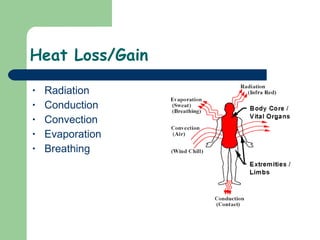
Heat Loss/Gain Radiation Conduction Convection Evaporation Breathing
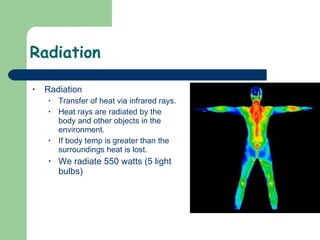
Radiation  Radiation Transfer of heat via infrared rays. Heat rays are radiated by the body and other objects in the environment. If body temp is greater than the surroundings heat is lost. We radiate 550 watts (5 light bulbs)
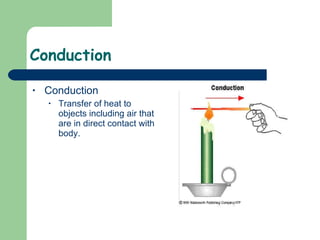
Conduction  Conduction Transfer of heat to objects including air that are in direct contact with body.
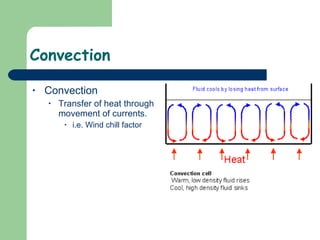
Convection  Convection Transfer of heat through movement of currents. i.e. Wind chill factor
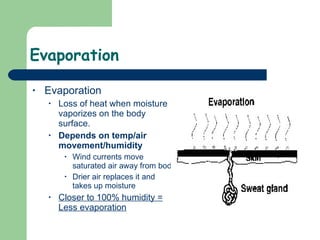
Evaporation  Evaporation Loss of heat when moisture vaporizes on the body surface. Depends on temp/air movement/humidity Wind currents move saturated air away from body Drier air replaces it and takes up moisture  Closer to 100% humidity = Less evaporation
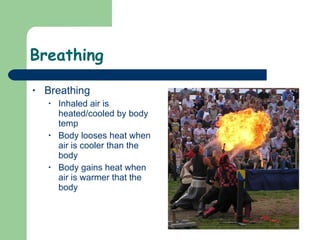
Breathing  Breathing Inhaled air is heated/cooled by body temp Body looses heat when air is cooler than the body Body gains heat when air is warmer that the body
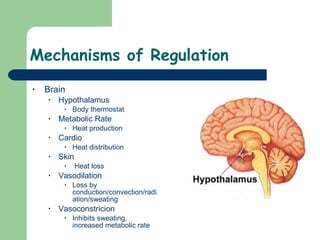
Mechanisms of Regulation  Brain Hypothalamus Body thermostat Metabolic Rate  Heat production Cardio  Heat distribution Skin  Heat loss Vasodilation Loss by conduction/convection/radiation/sweating Vasoconstricion Inhibits sweating, increased metabolic rate
Cardiovascular System  Cardiovascular Brings heated blood from core to extremities 5 % of cardiac output is in skin 250-300 ml/min Vasodilation More blood contact with skin Conduction, convection, radiation Can increase to 3000 ml/min!!!! Vasoconstriction Heat conservation Can decrease to 30 ml/min!!!!
 
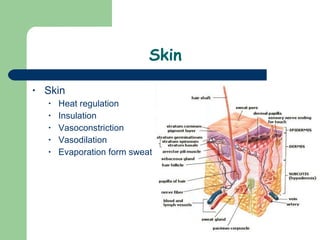
Skin Skin Heat regulation Insulation Vasoconstriction Vasodilation Evaporation form sweat
Questions to ask Source Environment Loss of consciousness Effects How long exposed
Cold Emergencies: Predisposing Factors  Cold Environment Immersion Non Immersion Age Very old Very young Small with LARGE surface area Small muscle mass – Poor in children and not existent in infants Less body fat Younger children need help to protect against environment Medical Conditions Shock  Head injuries, Injuries to spinal cord Burns Generalized infection Diabetes and hypoglycemia  Drugs/poisons
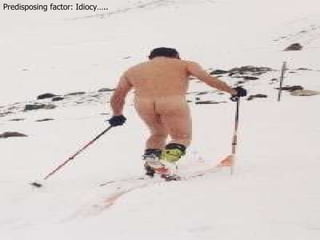
Predisposing factor: Idiocy…..
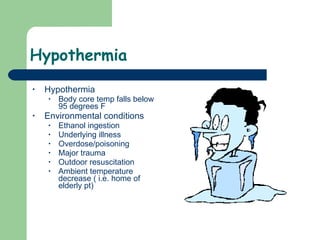
Hypothermia Hypothermia Body core temp falls below 95 degrees F Environmental conditions Ethanol ingestion Underlying illness Overdose/poisoning Major trauma Outdoor resuscitation Ambient temperature decrease ( i.e. home of elderly pt)
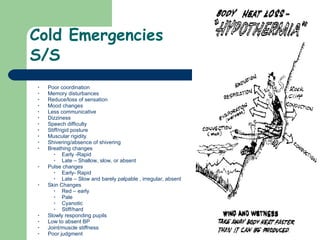
Cold Emergencies S/S Poor coordination Memory disturbances Reduce/loss of sensation Mood changes Less communicative Dizziness Speech difficulty Stiff/rigid posture Muscular rigidity Shivering/absence of shivering Breathing changes Early -Rapid Late – Shallow, slow, or absent Pulse changes Early- Rapid Late – Slow and barely palpable , irregular, absent Skin Changes Red – early  Pale Cyanotic Stiff/hard Slowly responding pupils Low to absent BP Joint/muscle stiffness Poor judgment
Assessment/Treatment Assessment: Place hand against pt abdomen Cool abdomen = Generalized hypothermia  Assess pulse 30-45 seconds before CPR Treatment: Remove pt from environment Remove wet clothing Cover with blankets Handle pt EXTREMELY carefully Do not allow pt to walk/exert self Admin O2 (warmed/humidified if able) Do not let pt ingest stimulants Do not massage extremity  If pt responsive : Active rewarming If pt unresponsive : Passive rewarming AFTERDROP…
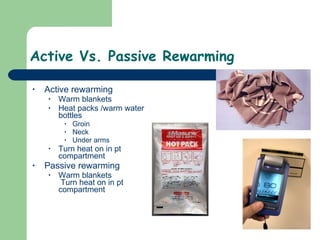
Active Vs. Passive Rewarming  Active rewarming Warm blankets Heat packs /warm water bottles Groin Neck Under arms Turn heat on in pt compartment Passive rewarming Warm blankets  Turn heat on in pt compartment
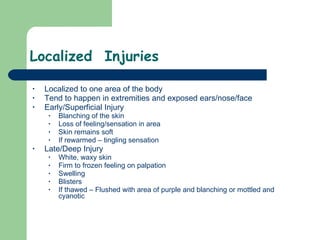
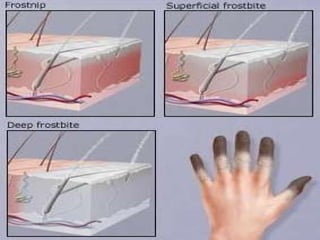
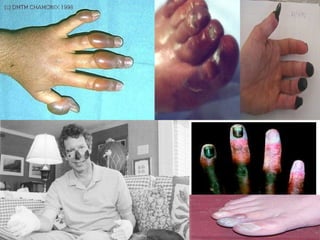
Localized  Injuries Localized to one area of the body Tend to happen in extremities and exposed ears/nose/face  Early/Superficial Injury Blanching of the skin Loss of feeling/sensation in area Skin remains soft If rewarmed – tingling sensation  Late/Deep Injury White, waxy skin Firm to frozen feeling on palpation Swelling Blisters If thawed – Flushed with area of purple and blanching or mottled and cyanotic
 
 
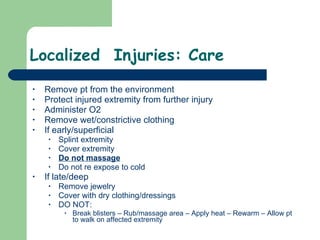
Localized  Injuries: Care Remove pt from the environment Protect injured extremity from further injury Administer O2 Remove wet/constrictive clothing If early/superficial Splint extremity Cover extremity Do not massage Do not re expose to cold If late/deep Remove jewelry  Cover with dry clothing/dressings DO NOT: Break blisters – Rub/massage area – Apply heat – Rewarm – Allow pt to walk on affected extremity
Prolonged/Delayed Transport Active Rapid Rewarming Immerse affected part in warm water bath Monitor water so that it doesnt cool from frozen part Continuously stir water Continue until the part is soft and sensation returns Dress the area with dry sterile dressings Protect against refreezing  Expect pt to c/o SEVERE pain
Changing Directions…
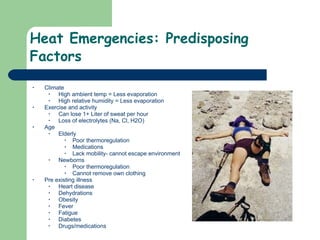
Heat Emergencies: Predisposing Factors Climate High ambient temp = Less evaporation High relative humidity = Less evaporation Exercise and activity Can lose 1+ Liter of sweat per hour Loss of electrolytes (Na, Cl, H2O) Age Elderly Poor thermoregulation Medications Lack mobility- cannot escape environment Newborns Poor thermoregulation Cannot remove own clothing Pre existing illness Heart disease Dehydrations Obesity Fever Fatigue Diabetes  Drugs/medications
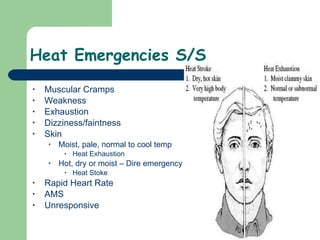
Heat Emergencies S/S Muscular Cramps Weakness Exhaustion Dizziness/faintness Skin Moist, pale, normal to cool temp Heat Exhaustion Hot, dry or moist – Dire emergency  Heat Stoke  Rapid Heart Rate AMS Unresponsive
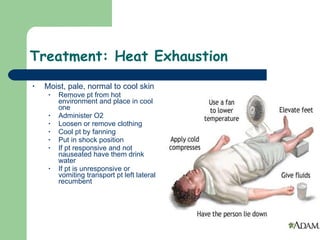
Treatment: Heat Exhaustion  Moist, pale, normal to cool skin Remove pt from hot environment and place in cool one Administer O2 Loosen or remove clothing Cool pt by fanning Put in shock position If pt responsive and not nauseated have them drink water If pt is unresponsive or vomiting transport pt left lateral recumbent
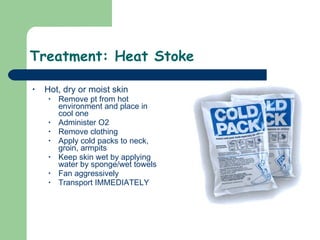
Treatment: Heat Stoke  Hot, dry or moist skin Remove pt from hot environment and place in cool one Administer O2 Remove clothing Apply cold packs to neck, groin, armpits Keep skin wet by applying water by sponge/wet towels Fan aggressively  Transport IMMEDIATELY
 
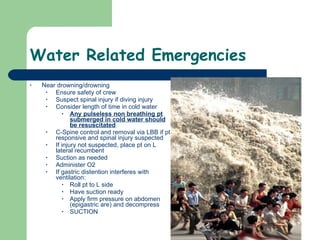
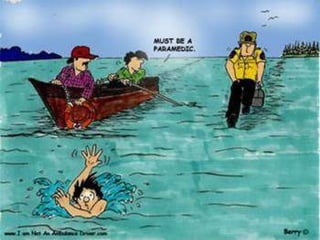
Water Related Emergencies Near drowning/drowning Ensure safety of crew Suspect spinal injury if diving injury Consider length of time in cold water Any pulseless non breathing pt submerged in cold water should be resuscitated C-Spine control and removal via LBB if pt responsive and spinal injury suspected If injury not suspected, place pt on L lateral recumbent Suction as needed Administer O2 If gastric distention interferes with ventilation:  Roll pt to L side Have suction ready Apply firm pressure on abdomen (epigastric are) and decompress SUCTION
 
 
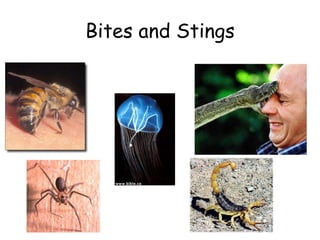
Bites and Stings
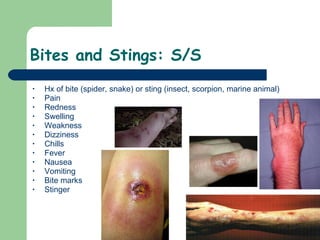
Bites and Stings: S/S Hx of bite (spider, snake) or sting (insect, scorpion, marine animal) Pain Redness Swelling Weakness Dizziness Chills Fever Nausea Vomiting Bite marks Stinger
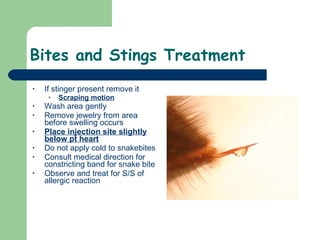
Bites and Stings Treatment If stinger present remove it Scraping motion Wash area gently Remove jewelry from area before swelling occurs Place injection site slightly below pt heart Do not apply cold to snakebites Consult medical direction for constricting band for snake bite Observe and treat for S/S of allergic reaction
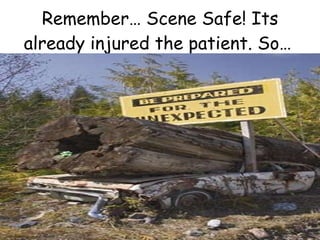
Remember… Scene Safe! Its already injured the patient. So…
 

22)Environmental Emergencies

  • 1.
  • 2.
    Environmental Emergencies BodyTemperature 96.4-99.8 degrees F Heat Regulation Based on heat lost v heat gained Variation throughout body core and periphery Cardiovascular System Transports heat through body Skin Allow heat to be lost/gained to/from environment Hypothalamus Temperature control center of the brain
  • 3.
    Heat Production MetabolismALL metabolic processes in body produce heat Basal metabolism Metabolic activity to maintain cell function at rest Generally more than enough heat to maintain core temp
  • 4.
    Heat Loss/Gain RadiationConduction Convection Evaporation Breathing
  • 5.
    Radiation RadiationTransfer of heat via infrared rays. Heat rays are radiated by the body and other objects in the environment. If body temp is greater than the surroundings heat is lost. We radiate 550 watts (5 light bulbs)
  • 6.
    Conduction ConductionTransfer of heat to objects including air that are in direct contact with body.
  • 7.
    Convection ConvectionTransfer of heat through movement of currents. i.e. Wind chill factor
  • 8.
    Evaporation EvaporationLoss of heat when moisture vaporizes on the body surface. Depends on temp/air movement/humidity Wind currents move saturated air away from body Drier air replaces it and takes up moisture Closer to 100% humidity = Less evaporation
  • 9.
    Breathing BreathingInhaled air is heated/cooled by body temp Body looses heat when air is cooler than the body Body gains heat when air is warmer that the body
  • 10.
    Mechanisms of Regulation Brain Hypothalamus Body thermostat Metabolic Rate Heat production Cardio Heat distribution Skin Heat loss Vasodilation Loss by conduction/convection/radiation/sweating Vasoconstricion Inhibits sweating, increased metabolic rate
  • 11.
    Cardiovascular System Cardiovascular Brings heated blood from core to extremities 5 % of cardiac output is in skin 250-300 ml/min Vasodilation More blood contact with skin Conduction, convection, radiation Can increase to 3000 ml/min!!!! Vasoconstriction Heat conservation Can decrease to 30 ml/min!!!!
  • 12.
  • 13.
    Skin Skin Heatregulation Insulation Vasoconstriction Vasodilation Evaporation form sweat
  • 14.
    Questions to askSource Environment Loss of consciousness Effects How long exposed
  • 15.
    Cold Emergencies: PredisposingFactors Cold Environment Immersion Non Immersion Age Very old Very young Small with LARGE surface area Small muscle mass – Poor in children and not existent in infants Less body fat Younger children need help to protect against environment Medical Conditions Shock Head injuries, Injuries to spinal cord Burns Generalized infection Diabetes and hypoglycemia Drugs/poisons
  • 16.
  • 17.
    Hypothermia Hypothermia Bodycore temp falls below 95 degrees F Environmental conditions Ethanol ingestion Underlying illness Overdose/poisoning Major trauma Outdoor resuscitation Ambient temperature decrease ( i.e. home of elderly pt)
  • 18.
    Cold Emergencies S/SPoor coordination Memory disturbances Reduce/loss of sensation Mood changes Less communicative Dizziness Speech difficulty Stiff/rigid posture Muscular rigidity Shivering/absence of shivering Breathing changes Early -Rapid Late – Shallow, slow, or absent Pulse changes Early- Rapid Late – Slow and barely palpable , irregular, absent Skin Changes Red – early Pale Cyanotic Stiff/hard Slowly responding pupils Low to absent BP Joint/muscle stiffness Poor judgment
  • 19.
    Assessment/Treatment Assessment: Placehand against pt abdomen Cool abdomen = Generalized hypothermia Assess pulse 30-45 seconds before CPR Treatment: Remove pt from environment Remove wet clothing Cover with blankets Handle pt EXTREMELY carefully Do not allow pt to walk/exert self Admin O2 (warmed/humidified if able) Do not let pt ingest stimulants Do not massage extremity If pt responsive : Active rewarming If pt unresponsive : Passive rewarming AFTERDROP…
  • 20.
    Active Vs. PassiveRewarming Active rewarming Warm blankets Heat packs /warm water bottles Groin Neck Under arms Turn heat on in pt compartment Passive rewarming Warm blankets Turn heat on in pt compartment
  • 21.
    Localized InjuriesLocalized to one area of the body Tend to happen in extremities and exposed ears/nose/face Early/Superficial Injury Blanching of the skin Loss of feeling/sensation in area Skin remains soft If rewarmed – tingling sensation Late/Deep Injury White, waxy skin Firm to frozen feeling on palpation Swelling Blisters If thawed – Flushed with area of purple and blanching or mottled and cyanotic
  • 22.
  • 23.
  • 24.
    Localized Injuries:Care Remove pt from the environment Protect injured extremity from further injury Administer O2 Remove wet/constrictive clothing If early/superficial Splint extremity Cover extremity Do not massage Do not re expose to cold If late/deep Remove jewelry Cover with dry clothing/dressings DO NOT: Break blisters – Rub/massage area – Apply heat – Rewarm – Allow pt to walk on affected extremity
  • 25.
    Prolonged/Delayed Transport ActiveRapid Rewarming Immerse affected part in warm water bath Monitor water so that it doesnt cool from frozen part Continuously stir water Continue until the part is soft and sensation returns Dress the area with dry sterile dressings Protect against refreezing Expect pt to c/o SEVERE pain
  • 26.
  • 27.
    Heat Emergencies: PredisposingFactors Climate High ambient temp = Less evaporation High relative humidity = Less evaporation Exercise and activity Can lose 1+ Liter of sweat per hour Loss of electrolytes (Na, Cl, H2O) Age Elderly Poor thermoregulation Medications Lack mobility- cannot escape environment Newborns Poor thermoregulation Cannot remove own clothing Pre existing illness Heart disease Dehydrations Obesity Fever Fatigue Diabetes Drugs/medications
  • 28.
    Heat Emergencies S/SMuscular Cramps Weakness Exhaustion Dizziness/faintness Skin Moist, pale, normal to cool temp Heat Exhaustion Hot, dry or moist – Dire emergency Heat Stoke Rapid Heart Rate AMS Unresponsive
  • 29.
    Treatment: Heat Exhaustion Moist, pale, normal to cool skin Remove pt from hot environment and place in cool one Administer O2 Loosen or remove clothing Cool pt by fanning Put in shock position If pt responsive and not nauseated have them drink water If pt is unresponsive or vomiting transport pt left lateral recumbent
  • 30.
    Treatment: Heat Stoke Hot, dry or moist skin Remove pt from hot environment and place in cool one Administer O2 Remove clothing Apply cold packs to neck, groin, armpits Keep skin wet by applying water by sponge/wet towels Fan aggressively Transport IMMEDIATELY
  • 31.
  • 32.
    Water Related EmergenciesNear drowning/drowning Ensure safety of crew Suspect spinal injury if diving injury Consider length of time in cold water Any pulseless non breathing pt submerged in cold water should be resuscitated C-Spine control and removal via LBB if pt responsive and spinal injury suspected If injury not suspected, place pt on L lateral recumbent Suction as needed Administer O2 If gastric distention interferes with ventilation: Roll pt to L side Have suction ready Apply firm pressure on abdomen (epigastric are) and decompress SUCTION
  • 33.
  • 34.
  • 35.
  • 36.
    Bites and Stings:S/S Hx of bite (spider, snake) or sting (insect, scorpion, marine animal) Pain Redness Swelling Weakness Dizziness Chills Fever Nausea Vomiting Bite marks Stinger
  • 37.
    Bites and StingsTreatment If stinger present remove it Scraping motion Wash area gently Remove jewelry from area before swelling occurs Place injection site slightly below pt heart Do not apply cold to snakebites Consult medical direction for constricting band for snake bite Observe and treat for S/S of allergic reaction
  • 38.
    Remember… Scene Safe!Its already injured the patient. So…
  • 39.