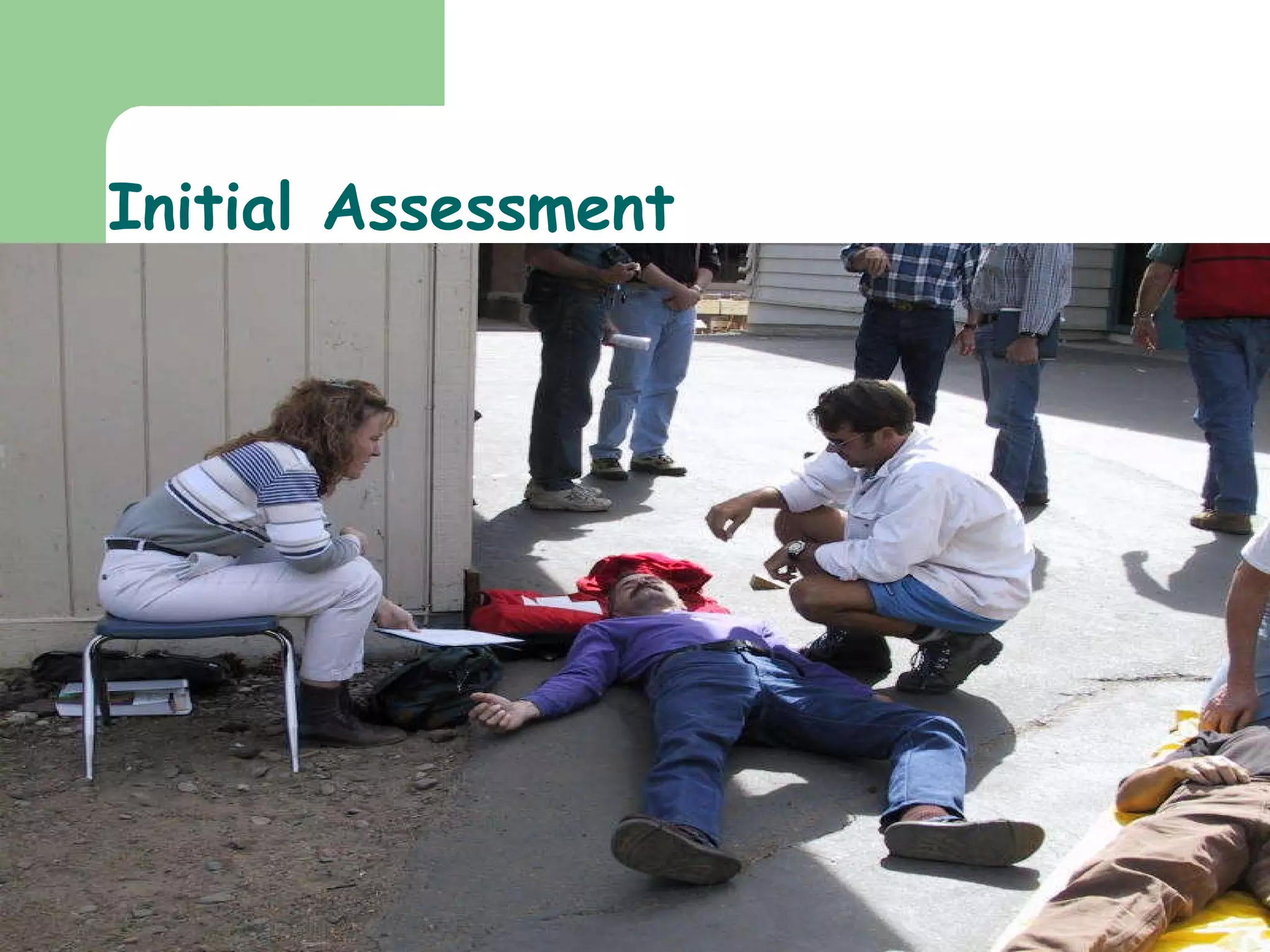
Initial Assessment
Initial Assessment Rapid means of assessing: Pt condition Life threats Priority of care “ Stay & Play” “ Load a& Go” Quickly evaluate the 3 major organ systems Respiratory Circulatory Nervous Identify and treat most life threatening conditions and transport.  AVPU ABC
General Impression Helps form a general sense of severity of pt Based on immediate assessment of scene and C/C Cardiac arrest Medical or Trauma MOI/NOI Age, Sex, Race If life threatening condition is found treat immediately Unresponsive Inadequate breathing Inadequate perfusion Severe bleeding
Life Saving Treatments Airway management + pressure ventilation Supplemental O2 Bleeding control CPR Defibrillation Medical direction ALS intercept Rapid transport
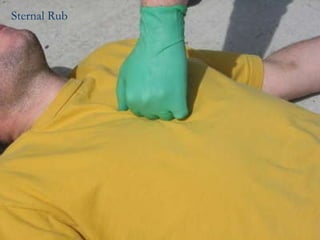
Assessment of Mental Status Mental status is most sensitive indicator of CNS activity Level of consciousness (LOC) = CNS function AVPU A -Alert Pt alert to Person/Place/Time  Alert and Oriented X 3---- AOX3 Pt alert to Person/Place/Time/Event Alert and Oriented X 4---- AOX4 V -Verbal Pt responds to verbal stimuli P -Painful Pt unresponsive to verbal but responds to pain Sternal run, pinch nail beds, etc U -Unresponsive  Pt unresponsive to both verbal and painful stimuli C-Spine control if trauma suspected/unresponsive Log Roll to supine if not
Sternal Rub
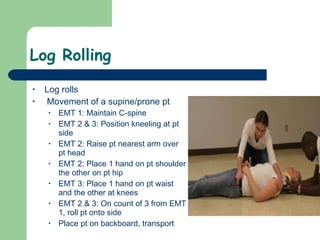
Log Rolling  Log rolls Movement of a supine/prone pt EMT 1: Maintain C-spine EMT 2 & 3: Position kneeling at pt side EMT 2: Raise pt nearest arm over pt head EMT 2: Place 1 hand on pt shoulder the other on pt hip EMT 3: Place 1 hand on pt waist and the other at knees EMT 2 & 3: On count of 3 from EMT 1, roll pt onto side Place pt on backboard, transport
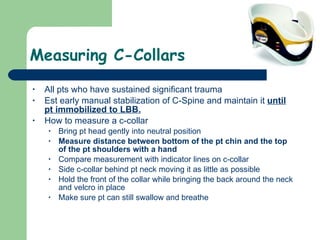
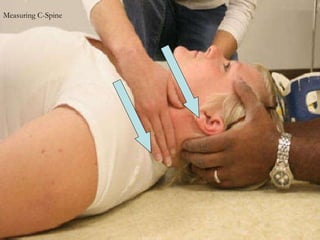
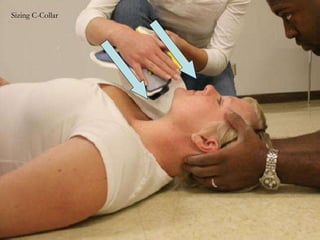
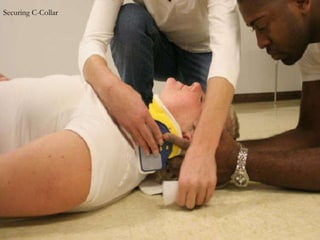
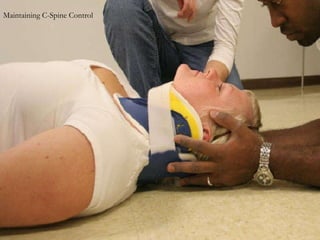
Measuring C-Collars All pts who have sustained significant trauma  Est early manual stabilization of C-Spine and maintain it  until pt immobilized to LBB. How to measure a c-collar Bring pt head gently into neutral position Measure distance between bottom of the pt chin and the top of the pt shoulders with a hand Compare measurement with indicator lines on c-collar Side c-collar behind pt neck moving it as little as possible Hold the front of the collar while bringing the back around the neck and velcro in place Make sure pt can still swallow and breathe
Manual Stabilization by 1 rescuer
Measuring C-Spine
Sizing C-Collar
Securing C-Collar
Maintaining C-Spine Control
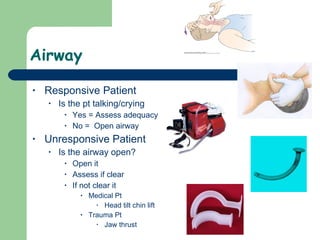
Airway Responsive Patient Is the pt talking/crying Yes = Assess adequacy No =  Open airway  Unresponsive Patient Is the airway open? Open it  Assess if clear If not clear it  Medical Pt Head tilt chin lift Trauma Pt  Jaw thrust
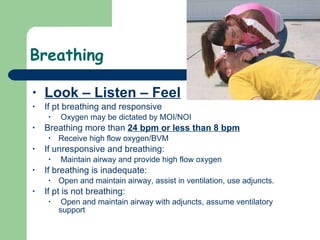
Breathing Look – Listen – Feel If pt breathing and responsive Oxygen may be dictated by MOI/NOI Breathing more than  24 bpm or less than 8 bpm   Receive high flow oxygen/BVM If unresponsive and breathing: Maintain airway and provide high flow oxygen If breathing is inadequate:  Open and maintain airway, assist in ventilation, use adjuncts.  If pt is not breathing: Open and maintain airway with adjuncts, assume ventilatory support
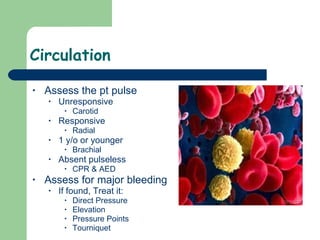
Circulation Assess the pt pulse Unresponsive Carotid Responsive Radial 1 y/o or younger  Brachial Absent pulseless CPR & AED Assess for major bleeding If found, Treat it: Direct Pressure Elevation Pressure Points Tourniquet
Skin Clues to perfusion and oxygenation Components Color Temp Moisture Capillary Refill
Skin Color Locations of assessment Nail beds, oral mucosa, conjunctiva Pediatric Palms of hand/Sole of feet Normal = Pink Abnormal Pale Poor Perfusion Cyanotic Blue/grey= Poor oxygenation/perfusion Flushed Heat or CO exposure Jaundiced  Liver/Gallbladder problems
Temperature  Place back of gloved hand on pt skin Normal = Warm Abnormal Hot Fever/Heat exposure Cool Poor perfusion/Cold exposure Cold Extreme cold exposure Excessively dead… Also check for moisture Diaphoresis or extremely dry
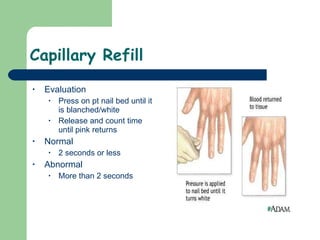
Capillary Refill Evaluation Press on pt nail bed until it is blanched/white Release and count time until pink returns Normal 2 seconds or less Abnormal More than 2 seconds
Identify Priority Patients Consider transport decision Load and Go Stay and Play Priority Patients Poor General Impression Unresponsive (No gag) AMS SOB Shock Complicated childbirth Chest pain with systolic pressure less than 100mmHg Uncontrollable bleeding Severe pain Provide lifesaving treatment throughout initial assessment as needed Transport unstable pt and pt with conditions needing immediate hospital treatment
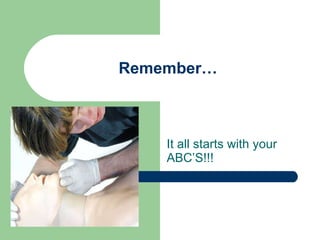
Remember… It all starts with your ABC’S!!!

11)Initial Assessment

  • 1.
  • 2.
    Initial Assessment Rapidmeans of assessing: Pt condition Life threats Priority of care “ Stay & Play” “ Load a& Go” Quickly evaluate the 3 major organ systems Respiratory Circulatory Nervous Identify and treat most life threatening conditions and transport. AVPU ABC
  • 3.
    General Impression Helpsform a general sense of severity of pt Based on immediate assessment of scene and C/C Cardiac arrest Medical or Trauma MOI/NOI Age, Sex, Race If life threatening condition is found treat immediately Unresponsive Inadequate breathing Inadequate perfusion Severe bleeding
  • 4.
    Life Saving TreatmentsAirway management + pressure ventilation Supplemental O2 Bleeding control CPR Defibrillation Medical direction ALS intercept Rapid transport
  • 5.
    Assessment of MentalStatus Mental status is most sensitive indicator of CNS activity Level of consciousness (LOC) = CNS function AVPU A -Alert Pt alert to Person/Place/Time Alert and Oriented X 3---- AOX3 Pt alert to Person/Place/Time/Event Alert and Oriented X 4---- AOX4 V -Verbal Pt responds to verbal stimuli P -Painful Pt unresponsive to verbal but responds to pain Sternal run, pinch nail beds, etc U -Unresponsive Pt unresponsive to both verbal and painful stimuli C-Spine control if trauma suspected/unresponsive Log Roll to supine if not
  • 6.
  • 7.
    Log Rolling Log rolls Movement of a supine/prone pt EMT 1: Maintain C-spine EMT 2 & 3: Position kneeling at pt side EMT 2: Raise pt nearest arm over pt head EMT 2: Place 1 hand on pt shoulder the other on pt hip EMT 3: Place 1 hand on pt waist and the other at knees EMT 2 & 3: On count of 3 from EMT 1, roll pt onto side Place pt on backboard, transport
  • 8.
    Measuring C-Collars Allpts who have sustained significant trauma Est early manual stabilization of C-Spine and maintain it until pt immobilized to LBB. How to measure a c-collar Bring pt head gently into neutral position Measure distance between bottom of the pt chin and the top of the pt shoulders with a hand Compare measurement with indicator lines on c-collar Side c-collar behind pt neck moving it as little as possible Hold the front of the collar while bringing the back around the neck and velcro in place Make sure pt can still swallow and breathe
  • 9.
  • 10.
  • 11.
  • 12.
  • 13.
  • 14.
    Airway Responsive PatientIs the pt talking/crying Yes = Assess adequacy No = Open airway Unresponsive Patient Is the airway open? Open it Assess if clear If not clear it Medical Pt Head tilt chin lift Trauma Pt Jaw thrust
  • 15.
    Breathing Look –Listen – Feel If pt breathing and responsive Oxygen may be dictated by MOI/NOI Breathing more than 24 bpm or less than 8 bpm Receive high flow oxygen/BVM If unresponsive and breathing: Maintain airway and provide high flow oxygen If breathing is inadequate: Open and maintain airway, assist in ventilation, use adjuncts. If pt is not breathing: Open and maintain airway with adjuncts, assume ventilatory support
  • 16.
    Circulation Assess thept pulse Unresponsive Carotid Responsive Radial 1 y/o or younger Brachial Absent pulseless CPR & AED Assess for major bleeding If found, Treat it: Direct Pressure Elevation Pressure Points Tourniquet
  • 17.
    Skin Clues toperfusion and oxygenation Components Color Temp Moisture Capillary Refill
  • 18.
    Skin Color Locationsof assessment Nail beds, oral mucosa, conjunctiva Pediatric Palms of hand/Sole of feet Normal = Pink Abnormal Pale Poor Perfusion Cyanotic Blue/grey= Poor oxygenation/perfusion Flushed Heat or CO exposure Jaundiced Liver/Gallbladder problems
  • 19.
    Temperature Placeback of gloved hand on pt skin Normal = Warm Abnormal Hot Fever/Heat exposure Cool Poor perfusion/Cold exposure Cold Extreme cold exposure Excessively dead… Also check for moisture Diaphoresis or extremely dry
  • 20.
    Capillary Refill EvaluationPress on pt nail bed until it is blanched/white Release and count time until pink returns Normal 2 seconds or less Abnormal More than 2 seconds
  • 21.
    Identify Priority PatientsConsider transport decision Load and Go Stay and Play Priority Patients Poor General Impression Unresponsive (No gag) AMS SOB Shock Complicated childbirth Chest pain with systolic pressure less than 100mmHg Uncontrollable bleeding Severe pain Provide lifesaving treatment throughout initial assessment as needed Transport unstable pt and pt with conditions needing immediate hospital treatment
  • 22.
    Remember… It allstarts with your ABC’S!!!