BASIC AIRWAY PROBLEMS AND
VENTILATORY SUPPORT
Function of the Respiratory System
Slide 13.2
 Oversees gas exchanges (oxygen and carbon
dioxide) between the blood and external
environment
 Exchange of gasses takes place within the lungs in
the alveoli
 Passageways to the lungs purify, warm, and
humidify the incoming air
 Shares responsibility with cardiovascular system
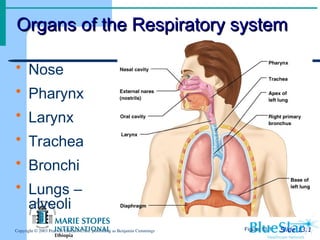
Organs of the Respiratory system
Slide 13.1
Copyright © 2003 Pearson Education, Inc. publishing as Benjamin Cummings
 Nose
 Pharynx
 Larynx
 Trachea
 Bronchi
 Lungs –
alveoli
Figure 13.1
Slide 13.3b
Copyright © 2003 Pearson Education, Inc. publishing as Benjamin Cummings
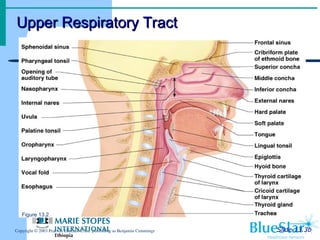
Figure 13.2
Upper Respiratory Tract
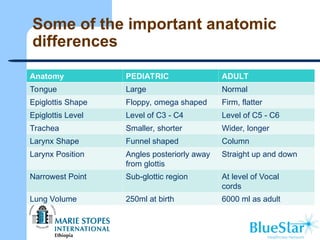
Some of the important anatomic
differences
Anatomy PEDIATRIC ADULT
Tongue Large Normal
Epiglottis Shape Floppy, omega shaped Firm, flatter
Epiglottis Level Level of C3 - C4 Level of C5 - C6
Trachea Smaller, shorter Wider, longer
Larynx Shape Funnel shaped Column
Larynx Position Angles posteriorly away
from glottis
Straight up and down
Narrowest Point Sub-glottic region At level of Vocal
cords
Lung Volume 250ml at birth 6000 ml as adult
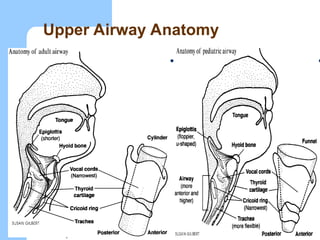
Upper Airway Anatomy
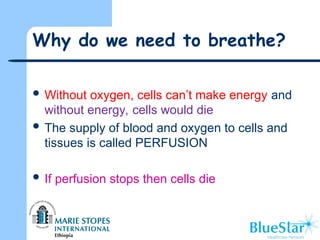
Why do we need to breathe?
 Without oxygen, cells can’t make energy and
without energy, cells would die
 The supply of blood and oxygen to cells and
tissues is called PERFUSION
 If perfusion stops then cells die
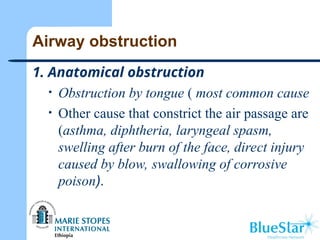
Airway obstruction
1. Anatomical obstruction
• Obstruction by tongue ( most common cause
• Other cause that constrict the air passage are
(asthma, diphtheria, laryngeal spasm,
swelling after burn of the face, direct injury
caused by blow, swallowing of corrosive
poison).
2. Mechanical obstruction
•Partial or complete blockage of the
air way by solid foreign object,
•Accumulation of fluid in the back of
the throat ( mucus, blood and saliva).
•Aspiration ( inhalation of vomits).
The tongue is the most common source of upper
airway obstruction by dropping back &
obstructing the throat.
A victim with partial obstruction from the tongue
will have snoring respirations & in case of
complete obstruction there is no respirations at
all.
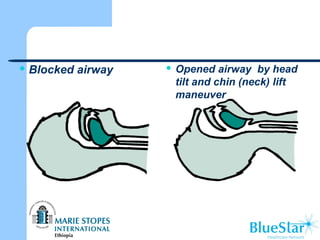
 Blocked airway  Opened airway by head
tilt and chin (neck) lift
maneuver
Management of obstruction by
Tongue
 It can correct using one of several measures that
elevate the base of the tongue away from the
back of the throat.
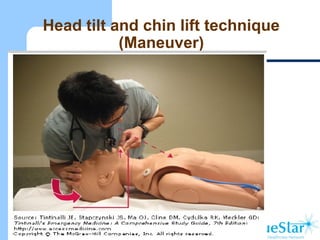
Head tilt- chin lift maneuver -use one hand to
press backward on the victim's forehead (head
tilt); at the same time, place the fingers of your
other hand under the bony part of the victim's
chin & pull the chin forward (chin lift).
Head tilt and chin lift technique
(Maneuver)
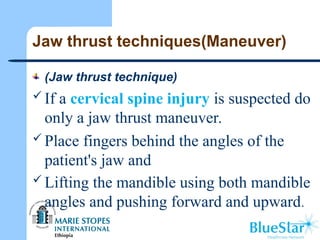
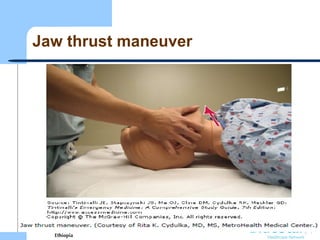
Jaw thrust techniques(Maneuver)
(Jaw thrust technique)
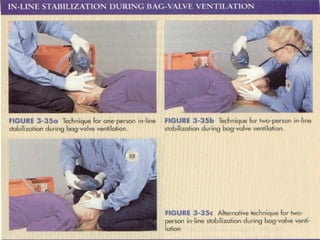
 If a cervical spine injury is suspected do
only a jaw thrust maneuver.
 Place fingers behind the angles of the
patient's jaw and
 Lifting the mandible using both mandible
angles and pushing forward and upward.
Jaw thrust maneuver
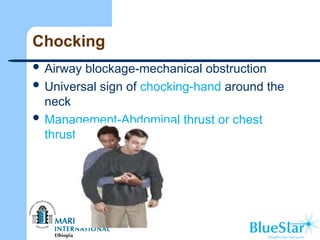
Chocking
 Airway blockage-mechanical obstruction
 Universal sign of chocking-hand around the
neck
 Management-Abdominal thrust or chest
thrust
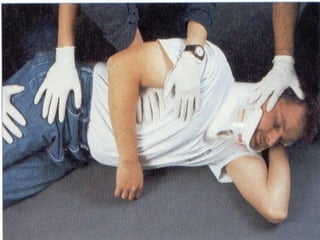
BODY POSITION
 Left lateral positioning of a patient aids
airway maintenance by allowing
fluids/vomitus to drain out
 Only to be used when spinal injury is NOT
suspected
 If spinal injury is suspected, the patient must
be secured solidly to a rigid board so that the
body can be turned to the side as a total unit.
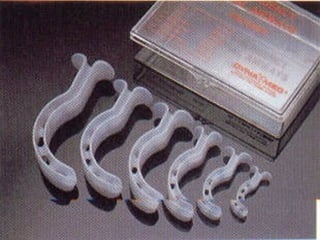
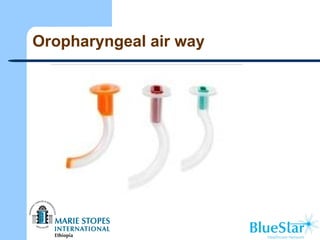
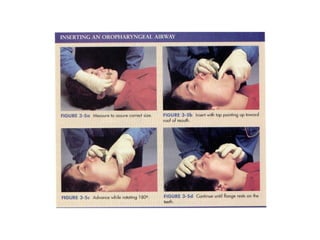
OROPHARYNGEAL AIRWAY (OP
AIRWAY)
 Semicircular, disposable and made of hard
plastic. Guedel and Berman are the frequent
types.
 Guedel is tubular and has a hollow center.
 Berman is solid and has channeled sides.
 Displaces the tongue away from the posterior
pharyngeal wall.
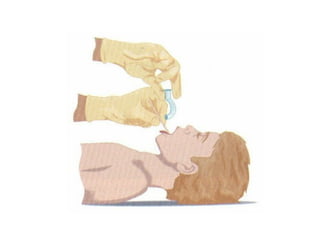
Oropharyngeal air way
OP AIRWAY
Even when in place, it is necessary to
maintain manual positioning of the airway by
a head-tilt, chin-lift or jaw-thrust maneuver.
INDICATIONS
 Adjunct for airway control, determines
presence of gag reflex.
 Unconscious/unresponsive
OP AIRWAY
Sizing
 Hold the airway next to the side of the
patient's face and measuring the length of
the airway from the corner of the mouth to
the tip of the earlobe, or
 Center of the mouth to the angle of the
mandible.
INSERTION
 Choose the appropriate size
 Open the airway
 Insert the airway:
1. Using a tongue blade. Preferred method in
children.
2. Insert upside down and rotate into place.
Not to be used in children.
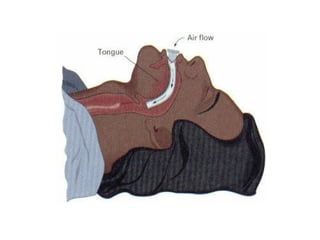
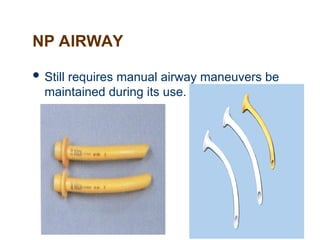
NP AIRWAY
 It may be used in a patient who is breathing
but needs assistance in maintaining a patent
airway.
 The distal tip sits at the posterior pharynx
 While the proximal flare is seated on the
external nares.
NP AIRWAY
 Still requires manual airway maneuvers be
maintained during its use.
NP AIRWAY
 Indications:
1. When OP is not able to be inserted
2. Airway of choice in spontaneously breathing,
but less responsive patient needing airway
control.
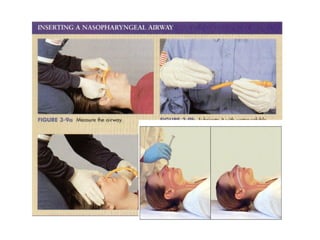
 Sizing
1. Proximal end of the tube at the tip of the
nose and the distal end at the earlobe
NP AIRWAY
 Technique of Insertion
* Needs to be lubricated.
* Proper size
* Advance with bevel toward the septum
* If patient is breathing you should feel
airflow when placed properly.
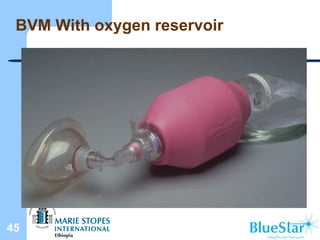
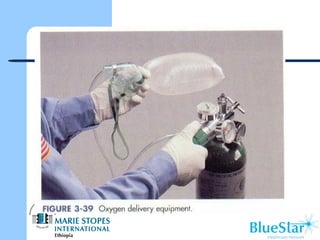
BVM With oxygen reservoir
45
Indications for the BVM
 Respiratory arrest
 Cardiopulmonary arrest
 To assist inadequate breathing
 To hyperventilate in specific situations
Advantages of BVM
 Provides immediate ventilation and
oxygenation
 Sense of compliance and airway resistance
conveyed to operator
 Ideal method of ventilation after intubation
 High oxygen concentrations are possible
 Can be used with spontaneous respirations
47
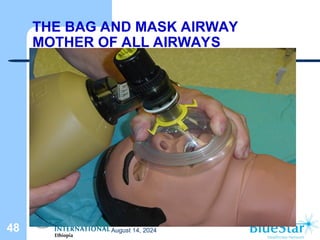
THE BAG AND MASK AIRWAY
MOTHER OF ALL AIRWAYS
August 14, 2024
48
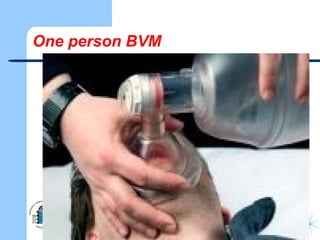
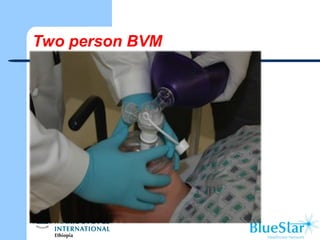
BVM Ventilation
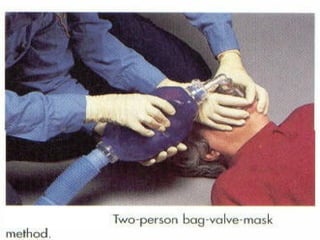
 Requires practice to master its use
 One hand to
– maintain face seal
– position head
– maintain patency
 Other hand ventilates
 NB before use the BVM has to be checked
for functioning.
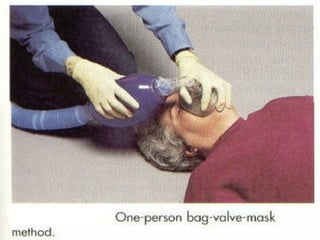
One person BVM
Two person BVM
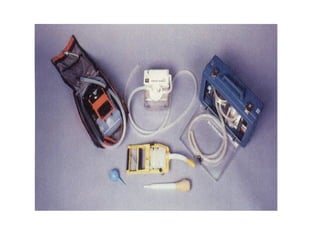
SUCTIONING
 Often a neglected skill.
 Very important skill that must accompany
airway maintenance
 Can be used to open an airway or to
maintain an airway
 All suctioning should be considered “sterile”
SUCTIONING
GENERAL RULES
 Hyperventilate the
patient, or apply
oxygen in a high-
concentration to those
who are
spontaneously
breathing and monitor
ECG
 Use only sterile
devices
 Be gentle
 Lubricate all suction
catheters and tips
 Maximum of 10
seconds of suction
time
 Suction on withdrawal
of catheter, rotating
slowly (ET)
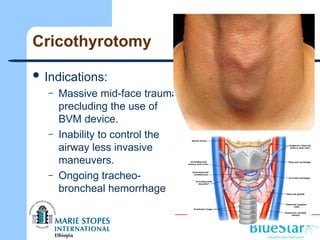
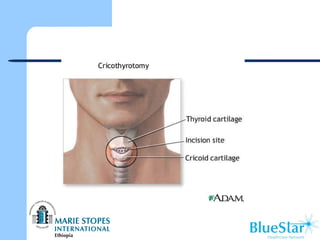
Cricothyrotomy
 Indications:
– Massive mid-face trauma
precluding the use of
BVM device.
– Inability to control the
airway less invasive
maneuvers.
– Ongoing tracheo-
broncheal hemorrhage
Administration of oxygen
 Oxygen is the most important drug that we
can give a patient.
 Without it, the body’s cells die and thus the
patient dies also.
 Room air contains approximately 21%
oxygen
ADMINISTRATION
 Usually stored in seamless, steel cylinders -
color GREEN
 Sizes and Capacity:
* “D” 350 L
* “E” 600 L
* “M” 3,000 L
ADMINISTRATION
1. The cylinder contents gauge shows the amount of oxygen
in the cylinder and is calibrated in pounds of pressure per
square inch (p.s.i.).
 When the tank is almost depleted (a pressure of 500 p.s.i.
is considered to be "on empty"), the needle points to a red
warning that the tank needs to be replaced
ADMINISTRATION
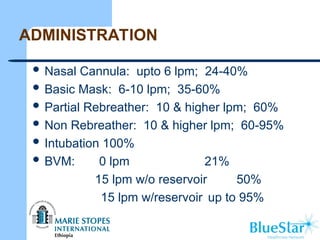
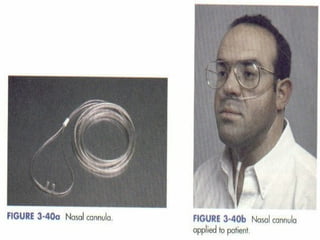
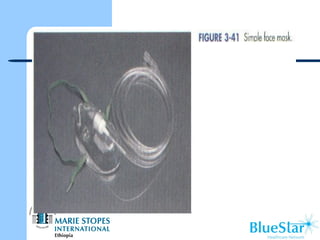
 Nasal Cannula: upto 6 lpm; 24-40%
 Basic Mask: 6-10 lpm; 35-60%
 Partial Rebreather: 10 & higher lpm; 60%
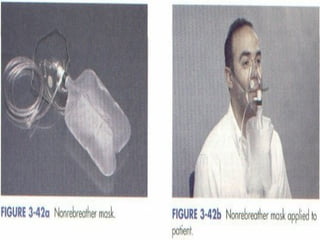
 Non Rebreather: 10 & higher lpm; 60-95%
 Intubation 100%
 BVM: 0 lpm 21%
15 lpm w/o reservoir 50%
15 lpm w/reservoir up to 95%
 Rebreather Mask
A rebreather mask has a soft plastic reservoir bag
attached at the end that saves one-third of a
person’s exhaled air, while the rest of the air gets out
via side ports covered with a one-way valve. This
allows the person to “rebreathe” some of the carbon
dioxide, which acts as a way to stimulate breathing.
 Non - Rebreather Mask
A Non-Rebreather has several one-way valves
in the side ports. This type of mask also has a
reservoir bag attached, but the bag has a one-
way valve that prevents the exhaled carbon
dioxide from getting into the reservoir. This type
of mask does not allow for the rebreathing of
exhaled air because it escapes through the side
ports.
Thank You

Basic Airway ventilatory support.power point

  • 1.
    BASIC AIRWAY PROBLEMSAND VENTILATORY SUPPORT
  • 2.
    Function of theRespiratory System Function of the Respiratory System Slide 13.2  Oversees gas exchanges (oxygen and carbon dioxide) between the blood and external environment  Exchange of gasses takes place within the lungs in the alveoli  Passageways to the lungs purify, warm, and humidify the incoming air  Shares responsibility with cardiovascular system
  • 3.
    Organs of theRespiratory system Organs of the Respiratory system Slide 13.1 Copyright © 2003 Pearson Education, Inc. publishing as Benjamin Cummings  Nose  Pharynx  Larynx  Trachea  Bronchi  Lungs – alveoli Figure 13.1
  • 4.
    Slide 13.3b Copyright ©2003 Pearson Education, Inc. publishing as Benjamin Cummings Figure 13.2 Upper Respiratory Tract Upper Respiratory Tract
  • 5.
    Some of theimportant anatomic differences Anatomy PEDIATRIC ADULT Tongue Large Normal Epiglottis Shape Floppy, omega shaped Firm, flatter Epiglottis Level Level of C3 - C4 Level of C5 - C6 Trachea Smaller, shorter Wider, longer Larynx Shape Funnel shaped Column Larynx Position Angles posteriorly away from glottis Straight up and down Narrowest Point Sub-glottic region At level of Vocal cords Lung Volume 250ml at birth 6000 ml as adult
  • 6.
  • 7.
    Why do weneed to breathe?  Without oxygen, cells can’t make energy and without energy, cells would die  The supply of blood and oxygen to cells and tissues is called PERFUSION  If perfusion stops then cells die
  • 8.
    Airway obstruction 1. Anatomicalobstruction • Obstruction by tongue ( most common cause • Other cause that constrict the air passage are (asthma, diphtheria, laryngeal spasm, swelling after burn of the face, direct injury caused by blow, swallowing of corrosive poison).
  • 9.
    2. Mechanical obstruction •Partialor complete blockage of the air way by solid foreign object, •Accumulation of fluid in the back of the throat ( mucus, blood and saliva). •Aspiration ( inhalation of vomits).
  • 10.
    The tongue isthe most common source of upper airway obstruction by dropping back & obstructing the throat. A victim with partial obstruction from the tongue will have snoring respirations & in case of complete obstruction there is no respirations at all.
  • 11.
     Blocked airway Opened airway by head tilt and chin (neck) lift maneuver
  • 12.
    Management of obstructionby Tongue  It can correct using one of several measures that elevate the base of the tongue away from the back of the throat. Head tilt- chin lift maneuver -use one hand to press backward on the victim's forehead (head tilt); at the same time, place the fingers of your other hand under the bony part of the victim's chin & pull the chin forward (chin lift).
  • 13.
    Head tilt andchin lift technique (Maneuver)
  • 14.
    Jaw thrust techniques(Maneuver) (Jawthrust technique)  If a cervical spine injury is suspected do only a jaw thrust maneuver.  Place fingers behind the angles of the patient's jaw and  Lifting the mandible using both mandible angles and pushing forward and upward.
  • 15.
  • 16.
    Chocking  Airway blockage-mechanicalobstruction  Universal sign of chocking-hand around the neck  Management-Abdominal thrust or chest thrust
  • 17.
    BODY POSITION  Leftlateral positioning of a patient aids airway maintenance by allowing fluids/vomitus to drain out  Only to be used when spinal injury is NOT suspected  If spinal injury is suspected, the patient must be secured solidly to a rigid board so that the body can be turned to the side as a total unit.
  • 19.
    OROPHARYNGEAL AIRWAY (OP AIRWAY) Semicircular, disposable and made of hard plastic. Guedel and Berman are the frequent types.  Guedel is tubular and has a hollow center.  Berman is solid and has channeled sides.  Displaces the tongue away from the posterior pharyngeal wall.
  • 21.
  • 22.
    OP AIRWAY Even whenin place, it is necessary to maintain manual positioning of the airway by a head-tilt, chin-lift or jaw-thrust maneuver. INDICATIONS  Adjunct for airway control, determines presence of gag reflex.  Unconscious/unresponsive
  • 23.
    OP AIRWAY Sizing  Holdthe airway next to the side of the patient's face and measuring the length of the airway from the corner of the mouth to the tip of the earlobe, or  Center of the mouth to the angle of the mandible.
  • 24.
    INSERTION  Choose theappropriate size  Open the airway  Insert the airway: 1. Using a tongue blade. Preferred method in children. 2. Insert upside down and rotate into place. Not to be used in children.
  • 28.
    NP AIRWAY  Itmay be used in a patient who is breathing but needs assistance in maintaining a patent airway.  The distal tip sits at the posterior pharynx  While the proximal flare is seated on the external nares.
  • 29.
    NP AIRWAY  Stillrequires manual airway maneuvers be maintained during its use.
  • 30.
    NP AIRWAY  Indications: 1.When OP is not able to be inserted 2. Airway of choice in spontaneously breathing, but less responsive patient needing airway control.  Sizing 1. Proximal end of the tube at the tip of the nose and the distal end at the earlobe
  • 31.
    NP AIRWAY  Techniqueof Insertion * Needs to be lubricated. * Proper size * Advance with bevel toward the septum * If patient is breathing you should feel airflow when placed properly.
  • 33.
    BVM With oxygenreservoir 45
  • 34.
    Indications for theBVM  Respiratory arrest  Cardiopulmonary arrest  To assist inadequate breathing  To hyperventilate in specific situations
  • 35.
    Advantages of BVM Provides immediate ventilation and oxygenation  Sense of compliance and airway resistance conveyed to operator  Ideal method of ventilation after intubation  High oxygen concentrations are possible  Can be used with spontaneous respirations 47
  • 36.
    THE BAG ANDMASK AIRWAY MOTHER OF ALL AIRWAYS August 14, 2024 48
  • 37.
    BVM Ventilation  Requirespractice to master its use  One hand to – maintain face seal – position head – maintain patency  Other hand ventilates  NB before use the BVM has to be checked for functioning.
  • 38.
  • 39.
  • 40.
    SUCTIONING  Often aneglected skill.  Very important skill that must accompany airway maintenance  Can be used to open an airway or to maintain an airway  All suctioning should be considered “sterile”
  • 41.
    SUCTIONING GENERAL RULES  Hyperventilatethe patient, or apply oxygen in a high- concentration to those who are spontaneously breathing and monitor ECG  Use only sterile devices  Be gentle  Lubricate all suction catheters and tips  Maximum of 10 seconds of suction time  Suction on withdrawal of catheter, rotating slowly (ET)
  • 43.
    Cricothyrotomy  Indications: – Massivemid-face trauma precluding the use of BVM device. – Inability to control the airway less invasive maneuvers. – Ongoing tracheo- broncheal hemorrhage
  • 45.
    Administration of oxygen Oxygen is the most important drug that we can give a patient.  Without it, the body’s cells die and thus the patient dies also.  Room air contains approximately 21% oxygen
  • 46.
    ADMINISTRATION  Usually storedin seamless, steel cylinders - color GREEN  Sizes and Capacity: * “D” 350 L * “E” 600 L * “M” 3,000 L
  • 47.
    ADMINISTRATION 1. The cylindercontents gauge shows the amount of oxygen in the cylinder and is calibrated in pounds of pressure per square inch (p.s.i.).  When the tank is almost depleted (a pressure of 500 p.s.i. is considered to be "on empty"), the needle points to a red warning that the tank needs to be replaced
  • 48.
    ADMINISTRATION  Nasal Cannula:upto 6 lpm; 24-40%  Basic Mask: 6-10 lpm; 35-60%  Partial Rebreather: 10 & higher lpm; 60%  Non Rebreather: 10 & higher lpm; 60-95%  Intubation 100%  BVM: 0 lpm 21% 15 lpm w/o reservoir 50% 15 lpm w/reservoir up to 95%
  • 49.
     Rebreather Mask Arebreather mask has a soft plastic reservoir bag attached at the end that saves one-third of a person’s exhaled air, while the rest of the air gets out via side ports covered with a one-way valve. This allows the person to “rebreathe” some of the carbon dioxide, which acts as a way to stimulate breathing.
  • 50.
     Non -Rebreather Mask A Non-Rebreather has several one-way valves in the side ports. This type of mask also has a reservoir bag attached, but the bag has a one- way valve that prevents the exhaled carbon dioxide from getting into the reservoir. This type of mask does not allow for the rebreathing of exhaled air because it escapes through the side ports.
  • 58.