This five-day course is designed to introduce the participant to principles of optical communication
along with the application of optical fiber in optical fibre access networks and optical transport/trans-
mission networks with details on different options available to build them and factors to consider when
building them.
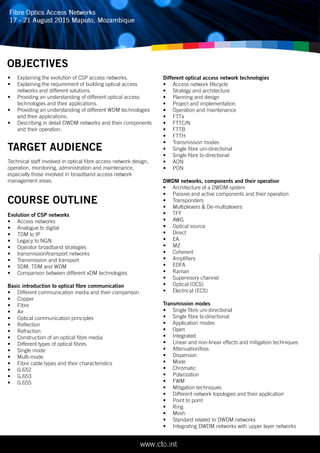
OBJECTIVES
•	 Explaining the evolution of CSP access networks.
•	 Explaining the requirement of building optical access
networks and different solutions.
•	 Providing an understanding of different optical access
technologies and their applications.
•	 Providing an understanding of different WDM technologies
and their applications.
•	 Describing in detail DWDM networks and their components
and their operation.
Technical staff involved in optical fibre access network design,
operation, monitoring, administration and maintenance,
especially those involved in broadband access network
management areas.
Evolution of CSP networks
•	 Access networks
•	 Analogue to digital
•	 TDM to IP
•	 Legacy to NGN
•	 Operator broadband strategies
•	 transmission/transport networks
•	 Transmission and transport
•	 SDM, TDM and WDM
•	 Comparison between different xDM technologies
Basic introduction to optical fibre communication
•	 Different communication media and their comparison
•	 Copper
•	 Fibre
•	 Air
•	 Optical communication principles
•	 Reflection
•	 Refraction
•	 Construction of an optical fibre media
•	 Different types of optical fibres
•	 Single mode
•	 Multi-mode
•	 Fibre cable types and their characteristics
•	 G.652
•	 G.653
•	 G.655
TARGET AUDIENCE
COURSE OUTLINE
Different optical access network technologies
•	 Access network lifecycle
•	 Strategy and architecture
•	 Planning and design
•	 Project and implementation
•	 Operation and maintenance
•	 FTTx
•	 FTTC/N
•	 FTTB
•	 FTTH
•	 Transmission modes
•	 Single fibre uni-directional
•	 Single fibre bi-directional
•	 AON
•	 PON
DWDM networks, components and their operation
•	 Architecture of a DWDM system
•	 Passive and active components and their operation
•	 Transponders
•	 Multiplexers & De-multiplexers
•	 TFF
•	 AWG
•	 Optical source
•	 Direct
•	 EA
•	 MZ
•	 Coherent
•	 Amplifiers
•	 EDFA
•	 Raman
•	 Supervisory channel
•	 Optical (OCS)
•	 Electrical (ECS)
Transmission modes
•	 Single fibre uni-directional
•	 Single fibre bi-directional
•	 Application modes
•	 Open
•	 Integrated
•	 Linear and non-linear effects and mitigation techniques
•	 Attenuation/loss
•	 Dispersion
•	 Mode
•	 Chromatic
•	 Polarization
•	 FWM
•	 Mitigation techniques
•	 Different network topologies and their application
•	 Point to point
•	 Ring
•	 Mesh
•	 Standard related to DWDM networks
•	 Integrating DWDM networks with upper layer networks
Anuradha Udunuwara
Anuradha has a BSc.Eng (Hons) in Electrical & Electronic
Engineering from the University of Peradeniya, Sri Lanka and
has gained the Chartered Engineer status from the Institution
of Engineers, Sri Lanka in 2008. Anuradha also holds many
professional certifications including MEF Carrier Ethernet Certified
Professional (MEF-CECP) and ITILv3 Foundation. Since joining
Sri Lanka Telecom as an engineer in 2003, he has served in
various capacities as engineer/data services maintenance,
engineer/data services networks and engineer/metro ethernet and
FTTx network planning. currently he is the engineer/sales-region
I where he is responsible for consulting, advising, architecting,
designing and planning technical solutions for small and medium
enterprise/business/industry (SME/B/I) customers. In addition,
he is also involved in xWDM/OTN backbone networks, FTTH,
carrier ethernet network, metro ethernet network and WiFi
implementations. He is a guest lecturer at the department of
electrical and electronic engineering, faculty of engineering,
University of Peradeniya, Sri Lanka.
COURSE TRAINERS
Who we are
The CTO is the oldest and largest Commonwealth organisation engaged in multilateral
collaboration in the field of ICTs. Using in-house and partner experience, it supports
members in integrating ICTs to deliver effective development interventions that
emancipate, enrich, equalise and empower people within the Commonwealth and
beyond.
What we do
The work of the CTO goes back to the Organisation’s creation in 1901 as the Pacific
Cable Board. Since then, the CTO has been at the centre of continuous and extensive
international communications development funding, cooperation and assistance
programmes. Since 1985, the Organisation has delivered to its members in Europe, the
Caribbean, the Americas, Africa and Asia-Pacific over 3,760 bilateral and multilateral
telecommunications and ICT capacity building projects in the form of policy, operational
and regulatory training, and expert assistance. Moreover, the CTO has been at the
forefront of generating cutting-edge knowledge through its research and consultancy
services, as well as sharing ideas through its conferences and workshops held around
the world. This long history as a development facilitator provides the Organisation with a
unique and growing delivery capacity for ICT4D programmes and services.
Supporting ICT4D in the Commonwealth
The CTO seeks to work collaboratively with other Commonwealth bodies to build
mutually beneficial synergies in the interests of its members. The CTO has a key role
to play in leading ICT4D initiatives across the Commonwealth, and it is committed to
working together with other Commonwealth entities to reduce overlap and replication
of activities. The CTO welcomes the opportunity to offer secretariat support to any
Commonwealth ICT initiatives that reflect the needs and interests of its members.

8000 - Fibre Optic Access Network

  • 1.
    This five-day courseis designed to introduce the participant to principles of optical communication along with the application of optical fiber in optical fibre access networks and optical transport/trans- mission networks with details on different options available to build them and factors to consider when building them.
  • 2.
    OBJECTIVES • Explaining theevolution of CSP access networks. • Explaining the requirement of building optical access networks and different solutions. • Providing an understanding of different optical access technologies and their applications. • Providing an understanding of different WDM technologies and their applications. • Describing in detail DWDM networks and their components and their operation. Technical staff involved in optical fibre access network design, operation, monitoring, administration and maintenance, especially those involved in broadband access network management areas. Evolution of CSP networks • Access networks • Analogue to digital • TDM to IP • Legacy to NGN • Operator broadband strategies • transmission/transport networks • Transmission and transport • SDM, TDM and WDM • Comparison between different xDM technologies Basic introduction to optical fibre communication • Different communication media and their comparison • Copper • Fibre • Air • Optical communication principles • Reflection • Refraction • Construction of an optical fibre media • Different types of optical fibres • Single mode • Multi-mode • Fibre cable types and their characteristics • G.652 • G.653 • G.655 TARGET AUDIENCE COURSE OUTLINE Different optical access network technologies • Access network lifecycle • Strategy and architecture • Planning and design • Project and implementation • Operation and maintenance • FTTx • FTTC/N • FTTB • FTTH • Transmission modes • Single fibre uni-directional • Single fibre bi-directional • AON • PON DWDM networks, components and their operation • Architecture of a DWDM system • Passive and active components and their operation • Transponders • Multiplexers & De-multiplexers • TFF • AWG • Optical source • Direct • EA • MZ • Coherent • Amplifiers • EDFA • Raman • Supervisory channel • Optical (OCS) • Electrical (ECS) Transmission modes • Single fibre uni-directional • Single fibre bi-directional • Application modes • Open • Integrated • Linear and non-linear effects and mitigation techniques • Attenuation/loss • Dispersion • Mode • Chromatic • Polarization • FWM • Mitigation techniques • Different network topologies and their application • Point to point • Ring • Mesh • Standard related to DWDM networks • Integrating DWDM networks with upper layer networks
  • 3.
    Anuradha Udunuwara Anuradha hasa BSc.Eng (Hons) in Electrical & Electronic Engineering from the University of Peradeniya, Sri Lanka and has gained the Chartered Engineer status from the Institution of Engineers, Sri Lanka in 2008. Anuradha also holds many professional certifications including MEF Carrier Ethernet Certified Professional (MEF-CECP) and ITILv3 Foundation. Since joining Sri Lanka Telecom as an engineer in 2003, he has served in various capacities as engineer/data services maintenance, engineer/data services networks and engineer/metro ethernet and FTTx network planning. currently he is the engineer/sales-region I where he is responsible for consulting, advising, architecting, designing and planning technical solutions for small and medium enterprise/business/industry (SME/B/I) customers. In addition, he is also involved in xWDM/OTN backbone networks, FTTH, carrier ethernet network, metro ethernet network and WiFi implementations. He is a guest lecturer at the department of electrical and electronic engineering, faculty of engineering, University of Peradeniya, Sri Lanka. COURSE TRAINERS Who we are The CTO is the oldest and largest Commonwealth organisation engaged in multilateral collaboration in the field of ICTs. Using in-house and partner experience, it supports members in integrating ICTs to deliver effective development interventions that emancipate, enrich, equalise and empower people within the Commonwealth and beyond. What we do The work of the CTO goes back to the Organisation’s creation in 1901 as the Pacific Cable Board. Since then, the CTO has been at the centre of continuous and extensive international communications development funding, cooperation and assistance programmes. Since 1985, the Organisation has delivered to its members in Europe, the Caribbean, the Americas, Africa and Asia-Pacific over 3,760 bilateral and multilateral telecommunications and ICT capacity building projects in the form of policy, operational and regulatory training, and expert assistance. Moreover, the CTO has been at the forefront of generating cutting-edge knowledge through its research and consultancy services, as well as sharing ideas through its conferences and workshops held around the world. This long history as a development facilitator provides the Organisation with a unique and growing delivery capacity for ICT4D programmes and services. Supporting ICT4D in the Commonwealth The CTO seeks to work collaboratively with other Commonwealth bodies to build mutually beneficial synergies in the interests of its members. The CTO has a key role to play in leading ICT4D initiatives across the Commonwealth, and it is committed to working together with other Commonwealth entities to reduce overlap and replication of activities. The CTO welcomes the opportunity to offer secretariat support to any Commonwealth ICT initiatives that reflect the needs and interests of its members.