CARRIER ETHERNET
FEBRUARY 2013
By Eng. Anuradha Udunuwara,
BSc.Eng(Hons), CEng, MIE(SL), MEF-CECP, MBCS, ITILv3 Foundation, MIEEE, MIEEE-CS, MIEE, MIET, MCS(SL), MSLAAS
Agenda
 What is Ethernet?
 What is Carrier Ethernet?
 Why Carrier Ethernet?
 Standards
 Technology neutral
 Technology specific
(c) Anuradha Udunuwara
WHAT IS ETHERNET?
What Do We Mean By “Ethernet?”
 Ethernet as an interface
 Ethernet as a point-to-point link
 IEEE 802.3 view
 Ethernet as a Packet Switched Network (PSN) infrastructure (transport)
 IEEE 802.1 (bridging) view
 ITU-T SG15 / SG13 managed Ethernet network view
 Ethernet as a protocol
 Ethernet as a service
 MEF view – user-to-user transfer of 802.3 frames over any transport layer
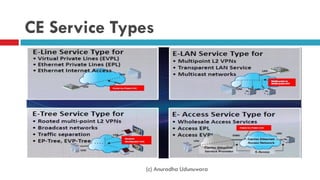
 E-Line, E-LAN, E-Tree, E-Access
(c) Anuradha Udunuwara
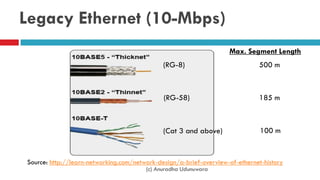
Legacy Ethernet (10-Mbps)
(c) Anuradha Udunuwara
Source: http://learn-networking.com/network-design/a-brief-overview-of-ethernet-history
(RG-58)
(RG-8)
(Cat 3 and above)
500 m
185 m
100 m
Max. Segment Length
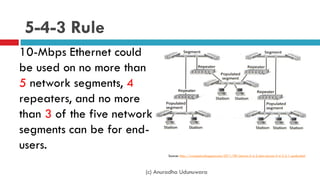
5-4-3 Rule
10-Mbps Ethernet could
be used on no more than
5 network segments, 4
repeaters, and no more
than 3 of the five network
segments can be for end-
users.
(c) Anuradha Udunuwara
Source: http://xvongola.blogspot.com/2011/09/aturan-5-4-3-dan-aturan-5-4-3-2-1-pada.html
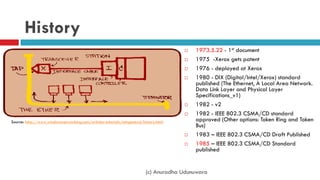
History
 1973.5.22 - 1st document
 1975 -Xerox gets patent
 1976 - deployed at Xerox
 1980 - DIX (Digital/Intel/Xerox) standard
published (The Ethernet, A Local Area Network.
Data Link Layer and Physical Layer
Specifications_v1)
 1982 - v2
 1982 - IEEE 802.3 CSMA/CD standard
approved (Other options: Token Ring and Token
Bus)
 1983 – IEEE 802.3 CSMA/CD Draft Published
 1985 – IEEE 802.3 CSMA/CD Standard
published
(c) Anuradha Udunuwara
Source: http://www.windowsnetworking.com/articles-tutorials/netgeneral/history.html
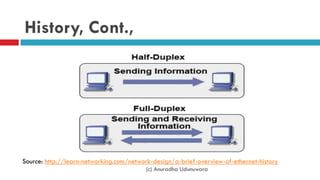
History, Cont.,
(c) Anuradha Udunuwara
Source: http://learn-networking.com/network-design/a-brief-overview-of-ethernet-history
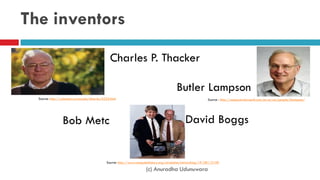
The inventors
(c) Anuradha Udunuwara
Charles P. Thacker
Butler Lampson
Source : http://research.microsoft.com/en-us/um/people/blampson/Source: http://calendar.cs.cmu.edu/dlseries/6235.html
Source: http://www.computerhistory.org/revolution/networking/19/381/2158
Bob Metcalf David Boggs
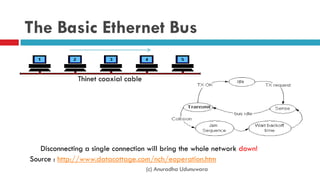
The Basic Ethernet Bus
(c) Anuradha Udunuwara
Thinet coaxial cable
Disconnecting a single connection will bring the whole network down!
Source : http://www.datacottage.com/nch/eoperation.htm
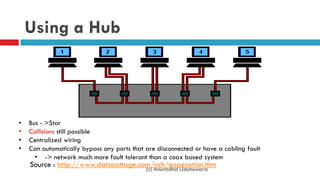
Using a Hub
(c) Anuradha Udunuwara
• Bus - >Star
• Collisions still possible
• Centralized wiring
• Can automatically bypass any ports that are disconnected or have a cabling fault
• -> network much more fault tolerant than a coax based system
Source : http://www.datacottage.com/nch/eoperation.htm
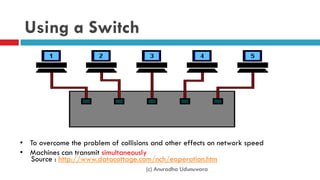
Using a Switch
(c) Anuradha Udunuwara
• To overcome the problem of collisions and other effects on network speed
• Machines can transmit simultaneously
Source : http://www.datacottage.com/nch/eoperation.htm
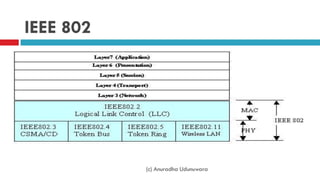
IEEE 802
(c) Anuradha Udunuwara
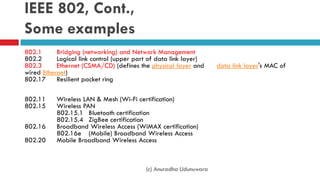
IEEE 802, Cont.,
Some examples
802.1 Bridging (networking) and Network Management
802.2 Logical link control (upper part of data link layer)
802.3 Ethernet (CSMA/CD) (defines the physical layer and data link layer's MAC of
wired Ethernet)
802.17 Resilient packet ring
802.11 Wireless LAN & Mesh (Wi-Fi certification)
802.15 Wireless PAN
802.15.1 Bluetooth certification
802.15.4 ZigBee certification
802.16 Broadband Wireless Access (WiMAX certification)
802.16e (Mobile) Broadband Wireless Access
802.20 Mobile Broadband Wireless Access
(c) Anuradha Udunuwara
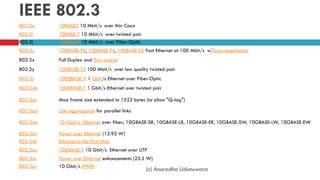
IEEE 802.3
802.3a 10BASE2 10 Mbit/s over thin Coax
802.3i 10BASE-T 10 Mbit/s over twisted pair
802.3j 10BASE-F 10 Mbit/s over Fiber-Optic
802.3u 100BASE-TX, 100BASE-T4, 100BASE-FX Fast Ethernet at 100 Mbit/s w/auto-negotiation
802.3x Full Duplex and flow control
802.3y 100BASE-T2 100 Mbit/s over low quality twisted pair
802.3z 1000BASE-X 1 Gbit/s Ethernet over Fiber-Optic
802.3ab 1000BASE-T 1 Gbit/s Ethernet over twisted pair
802.3ac Max frame size extended to 1522 bytes (to allow "Q-tag")
802.3ad Link aggregation for parallel links
802.3ae 10 Gbit/s Ethernet over fiber; 10GBASE-SR, 10GBASE-LR, 10GBASE-ER, 10GBASE-SW, 10GBASE-LW, 10GBASE-EW
802.3af Power over Ethernet (12.95 W)
802.3ah Ethernet in the First Mile
802.3an 10GBASE-T 10 Gbit/s Ethernet over UTP
802.3at Power over Ethernet enhancements (25.5 W)
802.3av 10 Gbit/s EPON
(c) Anuradha Udunuwara
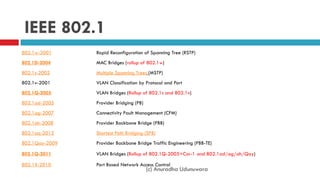
IEEE 802.1
(c) Anuradha Udunuwara
802.1w-2001 Rapid Reconfiguration of Spanning Tree (RSTP)
802.1D-2004 MAC Bridges (rollup of 802.1w)
802.1s-2002 Multiple Spanning Trees (MSTP)
802.1v-2001 VLAN Classification by Protocol and Port
802.1Q-2005 VLAN Bridges (Rollup of 802.1s and 802.1v)
802.1ad-2005 Provider Bridging (PB)
802.1ag-2007 Connectivity Fault Management (CFM)
802.1ah-2008 Provider Backbone Bridge (PBB)
802.1aq-2012 Shortest Path Bridging (SPB)
802.1Qay-2009 Provider Backbone Bridge Traffic Engineering (PBB-TE)
802.1Q-2011 VLAN Bridges (Rollup of 802.1Q-2005+Cor-1 and 802.1ad/ag/ah/Qay)
802.1X-2010 Port Based Network Access Control
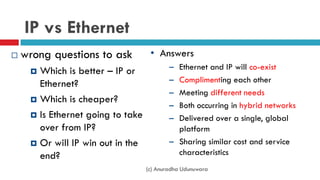
IP vs Ethernet
 wrong questions to ask
 Which is better – IP or
Ethernet?
 Which is cheaper?
 Is Ethernet going to take
over from IP?
 Or will IP win out in the
end?
• Answers
– Ethernet and IP will co-exist
– Complimenting each other
– Meeting different needs
– Both occurring in hybrid networks
– Delivered over a single, global
platform
– Sharing similar cost and service
characteristics
(c) Anuradha Udunuwara
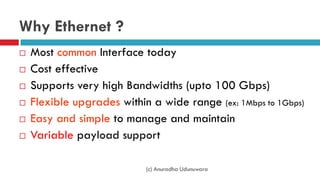
Why Ethernet ?
 Most common Interface today
 Cost effective
 Supports very high Bandwidths (upto 100 Gbps)
 Flexible upgrades within a wide range (ex: 1Mbps to 1Gbps)
 Easy and simple to manage and maintain
 Variable payload support
(c) Anuradha Udunuwara
WHAT IS CARRIER ETHERNET?
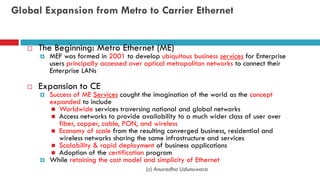
Global Expansion from Metro to Carrier Ethernet
 The Beginning: Metro Ethernet (ME)
 MEF was formed in 2001 to develop ubiquitous business services for Enterprise
users principally accessed over optical metropolitan networks to connect their
Enterprise LANs
 Expansion to CE
 Success of ME Services caught the imagination of the world as the concept
expanded to include
 Worldwide services traversing national and global networks
 Access networks to provide availability to a much wider class of user over
fiber, copper, cable, PON, and wireless
 Economy of scale from the resulting converged business, residential and
wireless networks sharing the same infrastructure and services
 Scalability & rapid deployment of business applications
 Adoption of the certification program
 While retaining the cost model and simplicity of Ethernet
(c) Anuradha Udunuwara
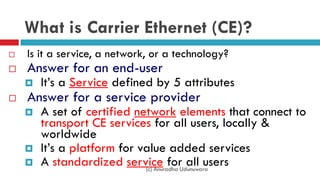
What is Carrier Ethernet (CE)?
 Is it a service, a network, or a technology?
 Answer for an end-user
 It’s a Service defined by 5 attributes
 Answer for a service provider
 A set of certified network elements that connect to
transport CE services for all users, locally &
worldwide
 It’s a platform for value added services
 A standardized service for all users(c) Anuradha Udunuwara
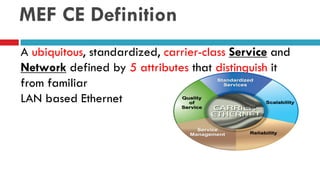
MEF CE Definition
A ubiquitous, standardized, carrier-class Service and
Network defined by 5 attributes that distinguish it
from familiar
LAN based Ethernet
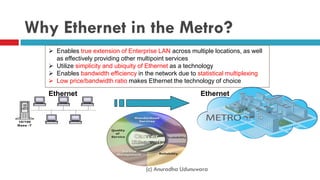
Why Ethernet in the Metro?
10/100
Base -T
 Enables true extension of Enterprise LAN across multiple locations, as well
as effectively providing other multipoint services
 Utilize simplicity and ubiquity of Ethernet as a technology
 Enables bandwidth efficiency in the network due to statistical multiplexing
 Low price/bandwidth ratio makes Ethernet the technology of choice
Ethernet Ethernet
(c) Anuradha Udunuwara
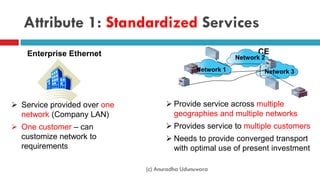
Attribute 1: Standardized Services
CEEnterprise Ethernet
 Provide service across multiple
geographies and multiple networks
 Provides service to multiple customers
 Needs to provide converged transport
with optimal use of present investment
 Service provided over one
network (Company LAN)
 One customer – can
customize network to
requirements
Network 1
Network 2
Network 3
(c) Anuradha Udunuwara
1000
Nodes
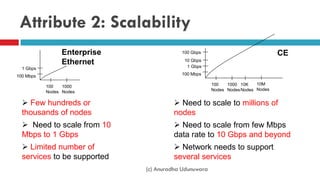
Attribute 2: Scalability
 Need to scale to millions of
nodes
 Need to scale from few Mbps
data rate to 10 Gbps and beyond
 Network needs to support
several services
 Few hundreds or
thousands of nodes
 Need to scale from 10
Mbps to 1 Gbps
 Limited number of
services to be supported
CEEnterprise
Ethernet
100
Nodes
100 Mbps
1 Gbps
100
Nodes
100 Mbps
1000
Nodes
1 Gbps
10 Gbps
10K
Nodes
100 Gbps
10M
Nodes
(c) Anuradha Udunuwara
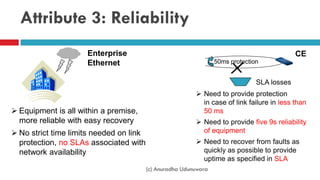
Attribute 3: Reliability
 Need to provide protection
in case of link failure in less than
50 ms
 Need to provide five 9s reliability
of equipment
 Need to recover from faults as
quickly as possible to provide
uptime as specified in SLA
 Equipment is all within a premise,
more reliable with easy recovery
 No strict time limits needed on link
protection, no SLAs associated with
network availability
CEEnterprise
Ethernet $$$$ $$
SLA losses
50ms protection
(c) Anuradha Udunuwara
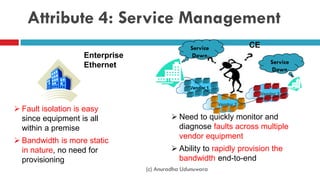
Attribute 4: Service Management
 Need to quickly monitor and
diagnose faults across multiple
vendor equipment
 Ability to rapidly provision the
bandwidth end-to-end
 Fault isolation is easy
since equipment is all
within a premise
 Bandwidth is more static
in nature, no need for
provisioning
CE
Enterprise
Ethernet
Service
Down
Vendor 1
Vendor 2
Vendor 3
Service
Down
(c) Anuradha Udunuwara
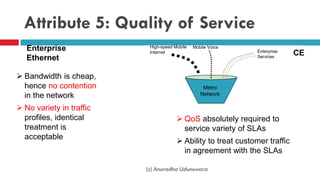
Attribute 5: Quality of Service
 Bandwidth is cheap,
hence no contention
in the network
 No variety in traffic
profiles, identical
treatment is
acceptable
Enterprise
Ethernet
High-speed
Mobile Internet
Mobile Voice
Enterprise
Services
Leakage of SLA-based
traffic due to congestion
Metro
Network
High-speed Mobile
Internet
Mobile Voice
Enterprise
Services
Metro
Network
 QoS absolutely required to
service variety of SLAs
 Ability to treat customer traffic
in agreement with the SLAs
CE
(c) Anuradha Udunuwara
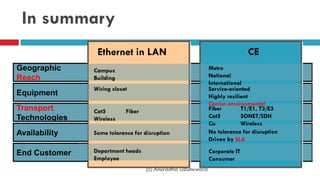
Equipment
Transport
Technologies
Availability
End Customer
Geographic
Reach
In summary
Ethernet in LAN CE
Department heads
Employee
Some tolerance for disruption
Cat5 Fiber
Wireless
Campus
Building
Wiring closet
Metro
National
International
Service-oriented
Highly resilient
Carrier environmental
Fiber T1/E1, T3/E3
Cat5 SONET/SDH
Cu Wireless
No tolerance for disruption
Driven by SLA
Corporate IT
Consumer
(c) Anuradha Udunuwara
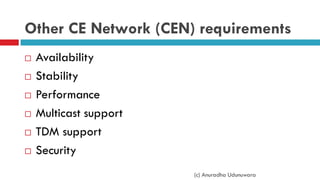
Other CE Network (CEN) requirements
 Availability
 Stability
 Performance
 Multicast support
 TDM support
 Security
(c) Anuradha Udunuwara
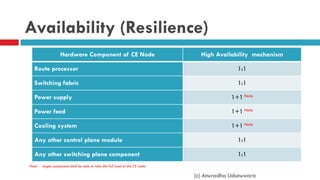
Availability (Resilience)
(c) Anuradha Udunuwara
Hardware Component of CE Node High Availability mechanism
Route processor 1:1
Switching fabric 1:1
Power supply 1+1 Note
Power feed 1+1 Note
Cooling system 1+1 Note
Any other control plane module 1:1
Any other switching plane component 1:1
Note : single component shall be able to take the full load of the CE node
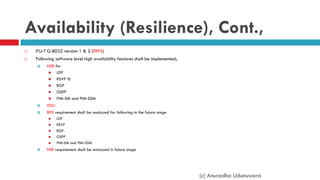
Availability (Resilience), Cont.,
 ITU-T G.8032 version 1 & 2 (ERPS)
 Following software level high availability features shall be implemented;
 NSR for
 LDP
 RSVP TE
 BGP
 OSPF
 PIM-SM and PIM-SSM
 ISSU
 BFD requirement shall be analyzed for following in the future stage
 LDP
 RSVP
 BGP
 OSPF
 PIM-SM and PIM-SSM
 NSF requirement shall be analyzed in future stage
(c) Anuradha Udunuwara
Stability
 Stability of the CEN and its NE are very
important. This should ensure consistent
performance of the NE
 MTBF and MTTR values shall meet
99.999% node availability
requirements
(c) Anuradha Udunuwara
Performance
 Scalability of the CEN determine by providing
sufficient bandwidth to be able to guarantee a
committed level of performance for the full service
portfolio of end users.
 CEN shall be designed to achieve the certain QoS
requirements/KPIs defined with the set of
services/products.
 CEN must be able to handle unpredictable surges in
traffic, and appropriate load
(c) Anuradha Udunuwara
Multicasting
 To support IPTV and other multicast applications,
the CEN shall support IP multicast protocols
 Layer 3 based (PIM) multicast technology is
preferred over Layer 2 technology for scalability
and flexibility reasons
 Layer 2 multicasting features shall be available
for customer multicasting services
(c) Anuradha Udunuwara
TDM Circuits
(e.g. T1/E1 Lines)
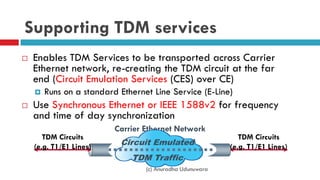
Supporting TDM services
 Enables TDM Services to be transported across Carrier
Ethernet network, re-creating the TDM circuit at the far
end (Circuit Emulation Services (CES) over CE)
 Runs on a standard Ethernet Line Service (E-Line)
 Use Synchronous Ethernet or IEEE 1588v2 for frequency
and time of day synchronization
Carrier Ethernet Network
TDM Circuits
(e.g. T1/E1 Lines)
Circuit Emulated
TDM Traffic
(c) Anuradha Udunuwara
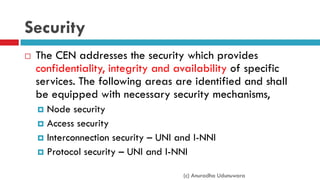
Security
 The CEN addresses the security which provides
confidentiality, integrity and availability of specific
services. The following areas are identified and shall
be equipped with necessary security mechanisms,
 Node security
 Access security
 Interconnection security – UNI and I-NNI
 Protocol security – UNI and I-NNI
(c) Anuradha Udunuwara
CE 2.0
Why CE Generations?
 Clearly communicate the Carrier Ethernet evolution
and the value it brings to the market
 Maximizes investment made by the industry
 Provides a directional roadmap for the industry
(c) Anuradha Udunuwara
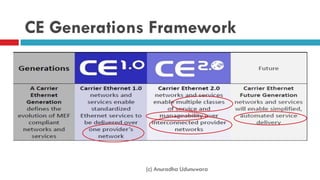
CE Generations Framework
(c) Anuradha Udunuwara
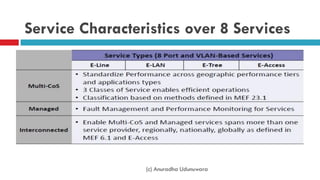
Service Characteristics over 8 Services
(c) Anuradha Udunuwara
CE Service Types
(c) Anuradha Udunuwara
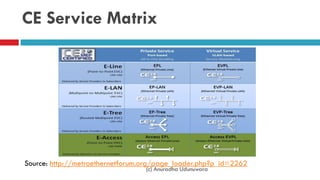
CE Service Matrix
(c) Anuradha Udunuwara
Source: http://metroethernetforum.org/page_loader.php?p_id=2262
WHY CARRIER ETHERNET?
Today’s world demands
 Any application, any connectivity, on any device
 Information, voice, video or data
 Entertainment – video voice, data any source
 At home, in the office, on the go, seamlessly and always
connected
 Any time, 24/7/365, on demand
 All delivered on one ubiquitous high performance, global
service.
(c) Anuradha Udunuwara
Issues with Legacy Networks
 Low bandwidth
 No flexibility to scale
 High cost of installation
 Slow provisioning
 Bandwidth growth inflexible/non-linear
 Limited by multiplexing hierarchy
 TDM-based access: inefficient for converged data
(c) Anuradha Udunuwara
CE Value Propositions
 Lower per-user provisioning costs
 Technically simple relative to TDM ckts.
 Due to large installed base
 Efficient and flexible transport
 Wide range of speeds: 1 Mbps--10 Gbps
 QoS capabilities
 Ease of inter-working
 Plug-and-play feature
 Ubiquitous adoption
 The technology of choice in enterprise networks
(c) Anuradha Udunuwara
Ethernet Business Drivers
 Business connectivity
 Storage networks
 Data centers
 Video conferencing
 Residential services
 Triple-play services (IPTV)
 On-line gaming
 High-speed Internet access
 Wireless backhaul
 Reduced cost, complexity for mobile operators
CE Market
 Services Revenue : $5B (2012) to over $11B (2017) [Insight Research]
 Equipment Revenue: $31.7B (2011) to $42B (2016) [Infonetics]
 CE Equipment spend: $186 billion over next 5 years!
(c) Anuradha Udunuwara
MOBILE BACKHAULING
(MBH)
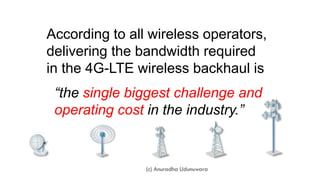
According to all wireless operators,
delivering the bandwidth required
in the 4G-LTE wireless backhaul is
“the single biggest challenge and
operating cost in the industry.”
(c) Anuradha Udunuwara
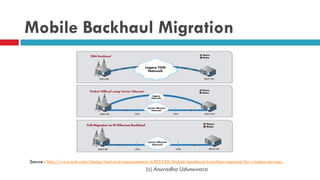
Mobile Backhaul Migration
(c) Anuradha Udunuwara
Source : http://www.edn.com/design/test-and-measurement/4405540/Mobile-backhaul-transition-required-for-wireless-services
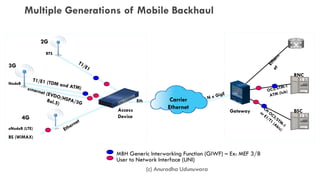
Multiple Generations of Mobile Backhaul
2G
3G
4G
Gateway
RNC
BSCAccess
Device
User to Network Interface (UNI)
MBH Generic Interworking Function (GIWF) – Ex: MEF 3/8
BTS
NodeB
eNodeB (LTE)
BS (WiMAX)
Eth Carrier
Ethernet
(c) Anuradha Udunuwara
STANDARDS
MEF
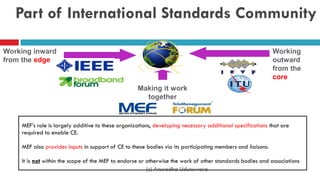
Part of International Standards Community
Working inward
from the edge
Working
outward
from the
core
Making it work
together
MEF’s role is largely additive to these organizations, developing necessary additional specifications that are
required to enable CE.
MEF also provides inputs in support of CE to these bodies via its participating members and liaisons.
It is not within the scope of the MEF to endorse or otherwise the work of other standards bodies and associations
(c) Anuradha Udunuwara
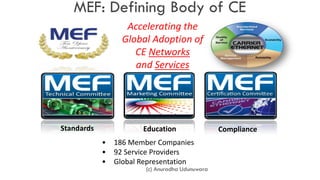
EducationStandards Compliance
Accelerating the
Global Adoption of
CE Networks
and Services
MEF: Defining Body of CE
• 186 Member Companies
• 92 Service Providers
• Global Representation
(c) Anuradha Udunuwara
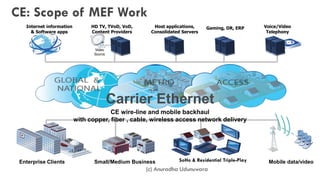
CE: Scope of MEF Work
SoHo & Residential Triple-PlaySmall/Medium BusinessEnterprise Clients Mobile data/video
HD TV, TVoD, VoD,
Content Providers
Video
Source
Gaming, DR, ERP Voice/Video
Telephony
Internet information
& Software apps
Host applications,
Consolidated Servers
Carrier Ethernet
CE wire-line and mobile backhaul
with copper, fiber , cable, wireless access network delivery
(c) Anuradha Udunuwara
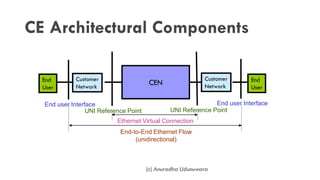
CE Architectural Components
End
User
Customer
Network
CEN
Customer
Network
End
User
UNI Reference Point UNI Reference Point
Ethernet Virtual Connection
End-to-End Ethernet Flow
(unidirectional)
End user Interface End user Interface
(c) Anuradha Udunuwara
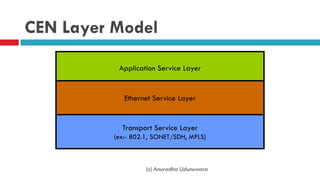
Application Service Layer
Ethernet Service Layer
Transport Service Layer
(ex:- 802.1, SONET/SDH, MPLS)
CEN Layer Model
(c) Anuradha Udunuwara
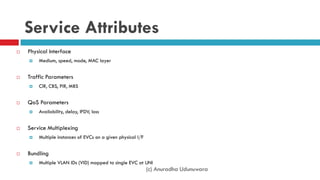
Service Attributes
 Physical Interface
 Medium, speed, mode, MAC layer
 Traffic Parameters
 CIR, CBS, PIR, MBS
 QoS Parameters
 Availability, delay, IFDV, loss
 Service Multiplexing
 Multiple instances of EVCs on a given physical I/F
 Bundling
 Multiple VLAN IDs (VID) mapped to single EVC at UNI
Services Using E-Line Service Type
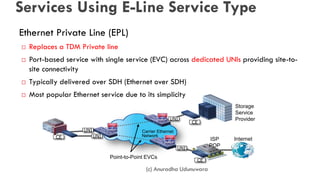
Ethernet Private Line (EPL)
 Replaces a TDM Private line
 Port-based service with single service (EVC) across dedicated UNIs providing site-to-
site connectivity
 Typically delivered over SDH (Ethernet over SDH)
 Most popular Ethernet service due to its simplicity
Point-to-Point EVCs
Carrier Ethernet
NetworkCE UNI
CE
UNI
CE
UNI
ISP
POP
UNI
Storage
Service
Provider
Internet
(c) Anuradha Udunuwara
Services Using E-Line Service Type
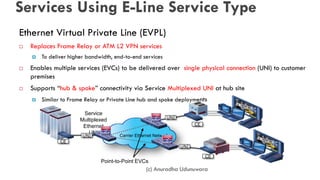
Ethernet Virtual Private Line (EVPL)
 Replaces Frame Relay or ATM L2 VPN services
 To deliver higher bandwidth, end-to-end services
 Enables multiple services (EVCs) to be delivered over single physical connection (UNI) to customer
premises
 Supports “hub & spoke” connectivity via Service Multiplexed UNI at hub site
 Similar to Frame Relay or Private Line hub and spoke deployments
Service
Multiplexed
Ethernet
UNI
Point-to-Point EVCs
Carrier Ethernet Network
CE
UNI
CE
UNI
CE
UNI
(c) Anuradha Udunuwara
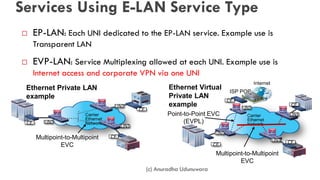
Services Using E-LAN Service Type
 EP-LAN: Each UNI dedicated to the EP-LAN service. Example use is
Transparent LAN
 EVP-LAN: Service Multiplexing allowed at each UNI. Example use is
Internet access and corporate VPN via one UNI
Ethernet Private LAN
example
Multipoint-to-Multipoint
EVC
Carrier
Ethernet
NetworkCE
UNI
CE
CE
UNI
UNI
Ethernet Virtual
Private LAN
example
Multipoint-to-Multipoint
EVC
Carrier
Ethernet
Network
CE
UNI
CE
CE
UNI
UNI
Point-to-Point EVC
(EVPL)
UNI
CE
ISP POP
Internet
(c) Anuradha Udunuwara
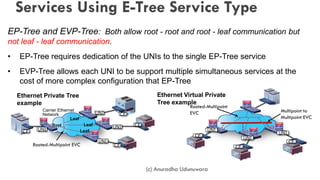
Services Using E-Tree Service Type
Carrier Ethernet
Network
CE
UNI
UNI
CE
CE
Leaf
Leaf
UNI
CE
Leaf
Rooted-Multipoint EVC
Ethernet Private Tree
example
UNI
Root
EP-Tree and EVP-Tree: Both allow root - root and root - leaf communication but
not leaf - leaf communication.
• EP-Tree requires dedication of the UNIs to the single EP-Tree service
• EVP-Tree allows each UNI to be support multiple simultaneous services at the
cost of more complex configuration that EP-Tree
Root
Ethernet Virtual Private
Tree example
CE
CE
CE
UNI
UNI
UNI
Rooted-Multipoint
EVC Multipoint to
Multipoint EVC
CARRIER ETHERNET
INTERCONNECT
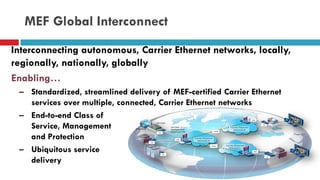
Interconnecting autonomous, Carrier Ethernet networks, locally,
regionally, nationally, globally
Enabling…
– Standardized, streamlined delivery of MEF-certified Carrier Ethernet
services over multiple, connected, Carrier Ethernet networks
– End-to-end Class of
Service, Management
and Protection
– Ubiquitous service
delivery
MEF Global Interconnect
Interconnect Technical Components
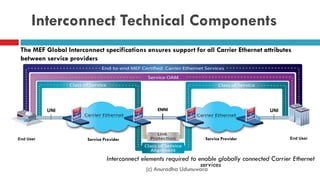
Interconnect elements required to enable globally connected Carrier Ethernet
services
The MEF Global Interconnect specifications ensures support for all Carrier Ethernet attributes
between service providers
ENNIUNI UNI
Service Provider Service ProviderEnd User End User
(c) Anuradha Udunuwara
TECHNICAL WORK OF THE
MEF
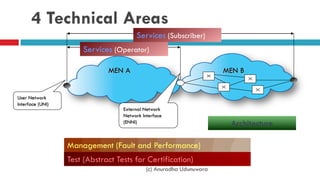
4 Technical Areas
MEN A MEN B
Services (Subscriber)
User Network
Interface (UNI)
Architecture
Management (Fault and Performance)
Test (Abstract Tests for Certification)
Services (Operator)
External Network
Network Interface
(ENNI)
(c) Anuradha Udunuwara
MEF CERTIFICATION
MEF Services
Certification Program
(c) Anuradha Udunuwara
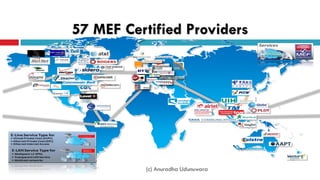
57 MEF Certified Providers
Worldwide Adoption of Service Certification
MERICA
(c) Anuradha Udunuwara
MEF Certifications for Services
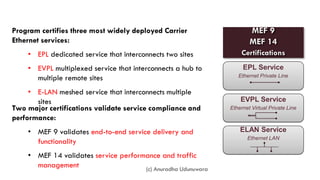
Program certifies three most widely deployed Carrier
Ethernet services:
• EPL dedicated service that interconnects two sites
• EVPL multiplexed service that interconnects a hub to
multiple remote sites
• E-LAN meshed service that interconnects multiple
sites
Two major certifications validate service compliance and
performance:
• MEF 9 validates end-to-end service delivery and
functionality
• MEF 14 validates service performance and traffic
management
EPL Service
Ethernet Private Line
EVPL Service
Ethernet Virtual Private Line
ELAN Service
Ethernet LAN
MEF 9
MEF 14
Certifications
(c) Anuradha Udunuwara
Frequently Asked Questions
Does my company need to be a MEF member prior to certification?
• MEF membership is a pre-requisite to certification
• Not renewing MEF membership does not invalidate certification
For how long are certifications valid?
• Certifications have unlimited validity in time for services delivered across the same type of UNI equipment
deployed at the time of testing
• Certifications of new services or services delivered across UNIs or MENs deploying new equipment,
software releases or transport technologies are at will
Who should I contact to find out more?
• Iometrix is the MEF authorized certification lab since 2005
• Contact certification@iometrix.com or visit www.iometrix.com
(c) Anuradha Udunuwara
MEF Equipment
Certification Program
(c) Anuradha Udunuwara
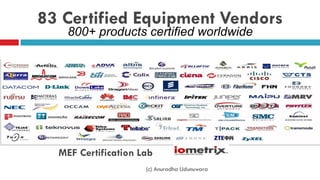
83 Certified Equipment Vendors
MEF Certification Lab
July 2011
800+ products certified worldwide
(c) Anuradha Udunuwara
Benefits of Certifying Equipment
• Sales Benefits
• Requirement in growing number of service provider RFPs
• Provides competitive advantage over non-certified equipment
• Builds buyer confidence and speeds up sales process
• Marketing Benefits
• Widely recognized by service provider and enterprise customers
• Aligns product portfolio with CE industry standards
• Ensures high level of consistency in products & services
• Technical Benefits
• Single testing process saves time / costs on conformance testing
• Facilitates multi-vendor deployments
• Supports service provider services certification
(c) Anuradha Udunuwara
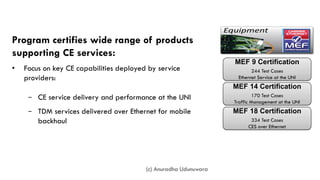
MEF Certifications for Equipment
Program certifies wide range of products
supporting CE services:
• Focus on key CE capabilities deployed by service
providers:
− CE service delivery and performance at the UNI
− TDM services delivered over Ethernet for mobile
backhaul
MEF 9 Certification
244 Test Cases
Ethernet Service at the UNI
MEF 14 Certification
170 Test Cases
Traffic Management at the UNI
MEF 18 Certification
334 Test Cases
CES over Ethernet
(c) Anuradha Udunuwara
MEF Professional
Certification Program
(c) Anuradha Udunuwara
Benefits CE Organizations
• Principle organizations
• Service providers
• Equipment vendors
• Benefits
• Demonstrates to customers and partners an employer’s
commitment to quality and knowledge of Carrier Ethernet
knowledge, skills and capabilities
• Enhances employer training requirements
• Improves employer candidate assessment process
• Valuable complement to MEF services and equipment
certification achieved by the organization
(c) Anuradha Udunuwara
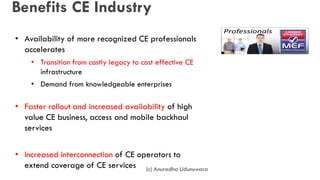
Benefits CE Industry
• Availability of more recognized CE professionals
accelerates
• Transition from costly legacy to cost effective CE
infrastructure
• Demand from knowledgeable enterprises
• Faster rollout and increased availability of high
value CE business, access and mobile backhaul
services
• Increased interconnection of CE operators to
extend coverage of CE services (c) Anuradha Udunuwara
TECHNOLOGY SPECIFIC
STANDARDS
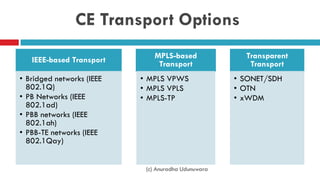
CE Transport Options
IEEE-based Transport
• Bridged networks (IEEE
802.1Q)
• PB Networks (IEEE
802.1ad)
• PBB networks (IEEE
802.1ah)
• PBB-TE networks (IEEE
802.1Qay)
MPLS-based
Transport
• MPLS VPWS
• MPLS VPLS
• MPLS-TP
Transparent
Transport
• SONET/SDH
• OTN
• xWDM
(c) Anuradha Udunuwara
IEEE BASED TRANSPORT
(c) Anuradha Udunuwara
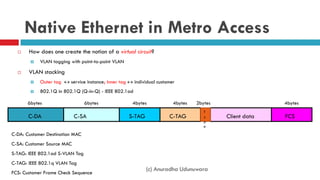
Native Ethernet in Metro Access
 How does one create the notion of a virtual circuit?
 VLAN tagging with point-to-point VLAN
 VLAN stacking
 Outer tag  service instance; Inner tag  individual customer
 802.1Q in 802.1Q (Q-in-Q) - IEEE 802.1ad
C-DA: Customer Destination MAC
C-SA: Customer Source MAC
S-TAG: IEEE 802.1ad S-VLAN Tag
C-TAG: IEEE 802.1q VLAN Tag
FCS: Customer Frame Check Sequence
C-DA C-TAGC-SA Client data FCSS-TAG
6bytes 6bytes 4bytes 4bytes 4bytes
T
y
p
e
2bytes
(c) Anuradha Udunuwara
Customer
Network
Customer
Network
Customer
Network
87
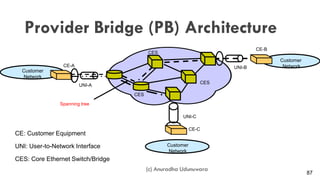
Provider Bridge (PB) Architecture
CE: Customer Equipment
UNI: User-to-Network Interface
CES: Core Ethernet Switch/Bridge
UNI-B
CES
CES
CE-A
UNI-A
UNI-C
CE-C
Spanning tree
CE-B
CES
(c) Anuradha Udunuwara
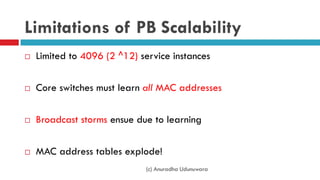
Limitations of PB Scalability
 Limited to 4096 (2 ^12) service instances
 Core switches must learn all MAC addresses
 Broadcast storms ensue due to learning
 MAC address tables explode!
(c) Anuradha Udunuwara
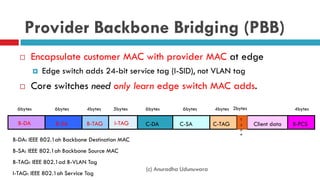
Provider Backbone Bridging (PBB)
 Encapsulate customer MAC with provider MAC at edge
 Edge switch adds 24-bit service tag (I-SID), not VLAN tag
 Core switches need only learn edge switch MAC adds.
B-DA: IEEE 802.1ah Backbone Destination MAC
B-SA: IEEE 802.1ah Backbone Source MAC
B-TAG: IEEE 802.1ad B-VLAN Tag
I-TAG: IEEE 802.1ah Service Tag
B-DA B-TAGB-SA I-TAG C-DA C-TAGC-SA Client data B-FCS
6bytes 6bytes 6bytes6bytes4bytes 5bytes 4bytes 4bytes
T
y
p
e
2bytes
(c) Anuradha Udunuwara
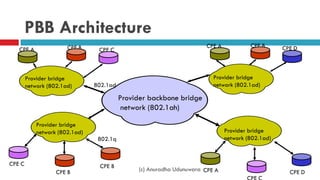
PBB Architecture
CPE BCPE A
CPE C
Provider backbone bridge
network (802.1ah)
CPE BCPE A
802.1ad
CPE B
CPE B
802.1q
CPE C
Provider bridge
network (802.1ad)
CPE D
CPE DCPE A
Provider bridge
network (802.1ad)
Provider bridge
network (802.1ad)
Provider bridge
network (802.1ad)
(c) Anuradha Udunuwara
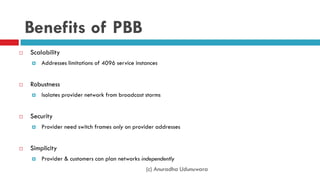
Benefits of PBB
 Scalability
 Addresses limitations of 4096 service instances
 Robustness
 Isolates provider network from broadcast storms
 Security
 Provider need switch frames only on provider addresses
 Simplicity
 Provider & customers can plan networks independently
(c) Anuradha Udunuwara
Traffic Engineering in PBB
 Via Multiple Spanning Tree Protocol (MSTP)
 Maps a VLAN to ST or multiple VLANs to ST
 Enables use of links that would otherwise be idle in ST
 Eliminates wasted bandwidth … but …
 Too slow for protection switching
 Not suitable for complex mesh topologies
 Difficult to predict QoS
(c) Anuradha Udunuwara
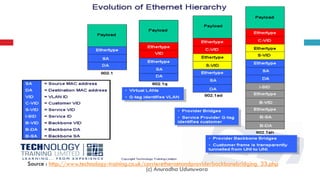
Source : http://www.technology-training.co.uk/carrierethernetandproviderbackbonebridging_33.php
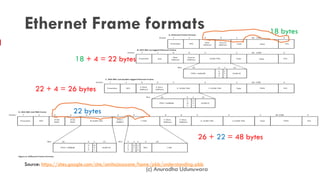
Ethernet Frame formats
(c) Anuradha Udunuwara
Source: https://sites.google.com/site/amitsciscozone/home/pbb/understanding-pbb
22 bytes
18 + 4 = 22 bytes
22 + 4 = 26 bytes
26 + 22 = 48 bytes
18 bytes
(c) Anuradha Udunuwara
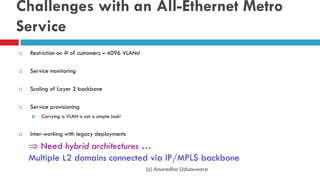
Challenges with an All-Ethernet Metro
Service
 Restriction on # of customers – 4096 VLANs!
 Service monitoring
 Scaling of Layer 2 backbone
 Service provisioning
 Carrying a VLAN is not a simple task!
 Inter-working with legacy deployments
 Need hybrid architectures …
Multiple L2 domains connected via IP/MPLS backbone
MPLS BASED TRANSPORT
MPLS
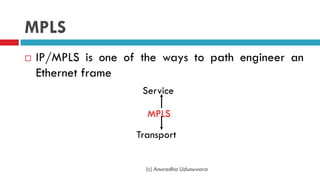
 IP/MPLS is one of the ways to path engineer an
Ethernet frame
MPLS
Service
Transport
(c) Anuradha Udunuwara
L2 & L3
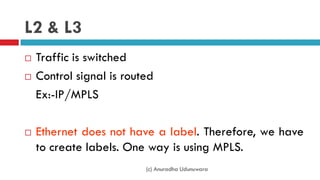
 Traffic is switched
 Control signal is routed
Ex:-IP/MPLS
 Ethernet does not have a label. Therefore, we have
to create labels. One way is using MPLS.
(c) Anuradha Udunuwara
Why MPLS for Ethernet Services (EoMPLS)?
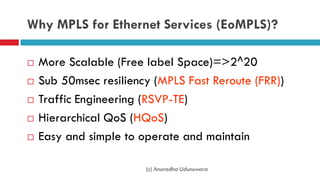
 More Scalable (Free label Space)=>2^20
 Sub 50msec resiliency (MPLS Fast Reroute (FRR))
 Traffic Engineering (RSVP-TE)
 Hierarchical QoS (HQoS)
 Easy and simple to operate and maintain
(c) Anuradha Udunuwara
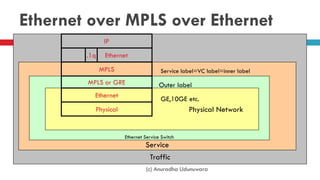
Traffic
Service
Ethernet Service Switch
Physical Network
Ethernet over MPLS over Ethernet
MPLS
Ethernet
Physical
IP
Ethernet
MPLS or GRE
.1q
GE,10GE etc.
Outer label
Service label=VC label=inner label
(c) Anuradha Udunuwara
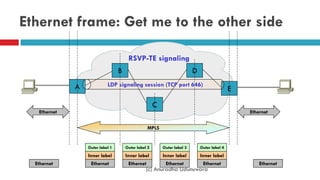
Outer label 1
Ethernet
Inner label
Ethernet
Inner label
Outer label 2
Ethernet
Inner label
Outer label 3
Ethernet
Inner label
Outer label 4
EthernetEthernet
A E
D
C
B
Ethernet Ethernet
MPLS
LDP signaling session (TCP port 646)
RSVP-TE signaling
Ethernet frame: Get me to the other side
(c) Anuradha Udunuwara
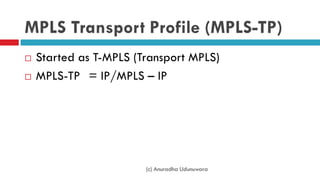
MPLS Transport Profile (MPLS-TP)
 Started as T-MPLS (Transport MPLS)
 MPLS-TP = IP/MPLS – IP
(c) Anuradha Udunuwara
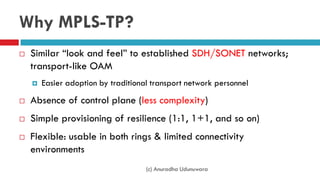
Why MPLS-TP?
 Similar “look and feel” to established SDH/SONET networks;
transport-like OAM
 Easier adoption by traditional transport network personnel
 Absence of control plane (less complexity)
 Simple provisioning of resilience (1:1, 1+1, and so on)
 Flexible: usable in both rings & limited connectivity
environments
(c) Anuradha Udunuwara
TRANSPARENT TRANSPORT
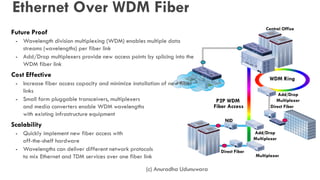
Ethernet Over WDM Fiber
Future Proof
- Wavelength division multiplexing (WDM) enables multiple data
streams (wavelengths) per fiber link
- Add/Drop multiplexers provide new access points by splicing into the
WDM fiber link
Cost Effective
- Increase fiber access capacity and minimize installation of new fiber
links
- Small form pluggable transceivers, multiplexers
and media converters enable WDM wavelengths
with existing infrastructure equipment
Scalability
- Quickly implement new fiber access with
off-the-shelf hardware
- Wavelengths can deliver different network protocols
to mix Ethernet and TDM services over one fiber link
Central Office
Direct Fiber
Add/Drop
Multiplexer
Multiplexer
P2P WDM
Fiber Access
WDM Ring
Add/Drop
Multiplexer
Direct Fiber
NID
(c) Anuradha Udunuwara
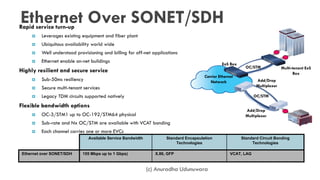
Ethernet Over SONET/SDHRapid service turn-up
 Leverages existing equipment and fiber plant
 Ubiquitous availability world wide
 Well understood provisioning and billing for off-net applications
 Ethernet enable on-net buildings
Highly resilient and secure service
 Sub-50ms resiliency
 Secure multi-tenant services
 Legacy TDM circuits supported natively
Flexible bandwidth options
 OC-3/STM1 up to OC-192/STM64 physical
 Sub-rate and Nx OC/STM are available with VCAT bonding
 Each channel carries one or more EVCs
Carrier Ethernet
Network
Available Service Bandwidth Standard Encapsulation
Technologies
Standard Circuit Bonding
Technologies
Ethernet over SONET/SDH 155 Mbps up to 1 Gbps) X.86, GFP VCAT, LAG
OC/STM
OC/STM
Add/Drop
Multiplexer
Add/Drop
Multiplexer
EoS Box
Multi-tenant EoS
Box
(c) Anuradha Udunuwara
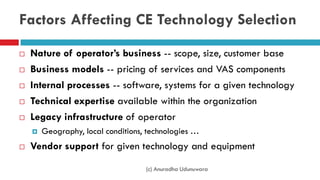
Factors Affecting CE Technology Selection
 Nature of operator’s business -- scope, size, customer base
 Business models -- pricing of services and VAS components
 Internal processes -- software, systems for a given technology
 Technical expertise available within the organization
 Legacy infrastructure of operator
 Geography, local conditions, technologies …
 Vendor support for given technology and equipment
(c) Anuradha Udunuwara
ETHERNET ACCESS
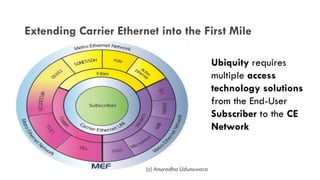
Extending Carrier Ethernet into the First Mile
Ubiquity requires
multiple access
technology solutions
from the End-User
Subscriber to the CE
Network
(c) Anuradha Udunuwara
Bonded
T1/E1
Ethernet
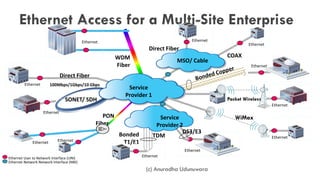
Ethernet Access for a Multi-Site Enterprise
MSO/ Cable
Ethernet User to Network Interface (UNI)
Ethernet Network Network Interface (NNI)
COAX
Direct Fiber
WDM
Fiber
Service
Provider 2
TDM
Ethernet
Ethernet Ethernet
Ethernet
Ethernet
Ethernet
Ethernet
Direct Fiber
100Mbps/1Gbps/10 Gbps
SONET/ SDH
PON
Fiber
Ethernet
Service
Provider 1
Ethernet
Ethernet
WiMax
Ethernet
Packet Wireless
DS3/E3
(c) Anuradha Udunuwara
Reference
[1] MEF ( http://metroethernetforum.org )
[2] Ethernet Academy
(http://www.ethernetacademy.net/ )
(c) Anuradha Udunuwara
About the Author
Eng. Anuradha Udunuwara is a Chartered Engineer by profession based in Sri Lanka. He has nearly a decade
industry experience in strategy, architecture, engineering, design, plan, implementation and maintenance of CSP
Networks using both packet-switched (PS) and Circuit-Switched (CS) technologies, along with legacy to NGN
migration. Eng. Anuradha is a well-known in the field of CSP industry, both locally and internationally.
Graduated from University of Peradeniya, Sri Lanka in 2001 with an honors in Electrical & Electronic Engineering,
Eng. Anuradha is a corporate member of the Institution of Engineers Sri Lanka, a professional member of British
Computer Society, a member of Institution of Electrical & Electronic Engineers, a member of Institution of
Engineering & Technology (formerly Institution of Electrical Engineers), a member of the Computer Society of Sri
Lanka, a life member of Sri Lanka Association for the Advancement of Science, a senior member of the Carrier
Ethernet Forum, a member of the Internet Society, a member of the Internet Strategy Forum, a member of the
Internet Strategy Forum Network, a member & a senior contributor of the Ethernet Academy, a member of the
NGN/IMS forum and a member of the Peradeniya Engineering Faculty Alumni Association. He is also an ITIL
foundation certified and the only MEF-CECP in the country.
In his spare time Anuradha enjoys spending time with his family, playing badminton, photography, reading and
travelling.
He can be reached at udunuwara@ieee.org
(c) Anuradha Udunuwara

Carrier Ethernet

  • 1.
    CARRIER ETHERNET FEBRUARY 2013 ByEng. Anuradha Udunuwara, BSc.Eng(Hons), CEng, MIE(SL), MEF-CECP, MBCS, ITILv3 Foundation, MIEEE, MIEEE-CS, MIEE, MIET, MCS(SL), MSLAAS
  • 2.
    Agenda  What isEthernet?  What is Carrier Ethernet?  Why Carrier Ethernet?  Standards  Technology neutral  Technology specific (c) Anuradha Udunuwara
  • 3.
  • 4.
    What Do WeMean By “Ethernet?”  Ethernet as an interface  Ethernet as a point-to-point link  IEEE 802.3 view  Ethernet as a Packet Switched Network (PSN) infrastructure (transport)  IEEE 802.1 (bridging) view  ITU-T SG15 / SG13 managed Ethernet network view  Ethernet as a protocol  Ethernet as a service  MEF view – user-to-user transfer of 802.3 frames over any transport layer  E-Line, E-LAN, E-Tree, E-Access (c) Anuradha Udunuwara
  • 5.
    Legacy Ethernet (10-Mbps) (c)Anuradha Udunuwara Source: http://learn-networking.com/network-design/a-brief-overview-of-ethernet-history (RG-58) (RG-8) (Cat 3 and above) 500 m 185 m 100 m Max. Segment Length
  • 6.
    5-4-3 Rule 10-Mbps Ethernetcould be used on no more than 5 network segments, 4 repeaters, and no more than 3 of the five network segments can be for end- users. (c) Anuradha Udunuwara Source: http://xvongola.blogspot.com/2011/09/aturan-5-4-3-dan-aturan-5-4-3-2-1-pada.html
  • 7.
    History  1973.5.22 -1st document  1975 -Xerox gets patent  1976 - deployed at Xerox  1980 - DIX (Digital/Intel/Xerox) standard published (The Ethernet, A Local Area Network. Data Link Layer and Physical Layer Specifications_v1)  1982 - v2  1982 - IEEE 802.3 CSMA/CD standard approved (Other options: Token Ring and Token Bus)  1983 – IEEE 802.3 CSMA/CD Draft Published  1985 – IEEE 802.3 CSMA/CD Standard published (c) Anuradha Udunuwara Source: http://www.windowsnetworking.com/articles-tutorials/netgeneral/history.html
  • 8.
    History, Cont., (c) AnuradhaUdunuwara Source: http://learn-networking.com/network-design/a-brief-overview-of-ethernet-history
  • 9.
    The inventors (c) AnuradhaUdunuwara Charles P. Thacker Butler Lampson Source : http://research.microsoft.com/en-us/um/people/blampson/Source: http://calendar.cs.cmu.edu/dlseries/6235.html Source: http://www.computerhistory.org/revolution/networking/19/381/2158 Bob Metcalf David Boggs
  • 10.
    The Basic EthernetBus (c) Anuradha Udunuwara Thinet coaxial cable Disconnecting a single connection will bring the whole network down! Source : http://www.datacottage.com/nch/eoperation.htm
  • 11.
    Using a Hub (c)Anuradha Udunuwara • Bus - >Star • Collisions still possible • Centralized wiring • Can automatically bypass any ports that are disconnected or have a cabling fault • -> network much more fault tolerant than a coax based system Source : http://www.datacottage.com/nch/eoperation.htm
  • 12.
    Using a Switch (c)Anuradha Udunuwara • To overcome the problem of collisions and other effects on network speed • Machines can transmit simultaneously Source : http://www.datacottage.com/nch/eoperation.htm
  • 13.
  • 14.
    IEEE 802, Cont., Someexamples 802.1 Bridging (networking) and Network Management 802.2 Logical link control (upper part of data link layer) 802.3 Ethernet (CSMA/CD) (defines the physical layer and data link layer's MAC of wired Ethernet) 802.17 Resilient packet ring 802.11 Wireless LAN & Mesh (Wi-Fi certification) 802.15 Wireless PAN 802.15.1 Bluetooth certification 802.15.4 ZigBee certification 802.16 Broadband Wireless Access (WiMAX certification) 802.16e (Mobile) Broadband Wireless Access 802.20 Mobile Broadband Wireless Access (c) Anuradha Udunuwara
  • 15.
    IEEE 802.3 802.3a 10BASE210 Mbit/s over thin Coax 802.3i 10BASE-T 10 Mbit/s over twisted pair 802.3j 10BASE-F 10 Mbit/s over Fiber-Optic 802.3u 100BASE-TX, 100BASE-T4, 100BASE-FX Fast Ethernet at 100 Mbit/s w/auto-negotiation 802.3x Full Duplex and flow control 802.3y 100BASE-T2 100 Mbit/s over low quality twisted pair 802.3z 1000BASE-X 1 Gbit/s Ethernet over Fiber-Optic 802.3ab 1000BASE-T 1 Gbit/s Ethernet over twisted pair 802.3ac Max frame size extended to 1522 bytes (to allow "Q-tag") 802.3ad Link aggregation for parallel links 802.3ae 10 Gbit/s Ethernet over fiber; 10GBASE-SR, 10GBASE-LR, 10GBASE-ER, 10GBASE-SW, 10GBASE-LW, 10GBASE-EW 802.3af Power over Ethernet (12.95 W) 802.3ah Ethernet in the First Mile 802.3an 10GBASE-T 10 Gbit/s Ethernet over UTP 802.3at Power over Ethernet enhancements (25.5 W) 802.3av 10 Gbit/s EPON (c) Anuradha Udunuwara
  • 16.
    IEEE 802.1 (c) AnuradhaUdunuwara 802.1w-2001 Rapid Reconfiguration of Spanning Tree (RSTP) 802.1D-2004 MAC Bridges (rollup of 802.1w) 802.1s-2002 Multiple Spanning Trees (MSTP) 802.1v-2001 VLAN Classification by Protocol and Port 802.1Q-2005 VLAN Bridges (Rollup of 802.1s and 802.1v) 802.1ad-2005 Provider Bridging (PB) 802.1ag-2007 Connectivity Fault Management (CFM) 802.1ah-2008 Provider Backbone Bridge (PBB) 802.1aq-2012 Shortest Path Bridging (SPB) 802.1Qay-2009 Provider Backbone Bridge Traffic Engineering (PBB-TE) 802.1Q-2011 VLAN Bridges (Rollup of 802.1Q-2005+Cor-1 and 802.1ad/ag/ah/Qay) 802.1X-2010 Port Based Network Access Control
  • 17.
    IP vs Ethernet wrong questions to ask  Which is better – IP or Ethernet?  Which is cheaper?  Is Ethernet going to take over from IP?  Or will IP win out in the end? • Answers – Ethernet and IP will co-exist – Complimenting each other – Meeting different needs – Both occurring in hybrid networks – Delivered over a single, global platform – Sharing similar cost and service characteristics (c) Anuradha Udunuwara
  • 18.
    Why Ethernet ? Most common Interface today  Cost effective  Supports very high Bandwidths (upto 100 Gbps)  Flexible upgrades within a wide range (ex: 1Mbps to 1Gbps)  Easy and simple to manage and maintain  Variable payload support (c) Anuradha Udunuwara
  • 19.
    WHAT IS CARRIERETHERNET?
  • 20.
    Global Expansion fromMetro to Carrier Ethernet  The Beginning: Metro Ethernet (ME)  MEF was formed in 2001 to develop ubiquitous business services for Enterprise users principally accessed over optical metropolitan networks to connect their Enterprise LANs  Expansion to CE  Success of ME Services caught the imagination of the world as the concept expanded to include  Worldwide services traversing national and global networks  Access networks to provide availability to a much wider class of user over fiber, copper, cable, PON, and wireless  Economy of scale from the resulting converged business, residential and wireless networks sharing the same infrastructure and services  Scalability & rapid deployment of business applications  Adoption of the certification program  While retaining the cost model and simplicity of Ethernet (c) Anuradha Udunuwara
  • 21.
    What is CarrierEthernet (CE)?  Is it a service, a network, or a technology?  Answer for an end-user  It’s a Service defined by 5 attributes  Answer for a service provider  A set of certified network elements that connect to transport CE services for all users, locally & worldwide  It’s a platform for value added services  A standardized service for all users(c) Anuradha Udunuwara
  • 22.
    MEF CE Definition Aubiquitous, standardized, carrier-class Service and Network defined by 5 attributes that distinguish it from familiar LAN based Ethernet
  • 23.
    Why Ethernet inthe Metro? 10/100 Base -T  Enables true extension of Enterprise LAN across multiple locations, as well as effectively providing other multipoint services  Utilize simplicity and ubiquity of Ethernet as a technology  Enables bandwidth efficiency in the network due to statistical multiplexing  Low price/bandwidth ratio makes Ethernet the technology of choice Ethernet Ethernet (c) Anuradha Udunuwara
  • 24.
    Attribute 1: StandardizedServices CEEnterprise Ethernet  Provide service across multiple geographies and multiple networks  Provides service to multiple customers  Needs to provide converged transport with optimal use of present investment  Service provided over one network (Company LAN)  One customer – can customize network to requirements Network 1 Network 2 Network 3 (c) Anuradha Udunuwara
  • 25.
    1000 Nodes Attribute 2: Scalability Need to scale to millions of nodes  Need to scale from few Mbps data rate to 10 Gbps and beyond  Network needs to support several services  Few hundreds or thousands of nodes  Need to scale from 10 Mbps to 1 Gbps  Limited number of services to be supported CEEnterprise Ethernet 100 Nodes 100 Mbps 1 Gbps 100 Nodes 100 Mbps 1000 Nodes 1 Gbps 10 Gbps 10K Nodes 100 Gbps 10M Nodes (c) Anuradha Udunuwara
  • 26.
    Attribute 3: Reliability Need to provide protection in case of link failure in less than 50 ms  Need to provide five 9s reliability of equipment  Need to recover from faults as quickly as possible to provide uptime as specified in SLA  Equipment is all within a premise, more reliable with easy recovery  No strict time limits needed on link protection, no SLAs associated with network availability CEEnterprise Ethernet $$$$ $$ SLA losses 50ms protection (c) Anuradha Udunuwara
  • 27.
    Attribute 4: ServiceManagement  Need to quickly monitor and diagnose faults across multiple vendor equipment  Ability to rapidly provision the bandwidth end-to-end  Fault isolation is easy since equipment is all within a premise  Bandwidth is more static in nature, no need for provisioning CE Enterprise Ethernet Service Down Vendor 1 Vendor 2 Vendor 3 Service Down (c) Anuradha Udunuwara
  • 28.
    Attribute 5: Qualityof Service  Bandwidth is cheap, hence no contention in the network  No variety in traffic profiles, identical treatment is acceptable Enterprise Ethernet High-speed Mobile Internet Mobile Voice Enterprise Services Leakage of SLA-based traffic due to congestion Metro Network High-speed Mobile Internet Mobile Voice Enterprise Services Metro Network  QoS absolutely required to service variety of SLAs  Ability to treat customer traffic in agreement with the SLAs CE (c) Anuradha Udunuwara
  • 29.
    Equipment Transport Technologies Availability End Customer Geographic Reach In summary Ethernetin LAN CE Department heads Employee Some tolerance for disruption Cat5 Fiber Wireless Campus Building Wiring closet Metro National International Service-oriented Highly resilient Carrier environmental Fiber T1/E1, T3/E3 Cat5 SONET/SDH Cu Wireless No tolerance for disruption Driven by SLA Corporate IT Consumer (c) Anuradha Udunuwara
  • 30.
    Other CE Network(CEN) requirements  Availability  Stability  Performance  Multicast support  TDM support  Security (c) Anuradha Udunuwara
  • 31.
    Availability (Resilience) (c) AnuradhaUdunuwara Hardware Component of CE Node High Availability mechanism Route processor 1:1 Switching fabric 1:1 Power supply 1+1 Note Power feed 1+1 Note Cooling system 1+1 Note Any other control plane module 1:1 Any other switching plane component 1:1 Note : single component shall be able to take the full load of the CE node
  • 32.
    Availability (Resilience), Cont., ITU-T G.8032 version 1 & 2 (ERPS)  Following software level high availability features shall be implemented;  NSR for  LDP  RSVP TE  BGP  OSPF  PIM-SM and PIM-SSM  ISSU  BFD requirement shall be analyzed for following in the future stage  LDP  RSVP  BGP  OSPF  PIM-SM and PIM-SSM  NSF requirement shall be analyzed in future stage (c) Anuradha Udunuwara
  • 33.
    Stability  Stability ofthe CEN and its NE are very important. This should ensure consistent performance of the NE  MTBF and MTTR values shall meet 99.999% node availability requirements (c) Anuradha Udunuwara
  • 34.
    Performance  Scalability ofthe CEN determine by providing sufficient bandwidth to be able to guarantee a committed level of performance for the full service portfolio of end users.  CEN shall be designed to achieve the certain QoS requirements/KPIs defined with the set of services/products.  CEN must be able to handle unpredictable surges in traffic, and appropriate load (c) Anuradha Udunuwara
  • 35.
    Multicasting  To supportIPTV and other multicast applications, the CEN shall support IP multicast protocols  Layer 3 based (PIM) multicast technology is preferred over Layer 2 technology for scalability and flexibility reasons  Layer 2 multicasting features shall be available for customer multicasting services (c) Anuradha Udunuwara
  • 36.
    TDM Circuits (e.g. T1/E1Lines) Supporting TDM services  Enables TDM Services to be transported across Carrier Ethernet network, re-creating the TDM circuit at the far end (Circuit Emulation Services (CES) over CE)  Runs on a standard Ethernet Line Service (E-Line)  Use Synchronous Ethernet or IEEE 1588v2 for frequency and time of day synchronization Carrier Ethernet Network TDM Circuits (e.g. T1/E1 Lines) Circuit Emulated TDM Traffic (c) Anuradha Udunuwara
  • 37.
    Security  The CENaddresses the security which provides confidentiality, integrity and availability of specific services. The following areas are identified and shall be equipped with necessary security mechanisms,  Node security  Access security  Interconnection security – UNI and I-NNI  Protocol security – UNI and I-NNI (c) Anuradha Udunuwara
  • 38.
  • 39.
    Why CE Generations? Clearly communicate the Carrier Ethernet evolution and the value it brings to the market  Maximizes investment made by the industry  Provides a directional roadmap for the industry (c) Anuradha Udunuwara
  • 40.
    CE Generations Framework (c)Anuradha Udunuwara
  • 41.
    Service Characteristics over8 Services (c) Anuradha Udunuwara
  • 42.
    CE Service Types (c)Anuradha Udunuwara
  • 43.
    CE Service Matrix (c)Anuradha Udunuwara Source: http://metroethernetforum.org/page_loader.php?p_id=2262
  • 44.
  • 45.
    Today’s world demands Any application, any connectivity, on any device  Information, voice, video or data  Entertainment – video voice, data any source  At home, in the office, on the go, seamlessly and always connected  Any time, 24/7/365, on demand  All delivered on one ubiquitous high performance, global service. (c) Anuradha Udunuwara
  • 46.
    (c) Anuradha Udunuwara Issueswith Legacy Networks  Low bandwidth  No flexibility to scale  High cost of installation  Slow provisioning  Bandwidth growth inflexible/non-linear  Limited by multiplexing hierarchy  TDM-based access: inefficient for converged data
  • 47.
    (c) Anuradha Udunuwara CEValue Propositions  Lower per-user provisioning costs  Technically simple relative to TDM ckts.  Due to large installed base  Efficient and flexible transport  Wide range of speeds: 1 Mbps--10 Gbps  QoS capabilities  Ease of inter-working  Plug-and-play feature  Ubiquitous adoption  The technology of choice in enterprise networks
  • 48.
    (c) Anuradha Udunuwara EthernetBusiness Drivers  Business connectivity  Storage networks  Data centers  Video conferencing  Residential services  Triple-play services (IPTV)  On-line gaming  High-speed Internet access  Wireless backhaul  Reduced cost, complexity for mobile operators
  • 49.
    CE Market  ServicesRevenue : $5B (2012) to over $11B (2017) [Insight Research]  Equipment Revenue: $31.7B (2011) to $42B (2016) [Infonetics]  CE Equipment spend: $186 billion over next 5 years! (c) Anuradha Udunuwara
  • 50.
  • 51.
    According to allwireless operators, delivering the bandwidth required in the 4G-LTE wireless backhaul is “the single biggest challenge and operating cost in the industry.” (c) Anuradha Udunuwara
  • 52.
    Mobile Backhaul Migration (c)Anuradha Udunuwara Source : http://www.edn.com/design/test-and-measurement/4405540/Mobile-backhaul-transition-required-for-wireless-services
  • 53.
    Multiple Generations ofMobile Backhaul 2G 3G 4G Gateway RNC BSCAccess Device User to Network Interface (UNI) MBH Generic Interworking Function (GIWF) – Ex: MEF 3/8 BTS NodeB eNodeB (LTE) BS (WiMAX) Eth Carrier Ethernet (c) Anuradha Udunuwara
  • 54.
  • 55.
  • 56.
    Part of InternationalStandards Community Working inward from the edge Working outward from the core Making it work together MEF’s role is largely additive to these organizations, developing necessary additional specifications that are required to enable CE. MEF also provides inputs in support of CE to these bodies via its participating members and liaisons. It is not within the scope of the MEF to endorse or otherwise the work of other standards bodies and associations (c) Anuradha Udunuwara
  • 57.
    EducationStandards Compliance Accelerating the GlobalAdoption of CE Networks and Services MEF: Defining Body of CE • 186 Member Companies • 92 Service Providers • Global Representation (c) Anuradha Udunuwara
  • 58.
    CE: Scope ofMEF Work SoHo & Residential Triple-PlaySmall/Medium BusinessEnterprise Clients Mobile data/video HD TV, TVoD, VoD, Content Providers Video Source Gaming, DR, ERP Voice/Video Telephony Internet information & Software apps Host applications, Consolidated Servers Carrier Ethernet CE wire-line and mobile backhaul with copper, fiber , cable, wireless access network delivery (c) Anuradha Udunuwara
  • 59.
    (c) Anuradha Udunuwara CEArchitectural Components End User Customer Network CEN Customer Network End User UNI Reference Point UNI Reference Point Ethernet Virtual Connection End-to-End Ethernet Flow (unidirectional) End user Interface End user Interface
  • 60.
    (c) Anuradha Udunuwara ApplicationService Layer Ethernet Service Layer Transport Service Layer (ex:- 802.1, SONET/SDH, MPLS) CEN Layer Model
  • 61.
    (c) Anuradha Udunuwara ServiceAttributes  Physical Interface  Medium, speed, mode, MAC layer  Traffic Parameters  CIR, CBS, PIR, MBS  QoS Parameters  Availability, delay, IFDV, loss  Service Multiplexing  Multiple instances of EVCs on a given physical I/F  Bundling  Multiple VLAN IDs (VID) mapped to single EVC at UNI
  • 62.
    Services Using E-LineService Type Ethernet Private Line (EPL)  Replaces a TDM Private line  Port-based service with single service (EVC) across dedicated UNIs providing site-to- site connectivity  Typically delivered over SDH (Ethernet over SDH)  Most popular Ethernet service due to its simplicity Point-to-Point EVCs Carrier Ethernet NetworkCE UNI CE UNI CE UNI ISP POP UNI Storage Service Provider Internet (c) Anuradha Udunuwara
  • 63.
    Services Using E-LineService Type Ethernet Virtual Private Line (EVPL)  Replaces Frame Relay or ATM L2 VPN services  To deliver higher bandwidth, end-to-end services  Enables multiple services (EVCs) to be delivered over single physical connection (UNI) to customer premises  Supports “hub & spoke” connectivity via Service Multiplexed UNI at hub site  Similar to Frame Relay or Private Line hub and spoke deployments Service Multiplexed Ethernet UNI Point-to-Point EVCs Carrier Ethernet Network CE UNI CE UNI CE UNI (c) Anuradha Udunuwara
  • 64.
    Services Using E-LANService Type  EP-LAN: Each UNI dedicated to the EP-LAN service. Example use is Transparent LAN  EVP-LAN: Service Multiplexing allowed at each UNI. Example use is Internet access and corporate VPN via one UNI Ethernet Private LAN example Multipoint-to-Multipoint EVC Carrier Ethernet NetworkCE UNI CE CE UNI UNI Ethernet Virtual Private LAN example Multipoint-to-Multipoint EVC Carrier Ethernet Network CE UNI CE CE UNI UNI Point-to-Point EVC (EVPL) UNI CE ISP POP Internet (c) Anuradha Udunuwara
  • 65.
    (c) Anuradha Udunuwara ServicesUsing E-Tree Service Type Carrier Ethernet Network CE UNI UNI CE CE Leaf Leaf UNI CE Leaf Rooted-Multipoint EVC Ethernet Private Tree example UNI Root EP-Tree and EVP-Tree: Both allow root - root and root - leaf communication but not leaf - leaf communication. • EP-Tree requires dedication of the UNIs to the single EP-Tree service • EVP-Tree allows each UNI to be support multiple simultaneous services at the cost of more complex configuration that EP-Tree Root Ethernet Virtual Private Tree example CE CE CE UNI UNI UNI Rooted-Multipoint EVC Multipoint to Multipoint EVC
  • 66.
  • 67.
    Interconnecting autonomous, CarrierEthernet networks, locally, regionally, nationally, globally Enabling… – Standardized, streamlined delivery of MEF-certified Carrier Ethernet services over multiple, connected, Carrier Ethernet networks – End-to-end Class of Service, Management and Protection – Ubiquitous service delivery MEF Global Interconnect
  • 68.
    Interconnect Technical Components Interconnectelements required to enable globally connected Carrier Ethernet services The MEF Global Interconnect specifications ensures support for all Carrier Ethernet attributes between service providers ENNIUNI UNI Service Provider Service ProviderEnd User End User (c) Anuradha Udunuwara
  • 69.
  • 70.
    4 Technical Areas MENA MEN B Services (Subscriber) User Network Interface (UNI) Architecture Management (Fault and Performance) Test (Abstract Tests for Certification) Services (Operator) External Network Network Interface (ENNI) (c) Anuradha Udunuwara
  • 71.
  • 72.
  • 73.
    57 MEF CertifiedProviders Worldwide Adoption of Service Certification MERICA (c) Anuradha Udunuwara
  • 74.
    MEF Certifications forServices Program certifies three most widely deployed Carrier Ethernet services: • EPL dedicated service that interconnects two sites • EVPL multiplexed service that interconnects a hub to multiple remote sites • E-LAN meshed service that interconnects multiple sites Two major certifications validate service compliance and performance: • MEF 9 validates end-to-end service delivery and functionality • MEF 14 validates service performance and traffic management EPL Service Ethernet Private Line EVPL Service Ethernet Virtual Private Line ELAN Service Ethernet LAN MEF 9 MEF 14 Certifications (c) Anuradha Udunuwara
  • 75.
    Frequently Asked Questions Doesmy company need to be a MEF member prior to certification? • MEF membership is a pre-requisite to certification • Not renewing MEF membership does not invalidate certification For how long are certifications valid? • Certifications have unlimited validity in time for services delivered across the same type of UNI equipment deployed at the time of testing • Certifications of new services or services delivered across UNIs or MENs deploying new equipment, software releases or transport technologies are at will Who should I contact to find out more? • Iometrix is the MEF authorized certification lab since 2005 • Contact certification@iometrix.com or visit www.iometrix.com (c) Anuradha Udunuwara
  • 76.
  • 77.
    83 Certified EquipmentVendors MEF Certification Lab July 2011 800+ products certified worldwide (c) Anuradha Udunuwara
  • 78.
    Benefits of CertifyingEquipment • Sales Benefits • Requirement in growing number of service provider RFPs • Provides competitive advantage over non-certified equipment • Builds buyer confidence and speeds up sales process • Marketing Benefits • Widely recognized by service provider and enterprise customers • Aligns product portfolio with CE industry standards • Ensures high level of consistency in products & services • Technical Benefits • Single testing process saves time / costs on conformance testing • Facilitates multi-vendor deployments • Supports service provider services certification (c) Anuradha Udunuwara
  • 79.
    MEF Certifications forEquipment Program certifies wide range of products supporting CE services: • Focus on key CE capabilities deployed by service providers: − CE service delivery and performance at the UNI − TDM services delivered over Ethernet for mobile backhaul MEF 9 Certification 244 Test Cases Ethernet Service at the UNI MEF 14 Certification 170 Test Cases Traffic Management at the UNI MEF 18 Certification 334 Test Cases CES over Ethernet (c) Anuradha Udunuwara
  • 80.
  • 81.
    Benefits CE Organizations •Principle organizations • Service providers • Equipment vendors • Benefits • Demonstrates to customers and partners an employer’s commitment to quality and knowledge of Carrier Ethernet knowledge, skills and capabilities • Enhances employer training requirements • Improves employer candidate assessment process • Valuable complement to MEF services and equipment certification achieved by the organization (c) Anuradha Udunuwara
  • 82.
    Benefits CE Industry •Availability of more recognized CE professionals accelerates • Transition from costly legacy to cost effective CE infrastructure • Demand from knowledgeable enterprises • Faster rollout and increased availability of high value CE business, access and mobile backhaul services • Increased interconnection of CE operators to extend coverage of CE services (c) Anuradha Udunuwara
  • 83.
  • 84.
    CE Transport Options IEEE-basedTransport • Bridged networks (IEEE 802.1Q) • PB Networks (IEEE 802.1ad) • PBB networks (IEEE 802.1ah) • PBB-TE networks (IEEE 802.1Qay) MPLS-based Transport • MPLS VPWS • MPLS VPLS • MPLS-TP Transparent Transport • SONET/SDH • OTN • xWDM (c) Anuradha Udunuwara
  • 85.
  • 86.
    (c) Anuradha Udunuwara NativeEthernet in Metro Access  How does one create the notion of a virtual circuit?  VLAN tagging with point-to-point VLAN  VLAN stacking  Outer tag  service instance; Inner tag  individual customer  802.1Q in 802.1Q (Q-in-Q) - IEEE 802.1ad C-DA: Customer Destination MAC C-SA: Customer Source MAC S-TAG: IEEE 802.1ad S-VLAN Tag C-TAG: IEEE 802.1q VLAN Tag FCS: Customer Frame Check Sequence C-DA C-TAGC-SA Client data FCSS-TAG 6bytes 6bytes 4bytes 4bytes 4bytes T y p e 2bytes
  • 87.
    (c) Anuradha Udunuwara Customer Network Customer Network Customer Network 87 ProviderBridge (PB) Architecture CE: Customer Equipment UNI: User-to-Network Interface CES: Core Ethernet Switch/Bridge UNI-B CES CES CE-A UNI-A UNI-C CE-C Spanning tree CE-B CES
  • 88.
    (c) Anuradha Udunuwara Limitationsof PB Scalability  Limited to 4096 (2 ^12) service instances  Core switches must learn all MAC addresses  Broadcast storms ensue due to learning  MAC address tables explode!
  • 89.
    (c) Anuradha Udunuwara ProviderBackbone Bridging (PBB)  Encapsulate customer MAC with provider MAC at edge  Edge switch adds 24-bit service tag (I-SID), not VLAN tag  Core switches need only learn edge switch MAC adds. B-DA: IEEE 802.1ah Backbone Destination MAC B-SA: IEEE 802.1ah Backbone Source MAC B-TAG: IEEE 802.1ad B-VLAN Tag I-TAG: IEEE 802.1ah Service Tag B-DA B-TAGB-SA I-TAG C-DA C-TAGC-SA Client data B-FCS 6bytes 6bytes 6bytes6bytes4bytes 5bytes 4bytes 4bytes T y p e 2bytes
  • 90.
    (c) Anuradha Udunuwara PBBArchitecture CPE BCPE A CPE C Provider backbone bridge network (802.1ah) CPE BCPE A 802.1ad CPE B CPE B 802.1q CPE C Provider bridge network (802.1ad) CPE D CPE DCPE A Provider bridge network (802.1ad) Provider bridge network (802.1ad) Provider bridge network (802.1ad)
  • 91.
    (c) Anuradha Udunuwara Benefitsof PBB  Scalability  Addresses limitations of 4096 service instances  Robustness  Isolates provider network from broadcast storms  Security  Provider need switch frames only on provider addresses  Simplicity  Provider & customers can plan networks independently
  • 92.
    (c) Anuradha Udunuwara TrafficEngineering in PBB  Via Multiple Spanning Tree Protocol (MSTP)  Maps a VLAN to ST or multiple VLANs to ST  Enables use of links that would otherwise be idle in ST  Eliminates wasted bandwidth … but …  Too slow for protection switching  Not suitable for complex mesh topologies  Difficult to predict QoS
  • 93.
    (c) Anuradha Udunuwara Source: http://www.technology-training.co.uk/carrierethernetandproviderbackbonebridging_33.php
  • 94.
    Ethernet Frame formats (c)Anuradha Udunuwara Source: https://sites.google.com/site/amitsciscozone/home/pbb/understanding-pbb 22 bytes 18 + 4 = 22 bytes 22 + 4 = 26 bytes 26 + 22 = 48 bytes 18 bytes
  • 95.
    (c) Anuradha Udunuwara Challengeswith an All-Ethernet Metro Service  Restriction on # of customers – 4096 VLANs!  Service monitoring  Scaling of Layer 2 backbone  Service provisioning  Carrying a VLAN is not a simple task!  Inter-working with legacy deployments  Need hybrid architectures … Multiple L2 domains connected via IP/MPLS backbone
  • 96.
  • 97.
    MPLS  IP/MPLS isone of the ways to path engineer an Ethernet frame MPLS Service Transport (c) Anuradha Udunuwara
  • 98.
    L2 & L3 Traffic is switched  Control signal is routed Ex:-IP/MPLS  Ethernet does not have a label. Therefore, we have to create labels. One way is using MPLS. (c) Anuradha Udunuwara
  • 99.
    Why MPLS forEthernet Services (EoMPLS)?  More Scalable (Free label Space)=>2^20  Sub 50msec resiliency (MPLS Fast Reroute (FRR))  Traffic Engineering (RSVP-TE)  Hierarchical QoS (HQoS)  Easy and simple to operate and maintain (c) Anuradha Udunuwara
  • 100.
    Traffic Service Ethernet Service Switch PhysicalNetwork Ethernet over MPLS over Ethernet MPLS Ethernet Physical IP Ethernet MPLS or GRE .1q GE,10GE etc. Outer label Service label=VC label=inner label (c) Anuradha Udunuwara
  • 101.
    Outer label 1 Ethernet Innerlabel Ethernet Inner label Outer label 2 Ethernet Inner label Outer label 3 Ethernet Inner label Outer label 4 EthernetEthernet A E D C B Ethernet Ethernet MPLS LDP signaling session (TCP port 646) RSVP-TE signaling Ethernet frame: Get me to the other side (c) Anuradha Udunuwara
  • 102.
    MPLS Transport Profile(MPLS-TP)  Started as T-MPLS (Transport MPLS)  MPLS-TP = IP/MPLS – IP (c) Anuradha Udunuwara
  • 103.
    Why MPLS-TP?  Similar“look and feel” to established SDH/SONET networks; transport-like OAM  Easier adoption by traditional transport network personnel  Absence of control plane (less complexity)  Simple provisioning of resilience (1:1, 1+1, and so on)  Flexible: usable in both rings & limited connectivity environments (c) Anuradha Udunuwara
  • 104.
  • 105.
    Ethernet Over WDMFiber Future Proof - Wavelength division multiplexing (WDM) enables multiple data streams (wavelengths) per fiber link - Add/Drop multiplexers provide new access points by splicing into the WDM fiber link Cost Effective - Increase fiber access capacity and minimize installation of new fiber links - Small form pluggable transceivers, multiplexers and media converters enable WDM wavelengths with existing infrastructure equipment Scalability - Quickly implement new fiber access with off-the-shelf hardware - Wavelengths can deliver different network protocols to mix Ethernet and TDM services over one fiber link Central Office Direct Fiber Add/Drop Multiplexer Multiplexer P2P WDM Fiber Access WDM Ring Add/Drop Multiplexer Direct Fiber NID (c) Anuradha Udunuwara
  • 106.
    Ethernet Over SONET/SDHRapidservice turn-up  Leverages existing equipment and fiber plant  Ubiquitous availability world wide  Well understood provisioning and billing for off-net applications  Ethernet enable on-net buildings Highly resilient and secure service  Sub-50ms resiliency  Secure multi-tenant services  Legacy TDM circuits supported natively Flexible bandwidth options  OC-3/STM1 up to OC-192/STM64 physical  Sub-rate and Nx OC/STM are available with VCAT bonding  Each channel carries one or more EVCs Carrier Ethernet Network Available Service Bandwidth Standard Encapsulation Technologies Standard Circuit Bonding Technologies Ethernet over SONET/SDH 155 Mbps up to 1 Gbps) X.86, GFP VCAT, LAG OC/STM OC/STM Add/Drop Multiplexer Add/Drop Multiplexer EoS Box Multi-tenant EoS Box (c) Anuradha Udunuwara
  • 107.
    Factors Affecting CETechnology Selection  Nature of operator’s business -- scope, size, customer base  Business models -- pricing of services and VAS components  Internal processes -- software, systems for a given technology  Technical expertise available within the organization  Legacy infrastructure of operator  Geography, local conditions, technologies …  Vendor support for given technology and equipment (c) Anuradha Udunuwara
  • 108.
  • 109.
    Extending Carrier Ethernetinto the First Mile Ubiquity requires multiple access technology solutions from the End-User Subscriber to the CE Network (c) Anuradha Udunuwara
  • 110.
    Bonded T1/E1 Ethernet Ethernet Access fora Multi-Site Enterprise MSO/ Cable Ethernet User to Network Interface (UNI) Ethernet Network Network Interface (NNI) COAX Direct Fiber WDM Fiber Service Provider 2 TDM Ethernet Ethernet Ethernet Ethernet Ethernet Ethernet Ethernet Direct Fiber 100Mbps/1Gbps/10 Gbps SONET/ SDH PON Fiber Ethernet Service Provider 1 Ethernet Ethernet WiMax Ethernet Packet Wireless DS3/E3 (c) Anuradha Udunuwara
  • 111.
    Reference [1] MEF (http://metroethernetforum.org ) [2] Ethernet Academy (http://www.ethernetacademy.net/ ) (c) Anuradha Udunuwara
  • 112.
    About the Author Eng.Anuradha Udunuwara is a Chartered Engineer by profession based in Sri Lanka. He has nearly a decade industry experience in strategy, architecture, engineering, design, plan, implementation and maintenance of CSP Networks using both packet-switched (PS) and Circuit-Switched (CS) technologies, along with legacy to NGN migration. Eng. Anuradha is a well-known in the field of CSP industry, both locally and internationally. Graduated from University of Peradeniya, Sri Lanka in 2001 with an honors in Electrical & Electronic Engineering, Eng. Anuradha is a corporate member of the Institution of Engineers Sri Lanka, a professional member of British Computer Society, a member of Institution of Electrical & Electronic Engineers, a member of Institution of Engineering & Technology (formerly Institution of Electrical Engineers), a member of the Computer Society of Sri Lanka, a life member of Sri Lanka Association for the Advancement of Science, a senior member of the Carrier Ethernet Forum, a member of the Internet Society, a member of the Internet Strategy Forum, a member of the Internet Strategy Forum Network, a member & a senior contributor of the Ethernet Academy, a member of the NGN/IMS forum and a member of the Peradeniya Engineering Faculty Alumni Association. He is also an ITIL foundation certified and the only MEF-CECP in the country. In his spare time Anuradha enjoys spending time with his family, playing badminton, photography, reading and travelling. He can be reached at udunuwara@ieee.org (c) Anuradha Udunuwara