Structure Cabling Technologies for Networking
Rumesh Eranga Hapuarachchi
rehrumesh@hotmail.com
Overview
• What is Structured Cabling?
• Structured Cabling Systems
• Subsystems of a structured cabling system
• Standards bodies
• Standards
What is
Structured
Cabling
• Foundation for any communication installation
• An appropriate cabling installation ensures,
• Proper operation of equipment
• Manageability
• Organization
• Expandability
Structured
Cabling Systems
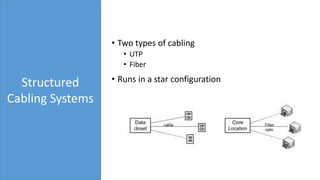
• Two types of cabling
• UTP
• Fiber
• Runs in a star configuration
UTP
• Unshielded Twisted Pair
• Most common media for LAN and Ethernet
• Often used in conjunction with T/P distribution
• UTP is,
• Small
• Flexible
• Less expensive
Twist Pitch
• Used in UTP cabling
• Used to identify different length distance of
different pairs within a single cable.
• Varies between pairs to reduce the affects of
NEXT or signals jumping from one pair to another
• Standard UTP
• Used for patch cable
• Wires/conductors are made of
many flexible stands
• Not suitable for longer distances
• Solid UTP
• Used in horizontal wiring
• Less flexible
• More brittle
• Cheaper
• Efficient
Standard UTP vs Solid UTP
Optical Fiber
• Uses light pulses to transmit data
• Impervious to EMI & RFI
• Good for distance
• Offer greater bandwidth
• Consists of a glass core surrounded by a
protective coating
Subsystems
TIA/EIA 568A
• Building Entrance
• Equipment Room
• Backbone Cabling
• Telecommunications Closet
• Horizontal Cabling
• Work Area
Entrance Facility
• Pint where outside plant cables and associated
hardware brought into the building
• Cables from the outside end in an equipment
room which is the main distribution point for the
building.
• Often called as the BDF (Building distance frame)
Equipment Room
• A Centralized space for communications
equipment.
• Equipment rooms often contain cabling
distribution equipment.
• Patch panels and Cross Connect Blocks are used
to terminate or end cables and to connect them
with other cables and equipment
Backbone Cabling
• Interconnection between closets and equipment
rooms within a single building or between other
buildings.
• Large building may contain several distribution
points
• Telecommunications closets which are necessary
to overcome distance limitations.
• Risers are Vertical cable runs which connect
telecommunications closets on different floors
Telecommunicati-
ons Closet
• A space where horizontal distribution cables are
terminated.
• All cable and media types must be terminated on
compatible connecting hardware.
• Backbone cables are also terminated in the
closet.
• Cross connection is done with jumpers or patch
cords to provide flexible connectivity.
Horizontal
Cabling
• Physical media used to connect each outlet to a
closet.
• Horizontal cables span from telecommunications
closets to the wall jacks with which users connect
their equipment
• Copper cables, Coaxial Cables and Fiber optic
cables may be used.
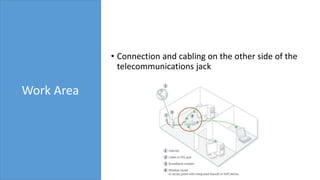
Work Area
• Connection and cabling on the other side of the
telecommunications jack
Standards Bodies
• ANSI: American National Standards Institutes
• TIA: Telecommunication Industry Association
• EIA: Electronics Industry Association
Cabling
Standards
• EIA/TIA 568: first version of the standard, 1991
• TSB-36: Technical systems bulletin specification
for higher grades (cat 4, cat 5) of UTP
• TSB 40 : UTP Connecting hardware
• CSA T529: Commercial Telecommunications
Cabling Standard
• CSA T528: Administration Standard for the
telecommunications infrastructure of commercial
buildings
References
• Wikipedia. “Structured Cabling” wikipedia.com [Online].
Available : http://en.wikipedia.org/wiki/Structured_cabling
• Linctionaryt . “TIA/EIA Structured Cabling Standards”
linktionary.com [Online]. Available :
http://www.linktionary.com/t/tia_cabling.html
• Paul Rosenberg (2000, Apr. 1). “The Basics of Structured
Cabling”. EC & M [Online]. Available:
http://ecmweb.com/basics/basics-structured-cabling

Structure cabling technologies for networking

  • 1.
    Structure Cabling Technologiesfor Networking Rumesh Eranga Hapuarachchi rehrumesh@hotmail.com
  • 2.
    Overview • What isStructured Cabling? • Structured Cabling Systems • Subsystems of a structured cabling system • Standards bodies • Standards
  • 3.
    What is Structured Cabling • Foundationfor any communication installation • An appropriate cabling installation ensures, • Proper operation of equipment • Manageability • Organization • Expandability
  • 4.
    Structured Cabling Systems • Twotypes of cabling • UTP • Fiber • Runs in a star configuration
  • 5.
    UTP • Unshielded TwistedPair • Most common media for LAN and Ethernet • Often used in conjunction with T/P distribution • UTP is, • Small • Flexible • Less expensive
  • 6.
    Twist Pitch • Usedin UTP cabling • Used to identify different length distance of different pairs within a single cable. • Varies between pairs to reduce the affects of NEXT or signals jumping from one pair to another
  • 7.
    • Standard UTP •Used for patch cable • Wires/conductors are made of many flexible stands • Not suitable for longer distances • Solid UTP • Used in horizontal wiring • Less flexible • More brittle • Cheaper • Efficient Standard UTP vs Solid UTP
  • 8.
    Optical Fiber • Useslight pulses to transmit data • Impervious to EMI & RFI • Good for distance • Offer greater bandwidth • Consists of a glass core surrounded by a protective coating
  • 9.
    Subsystems TIA/EIA 568A • BuildingEntrance • Equipment Room • Backbone Cabling • Telecommunications Closet • Horizontal Cabling • Work Area
  • 10.
    Entrance Facility • Pintwhere outside plant cables and associated hardware brought into the building • Cables from the outside end in an equipment room which is the main distribution point for the building. • Often called as the BDF (Building distance frame)
  • 11.
    Equipment Room • ACentralized space for communications equipment. • Equipment rooms often contain cabling distribution equipment. • Patch panels and Cross Connect Blocks are used to terminate or end cables and to connect them with other cables and equipment
  • 12.
    Backbone Cabling • Interconnectionbetween closets and equipment rooms within a single building or between other buildings. • Large building may contain several distribution points • Telecommunications closets which are necessary to overcome distance limitations. • Risers are Vertical cable runs which connect telecommunications closets on different floors
  • 13.
    Telecommunicati- ons Closet • Aspace where horizontal distribution cables are terminated. • All cable and media types must be terminated on compatible connecting hardware. • Backbone cables are also terminated in the closet. • Cross connection is done with jumpers or patch cords to provide flexible connectivity.
  • 14.
    Horizontal Cabling • Physical mediaused to connect each outlet to a closet. • Horizontal cables span from telecommunications closets to the wall jacks with which users connect their equipment • Copper cables, Coaxial Cables and Fiber optic cables may be used.
  • 15.
    Work Area • Connectionand cabling on the other side of the telecommunications jack
  • 16.
    Standards Bodies • ANSI:American National Standards Institutes • TIA: Telecommunication Industry Association • EIA: Electronics Industry Association
  • 17.
    Cabling Standards • EIA/TIA 568:first version of the standard, 1991 • TSB-36: Technical systems bulletin specification for higher grades (cat 4, cat 5) of UTP • TSB 40 : UTP Connecting hardware • CSA T529: Commercial Telecommunications Cabling Standard • CSA T528: Administration Standard for the telecommunications infrastructure of commercial buildings
  • 18.
    References • Wikipedia. “StructuredCabling” wikipedia.com [Online]. Available : http://en.wikipedia.org/wiki/Structured_cabling • Linctionaryt . “TIA/EIA Structured Cabling Standards” linktionary.com [Online]. Available : http://www.linktionary.com/t/tia_cabling.html • Paul Rosenberg (2000, Apr. 1). “The Basics of Structured Cabling”. EC & M [Online]. Available: http://ecmweb.com/basics/basics-structured-cabling

Editor's Notes

  • #5 UTP provides services to individual computers and between network closets Fiber provides service to buildings and between network closets
  • #6 UTP cable is a communications cable using one or more pair of wires that are twisted together. When driven as a balanced line, the twisting reduces the susceptibility to external interference and the radiation of signal energy.
  • #8 Standard UTP is low efficient than solid UTP
  • #9 EMI : Electro Magnetic Interference RFI : Radio Frequency Interferenec 1 pair of fiber bandwidth > 1400 copper pairs in a voice system
  • #17 Thse organizations are composed of representatives from various distributors, Manufacturers and customers in the communications industry.
  • #18 CSA T530 : commercial building standard for pathways TSB 67 Transmission performance specifications for field Testing of UTP TSB 72 : Centralized optical fiber cabling guidlines