

ALTERNATIVE INFRASTRUCTURE
DEPLOYMENT TECHNIQUES
FOR FTTH
Simon Roberts
M2fx Sales Director Africa & Middle East
Fiber revolution in Africa
Connectivity & Capacity has arrived in
Africa via high capacity submarine cables
Connectivity & Capacity has arrived in
Africa via high capacity submarine cables
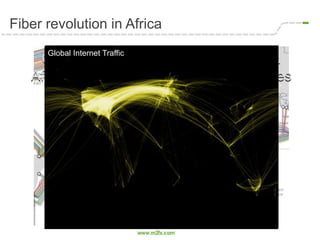
But is this capacity being used…??
Global Internet UseageGlobal Internet Traffic
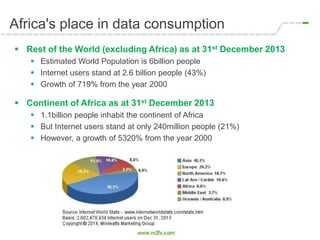
Africa's place in data consumption
 Rest of the World (excluding Africa) as at 31st December 2013
 Estimated World Population is 6billion people
 Internet users stand at 2.6 billion people (43%)
 Growth of 719% from the year 2000
 Continent of Africa as at 31st December 2013
 1.1billion people inhabit the continent of Africa
 But Internet users stand at only 240million people (21%)
 However, a growth of 5320% from the year 2000
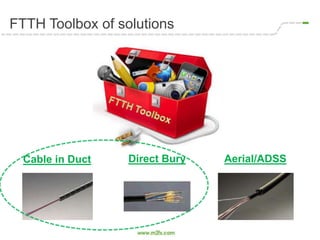
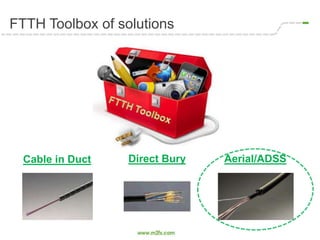
FTTH Toolbox of solutions
Cable in Duct Aerial/ADSSDirect Bury
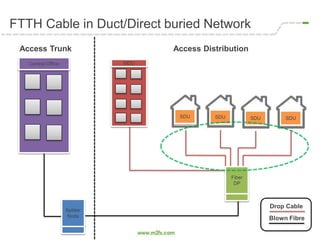
FTTH Cable in Duct/Direct buried Network
Access Trunk Access Distribution
SDU SDU SDU SDU
MDUCentral Office
Splitter
Node
Fiber
DP
Blown Fibre
Drop Cable
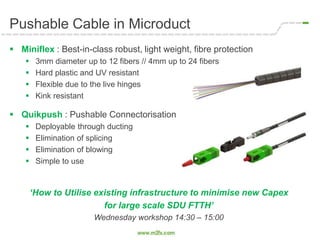
Pushable Cable in Microduct
 Miniflex : Best-in-class robust, light weight, fibre protection
 3mm diameter up to 12 fibers // 4mm up to 24 fibers
 Hard plastic and UV resistant
 Flexible due to the live hinges
 Kink resistant
 Quikpush : Pushable Connectorisation
 Deployable through ducting
 Elimination of splicing
 Elimination of blowing
 Simple to use
‘How to Utilise existing infrastructure to minimise new Capex
for large scale SDU FTTH’
Wednesday workshop 14:30 – 15:00
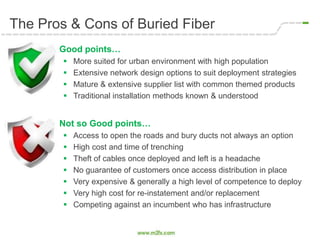
The Pros & Cons of Buried Fiber
 Good points…
 More suited for urban environment with high population
 Extensive network design options to suit deployment strategies
 Mature & extensive supplier list with common themed products
 Traditional installation methods known & understood
 Not so Good points…
 Access to open the roads and bury ducts not always an option
 High cost and time of trenching
 Theft of cables once deployed and left is a headache
 No guarantee of customers once access distribution in place
 Very expensive & generally a high level of competence to deploy
 Very high cost for re-instatement and/or replacement
 Competing against an incumbent who has infrastructure
FTTH Toolbox of solutions
Cable in Duct Aerial/ADSSDirect Bury
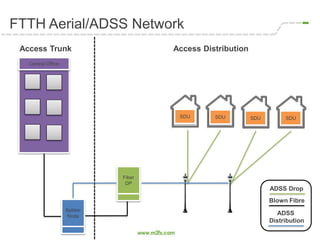
FTTH Aerial/ADSS Network
Access Trunk Access Distribution
SDU SDU SDU SDU
Central Office
Splitter
Node
Fiber
DP
Blown Fibre
ADSS Drop
ADSS
Distribution
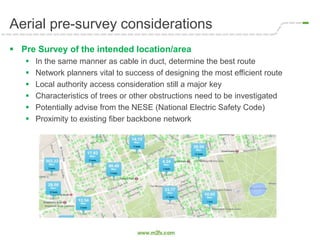
Aerial pre-survey considerations
 Pre Survey of the intended location/area
 In the same manner as cable in duct, determine the best route
 Network planners vital to success of designing the most efficient route
 Local authority access consideration still a major key
 Characteristics of trees or other obstructions need to be investigated
 Potentially advise from the NESE (National Electric Safety Code)
 Proximity to existing fiber backbone network
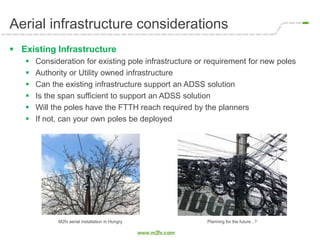
Aerial infrastructure considerations
 Existing Infrastructure
 Consideration for existing pole infrastructure or requirement for new poles
 Authority or Utility owned infrastructure
 Can the existing infrastructure support an ADSS solution
 Is the span sufficient to support an ADSS solution
 Will the poles have the FTTH reach required by the planners
 If not, can your own poles be deployed
M2fx aerial installation in Hungry Planning for the future ..?
Aerial infrastructure considerations
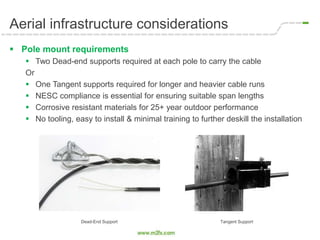
 Pole mount requirements
 Two Dead-end supports required at each pole to carry the cable
Or
 One Tangent supports required for longer and heavier cable runs
 NESC compliance is essential for ensuring suitable span lengths
 Corrosive resistant materials for 25+ year outdoor performance
 No tooling, easy to install & minimal training to further deskill the installation
Dead-End Support Tangent Support
Aerial installation methodology
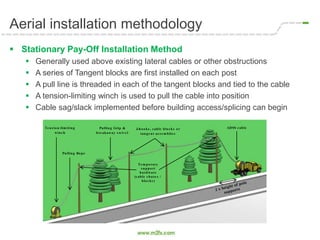
 Stationary Pay-Off Installation Method
 Generally used above existing lateral cables or other obstructions
 A series of Tangent blocks are first installed on each post
 A pull line is threaded in each of the tangent blocks and tied to the cable
 A tension-limiting winch is used to pull the cable into position
 Cable sag/slack implemented before building access/splicing can begin
Te ns io n-lim iting
winch
Pulling Ro pe
Pulling Grip &
bre akaway s wive l
J-ho o ks , cable blo cks o r
tange nt as s e m blie s
Te m po rary
s uppo rt
hardware
(cable chute s /
blo cks )
ADSS cable
Aerial installation methodology
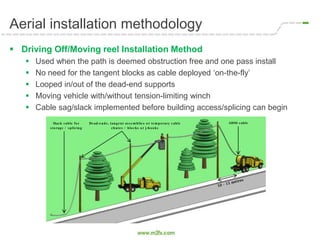
 Driving Off/Moving reel Installation Method
 Used when the path is deemed obstruction free and one pass install
 No need for the tangent blocks as cable deployed ‘on-the-fly’
 Looped in/out of the dead-end supports
 Moving vehicle with/without tension-limiting winch
 Cable sag/slack implemented before building access/splicing can begin
Slack cable fo r
s to rage / s plicing
ADSS cableDe ad-e nds , tange nt as s e m blie s o r te m po rary cable
chute s / blo cks o r j-ho o ks
Aerial installation considerations
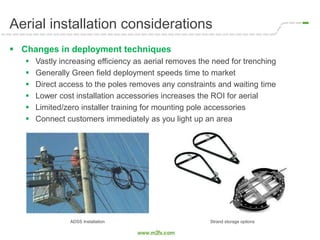
ADSS Installation Strand storage options
 Changes in deployment techniques
 Vastly increasing efficiency as aerial removes the need for trenching
 Generally Green field deployment speeds time to market
 Direct access to the poles removes any constraints and waiting time
 Lower cost installation accessories increases the ROI for aerial
 Limited/zero installer training for mounting pole accessories
 Connect customers immediately as you light up an area
Aerial cable considerations
 Cable selection is essential for successful deployment
 Combined cable for Distribution and Drop requirements
 MDPE material gives excellent UV stability and 25+year UV resistance
 Temperature range from -40°C/+80 °C for the African environment
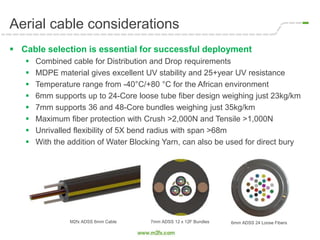
 6mm supports up to 24-Core loose tube fiber design weighing just 23kg/km
 7mm supports 36 and 48-Core bundles weighing just 35kg/km
 Maximum fiber protection with Crush >2,000N and Tensile >1,000N
 Unrivalled flexibility of 5X bend radius with span >68m
 With the addition of Water Blocking Yarn, can also be used for direct bury
M2fx ADSS 6mm Cable 7mm ADSS 12 x 12F Bundles 6mm ADSS 24 Loose Fibers
Not all aerial cable is created equal
 Ultra light cable is unsung star of Cornwall fibre roll-out
 The ‘Big Build’ as it’s known – a partnership between the European Union,
BT and Cornwall Council to roll-out high speed broadband to the county and
the Isles of Scilly – signed up its 10,000th customer
 Chris Munnings : BT Innovate & Design’s Access Platform team
“If engineers were to use traditional aerial fibre cable, it would require a
survey, planning & remedial work before they could be installed.
Not only would this take a lot of time, it would also be expensive.
The (m2fx) cable is strung on existing telegraph poles, but because it is so
lightweight, the poles and other fittings do not need to be strengthened.
Put simply, many parts of rural Cornwall wouldn’t be able to get cost-
effective fibre broadband without this cable,”
http://www.btplc.com/Innovation/News/Cornwallmilestone.htm
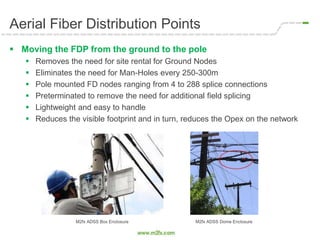
Aerial Fiber Distribution Points
 Moving the FDP from the ground to the pole
 Removes the need for site rental for Ground Nodes
 Eliminates the need for Man-Holes every 250-300m
 Pole mounted FD nodes ranging from 4 to 288 splice connections
 Preterminated to remove the need for additional field splicing
 Lightweight and easy to handle
 Reduces the visible footprint and in turn, reduces the Opex on the network
M2fx ADSS Box Enclosure M2fx ADSS Dome Enclosure
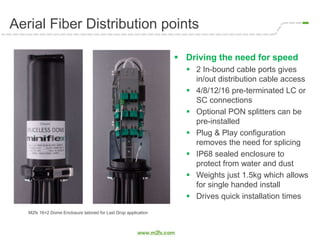
Aerial Fiber Distribution points
 Driving the need for speed
 2 In-bound cable ports gives
in/out distribution cable access
 4/8/12/16 pre-terminated LC or
SC connections
 Optional PON splitters can be
pre-installed
 Plug & Play configuration
removes the need for splicing
 IP68 sealed enclosure to
protect from water and dust
 Weights just 1.5kg which allows
for single handed install
 Drives quick installation times
M2fx 16+2 Dome Enclosure tailored for Last Drop application
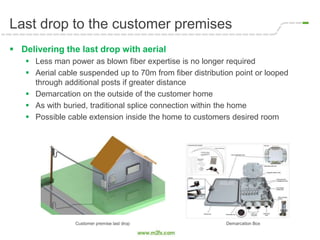
Last drop to the customer premises
 Delivering the last drop with aerial
 Less man power as blown fiber expertise is no longer required
 Aerial cable suspended up to 70m from fiber distribution point or looped
through additional posts if greater distance
 Demarcation on the outside of the customer home
 As with buried, traditional splice connection within the home
 Possible cable extension inside the home to customers desired room
Customer premise last drop Demarcation Box
Last drop to the customer premises
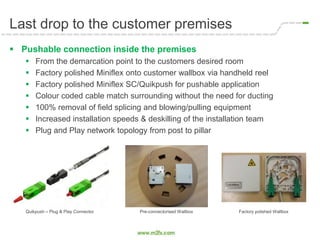
 Pushable connection inside the premises
 From the demarcation point to the customers desired room
 Factory polished Miniflex onto customer wallbox via handheld reel
 Factory polished Miniflex SC/Quikpush for pushable application
 Colour coded cable match surrounding without the need for ducting
 100% removal of field splicing and blowing/pulling equipment
 Increased installation speeds & deskilling of the installation team
 Plug and Play network topology from post to pillar
Quikpush – Plug & Play Connector Pre-connectorised Wallbox Factory polished Wallbox
The Pros & Cons of Aerial
 Pros
 Ideally suited for high speed deployment
 Extending fiber penetration beyond the urban environment
 Vastly reduces the homes past v household connections ratio
 Removes the need for extensive and time consuming trenching
 Removes the need for air blown fiber
 Reduces the installer skills requirement
 Increased time to market and ROI
 Cons
 Possible restriction due to existing pole infrastructure
 Requirement to re-train installers and new equipment
FTTH Toolbox Conclusion
No one peg fits all the holes!
You get what you pay for…
No one peg fits all the holes!
Mr. Simon Roberts
Sales Director Middle East & Africa
s.roberts@m2fx.com
Mob: +44 7787 298350

M2FX FTTH Africa: Alternative FTTH Techniques

  • 1.
    ALTERNATIVE INFRASTRUCTURE DEPLOYMENT TECHNIQUES FORFTTH Simon Roberts M2fx Sales Director Africa & Middle East
  • 2.
    Fiber revolution inAfrica Connectivity & Capacity has arrived in Africa via high capacity submarine cables Connectivity & Capacity has arrived in Africa via high capacity submarine cables But is this capacity being used…?? Global Internet UseageGlobal Internet Traffic
  • 3.
    Africa's place indata consumption  Rest of the World (excluding Africa) as at 31st December 2013  Estimated World Population is 6billion people  Internet users stand at 2.6 billion people (43%)  Growth of 719% from the year 2000  Continent of Africa as at 31st December 2013  1.1billion people inhabit the continent of Africa  But Internet users stand at only 240million people (21%)  However, a growth of 5320% from the year 2000
  • 4.
    FTTH Toolbox ofsolutions Cable in Duct Aerial/ADSSDirect Bury
  • 5.
    FTTH Cable inDuct/Direct buried Network Access Trunk Access Distribution SDU SDU SDU SDU MDUCentral Office Splitter Node Fiber DP Blown Fibre Drop Cable
  • 6.
    Pushable Cable inMicroduct  Miniflex : Best-in-class robust, light weight, fibre protection  3mm diameter up to 12 fibers // 4mm up to 24 fibers  Hard plastic and UV resistant  Flexible due to the live hinges  Kink resistant  Quikpush : Pushable Connectorisation  Deployable through ducting  Elimination of splicing  Elimination of blowing  Simple to use ‘How to Utilise existing infrastructure to minimise new Capex for large scale SDU FTTH’ Wednesday workshop 14:30 – 15:00
  • 7.
    The Pros &Cons of Buried Fiber  Good points…  More suited for urban environment with high population  Extensive network design options to suit deployment strategies  Mature & extensive supplier list with common themed products  Traditional installation methods known & understood  Not so Good points…  Access to open the roads and bury ducts not always an option  High cost and time of trenching  Theft of cables once deployed and left is a headache  No guarantee of customers once access distribution in place  Very expensive & generally a high level of competence to deploy  Very high cost for re-instatement and/or replacement  Competing against an incumbent who has infrastructure
  • 8.
    FTTH Toolbox ofsolutions Cable in Duct Aerial/ADSSDirect Bury
  • 9.
    FTTH Aerial/ADSS Network AccessTrunk Access Distribution SDU SDU SDU SDU Central Office Splitter Node Fiber DP Blown Fibre ADSS Drop ADSS Distribution
  • 10.
    Aerial pre-survey considerations Pre Survey of the intended location/area  In the same manner as cable in duct, determine the best route  Network planners vital to success of designing the most efficient route  Local authority access consideration still a major key  Characteristics of trees or other obstructions need to be investigated  Potentially advise from the NESE (National Electric Safety Code)  Proximity to existing fiber backbone network
  • 11.
    Aerial infrastructure considerations Existing Infrastructure  Consideration for existing pole infrastructure or requirement for new poles  Authority or Utility owned infrastructure  Can the existing infrastructure support an ADSS solution  Is the span sufficient to support an ADSS solution  Will the poles have the FTTH reach required by the planners  If not, can your own poles be deployed M2fx aerial installation in Hungry Planning for the future ..?
  • 12.
    Aerial infrastructure considerations Pole mount requirements  Two Dead-end supports required at each pole to carry the cable Or  One Tangent supports required for longer and heavier cable runs  NESC compliance is essential for ensuring suitable span lengths  Corrosive resistant materials for 25+ year outdoor performance  No tooling, easy to install & minimal training to further deskill the installation Dead-End Support Tangent Support
  • 13.
    Aerial installation methodology Stationary Pay-Off Installation Method  Generally used above existing lateral cables or other obstructions  A series of Tangent blocks are first installed on each post  A pull line is threaded in each of the tangent blocks and tied to the cable  A tension-limiting winch is used to pull the cable into position  Cable sag/slack implemented before building access/splicing can begin Te ns io n-lim iting winch Pulling Ro pe Pulling Grip & bre akaway s wive l J-ho o ks , cable blo cks o r tange nt as s e m blie s Te m po rary s uppo rt hardware (cable chute s / blo cks ) ADSS cable
  • 14.
    Aerial installation methodology Driving Off/Moving reel Installation Method  Used when the path is deemed obstruction free and one pass install  No need for the tangent blocks as cable deployed ‘on-the-fly’  Looped in/out of the dead-end supports  Moving vehicle with/without tension-limiting winch  Cable sag/slack implemented before building access/splicing can begin Slack cable fo r s to rage / s plicing ADSS cableDe ad-e nds , tange nt as s e m blie s o r te m po rary cable chute s / blo cks o r j-ho o ks
  • 15.
    Aerial installation considerations ADSSInstallation Strand storage options  Changes in deployment techniques  Vastly increasing efficiency as aerial removes the need for trenching  Generally Green field deployment speeds time to market  Direct access to the poles removes any constraints and waiting time  Lower cost installation accessories increases the ROI for aerial  Limited/zero installer training for mounting pole accessories  Connect customers immediately as you light up an area
  • 16.
    Aerial cable considerations Cable selection is essential for successful deployment  Combined cable for Distribution and Drop requirements  MDPE material gives excellent UV stability and 25+year UV resistance  Temperature range from -40°C/+80 °C for the African environment  6mm supports up to 24-Core loose tube fiber design weighing just 23kg/km  7mm supports 36 and 48-Core bundles weighing just 35kg/km  Maximum fiber protection with Crush >2,000N and Tensile >1,000N  Unrivalled flexibility of 5X bend radius with span >68m  With the addition of Water Blocking Yarn, can also be used for direct bury M2fx ADSS 6mm Cable 7mm ADSS 12 x 12F Bundles 6mm ADSS 24 Loose Fibers
  • 17.
    Not all aerialcable is created equal  Ultra light cable is unsung star of Cornwall fibre roll-out  The ‘Big Build’ as it’s known – a partnership between the European Union, BT and Cornwall Council to roll-out high speed broadband to the county and the Isles of Scilly – signed up its 10,000th customer  Chris Munnings : BT Innovate & Design’s Access Platform team “If engineers were to use traditional aerial fibre cable, it would require a survey, planning & remedial work before they could be installed. Not only would this take a lot of time, it would also be expensive. The (m2fx) cable is strung on existing telegraph poles, but because it is so lightweight, the poles and other fittings do not need to be strengthened. Put simply, many parts of rural Cornwall wouldn’t be able to get cost- effective fibre broadband without this cable,” http://www.btplc.com/Innovation/News/Cornwallmilestone.htm
  • 18.
    Aerial Fiber DistributionPoints  Moving the FDP from the ground to the pole  Removes the need for site rental for Ground Nodes  Eliminates the need for Man-Holes every 250-300m  Pole mounted FD nodes ranging from 4 to 288 splice connections  Preterminated to remove the need for additional field splicing  Lightweight and easy to handle  Reduces the visible footprint and in turn, reduces the Opex on the network M2fx ADSS Box Enclosure M2fx ADSS Dome Enclosure
  • 19.
    Aerial Fiber Distributionpoints  Driving the need for speed  2 In-bound cable ports gives in/out distribution cable access  4/8/12/16 pre-terminated LC or SC connections  Optional PON splitters can be pre-installed  Plug & Play configuration removes the need for splicing  IP68 sealed enclosure to protect from water and dust  Weights just 1.5kg which allows for single handed install  Drives quick installation times M2fx 16+2 Dome Enclosure tailored for Last Drop application
  • 20.
    Last drop tothe customer premises  Delivering the last drop with aerial  Less man power as blown fiber expertise is no longer required  Aerial cable suspended up to 70m from fiber distribution point or looped through additional posts if greater distance  Demarcation on the outside of the customer home  As with buried, traditional splice connection within the home  Possible cable extension inside the home to customers desired room Customer premise last drop Demarcation Box
  • 21.
    Last drop tothe customer premises  Pushable connection inside the premises  From the demarcation point to the customers desired room  Factory polished Miniflex onto customer wallbox via handheld reel  Factory polished Miniflex SC/Quikpush for pushable application  Colour coded cable match surrounding without the need for ducting  100% removal of field splicing and blowing/pulling equipment  Increased installation speeds & deskilling of the installation team  Plug and Play network topology from post to pillar Quikpush – Plug & Play Connector Pre-connectorised Wallbox Factory polished Wallbox
  • 22.
    The Pros &Cons of Aerial  Pros  Ideally suited for high speed deployment  Extending fiber penetration beyond the urban environment  Vastly reduces the homes past v household connections ratio  Removes the need for extensive and time consuming trenching  Removes the need for air blown fiber  Reduces the installer skills requirement  Increased time to market and ROI  Cons  Possible restriction due to existing pole infrastructure  Requirement to re-train installers and new equipment
  • 23.
    FTTH Toolbox Conclusion Noone peg fits all the holes! You get what you pay for…
  • 24.
    No one pegfits all the holes! Mr. Simon Roberts Sales Director Middle East & Africa s.roberts@m2fx.com Mob: +44 7787 298350