FUTURE OF WIRE-LINE
ACCESS NETWORKS
SEPTEMBER 2012

By Eng. Anuradha Udunuwara,
BSc.Eng(Hons), CEng, MIE(SL), MEF-CECP, MBCS, ITILv3 Foundation, MIEEE, MIEEE-CS, MIEE, MIET, MCS(SL), MSLAAS
Agenda
2


       Introduction
       Design Criteria
       Copper or fiber
       Optical access network


                            (c) Anuradha Udunuwara
Introduction
3


                             Wired (optical fiber)                                   APON
                  Core
                                   Wireless                                          BPON
                             Wired (optical fiber)                     TDM PON
               Aggregation                                                           GPON
                                   Wireless

                                                                                     EPON
                                                     Cable       PON
CSP networks
                                                                       WDM PON
                             Wired
                                                                                    10GPON
                                                 Optical fiber
                 Access
                                                                 AON
                                                     Copper            Hybrid PON   10GEPON


                                Wireless

                                       (c) Anuradha Udunuwara
Design Criteria
4


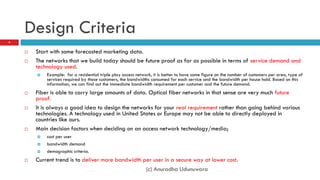
       Start with some forecasted marketing data.
       The networks that we build today should be future proof as far as possible in terms of service demand and
        technology used.
           Example: for a residential triple play access network, it is better to have some figure on the number of customers per area, type of
            services required by those customers, the bandwidths consumed for each service and the bandwidth per house hold. Based on this
            information, we can find out the immediate bandwidth requirement per customer and the future demand.
       Fiber is able to carry large amounts of data. Optical fiber networks in that sense are very much future
        proof.
       It is always a good idea to design the networks for your real requirement rather than going behind various
        technologies. A technology used in United States or Europe may not be able to directly deployed in
        countries like ours.
       Main decision factors when deciding on an access network technology/media;
           cost per user
           bandwidth demand
           demographic criteria.
       Current trend is to deliver more bandwidth per user in a secure way at lower cost.
                                                    (c) Anuradha Udunuwara
Copper or fiber ?
5


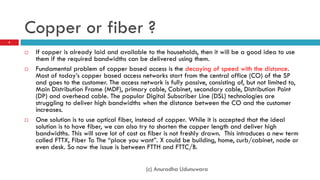
       If copper is already laid and available to the households, then it will be a good idea to use
        them if the required bandwidths can be delivered using them.
       Fundamental problem of copper based access is the decaying of speed with the distance.
        Most of today’s copper based access networks start from the central office (CO) of the SP
        and goes to the customer. The access network is fully passive, consisting of, but not limited to,
        Main Distribution Frame (MDF), primary cable, Cabinet, secondary cable, Distribution Point
        (DP) and overhead cable. The popular Digital Subscriber Line (DSL) technologies are
        struggling to deliver high bandwidths when the distance between the CO and the customer
        increases.
       One solution is to use optical fiber, instead of copper. While it is accepted that the ideal
        solution is to have fiber, we can also try to shorten the copper length and deliver high
        bandwidths. This will save lot of cost as fiber is not freshly drawn. This introduces a new term
        called FTTX, Fiber To The “place you want”. X could be building, home, curb/cabinet, node or
        even desk. So now the issue is between FTTH and FTTC/B.


                                                (c) Anuradha Udunuwara
Optical access networks
6


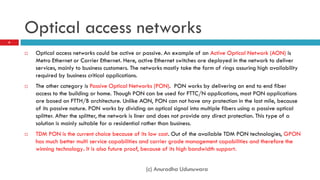
       Optical access networks could be active or passive. An example of an Active Optical Network (AON) is
        Metro Ethernet or Carrier Ethernet. Here, active Ethernet switches are deployed in the network to deliver
        services, mainly to business customers. The networks mostly take the form of rings assuring high availability
        required by business critical applications.
       The other category is Passive Optical Networks (PON). PON works by delivering an end to end fiber
        access to the building or home. Though PON can be used for FTTC/N applications, most PON applications
        are based on FTTH/B architecture. Unlike AON, PON can not have any protection in the last mile, because
        of its passive nature. PON works by dividing an optical signal into multiple fibers using a passive optical
        splitter. After the splitter, the network is liner and does not provide any direct protection. This type of a
        solution is mainly suitable for a residential rather than business.
       TDM PON is the current choice because of its low cost. Out of the available TDM PON technologies, GPON
        has much better multi service capabilities and carrier grade management capabilities and therefore the
        winning technology. It is also future proof, because of its high bandwidth support.


                                                     (c) Anuradha Udunuwara
Options
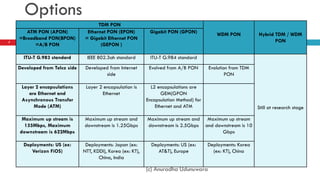
                                      TDM PON
       ATM PON (APON)            Ethernet PON (EPON)           Gigabit PON (GPON)             WDM PON            Hybrid TDM / WDM
    =Broadband PON(BPON)        = Gigabit Ethernet PON                                                                  PON
7
          =A/B PON                     (GEPON )

      ITU-T G.983 standard       IEEE 802.3ah standard         ITU-T G.984 standard
    Developed from Telco side    Developed from Internet       Evolved from A/B PON        Evolution from TDM
                                         side                                                      PON

     Layer 2 encapsulations      Layer 2 encapsulation is       L2 encapsulations are
        are Ethernet and                Ethernet                     GEM(GPON
     Asynchronous Transfer                                    Encapsulation Method) for
          Mode (ATM)                                              Ethernet and ATM                               Still at research stage

     Maximum up stream is       Maximum up stream and         Maximum up stream and        Maximum up stream
      155Mbps, Maximum          downstream is 1.25Gbps        downstream is 2.5Gbps       and downstream is 10
    downstream is 622Mbps                                                                        Gbps

      Deployments: US (ex:       Deployments: Japan (ex:        Deployments: US (ex:      Deployments: Korea
         Verizon FiOS)          NTT, KDDI), Korea (ex: KT),        AT&T), Europe            (ex: KT), China
                                       China, India

                                                              (c) Anuradha Udunuwara
About the Author
8


    Eng. Anuradha Udunuwara is a Chartered Engineer by profession based in Sri Lanka. He has nearly a decade
    industry experience in strategy, architecture, engineering, design, plan, implementation and maintenance of CSP
    Networks using both packet-switched (PS) and Circuit-Switched (CS) technologies, along with legacy to NGN
    migration. Eng. Anuradha is a well-known in the field of CSP industry, both locally and internationally.
    Graduated from University of Peradeniya, Sri Lanka in 2001 with an honors in Electrical & Electronic Engineering,
    Eng. Anuradha is a corporate member of the Institution of Engineers Sri Lanka, a professional member of British
    Computer Society, a member of Institution of Electrical & Electronic Engineers, a member of Institution of
    Engineering & Technology (formerly Institution of Electrical Engineers), a member of the Computer Society of Sri
    Lanka, a life member of Sri Lanka Association for the Advancement of Science, senior member of the Carrier
    Ethernet Forum, member of the Internet Society, member of the Internet Strategy Forum, member of the Internet
    Strategy Forum Network, member of the Ethernet Academy, member of the NGN/IMS forum and member of the
    Peradeniya Engineering Faculty Alumni Association. He is also an ITIL foundation certified and the only MEF-CECP in
    the country.
    In his spare time Anuradha enjoys spending time with his family, playing badminton, photography, reading and
    travelling.
    He can be reached at udunuwara@ieee.org

                                                      (c) Anuradha Udunuwara

Future of wire line access networks

  • 1.
    FUTURE OF WIRE-LINE ACCESSNETWORKS SEPTEMBER 2012 By Eng. Anuradha Udunuwara, BSc.Eng(Hons), CEng, MIE(SL), MEF-CECP, MBCS, ITILv3 Foundation, MIEEE, MIEEE-CS, MIEE, MIET, MCS(SL), MSLAAS
  • 2.
    Agenda 2  Introduction  Design Criteria  Copper or fiber  Optical access network (c) Anuradha Udunuwara
  • 3.
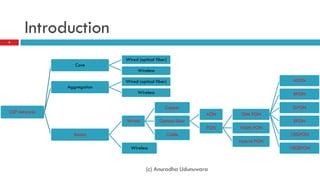
    Introduction 3 Wired (optical fiber) APON Core Wireless BPON Wired (optical fiber) TDM PON Aggregation GPON Wireless EPON Cable PON CSP networks WDM PON Wired 10GPON Optical fiber Access AON Copper Hybrid PON 10GEPON Wireless (c) Anuradha Udunuwara
  • 4.
    Design Criteria 4  Start with some forecasted marketing data.  The networks that we build today should be future proof as far as possible in terms of service demand and technology used.  Example: for a residential triple play access network, it is better to have some figure on the number of customers per area, type of services required by those customers, the bandwidths consumed for each service and the bandwidth per house hold. Based on this information, we can find out the immediate bandwidth requirement per customer and the future demand.  Fiber is able to carry large amounts of data. Optical fiber networks in that sense are very much future proof.  It is always a good idea to design the networks for your real requirement rather than going behind various technologies. A technology used in United States or Europe may not be able to directly deployed in countries like ours.  Main decision factors when deciding on an access network technology/media;  cost per user  bandwidth demand  demographic criteria.  Current trend is to deliver more bandwidth per user in a secure way at lower cost. (c) Anuradha Udunuwara
  • 5.
    Copper or fiber? 5  If copper is already laid and available to the households, then it will be a good idea to use them if the required bandwidths can be delivered using them.  Fundamental problem of copper based access is the decaying of speed with the distance. Most of today’s copper based access networks start from the central office (CO) of the SP and goes to the customer. The access network is fully passive, consisting of, but not limited to, Main Distribution Frame (MDF), primary cable, Cabinet, secondary cable, Distribution Point (DP) and overhead cable. The popular Digital Subscriber Line (DSL) technologies are struggling to deliver high bandwidths when the distance between the CO and the customer increases.  One solution is to use optical fiber, instead of copper. While it is accepted that the ideal solution is to have fiber, we can also try to shorten the copper length and deliver high bandwidths. This will save lot of cost as fiber is not freshly drawn. This introduces a new term called FTTX, Fiber To The “place you want”. X could be building, home, curb/cabinet, node or even desk. So now the issue is between FTTH and FTTC/B. (c) Anuradha Udunuwara
  • 6.
    Optical access networks 6  Optical access networks could be active or passive. An example of an Active Optical Network (AON) is Metro Ethernet or Carrier Ethernet. Here, active Ethernet switches are deployed in the network to deliver services, mainly to business customers. The networks mostly take the form of rings assuring high availability required by business critical applications.  The other category is Passive Optical Networks (PON). PON works by delivering an end to end fiber access to the building or home. Though PON can be used for FTTC/N applications, most PON applications are based on FTTH/B architecture. Unlike AON, PON can not have any protection in the last mile, because of its passive nature. PON works by dividing an optical signal into multiple fibers using a passive optical splitter. After the splitter, the network is liner and does not provide any direct protection. This type of a solution is mainly suitable for a residential rather than business.  TDM PON is the current choice because of its low cost. Out of the available TDM PON technologies, GPON has much better multi service capabilities and carrier grade management capabilities and therefore the winning technology. It is also future proof, because of its high bandwidth support. (c) Anuradha Udunuwara
  • 7.
    Options TDM PON ATM PON (APON) Ethernet PON (EPON) Gigabit PON (GPON) WDM PON Hybrid TDM / WDM =Broadband PON(BPON) = Gigabit Ethernet PON PON 7 =A/B PON (GEPON ) ITU-T G.983 standard IEEE 802.3ah standard ITU-T G.984 standard Developed from Telco side Developed from Internet Evolved from A/B PON Evolution from TDM side PON Layer 2 encapsulations Layer 2 encapsulation is L2 encapsulations are are Ethernet and Ethernet GEM(GPON Asynchronous Transfer Encapsulation Method) for Mode (ATM) Ethernet and ATM Still at research stage Maximum up stream is Maximum up stream and Maximum up stream and Maximum up stream 155Mbps, Maximum downstream is 1.25Gbps downstream is 2.5Gbps and downstream is 10 downstream is 622Mbps Gbps Deployments: US (ex: Deployments: Japan (ex: Deployments: US (ex: Deployments: Korea Verizon FiOS) NTT, KDDI), Korea (ex: KT), AT&T), Europe (ex: KT), China China, India (c) Anuradha Udunuwara
  • 8.
    About the Author 8 Eng. Anuradha Udunuwara is a Chartered Engineer by profession based in Sri Lanka. He has nearly a decade industry experience in strategy, architecture, engineering, design, plan, implementation and maintenance of CSP Networks using both packet-switched (PS) and Circuit-Switched (CS) technologies, along with legacy to NGN migration. Eng. Anuradha is a well-known in the field of CSP industry, both locally and internationally. Graduated from University of Peradeniya, Sri Lanka in 2001 with an honors in Electrical & Electronic Engineering, Eng. Anuradha is a corporate member of the Institution of Engineers Sri Lanka, a professional member of British Computer Society, a member of Institution of Electrical & Electronic Engineers, a member of Institution of Engineering & Technology (formerly Institution of Electrical Engineers), a member of the Computer Society of Sri Lanka, a life member of Sri Lanka Association for the Advancement of Science, senior member of the Carrier Ethernet Forum, member of the Internet Society, member of the Internet Strategy Forum, member of the Internet Strategy Forum Network, member of the Ethernet Academy, member of the NGN/IMS forum and member of the Peradeniya Engineering Faculty Alumni Association. He is also an ITIL foundation certified and the only MEF-CECP in the country. In his spare time Anuradha enjoys spending time with his family, playing badminton, photography, reading and travelling. He can be reached at udunuwara@ieee.org (c) Anuradha Udunuwara