Objectives
In this module, you will learn to:
Explaining Optic Fiber
History of Fiber
WHY Fiber Network?
Application of Fiber
Execution Stages in Fiber Netowrk
OPTIC FIBER
Explaining Optic Fiber
OPTIC FIBER
Explaining Optic Fiber
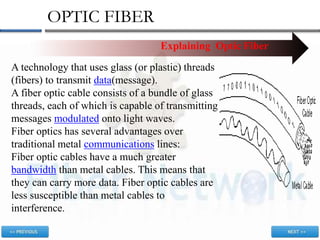
A technology that uses glass (or plastic) threads
(fibers) to transmit data(message).
A fiber optic cable consists of a bundle of glass
threads, each of which is capable of transmitting
messages modulated onto light waves.
Fiber optics has several advantages over
traditional metal communications lines:
Fiber optic cables have a much greater
bandwidth than metal cables. This means that
they can carry more data. Fiber optic cables are
less susceptible than metal cables to
interference.
OPTIC FIBER
Explaining Optic Fiber
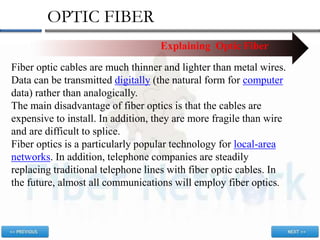
Fiber optic cables are much thinner and lighter than metal wires.
Data can be transmitted digitally (the natural form for computer
data) rather than analogically.
The main disadvantage of fiber optics is that the cables are
expensive to install. In addition, they are more fragile than wire
and are difficult to splice.
Fiber optics is a particularly popular technology for local-area
networks. In addition, telephone companies are steadily
replacing traditional telephone lines with fiber optic cables. In
the future, almost all communications will employ fiber optics.
OPTIC FIBER
History
OPTIC FIBER
History
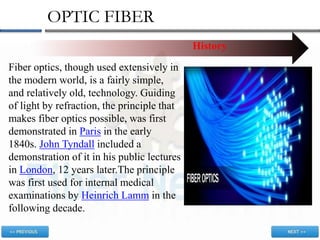
Fiber optics, though used extensively in
the modern world, is a fairly simple,
and relatively old, technology. Guiding
of light by refraction, the principle that
makes fiber optics possible, was first
demonstrated in Paris in the early
1840s. John Tyndall included a
demonstration of it in his public lectures
in London, 12 years later.The principle
was first used for internal medical
examinations by Heinrich Lamm in the
following decade.
OPTIC FIBER
History
Modern optical fibers, where the glass fiber is coated with a
transparent cladding to offer a more suitable refractive index,
appeared later in the decade. Development then focused on
fiber bundles for image transmission. Robust modern optical
fiber uses glass for both core and sheath, and is therefore less
prone to aging. It was invented by Gerhard Bernsee of Schott
Glass in Germany in 1973.
The emerging field of photonic crystals led to the
development in 1991 of photonic-crystal fiber,[21] which
guides light by diffraction from a periodic structure, rather
than by total internal reflection. The first photonic crystal
fibers became commercially available in 2000.Photonic
crystal fibers can carry higher power than conventional fibers
and their wavelength-dependent properties can be
manipulated to improve performance
OPTIC FIBER
WHY FIBER?
OPTIC FIBER
Essence & Application of Fiber Network
How can fiber optics be used?
The possibilities for fiber optics are nearly endless
because they are very flexible and durable, even under
extreme conditions, and the signal cannot be easily
distorted.
They also don’t require much power and are
efficient. Today, they are used mostly in
telecommunications, such as in cable TV and internet.
OPTIC FIBER
Essence & Application of Fiber Network
How do they compare to the old-fashioned
metal wires?
Fiber optics are thinner and more flexible;
therefore they are lighter and take up less space.
They can carry more information.
They use less power and are more efficient
because they don’t degrade as much over time.
They are better suited to carrying digital
signals (i.e. computer information).
There is no electricity passing through them,
so you won’t burn your house down.
If you were to make a phone call
to Europe, traditionally the
signal would go up to a satellite
and then back down to Europe.
That process can create
distortion and echoes. With fiber
optics, if the call is transmitted
through a transatlantic fiber
optic cable, there is a direct
connection, so your call will be
more clear!
OPTIC FIBER
Essence & Application of Fiber Network
Parts of the Fibre Optic System
A fibre optic system has four main components:
Transmitter : Converts a signal, for example sound, into a pattern of light.
Optical Fiber : The cable that conducts the light patterns over large
distances.
Optical Regenerator : In transmittance, some light energy may be lost. This
device boosts the light signal back up to continue its
journey. This is used for signals sent over very large
distances.
Optical Receiver: Converts the light patterns back to an understandable
message, (i.e., sound).
OPTIC FIBER
Execution Stages ?
OPTIC FIBER
Execution
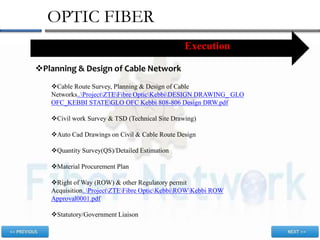
Planning & Design of Cable Network
Cable Route Survey, Planning & Design of Cable
Networks..ProjectZTEFibre OpticKebbiDESIGN DRAWING_ GLO
OFC_KEBBI STATEGLO OFC Kebbi 808-806 Design DRW.pdf
Civil work Survey & TSD (Technical Site Drawing)
Auto Cad Drawings on Civil & Cable Route Design
Quantity Survey(QS)/Detailed Estimation
Material Procurement Plan
Right of Way (ROW) & other Regulatory permit
Acquisition..ProjectZTEFibre OpticKebbiROWKebbi ROW
Approval0001.pdf
Statutory/Government Liaison
OPTIC FIBER
Execution
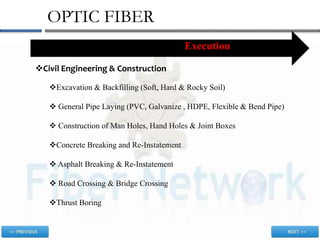
Civil Engineering & Construction
Excavation & Backfilling (Soft, Hard & Rocky Soil)
 General Pipe Laying (PVC, Galvanize , HDPE, Flexible & Bend Pipe)
 Construction of Man Holes, Hand Holes & Joint Boxes
Concrete Breaking and Re-Instatement
 Asphalt Breaking & Re-Instatement
 Road Crossing & Bridge Crossing
Thrust Boring
OPTIC FIBER
Execution
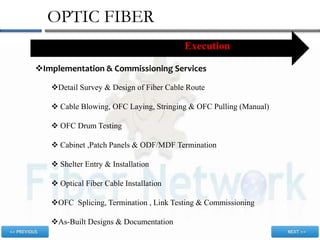
Implementation & Commissioning Services
Detail Survey & Design of Fiber Cable Route
 Cable Blowing, OFC Laying, Stringing & OFC Pulling (Manual)
 OFC Drum Testing
 Cabinet ,Patch Panels & ODF/MDF Termination
 Shelter Entry & Installation
 Optical Fiber Cable Installation
OFC Splicing, Termination , Link Testing & Commissioning
As-Built Designs & Documentation
OPTIC FIBER
Execution
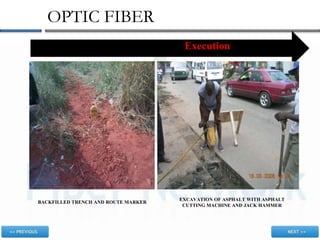
BACKFILLED TRENCH AND ROUTE MARKER
EXCAVATION OF ASPHALT WITH ASPHALT
CUTTING MACHINE AND JACK HAMMER
OPTIC FIBER
Execution
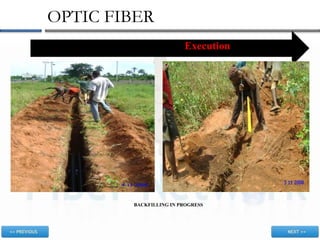
BACKFILLING IN PROGRESS
OPTIC FIBER
Execution
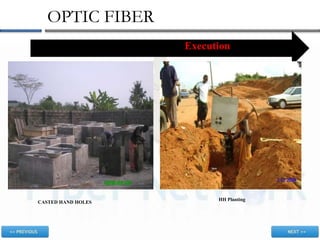
CASTED HAND HOLES
HH Planting
OPTIC FIBER
Execution
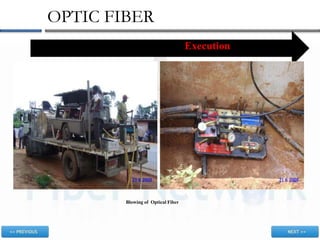
Blowing of Optical Fiber
Fiber Network Deployment

Fiber Network Deployment

  • 2.
    Objectives In this module,you will learn to: Explaining Optic Fiber History of Fiber WHY Fiber Network? Application of Fiber Execution Stages in Fiber Netowrk
  • 3.
  • 4.
    OPTIC FIBER Explaining OpticFiber A technology that uses glass (or plastic) threads (fibers) to transmit data(message). A fiber optic cable consists of a bundle of glass threads, each of which is capable of transmitting messages modulated onto light waves. Fiber optics has several advantages over traditional metal communications lines: Fiber optic cables have a much greater bandwidth than metal cables. This means that they can carry more data. Fiber optic cables are less susceptible than metal cables to interference.
  • 5.
    OPTIC FIBER Explaining OpticFiber Fiber optic cables are much thinner and lighter than metal wires. Data can be transmitted digitally (the natural form for computer data) rather than analogically. The main disadvantage of fiber optics is that the cables are expensive to install. In addition, they are more fragile than wire and are difficult to splice. Fiber optics is a particularly popular technology for local-area networks. In addition, telephone companies are steadily replacing traditional telephone lines with fiber optic cables. In the future, almost all communications will employ fiber optics.
  • 6.
  • 7.
    OPTIC FIBER History Fiber optics,though used extensively in the modern world, is a fairly simple, and relatively old, technology. Guiding of light by refraction, the principle that makes fiber optics possible, was first demonstrated in Paris in the early 1840s. John Tyndall included a demonstration of it in his public lectures in London, 12 years later.The principle was first used for internal medical examinations by Heinrich Lamm in the following decade.
  • 8.
    OPTIC FIBER History Modern opticalfibers, where the glass fiber is coated with a transparent cladding to offer a more suitable refractive index, appeared later in the decade. Development then focused on fiber bundles for image transmission. Robust modern optical fiber uses glass for both core and sheath, and is therefore less prone to aging. It was invented by Gerhard Bernsee of Schott Glass in Germany in 1973. The emerging field of photonic crystals led to the development in 1991 of photonic-crystal fiber,[21] which guides light by diffraction from a periodic structure, rather than by total internal reflection. The first photonic crystal fibers became commercially available in 2000.Photonic crystal fibers can carry higher power than conventional fibers and their wavelength-dependent properties can be manipulated to improve performance
  • 9.
  • 10.
    OPTIC FIBER Essence &Application of Fiber Network How can fiber optics be used? The possibilities for fiber optics are nearly endless because they are very flexible and durable, even under extreme conditions, and the signal cannot be easily distorted. They also don’t require much power and are efficient. Today, they are used mostly in telecommunications, such as in cable TV and internet.
  • 11.
    OPTIC FIBER Essence &Application of Fiber Network How do they compare to the old-fashioned metal wires? Fiber optics are thinner and more flexible; therefore they are lighter and take up less space. They can carry more information. They use less power and are more efficient because they don’t degrade as much over time. They are better suited to carrying digital signals (i.e. computer information). There is no electricity passing through them, so you won’t burn your house down. If you were to make a phone call to Europe, traditionally the signal would go up to a satellite and then back down to Europe. That process can create distortion and echoes. With fiber optics, if the call is transmitted through a transatlantic fiber optic cable, there is a direct connection, so your call will be more clear!
  • 12.
    OPTIC FIBER Essence &Application of Fiber Network Parts of the Fibre Optic System A fibre optic system has four main components: Transmitter : Converts a signal, for example sound, into a pattern of light. Optical Fiber : The cable that conducts the light patterns over large distances. Optical Regenerator : In transmittance, some light energy may be lost. This device boosts the light signal back up to continue its journey. This is used for signals sent over very large distances. Optical Receiver: Converts the light patterns back to an understandable message, (i.e., sound).
  • 13.
  • 14.
    OPTIC FIBER Execution Planning &Design of Cable Network Cable Route Survey, Planning & Design of Cable Networks..ProjectZTEFibre OpticKebbiDESIGN DRAWING_ GLO OFC_KEBBI STATEGLO OFC Kebbi 808-806 Design DRW.pdf Civil work Survey & TSD (Technical Site Drawing) Auto Cad Drawings on Civil & Cable Route Design Quantity Survey(QS)/Detailed Estimation Material Procurement Plan Right of Way (ROW) & other Regulatory permit Acquisition..ProjectZTEFibre OpticKebbiROWKebbi ROW Approval0001.pdf Statutory/Government Liaison
  • 15.
    OPTIC FIBER Execution Civil Engineering& Construction Excavation & Backfilling (Soft, Hard & Rocky Soil)  General Pipe Laying (PVC, Galvanize , HDPE, Flexible & Bend Pipe)  Construction of Man Holes, Hand Holes & Joint Boxes Concrete Breaking and Re-Instatement  Asphalt Breaking & Re-Instatement  Road Crossing & Bridge Crossing Thrust Boring
  • 16.
    OPTIC FIBER Execution Implementation &Commissioning Services Detail Survey & Design of Fiber Cable Route  Cable Blowing, OFC Laying, Stringing & OFC Pulling (Manual)  OFC Drum Testing  Cabinet ,Patch Panels & ODF/MDF Termination  Shelter Entry & Installation  Optical Fiber Cable Installation OFC Splicing, Termination , Link Testing & Commissioning As-Built Designs & Documentation
  • 17.
    OPTIC FIBER Execution BACKFILLED TRENCHAND ROUTE MARKER EXCAVATION OF ASPHALT WITH ASPHALT CUTTING MACHINE AND JACK HAMMER
  • 18.
  • 19.
  • 20.