METRO ETHERNET (ME)
OCTOBER 2012

By Eng. Anuradha Udunuwara,
BSc.Eng(Hons), CEng, MIE(SL), MEF-CECP, MBCS, ITILv3 Foundation, MIEEE, MIEEE-CS, MIEE, MIET, MCS(SL), MSLAAS
Agenda
2


       ME concepts
       ME technology


                        (c) Anuradha Udunuwara
3
    ME concepts


                  (c) Anuradha Udunuwara
Ethernet vs. ME
4


       Ethernet
         a transport technology
         an interface
         a protocol (the 1st asynchronous protocol designed to carry
          data)
       ME
           a service (with defined set of attributes)
       ME = Carrier Ethernet (CE)
                                    (c) Anuradha Udunuwara
5
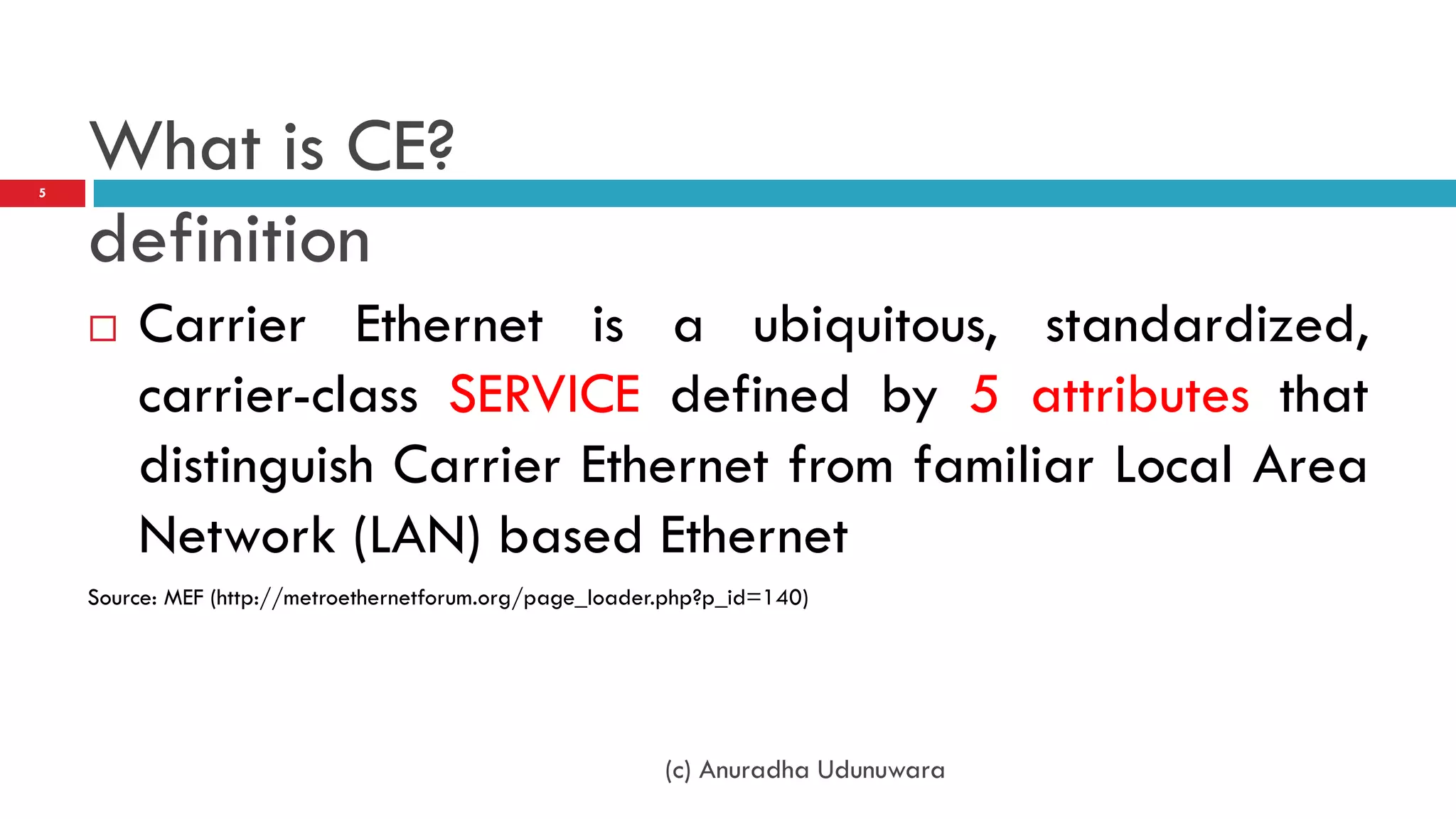
    What is CE?
    definition
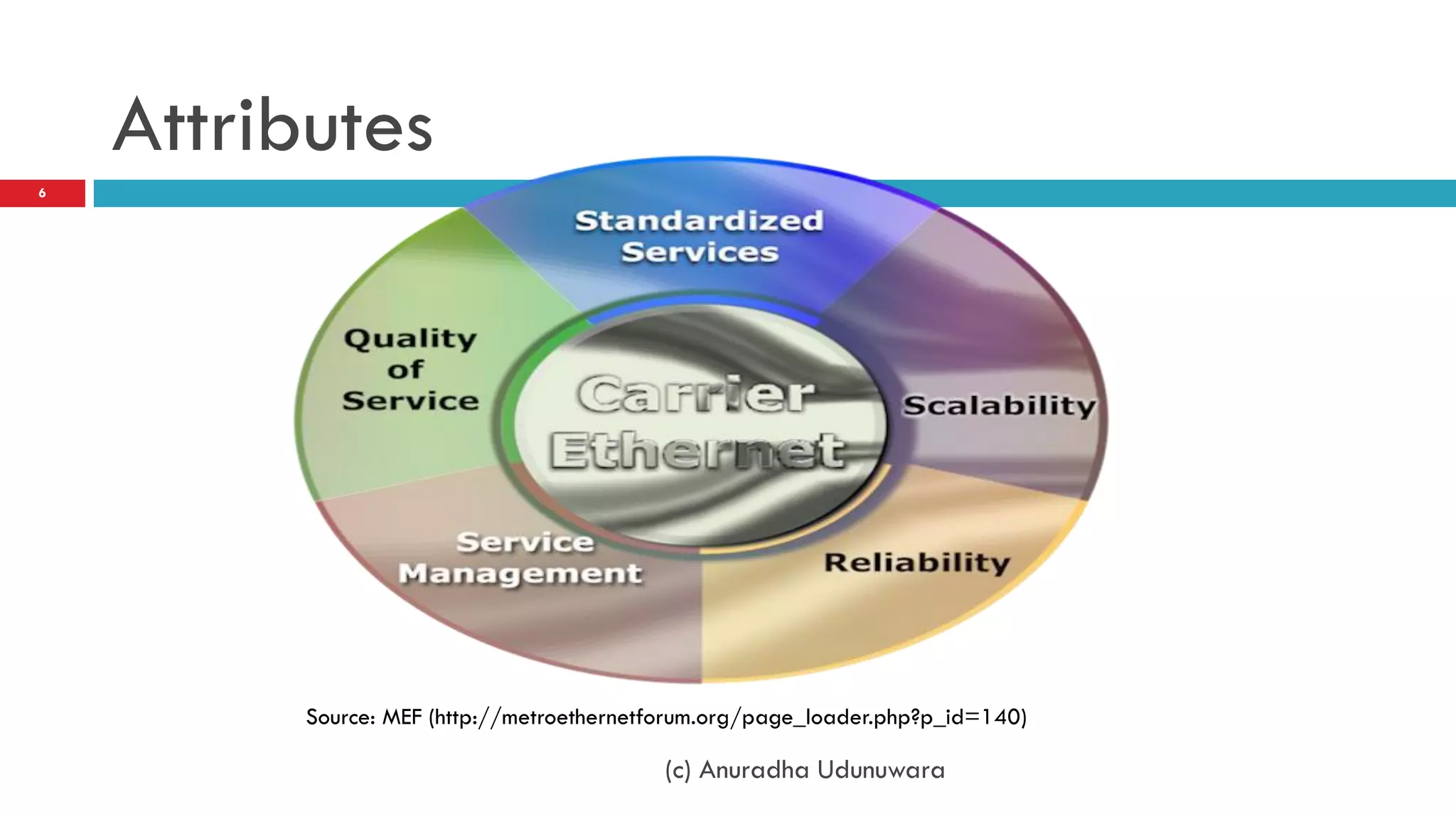
       Carrier Ethernet is a ubiquitous, standardized,
        carrier-class SERVICE defined by 5 attributes that
        distinguish Carrier Ethernet from familiar Local Area
        Network (LAN) based Ethernet
    Source: MEF (http://metroethernetforum.org/page_loader.php?p_id=140)


                                                          (c) Anuradha Udunuwara
Attributes
6


          Source: MEF (http://metroethernetforum.org/page_loader.php?p_id=140)

                                           (c) Anuradha Udunuwara
ME drivers
7


    1.   Simplicity

    2.   Any transport


                         (c) Anuradha Udunuwara
8


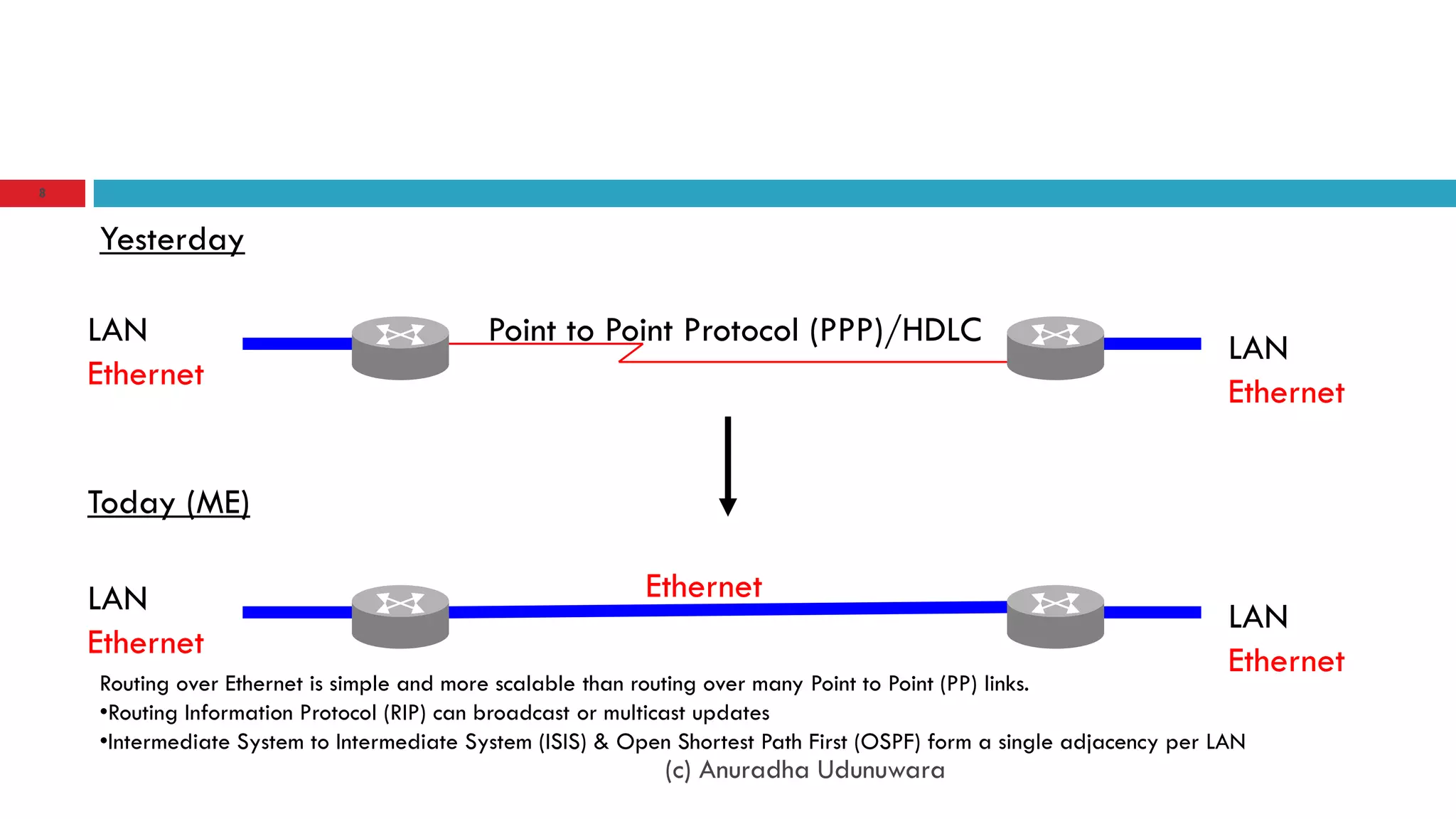
    Yesterday

    LAN                                    Point to Point Protocol (PPP)/HDLC                                         LAN
    Ethernet                                                                                                          Ethernet


    Today (ME)

    LAN                                                    Ethernet
                                                                                                                      LAN
    Ethernet                                                                                                          Ethernet
    Routing over Ethernet is simple and more scalable than routing over many Point to Point (PP) links.
    •Routing Information Protocol (RIP) can broadcast or multicast updates
    •Intermediate System to Intermediate System (ISIS) & Open Shortest Path First (OSPF) form a single adjacency per LAN
                                                             (c) Anuradha Udunuwara
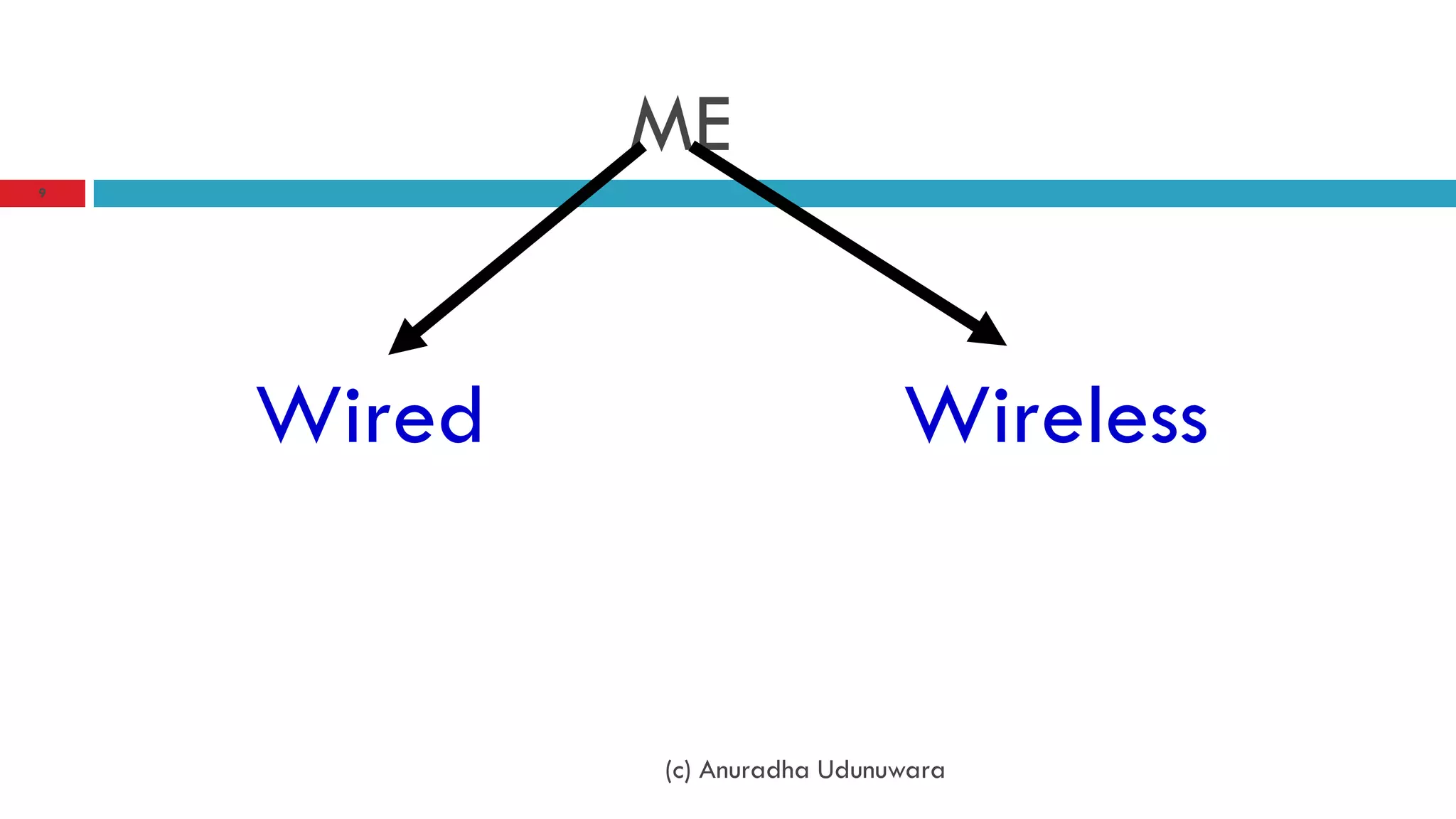
ME
9


    Wired                     Wireless


            (c) Anuradha Udunuwara
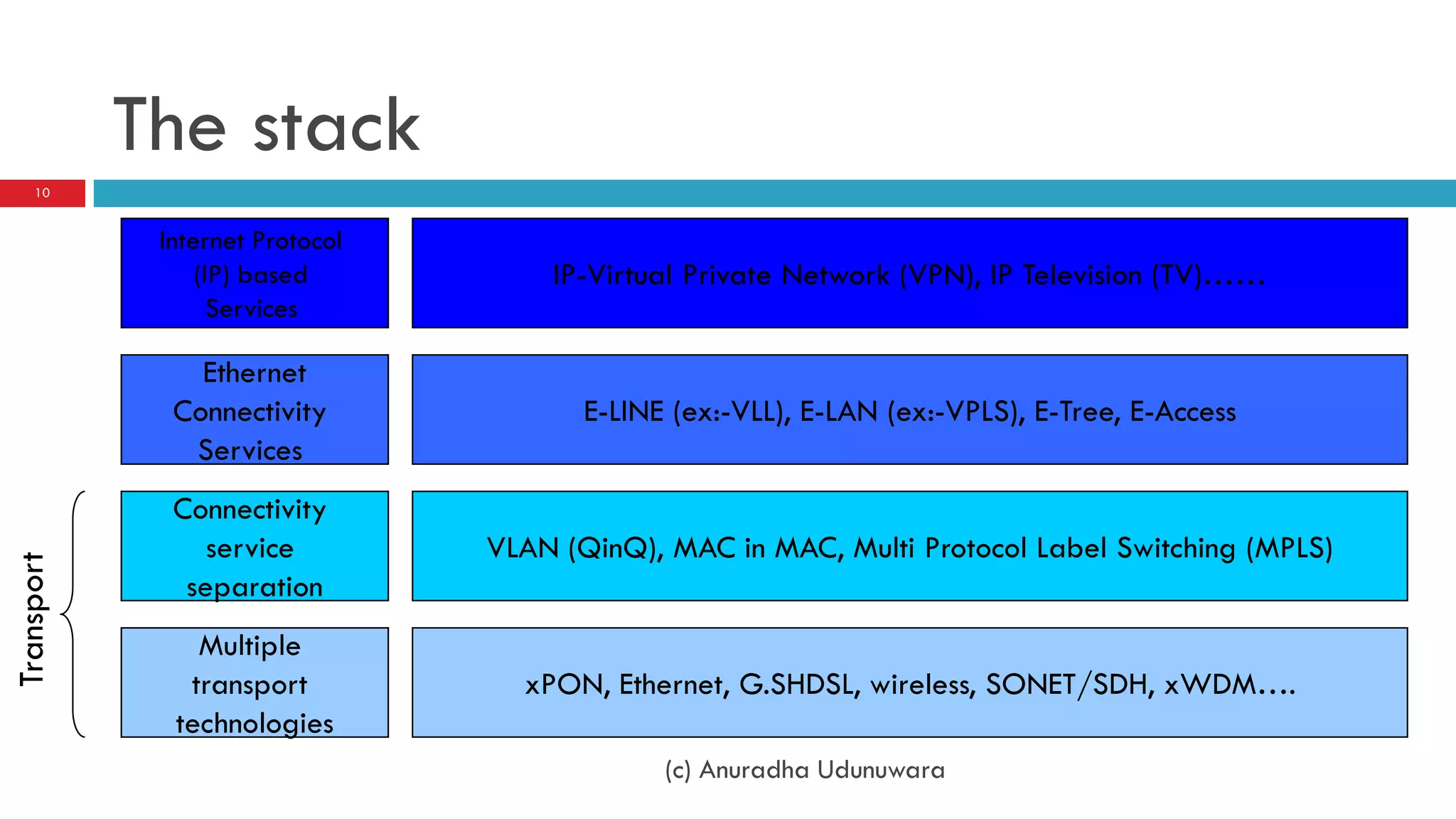
The stack
     10


             Internet Protocol
                 (IP) based          IP-Virtual Private Network (VPN), IP Television (TV)……
                   Services

                Ethernet
              Connectivity              E-LINE (ex:-VLL), E-LAN (ex:-VPLS), E-Tree, E-Access
               Services
              Connectivity
                 service         VLAN (QinQ), MAC in MAC, Multi Protocol Label Switching (MPLS)
Transport


               separation
                Multiple
               transport           xPON, Ethernet, G.SHDSL, wireless, SONET/SDH, xWDM….
              technologies
                                              (c) Anuradha Udunuwara
11


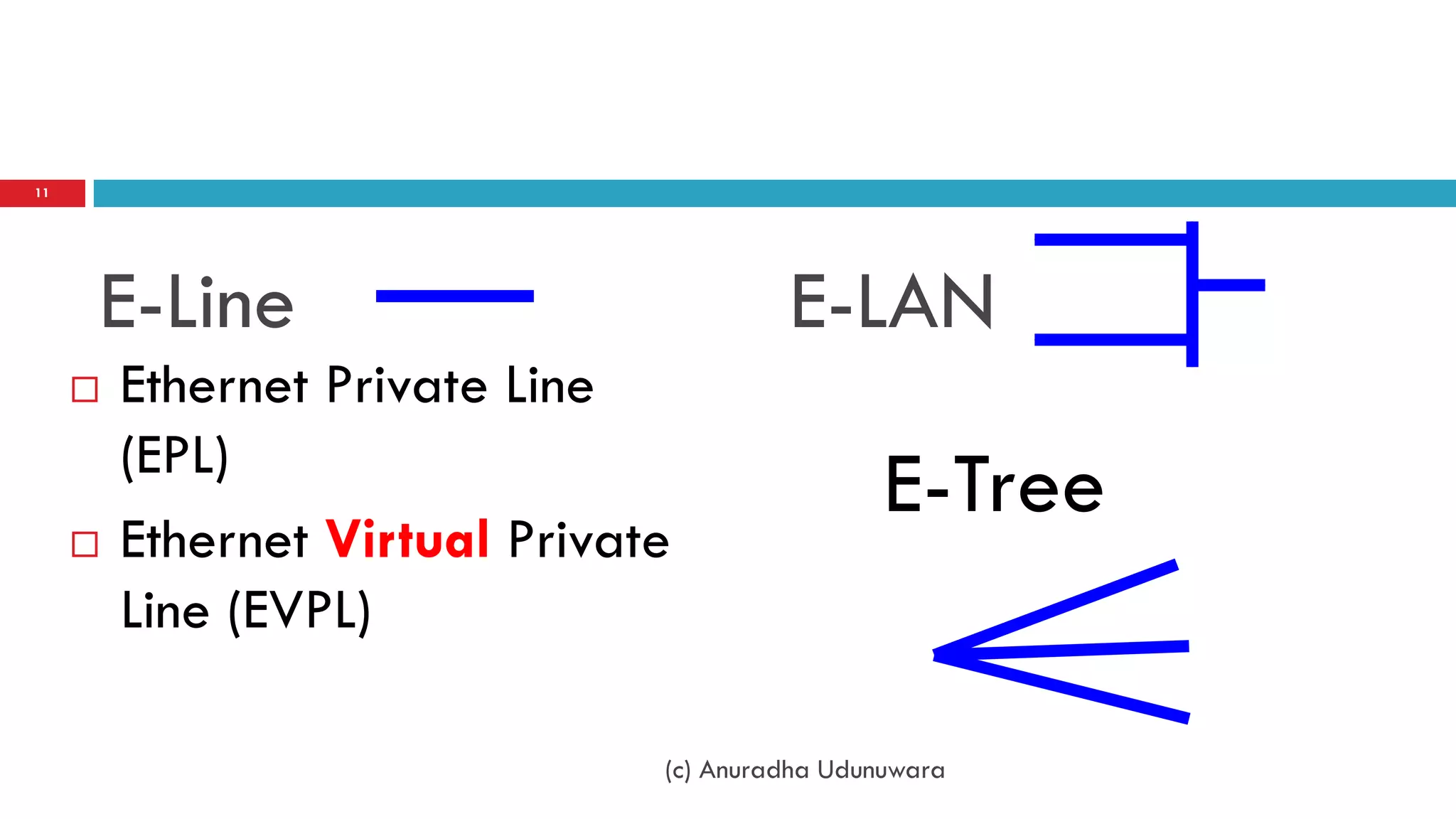
     E-Line                              E-LAN
        Ethernet Private Line
         (EPL)
                                                 E-Tree
        Ethernet Virtual Private
         Line (EVPL)

                                (c) Anuradha Udunuwara
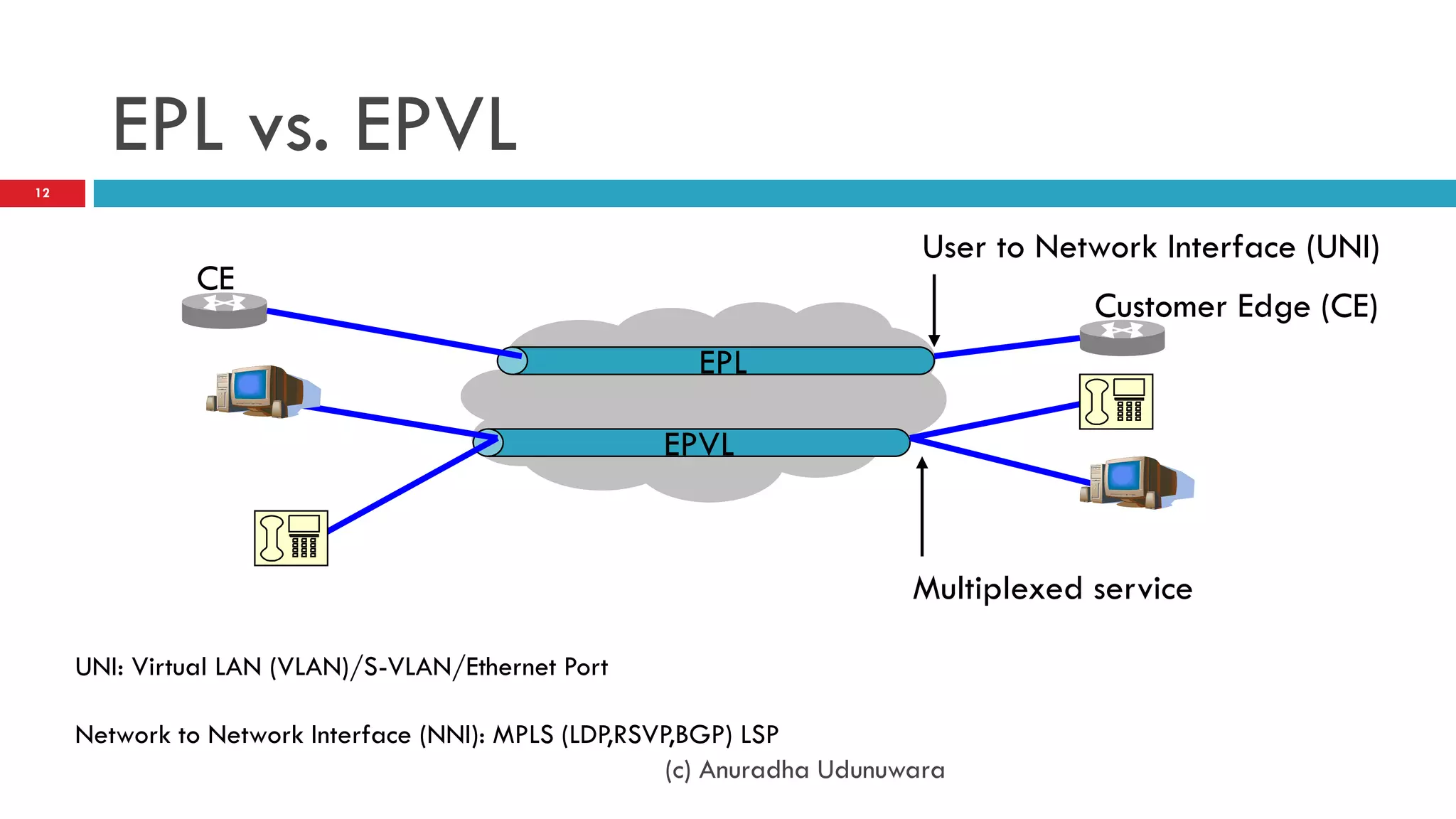
EPL vs. EPVL
12


                                                                           User to Network Interface (UNI)
               CE
                                                                                      Customer Edge (CE)
                                                        EPL

                                                     EPVL


                                                                          Multiplexed service

     UNI: Virtual LAN (VLAN)/S-VLAN/Ethernet Port

     Network to Network Interface (NNI): MPLS (LDP,RSVP,BGP) LSP
                                                       (c) Anuradha Udunuwara
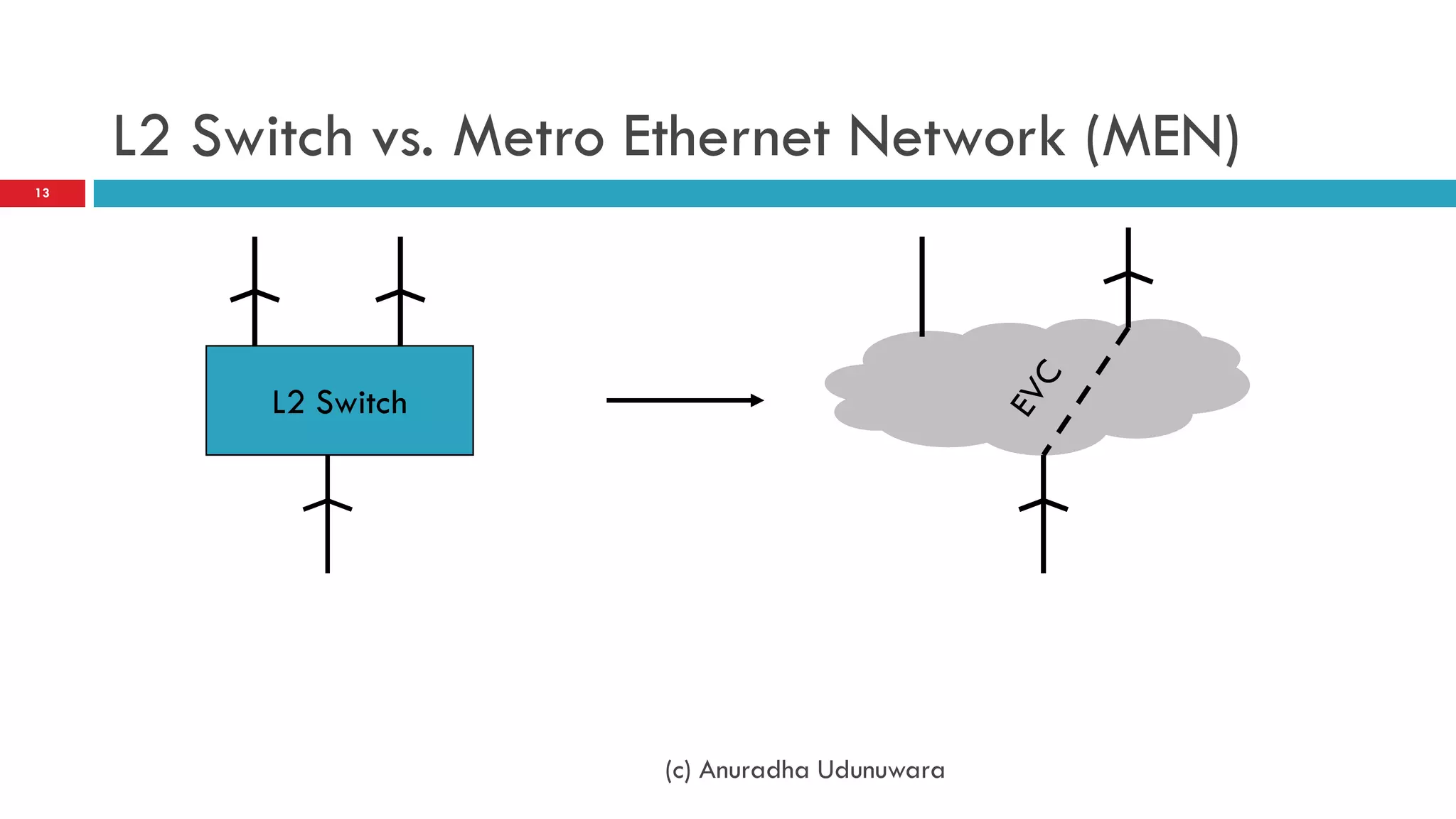
L2 Switch vs. Metro Ethernet Network (MEN)
13


          L2 Switch


                         (c) Anuradha Udunuwara
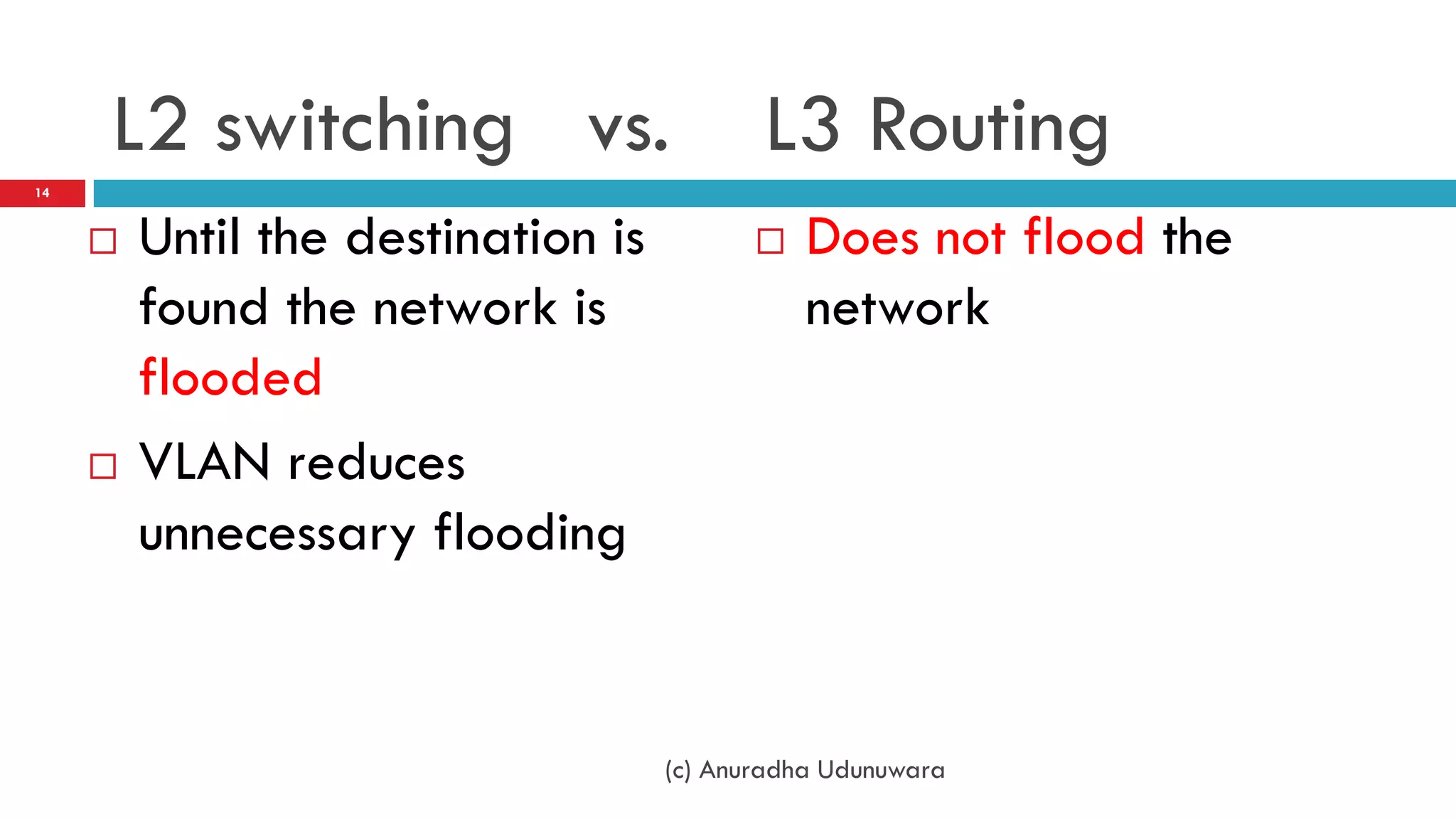
L2 switching vs.                      L3 Routing
14


        Until the destination is             Does not flood the
         found the network is                  network
         flooded
        VLAN reduces
         unnecessary flooding


                                    (c) Anuradha Udunuwara
L2 switching
15


        Media Access Control (MAC) based
        VLAN based


                             (c) Anuradha Udunuwara
L2 switch
16


     • MAC learning table (forwarding table)
       – MAC/VLAN <-> port
     • VLAN table – identification/separation (used
       for tagging/un tagging)
       – VLAN <-> port
       A VLAN is assigned to a port by the switch. This is not
         dynamic. Need to provision.
                              (c) Anuradha Udunuwara
Functions of a L2 Switch
17


        MAC learning (populating the MAC/VLAN table)
        Forwarding (uses MAC/VALN table)

        If a computer does not send traffic (silent), then all
         the traffic coming to that computer come as
         flooding (the switch learns the computers MAC by
         the source MAC).
                               (c) Anuradha Udunuwara
Broadcasting
18


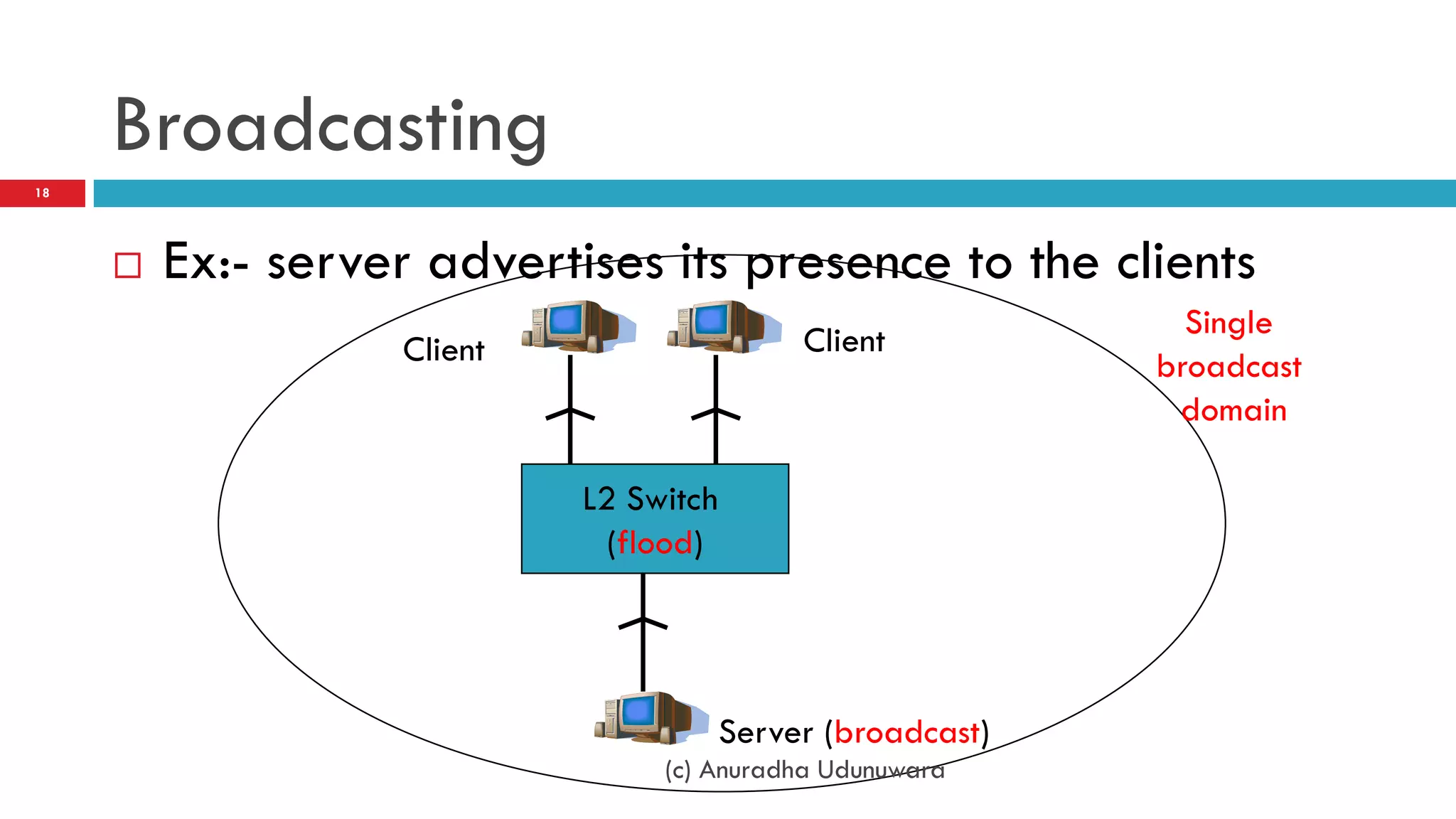
        Ex:- server advertises its presence to the clients
                                                               Single
                   Client                    Client
                                                             broadcast
                                                              domain

                            L2 Switch
                              (flood)


                                        Server (broadcast)
                                 (c) Anuradha Udunuwara
QinQ aka stacked VLANs
19


        = Institution of Electrical & Electronic Engineers
         (IEEE) 802.1QiQ = IEEE 802.1ad (provider
         bridging)
        [customer (C)-VLAN inner, Service provider (S)-
         VLAN outer]


                             (c) Anuradha Udunuwara
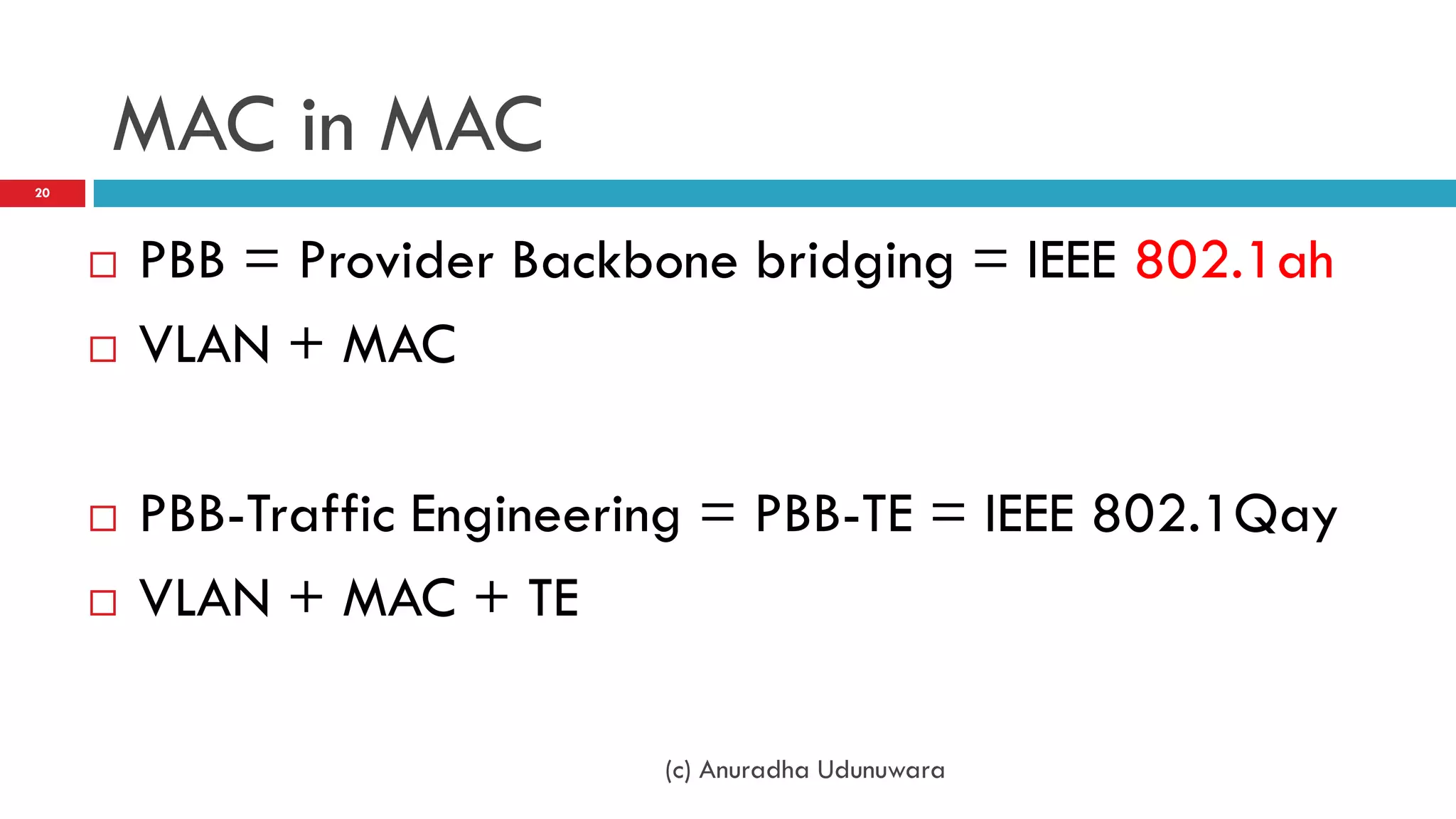
MAC in MAC
20


        PBB = Provider Backbone bridging = IEEE 802.1ah
        VLAN + MAC

        PBB-Traffic Engineering = PBB-TE = IEEE 802.1Qay
        VLAN + MAC + TE

                              (c) Anuradha Udunuwara
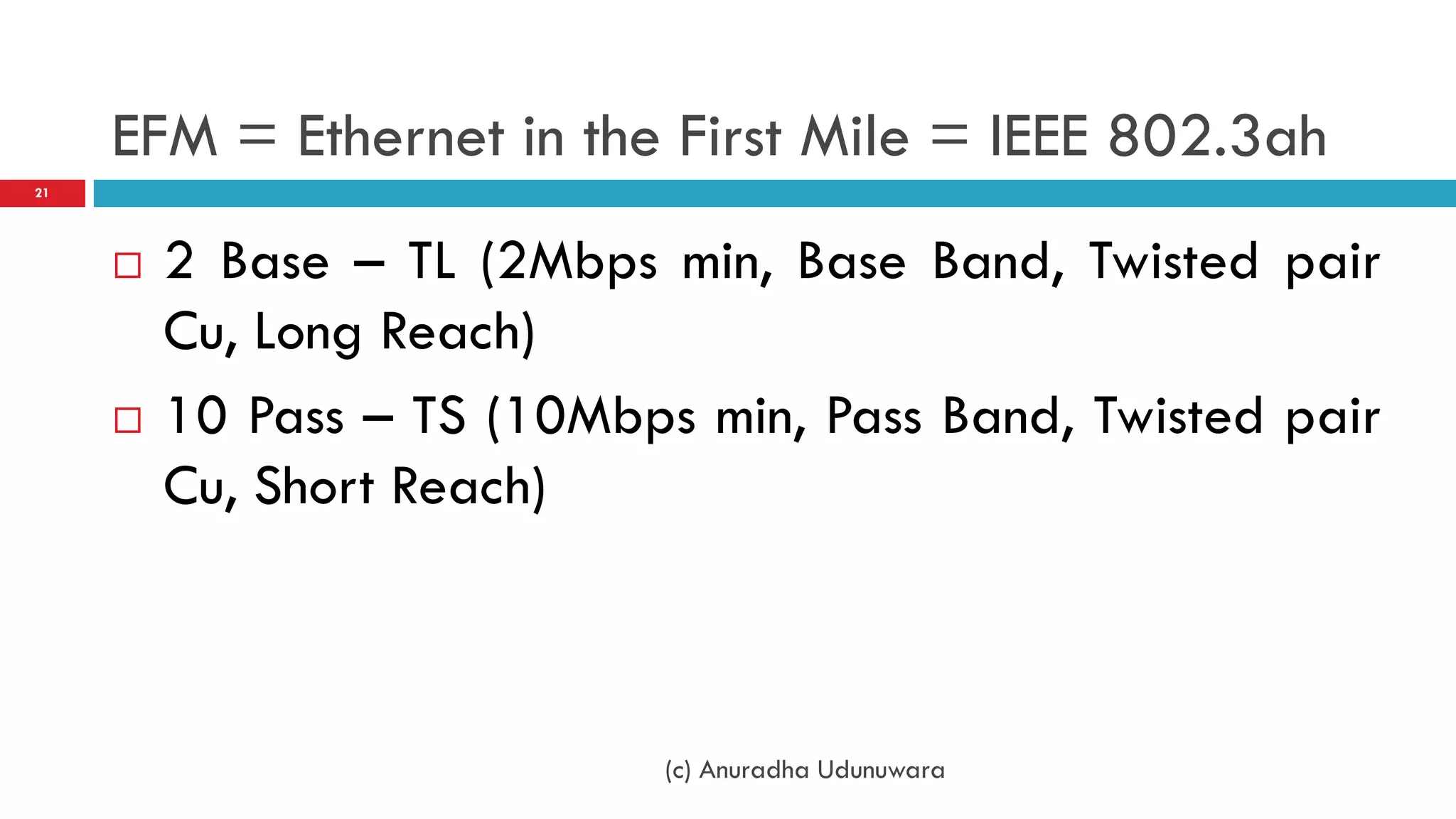
EFM = Ethernet in the First Mile = IEEE 802.3ah
21


        2 Base – TL (2Mbps min, Base Band, Twisted pair
         Cu, Long Reach)
        10 Pass – TS (10Mbps min, Pass Band, Twisted pair
         Cu, Short Reach)


                             (c) Anuradha Udunuwara
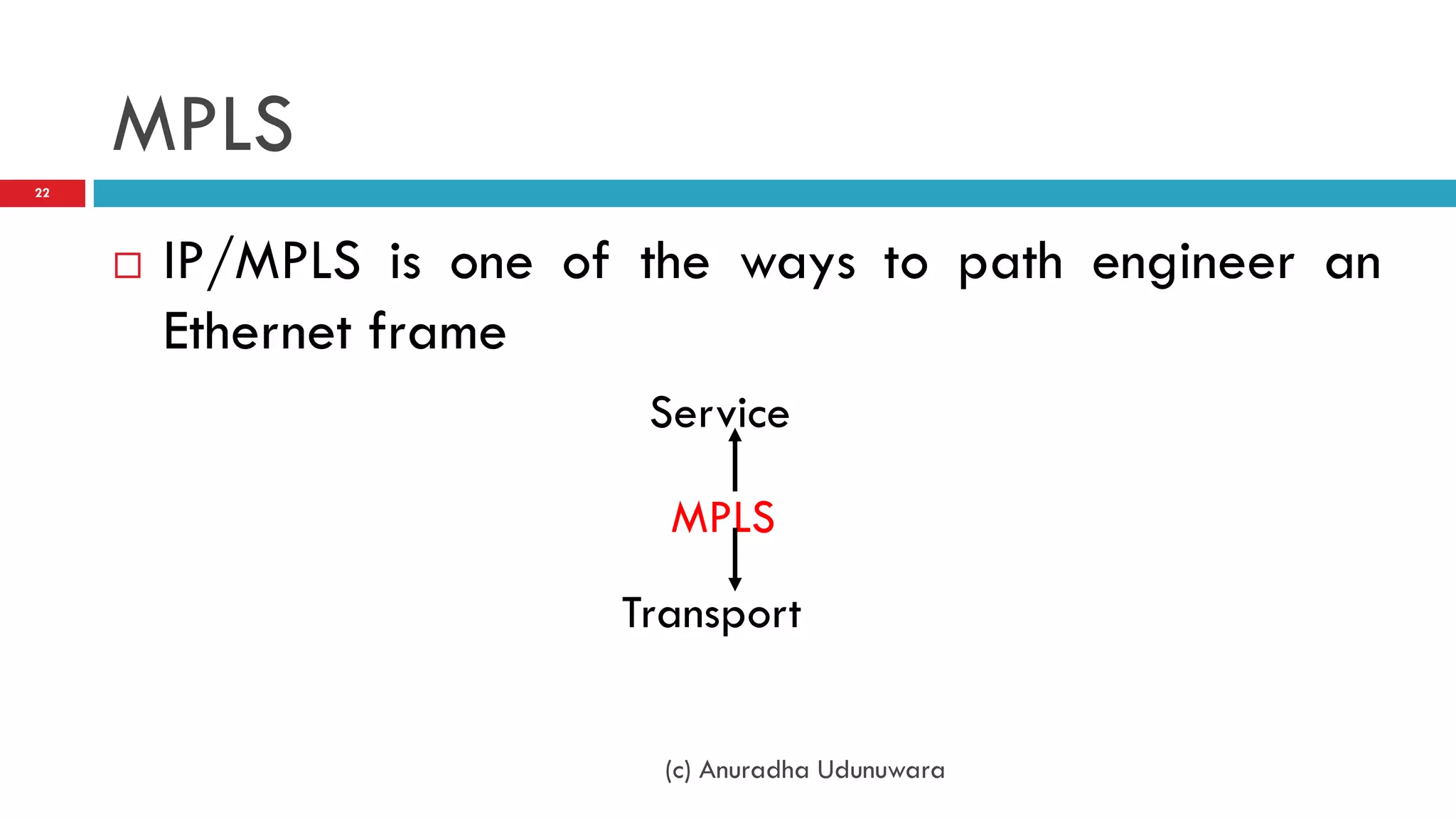
MPLS
22


        IP/MPLS is one of the ways to path engineer an
         Ethernet frame
                           Service

                            MPLS
                          Transport


                            (c) Anuradha Udunuwara
EoMPLS (Ethernet over MPLS)
23


        Port based
        VLAN based


                      (c) Anuradha Udunuwara
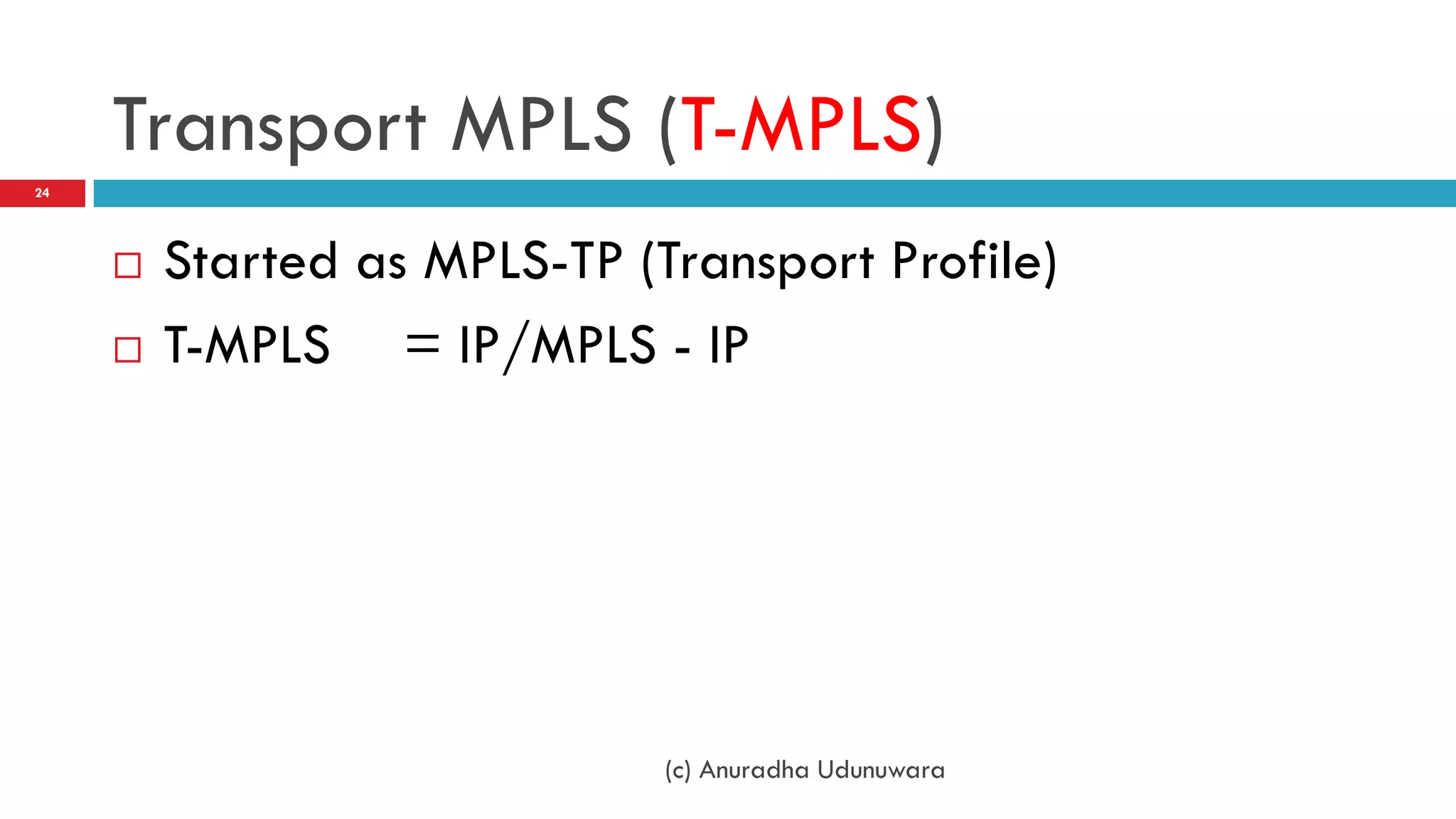
Transport MPLS (T-MPLS)
24


        Started as MPLS-TP (Transport Profile)
        T-MPLS = IP/MPLS - IP


                              (c) Anuradha Udunuwara
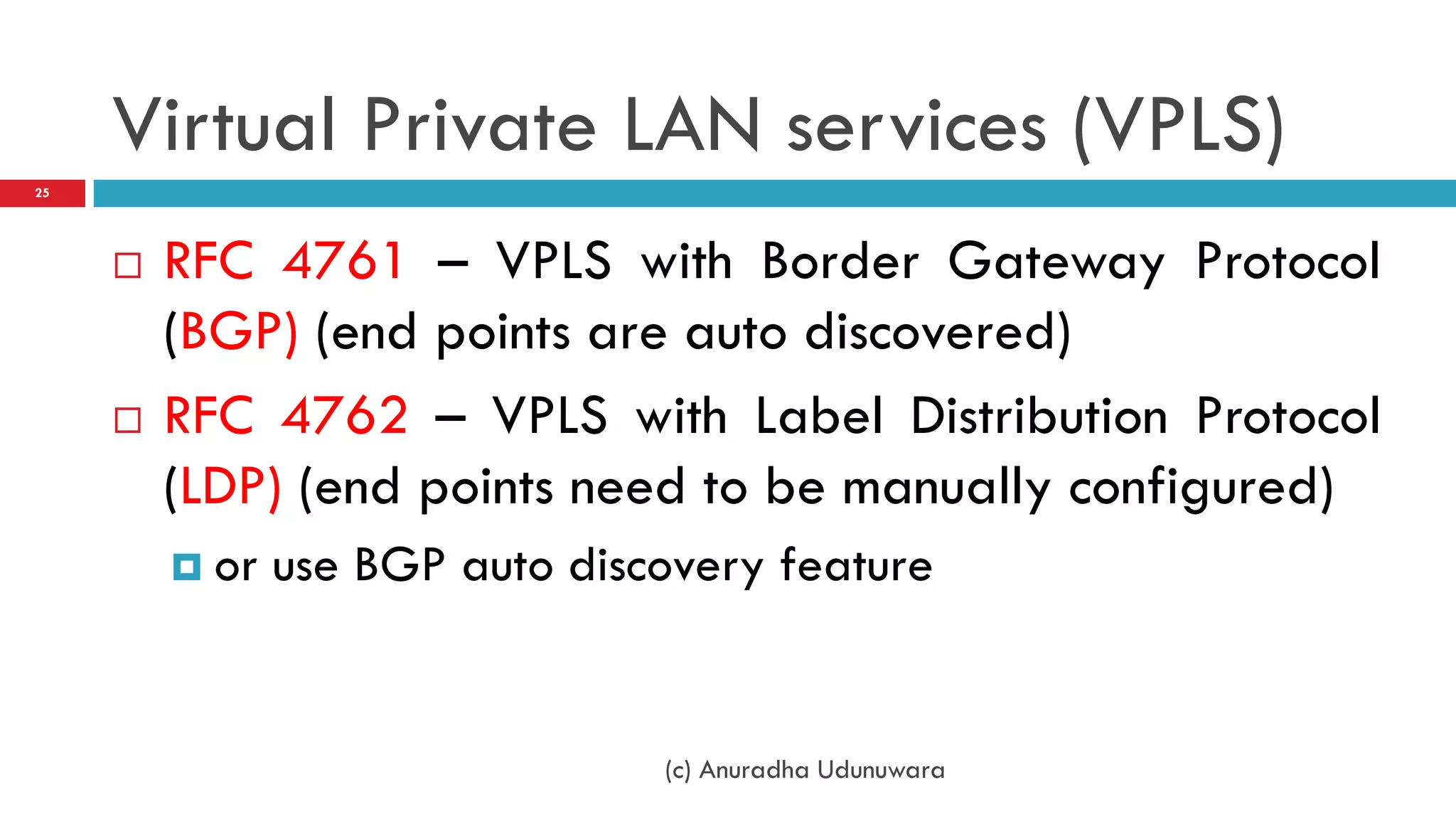
Virtual Private LAN services (VPLS)
25


        RFC 4761 – VPLS with Border Gateway Protocol
         (BGP) (end points are auto discovered)
        RFC 4762 – VPLS with Label Distribution Protocol
         (LDP) (end points need to be manually configured)
          or   use BGP auto discovery feature


                                 (c) Anuradha Udunuwara
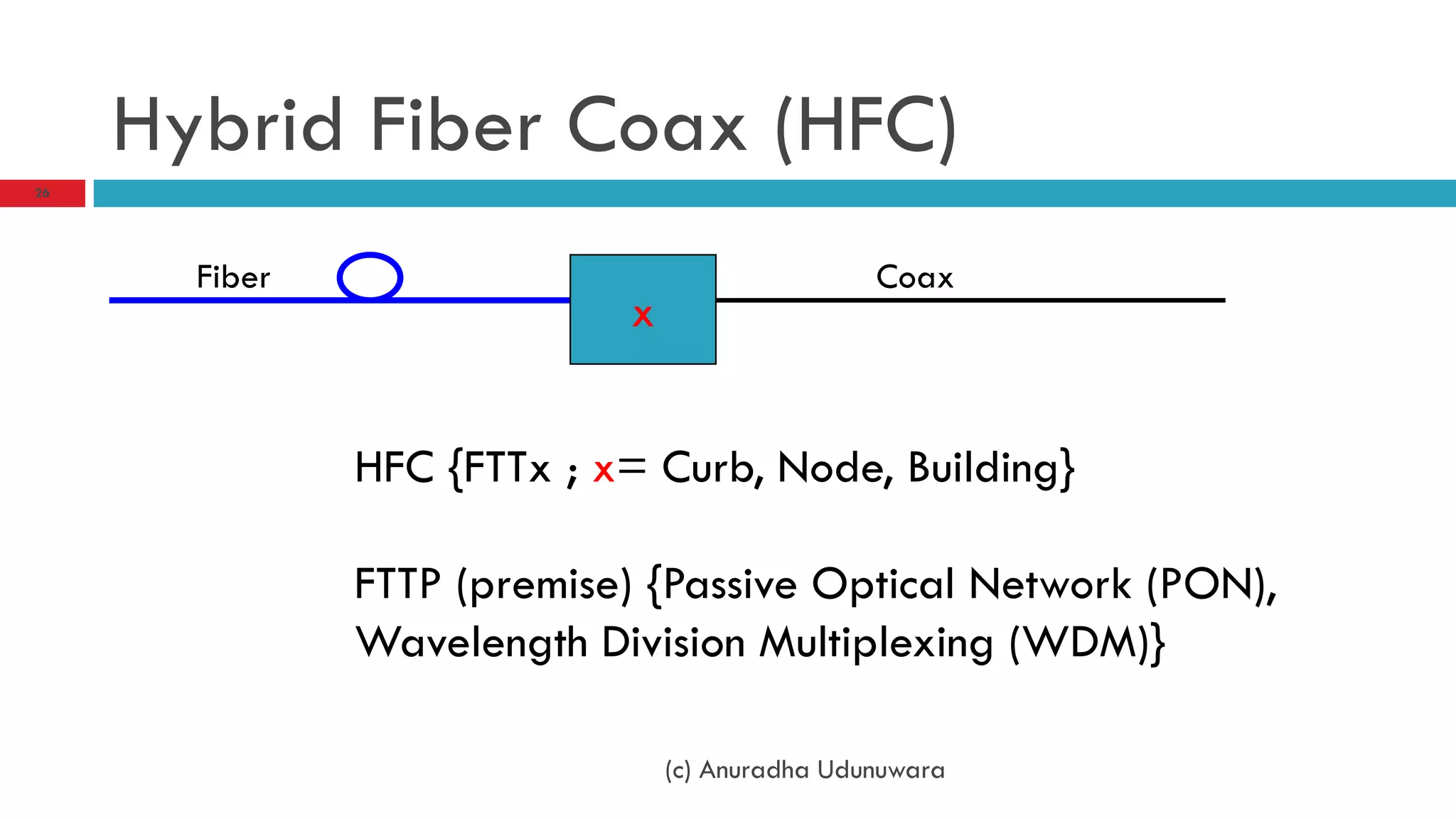
Hybrid Fiber Coax (HFC)
26


       Fiber                                    Coax
                            x


               HFC {FTTx ; x= Curb, Node, Building}

               FTTP (premise) {Passive Optical Network (PON),
               Wavelength Division Multiplexing (WDM)}

                                (c) Anuradha Udunuwara
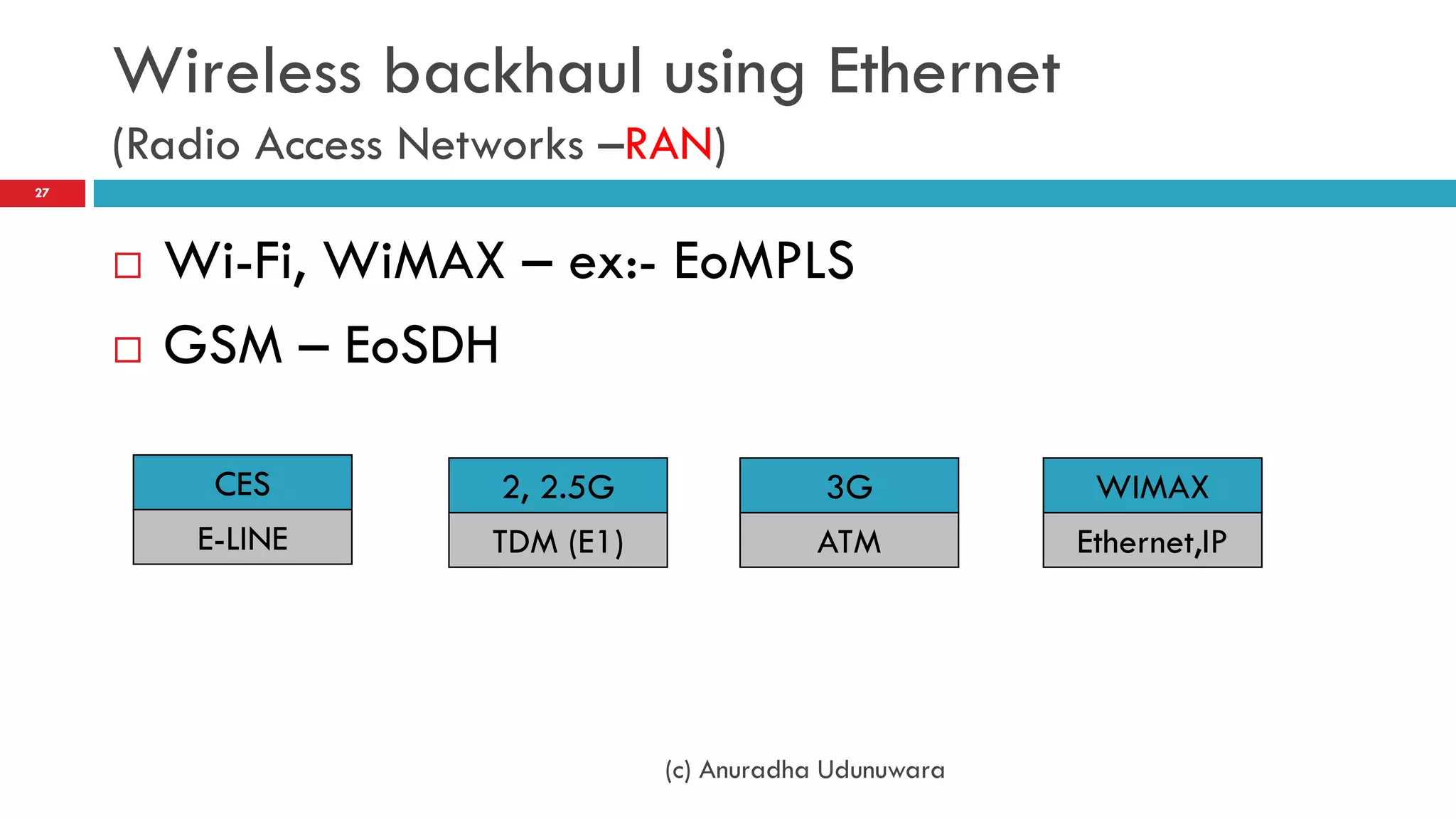
Wireless backhaul using Ethernet
     (Radio Access Networks –RAN)
27


        Wi-Fi, WiMAX – ex:- EoMPLS
        GSM – EoSDH

           CES         2, 2.5G              3G             WIMAX
          E-LINE      TDM (E1)              ATM           Ethernet,IP


                                 (c) Anuradha Udunuwara
ME Technology
Types of Networks
29


     1.Local Area Network (LAN)

     2.Wide Area Network (WAN)

     3.Metropolitan Area Network (MAN)
                          (c) Anuradha Udunuwara
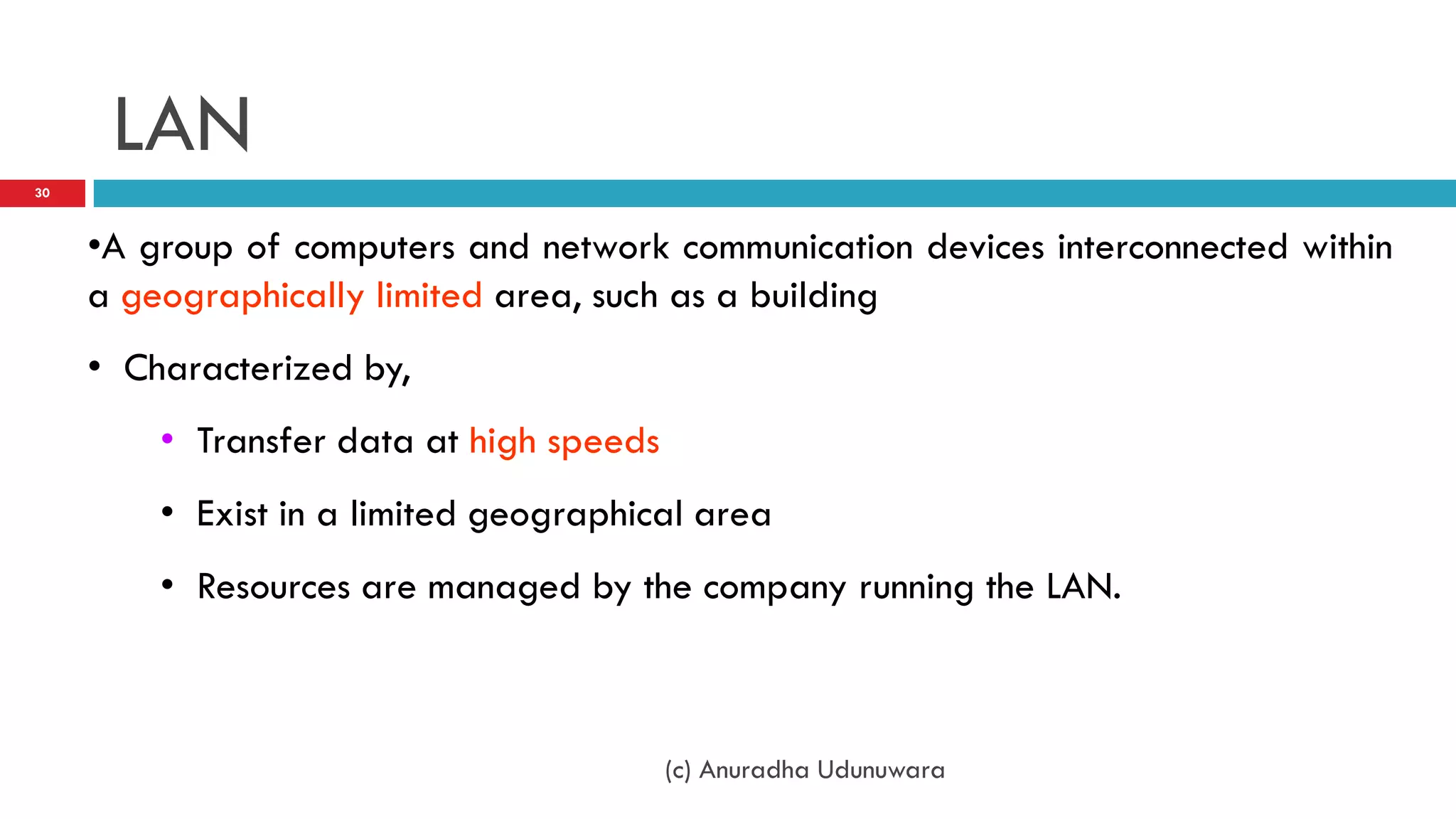
LAN
30


     •A group of computers and network communication devices interconnected within
     a geographically limited area, such as a building
     • Characterized by,
         • Transfer data at high speeds
         • Exist in a limited geographical area
         • Resources are managed by the company running the LAN.


                                          (c) Anuradha Udunuwara
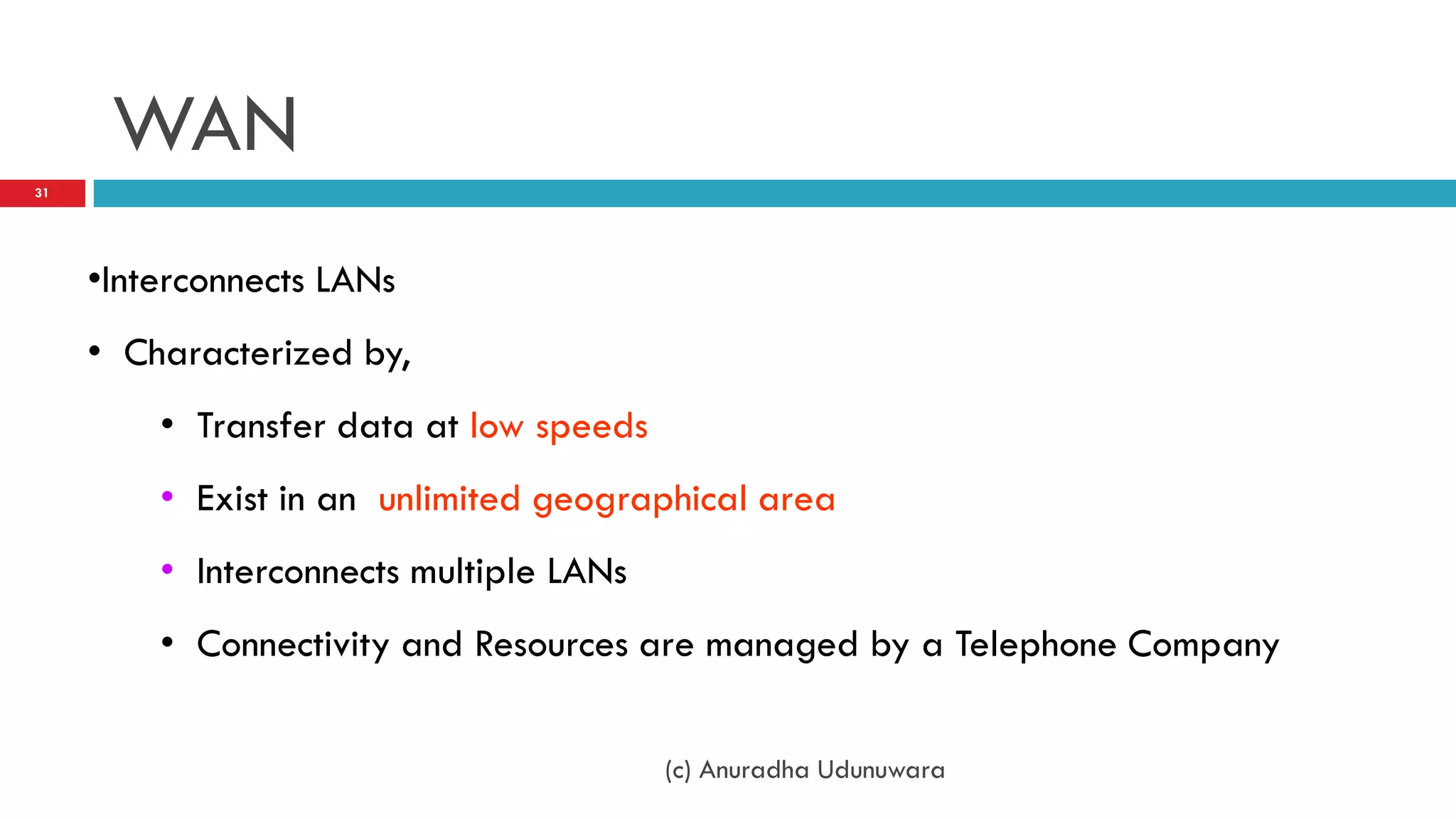
WAN
31


     •Interconnects LANs
     • Characterized by,
         • Transfer data at low speeds
         • Exist in an unlimited geographical area
         • Interconnects multiple LANs
         • Connectivity and Resources are managed by a Telephone Company


                                         (c) Anuradha Udunuwara
Why Ethernet ?
32


        Most common Interface today
        Cost effective
        Supports very high Bandwidths (upto 10 Gbps)
        Flexible upgrades within a wide range (ex: 1Mbps to 1Gbps)
        Easy and simple to manage and maintain


                                 (c) Anuradha Udunuwara
L1, L2
33


        Connection Oriented
        Circuit Switched
         Ex:-Time Division Multiplexing (TDM), Asynchronous
         Transfer Mode (ATM), Frame Relay (FR)

        FR and ATM have a Virtual Circuit (VC) identifier
         (VCI/VPI Virtual Channel Identifier/Virtual Path
         Identifier). Therefore, we do not have to create labels.
                                (c) Anuradha Udunuwara
L3
34


        Connectionless
        Packet Switched
         Ex:-IP


                           (c) Anuradha Udunuwara
L2 & L3
35


        Traffic is switched
        Control signal is routed
         Ex:-IP/MPLS

        Ethernet does not have a label. Therefore, we have
         to create labels. One way is using MPLS.
                               (c) Anuradha Udunuwara
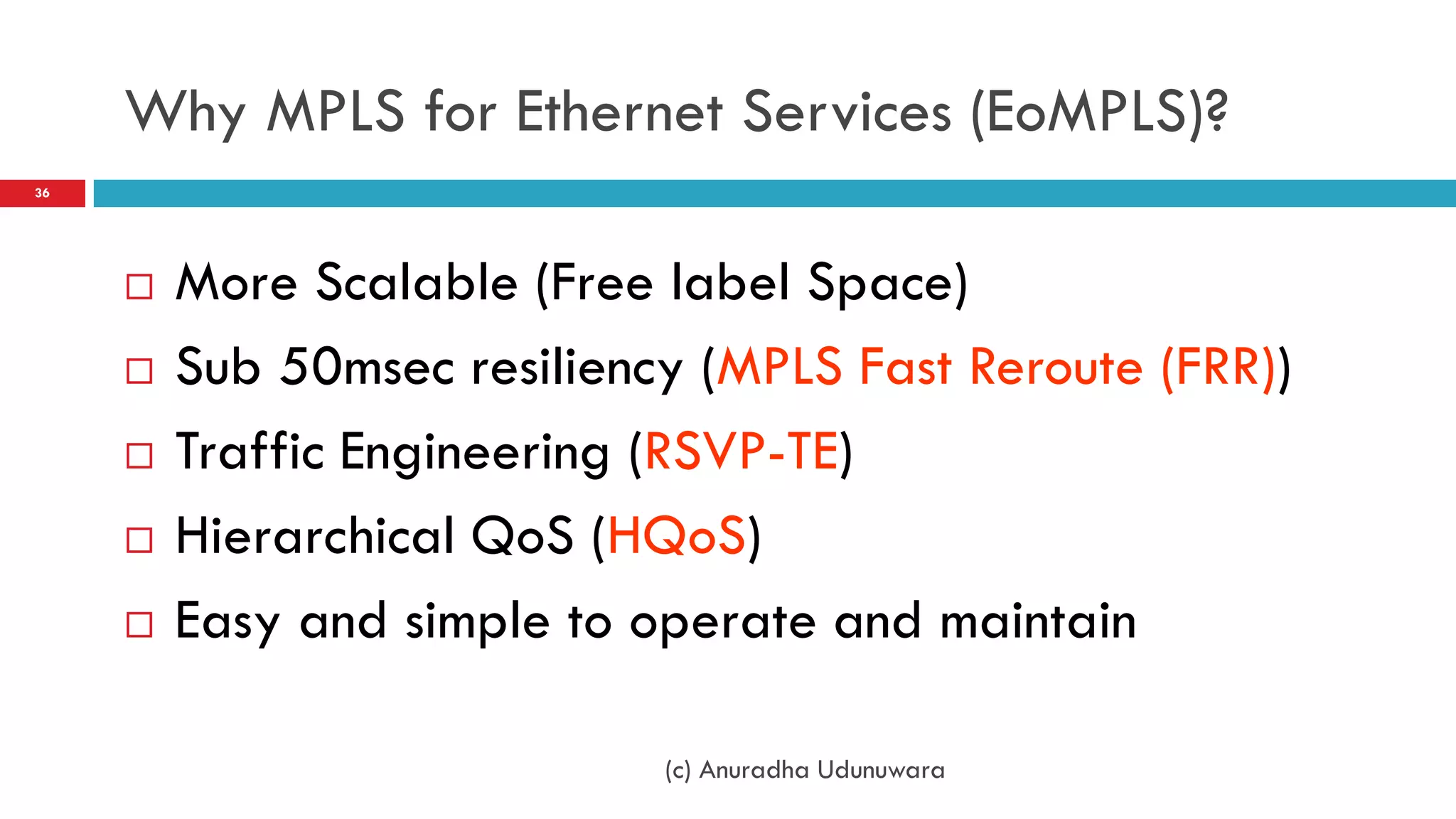
Why MPLS for Ethernet Services (EoMPLS)?
36


        More Scalable (Free label Space)
        Sub 50msec resiliency (MPLS Fast Reroute (FRR))
        Traffic Engineering (RSVP-TE)
        Hierarchical QoS (HQoS)
        Easy and simple to operate and maintain

                             (c) Anuradha Udunuwara
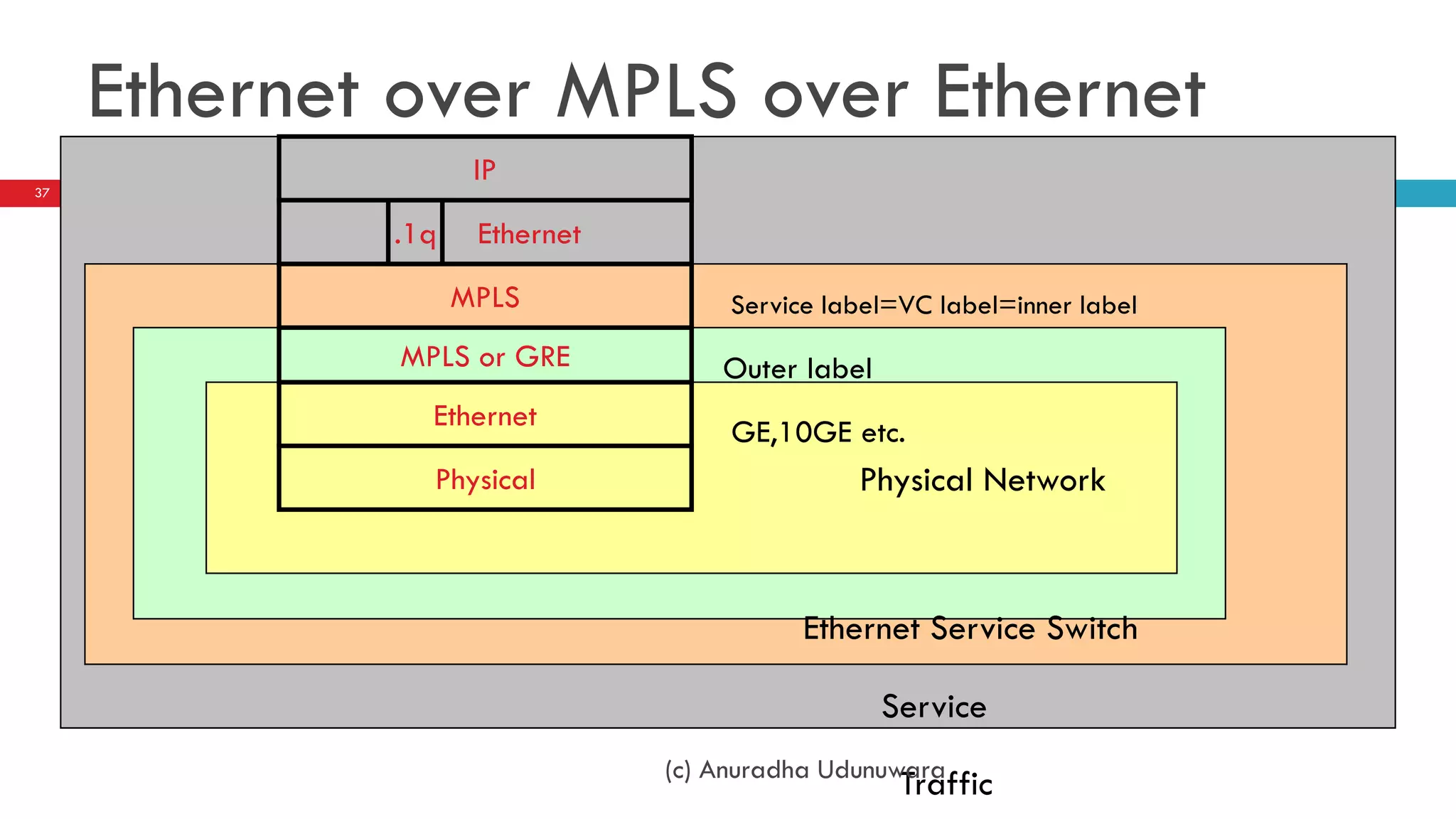
Ethernet over MPLS over Ethernet
                    IP
37


             .1q    Ethernet
                   MPLS             Service label=VC label=inner label
             MPLS or GRE           Outer label
               Ethernet
                                    GE,10GE etc.
               Physical                       Physical Network


                                          Ethernet Service Switch

                                                 Service
                               (c) Anuradha Udunuwara
                                                  Traffic
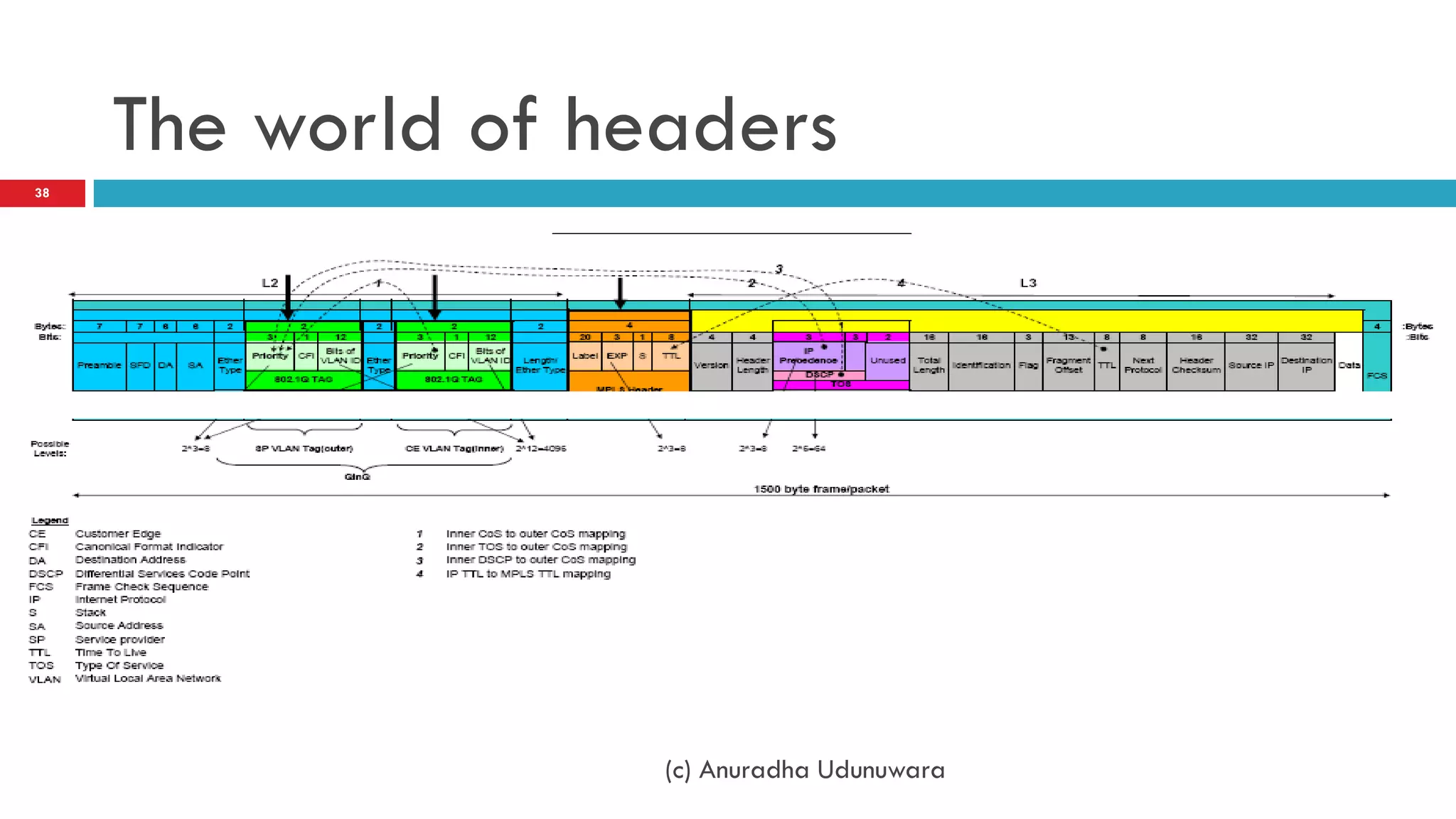
The world of headers
38


                    (c) Anuradha Udunuwara
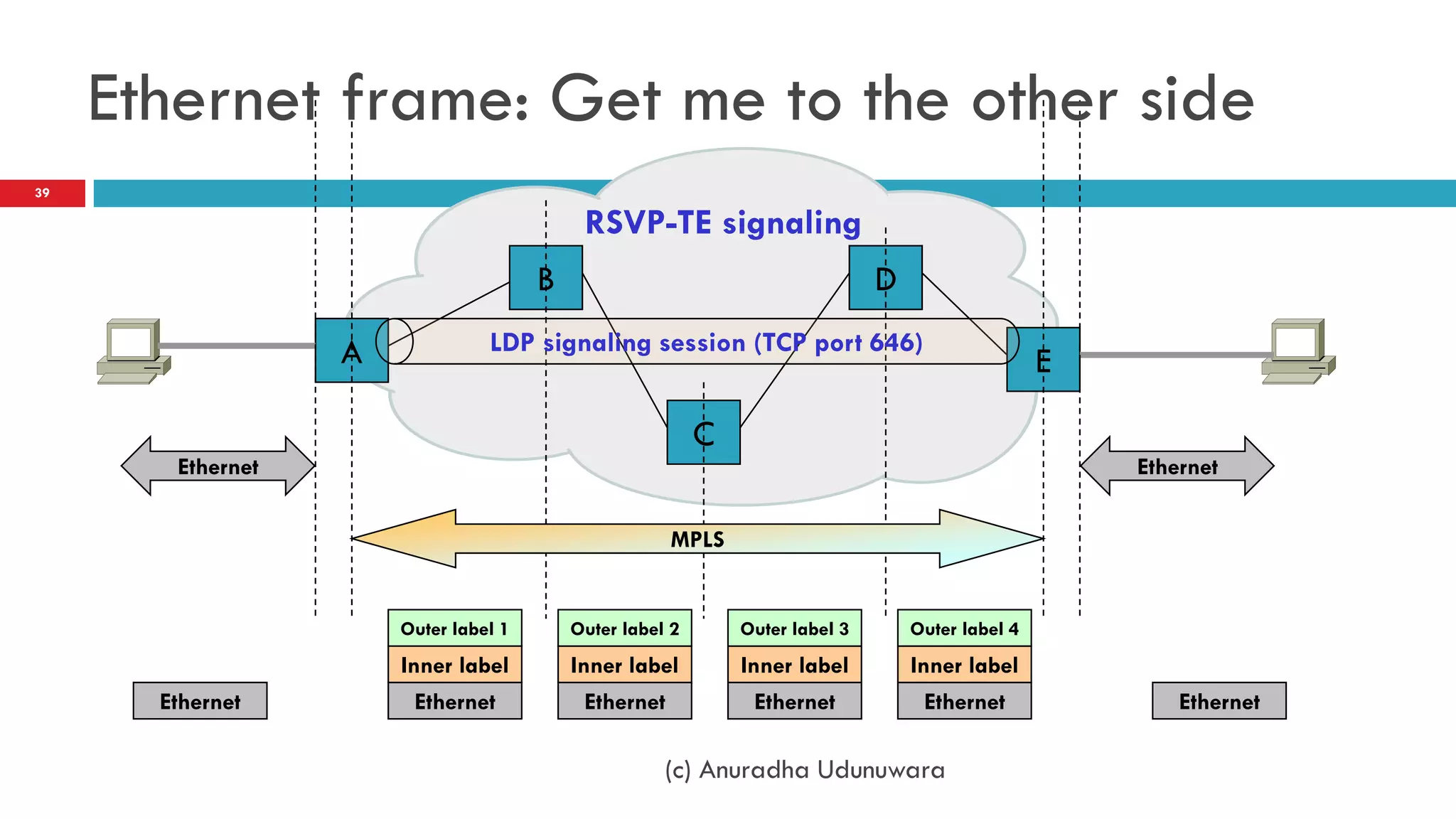
Ethernet frame: Get me to the other side
39

                                            RSVP-TE signaling
                                       B                                       D

                   A             LDP signaling session (TCP port 646)
                                                                                                   E

                                                           C
        Ethernet                                                                                       Ethernet


                                                       MPLS


                       Outer label 1       Outer label 2       Outer label 3       Outer label 4
                       Inner label         Inner label         Inner label         Inner label
       Ethernet         Ethernet            Ethernet            Ethernet            Ethernet               Ethernet

                                                      (c) Anuradha Udunuwara
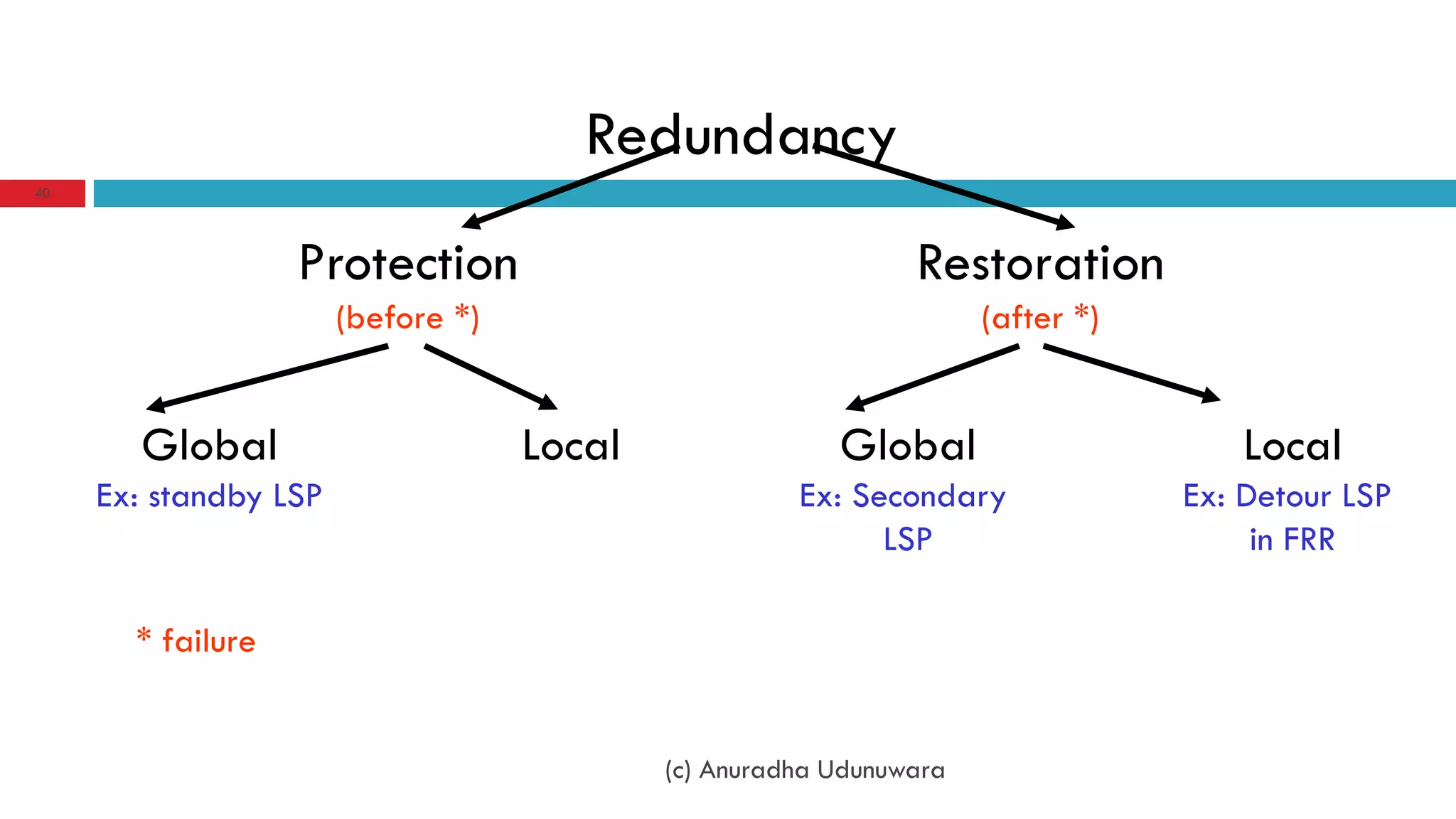
Redundancy
40


                   Protection                                  Restoration
                       (before *)                                    (after *)


       Global                       Local                Global                      Local
     Ex: standby LSP                                  Ex: Secondary              Ex: Detour LSP
                                                            LSP                       in FRR

       * failure


                                            (c) Anuradha Udunuwara
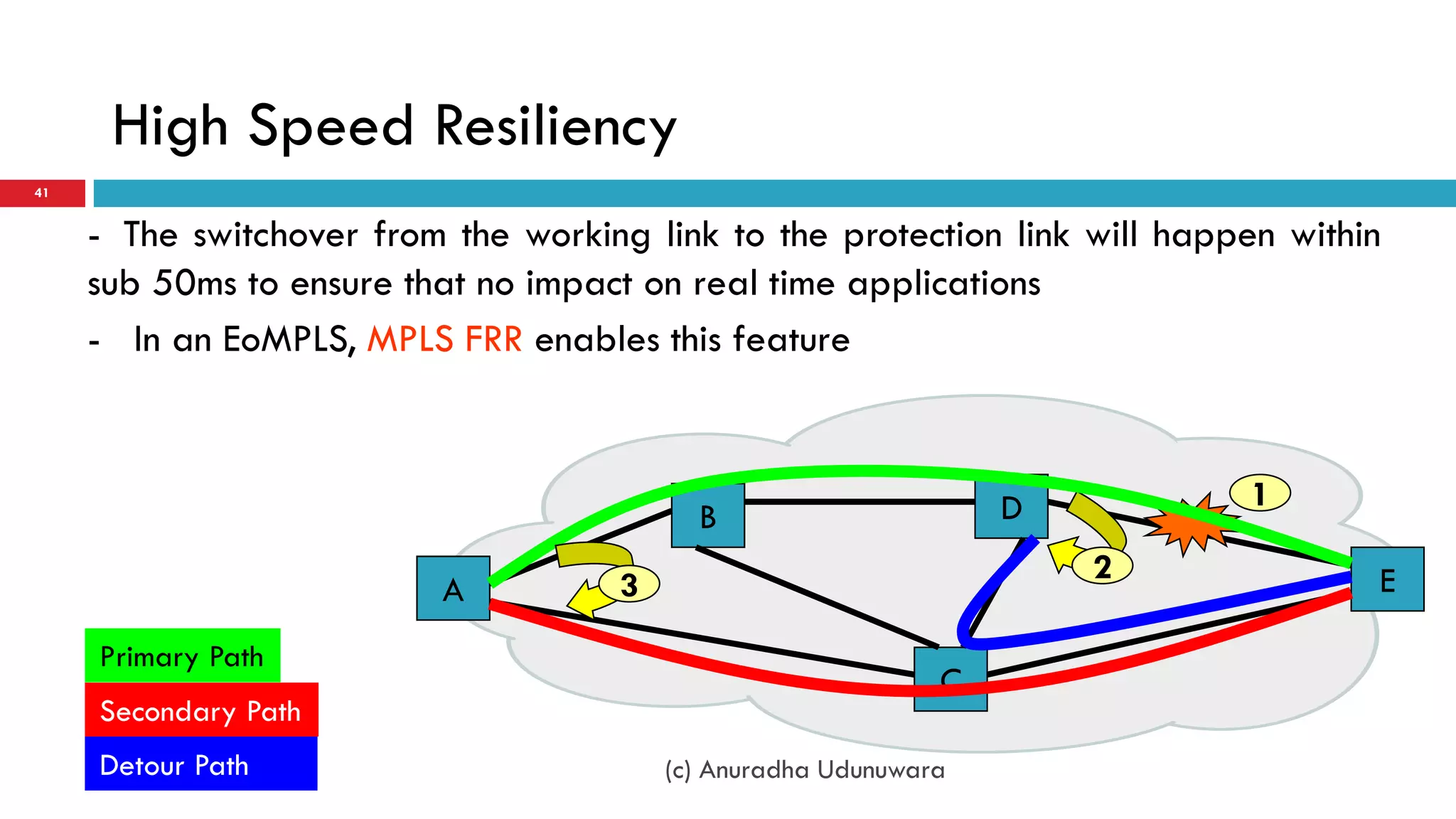
High Speed Resiliency
41


     - The switchover from the working link to the protection link will happen within
     sub 50ms to ensure that no impact on real time applications
     - In an EoMPLS, MPLS FRR enables this feature


                                                                  D         1
                                           B
                                                                      2             E
                          A          3
     Primary Path
                                                              C
     Secondary Path
     Detour Path                         (c) Anuradha Udunuwara
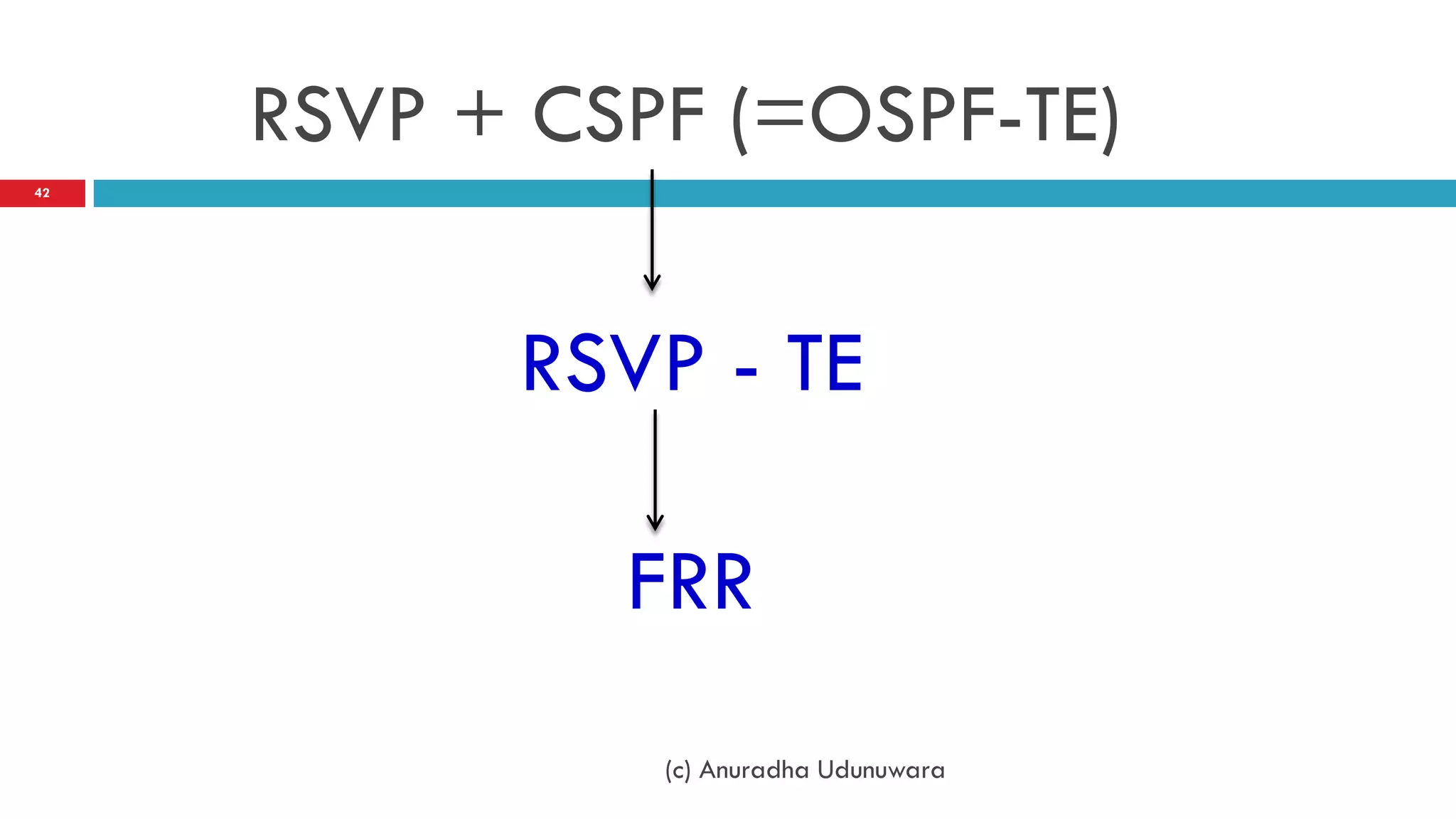
RSVP + CSPF (=OSPF-TE)
42


           RSVP - TE

              FRR
               (c) Anuradha Udunuwara
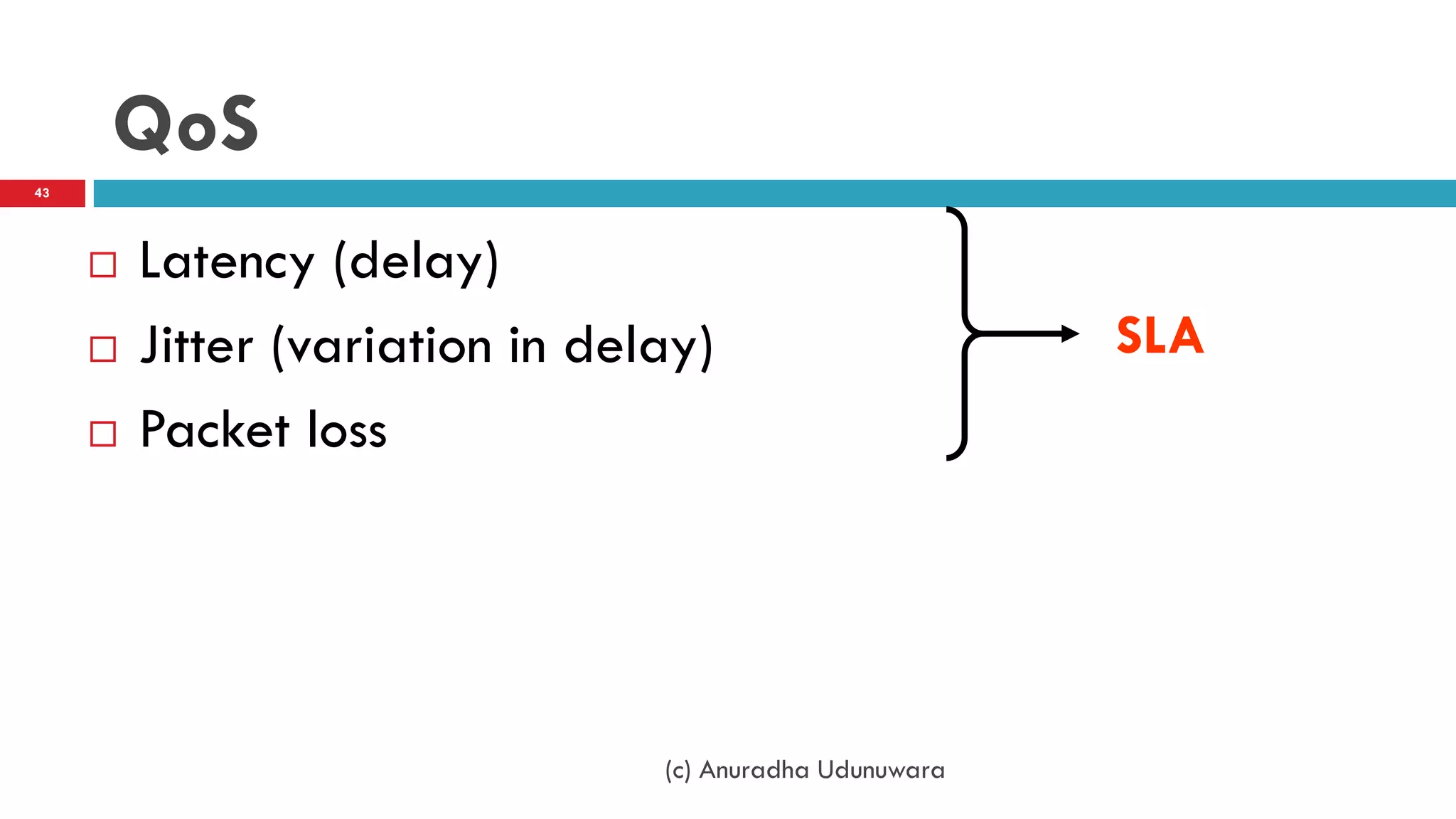
QoS
43


        Latency (delay)
        Jitter (variation in delay)                      SLA
        Packet loss


                                 (c) Anuradha Udunuwara
About the Author
44


     Eng. Anuradha Udunuwara is a Chartered Engineer by profession based in Sri Lanka. He has nearly a decade
     industry experience in strategy, architecture, engineering, design, plan, implementation and maintenance of CSP
     Networks using both packet-switched (PS) and Circuit-Switched (CS) technologies, along with legacy to NGN
     migration. Eng. Anuradha is a well-known in the field of CSP industry, both locally and internationally.
     Graduated from University of Peradeniya, Sri Lanka in 2001 with an honors in Electrical & Electronic Engineering,
     Eng. Anuradha is a corporate member of the Institution of Engineers Sri Lanka, a professional member of British
     Computer Society, a member of Institution of Electrical & Electronic Engineers, a member of Institution of
     Engineering & Technology (formerly Institution of Electrical Engineers), a member of the Computer Society of Sri
     Lanka, a life member of Sri Lanka Association for the Advancement of Science, senior member of the Carrier
     Ethernet Forum, member of the Internet Society, member of the Internet Strategy Forum, member of the Internet
     Strategy Forum Network, member of the Ethernet Academy, member of the NGN/IMS forum and member of the
     Peradeniya Engineering Faculty Alumni Association. He is also an ITIL foundation certified and the only MEF-CECP in
     the country.
     In his spare time Anuradha enjoys spending time with his family, playing badminton, photography, reading and
     travelling.
     He can be reached at udunuwara@ieee.org

                                                       (c) Anuradha Udunuwara

Metro Ethernet Concepts

  • 1.
    METRO ETHERNET (ME) OCTOBER2012 By Eng. Anuradha Udunuwara, BSc.Eng(Hons), CEng, MIE(SL), MEF-CECP, MBCS, ITILv3 Foundation, MIEEE, MIEEE-CS, MIEE, MIET, MCS(SL), MSLAAS
  • 2.
    Agenda 2  ME concepts  ME technology (c) Anuradha Udunuwara
  • 3.
    3 ME concepts (c) Anuradha Udunuwara
  • 4.
    Ethernet vs. ME 4  Ethernet  a transport technology  an interface  a protocol (the 1st asynchronous protocol designed to carry data)  ME  a service (with defined set of attributes)  ME = Carrier Ethernet (CE) (c) Anuradha Udunuwara
  • 5.
    5 What is CE? definition  Carrier Ethernet is a ubiquitous, standardized, carrier-class SERVICE defined by 5 attributes that distinguish Carrier Ethernet from familiar Local Area Network (LAN) based Ethernet Source: MEF (http://metroethernetforum.org/page_loader.php?p_id=140) (c) Anuradha Udunuwara
  • 6.
    Attributes 6 Source: MEF (http://metroethernetforum.org/page_loader.php?p_id=140) (c) Anuradha Udunuwara
  • 7.
    ME drivers 7 1. Simplicity 2. Any transport (c) Anuradha Udunuwara
  • 8.
    8 Yesterday LAN Point to Point Protocol (PPP)/HDLC LAN Ethernet Ethernet Today (ME) LAN Ethernet LAN Ethernet Ethernet Routing over Ethernet is simple and more scalable than routing over many Point to Point (PP) links. •Routing Information Protocol (RIP) can broadcast or multicast updates •Intermediate System to Intermediate System (ISIS) & Open Shortest Path First (OSPF) form a single adjacency per LAN (c) Anuradha Udunuwara
  • 9.
    ME 9 Wired Wireless (c) Anuradha Udunuwara
  • 10.
    The stack 10 Internet Protocol (IP) based IP-Virtual Private Network (VPN), IP Television (TV)…… Services Ethernet Connectivity E-LINE (ex:-VLL), E-LAN (ex:-VPLS), E-Tree, E-Access Services Connectivity service VLAN (QinQ), MAC in MAC, Multi Protocol Label Switching (MPLS) Transport separation Multiple transport xPON, Ethernet, G.SHDSL, wireless, SONET/SDH, xWDM…. technologies (c) Anuradha Udunuwara
  • 11.
    11 E-Line E-LAN  Ethernet Private Line (EPL) E-Tree  Ethernet Virtual Private Line (EVPL) (c) Anuradha Udunuwara
  • 12.
    EPL vs. EPVL 12 User to Network Interface (UNI) CE Customer Edge (CE) EPL EPVL Multiplexed service UNI: Virtual LAN (VLAN)/S-VLAN/Ethernet Port Network to Network Interface (NNI): MPLS (LDP,RSVP,BGP) LSP (c) Anuradha Udunuwara
  • 13.
    L2 Switch vs.Metro Ethernet Network (MEN) 13 L2 Switch (c) Anuradha Udunuwara
  • 14.
    L2 switching vs. L3 Routing 14  Until the destination is  Does not flood the found the network is network flooded  VLAN reduces unnecessary flooding (c) Anuradha Udunuwara
  • 15.
    L2 switching 15  Media Access Control (MAC) based  VLAN based (c) Anuradha Udunuwara
  • 16.
    L2 switch 16 • MAC learning table (forwarding table) – MAC/VLAN <-> port • VLAN table – identification/separation (used for tagging/un tagging) – VLAN <-> port A VLAN is assigned to a port by the switch. This is not dynamic. Need to provision. (c) Anuradha Udunuwara
  • 17.
    Functions of aL2 Switch 17  MAC learning (populating the MAC/VLAN table)  Forwarding (uses MAC/VALN table)  If a computer does not send traffic (silent), then all the traffic coming to that computer come as flooding (the switch learns the computers MAC by the source MAC). (c) Anuradha Udunuwara
  • 18.
    Broadcasting 18  Ex:- server advertises its presence to the clients Single Client Client broadcast domain L2 Switch (flood) Server (broadcast) (c) Anuradha Udunuwara
  • 19.
    QinQ aka stackedVLANs 19  = Institution of Electrical & Electronic Engineers (IEEE) 802.1QiQ = IEEE 802.1ad (provider bridging)  [customer (C)-VLAN inner, Service provider (S)- VLAN outer] (c) Anuradha Udunuwara
  • 20.
    MAC in MAC 20  PBB = Provider Backbone bridging = IEEE 802.1ah  VLAN + MAC  PBB-Traffic Engineering = PBB-TE = IEEE 802.1Qay  VLAN + MAC + TE (c) Anuradha Udunuwara
  • 21.
    EFM = Ethernetin the First Mile = IEEE 802.3ah 21  2 Base – TL (2Mbps min, Base Band, Twisted pair Cu, Long Reach)  10 Pass – TS (10Mbps min, Pass Band, Twisted pair Cu, Short Reach) (c) Anuradha Udunuwara
  • 22.
    MPLS 22  IP/MPLS is one of the ways to path engineer an Ethernet frame Service MPLS Transport (c) Anuradha Udunuwara
  • 23.
    EoMPLS (Ethernet overMPLS) 23  Port based  VLAN based (c) Anuradha Udunuwara
  • 24.
    Transport MPLS (T-MPLS) 24  Started as MPLS-TP (Transport Profile)  T-MPLS = IP/MPLS - IP (c) Anuradha Udunuwara
  • 25.
    Virtual Private LANservices (VPLS) 25  RFC 4761 – VPLS with Border Gateway Protocol (BGP) (end points are auto discovered)  RFC 4762 – VPLS with Label Distribution Protocol (LDP) (end points need to be manually configured)  or use BGP auto discovery feature (c) Anuradha Udunuwara
  • 26.
    Hybrid Fiber Coax(HFC) 26 Fiber Coax x HFC {FTTx ; x= Curb, Node, Building} FTTP (premise) {Passive Optical Network (PON), Wavelength Division Multiplexing (WDM)} (c) Anuradha Udunuwara
  • 27.
    Wireless backhaul usingEthernet (Radio Access Networks –RAN) 27  Wi-Fi, WiMAX – ex:- EoMPLS  GSM – EoSDH CES 2, 2.5G 3G WIMAX E-LINE TDM (E1) ATM Ethernet,IP (c) Anuradha Udunuwara
  • 28.
  • 29.
    Types of Networks 29 1.Local Area Network (LAN) 2.Wide Area Network (WAN) 3.Metropolitan Area Network (MAN) (c) Anuradha Udunuwara
  • 30.
    LAN 30 •A group of computers and network communication devices interconnected within a geographically limited area, such as a building • Characterized by, • Transfer data at high speeds • Exist in a limited geographical area • Resources are managed by the company running the LAN. (c) Anuradha Udunuwara
  • 31.
    WAN 31 •Interconnects LANs • Characterized by, • Transfer data at low speeds • Exist in an unlimited geographical area • Interconnects multiple LANs • Connectivity and Resources are managed by a Telephone Company (c) Anuradha Udunuwara
  • 32.
    Why Ethernet ? 32  Most common Interface today  Cost effective  Supports very high Bandwidths (upto 10 Gbps)  Flexible upgrades within a wide range (ex: 1Mbps to 1Gbps)  Easy and simple to manage and maintain (c) Anuradha Udunuwara
  • 33.
    L1, L2 33  Connection Oriented  Circuit Switched Ex:-Time Division Multiplexing (TDM), Asynchronous Transfer Mode (ATM), Frame Relay (FR)  FR and ATM have a Virtual Circuit (VC) identifier (VCI/VPI Virtual Channel Identifier/Virtual Path Identifier). Therefore, we do not have to create labels. (c) Anuradha Udunuwara
  • 34.
    L3 34  Connectionless  Packet Switched Ex:-IP (c) Anuradha Udunuwara
  • 35.
    L2 & L3 35  Traffic is switched  Control signal is routed Ex:-IP/MPLS  Ethernet does not have a label. Therefore, we have to create labels. One way is using MPLS. (c) Anuradha Udunuwara
  • 36.
    Why MPLS forEthernet Services (EoMPLS)? 36  More Scalable (Free label Space)  Sub 50msec resiliency (MPLS Fast Reroute (FRR))  Traffic Engineering (RSVP-TE)  Hierarchical QoS (HQoS)  Easy and simple to operate and maintain (c) Anuradha Udunuwara
  • 37.
    Ethernet over MPLSover Ethernet IP 37 .1q Ethernet MPLS Service label=VC label=inner label MPLS or GRE Outer label Ethernet GE,10GE etc. Physical Physical Network Ethernet Service Switch Service (c) Anuradha Udunuwara Traffic
  • 38.
    The world ofheaders 38 (c) Anuradha Udunuwara
  • 39.
    Ethernet frame: Getme to the other side 39 RSVP-TE signaling B D A LDP signaling session (TCP port 646) E C Ethernet Ethernet MPLS Outer label 1 Outer label 2 Outer label 3 Outer label 4 Inner label Inner label Inner label Inner label Ethernet Ethernet Ethernet Ethernet Ethernet Ethernet (c) Anuradha Udunuwara
  • 40.
    Redundancy 40 Protection Restoration (before *) (after *) Global Local Global Local Ex: standby LSP Ex: Secondary Ex: Detour LSP LSP in FRR * failure (c) Anuradha Udunuwara
  • 41.
    High Speed Resiliency 41 - The switchover from the working link to the protection link will happen within sub 50ms to ensure that no impact on real time applications - In an EoMPLS, MPLS FRR enables this feature D 1 B 2 E A 3 Primary Path C Secondary Path Detour Path (c) Anuradha Udunuwara
  • 42.
    RSVP + CSPF(=OSPF-TE) 42 RSVP - TE FRR (c) Anuradha Udunuwara
  • 43.
    QoS 43  Latency (delay)  Jitter (variation in delay) SLA  Packet loss (c) Anuradha Udunuwara
  • 44.
    About the Author 44 Eng. Anuradha Udunuwara is a Chartered Engineer by profession based in Sri Lanka. He has nearly a decade industry experience in strategy, architecture, engineering, design, plan, implementation and maintenance of CSP Networks using both packet-switched (PS) and Circuit-Switched (CS) technologies, along with legacy to NGN migration. Eng. Anuradha is a well-known in the field of CSP industry, both locally and internationally. Graduated from University of Peradeniya, Sri Lanka in 2001 with an honors in Electrical & Electronic Engineering, Eng. Anuradha is a corporate member of the Institution of Engineers Sri Lanka, a professional member of British Computer Society, a member of Institution of Electrical & Electronic Engineers, a member of Institution of Engineering & Technology (formerly Institution of Electrical Engineers), a member of the Computer Society of Sri Lanka, a life member of Sri Lanka Association for the Advancement of Science, senior member of the Carrier Ethernet Forum, member of the Internet Society, member of the Internet Strategy Forum, member of the Internet Strategy Forum Network, member of the Ethernet Academy, member of the NGN/IMS forum and member of the Peradeniya Engineering Faculty Alumni Association. He is also an ITIL foundation certified and the only MEF-CECP in the country. In his spare time Anuradha enjoys spending time with his family, playing badminton, photography, reading and travelling. He can be reached at udunuwara@ieee.org (c) Anuradha Udunuwara