NEXT GENERATION OTN                                                                              SEPTEMBER 2012


By Eng. Anuradha Udunuwara,
BSc.Eng(Hons), CEng, MIE(SL), MEF-CECP, MBCS, ITILv3 Foundation, MIEEE, MIEEE-CS, MIEE, MIET, MCS(SL), MSLAAS
Agenda
2


       Introduction
       OTN switching
       Available options
       3 CAPEX components!
       Recommended options

                          (c) Anuradha Udunuwara
Introduction
3


       Optical Transport Networks (OTN) could
        mean;
         OTN wrapper capability
         OTN switching capability


                          (c) Anuradha Udunuwara
OTN switching
4


       OTN switching is more a hype than a reality. This is quite evident from the low
        number of OTN switching deployments currently in the world.
       Prime advantage: sub-lambda grooming at intermediate sites.
       Industry trend(both suppliers and operators): Start WITHOUT OTN switching and go
        for OTN switching in the future if all the lambdas run out/close to run out (aka
        Wave-length blocking).
       This requires that you select a vendor who's capable of OTN switching but you need
        NOT purchase OTN switching components (cards) on day one.
       You do NOT need OTN switching to achieve mesh protection. What is then required
        is ASON/GMPLS.
                                           (c) Anuradha Udunuwara
Available options
5


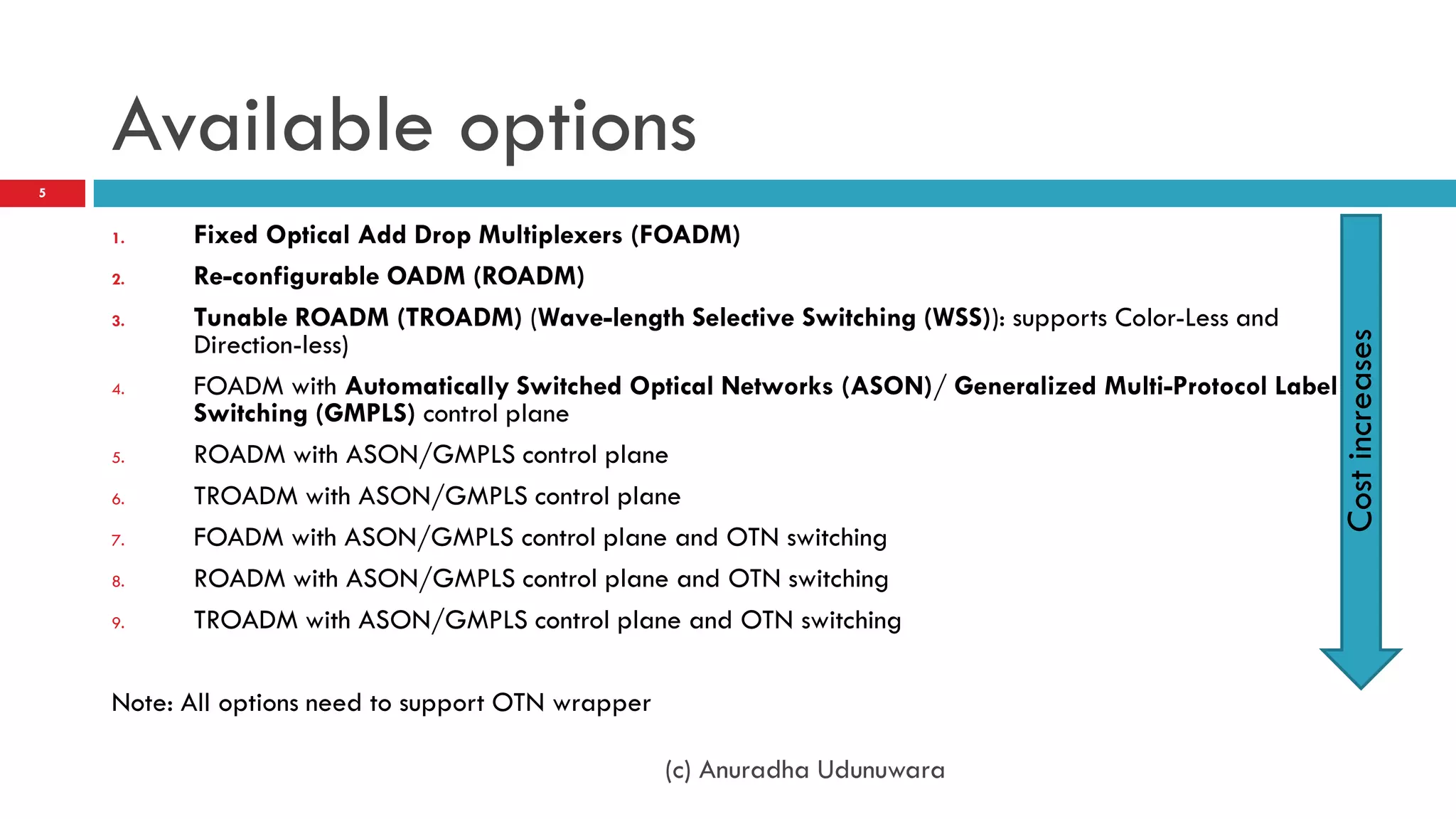
    1.    Fixed Optical Add Drop Multiplexers (FOADM)
    2.    Re-configurable OADM (ROADM)
    3.    Tunable ROADM (TROADM) (Wave-length Selective Switching (WSS)): supports Color-Less and
          Direction-less)


                                                                                                        Cost increases
    4.    FOADM with Automatically Switched Optical Networks (ASON)/ Generalized Multi-Protocol Label
          Switching (GMPLS) control plane
    5.    ROADM with ASON/GMPLS control plane
    6.    TROADM with ASON/GMPLS control plane
    7.    FOADM with ASON/GMPLS control plane and OTN switching
    8.    ROADM with ASON/GMPLS control plane and OTN switching
    9.    TROADM with ASON/GMPLS control plane and OTN switching

    Note: All options need to support OTN wrapper

                                                    (c) Anuradha Udunuwara
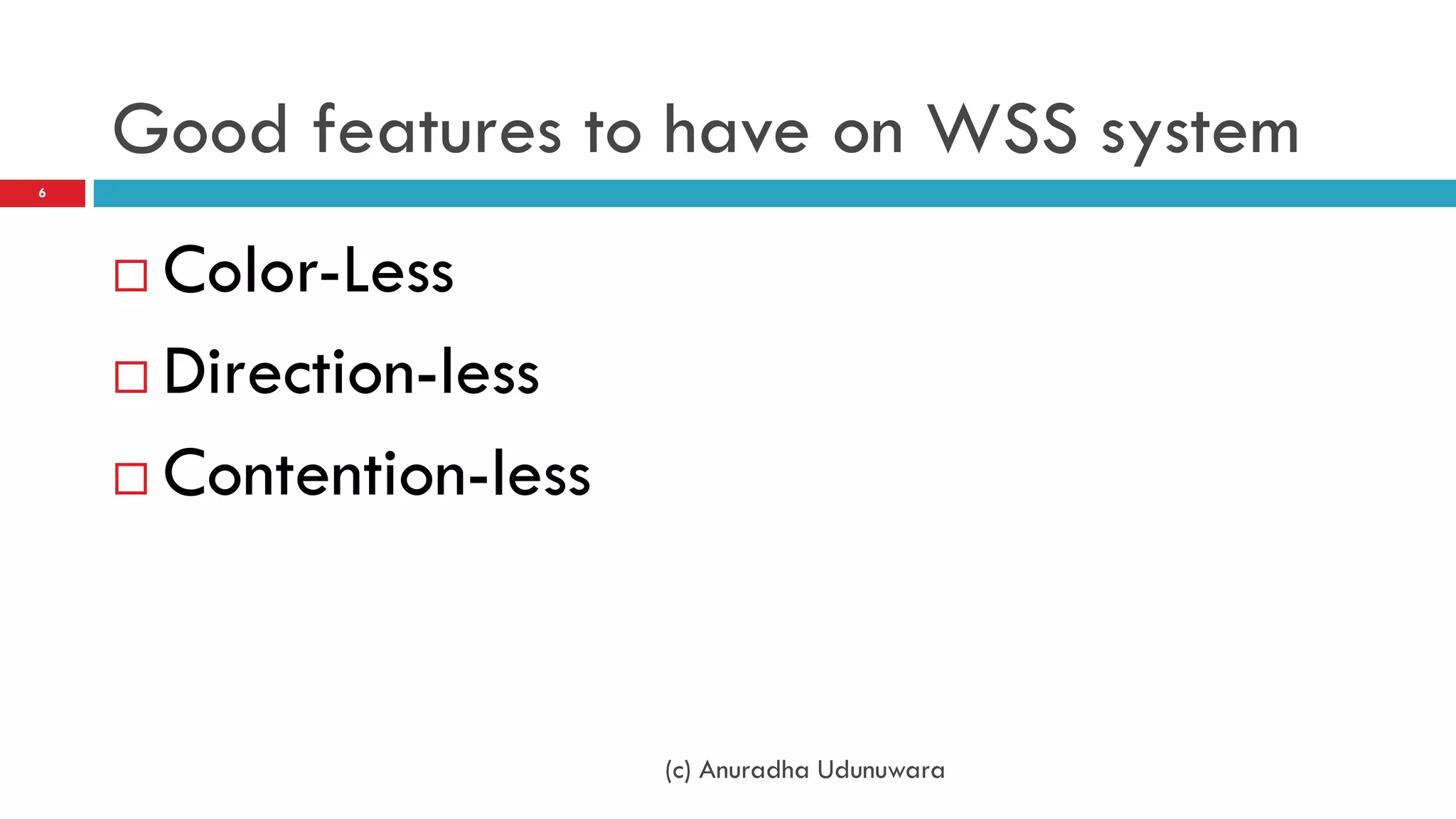
Good features to have on WSS system
6


     Color-Less
     Direction-less

     Contention-less


                        (c) Anuradha Udunuwara
3 CAPEX components
7

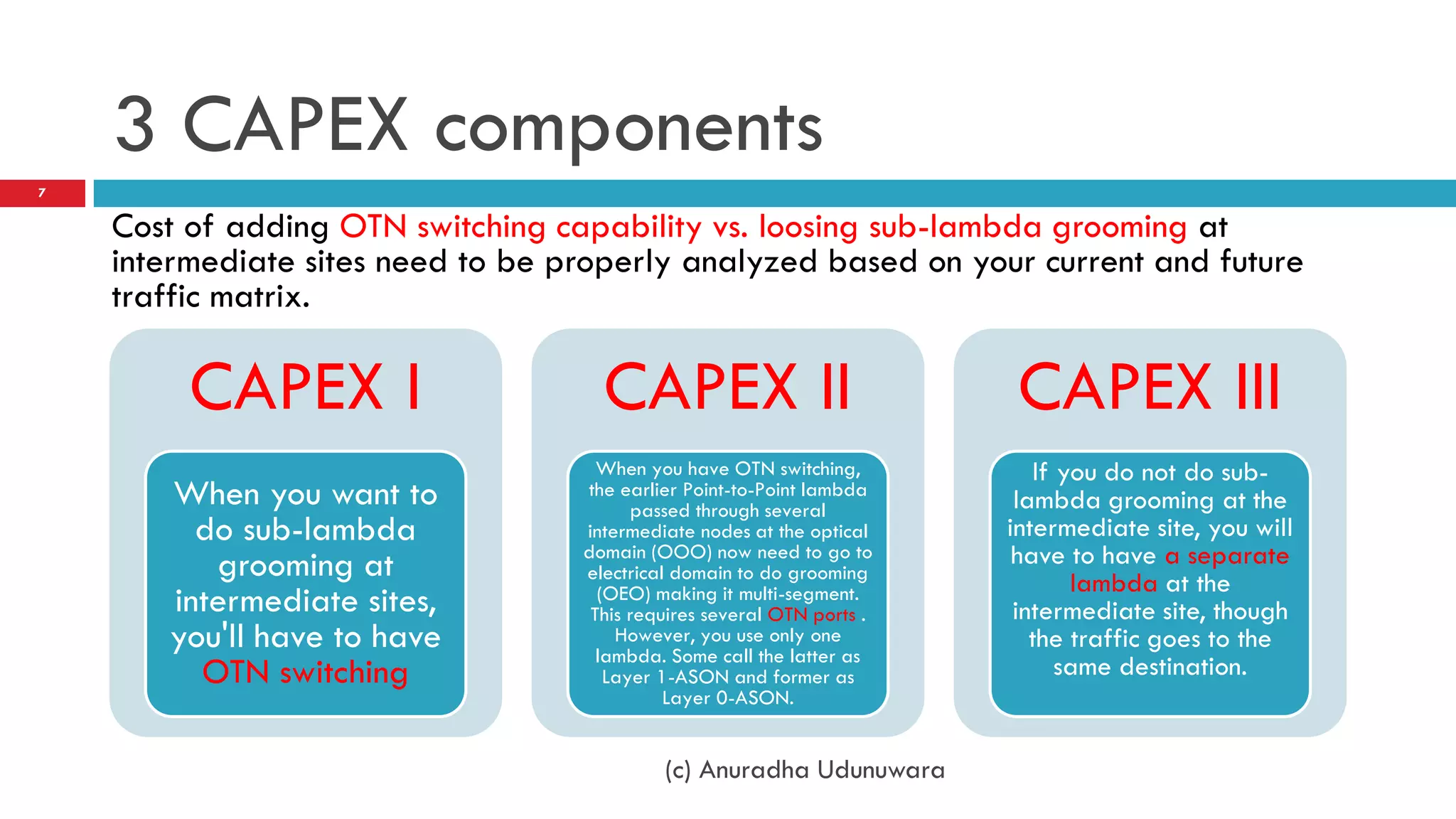
    Cost of adding OTN switching capability vs. loosing sub-lambda grooming at
    intermediate sites need to be properly analyzed based on your current and future
    traffic matrix.

         CAPEX I                     CAPEX II                            CAPEX III
                                     When you have OTN switching,          If you do not do sub-
       When you want to            the earlier Point-to-Point lambda
                                         passed through several          lambda grooming at the
         do sub-lambda             intermediate nodes at the optical    intermediate site, you will
          grooming at              domain (OOO) now need to go to        have to have a separate
                                   electrical domain to do grooming
                                                                               lambda at the
       intermediate sites,           (OEO) making it multi-segment.
                                    This requires several OTN ports .    intermediate site, though
       you'll have to have             However, you use only one
                                     lambda. Some call the latter as
                                                                           the traffic goes to the
         OTN switching                Layer 1-ASON and former as              same destination.
                                             Layer 0-ASON.


                                            (c) Anuradha Udunuwara
How to select a good solution?
8


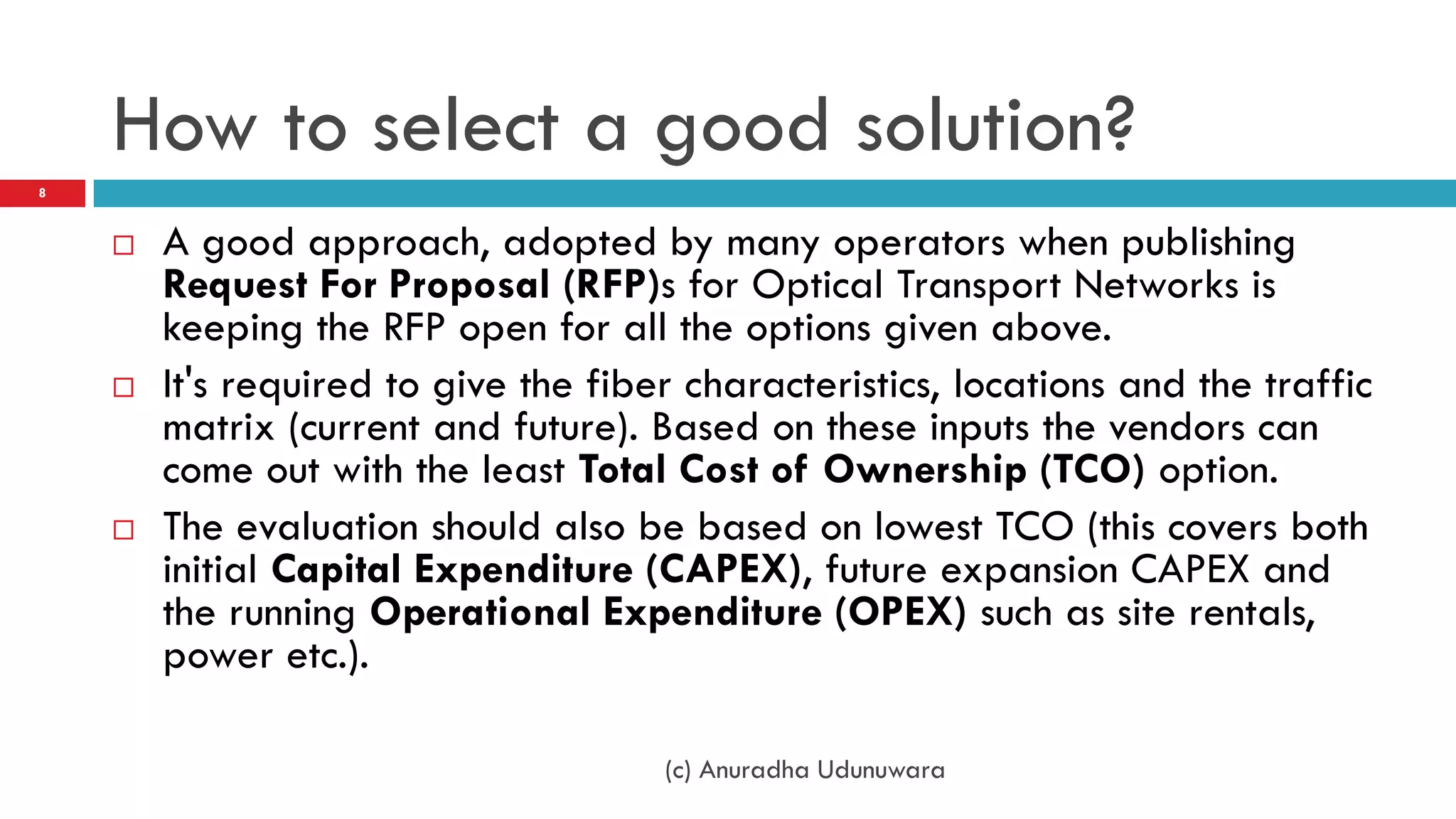
       A good approach, adopted by many operators when publishing
        Request For Proposal (RFP)s for Optical Transport Networks is
        keeping the RFP open for all the options given above.
       It's required to give the fiber characteristics, locations and the traffic
        matrix (current and future). Based on these inputs the vendors can
        come out with the least Total Cost of Ownership (TCO) option.
       The evaluation should also be based on lowest TCO (this covers both
        initial Capital Expenditure (CAPEX), future expansion CAPEX and
        the running Operational Expenditure (OPEX) such as site rentals,
        power etc.).

                                      (c) Anuradha Udunuwara
Recommended options
9


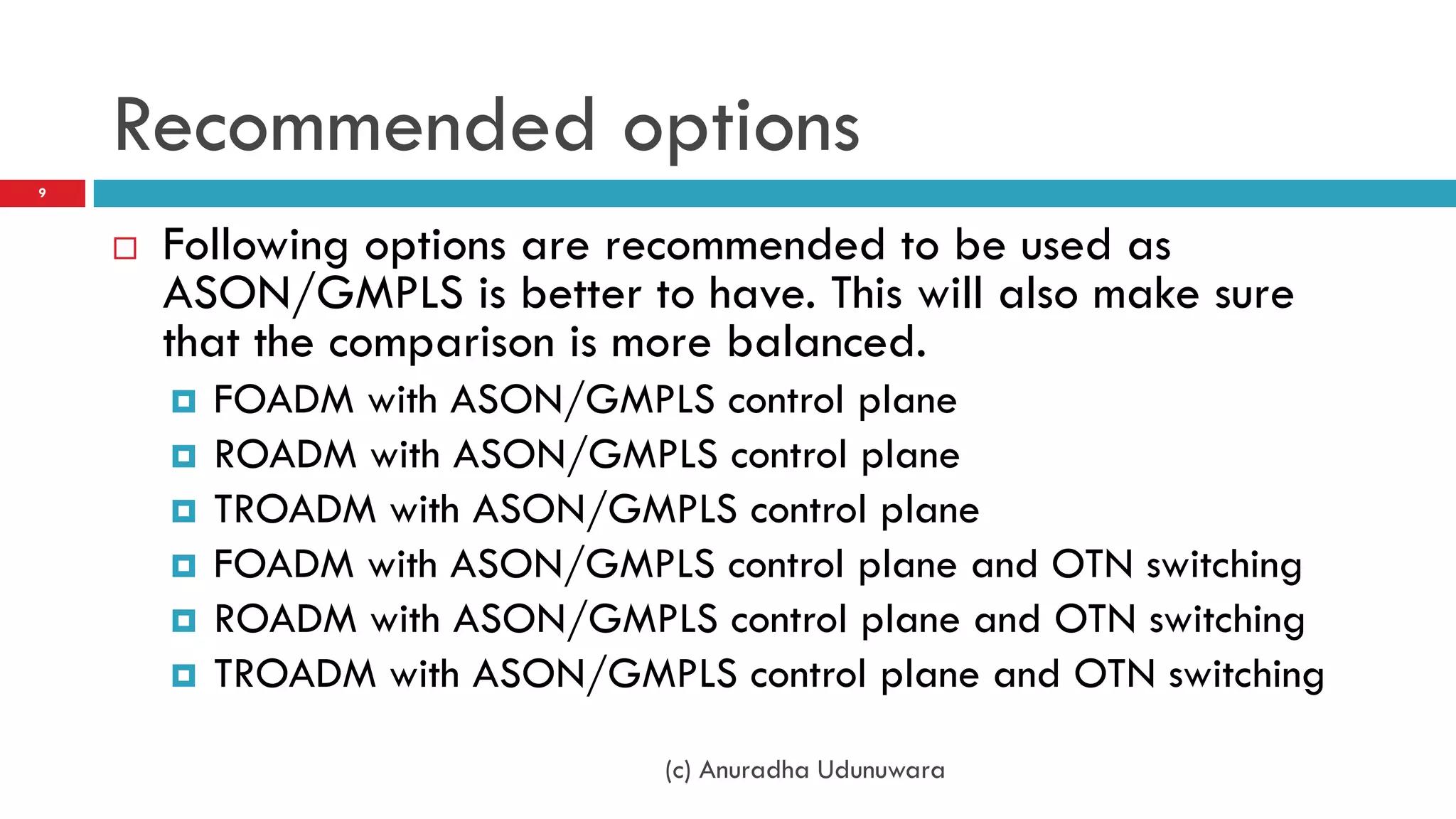
       Following options are recommended to be used as
        ASON/GMPLS is better to have. This will also make sure
        that the comparison is more balanced.
           FOADM with ASON/GMPLS control plane
           ROADM with ASON/GMPLS control plane
           TROADM with ASON/GMPLS control plane
           FOADM with ASON/GMPLS control plane and OTN switching
           ROADM with ASON/GMPLS control plane and OTN switching
           TROADM with ASON/GMPLS control plane and OTN switching

                                 (c) Anuradha Udunuwara
About the Author
10


     Eng. Anuradha Udunuwara is a Chartered Engineer by profession based in Sri Lanka. He has nearly a decade
     industry experience in strategy, architecture, engineering, design, plan, implementation and maintenance of CSP
     Networks using both packet-switched (PS) and Circuit-Switched (CS) technologies, along with legacy to NGN
     migration. Eng. Anuradha is a well-known in the field of CSP industry, both locally and internationally.
     Graduated from University of Peradeniya, Sri Lanka in 2001 with an honors in Electrical & Electronic Engineering,
     Eng. Anuradha is a corporate member of the Institution of Engineers Sri Lanka, a professional member of British
     Computer Society, a member of Institution of Electrical & Electronic Engineers, a member of Institution of
     Engineering & Technology (formerly Institution of Electrical Engineers), a member of the Computer Society of Sri
     Lanka, a life member of Sri Lanka Association for the Advancement of Science, senior member of the Carrier
     Ethernet Forum, member of the Internet Society, member of the Internet Strategy Forum, member of the Internet
     Strategy Forum Network, member of the Ethernet Academy, member of the NGN/IMS forum and member of the
     Peradeniya Engineering Faculty Alumni Association. He is also an ITIL foundation certified and the only MEF-CECP in
     the country.
     In his spare time Anuradha enjoys spending time with his family, playing badminton, photography, reading and
     travelling.
     He can be reached at udunuwara@ieee.org

                                                       (c) Anuradha Udunuwara

Next Generation OTN

  • 1.
    NEXT GENERATION OTN SEPTEMBER 2012 By Eng. Anuradha Udunuwara, BSc.Eng(Hons), CEng, MIE(SL), MEF-CECP, MBCS, ITILv3 Foundation, MIEEE, MIEEE-CS, MIEE, MIET, MCS(SL), MSLAAS
  • 2.
    Agenda 2  Introduction  OTN switching  Available options  3 CAPEX components!  Recommended options (c) Anuradha Udunuwara
  • 3.
    Introduction 3  Optical Transport Networks (OTN) could mean;  OTN wrapper capability  OTN switching capability (c) Anuradha Udunuwara
  • 4.
    OTN switching 4  OTN switching is more a hype than a reality. This is quite evident from the low number of OTN switching deployments currently in the world.  Prime advantage: sub-lambda grooming at intermediate sites.  Industry trend(both suppliers and operators): Start WITHOUT OTN switching and go for OTN switching in the future if all the lambdas run out/close to run out (aka Wave-length blocking).  This requires that you select a vendor who's capable of OTN switching but you need NOT purchase OTN switching components (cards) on day one.  You do NOT need OTN switching to achieve mesh protection. What is then required is ASON/GMPLS. (c) Anuradha Udunuwara
  • 5.
    Available options 5 1. Fixed Optical Add Drop Multiplexers (FOADM) 2. Re-configurable OADM (ROADM) 3. Tunable ROADM (TROADM) (Wave-length Selective Switching (WSS)): supports Color-Less and Direction-less) Cost increases 4. FOADM with Automatically Switched Optical Networks (ASON)/ Generalized Multi-Protocol Label Switching (GMPLS) control plane 5. ROADM with ASON/GMPLS control plane 6. TROADM with ASON/GMPLS control plane 7. FOADM with ASON/GMPLS control plane and OTN switching 8. ROADM with ASON/GMPLS control plane and OTN switching 9. TROADM with ASON/GMPLS control plane and OTN switching Note: All options need to support OTN wrapper (c) Anuradha Udunuwara
  • 6.
    Good features tohave on WSS system 6  Color-Less  Direction-less  Contention-less (c) Anuradha Udunuwara
  • 7.
    3 CAPEX components 7 Cost of adding OTN switching capability vs. loosing sub-lambda grooming at intermediate sites need to be properly analyzed based on your current and future traffic matrix. CAPEX I CAPEX II CAPEX III When you have OTN switching, If you do not do sub- When you want to the earlier Point-to-Point lambda passed through several lambda grooming at the do sub-lambda intermediate nodes at the optical intermediate site, you will grooming at domain (OOO) now need to go to have to have a separate electrical domain to do grooming lambda at the intermediate sites, (OEO) making it multi-segment. This requires several OTN ports . intermediate site, though you'll have to have However, you use only one lambda. Some call the latter as the traffic goes to the OTN switching Layer 1-ASON and former as same destination. Layer 0-ASON. (c) Anuradha Udunuwara
  • 8.
    How to selecta good solution? 8  A good approach, adopted by many operators when publishing Request For Proposal (RFP)s for Optical Transport Networks is keeping the RFP open for all the options given above.  It's required to give the fiber characteristics, locations and the traffic matrix (current and future). Based on these inputs the vendors can come out with the least Total Cost of Ownership (TCO) option.  The evaluation should also be based on lowest TCO (this covers both initial Capital Expenditure (CAPEX), future expansion CAPEX and the running Operational Expenditure (OPEX) such as site rentals, power etc.). (c) Anuradha Udunuwara
  • 9.
    Recommended options 9  Following options are recommended to be used as ASON/GMPLS is better to have. This will also make sure that the comparison is more balanced.  FOADM with ASON/GMPLS control plane  ROADM with ASON/GMPLS control plane  TROADM with ASON/GMPLS control plane  FOADM with ASON/GMPLS control plane and OTN switching  ROADM with ASON/GMPLS control plane and OTN switching  TROADM with ASON/GMPLS control plane and OTN switching (c) Anuradha Udunuwara
  • 10.
    About the Author 10 Eng. Anuradha Udunuwara is a Chartered Engineer by profession based in Sri Lanka. He has nearly a decade industry experience in strategy, architecture, engineering, design, plan, implementation and maintenance of CSP Networks using both packet-switched (PS) and Circuit-Switched (CS) technologies, along with legacy to NGN migration. Eng. Anuradha is a well-known in the field of CSP industry, both locally and internationally. Graduated from University of Peradeniya, Sri Lanka in 2001 with an honors in Electrical & Electronic Engineering, Eng. Anuradha is a corporate member of the Institution of Engineers Sri Lanka, a professional member of British Computer Society, a member of Institution of Electrical & Electronic Engineers, a member of Institution of Engineering & Technology (formerly Institution of Electrical Engineers), a member of the Computer Society of Sri Lanka, a life member of Sri Lanka Association for the Advancement of Science, senior member of the Carrier Ethernet Forum, member of the Internet Society, member of the Internet Strategy Forum, member of the Internet Strategy Forum Network, member of the Ethernet Academy, member of the NGN/IMS forum and member of the Peradeniya Engineering Faculty Alumni Association. He is also an ITIL foundation certified and the only MEF-CECP in the country. In his spare time Anuradha enjoys spending time with his family, playing badminton, photography, reading and travelling. He can be reached at udunuwara@ieee.org (c) Anuradha Udunuwara