7th Grade Chapter 6 Lesson 3 Pgs. 207 - 211 For Student Use Only
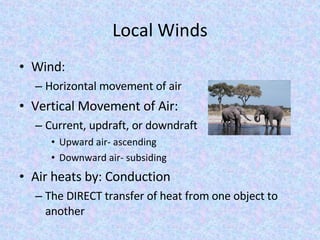
Local Winds Wind: Horizontal movement of air Vertical Movement of Air: Current, updraft, or downdraft Upward air- ascending Downward air- subsiding Air heats by: Conduction The DIRECT transfer of heat from one object to another
Local Winds Local Wind- wind movement in a smaller area Heat is transferred from molecule to molecule Cold ground and cold air have little heat to pass on Air can help control the temperature of a region Air can be warm or cool Air travels: Air always goes from an area of high pressure to an area of low pressure
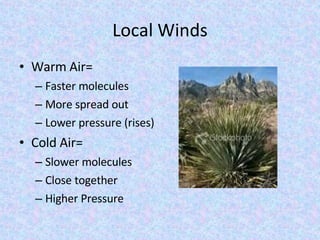
Local Winds Warm Air= Faster molecules More spread out Lower pressure (rises) Cold Air= Slower molecules Close together Higher Pressure
Local Winds Water and Land: Sea breezes (or lake breezes) bring cool air during the day Cool air from the water rushes to fill the area where the hot land air rose Woods: Forest breeze Cool air from under the tress rushes to fill the area where there are no trees and the land is warm and air is rising
Local Winds Valley Breeze: Day: Breeze blows up from the valley Mountains peaks warm more quickly than the valley Cool air rises up to the warm mountain from the cool valley Mountain Breeze: Night: Breeze blows from the mountain Valley cools very slowly, mountain cools quickly Air goes from cooler area to warmer area
Local Winds Katabatic Winds: Movements of cold air from higher elevations to lower elevations Cool air from mountains rush to fill warmer areas
Local Winds Foehn (Alps) and Chinook (Am. Rockies): Gusty winds caused by cold air seeking an area of warm air Windward: side of mountain facing wind, warm air gets forced up the mountain and creates clouds (as air gets cooler) (Note: Condensation helps air stay warm) Leeward: side of the mountain facing away from wind: warm air that is now drier blows over surface and brings warmer, dry air to leeward side

7th Grade Chapter 6 Lesson 3

  • 1.
    7th Grade Chapter6 Lesson 3 Pgs. 207 - 211 For Student Use Only
  • 2.
    Local Winds Wind:Horizontal movement of air Vertical Movement of Air: Current, updraft, or downdraft Upward air- ascending Downward air- subsiding Air heats by: Conduction The DIRECT transfer of heat from one object to another
  • 3.
    Local Winds LocalWind- wind movement in a smaller area Heat is transferred from molecule to molecule Cold ground and cold air have little heat to pass on Air can help control the temperature of a region Air can be warm or cool Air travels: Air always goes from an area of high pressure to an area of low pressure
  • 4.
    Local Winds WarmAir= Faster molecules More spread out Lower pressure (rises) Cold Air= Slower molecules Close together Higher Pressure
  • 5.
    Local Winds Waterand Land: Sea breezes (or lake breezes) bring cool air during the day Cool air from the water rushes to fill the area where the hot land air rose Woods: Forest breeze Cool air from under the tress rushes to fill the area where there are no trees and the land is warm and air is rising
  • 6.
    Local Winds ValleyBreeze: Day: Breeze blows up from the valley Mountains peaks warm more quickly than the valley Cool air rises up to the warm mountain from the cool valley Mountain Breeze: Night: Breeze blows from the mountain Valley cools very slowly, mountain cools quickly Air goes from cooler area to warmer area
  • 7.
    Local Winds KatabaticWinds: Movements of cold air from higher elevations to lower elevations Cool air from mountains rush to fill warmer areas
  • 8.
    Local Winds Foehn(Alps) and Chinook (Am. Rockies): Gusty winds caused by cold air seeking an area of warm air Windward: side of mountain facing wind, warm air gets forced up the mountain and creates clouds (as air gets cooler) (Note: Condensation helps air stay warm) Leeward: side of the mountain facing away from wind: warm air that is now drier blows over surface and brings warmer, dry air to leeward side