
CHAPTER 19
WEATHER AND CLIMATE
 Weather satellites, computers, and other kinds
  of weather instrument provide accurate
  information about weather conditions.
 Meteorologists are people who study the
  weather and use weather data to predict the
  weather.
 Their forecasts help us plan our daily activities.

 Guide Questions:

 1.Have you ever wondered what the weather
  will be on a certain day?
 2.You experience weather (yes or no) and
  why?
WHAT DOES WEATHER MEAN?
 Weather is the condition of the atmosphere at
  any given time and place.
 The chief elements of weather are
  sunshine, temperature, air
  pressure, wind, humidity (moisture), clouds
  , and precipitation. All these elements change
  frequently.
 Weather science is known as meteorology.

 This term comes from two Greek words

 Meteoros meaning ‘high in the air’

 Logos meaning ‘knowledge’
 Meteorologists in all parts every hour of what
  the weather is where they are.
 Each country has typical or average weather.In
  the Philippines, April and May are the warm
  summer months, while July and August are the
  rainy months.
 The average weather in a region over a period
  of time is called climate.
 Climate is the weather condition of a place over
  a long period of time.
 Thus weather is very variable and can be
  described as fair, rainy, sunny, or stormy.
THE EARTH IS DIVIDED INTO THREE ZONES
 (1)The zone of tropical climate,
 (2)The zone of temperate climate,and
 (3)The zone of polar climate
 These climate zones are related to the angle at
  which the sun’s rays strike the earth
 Thus the general descriptions of climate
  conditions in these zones are as follows:
 1.Zone of tropical climate – hot humid climate
 2.Zone of polar climate – very cold climate
 3.Zone of temperate climate – mild climate
ELEMENTS OF WEATHER
 The earth’s surface absorbs heat but also radiates
  some of this heat but also radiates some of this
  heat.
 The sun’s energy that is absorbed by the earth is
  spread throughout the atmosphere in
 Three basic ways: Conduction, Convection, and
  Radiation
 Conduction is the direct transfer of heat energy
  from one substance to another.
 Convection is the transfer of heat in a gas or liquid.

 Radiation is the transfer of heat energy in the form
  of waves through a vacuum.
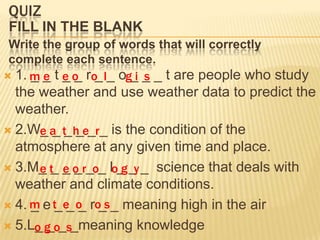
QUIZ
FILL IN THE BLANK
 Write the group of words that will correctly
 complete each sentence.
 1. m _ t e o ro l_ og_ _ _ t are people who study
     _e __ _            i s
  the weather and use weather data to predict the
  weather.
 2.W_ a t h e_r_ is the condition of the
       e ___
  atmosphere at any given time and place.
 3.M_ t _ o r_o_ lo_ _ _ science that deals with
       e_e _          g y
  weather and climate conditions.
 4. m e t_e o ro s _ meaning high in the air
     _      __ _
 5.L_ g o_s_meaning knowledge
     o _
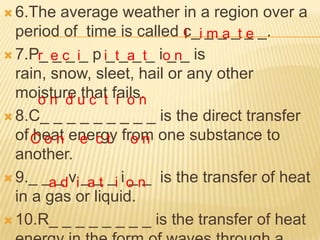
 6.The   average weather in a region over a
  period of time is called c_i _ _ _t _ _.
                              l ma e
 7.P_ e c i_ p i_ t_a t_ io n_ is
      r __             _    _
  rain, snow, sleet, hail or any other
  moisture u c t fails.
      o n d that i o n
 8.C_ _ _ _ _ _ _ _ _ is the direct transfer
  of C o n energy from one substance to
     heat e c t o n
  another.
 9._ _a_ vi _ _ _i i o n is the transfer of heat
          d at        __
  in a gas or liquid.
 10.R_ _ _ _ _ _ _ _ is the transfer of heat
TYPES OF CLOUDS
 Clouds have different shapes and sizes.
 Clouds are classified according to shape and
  altitude.
 The main types of clouds are cirrus
  clouds, cumulus clouds, stratus clouds, and
  nimbus clouds.
 Cirrus clouds are fair-weather clouds. They
  appear thin and curly.
 Cirrus means ‘feathery’. They consist of ice
  crystals because they are formed under low
  temperature at high altitudes.
 Cumulus means ‘piled’ or ‘heaped up’.
 Cumulus clouds look like heads of cauliflower
  with flat bottoms.
 These clouds develop when rising columns of
  moist air are cooled to the dewpoint
  temperature.
 Stratus means ‘spread out’ or ‘stretched in
  layers’.
 Unlike cumulus clouds, stratus clouds are only
  a few hundred meters thick but may extend
  over thousands of square kilometers.
 Nimbus means ‘rainy’.
AIR MASSES
 A cold air mass is turbulent because of the
  many convection currents affecting it.
 The convection currents are caused by the
  warming of the air when it comes in contact
  with the ground.
 Warm air masses form very few convection
  currents but form fog and low clouds close to
  the ground.
 This condition develops because the air close
  to the ground is cooled to a temperature near
  its dew point.
AIR MASS BOUNDARIES
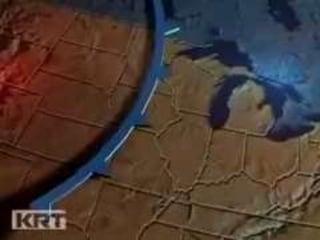
 A cold front forms when a mass of cold air
  meets and replaces a mass of warm air.
 A warm front forms when a mass of warm air
  overtakes a cold air mass and moves over it.
 A cold front travels faster than a warm front.
 When cold front overtakes a warm front, and is
  rushed upward, an occluding front occurs.
 An occluded front produces less extreme
  weather than a cold or a warm front.
 When a warm air masses meets a cold air
  mass and no movement occurs, a stationary
  front forms.
ENUMERATE THE FOLLOWING:
 1-4 types of clouds
 5-8 types of fronts

 9-10 two air masses

 Answers:
   1.Cumulus clouds   5.cold front       9.cold air masses
   2.Cirrus clouds    6.warm front 10.warm air masses
   3.Stratus clouds   7.occluding front
   4.Nimbus clouds    8.stationary front
STORMS AND TYPHOONS
 Thunderstorms are heavy rainstorms with
  thunder and lightning.
 These storms can be violent.During a
  thunderstorm, areas of positive and
  negative electrical charges build up in the
  storm clouds.
 Lightning is a sudden discharge or spark
  of electricity between these cloud areas or
  between a cloud and the ground.
THE CLIMATE OF THE PHILIPPINES

 The climate of the philippines may be
  categorized into three:
 1.From March to May–warm and dry
  seasons
 2.From June to November–rainy
  seasons
 3.From December to February–cool
  and dry seasons
 Tropical cyclones, which affect the Philippines
  during the months of June to November, may
  be classified into three categories depending on
  the wind speed.
 1.Tropical depression–has a maximum wind
  speed of less than 63 kilometers per hour(kph).
 2.Tropical storm–has a maximum wind speed of
  63 to 118 kph.
 3.Typhoon–has a maximum wind speed
  exceeding 118 kph.
 The Philippines Atmospheric, Geophysical, and
  Astronomical Services Administration
  (PAGASA)
WEATHER FORECASTING

 All over the world, weather stations keep track
  of the presence of cyclones, anticyclones, and
  weather fronts.
 This information is supplied to meteorologists in
  local weather stations.
 The information received is put together or
  summarized in a weather map.
 Stations with the same air pressure are joined
  by a line.
 Such a line is called an isobar.
CLOUD SEEDING
 Cloud seeding is a method that is used to
  control precipitation.
 This method uses silver iodide particles spread
  in clouds to act as condensation nuclei.
 Cloud seeding helps disperse fog in airports
  and, in dry areas, it induces rainfall and
  snowball.
 It ha also been successful in reducing the
  power of thunderstorms and hurricanes.
 Cloud seeding causes droplets of water to
QUIZ
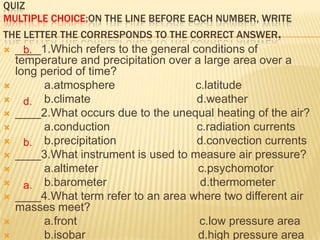
MULTIPLE CHOICE:ON THE LINE BEFORE EACH NUMBER, WRITE
THE LETTER THE CORRESPONDS TO THE CORRECT ANSWER.
 ____1.Which refers to the general conditions of
    b.
    temperature and precipitation over a large area over a
    long period of time?
         a.atmosphere                 c.latitude
     d. b.climate                     d.weather
   ____2.What occurs due to the unequal heating of the air?
         a.conduction                 c.radiation currents
     b. b.precipitation               d.convection currents
   ____3.What instrument is used to measure air pressure?
         a.altimeter                   c.psychomotor
     a. b.barometer                    d.thermometer
   ____4.What term refer to an area where two different air
    masses meet?
         a.front                       c.low pressure area
         b.isobar                      d.high pressure area
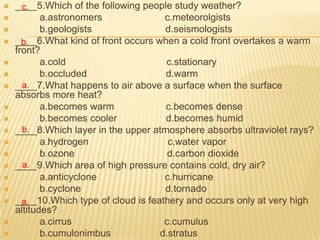
   ____5.Which of the following people study weather?
      c.
          a.astronomers              c.meteorolgists
          b.geologists               d.seismologists
   ____6.What kind of front occurs when a cold front overtakes a warm
      b.
    front?
          a.cold                     c.stationary
          b.occluded                 d.warm
   ____7.What happens to air above a surface when the surface
      a.
    absorbs more heat?
          a.becomes warm             c.becomes dense
          b.becomes cooler           d.becomes humid
     b.
    ____8.Which layer in the upper atmosphere absorbs ultraviolet rays?
          a.hydrogen                  c.water vapor
          b.ozone                     d.carbon dioxide
     a.
    ____9.Which area of high pressure contains cold, dry air?
          a.anticyclone              c.hurricane
          b.cyclone                  d.tornado
   ____10.Which type of cloud is feathery and occurs only at very high
      a.
    altitudes?
          a.cirrus                   c.cumulus
          b.cumulonimbus            d.stratus
SEATWORK/HOMEWORK

ANSWERS:

Pages   281 to 283

Weather and Climate

  • 1.
  • 2.
     Weather satellites,computers, and other kinds of weather instrument provide accurate information about weather conditions.  Meteorologists are people who study the weather and use weather data to predict the weather.  Their forecasts help us plan our daily activities.  Guide Questions:  1.Have you ever wondered what the weather will be on a certain day?  2.You experience weather (yes or no) and why?
  • 3.
    WHAT DOES WEATHERMEAN?  Weather is the condition of the atmosphere at any given time and place.  The chief elements of weather are sunshine, temperature, air pressure, wind, humidity (moisture), clouds , and precipitation. All these elements change frequently.  Weather science is known as meteorology.  This term comes from two Greek words  Meteoros meaning ‘high in the air’  Logos meaning ‘knowledge’
  • 4.
     Meteorologists inall parts every hour of what the weather is where they are.  Each country has typical or average weather.In the Philippines, April and May are the warm summer months, while July and August are the rainy months.  The average weather in a region over a period of time is called climate.  Climate is the weather condition of a place over a long period of time.  Thus weather is very variable and can be described as fair, rainy, sunny, or stormy.
  • 5.
    THE EARTH ISDIVIDED INTO THREE ZONES  (1)The zone of tropical climate,  (2)The zone of temperate climate,and  (3)The zone of polar climate  These climate zones are related to the angle at which the sun’s rays strike the earth  Thus the general descriptions of climate conditions in these zones are as follows:  1.Zone of tropical climate – hot humid climate  2.Zone of polar climate – very cold climate  3.Zone of temperate climate – mild climate
  • 6.
    ELEMENTS OF WEATHER The earth’s surface absorbs heat but also radiates some of this heat but also radiates some of this heat.  The sun’s energy that is absorbed by the earth is spread throughout the atmosphere in  Three basic ways: Conduction, Convection, and Radiation  Conduction is the direct transfer of heat energy from one substance to another.  Convection is the transfer of heat in a gas or liquid.  Radiation is the transfer of heat energy in the form of waves through a vacuum.
  • 7.
    QUIZ FILL IN THEBLANK Write the group of words that will correctly complete each sentence.  1. m _ t e o ro l_ og_ _ _ t are people who study _e __ _ i s the weather and use weather data to predict the weather.  2.W_ a t h e_r_ is the condition of the e ___ atmosphere at any given time and place.  3.M_ t _ o r_o_ lo_ _ _ science that deals with e_e _ g y weather and climate conditions.  4. m e t_e o ro s _ meaning high in the air _ __ _  5.L_ g o_s_meaning knowledge o _
  • 8.
     6.The average weather in a region over a period of time is called c_i _ _ _t _ _. l ma e  7.P_ e c i_ p i_ t_a t_ io n_ is r __ _ _ rain, snow, sleet, hail or any other moisture u c t fails. o n d that i o n  8.C_ _ _ _ _ _ _ _ _ is the direct transfer of C o n energy from one substance to heat e c t o n another.  9._ _a_ vi _ _ _i i o n is the transfer of heat d at __ in a gas or liquid.  10.R_ _ _ _ _ _ _ _ is the transfer of heat
  • 9.
    TYPES OF CLOUDS Clouds have different shapes and sizes.  Clouds are classified according to shape and altitude.  The main types of clouds are cirrus clouds, cumulus clouds, stratus clouds, and nimbus clouds.  Cirrus clouds are fair-weather clouds. They appear thin and curly.  Cirrus means ‘feathery’. They consist of ice crystals because they are formed under low temperature at high altitudes.
  • 10.
     Cumulus means‘piled’ or ‘heaped up’.  Cumulus clouds look like heads of cauliflower with flat bottoms.  These clouds develop when rising columns of moist air are cooled to the dewpoint temperature.  Stratus means ‘spread out’ or ‘stretched in layers’.  Unlike cumulus clouds, stratus clouds are only a few hundred meters thick but may extend over thousands of square kilometers.  Nimbus means ‘rainy’.
  • 11.
    AIR MASSES  Acold air mass is turbulent because of the many convection currents affecting it.  The convection currents are caused by the warming of the air when it comes in contact with the ground.  Warm air masses form very few convection currents but form fog and low clouds close to the ground.  This condition develops because the air close to the ground is cooled to a temperature near its dew point.
  • 14.
    AIR MASS BOUNDARIES A cold front forms when a mass of cold air meets and replaces a mass of warm air.  A warm front forms when a mass of warm air overtakes a cold air mass and moves over it.  A cold front travels faster than a warm front.  When cold front overtakes a warm front, and is rushed upward, an occluding front occurs.  An occluded front produces less extreme weather than a cold or a warm front.  When a warm air masses meets a cold air mass and no movement occurs, a stationary front forms.
  • 15.
    ENUMERATE THE FOLLOWING: 1-4 types of clouds  5-8 types of fronts  9-10 two air masses  Answers:  1.Cumulus clouds 5.cold front 9.cold air masses  2.Cirrus clouds 6.warm front 10.warm air masses  3.Stratus clouds 7.occluding front  4.Nimbus clouds 8.stationary front
  • 16.
    STORMS AND TYPHOONS Thunderstorms are heavy rainstorms with thunder and lightning.  These storms can be violent.During a thunderstorm, areas of positive and negative electrical charges build up in the storm clouds.  Lightning is a sudden discharge or spark of electricity between these cloud areas or between a cloud and the ground.
  • 17.
    THE CLIMATE OFTHE PHILIPPINES  The climate of the philippines may be categorized into three:  1.From March to May–warm and dry seasons  2.From June to November–rainy seasons  3.From December to February–cool and dry seasons
  • 18.
     Tropical cyclones,which affect the Philippines during the months of June to November, may be classified into three categories depending on the wind speed.  1.Tropical depression–has a maximum wind speed of less than 63 kilometers per hour(kph).  2.Tropical storm–has a maximum wind speed of 63 to 118 kph.  3.Typhoon–has a maximum wind speed exceeding 118 kph.  The Philippines Atmospheric, Geophysical, and Astronomical Services Administration (PAGASA)
  • 19.
    WEATHER FORECASTING  Allover the world, weather stations keep track of the presence of cyclones, anticyclones, and weather fronts.  This information is supplied to meteorologists in local weather stations.  The information received is put together or summarized in a weather map.  Stations with the same air pressure are joined by a line.  Such a line is called an isobar.
  • 20.
    CLOUD SEEDING  Cloudseeding is a method that is used to control precipitation.  This method uses silver iodide particles spread in clouds to act as condensation nuclei.  Cloud seeding helps disperse fog in airports and, in dry areas, it induces rainfall and snowball.  It ha also been successful in reducing the power of thunderstorms and hurricanes.  Cloud seeding causes droplets of water to
  • 21.
    QUIZ MULTIPLE CHOICE:ON THELINE BEFORE EACH NUMBER, WRITE THE LETTER THE CORRESPONDS TO THE CORRECT ANSWER.  ____1.Which refers to the general conditions of b. temperature and precipitation over a large area over a long period of time?  a.atmosphere c.latitude  d. b.climate d.weather  ____2.What occurs due to the unequal heating of the air?  a.conduction c.radiation currents  b. b.precipitation d.convection currents  ____3.What instrument is used to measure air pressure?  a.altimeter c.psychomotor  a. b.barometer d.thermometer  ____4.What term refer to an area where two different air masses meet?  a.front c.low pressure area  b.isobar d.high pressure area
  • 22.
    ____5.Which of the following people study weather? c.  a.astronomers c.meteorolgists  b.geologists d.seismologists  ____6.What kind of front occurs when a cold front overtakes a warm b. front?  a.cold c.stationary  b.occluded d.warm  ____7.What happens to air above a surface when the surface a. absorbs more heat?  a.becomes warm c.becomes dense  b.becomes cooler d.becomes humid  b. ____8.Which layer in the upper atmosphere absorbs ultraviolet rays?  a.hydrogen c.water vapor  b.ozone d.carbon dioxide  a. ____9.Which area of high pressure contains cold, dry air?  a.anticyclone c.hurricane  b.cyclone d.tornado  ____10.Which type of cloud is feathery and occurs only at very high a. altitudes?  a.cirrus c.cumulus  b.cumulonimbus d.stratus
  • 23.