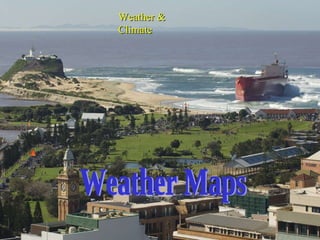
Weather Maps Weather & Climate
Weather and Climate Weather  is the  state of   the atmosphere at any   one place or time . This includes: humidity, temperature, sunshine hours, cloud cover, precipitation (any moisture reaching the earth’s surface). This  includes rain, sleet, snow, hail, dew and frost. Song: http:// www.youtube.com/watch?v =c3MKsTLnTKc Climate   is  the  average or long term weather conditions  of a region.  It is t he result of years of  research  into data.
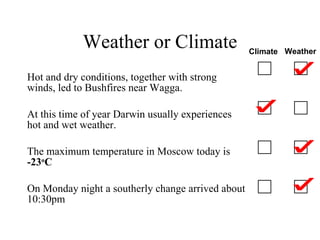
Weather or Climate Hot and dry conditions, together with strong winds, led to Bushfires near Wagga. At this time of year Darwin usually experiences hot and wet weather. The maximum temperature in Moscow today is  -23 o C On Monday night a southerly change arrived about 10:30pm Climate Weather
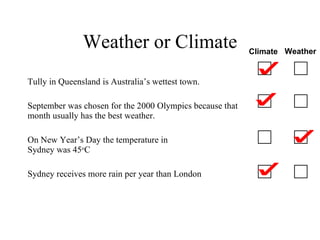
Weather or Climate Tully in Queensland is Australia’s wettest town. September was chosen for the 2000 Olympics because that month usually has the best weather. On New Year’s Day the temperature in  Sydney was 45 o C Sydney receives more rain per year than London Climate Weather
Bureau of Meteorology http://www.bom.gov.au/ http://www.aus-emaps.com/severe_weather.php
Atmospheric pressure Atmospheric pressure or barometric pressure is the  pressure exerted by the weight of the air  on the earth’s surface. Atmospheric pressure is  measured in hectopascals (hPa) .  Atmospheric pressure is  mapped to form isobars . http://www.juicygeography.co.uk/animations.htm#downloads/flash/highpressure.swf
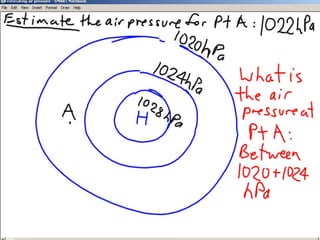
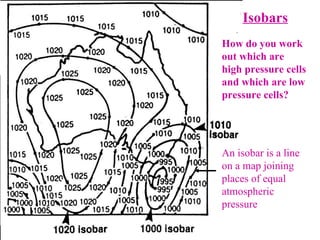
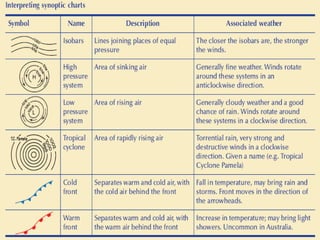
Isobars Are  lines on a synoptic chart joining places of equal atmospheric pressure .   To estimate atmospheric pressure you need to refer to the two nearest isobars.  e.g.  if point “A” is situated half way between 1020 hPa and 1024 hPa, “A” would be > 1020 but < 1024 hPa.
 
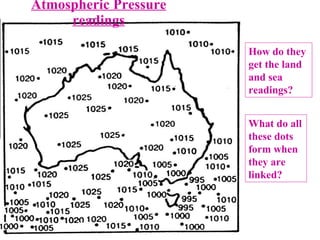
Atmospheric Pressure readings How do they get the land and sea readings? What do all these dots form when they are linked?
Isobars How do you work out which are high pressure cells and which are low pressure cells? An isobar is a line on a map joining places of equal atmospheric pressure
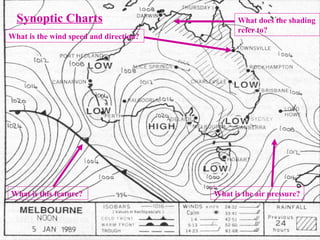
Synoptic Charts Synoptic charts or weather maps provide a  snapshot of the weather  experienced at a particular place at a certain time.  They  show  information relating to  air pressure, air masses and fronts, cloud cover, wind speed, wind direction and rainfall .  This information allows us to make predictions relating to temperature, humidity, ocean conditions and the likely weather for the next few days.
Synoptic Charts Synoptic Charts What is this feature?   What does the shading refer to? What is the wind speed and direction? What is the air pressure?
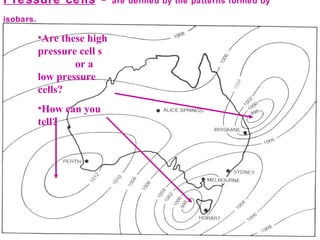
Pressure cells  -  are defined by the patterns formed by isobars.   Are these high pressure cell s  or a low pressure cells? How can you tell?
http://www.bom.gov.au/lam/Students_Teachers/pressure.shtml http://www.bom.gov.au/lam/Students_Teachers/Worksheet23.shtml
High pressure  cells  (anticyclones) occur where  atmospheric pressure increases towards the centre  of the system. High pressure systems are  characterised by light winds, clear skies, dry weather and a high diurnal (daily) temperature range .  A  ridge  is an  extension of high pressure  from a high pressure system. http:// www.bom.gov.au/weather/national/charts/synoptic.shtml
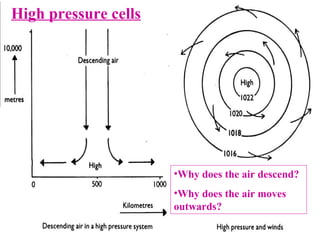
High pressure cells Why does the air descend? Why does the air moves outwards?
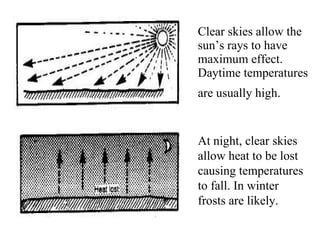
Typical weather associated with High pressure light winds clear skies, dry weather  higher  diurnal  ( daily) temperature range  i.e. hot days (sun rays maximum effect)  cool nights  (because of lack of cloud cover).  Frosts  are likely  in winter .
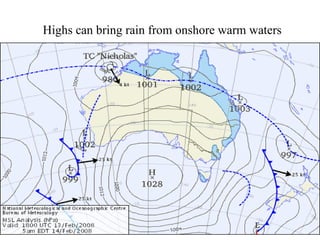
Highs can bring rain from onshore warm waters
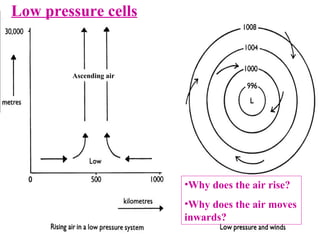
Low pressure  cells  (cyclones or depressions) occur where  atmospheric pressure decreases towards the centre  of the system.  Low pressure systems  are associated with stronger winds, cloudy skies, rain  a lower diurnal temperature range.  A  trough  is an  extension of low pressure  from a low pressure system.
Low pressure cells Ascending air Why does the air rise? Why does the air moves inwards?
Typical weather associated with Low pressure strong winds, cloudy skies, rain  and a lower diurnal ( daily) temperature range  i.e. mild temperatures (sun does not have maximum effect because of cloud cover, heat trapped in at night).  Frosts are unlikely .
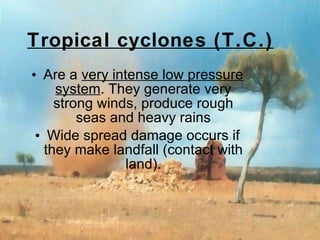
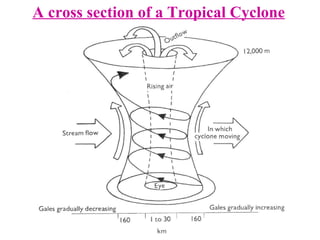
T ropical  c yclone s  (T.C.) A re a   very intense low pressure system . They generate very strong winds, produce rough seas and heavy rains Wide spread damage occurs if they make  landfall ( contact with land ) .
A cross section of a Tropical Cyclone
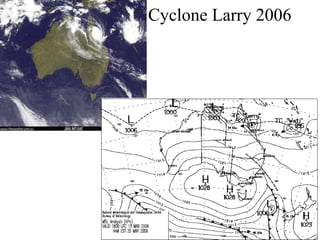
Cyclone Larry 2006
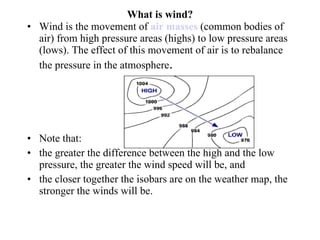
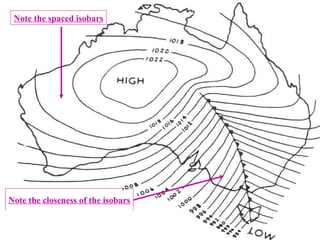
What is wind? Wind is the movement of  air masses  (common bodies of air) from high pressure areas (highs) to low pressure areas (lows). The effect of this movement of air is to rebalance the pressure in the atmosphere .  Note that: the greater the difference between the high and the low pressure, the greater the wind speed will be, and the closer together the isobars are on the weather map, the stronger the winds will be.
 
Wind speed is  determined by the closeness of the isobars . The closer the isobars the stronger the winds.  A  steep pressure gradient  exists where  isobars  are  close together .  If isobars are far apart a place will generally experience light winds. This is called a slight pressure gradient.
Note the closeness of the isobars Note the spaced isobars
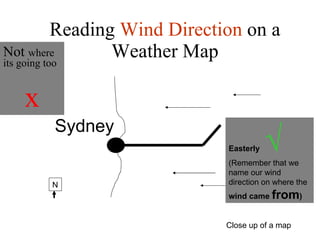
Reading  Wind Direction  on a Weather Map Not  where its going too x Sydney N Close up of a map Easterly   √  (Remember that we name our wind direction on where the  wind came  from )
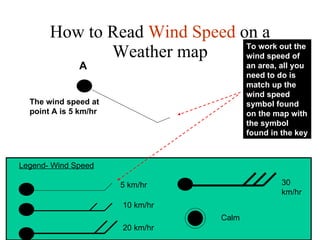
How to Read  Wind Speed  on a Weather map Legend- Wind Speed 5 km/hr 10 km/hr 20 km/hr To work out the wind speed of an area, all you need to do is match up the wind speed symbol found on the map with the symbol found in the key The wind speed at point A is 5 km/hr A 30 km/hr Calm
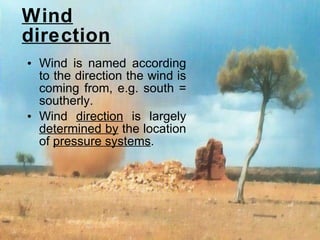
Wind direction Wind is named according to the direction the wind is coming from, e.g. south = southerly. Wind  direction  is largely  determined by  the location of  pressure systems . 
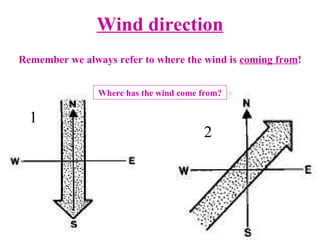
Wind direction Remember we always refer to where the wind is  coming from ! Where has the wind come from? 1 2
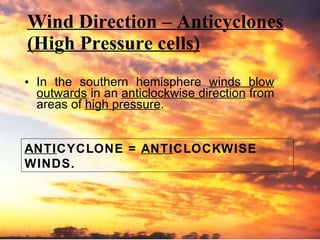
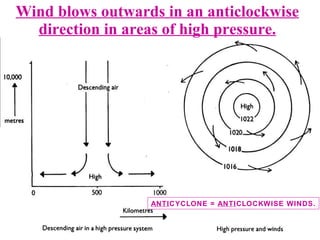
Wind Direction – Anticyclones (High Pressure cells) In the southern hemisphere  winds blow outwards  in an  anticlockwise direction  from areas of  high pressure . ANTI CYCLONE =  ANTI CLOCKWISE WINDS.
Wind blows outwards in an anticlockwise direction in areas of high pressure. ANTI CYCLONE =  ANTI CLOCKWISE WINDS.
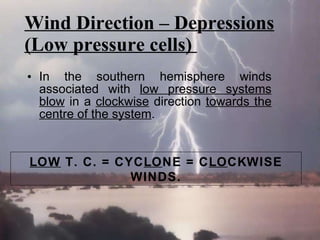
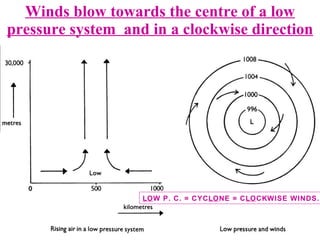
Wind Direction – Depressions (Low pressure cells)  In the southern hemisphere winds associated with  low pressure systems blow  in a  clockwise  direction  towards the centre of the system .  LOW  T. C. = CYC LO NE = C LO CKWISE WINDS.
Winds blow towards the centre of a low pressure system  and in a clockwise direction LO W P. C. = CYC LO NE = C LO CKWISE WINDS.
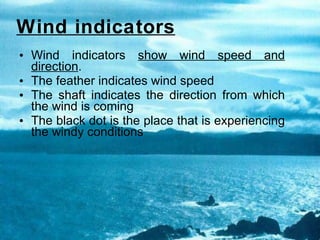
Wind indicators   Wind indicators  show wind speed and direction . The feather indicates wind speed The shaft indicates the direction from which the wind is coming The black dot is the place that is experiencing the windy conditions
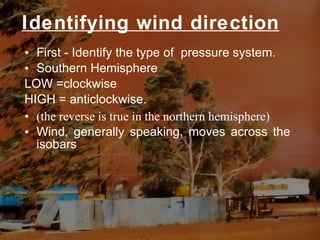
Identifying wind direction First - Identify the type of  pressure system. Southern Hemisphere  LOW =clockwise  HIGH = anticlockwise. (the reverse is true in the northern hemisphere) Wind, generally speaking, moves across the isobars
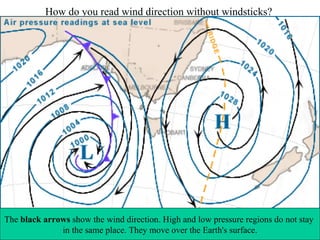
How do you read wind direction without windsticks?  The  black arrows  show the wind direction. High and low pressure regions do not stay  in the same place. They move over the Earth's surface.
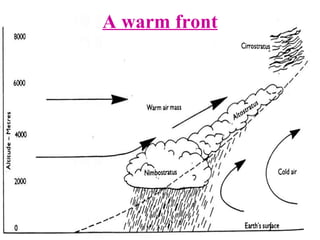
FRONTS A front is the  leading edge of change . They are the  border zone between warm and cold air . There are two types of fronts: Warm fronts  occur when warm air is pushed into a cold air mass. These are very rare in Australia. They result in drizzle and light rain over a few days. http://www.rnli.org.uk/upload/complete_eCD/fscommand/pop_up_safety.htm   Go into sailing and search for weather fronts
A warm front
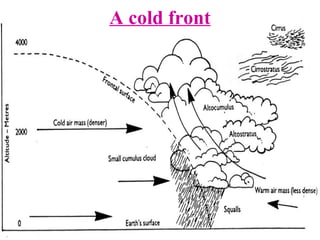
Cold fronts  are far more common in Australia and occur when  cold air is pushed into a warm air mass . This forces the warm air to rise causing a number of changes: (a)  Decrease in temperature : cold air replaces warm air. (b)  Change in wind direction  and sometimes speed. (c)  Build up of cumulonimbus or rain bearing clouds . (d)  Increase in humidity : corresponding to a build up of clouds. (e)  Probability of rain . Make up an acronym to remember these changes.
A cold front
 
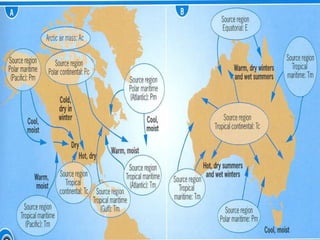
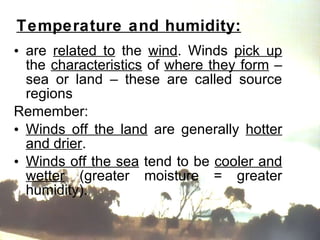
Temperature and humidity: are  related to  the  wind . Winds  pick up  the  characteristics  of  where they form  – sea or land – these are called source regions  Remember: Winds off the land  are generally  hotter and drier . Winds off the sea  tend to be  cooler and wetter  (greater moisture = greater humidity).
Humidity Humidity  is the amount of  water vapour  in the  atmosphere   A high humidity means there is a lot of water vapour, and a low humidity means a little.  The humidity level varies with  temperature . The warmer air is, the more moisture the air can hold as vapour. The colder the air is, the less moisture the air can hold.  Humidity is measured as a percentage, relative to the saturation point where the air can hold no more water vapour (i.e. 100 percent humidity).
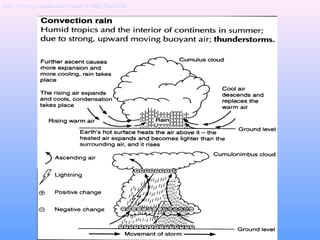
Types of rainfall: Convection http://www.youtube.com/watch?v=RkgThul2El8
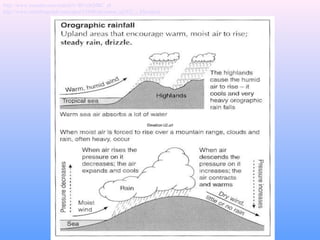
Types of rainfall: Orographic http://www.youtube.com/watch?v=BVykQfRC_aI http://www.radioblogclub.com/open/51998/elevation_u2/U2_-_Elevation
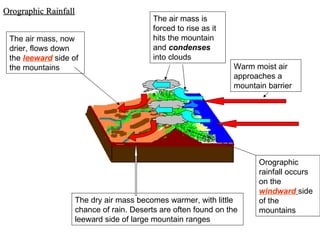
Orographic Rainfall The dry air mass becomes warmer, with little chance of rain. Deserts are often found on the leeward side of large mountain ranges Warm moist air approaches a mountain barrier The air mass is forced to rise as it hits the mountain and  condenses  into clouds Orographic rainfall occurs on the  windward   side of the mountains The air mass, now drier, flows down the  leeward  side of the mountains
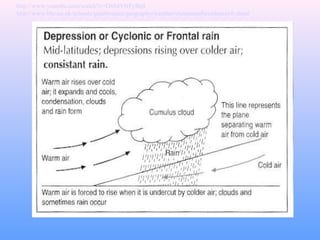
Types of rainfall: Frontal http://www.youtube.com/watch?v=D88dYNFyBq8 http://www.bbc.co.uk/schools/gcsebitesize/geography/weather/elementsofweatherrev6.shtml
Flash video on types of rainfall Show Weather Rainfall wmv http://blip.tv/scripts/flash/blipplayer.swf?autoStart=false&file=http://blip.tv/file/get/Gatm-Rainfall922.flv?source=3
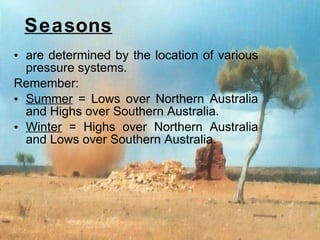
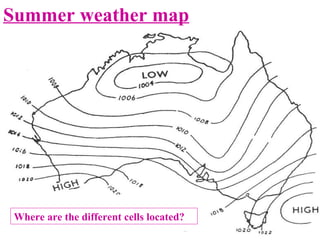
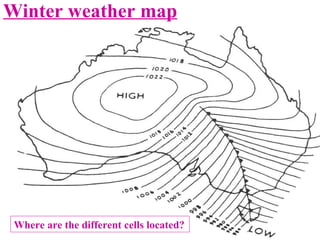
Seasons are determined by the location of various pressure systems.  Remember:  Summer  = Lows over Northern Australia and Highs over Southern Australia. Winter  = Highs over Northern Australia and Lows over Southern Australia.
Summer weather map   Where are the different cells located?
Winter weather map Where are the different cells located?
Clear skies allow the sun’s rays to have maximum effect. Daytime temperatures are usually high.   At night, clear skies allow heat to be lost causing temperatures to fall. In winter frosts are likely.
Why Do Climates Vary?
Factors Affecting The Climate What makes a certain place hot, cold, wet, dry, windy…?
Your Ideas On the A4 paper provided  and working in pairs: Quickly sketch as many ideas as you can as what might cause  temperature  and  rainfall  to be different at various places.  You have 3 minutes
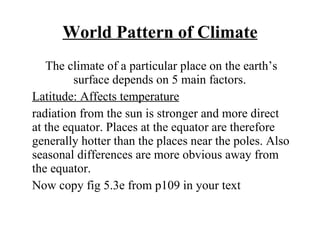
World Pattern of Climate The climate of a particular place on the earth’s surface depends on 5 main factors.  Latitude: Affects temperature radiation from the sun is stronger and more direct at the equator. Places at the equator are therefore generally hotter than the places near the poles. Also seasonal differences are more obvious away from the equator. Now copy fig 5.3e from p109 in your text
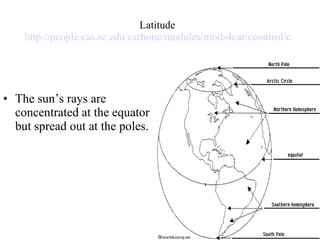
Latitude http://people.cas.sc.edu/carbone/modules/mods4car/ccontrol/controls/latitude.html The sun’s rays are concentrated at the equator but spread out at the poles.
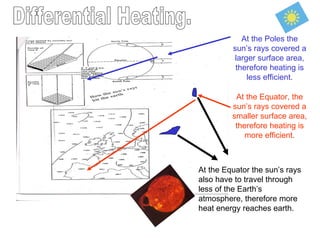
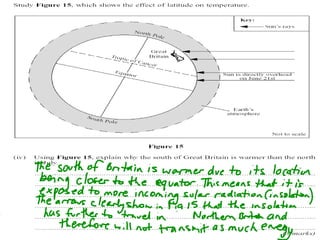
Differential Heating. At the Poles the sun’s rays covered a larger surface area, therefore heating is less efficient. At the Equator, the sun’s rays covered a smaller surface area, therefore heating is more efficient. At the Equator the sun’s rays also have to travel through less of the Earth’s atmosphere, therefore more heat energy reaches earth.
 
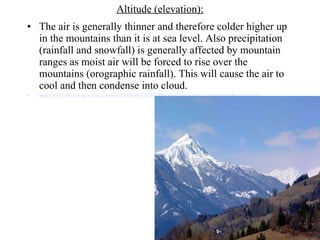
Altitude (elevation): The air is generally thinner and therefore colder higher up in the mountains than it is at sea level. Also precipitation (rainfall and snowfall) is generally affected by mountain ranges as moist air will be forced to rise over the mountains (orographic rainfall). This will cause the air to cool and then condense into cloud. http://www.abc.net.au/science/articles/2008/08/21/2342845.htm?site=science/ askanexpert&topic =latest
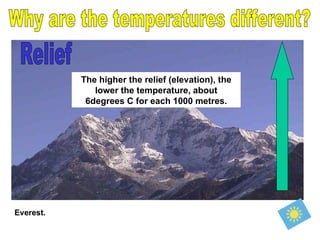
Why are the temperatures different? Relief Everest. The higher the relief (elevation), the lower the temperature, about 6degrees C for each 1000 metres.
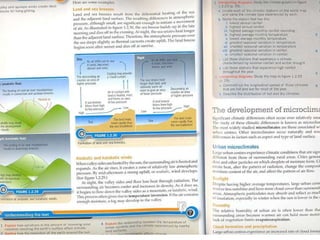
Distance from the sea: The ocean acts as a stabilising influence on temperatures as the sea heats and cools more slowly than the land. Thus diurnal (daily) and annual (yearly) ranges of temperature are smaller near the coast and greater in inland areas. This means that inland areas generally have hotter summers and colder winters than coastal areas. Also moist air near the coast may result in more rainfall in coastal areas than places inland.
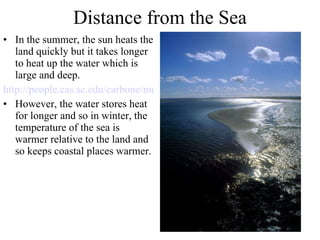
Distance from the Sea In the summer, the sun heats the land quickly but it takes longer to heat up the water which is large and deep. http://people.cas.sc.edu/carbone/modules/mods4car/ccontrol/controls/landwater1.html However, the water stores heat for longer and so in winter, the temperature of the sea is warmer relative to the land and so keeps coastal places warmer.
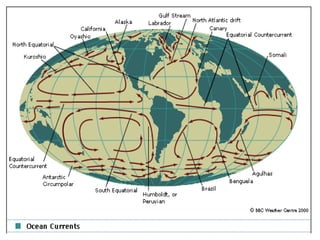
Ocean Currents: Cold ocean currents cool the air and generally cause dry conditions along the coastline. Warm ocean currents will warm the air and cause warmer, wetter conditions. http://people.cas.sc.edu/carbone/modules/mods4car/ccontrol/controls/ocean.html
 
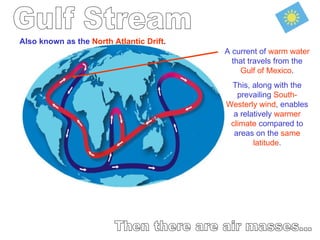
Gulf Stream Then there are air masses... Also known as the  North Atlantic Drift . A current of  warm water  that travels from the  Gulf of Mexico . This, along with the prevailing  South-Westerly wind , enables a relatively  warmer climate  compared to areas on the  same latitude .
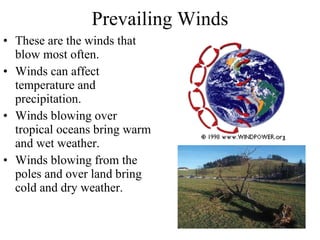
Prevailing Winds These are the winds that blow most often.  Winds can affect temperature and precipitation. Winds blowing over tropical oceans bring warm and wet weather. Winds blowing from the poles and over land bring cold and dry weather.
Length of day & Night Because the earth’s axis is tilted at an angle of 23.5 degrees, there are seasonal differences in the number of daylight hours. The shorter the day the less opportunity there is for the earth to absorb heat.
 
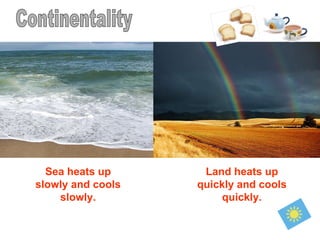
Continentality Sea heats up slowly and cools slowly. Land heats up quickly and cools quickly.
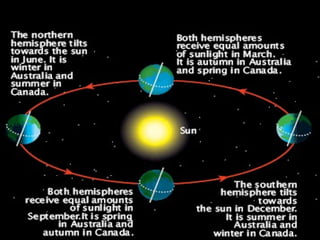
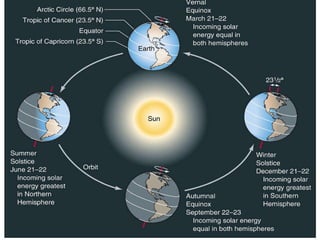
The Seasons Seasons are created by the combination of the earths tilt and its orbit around the sun. The distance between the earth and sun is about 149 million kms. The earth rotates around the sun in an elliptical, or oval shaped path and takes about 365 days or 1 year to complete an orbit.
The earth also rotates in an anti-clockwise direction about its north-south axis, an imaginary line that runs between the poles. It takes 24 hours for the earth to spin around once, and this rotation creates day and night. When one half of the world is in darkness, the other is in daylight.
The earth is also tilted about 23.5 degrees on its axis. So, depending on the time of year, certain latitudes of the earth incline toward the sun more than others. Throughout the year different areas, particularly those that are far from the equator, receive more or less solar radiation. If the earth did not tilt, we would not have seasons.
During summer in the Northern Hemisphere the longest day (the summer solstice) occurs when the sun is directly over the tropic of Cancer. As the earth continues its year long orbit the North Pole tilts away from the sun, and the South Pole tilts towards the sun.
The equinox is when the sun is directly over the equator. The Northern Hemisphere winter solstice (the shortest day) occurs when the sun is over the Tropic of Capricorn.
 
 
World Sunlight Map http:// www.die.net /earth/

Weather and Climate

  • 1.
  • 2.
    Weather and ClimateWeather is the state of the atmosphere at any one place or time . This includes: humidity, temperature, sunshine hours, cloud cover, precipitation (any moisture reaching the earth’s surface). This includes rain, sleet, snow, hail, dew and frost. Song: http:// www.youtube.com/watch?v =c3MKsTLnTKc Climate is the average or long term weather conditions of a region. It is t he result of years of research into data.
  • 3.
    Weather or ClimateHot and dry conditions, together with strong winds, led to Bushfires near Wagga. At this time of year Darwin usually experiences hot and wet weather. The maximum temperature in Moscow today is -23 o C On Monday night a southerly change arrived about 10:30pm Climate Weather
  • 4.
    Weather or ClimateTully in Queensland is Australia’s wettest town. September was chosen for the 2000 Olympics because that month usually has the best weather. On New Year’s Day the temperature in Sydney was 45 o C Sydney receives more rain per year than London Climate Weather
  • 5.
    Bureau of Meteorologyhttp://www.bom.gov.au/ http://www.aus-emaps.com/severe_weather.php
  • 6.
    Atmospheric pressure Atmosphericpressure or barometric pressure is the pressure exerted by the weight of the air on the earth’s surface. Atmospheric pressure is measured in hectopascals (hPa) . Atmospheric pressure is mapped to form isobars . http://www.juicygeography.co.uk/animations.htm#downloads/flash/highpressure.swf
  • 7.
    Isobars Are lines on a synoptic chart joining places of equal atmospheric pressure . To estimate atmospheric pressure you need to refer to the two nearest isobars. e.g. if point “A” is situated half way between 1020 hPa and 1024 hPa, “A” would be > 1020 but < 1024 hPa.
  • 8.
  • 9.
    Atmospheric Pressure readingsHow do they get the land and sea readings? What do all these dots form when they are linked?
  • 10.
    Isobars How doyou work out which are high pressure cells and which are low pressure cells? An isobar is a line on a map joining places of equal atmospheric pressure
  • 11.
    Synoptic Charts Synopticcharts or weather maps provide a snapshot of the weather experienced at a particular place at a certain time. They show information relating to air pressure, air masses and fronts, cloud cover, wind speed, wind direction and rainfall . This information allows us to make predictions relating to temperature, humidity, ocean conditions and the likely weather for the next few days.
  • 12.
    Synoptic Charts SynopticCharts What is this feature? What does the shading refer to? What is the wind speed and direction? What is the air pressure?
  • 13.
    Pressure cells - are defined by the patterns formed by isobars. Are these high pressure cell s or a low pressure cells? How can you tell?
  • 14.
  • 15.
    High pressure cells (anticyclones) occur where atmospheric pressure increases towards the centre of the system. High pressure systems are characterised by light winds, clear skies, dry weather and a high diurnal (daily) temperature range . A ridge is an extension of high pressure from a high pressure system. http:// www.bom.gov.au/weather/national/charts/synoptic.shtml
  • 16.
    High pressure cellsWhy does the air descend? Why does the air moves outwards?
  • 17.
    Typical weather associatedwith High pressure light winds clear skies, dry weather higher diurnal ( daily) temperature range i.e. hot days (sun rays maximum effect) cool nights (because of lack of cloud cover). Frosts are likely in winter .
  • 18.
    Highs can bringrain from onshore warm waters
  • 19.
    Low pressure cells (cyclones or depressions) occur where atmospheric pressure decreases towards the centre of the system. Low pressure systems are associated with stronger winds, cloudy skies, rain a lower diurnal temperature range. A trough is an extension of low pressure from a low pressure system.
  • 20.
    Low pressure cellsAscending air Why does the air rise? Why does the air moves inwards?
  • 21.
    Typical weather associatedwith Low pressure strong winds, cloudy skies, rain and a lower diurnal ( daily) temperature range i.e. mild temperatures (sun does not have maximum effect because of cloud cover, heat trapped in at night). Frosts are unlikely .
  • 22.
    T ropical c yclone s (T.C.) A re a very intense low pressure system . They generate very strong winds, produce rough seas and heavy rains Wide spread damage occurs if they make landfall ( contact with land ) .
  • 23.
    A cross sectionof a Tropical Cyclone
  • 24.
  • 25.
    What is wind?Wind is the movement of air masses (common bodies of air) from high pressure areas (highs) to low pressure areas (lows). The effect of this movement of air is to rebalance the pressure in the atmosphere . Note that: the greater the difference between the high and the low pressure, the greater the wind speed will be, and the closer together the isobars are on the weather map, the stronger the winds will be.
  • 26.
  • 27.
    Wind speed is determined by the closeness of the isobars . The closer the isobars the stronger the winds. A steep pressure gradient exists where isobars are close together . If isobars are far apart a place will generally experience light winds. This is called a slight pressure gradient.
  • 28.
    Note the closenessof the isobars Note the spaced isobars
  • 29.
    Reading WindDirection on a Weather Map Not where its going too x Sydney N Close up of a map Easterly √ (Remember that we name our wind direction on where the wind came from )
  • 30.
    How to Read Wind Speed on a Weather map Legend- Wind Speed 5 km/hr 10 km/hr 20 km/hr To work out the wind speed of an area, all you need to do is match up the wind speed symbol found on the map with the symbol found in the key The wind speed at point A is 5 km/hr A 30 km/hr Calm
  • 31.
    Wind direction Windis named according to the direction the wind is coming from, e.g. south = southerly. Wind direction is largely determined by the location of pressure systems . 
  • 32.
    Wind direction Rememberwe always refer to where the wind is coming from ! Where has the wind come from? 1 2
  • 33.
    Wind Direction –Anticyclones (High Pressure cells) In the southern hemisphere winds blow outwards in an anticlockwise direction from areas of high pressure . ANTI CYCLONE = ANTI CLOCKWISE WINDS.
  • 34.
    Wind blows outwardsin an anticlockwise direction in areas of high pressure. ANTI CYCLONE = ANTI CLOCKWISE WINDS.
  • 35.
    Wind Direction –Depressions (Low pressure cells) In the southern hemisphere winds associated with low pressure systems blow in a clockwise direction towards the centre of the system .  LOW T. C. = CYC LO NE = C LO CKWISE WINDS.
  • 36.
    Winds blow towardsthe centre of a low pressure system and in a clockwise direction LO W P. C. = CYC LO NE = C LO CKWISE WINDS.
  • 37.
    Wind indicators Wind indicators show wind speed and direction . The feather indicates wind speed The shaft indicates the direction from which the wind is coming The black dot is the place that is experiencing the windy conditions
  • 38.
    Identifying wind directionFirst - Identify the type of pressure system. Southern Hemisphere LOW =clockwise HIGH = anticlockwise. (the reverse is true in the northern hemisphere) Wind, generally speaking, moves across the isobars
  • 39.
    How do youread wind direction without windsticks? The black arrows show the wind direction. High and low pressure regions do not stay in the same place. They move over the Earth's surface.
  • 40.
    FRONTS A frontis the leading edge of change . They are the border zone between warm and cold air . There are two types of fronts: Warm fronts occur when warm air is pushed into a cold air mass. These are very rare in Australia. They result in drizzle and light rain over a few days. http://www.rnli.org.uk/upload/complete_eCD/fscommand/pop_up_safety.htm Go into sailing and search for weather fronts
  • 41.
  • 42.
    Cold fronts are far more common in Australia and occur when cold air is pushed into a warm air mass . This forces the warm air to rise causing a number of changes: (a) Decrease in temperature : cold air replaces warm air. (b) Change in wind direction and sometimes speed. (c) Build up of cumulonimbus or rain bearing clouds . (d) Increase in humidity : corresponding to a build up of clouds. (e) Probability of rain . Make up an acronym to remember these changes.
  • 43.
  • 44.
  • 45.
    Temperature and humidity:are related to the wind . Winds pick up the characteristics of where they form – sea or land – these are called source regions Remember: Winds off the land are generally hotter and drier . Winds off the sea tend to be cooler and wetter (greater moisture = greater humidity).
  • 46.
    Humidity Humidity is the amount of water vapour in the atmosphere A high humidity means there is a lot of water vapour, and a low humidity means a little. The humidity level varies with temperature . The warmer air is, the more moisture the air can hold as vapour. The colder the air is, the less moisture the air can hold. Humidity is measured as a percentage, relative to the saturation point where the air can hold no more water vapour (i.e. 100 percent humidity).
  • 47.
    Types of rainfall:Convection http://www.youtube.com/watch?v=RkgThul2El8
  • 48.
    Types of rainfall:Orographic http://www.youtube.com/watch?v=BVykQfRC_aI http://www.radioblogclub.com/open/51998/elevation_u2/U2_-_Elevation
  • 49.
    Orographic Rainfall Thedry air mass becomes warmer, with little chance of rain. Deserts are often found on the leeward side of large mountain ranges Warm moist air approaches a mountain barrier The air mass is forced to rise as it hits the mountain and condenses into clouds Orographic rainfall occurs on the windward side of the mountains The air mass, now drier, flows down the leeward side of the mountains
  • 50.
    Types of rainfall:Frontal http://www.youtube.com/watch?v=D88dYNFyBq8 http://www.bbc.co.uk/schools/gcsebitesize/geography/weather/elementsofweatherrev6.shtml
  • 51.
    Flash video ontypes of rainfall Show Weather Rainfall wmv http://blip.tv/scripts/flash/blipplayer.swf?autoStart=false&file=http://blip.tv/file/get/Gatm-Rainfall922.flv?source=3
  • 52.
    Seasons are determinedby the location of various pressure systems. Remember:  Summer = Lows over Northern Australia and Highs over Southern Australia. Winter = Highs over Northern Australia and Lows over Southern Australia.
  • 53.
    Summer weather map Where are the different cells located?
  • 54.
    Winter weather mapWhere are the different cells located?
  • 55.
    Clear skies allowthe sun’s rays to have maximum effect. Daytime temperatures are usually high. At night, clear skies allow heat to be lost causing temperatures to fall. In winter frosts are likely.
  • 56.
  • 57.
    Factors Affecting TheClimate What makes a certain place hot, cold, wet, dry, windy…?
  • 58.
    Your Ideas Onthe A4 paper provided and working in pairs: Quickly sketch as many ideas as you can as what might cause temperature and rainfall to be different at various places. You have 3 minutes
  • 59.
    World Pattern ofClimate The climate of a particular place on the earth’s surface depends on 5 main factors. Latitude: Affects temperature radiation from the sun is stronger and more direct at the equator. Places at the equator are therefore generally hotter than the places near the poles. Also seasonal differences are more obvious away from the equator. Now copy fig 5.3e from p109 in your text
  • 60.
    Latitude http://people.cas.sc.edu/carbone/modules/mods4car/ccontrol/controls/latitude.html Thesun’s rays are concentrated at the equator but spread out at the poles.
  • 61.
    Differential Heating. Atthe Poles the sun’s rays covered a larger surface area, therefore heating is less efficient. At the Equator, the sun’s rays covered a smaller surface area, therefore heating is more efficient. At the Equator the sun’s rays also have to travel through less of the Earth’s atmosphere, therefore more heat energy reaches earth.
  • 62.
  • 63.
    Altitude (elevation): Theair is generally thinner and therefore colder higher up in the mountains than it is at sea level. Also precipitation (rainfall and snowfall) is generally affected by mountain ranges as moist air will be forced to rise over the mountains (orographic rainfall). This will cause the air to cool and then condense into cloud. http://www.abc.net.au/science/articles/2008/08/21/2342845.htm?site=science/ askanexpert&topic =latest
  • 64.
    Why are thetemperatures different? Relief Everest. The higher the relief (elevation), the lower the temperature, about 6degrees C for each 1000 metres.
  • 65.
    Distance from thesea: The ocean acts as a stabilising influence on temperatures as the sea heats and cools more slowly than the land. Thus diurnal (daily) and annual (yearly) ranges of temperature are smaller near the coast and greater in inland areas. This means that inland areas generally have hotter summers and colder winters than coastal areas. Also moist air near the coast may result in more rainfall in coastal areas than places inland.
  • 66.
    Distance from theSea In the summer, the sun heats the land quickly but it takes longer to heat up the water which is large and deep. http://people.cas.sc.edu/carbone/modules/mods4car/ccontrol/controls/landwater1.html However, the water stores heat for longer and so in winter, the temperature of the sea is warmer relative to the land and so keeps coastal places warmer.
  • 67.
    Ocean Currents: Coldocean currents cool the air and generally cause dry conditions along the coastline. Warm ocean currents will warm the air and cause warmer, wetter conditions. http://people.cas.sc.edu/carbone/modules/mods4car/ccontrol/controls/ocean.html
  • 68.
  • 69.
    Gulf Stream Thenthere are air masses... Also known as the North Atlantic Drift . A current of warm water that travels from the Gulf of Mexico . This, along with the prevailing South-Westerly wind , enables a relatively warmer climate compared to areas on the same latitude .
  • 70.
    Prevailing Winds Theseare the winds that blow most often. Winds can affect temperature and precipitation. Winds blowing over tropical oceans bring warm and wet weather. Winds blowing from the poles and over land bring cold and dry weather.
  • 71.
    Length of day& Night Because the earth’s axis is tilted at an angle of 23.5 degrees, there are seasonal differences in the number of daylight hours. The shorter the day the less opportunity there is for the earth to absorb heat.
  • 72.
  • 73.
    Continentality Sea heatsup slowly and cools slowly. Land heats up quickly and cools quickly.
  • 74.
    The Seasons Seasonsare created by the combination of the earths tilt and its orbit around the sun. The distance between the earth and sun is about 149 million kms. The earth rotates around the sun in an elliptical, or oval shaped path and takes about 365 days or 1 year to complete an orbit.
  • 75.
    The earth alsorotates in an anti-clockwise direction about its north-south axis, an imaginary line that runs between the poles. It takes 24 hours for the earth to spin around once, and this rotation creates day and night. When one half of the world is in darkness, the other is in daylight.
  • 76.
    The earth isalso tilted about 23.5 degrees on its axis. So, depending on the time of year, certain latitudes of the earth incline toward the sun more than others. Throughout the year different areas, particularly those that are far from the equator, receive more or less solar radiation. If the earth did not tilt, we would not have seasons.
  • 77.
    During summer inthe Northern Hemisphere the longest day (the summer solstice) occurs when the sun is directly over the tropic of Cancer. As the earth continues its year long orbit the North Pole tilts away from the sun, and the South Pole tilts towards the sun.
  • 78.
    The equinox iswhen the sun is directly over the equator. The Northern Hemisphere winter solstice (the shortest day) occurs when the sun is over the Tropic of Capricorn.
  • 79.
  • 80.
  • 81.
    World Sunlight Maphttp:// www.die.net /earth/

Editor's Notes

  • #3 1. What is the difference between weather and climate?
  • #7 A line on a Synoptic Chart that joins places of equal barometric or atmospheric pressure is called? The unit of measurement of atmospheric pressure is termed? What is the abbreviation for this unit of atmospheric pressure?
  • #11 High Pressure occurs when the barometric reading is usually above 1010 hectopascals Low Pressure occurs when the barometric reading is usually below 1010 hectopascals.
  • #12 What are Synoptic Charts? Give six examples of the information shown by Synoptic Charts. List two groups of people you think that would benefit from using the information contained in Synoptic Charts.
  • #13 Identify the type of pressure system over Perth. What type of weather can Perth expect today? Why is Adelaide likely to have fine, settled weather? What is the wind speed and direction at Townsville? The shading on the map, in the Northern Territory, refers to what? Estimate the barometric pressure, north east of Hobart – where the pink arrow indicates.
  • #14 As you move your over the isobars between Alice Springs and Brisbane, what happens to the size of the numbers as you move to the centre of this pressure system? (move from 1006 hPa to 998 hPa) As you move your eyes over the isobars from north – west of Hobart to Perth, what happens to the air pressure readings? (998 hPa to 1012 hPa)
  • #16 List three features of weather associated with High Pressure systems. The term ‘diurnal means?
  • #17 Why does the air descend in high pressure systems? 2. True or false – air moves from high to low pressure?
  • #18 1. What does the word ‘diurnal’ mean? 2. Why are the nights likely to be cool?
  • #20 True or False – atmospheric pressure decreases towards the centre in low pressure cells. True or False – Strong winds, cloudy skies and rain are associated with low pressure cells. True or False – an extension of low pressure is known as a trough.
  • #22 1. Why are frosts unlikely with low pressure systems?
  • #24 What is the relationship between wind speed and the direction of the cyclone? What happens to wind speed after the cyclone has passed?
  • #28 If the isobars are closer together, what happens to wind speed? If the isobars are further apart, what happens to the speed of the wind?
  • #32 1. What is the golden rule to remember with wind direction?
  • #33 With number 1, where is the wind coming from? In what direction is the wind coming from on this occasion?
  • #34 In what way do the winds in the southern hemisphere blow around high pressure systems? If winds blow anticlockwise in high pressure systems in the southern hemisphere, in what direction do winds blow in low pressure systems in the same hemisphere?
  • #36 In the southern hemisphere, in what direction do winds in a low pressure system blow?
  • #41 What is a front? Name the two types of fronts – look at the next slide to help you answer this question
  • #42 Identify the type of cloud that is bringing rain to the Earth’s surface. Name the highest cloud type shown on this slide.
  • #49 Would the following be a correct definition for Orographic Rain? The rain that results from air being forced to rise over a mountain barrier. If yes, explain why this definition is correct. Why is there relatively little rain after the air has been forced to rise over the mountain range?
  • #53 Over which part of Australia do low pressure systems occur during Summer? High Pressure systems occur over which part of Australia during Summer? Low pressure systems occur during which season over Southern Australia? What type of pressure system occurs during Winter over Northern Australia?
  • #54 1. How can you prove that this synoptic chart is characteristic of a Summer Weather pattern?
  • #55 1. Why is this synoptic chart characteristic of a southern hemisphere winter?
  • #56 Why are daytime temperatures usually high with high pressure systems? Why are temperatures at night likely to be colder?