9 th  Grade Chapter 7  Lesson 3 Pgs. 180-191 For Student Use Only
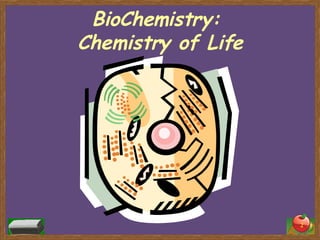
BioChemistry:  Chemistry of Life
BioChemistry:  Chemistry of Life Parts of the Cell: Lysozome- recycles things in cell Microtubles- transporation Cytoplasm- gel and fuel refueling E.R.- protein and lipid factory Mitochondria- power plant Golgi Apparatus- packs and ships  Vacuole- water and food storage Nucleus- control center
BioChemistry:  Chemistry of Life Cell has 4 main compounds: Carbohydrates Lipids Proteins Nucleic Acids
BioChemistry:  Chemistry of Life Biochemistry- study of the chemistry of life Life Processes that use Chemistry Energy Digestion Thinking
BioChemistry:  Chemistry of Life Carbohydrates: Energy producing compounds Simple Sugars- (simple carbs) have up to 12 carbons Have 3, 4, 5, or 6 atoms per molecule Glucose- 6 carbon sugar Fructose- (honey) 6 carbon sugar
BioChemistry:  Chemistry of Life Photosynthesis: Uses sun to create glucose from CO 2  and H 2 O Glucose= C 6 H 12 O 6 This is the ultimate food for most living things
BioChemistry:  Chemistry of Life Complex Sugars: Disaccharides: 2 sugars- Fructose + Glucose= Sucrose (table sugar)- C 12 H 22 O 11 Polysaccharides: many sugars Starches:  found in plants Glucogen: found in humans and animals Cellulose: building sugar in plants
BioChemistry:  Chemistry of Life Lipids: Chains of Carbon, Hydrogen, and Oxygen Types of Lipids Fatty Acid- has a carboxylic acid at the end Fats- large molecule- three fatty acids attached to a glycerol Oils- fats that are liquids at room temperature
BioChemistry:  Chemistry of Life Types of Fats: Saturated Fats: animal fats and Carbons are connected to as many hydrogens as possible Unsaturated Fats: not full of hydrogens Monounsaturated: lacking one hydrogen Polyunsaturated: contain linoleic acid  Hydrogenation- adding hydrogen to make oils thicker
BioChemistry:  Chemistry of Life Types of Lipids: Choloesterol: used for horomones, bile, and vitamin D Lipoproteins- cholesterol globs that are encased in a membrane of lipids and proteins LDL- Low Density Lipoproteins HDL- High Density Lipoproteins (better for you)
BioChemistry:  Chemistry of Life Proteins: Complex molecules that build cells Composed of carbon, hydrogen, oxygen, nitrogen, and possibly other elements Made of AMINO ACIDS
BioChemistry:  Chemistry of Life Proteins: Compose most structures of the cell Special proteins directly control the chemical activities in the cell AMINO ACIDS: Building blocks of proteins
BioChemistry:  Chemistry of Life AMINO ACIDS: They are 20 amino acids Different combinations= different proteins Some are found in the body Some have to be eaten directly in food
BioChemistry:  Chemistry of Life Complete Proteins: Have all essential amino acids Found in meat, eggs, fish, milk and cheese Incomplete Proteins: Are missing essential amino acids Found mostly in vegetables
BioChemistry:  Chemistry of Life Amino Acid: Have central carbon bonded to (4): 1 hydrogen 1 amine group 1 Carboxyol group Something that distinguishes one amino acid from another
BioChemistry:  Chemistry of Life Fibrous Proteins: Long (fairly) straight chains of amino acids Globular Proteins: Form into tight folds Have intricate three dimensional shapes
BioChemistry:  Chemistry of Life Proteins: Enzymes- initiate chemical reactions in the cell Catalyst- speed up reactions but are not changed themselves, enzymes are biocatalysts
BioChemistry:  Chemistry of Life Nucleic Acids: Most important proteins Found in DNA and RNA DNA: Deoxyribonucleic Acid- plans for your body
BioChemistry:  Chemistry of Life Importance of DNA: It is found in every cell of every living organism Contains blueprint for every protein in the body Directs constructions of new cells Directs repair and putting together of new and old cells It controls what traits you will pass on to your children
BioChemistry:  Chemistry of Life DNA in Humans 46 Chromosomes (23 pairs) Found in cells nucleus Found in a (ladder) double helix shape Deoxyribose and Phospate backbone Nitrogen Bases: Adenine, Quanine, Cytosine, and Thymine Order of bases create genetic code 3 bases create one amino acid and amino acids make proteins Gene- one segment of DNA
BioChemistry:  Chemistry of Life RNA: Ribonucleic Acid: Messenger  Carries DNA code where it needs to go Is a single chain of the code
BioChemistry:  Chemistry of Life Metabolism: Glucose: most important carbohydrates Cellular Respiration: Takes place in Mitochondria Glucose is broken down into energy, CO 2  and H 2 O ATP: cells energy Called Adenosine Triphosphate Metabolism: uses food energy for body processes

9th Grade Chapter 7 Lesson 3

  • 1.
    9 th Grade Chapter 7 Lesson 3 Pgs. 180-191 For Student Use Only
  • 2.
  • 3.
    BioChemistry: Chemistryof Life Parts of the Cell: Lysozome- recycles things in cell Microtubles- transporation Cytoplasm- gel and fuel refueling E.R.- protein and lipid factory Mitochondria- power plant Golgi Apparatus- packs and ships Vacuole- water and food storage Nucleus- control center
  • 4.
    BioChemistry: Chemistryof Life Cell has 4 main compounds: Carbohydrates Lipids Proteins Nucleic Acids
  • 5.
    BioChemistry: Chemistryof Life Biochemistry- study of the chemistry of life Life Processes that use Chemistry Energy Digestion Thinking
  • 6.
    BioChemistry: Chemistryof Life Carbohydrates: Energy producing compounds Simple Sugars- (simple carbs) have up to 12 carbons Have 3, 4, 5, or 6 atoms per molecule Glucose- 6 carbon sugar Fructose- (honey) 6 carbon sugar
  • 7.
    BioChemistry: Chemistryof Life Photosynthesis: Uses sun to create glucose from CO 2 and H 2 O Glucose= C 6 H 12 O 6 This is the ultimate food for most living things
  • 8.
    BioChemistry: Chemistryof Life Complex Sugars: Disaccharides: 2 sugars- Fructose + Glucose= Sucrose (table sugar)- C 12 H 22 O 11 Polysaccharides: many sugars Starches: found in plants Glucogen: found in humans and animals Cellulose: building sugar in plants
  • 9.
    BioChemistry: Chemistryof Life Lipids: Chains of Carbon, Hydrogen, and Oxygen Types of Lipids Fatty Acid- has a carboxylic acid at the end Fats- large molecule- three fatty acids attached to a glycerol Oils- fats that are liquids at room temperature
  • 10.
    BioChemistry: Chemistryof Life Types of Fats: Saturated Fats: animal fats and Carbons are connected to as many hydrogens as possible Unsaturated Fats: not full of hydrogens Monounsaturated: lacking one hydrogen Polyunsaturated: contain linoleic acid Hydrogenation- adding hydrogen to make oils thicker
  • 11.
    BioChemistry: Chemistryof Life Types of Lipids: Choloesterol: used for horomones, bile, and vitamin D Lipoproteins- cholesterol globs that are encased in a membrane of lipids and proteins LDL- Low Density Lipoproteins HDL- High Density Lipoproteins (better for you)
  • 12.
    BioChemistry: Chemistryof Life Proteins: Complex molecules that build cells Composed of carbon, hydrogen, oxygen, nitrogen, and possibly other elements Made of AMINO ACIDS
  • 13.
    BioChemistry: Chemistryof Life Proteins: Compose most structures of the cell Special proteins directly control the chemical activities in the cell AMINO ACIDS: Building blocks of proteins
  • 14.
    BioChemistry: Chemistryof Life AMINO ACIDS: They are 20 amino acids Different combinations= different proteins Some are found in the body Some have to be eaten directly in food
  • 15.
    BioChemistry: Chemistryof Life Complete Proteins: Have all essential amino acids Found in meat, eggs, fish, milk and cheese Incomplete Proteins: Are missing essential amino acids Found mostly in vegetables
  • 16.
    BioChemistry: Chemistryof Life Amino Acid: Have central carbon bonded to (4): 1 hydrogen 1 amine group 1 Carboxyol group Something that distinguishes one amino acid from another
  • 17.
    BioChemistry: Chemistryof Life Fibrous Proteins: Long (fairly) straight chains of amino acids Globular Proteins: Form into tight folds Have intricate three dimensional shapes
  • 18.
    BioChemistry: Chemistryof Life Proteins: Enzymes- initiate chemical reactions in the cell Catalyst- speed up reactions but are not changed themselves, enzymes are biocatalysts
  • 19.
    BioChemistry: Chemistryof Life Nucleic Acids: Most important proteins Found in DNA and RNA DNA: Deoxyribonucleic Acid- plans for your body
  • 20.
    BioChemistry: Chemistryof Life Importance of DNA: It is found in every cell of every living organism Contains blueprint for every protein in the body Directs constructions of new cells Directs repair and putting together of new and old cells It controls what traits you will pass on to your children
  • 21.
    BioChemistry: Chemistryof Life DNA in Humans 46 Chromosomes (23 pairs) Found in cells nucleus Found in a (ladder) double helix shape Deoxyribose and Phospate backbone Nitrogen Bases: Adenine, Quanine, Cytosine, and Thymine Order of bases create genetic code 3 bases create one amino acid and amino acids make proteins Gene- one segment of DNA
  • 22.
    BioChemistry: Chemistryof Life RNA: Ribonucleic Acid: Messenger Carries DNA code where it needs to go Is a single chain of the code
  • 23.
    BioChemistry: Chemistryof Life Metabolism: Glucose: most important carbohydrates Cellular Respiration: Takes place in Mitochondria Glucose is broken down into energy, CO 2 and H 2 O ATP: cells energy Called Adenosine Triphosphate Metabolism: uses food energy for body processes