SYSTEMSSCIENCE
SYSTEM
• A set of connected, interacting
parts forming a complex whole
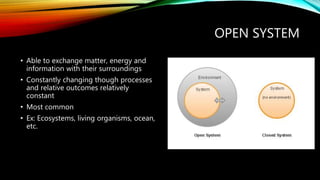
OPEN SYSTEM
• Able to exchange matter, energy and
information with their surroundings
• Constantly changing though processes
and relative outcomes relatively
constant
• Most common
• Ex: Ecosystems, living organisms, ocean,
etc.
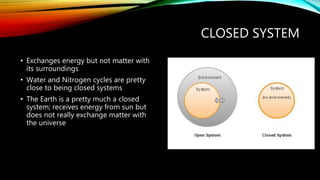
CLOSED SYSTEM
• Exchanges energy but not matter with
its surroundings
• Water and Nitrogen cycles are pretty
close to being closed systems
• The Earth is a pretty much a closed
system; receives energy from sun but
does not really exchange matter with
the universe
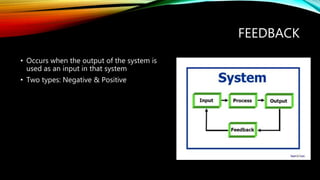
FEEDBACK
• Occurs when the output of the system is
used as an input in that system
• Two types: Negative & Positive
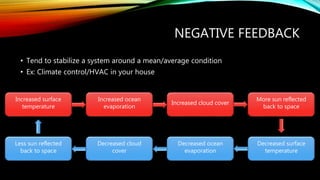
NEGATIVE FEEDBACK
• Tend to stabilize a system around a mean/average condition
• Ex: Climate control/HVAC in your house
Increased surface
temperature
Increased ocean
evaporation
Increased cloud cover
More sun reflected
back to space
Decreased surface
temperature
Decreased ocean
evaporation
Decreased cloud
cover
Less sun reflected
back to space
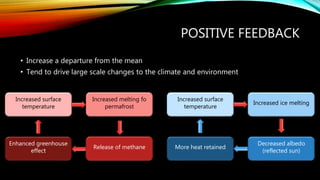
POSITIVE FEEDBACK
• Increase a departure from the mean
• Tend to drive large scale changes to the climate and environment
Increased surface
temperature
Increased melting fo
permafrost
Increased surface
temperature
Increased ice melting
Decreased albedo
(reflected sun)
More heat retainedRelease of methane
Enhanced greenhouse
effect
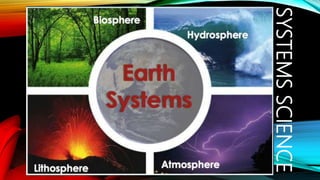
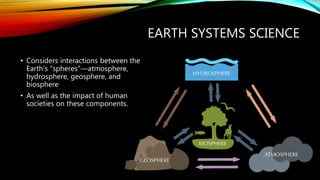
EARTH SYSTEMS SCIENCE
• Considers interactions between the
Earth's "spheres"—atmosphere,
hydrosphere, geosphere, and
biosphere
• As well as the impact of human
societies on these components.
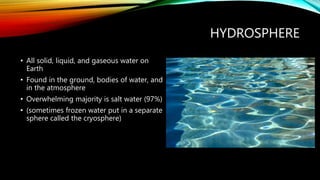
HYDROSPHERE
• All solid, liquid, and gaseous water on
Earth
• Found in the ground, bodies of water, and
in the atmosphere
• Overwhelming majority is salt water (97%)
• (sometimes frozen water put in a separate
sphere called the cryosphere)
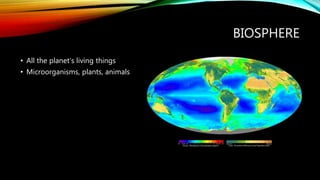
BIOSPHERE
• All the planet’s living things
• Microorganisms, plants, animals
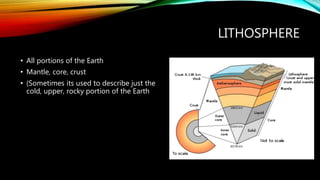
LITHOSPHERE
• All portions of the Earth
• Mantle, core, crust
• (Sometimes its used to describe just the
cold, upper, rocky portion of the Earth
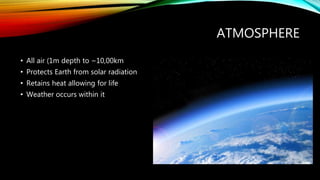
ATMOSPHERE
• All air (1m depth to ~10,00km
• Protects Earth from solar radiation
• Retains heat allowing for life
• Weather occurs within it

Earth Systems Science Notes

  • 1.
  • 2.
    SYSTEM • A setof connected, interacting parts forming a complex whole
  • 3.
    OPEN SYSTEM • Ableto exchange matter, energy and information with their surroundings • Constantly changing though processes and relative outcomes relatively constant • Most common • Ex: Ecosystems, living organisms, ocean, etc.
  • 4.
    CLOSED SYSTEM • Exchangesenergy but not matter with its surroundings • Water and Nitrogen cycles are pretty close to being closed systems • The Earth is a pretty much a closed system; receives energy from sun but does not really exchange matter with the universe
  • 5.
    FEEDBACK • Occurs whenthe output of the system is used as an input in that system • Two types: Negative & Positive
  • 6.
    NEGATIVE FEEDBACK • Tendto stabilize a system around a mean/average condition • Ex: Climate control/HVAC in your house Increased surface temperature Increased ocean evaporation Increased cloud cover More sun reflected back to space Decreased surface temperature Decreased ocean evaporation Decreased cloud cover Less sun reflected back to space
  • 7.
    POSITIVE FEEDBACK • Increasea departure from the mean • Tend to drive large scale changes to the climate and environment Increased surface temperature Increased melting fo permafrost Increased surface temperature Increased ice melting Decreased albedo (reflected sun) More heat retainedRelease of methane Enhanced greenhouse effect
  • 8.
    EARTH SYSTEMS SCIENCE •Considers interactions between the Earth's "spheres"—atmosphere, hydrosphere, geosphere, and biosphere • As well as the impact of human societies on these components.
  • 9.
    HYDROSPHERE • All solid,liquid, and gaseous water on Earth • Found in the ground, bodies of water, and in the atmosphere • Overwhelming majority is salt water (97%) • (sometimes frozen water put in a separate sphere called the cryosphere)
  • 10.
    BIOSPHERE • All theplanet’s living things • Microorganisms, plants, animals
  • 11.
    LITHOSPHERE • All portionsof the Earth • Mantle, core, crust • (Sometimes its used to describe just the cold, upper, rocky portion of the Earth
  • 12.
    ATMOSPHERE • All air(1m depth to ~10,00km • Protects Earth from solar radiation • Retains heat allowing for life • Weather occurs within it