9 th  Grade Chapter 7 Lesson 2 Pgs. 172-180 For Student Use Only
Organic Chemistry Life Chemistry Organic chemistry is the study of living chemistry Inorganic Chemistry is the study of non-living chemistry Organic Chemistry deals with Carbon or carbon containing elements
Uniqueness of Carbon Why are we referred to as carbon-based life forms? More elements are formed with carbon than any other elements There are an estimated 5 million carbon compounds
Carbon Notes Carbon forms 4 covalent bonds Carbon can bond to form several different shapes. Carbon atoms may form single, double, or triple bonds Carbon may form single or double bonds with atoms of many other elements Carbon may form compounds that contain different structural arrangements and combinations with the same molecular formula (different shape, but same formula) Notes from movie: “When Carbon Combines- Useful Carbon & Element of Life”
Hydrocarbons Movies Notes: Hydro-Carbons Many organic compounds contain hydrogen and carbon Hydrocarbons are combinations of hydrogen and carbon Naming: Single bond= -ane Double bond= -ene Triple bond= -yne More naming rules: Prefix tells number of carbons in chain See chart pg. 173
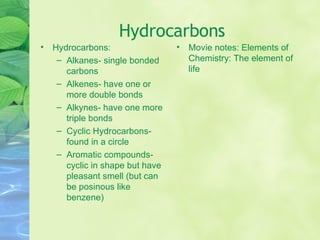
Hydrocarbons Hydrocarbons: Alkanes- single bonded carbons Alkenes- have one or more double bonds Alkynes- have one more triple bonds Cyclic Hydrocarbons- found in a circle Aromatic compounds- cyclic in shape but have pleasant smell (but can be posinous like benzene) Movie notes: Elements of Chemistry: The element of life
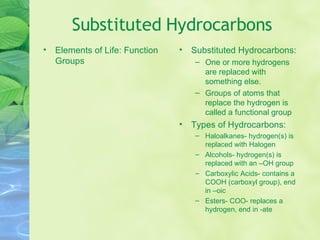
Substituted Hydrocarbons Elements of Life: Function Groups Substituted Hydrocarbons: One or more hydrogens are replaced with something else. Groups of atoms that replace the hydrogen is called a functional group Types of Hydrocarbons: Haloalkanes- hydrogen(s) is replaced with Halogen Alcohols- hydrogen(s) is replaced with an –OH group Carboxylic Acids- contains a COOH (carboxyl group), end in –oic Esters- COO- replaces a hydrogen, end in -ate
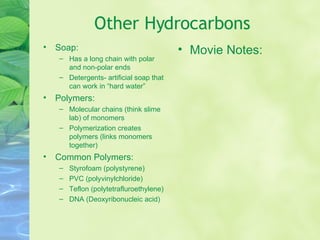
Other Hydrocarbons Soap:  Has a long chain with polar and non-polar ends Detergents- artificial soap that can work in “hard water” Polymers:  Molecular chains (think slime lab) of monomers Polymerization creates polymers (links monomers together) Common Polymers: Styrofoam (polystyrene) PVC (polyvinylchloride) Teflon (polytetrafluroethylene) DNA (Deoxyribonucleic acid) Movie Notes:

9th Grade Chapter 7 Lesson 2

  • 1.
    9 th Grade Chapter 7 Lesson 2 Pgs. 172-180 For Student Use Only
  • 2.
    Organic Chemistry LifeChemistry Organic chemistry is the study of living chemistry Inorganic Chemistry is the study of non-living chemistry Organic Chemistry deals with Carbon or carbon containing elements
  • 3.
    Uniqueness of CarbonWhy are we referred to as carbon-based life forms? More elements are formed with carbon than any other elements There are an estimated 5 million carbon compounds
  • 4.
    Carbon Notes Carbonforms 4 covalent bonds Carbon can bond to form several different shapes. Carbon atoms may form single, double, or triple bonds Carbon may form single or double bonds with atoms of many other elements Carbon may form compounds that contain different structural arrangements and combinations with the same molecular formula (different shape, but same formula) Notes from movie: “When Carbon Combines- Useful Carbon & Element of Life”
  • 5.
    Hydrocarbons Movies Notes:Hydro-Carbons Many organic compounds contain hydrogen and carbon Hydrocarbons are combinations of hydrogen and carbon Naming: Single bond= -ane Double bond= -ene Triple bond= -yne More naming rules: Prefix tells number of carbons in chain See chart pg. 173
  • 6.
    Hydrocarbons Hydrocarbons: Alkanes-single bonded carbons Alkenes- have one or more double bonds Alkynes- have one more triple bonds Cyclic Hydrocarbons- found in a circle Aromatic compounds- cyclic in shape but have pleasant smell (but can be posinous like benzene) Movie notes: Elements of Chemistry: The element of life
  • 7.
    Substituted Hydrocarbons Elementsof Life: Function Groups Substituted Hydrocarbons: One or more hydrogens are replaced with something else. Groups of atoms that replace the hydrogen is called a functional group Types of Hydrocarbons: Haloalkanes- hydrogen(s) is replaced with Halogen Alcohols- hydrogen(s) is replaced with an –OH group Carboxylic Acids- contains a COOH (carboxyl group), end in –oic Esters- COO- replaces a hydrogen, end in -ate
  • 8.
    Other Hydrocarbons Soap: Has a long chain with polar and non-polar ends Detergents- artificial soap that can work in “hard water” Polymers: Molecular chains (think slime lab) of monomers Polymerization creates polymers (links monomers together) Common Polymers: Styrofoam (polystyrene) PVC (polyvinylchloride) Teflon (polytetrafluroethylene) DNA (Deoxyribonucleic acid) Movie Notes: