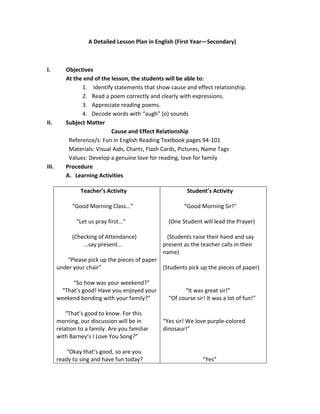
A Detailed Lesson Plan in English (First Year—Secondary) 
I. Objectives 
At the end of the lesson, the students will be able to: 
1. Identify statements that show cause and effect relationship. 
2. Read a poem correctly and clearly with expressions. 
3. Appreciate reading poems. 
4. Decode words with “augh” (o) sounds 
II. Subject Matter 
Cause and Effect Relationship 
Reference/s: Fun in English Reading Textbook pages 94-101 
Materials: Visual Aids, Charts, Flash Cards, Pictures, Name Tags 
Values: Develop a genuine love for reading, love for family 
III. Procedure 
A. Learning Activities 
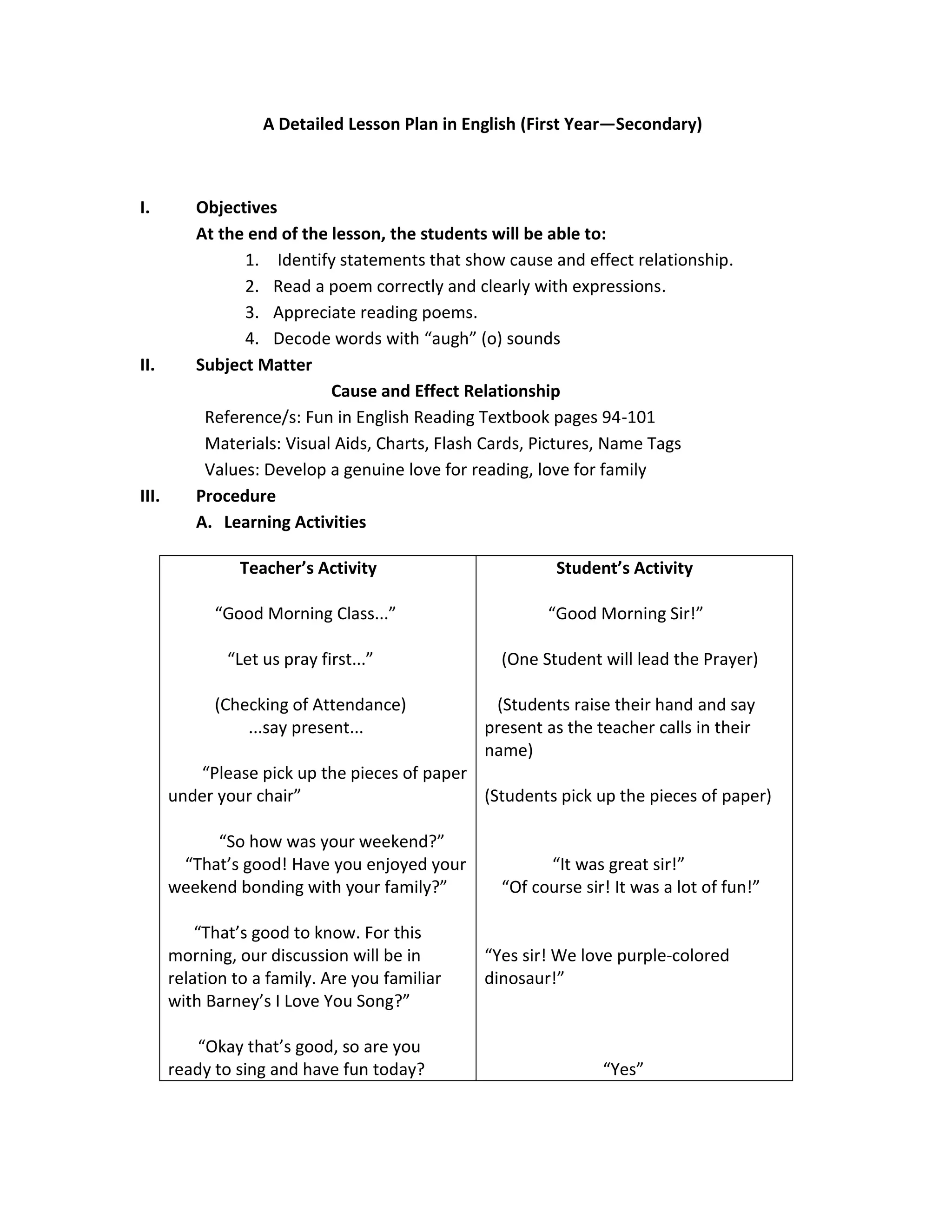
Teacher’s Activity 
“Good Morning Class...” 
“Let us pray first...” 
(Checking of Attendance) 
...say present... 
“Please pick up the pieces of paper 
under your chair” 
“So how was your weekend?” 
“That’s good! Have you enjoyed your 
weekend bonding with your family?” 
“That’s good to know. For this 
morning, our discussion will be in 
relation to a family. Are you familiar 
with Barney’s I Love You Song?” 
“Okay that’s good, so are you 
ready to sing and have fun today? 
Student’s Activity 
“Good Morning Sir!” 
(One Student will lead the Prayer) 
(Students raise their hand and say 
present as the teacher calls in their 
name) 
(Students pick up the pieces of paper) 
“It was great sir!” 
“Of course sir! It was a lot of fun!” 
“Yes sir! We love purple-colored 
dinosaur!” 
“Yes”
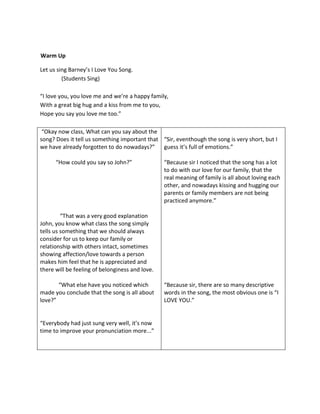
Warm Up 
Let us sing Barney’s I Love You Song. 
(Students Sing) 
“I love you, you love me and we’re a happy family, 
With a great big hug and a kiss from me to you, 
Hope you say you love me too.” 
“Okay now class, What can you say about the 
song? Does it tell us something important that 
we have already forgotten to do nowadays?” 
“How could you say so John?” 
“That was a very good explanation 
John, you know what class the song simply 
tells us something that we should always 
consider for us to keep our family or 
relationship with others intact, sometimes 
showing affection/love towards a person 
makes him feel that he is appreciated and 
there will be feeling of belonginess and love. 
“What else have you noticed which 
made you conclude that the song is all about 
love?” 
“Everybody had just sung very well, it’s now 
time to improve your pronunciation more...” 
“Sir, eventhough the song is very short, but I 
guess it’s full of emotions.” 
“Because sir I noticed that the song has a lot 
to do with our love for our family, that the 
real meaning of family is all about loving each 
other, and nowadays kissing and hugging our 
parents or family members are not being 
practiced anymore.” 
“Because sir, there are so many descriptive 
words in the song, the most obvious one is “I 
LOVE YOU.”
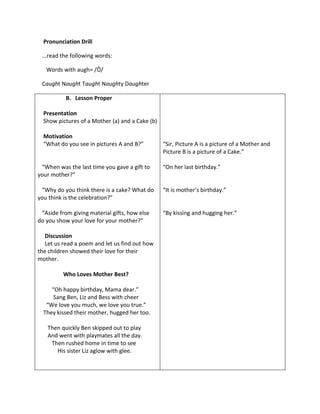
Pronunciation Drill 
...read the following words: 
Words with augh= /Ô/ 
Caught Naught Taught Naughty Daughter 
B. Lesson Proper 
Presentation 
Show pictures of a Mother (a) and a Cake (b) 
Motivation 
“What do you see in pictures A and B?” 
“When was the last time you gave a gift to 
your mother?” 
“Why do you think there is a cake? What do 
you think is the celebration?” 
“Aside from giving material gifts, how else 
do you show your love for your mother?” 
Discussion 
Let us read a poem and let us find out how 
the children showed their love for their 
mother. 
Who Loves Mother Best? 
“Oh happy birthday, Mama dear.” 
Sang Ben, Liz and Bess with cheer 
“We love you much, we love you true.” 
They kissed their mother, hugged her too. 
Then quickly Ben skipped out to play 
And went with playmates all the day. 
Then rushed home in time to see 
His sister Liz aglow with glee. 
“Sir, Picture A is a picture of a Mother and 
Picture B is a picture of a Cake.” 
“On her last birthday.” 
“It is mother’s birthday.” 
“By kissing and hugging her.”
For Liz held up an ice cream cone, 
Enjoying it, she sat alone. 
Ben grabbed the cone, and slipped away, 
So Liz cried out, “For that you’ll pay!” 
Like cats and dogs the two did struggle 
Each making sure to win the battle. 
They tried to push and then to pull, 
While Mama almost lost her cool. 
But little Bess with Mom she stayed, 
She set the table, drinks she laid. 
And helped to serve Mom’s friends and 
guests 
Now tell me, who loves Mother best? 
After reading the poem, let us now answer 
these questions: 
“Why did Bess, Ben, and Liz kiss and hug their 
Mother?” 
“Why was Liz aglow with glee?” 
“What made Liz cry out, “For that you’ll pay?” 
“Why did Mother almost lost her cool?” 
“Who among the three children loved their 
Mother best? How did he/she show it? 
“What is the best way to show your love for 
your parents?” Explain. 
Analysis 
(Show picture of a girl eating an ice cream) 
“What do you see on the picture?” 
“Because it is their Mother’s Birthday.” 
“Liz was aglow a glee because she was 
eating a cone of ice cream.” 
“Liz cried out because Ben grabbed the cone 
then slipped away.” 
“Because Ben and Liz struggled.” 
“Bess, because she helped mother to serve 
the guests.” 
“The best way to show my love for my 
parents is by...” 
“A girl is eating a cone of ice cream.”
“What happened to Liz when she was eating 
a cone of ice cream?” 
Liz was aglow with glee, answers what 
happens to Liz when she eats a cone of ice 
cream. This is called the effect. 
Look again at the picture, 
“What do you notice on Liz’s face?” 
“Why was Liz aglow with glee?” 
Because she was eating a cone of ice cream, 
answers why Liz was aglow with glee. This is 
called the cause. 
And that’s what we call the Cause-and-effect 
relationship. 
Generalization 
“A cause and effect relationship describes 
something that happens and why it happens.” 
“What happens is called the effect; and why it 
happens is called the cause.” 
“The cause is usually introduced by the 
connective because.” 
Application 
(Pantomine) 
Each group will act out the following 
situations from the poem. 
Group1: 
But little Bess with Mom she stayed, 
She set the table, drinks she laid. 
And helped to serve Mother’s friends and 
guests. 
Now tell me, who loves Mother best? 
“Liz was happy (aglow with glee)” 
“Because she was eating a cone of ice cream.”
Group2: 
For Liz held up an ice cream cone, 
Enjoying it, she sat alone. 
Ben grabbed the cone and slipped away, 
So Liz cried out, “For that you’ll pay!” 
Group3: 
“Oh happy birthday, Mama dear.” 
Sang Ben and Liz and Bess with cheer 
“We love you much, we love you true.” 
They kissed their mother, hugged her too. 
Group4: 
Like cats and dogs the two did struggle 
Each making sure to win the battle. 
They tried to push and then to pull, 
While Mama almost her cool. 
IV. Evaluation 
Read the following sentences. Write C before the sentence for the cause and write E 
for the part that is the effect. 
1. _____ because it is her birthday. 
2. _____ Ben, Liz and Bess kissed and hugged their mother. 
3. _____ Liz cried out. 
4. _____ Because Ben grabbed the cone of ice cream and slipped away. 
5. _____ Mama almost lost her cool. 
V. Assignment 
Identifying CAUSE-AND-EFFECT RELATIONSHIP. 
Read the short fable. Underline the CAUSE and Encircle the EFFECT. 
A fox said to a crow with a piece of cheese between its beak, “If you can sing as 
prettily as you sit, then you are the prettiest singer.” 
The fox thought that once the crow starts to sing, the cheese would drop from 
her beak. But the crow carefully removed the cheese from the claws on one foot and 
said, “they say you are sly, but you cannot fool me”. Not giving up, the fox continued 
to praise the crow. “I wish I could hear you tell about your talents but I have to go 
look for food because I’m hungry”.
A Detailed Lesson Plan in Mathematics (First Year—Secondary) 
I. Objectives 
At the end of the lesson, the students will be able to: 
A. To recognize Euclidean transformations. 
B. To recognize reflections, translations, and rotations. 
C. To prove theorems related to transformations. 
D. To solve problems involving transformations. 
E. To apply transformations to real-world situations. 
F. To create designs using transformations. 
II. Subject Matter 
Geometry (Transformations) 
Reference: Geometry for Highschool Textbook 
Materials: sheets of paper, protractor, tangram puzzles. 
Values: creativity, determination, patience 
III. Procedure 
A. Learning Activities 
Teacher’s Activity 
“Good Morning Class...” 
“Let us pray first...” 
(Checking of Attendance) 
...say present... 
“Please pick up the pieces of paper 
under your chair” 
Student’s Activity 
“Good Morning Sir!” 
(One Student will lead the Prayer) 
(Students raise their hand and say 
present as the teacher calls in their 
name) 
(Students pick up the pieces of paper)
Presentation 
Activity - Folding of Paper 
The teacher will give an activity that 
involves the folding of paper and 
tracing of shapes. 
Discussion 
From the activity, the teacher will point 
out that geometry is not only the 
study of figures but is also the study of 
the movement of figures. 
 Is the original figure congruent to the 
other figures? 
 How does the second image compare 
to the original figure? 
Input 
Definitions: 
 Transformations 
 Reflection 
 Rotation 
 Translation 
 Dilation 
 Rigid Motion 
Theorems: 
 Theorem 18-1 
 Theorem 18-2 
(Students follow the instruction of the 
teacher) 
(Students listen attentively) 
(Conduct a solving on the board) 
(Students raise their hands and define 
the terms)
 Theorem 18-3 
 Theorem 18-4 
 
Discussion 
The above definitions and theorems 
will be discussed and proved. The 
teacher will ask the student to give 
examples of transformations. 
D. Activity 
Tangram Puzzle 
The students will form six groups. Each 
group is going to make images of 
animals using tangram puzzle and they 
will identify the kind of transformation 
depicted or made after doing the 
activity. 
(Students listen attentively) 
(Students perform) 
IV. Evaluation 
Worksheet 
1. Which of the following transformations creates a figure that is similar (but not 
congruent) to the original figure? 
2. How can transformations be applied to real-world situations? 
III. Assignment 
Drawing 
The student will use transformations to move figures and create designs.
A Detailed Lesson Plan in Science (First Year—Secondary) 
I. Objectives 
At the end of the lesson, the students will be able to: 
A. Describe the polarity of a water molecule and explain how that polarity affects 
the properties of water. 
B. Explain why water climbs the inside of a thin glass capillary but not a thin plastic 
capillary. 
C. Describe a system whereby the components of a water-based substance might 
be separated and discuss how this separation occurs. 
D. Explain why oil and water don't mix. 
E. Predict whether a substance, based on its hydrophilic and/or hydrophobic 
properties, will dissolve into water or oil. 
II. Subject Matter 
The Properties of Water 
Reference: Science and Technology 1 by Scott 
Materials: paper strips, detergent, wax paper, coins, glue, cooking oil, red food 
coloring, cups of water, 10 ml grad cylinders, 50 ml grad. Cylinders, beaker, glass 
slides, stirring rods, medicine droppers, scissors 
Values: Creativity, Patience, Following Instructions 
III. Procedure 
A. Learning Activities 
Teacher’s Activity 
“Good Morning Class...” 
“Let us pray first...” 
(Checking of Attendance) 
...say present... 
“Please pick up the pieces of paper 
under your chair” 
“Have you ever wondered what’s 
behind water?—not bodies of water, but the 
water itself, the liquid, Everything in this 
world are made by God with their special 
functions... Now let us discover what’s so 
Student’s Activity 
“Good Morning Sir!” 
(One Student will lead the Prayer) 
(Students raise their hand and say 
present as the teacher calls in their 
name) 
(Students pick up the pieces of 
paper)
special about water. 
Presentation 
Effects of 
Detergent 
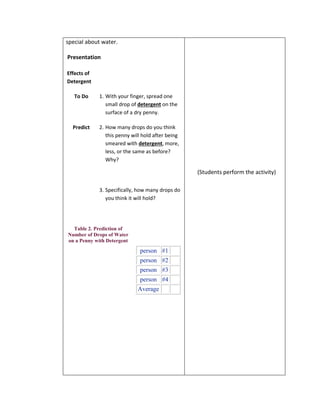
To Do 1. With your finger, spread one 
small drop of detergent on the 
surface of a dry penny. 
Predict 2. How many drops do you think 
this penny will hold after being 
smeared with detergent, more, 
less, or the same as before? 
Why? 
3. Specifically, how many drops do 
you think it will hold? 
Table 2. Prediction of 
Number of Drops of Water 
on a Penny with Detergent 
person #1 
person #2 
person #3 
person #4 
Average 
(Students perform the activity)
Discussion 
Water covers about three fourths of the 
surface of the earth? It is ubiquitous. It 
is also one of the simplest yet most 
important molecules in living systems. 
It makes up from 50 to 95 percent of 
the weight of living organisms. The 
cytoplasm of a cell is a water-based 
solution that contains a variety of ions, 
salts, and molecules which make life 
'happen.' Water is literally involved in 
every facet of life. 
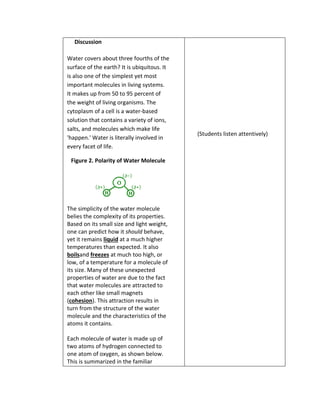
Figure 2. Polarity of Water Molecule 
The simplicity of the water molecule 
belies the complexity of its properties. 
Based on its small size and light weight, 
one can predict how it should behave, 
yet it remains liquid at a much higher 
temperatures than expected. It also 
boilsand freezes at much too high, or 
low, of a temperature for a molecule of 
its size. Many of these unexpected 
properties of water are due to the fact 
that water molecules are attracted to 
each other like small magnets 
(cohesion). This attraction results in 
turn from the structure of the water 
molecule and the characteristics of the 
atoms it contains. 
Each molecule of water is made up of 
two atoms of hydrogen connected to 
one atom of oxygen, as shown below. 
This is summarized in the familiar 
(Students listen attentively)
formula, H2O. 
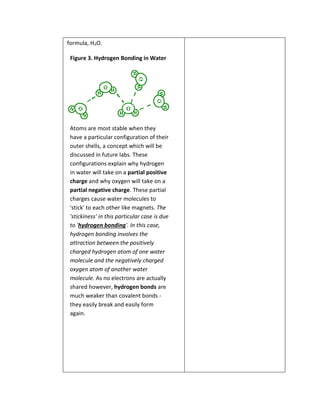
Figure 3. Hydrogen Bonding in Water 
Atoms are most stable when they 
have a particular configuration of their 
outer shells, a concept which will be 
discussed in future labs. These 
configurations explain why hydrogen 
in water will take on a partial positive 
charge and why oxygen will take on a 
partial negative charge. These partial 
charges cause water molecules to 
'stick' to each other like magnets. The 
'stickiness' in this particular case is due 
to 'hydrogen bonding'. In this case, 
hydrogen bonding involves the 
attraction between the positively 
charged hydrogen atom of one water 
molecule and the negatively charged 
oxygen atom of another water 
molecule. As no electrons are actually 
shared however, hydrogen bonds are 
much weaker than covalent bonds - 
they easily break and easily form 
again.
Application (Activity) 
1. Water moves to the tops of tall trees 
due to capillary action combined 
with root pressure and evaporation 
from the stomata (openings) in the 
leaves. Water will also climb up paper, 
and often the migrating water will carry 
other molecules along with it. The 
distance traveled by these other 
molecules will vary with their mass and 
charge. 
2. How fast do you think water would 
climb a strip of absorbent paper about 
one-half inch wide? 
about one inch per 
____________________ (time) 
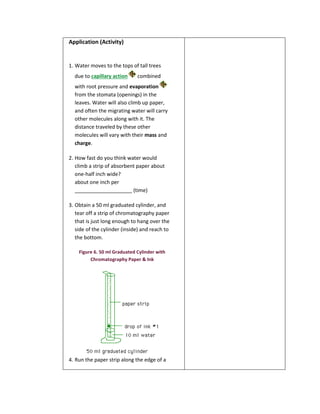
3. Obtain a 50 ml graduated cylinder, and 
tear off a strip of chromatography paper 
that is just long enough to hang over the 
side of the cylinder (inside) and reach to 
the bottom. 
Figure 6. 50 ml Graduated Cylinder with 
Chromatography Paper & Ink 
4. Run the paper strip along the edge of a
scissors to take the curl out of it. 
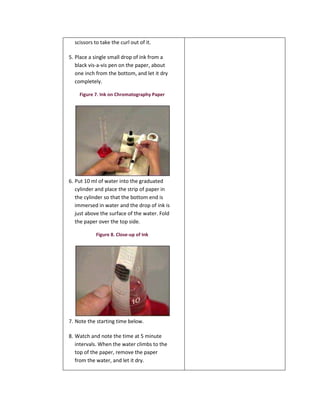
5. Place a single small drop of ink from a 
black vis-a-vis pen on the paper, about 
one inch from the bottom, and let it dry 
completely. 
Figure 7. Ink on Chromatography Paper 
6. Put 10 ml of water into the graduated 
cylinder and place the strip of paper in 
the cylinder so that the bottom end is 
immersed in water and the drop of ink is 
just above the surface of the water. Fold 
the paper over the top side. 
Figure 8. Close-up of Ink 
7. Note the starting time below. 
8. Watch and note the time at 5 minute 
intervals. When the water climbs to the 
top of the paper, remove the paper 
from the water, and let it dry.
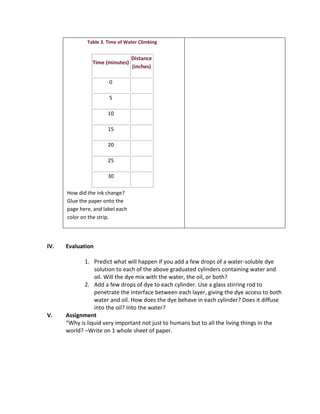
Table 3. Time of Water Climbing 
Time (minutes) 
Distance 
(inches) 
0 
5 
10 
15 
20 
25 
30 
How did the ink change? 
Glue the paper onto the 
page here, and label each 
color on the strip. 
IV. Evaluation 
1. Predict what will happen if you add a few drops of a water-soluble dye 
solution to each of the above graduated cylinders containing water and 
oil. Will the dye mix with the water, the oil, or both? 
2. Add a few drops of dye to each cylinder. Use a glass stirring rod to 
penetrate the interface between each layer, giving the dye access to both 
water and oil. How does the dye behave in each cylinder? Does it diffuse 
into the oil? Into the water? 
V. Assignment 
“Why is liquid very important not just to humans but to all the living things in the 
world? –Write on 1 whole sheet of paper.
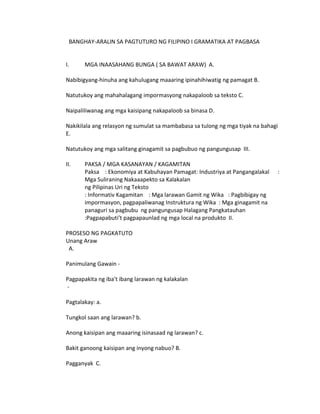
BANGHAY-ARALIN SA PAGTUTURO NG FILIPINO I GRAMATIKA AT PAGBASA 
I. MGA INAASAHANG BUNGA ( SA BAWAT ARAW) A. 
Nabibigyang-hinuha ang kahulugang maaaring ipinahihiwatig ng pamagat B. 
Natutukoy ang mahahalagang impormasyong nakapaloob sa teksto C. 
Naipaliliwanag ang mga kaisipang nakapaloob sa binasa D. 
Nakikilala ang relasyon ng sumulat sa mambabasa sa tulong ng mga tiyak na bahagi 
E. 
Natutukoy ang mga salitang ginagamit sa pagbubuo ng pangungusap III. 
II. PAKSA / MGA KASANAYAN / KAGAMITAN 
Paksa : Ekonomiya at Kabuhayan Pamagat: Industriya at Pangangalakal : 
Mga Suliraning Nakaaapekto sa Kalakalan 
ng Pilipinas Uri ng Teksto 
: Informativ Kagamitan : Mga larawan Gamit ng Wika : Pagbibigay ng 
impormasyon, pagpapaliwanag Instruktura ng Wika : Mga ginagamit na 
panaguri sa pagbubu ng pangungusap Halagang Pangkatauhan 
:Pagpapabuti’t pagpapaunlad ng mga local na produkto II. 
PROSESO NG PAGKATUTO 
Unang Araw 
A. 
Panimulang Gawain - 
Pagpapakita ng iba’t ibang larawan ng kalakalan 
- 
Pagtalakay: a. 
Tungkol saan ang larawan? b. 
Anong kaisipan ang maaaring isinasaad ng larawan? c. 
Bakit ganoong kaisipan ang inyong nabuo? B. 
Pagganyak C.
Paglalahad - 
Pagpapabasa sa pamagat ng tekstong ipababasa at paghihinuha sa kahulugang 
maaaring ipinahihiwatig nito. D. 
Pangkatang Gawain ( 
Tingnan sa: Gawain Para sa Paksang-Aralin 
– 
) Pangkat 1 
– 
Ipabigay ang kahulugan ng pamagat ng tekstong lunsaran at nais 
ipahiwatig nito. “ Industriya at Pangangalakal” 
Pangkat 2 - Cycle Map Panuto: Ipaliwanag ang bawat yugtong napapaloob sa 
cycle map. Pangkat 3 - Pagbubuo sa Tsart Pangkat 4 - Data Retrieval Chart E. 
Pagpapabasa sa tekstong lunsaran - 
Basahin ang tekstong lunsaran: “ 
Industriya at Pangangalakal 
” 
( Tingnan sa Gawain Para sa Paksang-Aralin ) Page 1 
Cont. Lesson Plan 2 
Ikalawa at Ikatlong Araw 
A. 
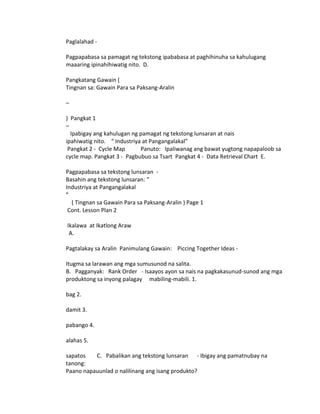
Pagtalakay sa Aralin Panimulang Gawain: Piccing Together Ideas - 
Itugma sa larawan ang mga sumusunod na salita. 
B. Pagganyak: Rank Order - Isaayos ayon sa nais na pagkakasunud-sunod ang mga 
produktong sa inyong palagay mabiling-mabili. 1. 
bag 2. 
damit 3. 
pabango 4. 
alahas 5. 
sapatos C. Pabalikan ang tekstong lunsaran - Ibigay ang pamatnubay na 
tanong: 
Paano napauunlad o nalilinang ang isang produkto?
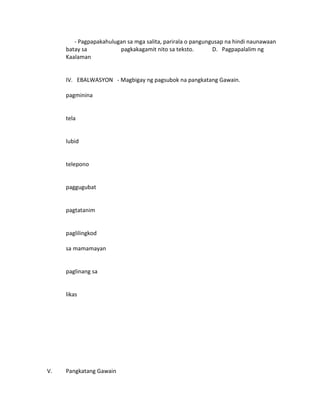
- Pagpapakahulugan sa mga salita, parirala o pangungusap na hindi naunawaan 
batay sa pagkakagamit nito sa teksto. D. Pagpapalalim ng 
Kaalaman 
IV. EBALWASYON - Magbigay ng pagsubok na pangkatang Gawain. 
pagminina 
tela 
lubid 
telepono 
paggugubat 
pagtatanim 
paglilingkod 
sa mamamayan 
paglinang sa 
likas 
V. Pangkatang Gawain
( makikita sa Gawain Para sa Paksang-Aralin ) 
Pangkat 1 - Double Bubble Map Pangkat 2 - Circle Map Pangkat 3 - Chart 
Grid Pangkat 4 - Pagpili ng mga bahaging nagpapahayag ng opinion mula sa 
teksto. 
Ikaapat at Ikalimang Araw 
- Pagpapatuloy sa talakayan sa aralin - Pagsusuri ng teksto batay sa tiyak na 
katangian at uri nito - Pagbibigay input

Lesson plan in English 1

  • 1.
    A Detailed LessonPlan in English (First Year—Secondary) I. Objectives At the end of the lesson, the students will be able to: 1. Identify statements that show cause and effect relationship. 2. Read a poem correctly and clearly with expressions. 3. Appreciate reading poems. 4. Decode words with “augh” (o) sounds II. Subject Matter Cause and Effect Relationship Reference/s: Fun in English Reading Textbook pages 94-101 Materials: Visual Aids, Charts, Flash Cards, Pictures, Name Tags Values: Develop a genuine love for reading, love for family III. Procedure A. Learning Activities Teacher’s Activity “Good Morning Class...” “Let us pray first...” (Checking of Attendance) ...say present... “Please pick up the pieces of paper under your chair” “So how was your weekend?” “That’s good! Have you enjoyed your weekend bonding with your family?” “That’s good to know. For this morning, our discussion will be in relation to a family. Are you familiar with Barney’s I Love You Song?” “Okay that’s good, so are you ready to sing and have fun today? Student’s Activity “Good Morning Sir!” (One Student will lead the Prayer) (Students raise their hand and say present as the teacher calls in their name) (Students pick up the pieces of paper) “It was great sir!” “Of course sir! It was a lot of fun!” “Yes sir! We love purple-colored dinosaur!” “Yes”
  • 2.
    Warm Up Letus sing Barney’s I Love You Song. (Students Sing) “I love you, you love me and we’re a happy family, With a great big hug and a kiss from me to you, Hope you say you love me too.” “Okay now class, What can you say about the song? Does it tell us something important that we have already forgotten to do nowadays?” “How could you say so John?” “That was a very good explanation John, you know what class the song simply tells us something that we should always consider for us to keep our family or relationship with others intact, sometimes showing affection/love towards a person makes him feel that he is appreciated and there will be feeling of belonginess and love. “What else have you noticed which made you conclude that the song is all about love?” “Everybody had just sung very well, it’s now time to improve your pronunciation more...” “Sir, eventhough the song is very short, but I guess it’s full of emotions.” “Because sir I noticed that the song has a lot to do with our love for our family, that the real meaning of family is all about loving each other, and nowadays kissing and hugging our parents or family members are not being practiced anymore.” “Because sir, there are so many descriptive words in the song, the most obvious one is “I LOVE YOU.”
  • 3.
    Pronunciation Drill ...readthe following words: Words with augh= /Ô/ Caught Naught Taught Naughty Daughter B. Lesson Proper Presentation Show pictures of a Mother (a) and a Cake (b) Motivation “What do you see in pictures A and B?” “When was the last time you gave a gift to your mother?” “Why do you think there is a cake? What do you think is the celebration?” “Aside from giving material gifts, how else do you show your love for your mother?” Discussion Let us read a poem and let us find out how the children showed their love for their mother. Who Loves Mother Best? “Oh happy birthday, Mama dear.” Sang Ben, Liz and Bess with cheer “We love you much, we love you true.” They kissed their mother, hugged her too. Then quickly Ben skipped out to play And went with playmates all the day. Then rushed home in time to see His sister Liz aglow with glee. “Sir, Picture A is a picture of a Mother and Picture B is a picture of a Cake.” “On her last birthday.” “It is mother’s birthday.” “By kissing and hugging her.”
  • 4.
    For Liz heldup an ice cream cone, Enjoying it, she sat alone. Ben grabbed the cone, and slipped away, So Liz cried out, “For that you’ll pay!” Like cats and dogs the two did struggle Each making sure to win the battle. They tried to push and then to pull, While Mama almost lost her cool. But little Bess with Mom she stayed, She set the table, drinks she laid. And helped to serve Mom’s friends and guests Now tell me, who loves Mother best? After reading the poem, let us now answer these questions: “Why did Bess, Ben, and Liz kiss and hug their Mother?” “Why was Liz aglow with glee?” “What made Liz cry out, “For that you’ll pay?” “Why did Mother almost lost her cool?” “Who among the three children loved their Mother best? How did he/she show it? “What is the best way to show your love for your parents?” Explain. Analysis (Show picture of a girl eating an ice cream) “What do you see on the picture?” “Because it is their Mother’s Birthday.” “Liz was aglow a glee because she was eating a cone of ice cream.” “Liz cried out because Ben grabbed the cone then slipped away.” “Because Ben and Liz struggled.” “Bess, because she helped mother to serve the guests.” “The best way to show my love for my parents is by...” “A girl is eating a cone of ice cream.”
  • 5.
    “What happened toLiz when she was eating a cone of ice cream?” Liz was aglow with glee, answers what happens to Liz when she eats a cone of ice cream. This is called the effect. Look again at the picture, “What do you notice on Liz’s face?” “Why was Liz aglow with glee?” Because she was eating a cone of ice cream, answers why Liz was aglow with glee. This is called the cause. And that’s what we call the Cause-and-effect relationship. Generalization “A cause and effect relationship describes something that happens and why it happens.” “What happens is called the effect; and why it happens is called the cause.” “The cause is usually introduced by the connective because.” Application (Pantomine) Each group will act out the following situations from the poem. Group1: But little Bess with Mom she stayed, She set the table, drinks she laid. And helped to serve Mother’s friends and guests. Now tell me, who loves Mother best? “Liz was happy (aglow with glee)” “Liz was happy (aglow with glee)” “Because she was eating a cone of ice cream.”
  • 6.
    Group2: For Lizheld up an ice cream cone, Enjoying it, she sat alone. Ben grabbed the cone and slipped away, So Liz cried out, “For that you’ll pay!” Group3: “Oh happy birthday, Mama dear.” Sang Ben and Liz and Bess with cheer “We love you much, we love you true.” They kissed their mother, hugged her too. Group4: Like cats and dogs the two did struggle Each making sure to win the battle. They tried to push and then to pull, While Mama almost her cool. IV. Evaluation Read the following sentences. Write C before the sentence for the cause and write E for the part that is the effect. 1. _____ because it is her birthday. 2. _____ Ben, Liz and Bess kissed and hugged their mother. 3. _____ Liz cried out. 4. _____ Because Ben grabbed the cone of ice cream and slipped away. 5. _____ Mama almost lost her cool. V. Assignment Identifying CAUSE-AND-EFFECT RELATIONSHIP. Read the short fable. Underline the CAUSE and Encircle the EFFECT. A fox said to a crow with a piece of cheese between its beak, “If you can sing as prettily as you sit, then you are the prettiest singer.” The fox thought that once the crow starts to sing, the cheese would drop from her beak. But the crow carefully removed the cheese from the claws on one foot and said, “they say you are sly, but you cannot fool me”. Not giving up, the fox continued to praise the crow. “I wish I could hear you tell about your talents but I have to go look for food because I’m hungry”.
  • 7.
    A Detailed LessonPlan in Mathematics (First Year—Secondary) I. Objectives At the end of the lesson, the students will be able to: A. To recognize Euclidean transformations. B. To recognize reflections, translations, and rotations. C. To prove theorems related to transformations. D. To solve problems involving transformations. E. To apply transformations to real-world situations. F. To create designs using transformations. II. Subject Matter Geometry (Transformations) Reference: Geometry for Highschool Textbook Materials: sheets of paper, protractor, tangram puzzles. Values: creativity, determination, patience III. Procedure A. Learning Activities Teacher’s Activity “Good Morning Class...” “Let us pray first...” (Checking of Attendance) ...say present... “Please pick up the pieces of paper under your chair” Student’s Activity “Good Morning Sir!” (One Student will lead the Prayer) (Students raise their hand and say present as the teacher calls in their name) (Students pick up the pieces of paper)
  • 8.
    Presentation Activity -Folding of Paper The teacher will give an activity that involves the folding of paper and tracing of shapes. Discussion From the activity, the teacher will point out that geometry is not only the study of figures but is also the study of the movement of figures.  Is the original figure congruent to the other figures?  How does the second image compare to the original figure? Input Definitions:  Transformations  Reflection  Rotation  Translation  Dilation  Rigid Motion Theorems:  Theorem 18-1  Theorem 18-2 (Students follow the instruction of the teacher) (Students listen attentively) (Conduct a solving on the board) (Students raise their hands and define the terms)
  • 9.
     Theorem 18-3  Theorem 18-4  Discussion The above definitions and theorems will be discussed and proved. The teacher will ask the student to give examples of transformations. D. Activity Tangram Puzzle The students will form six groups. Each group is going to make images of animals using tangram puzzle and they will identify the kind of transformation depicted or made after doing the activity. (Students listen attentively) (Students perform) IV. Evaluation Worksheet 1. Which of the following transformations creates a figure that is similar (but not congruent) to the original figure? 2. How can transformations be applied to real-world situations? III. Assignment Drawing The student will use transformations to move figures and create designs.
  • 10.
    A Detailed LessonPlan in Science (First Year—Secondary) I. Objectives At the end of the lesson, the students will be able to: A. Describe the polarity of a water molecule and explain how that polarity affects the properties of water. B. Explain why water climbs the inside of a thin glass capillary but not a thin plastic capillary. C. Describe a system whereby the components of a water-based substance might be separated and discuss how this separation occurs. D. Explain why oil and water don't mix. E. Predict whether a substance, based on its hydrophilic and/or hydrophobic properties, will dissolve into water or oil. II. Subject Matter The Properties of Water Reference: Science and Technology 1 by Scott Materials: paper strips, detergent, wax paper, coins, glue, cooking oil, red food coloring, cups of water, 10 ml grad cylinders, 50 ml grad. Cylinders, beaker, glass slides, stirring rods, medicine droppers, scissors Values: Creativity, Patience, Following Instructions III. Procedure A. Learning Activities Teacher’s Activity “Good Morning Class...” “Let us pray first...” (Checking of Attendance) ...say present... “Please pick up the pieces of paper under your chair” “Have you ever wondered what’s behind water?—not bodies of water, but the water itself, the liquid, Everything in this world are made by God with their special functions... Now let us discover what’s so Student’s Activity “Good Morning Sir!” (One Student will lead the Prayer) (Students raise their hand and say present as the teacher calls in their name) (Students pick up the pieces of paper)
  • 11.
    special about water. Presentation Effects of Detergent To Do 1. With your finger, spread one small drop of detergent on the surface of a dry penny. Predict 2. How many drops do you think this penny will hold after being smeared with detergent, more, less, or the same as before? Why? 3. Specifically, how many drops do you think it will hold? Table 2. Prediction of Number of Drops of Water on a Penny with Detergent person #1 person #2 person #3 person #4 Average (Students perform the activity)
  • 12.
    Discussion Water coversabout three fourths of the surface of the earth? It is ubiquitous. It is also one of the simplest yet most important molecules in living systems. It makes up from 50 to 95 percent of the weight of living organisms. The cytoplasm of a cell is a water-based solution that contains a variety of ions, salts, and molecules which make life 'happen.' Water is literally involved in every facet of life. Figure 2. Polarity of Water Molecule The simplicity of the water molecule belies the complexity of its properties. Based on its small size and light weight, one can predict how it should behave, yet it remains liquid at a much higher temperatures than expected. It also boilsand freezes at much too high, or low, of a temperature for a molecule of its size. Many of these unexpected properties of water are due to the fact that water molecules are attracted to each other like small magnets (cohesion). This attraction results in turn from the structure of the water molecule and the characteristics of the atoms it contains. Each molecule of water is made up of two atoms of hydrogen connected to one atom of oxygen, as shown below. This is summarized in the familiar (Students listen attentively)
  • 13.
    formula, H2O. Figure3. Hydrogen Bonding in Water Atoms are most stable when they have a particular configuration of their outer shells, a concept which will be discussed in future labs. These configurations explain why hydrogen in water will take on a partial positive charge and why oxygen will take on a partial negative charge. These partial charges cause water molecules to 'stick' to each other like magnets. The 'stickiness' in this particular case is due to 'hydrogen bonding'. In this case, hydrogen bonding involves the attraction between the positively charged hydrogen atom of one water molecule and the negatively charged oxygen atom of another water molecule. As no electrons are actually shared however, hydrogen bonds are much weaker than covalent bonds - they easily break and easily form again.
  • 14.
    Application (Activity) 1.Water moves to the tops of tall trees due to capillary action combined with root pressure and evaporation from the stomata (openings) in the leaves. Water will also climb up paper, and often the migrating water will carry other molecules along with it. The distance traveled by these other molecules will vary with their mass and charge. 2. How fast do you think water would climb a strip of absorbent paper about one-half inch wide? about one inch per ____________________ (time) 3. Obtain a 50 ml graduated cylinder, and tear off a strip of chromatography paper that is just long enough to hang over the side of the cylinder (inside) and reach to the bottom. Figure 6. 50 ml Graduated Cylinder with Chromatography Paper & Ink 4. Run the paper strip along the edge of a
  • 15.
    scissors to takethe curl out of it. 5. Place a single small drop of ink from a black vis-a-vis pen on the paper, about one inch from the bottom, and let it dry completely. Figure 7. Ink on Chromatography Paper 6. Put 10 ml of water into the graduated cylinder and place the strip of paper in the cylinder so that the bottom end is immersed in water and the drop of ink is just above the surface of the water. Fold the paper over the top side. Figure 8. Close-up of Ink 7. Note the starting time below. 8. Watch and note the time at 5 minute intervals. When the water climbs to the top of the paper, remove the paper from the water, and let it dry.
  • 16.
    Table 3. Timeof Water Climbing Time (minutes) Distance (inches) 0 5 10 15 20 25 30 How did the ink change? Glue the paper onto the page here, and label each color on the strip. IV. Evaluation 1. Predict what will happen if you add a few drops of a water-soluble dye solution to each of the above graduated cylinders containing water and oil. Will the dye mix with the water, the oil, or both? 2. Add a few drops of dye to each cylinder. Use a glass stirring rod to penetrate the interface between each layer, giving the dye access to both water and oil. How does the dye behave in each cylinder? Does it diffuse into the oil? Into the water? V. Assignment “Why is liquid very important not just to humans but to all the living things in the world? –Write on 1 whole sheet of paper.
  • 17.
    BANGHAY-ARALIN SA PAGTUTURONG FILIPINO I GRAMATIKA AT PAGBASA I. MGA INAASAHANG BUNGA ( SA BAWAT ARAW) A. Nabibigyang-hinuha ang kahulugang maaaring ipinahihiwatig ng pamagat B. Natutukoy ang mahahalagang impormasyong nakapaloob sa teksto C. Naipaliliwanag ang mga kaisipang nakapaloob sa binasa D. Nakikilala ang relasyon ng sumulat sa mambabasa sa tulong ng mga tiyak na bahagi E. Natutukoy ang mga salitang ginagamit sa pagbubuo ng pangungusap III. II. PAKSA / MGA KASANAYAN / KAGAMITAN Paksa : Ekonomiya at Kabuhayan Pamagat: Industriya at Pangangalakal : Mga Suliraning Nakaaapekto sa Kalakalan ng Pilipinas Uri ng Teksto : Informativ Kagamitan : Mga larawan Gamit ng Wika : Pagbibigay ng impormasyon, pagpapaliwanag Instruktura ng Wika : Mga ginagamit na panaguri sa pagbubu ng pangungusap Halagang Pangkatauhan :Pagpapabuti’t pagpapaunlad ng mga local na produkto II. PROSESO NG PAGKATUTO Unang Araw A. Panimulang Gawain - Pagpapakita ng iba’t ibang larawan ng kalakalan - Pagtalakay: a. Tungkol saan ang larawan? b. Anong kaisipan ang maaaring isinasaad ng larawan? c. Bakit ganoong kaisipan ang inyong nabuo? B. Pagganyak C.
  • 18.
    Paglalahad - Pagpapabasasa pamagat ng tekstong ipababasa at paghihinuha sa kahulugang maaaring ipinahihiwatig nito. D. Pangkatang Gawain ( Tingnan sa: Gawain Para sa Paksang-Aralin – ) Pangkat 1 – Ipabigay ang kahulugan ng pamagat ng tekstong lunsaran at nais ipahiwatig nito. “ Industriya at Pangangalakal” Pangkat 2 - Cycle Map Panuto: Ipaliwanag ang bawat yugtong napapaloob sa cycle map. Pangkat 3 - Pagbubuo sa Tsart Pangkat 4 - Data Retrieval Chart E. Pagpapabasa sa tekstong lunsaran - Basahin ang tekstong lunsaran: “ Industriya at Pangangalakal ” ( Tingnan sa Gawain Para sa Paksang-Aralin ) Page 1 Cont. Lesson Plan 2 Ikalawa at Ikatlong Araw A. Pagtalakay sa Aralin Panimulang Gawain: Piccing Together Ideas - Itugma sa larawan ang mga sumusunod na salita. B. Pagganyak: Rank Order - Isaayos ayon sa nais na pagkakasunud-sunod ang mga produktong sa inyong palagay mabiling-mabili. 1. bag 2. damit 3. pabango 4. alahas 5. sapatos C. Pabalikan ang tekstong lunsaran - Ibigay ang pamatnubay na tanong: Paano napauunlad o nalilinang ang isang produkto?
  • 19.
    - Pagpapakahulugan samga salita, parirala o pangungusap na hindi naunawaan batay sa pagkakagamit nito sa teksto. D. Pagpapalalim ng Kaalaman IV. EBALWASYON - Magbigay ng pagsubok na pangkatang Gawain. pagminina tela lubid telepono paggugubat pagtatanim paglilingkod sa mamamayan paglinang sa likas V. Pangkatang Gawain
  • 20.
    ( makikita saGawain Para sa Paksang-Aralin ) Pangkat 1 - Double Bubble Map Pangkat 2 - Circle Map Pangkat 3 - Chart Grid Pangkat 4 - Pagpili ng mga bahaging nagpapahayag ng opinion mula sa teksto. Ikaapat at Ikalimang Araw - Pagpapatuloy sa talakayan sa aralin - Pagsusuri ng teksto batay sa tiyak na katangian at uri nito - Pagbibigay input