Air Masses and Fronts
 Air moves from areas of high pressure to low
pressure, which are caused by the uneven heating of
the Earth
Air Masses:
 A large body of air throughout which temperature
and moisture content are similar; take on the
characteristics of the area over which they sit and
remain stationary
Air Mass:
 Classified by their temperature and moisture content
which are dependent upon the are over which they
formed
Types of Air Masses:
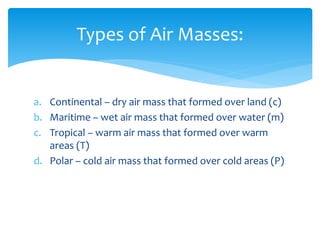
a. Continental – dry air mass that formed over land (c)
b. Maritime – wet air mass that formed over water (m)
c. Tropical – warm air mass that formed over warm
areas (T)
d. Polar – cold air mass that formed over cold areas (P)
Types of Air Masses:
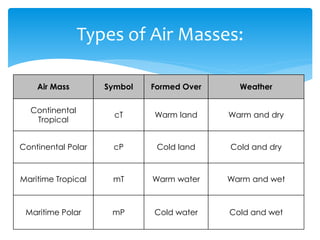
Air Mass Symbol Formed Over Weather
Continental
Tropical
cT Warm land Warm and dry
Continental Polar cP Cold land Cold and dry
Maritime Tropical mT Warm water Warm and wet
Maritime Polar mP Cold water Cold and wet
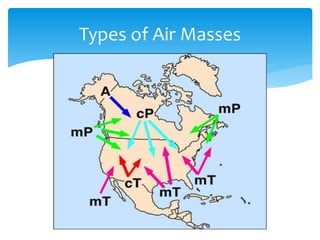
Types of Air Masses:
Types of Air Masses
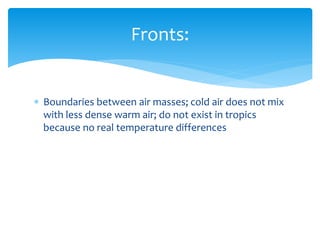
 Boundaries between air masses; cold air does not mix
with less dense warm air; do not exist in tropics
because no real temperature differences
Fronts:
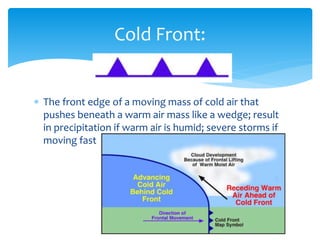
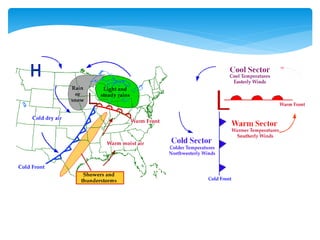
 The front edge of a moving mass of cold air that
pushes beneath a warm air mass like a wedge; result
in precipitation if warm air is humid; severe storms if
moving fast
Cold Front:
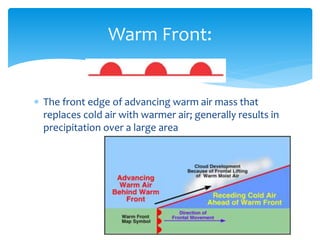
 The front edge of advancing warm air mass that
replaces cold air with warmer air; generally results in
precipitation over a large area
Warm Front:
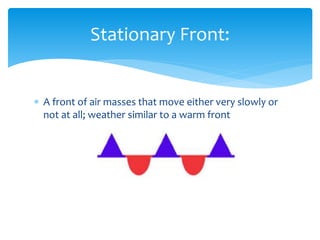
 A front of air masses that move either very slowly or
not at all; weather similar to a warm front
Stationary Front:
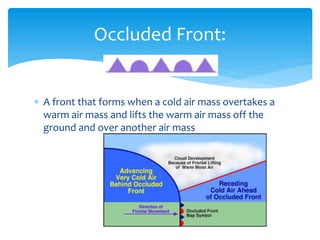
 A front that forms when a cold air mass overtakes a
warm air mass and lifts the warm air mass off the
ground and over another air mass
Occluded Front:
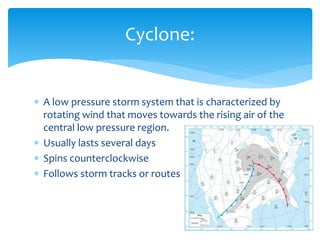
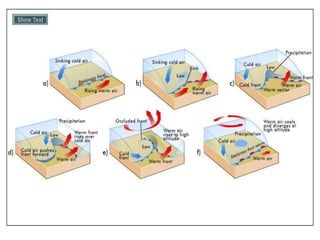
 A low pressure storm system that is characterized by
rotating wind that moves towards the rising air of the
central low pressure region.
 Usually lasts several days
 Spins counterclockwise
 Follows storm tracks or routes
Cyclone:
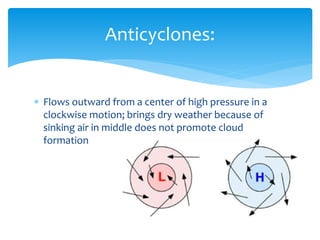
 Flows outward from a center of high pressure in a
clockwise motion; brings dry weather because of
sinking air in middle does not promote cloud
formation
Anticyclones:
18. air masses and fronts notes

18. air masses and fronts notes

  • 1.
  • 2.
     Air movesfrom areas of high pressure to low pressure, which are caused by the uneven heating of the Earth Air Masses:
  • 3.
     A largebody of air throughout which temperature and moisture content are similar; take on the characteristics of the area over which they sit and remain stationary Air Mass:
  • 4.
     Classified bytheir temperature and moisture content which are dependent upon the are over which they formed Types of Air Masses:
  • 5.
    a. Continental –dry air mass that formed over land (c) b. Maritime – wet air mass that formed over water (m) c. Tropical – warm air mass that formed over warm areas (T) d. Polar – cold air mass that formed over cold areas (P) Types of Air Masses:
  • 6.
    Air Mass SymbolFormed Over Weather Continental Tropical cT Warm land Warm and dry Continental Polar cP Cold land Cold and dry Maritime Tropical mT Warm water Warm and wet Maritime Polar mP Cold water Cold and wet Types of Air Masses:
  • 7.
  • 8.
     Boundaries betweenair masses; cold air does not mix with less dense warm air; do not exist in tropics because no real temperature differences Fronts:
  • 9.
     The frontedge of a moving mass of cold air that pushes beneath a warm air mass like a wedge; result in precipitation if warm air is humid; severe storms if moving fast Cold Front:
  • 10.
     The frontedge of advancing warm air mass that replaces cold air with warmer air; generally results in precipitation over a large area Warm Front:
  • 11.
     A frontof air masses that move either very slowly or not at all; weather similar to a warm front Stationary Front:
  • 12.
     A frontthat forms when a cold air mass overtakes a warm air mass and lifts the warm air mass off the ground and over another air mass Occluded Front:
  • 13.
     A lowpressure storm system that is characterized by rotating wind that moves towards the rising air of the central low pressure region.  Usually lasts several days  Spins counterclockwise  Follows storm tracks or routes Cyclone:
  • 15.
     Flows outwardfrom a center of high pressure in a clockwise motion; brings dry weather because of sinking air in middle does not promote cloud formation Anticyclones: