Warm Up Problem of the Day Lesson Presentation 5-6 Dilations Course 3
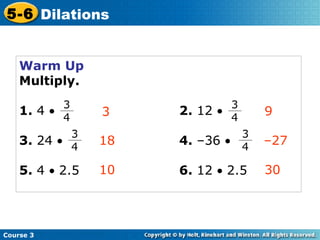
Warm Up Multiply. 1.  4   2.  12   3.  24     4.  –36     3 18 10 9 – 27 30 5.  4     2.5 6.  12     2.5 Course 3 5-6 Dilations 3 4 3 4 3 4 3 4
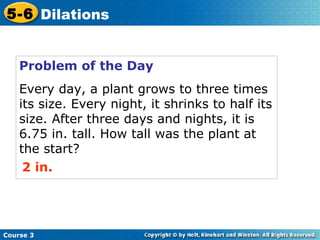
Problem of the Day Every day, a plant grows to three times its size. Every night, it shrinks to half its size. After three days and nights, it is 6.75 in. tall. How tall was the plant at the start?  2 in.
Learn  to identify and create dilations of plane figures.
Vocabulary dilation center of dilation
Your pupils are the black areas in the center of your eyes. When you go to the eye doctor, the doctor may  dilate  your pupils, which makes them larger. Translations, reflections, and rotations are transformations that do not change the size or shape of a figure. A  dilation  is a transformation that changes the size, but not the shape, of a figure. A dilation can enlarge or reduce a figure.
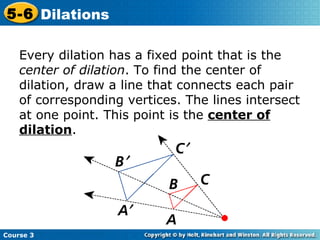
Every dilation has a fixed point that is the  center of dilation . To find the center of dilation, draw a line that connects each pair of corresponding vertices. The lines intersect at one point. This point is the  center of dilation .
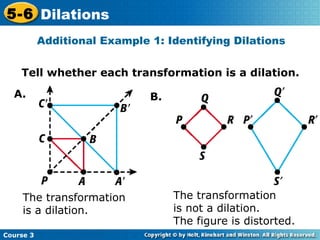
Tell whether each transformation is a dilation. The transformation  is a dilation. The transformation  is not a dilation.  The figure is distorted. Additional Example 1: Identifying Dilations A. B.
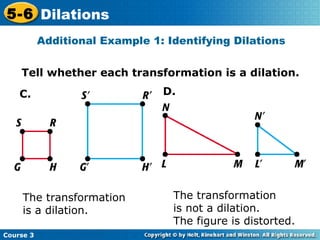
Tell whether each transformation is a dilation. The transformation  is a dilation. The transformation  is not a dilation.  The figure is distorted. Additional Example 1: Identifying Dilations C. D.
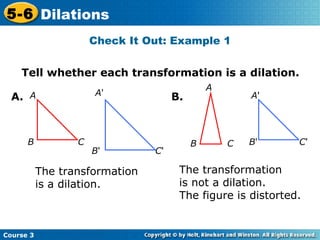
Tell whether each transformation is a dilation. A. The transformation  is a dilation. The transformation  is not a dilation.  The figure is distorted. Check It Out: Example 1 B. A ' B ' C ' A B C B A C A ' B ' C '
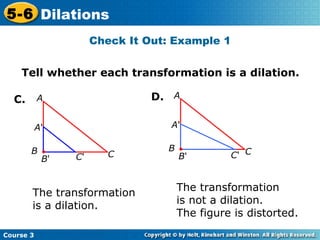
Tell whether each transformation is a dilation. C. The transformation  is a dilation. The transformation  is not a dilation.  The figure is distorted. Check It Out: Example 1 D. A ' B ' C ' A B C A ' B ' C ' A B C
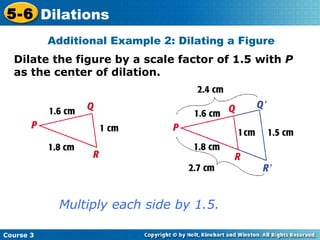
Dilate the figure by a scale factor of 1.5 with  P  as the center of dilation. Additional Example 2: Dilating a Figure Multiply each side by 1.5.
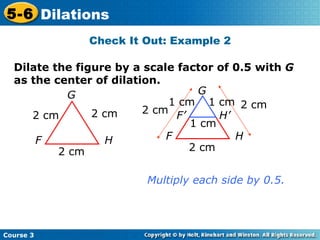
Dilate the figure by a scale factor of 0.5 with  G  as the center of dilation. G F H 2 cm 2 cm 2 cm Multiply each side by 0.5. Check It Out: Example 2 G F H 2 cm 2 cm 2 cm F’ H’ 1 cm 1 cm 1 cm
Insert Lesson Title Here Course 3 5-6 Dilations A scale factor between 0 and 1 reduces a figure. A scale factor greater than 1 enlarges it. Helpful Hint
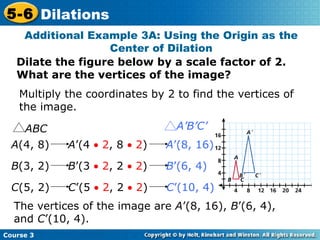
Additional Example 3A: Using the Origin as the Center of Dilation Dilate the figure below by a scale factor of 2. What are the vertices of the image? Multiply the coordinates by 2 to find the vertices of the image. The vertices of the image are  A ’(8, 16),  B ’(6, 4), and  C ’(10, 4). A (4, 8)  A ’(4    2 , 8    2 )  A ’(8, 16)   B (3, 2)  B ’(3    2 , 2    2 )  B ’(6, 4)   C (5, 2)  C ’(5    2 , 2    2 )  C ’(10, 4)   ABC A’B’C’
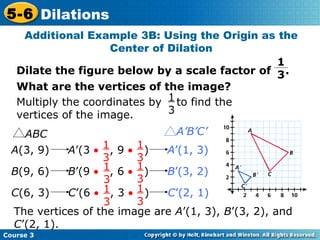
Additional Example 3B: Using the Origin as the Center of Dilation Dilate the figure below by a scale factor of  . What are the vertices of the image? The vertices of the image are  A ’(1, 3),  B ’(3, 2), and  C ’(2, 1). 1 3 ABC A’B’C’ A (3, 9)  A ’(3     , 9     )  A ’(1, 3)   1  3 1  3 B (9, 6)  B ’(9     , 6     )  B ’(3, 2)   1  3 1  3 C (6, 3)  C ’(6     , 3     )  C ’(2, 1)   1  3 1  3 Multiply the coordinates by  to find the vertices of the image. 1  3
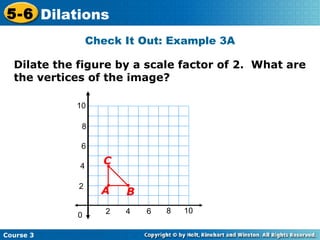
Check It Out: Example 3A Dilate the figure by a scale factor of 2.  What are the vertices of the image? 2 4 2 4 6 8 10 0 6 8 10 B C A
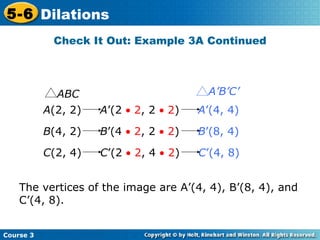
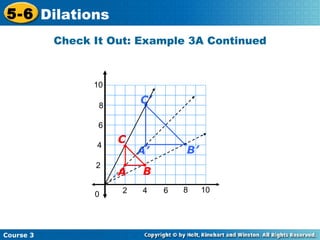
Check It Out: Example 3A Continued The vertices of the image are A’(4, 4), B’(8, 4), and C’(4, 8). A (2, 2)  A ’(2    2 , 2    2 )  A ’(4, 4)   B (4, 2)  B ’(4    2 , 2    2 )  B ’(8, 4)   C (2, 4)  C ’(2    2 , 4    2 )  C ’(4, 8)   ABC A’B’C’
Check It Out: Example 3A Continued 2 4 2 4 6 8 10 0 6 8 10 B C A B’ C’ A’
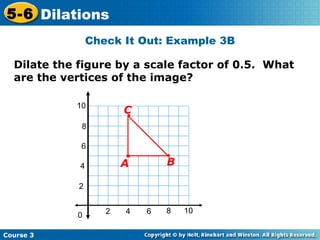
Check It Out: Example 3B Dilate the figure by a scale factor of 0.5.  What are the vertices of the image? 2 4 2 4 6 8 10 0 6 8 10 B C A
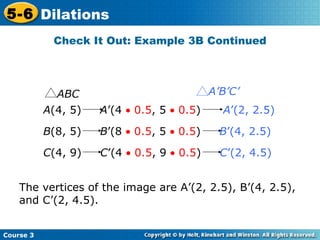
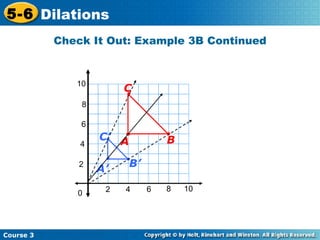
Check It Out: Example 3B Continued The vertices of the image are A’(2, 2.5), B’(4, 2.5), and C’(2, 4.5). A (4, 5)  A ’(4    0.5 , 5    0.5 )  A ’(2, 2.5)   B (8, 5)  B ’(8    0.5 , 5    0.5 )  B ’(4, 2.5)   C (4, 9)  C ’(4    0.5 , 9    0.5 )  C ’(2, 4.5)   ABC A’B’C’
Check It Out: Example 3B Continued 2 4 2 4 6 8 10 0 6 8 10 B C A B’ C’ A’
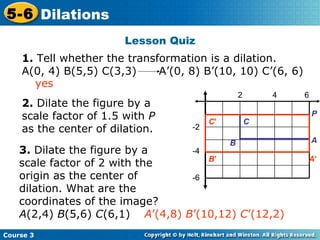
Lesson Quiz 2 4 6 -2 -4 -6 2.  Dilate the figure by a scale factor of 1.5 with  P  as the center of dilation. 3.  Dilate the figure by a scale factor of 2 with the origin as the center of dilation. What are the coordinates of the image?  A (2,4)  B (5,6)  C (6,1)  A ’(4,8)  B ’(10,12)  C ’(12,2) yes 1.  Tell whether the transformation is a dilation.  A(0, 4) B(5,5) C(3,3)  A’(0, 8) B’(10, 10) C’(6, 6) P A B C C ’ B ’ A ’

Dilations 1

  • 1.
    Warm Up Problemof the Day Lesson Presentation 5-6 Dilations Course 3
  • 2.
    Warm Up Multiply.1. 4  2. 12  3. 24  4. –36  3 18 10 9 – 27 30 5. 4  2.5 6. 12  2.5 Course 3 5-6 Dilations 3 4 3 4 3 4 3 4
  • 3.
    Problem of theDay Every day, a plant grows to three times its size. Every night, it shrinks to half its size. After three days and nights, it is 6.75 in. tall. How tall was the plant at the start? 2 in.
  • 4.
    Learn toidentify and create dilations of plane figures.
  • 5.
  • 6.
    Your pupils arethe black areas in the center of your eyes. When you go to the eye doctor, the doctor may dilate your pupils, which makes them larger. Translations, reflections, and rotations are transformations that do not change the size or shape of a figure. A dilation is a transformation that changes the size, but not the shape, of a figure. A dilation can enlarge or reduce a figure.
  • 7.
    Every dilation hasa fixed point that is the center of dilation . To find the center of dilation, draw a line that connects each pair of corresponding vertices. The lines intersect at one point. This point is the center of dilation .
  • 8.
    Tell whether eachtransformation is a dilation. The transformation is a dilation. The transformation is not a dilation. The figure is distorted. Additional Example 1: Identifying Dilations A. B.
  • 9.
    Tell whether eachtransformation is a dilation. The transformation is a dilation. The transformation is not a dilation. The figure is distorted. Additional Example 1: Identifying Dilations C. D.
  • 10.
    Tell whether eachtransformation is a dilation. A. The transformation is a dilation. The transformation is not a dilation. The figure is distorted. Check It Out: Example 1 B. A ' B ' C ' A B C B A C A ' B ' C '
  • 11.
    Tell whether eachtransformation is a dilation. C. The transformation is a dilation. The transformation is not a dilation. The figure is distorted. Check It Out: Example 1 D. A ' B ' C ' A B C A ' B ' C ' A B C
  • 12.
    Dilate the figureby a scale factor of 1.5 with P as the center of dilation. Additional Example 2: Dilating a Figure Multiply each side by 1.5.
  • 13.
    Dilate the figureby a scale factor of 0.5 with G as the center of dilation. G F H 2 cm 2 cm 2 cm Multiply each side by 0.5. Check It Out: Example 2 G F H 2 cm 2 cm 2 cm F’ H’ 1 cm 1 cm 1 cm
  • 14.
    Insert Lesson TitleHere Course 3 5-6 Dilations A scale factor between 0 and 1 reduces a figure. A scale factor greater than 1 enlarges it. Helpful Hint
  • 15.
    Additional Example 3A:Using the Origin as the Center of Dilation Dilate the figure below by a scale factor of 2. What are the vertices of the image? Multiply the coordinates by 2 to find the vertices of the image. The vertices of the image are A ’(8, 16), B ’(6, 4), and C ’(10, 4). A (4, 8) A ’(4  2 , 8  2 ) A ’(8, 16) B (3, 2) B ’(3  2 , 2  2 ) B ’(6, 4) C (5, 2) C ’(5  2 , 2  2 ) C ’(10, 4) ABC A’B’C’
  • 16.
    Additional Example 3B:Using the Origin as the Center of Dilation Dilate the figure below by a scale factor of . What are the vertices of the image? The vertices of the image are A ’(1, 3), B ’(3, 2), and C ’(2, 1). 1 3 ABC A’B’C’ A (3, 9) A ’(3  , 9  ) A ’(1, 3) 1 3 1 3 B (9, 6) B ’(9  , 6  ) B ’(3, 2) 1 3 1 3 C (6, 3) C ’(6  , 3  ) C ’(2, 1) 1 3 1 3 Multiply the coordinates by to find the vertices of the image. 1 3
  • 17.
    Check It Out:Example 3A Dilate the figure by a scale factor of 2. What are the vertices of the image? 2 4 2 4 6 8 10 0 6 8 10 B C A
  • 18.
    Check It Out:Example 3A Continued The vertices of the image are A’(4, 4), B’(8, 4), and C’(4, 8). A (2, 2) A ’(2  2 , 2  2 ) A ’(4, 4) B (4, 2) B ’(4  2 , 2  2 ) B ’(8, 4) C (2, 4) C ’(2  2 , 4  2 ) C ’(4, 8) ABC A’B’C’
  • 19.
    Check It Out:Example 3A Continued 2 4 2 4 6 8 10 0 6 8 10 B C A B’ C’ A’
  • 20.
    Check It Out:Example 3B Dilate the figure by a scale factor of 0.5. What are the vertices of the image? 2 4 2 4 6 8 10 0 6 8 10 B C A
  • 21.
    Check It Out:Example 3B Continued The vertices of the image are A’(2, 2.5), B’(4, 2.5), and C’(2, 4.5). A (4, 5) A ’(4  0.5 , 5  0.5 ) A ’(2, 2.5) B (8, 5) B ’(8  0.5 , 5  0.5 ) B ’(4, 2.5) C (4, 9) C ’(4  0.5 , 9  0.5 ) C ’(2, 4.5) ABC A’B’C’
  • 22.
    Check It Out:Example 3B Continued 2 4 2 4 6 8 10 0 6 8 10 B C A B’ C’ A’
  • 23.
    Lesson Quiz 24 6 -2 -4 -6 2. Dilate the figure by a scale factor of 1.5 with P as the center of dilation. 3. Dilate the figure by a scale factor of 2 with the origin as the center of dilation. What are the coordinates of the image? A (2,4) B (5,6) C (6,1) A ’(4,8) B ’(10,12) C ’(12,2) yes 1. Tell whether the transformation is a dilation. A(0, 4) B(5,5) C(3,3) A’(0, 8) B’(10, 10) C’(6, 6) P A B C C ’ B ’ A ’