5.6 Inequalities in Two Triangles and Indirect Proof

5.6

Bell Thinger
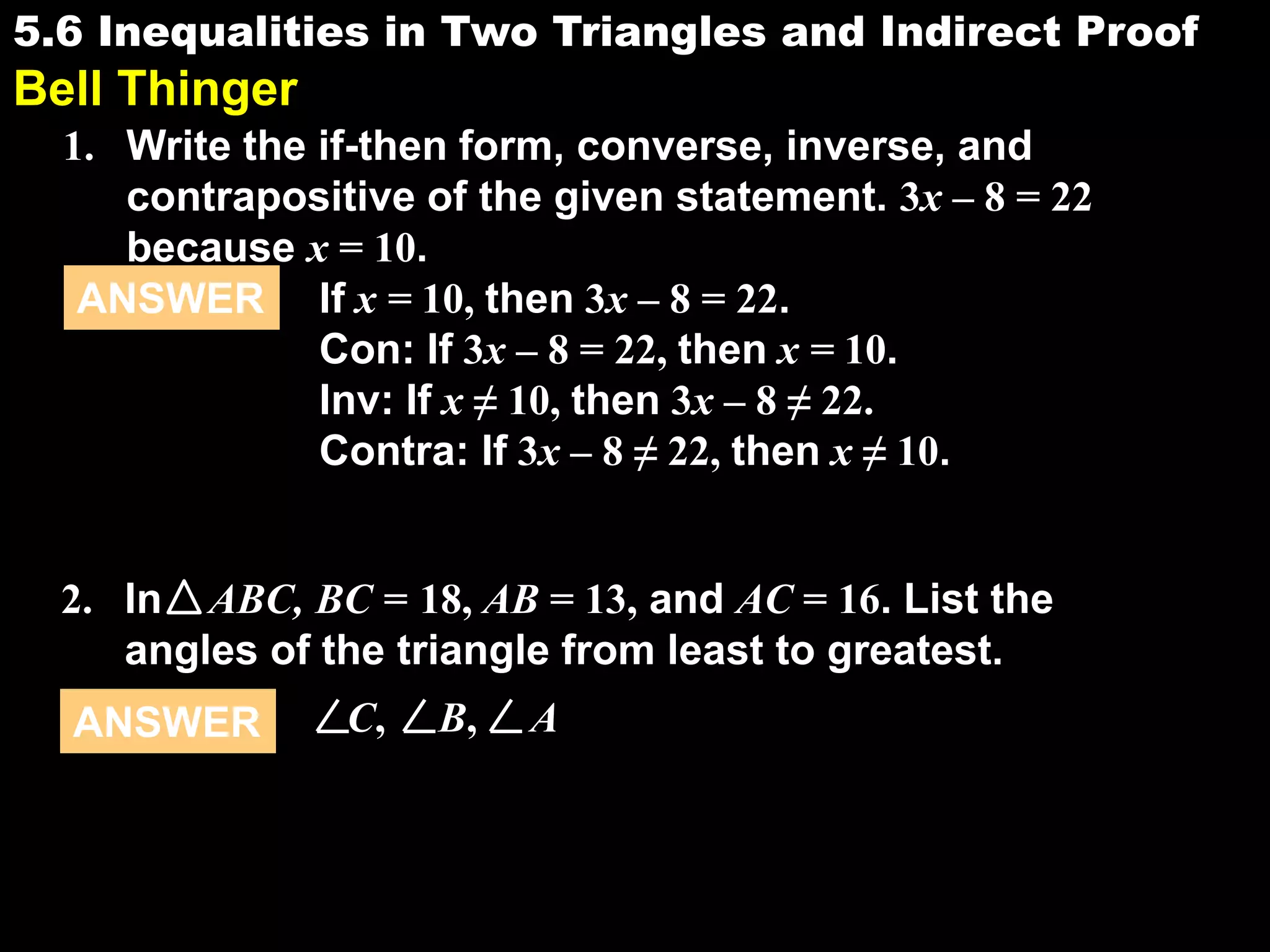
1. Write the if-then form, converse, inverse, and
contrapositive of the given statement. 3x – 8 = 22
because x = 10.
ANSWER If x = 10, then 3x – 8 = 22.
Con: If 3x – 8 = 22, then x = 10.
Inv: If x ≠ 10, then 3x – 8 ≠ 22.
Contra: If 3x – 8 ≠ 22, then x ≠ 10.

2. In ABC, BC = 18, AB = 13, and AC = 16. List the
angles of the triangle from least to greatest.
ANSWER

C,

B,

A
5.6
Example 1
5.6
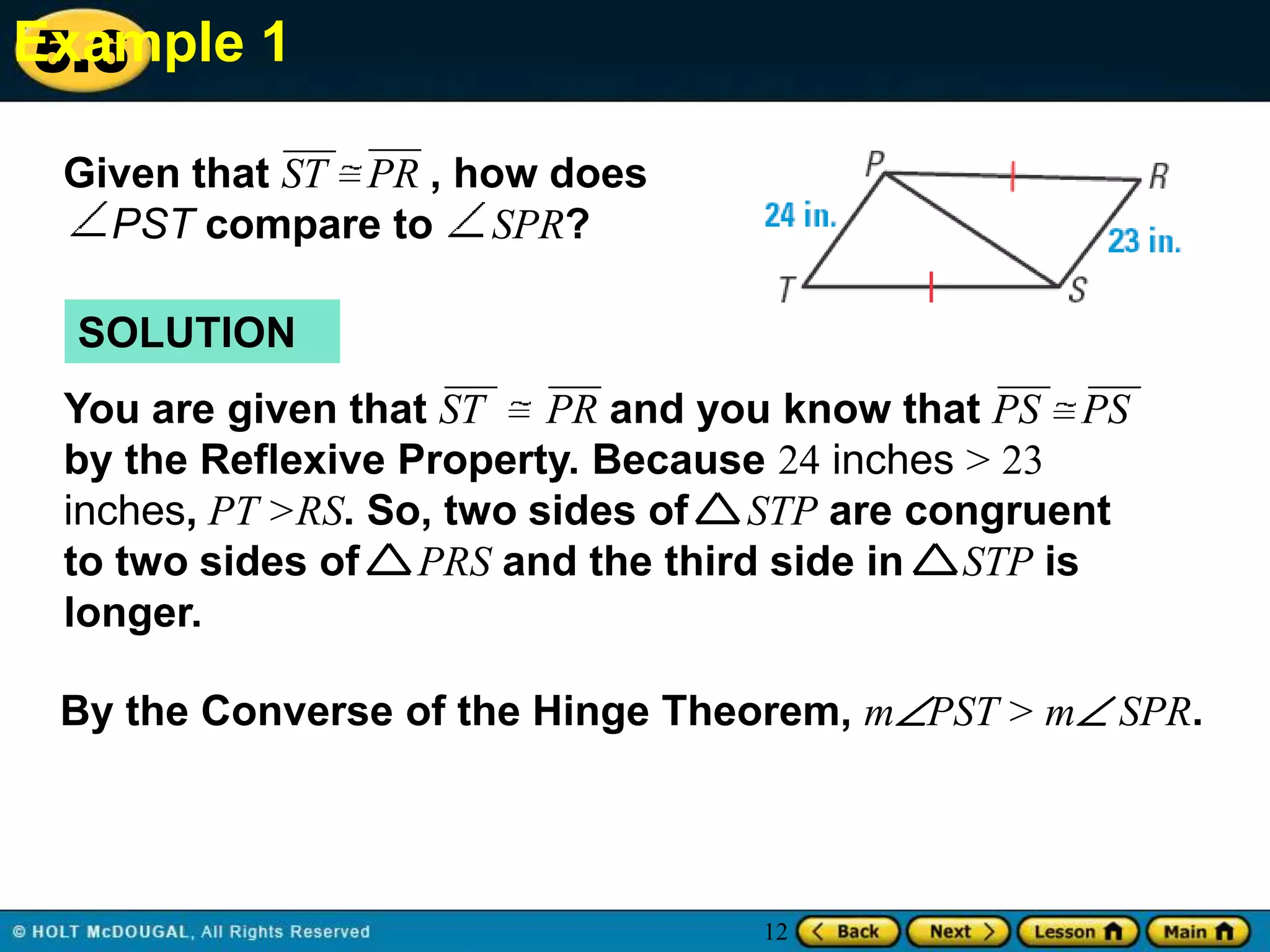
Given that ST PR , how does
PST compare to SPR?
SOLUTION
You are given that ST PR and you know that PS PS
by the Reflexive Property. Because 24 inches > 23
inches, PT >RS. So, two sides of STP are congruent
to two sides of PRS and the third side in STP is
longer.
By the Converse of the Hinge Theorem, mPST > m SPR.

12
Example 2
5.6
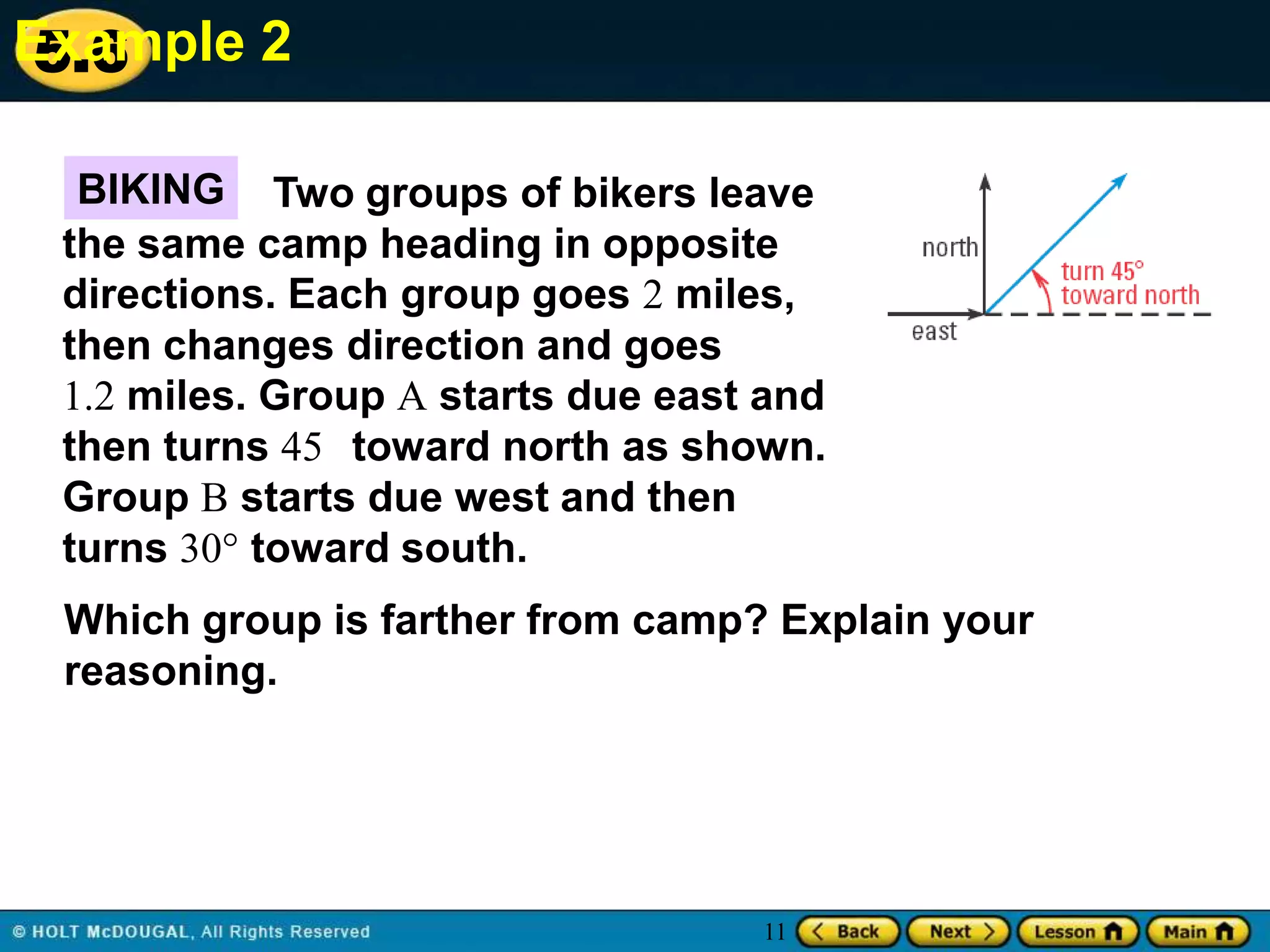
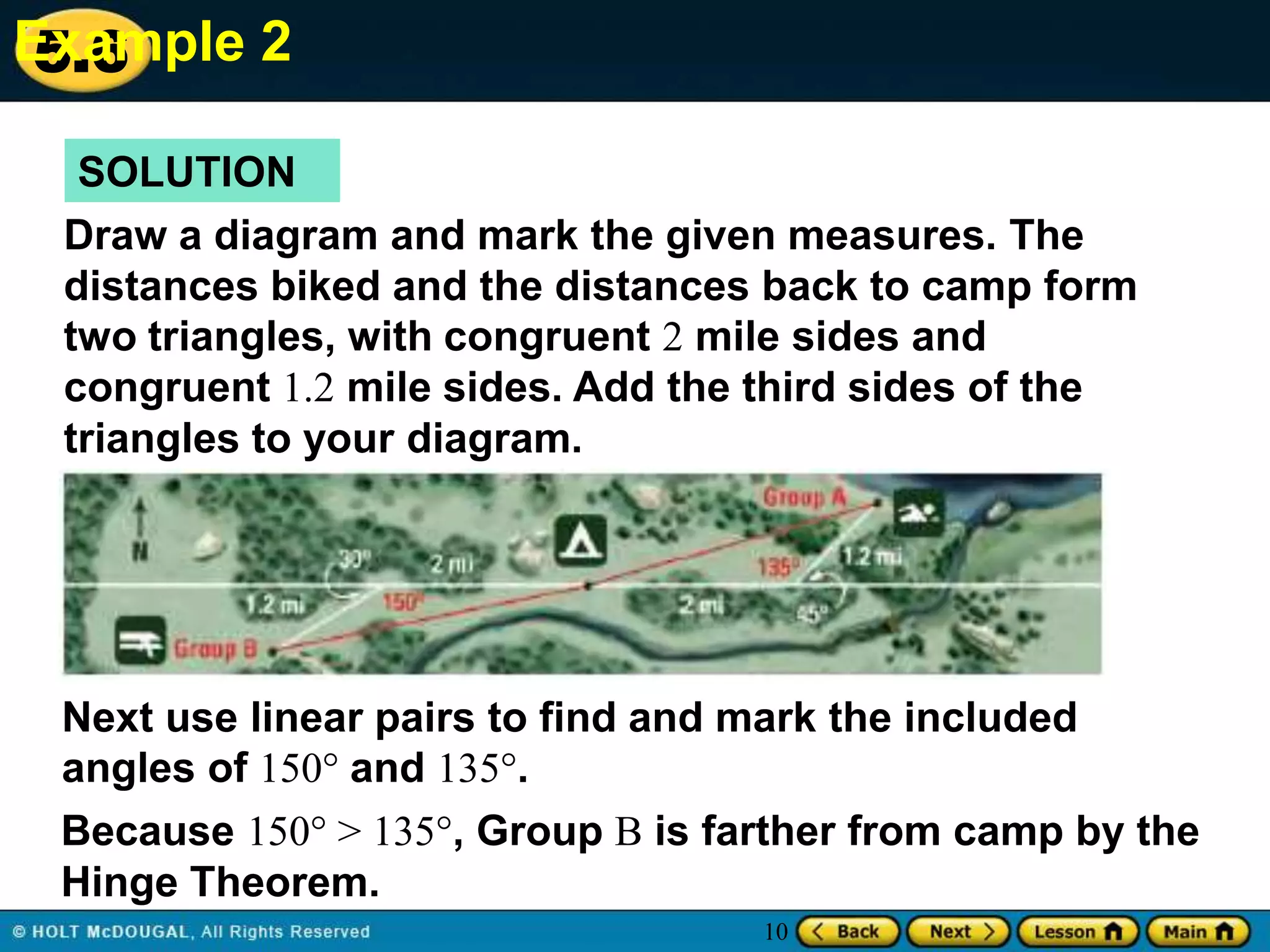
BIKING Two groups of bikers leave
the same camp heading in opposite
directions. Each group goes 2 miles,
then changes direction and goes
1.2 miles. Group A starts due east and
then turns 45 toward north as shown.
Group B starts due west and then
turns 30° toward south.
Which group is farther from camp? Explain your
reasoning.

11
Example 2
5.6
SOLUTION
Draw a diagram and mark the given measures. The
distances biked and the distances back to camp form
two triangles, with congruent 2 mile sides and
congruent 1.2 mile sides. Add the third sides of the
triangles to your diagram.

Next use linear pairs to find and mark the included
angles of 150° and 135°.
Because 150° > 135°, Group B is farther from camp by the
Hinge Theorem.
10
Guided Practice
5.6
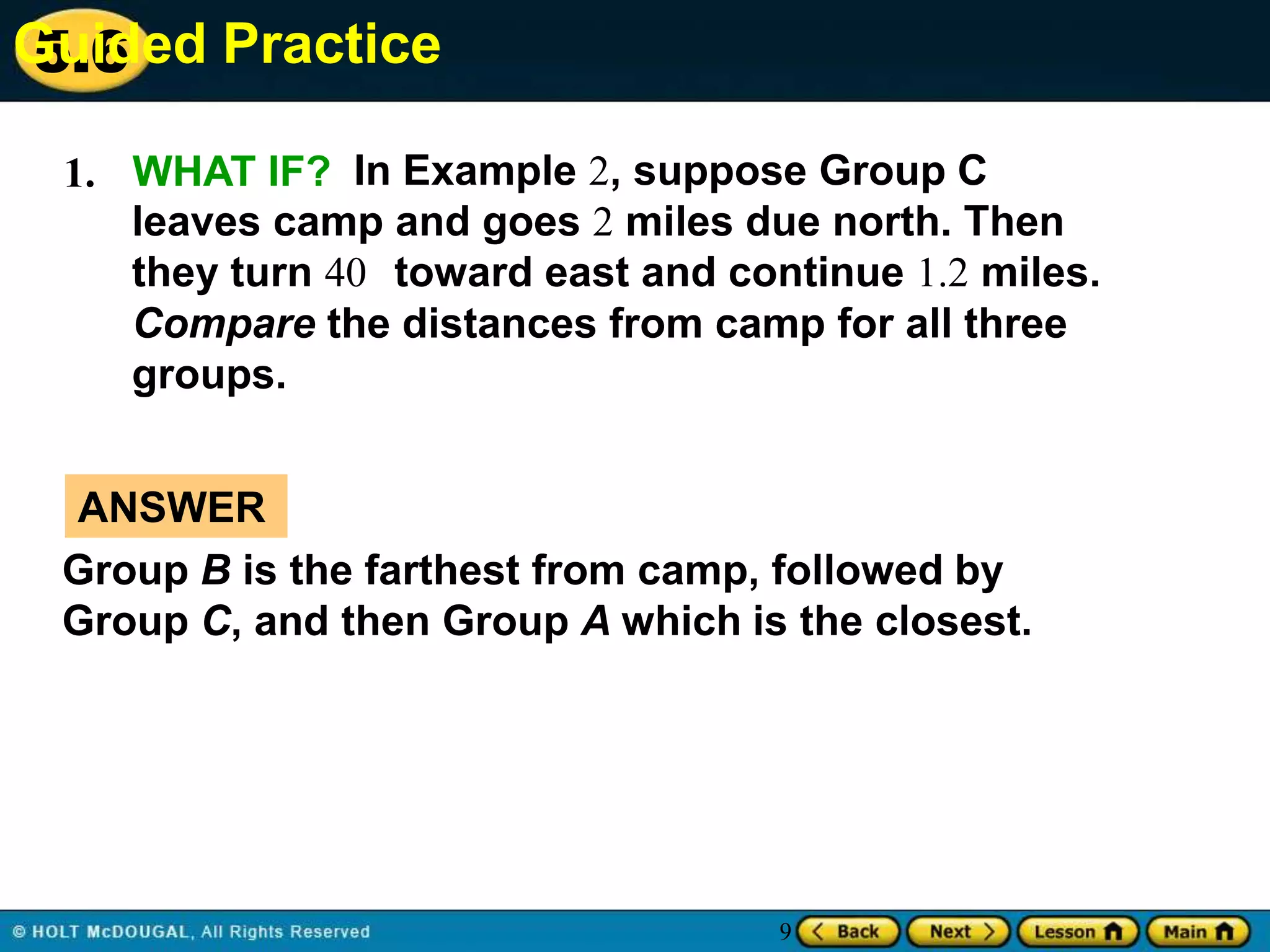
1. WHAT IF? In Example 2, suppose Group C
leaves camp and goes 2 miles due north. Then
they turn 40 toward east and continue 1.2 miles.
Compare the distances from camp for all three
groups.
ANSWER
Group B is the farthest from camp, followed by
Group C, and then Group A which is the closest.

9
Guided Practice
5.6
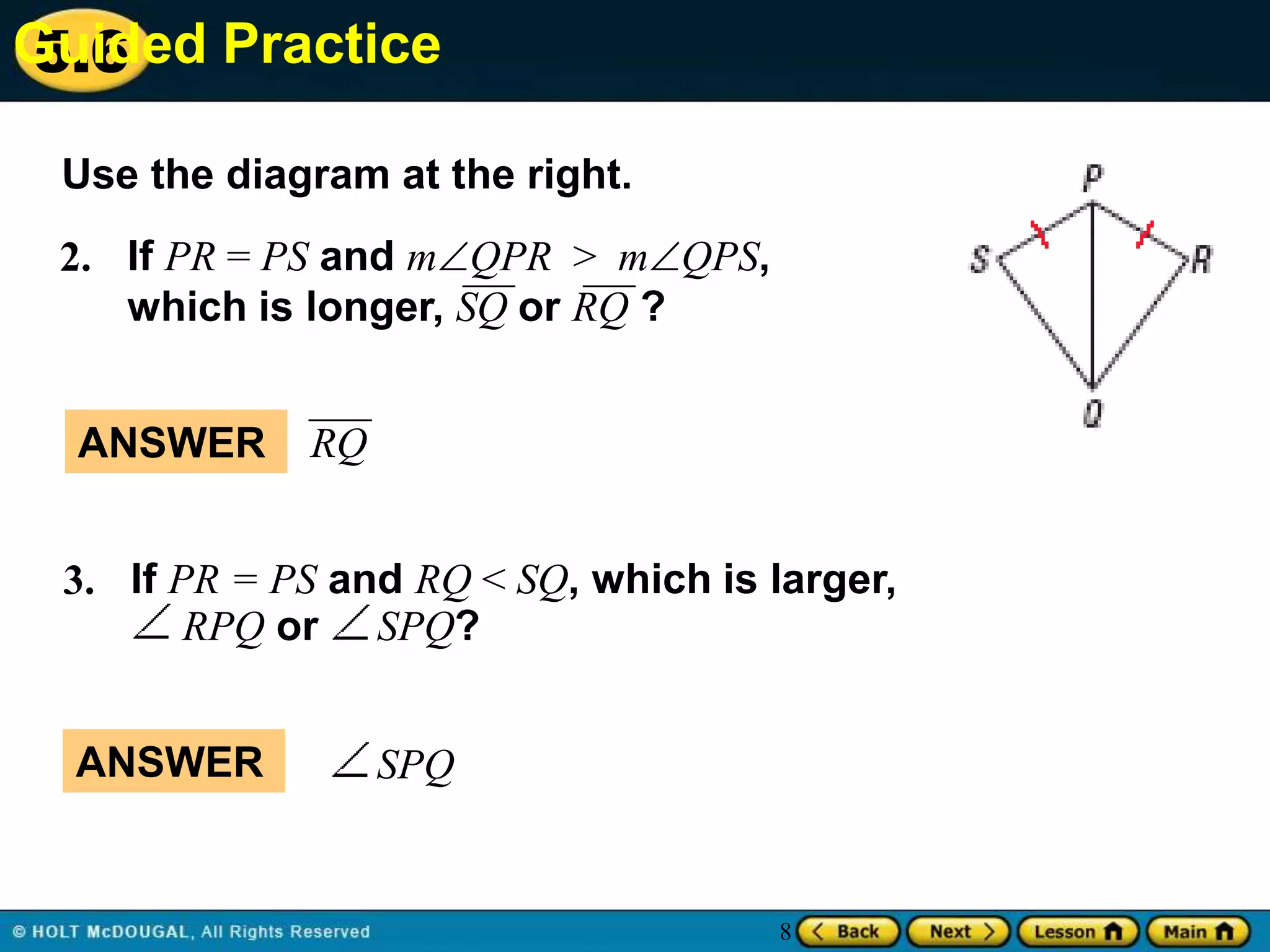
Use the diagram at the right.

2. If PR = PS and mQPR > mQPS,
which is longer, SQ or RQ ?
ANSWER

RQ

3. If PR = PS and RQ < SQ, which is larger,
RPQ or SPQ?
ANSWER

SPQ

8
5.6
5.6
Example 3
5.6
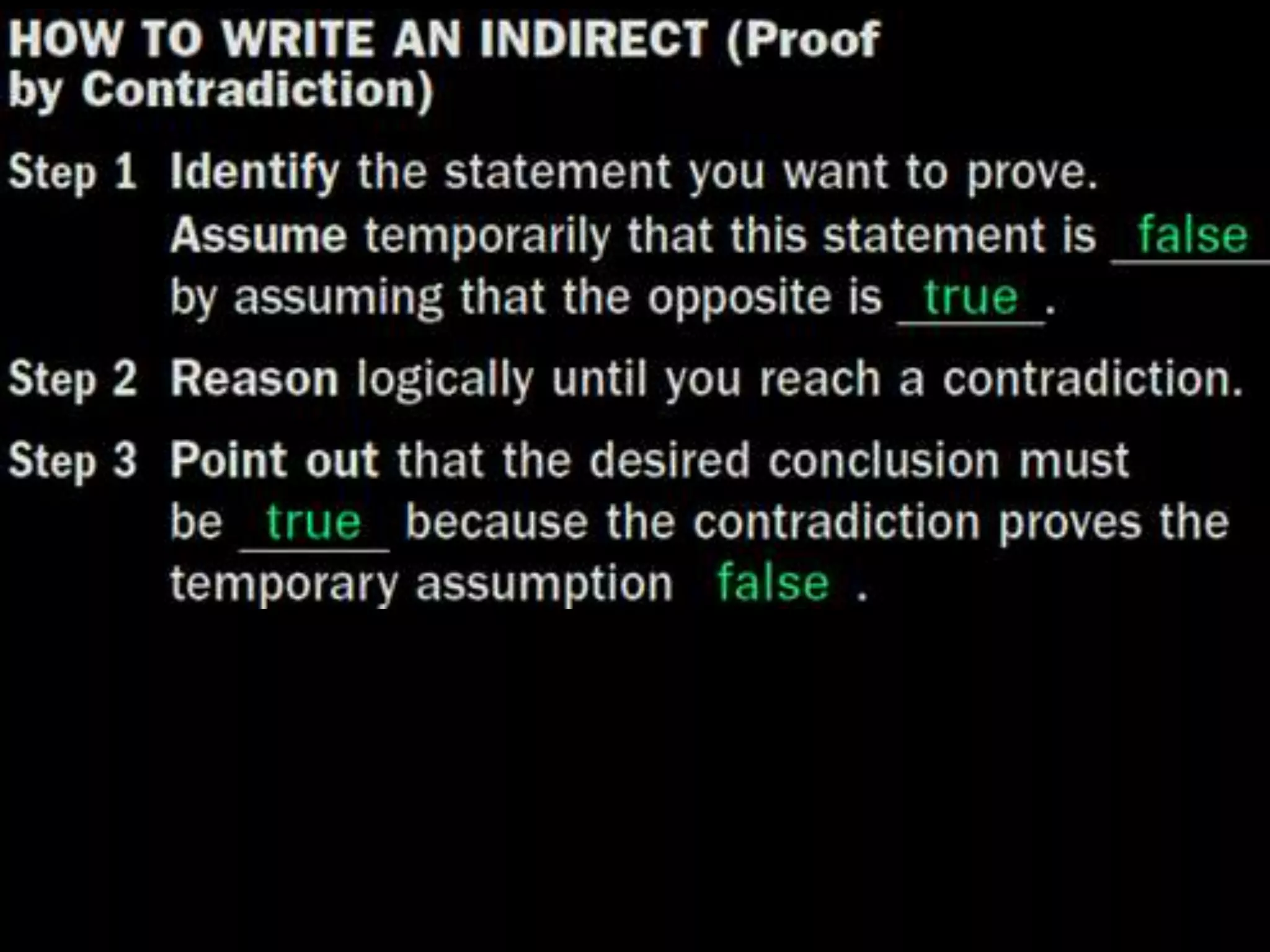
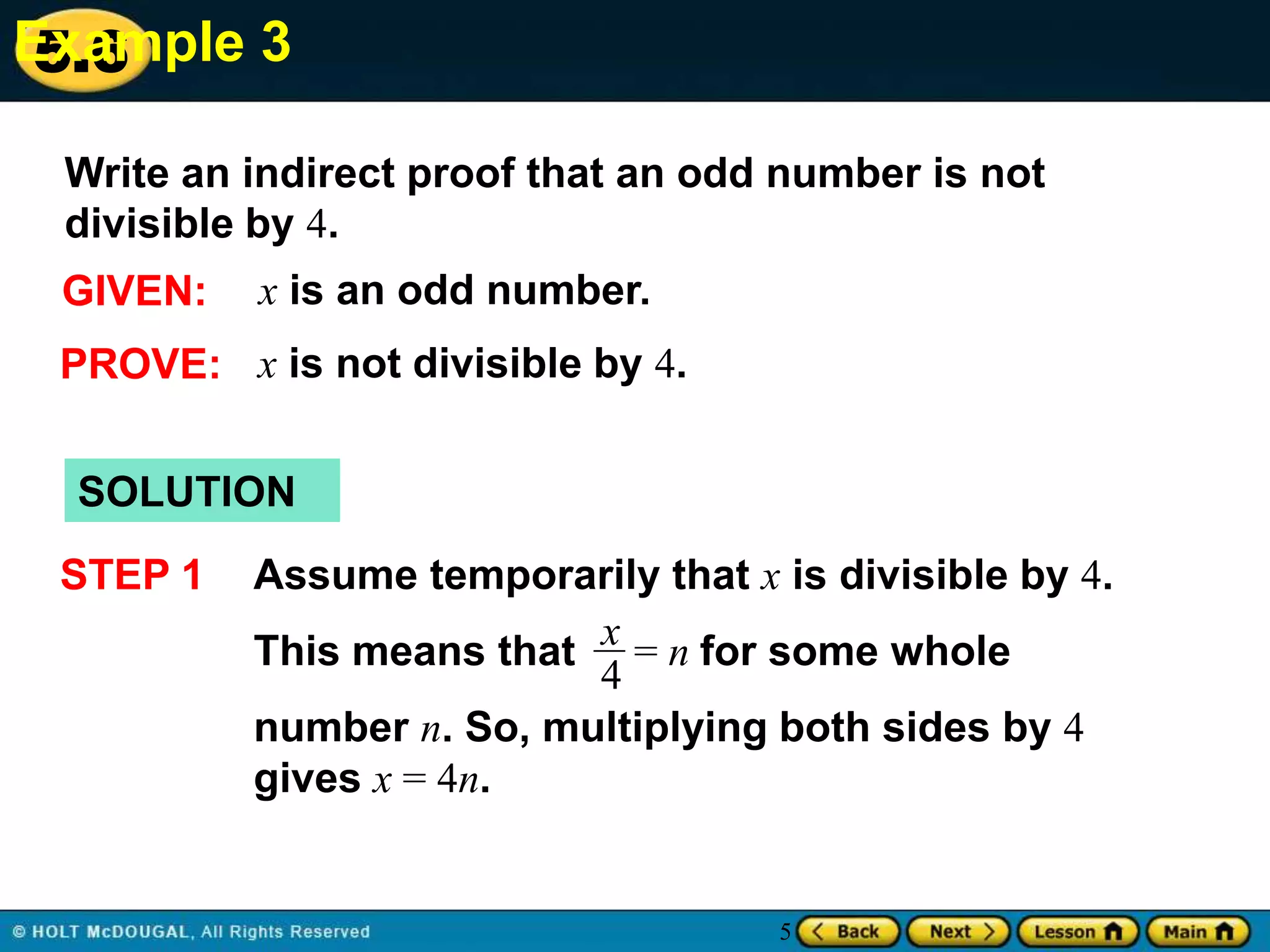
Write an indirect proof that an odd number is not
divisible by 4.
GIVEN:

x is an odd number.

PROVE: x is not divisible by 4.
SOLUTION

STEP 1

Assume temporarily that x is divisible by 4.
This means that x = n for some whole
4
number n. So, multiplying both sides by 4
gives x = 4n.

5
Example 3
5.6
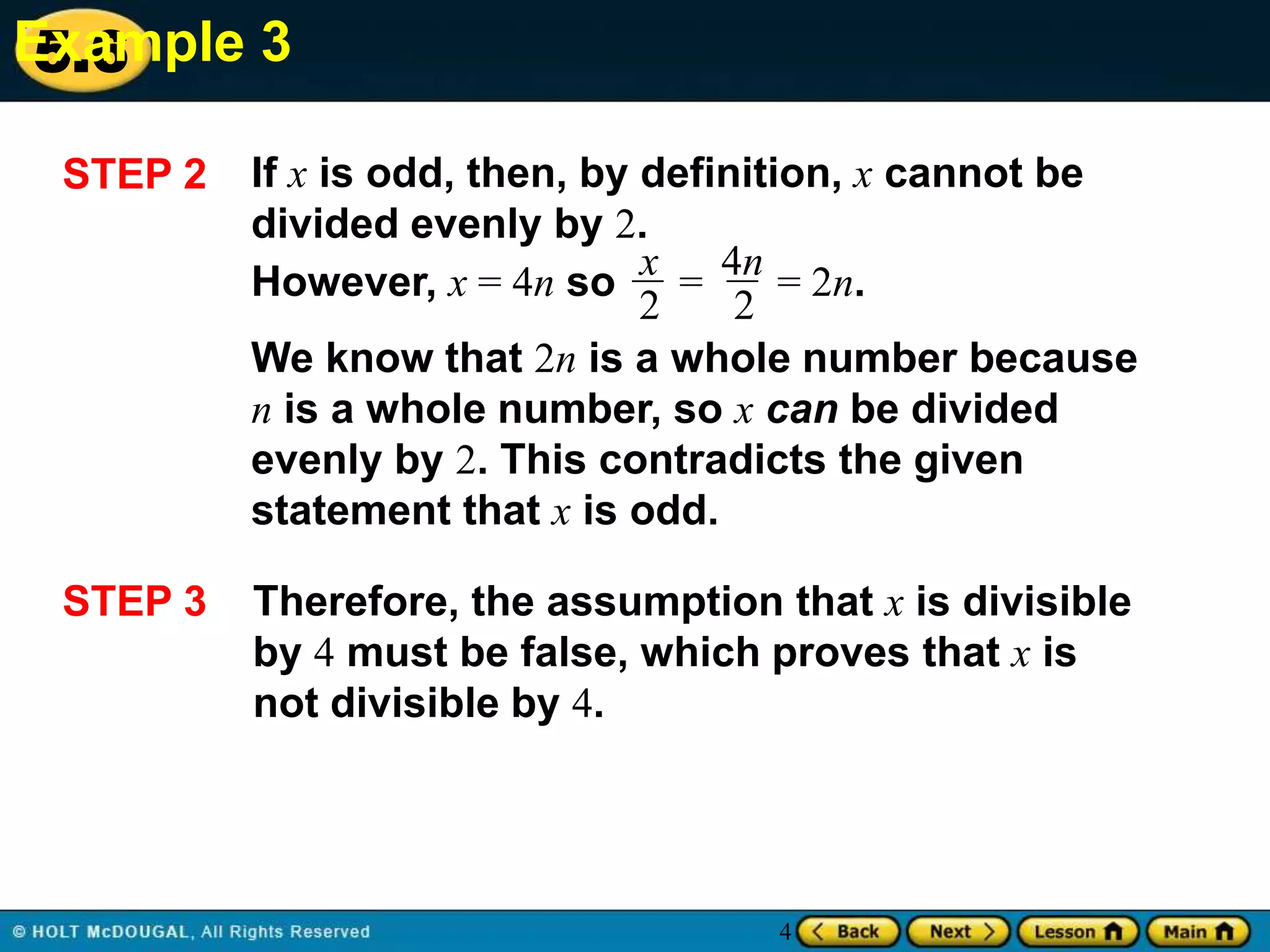
STEP 2

If x is odd, then, by definition, x cannot be
divided evenly by 2.
However, x = 4n so x = 4n = 2n.
2
2
We know that 2n is a whole number because
n is a whole number, so x can be divided
evenly by 2. This contradicts the given
statement that x is odd.

STEP 3

Therefore, the assumption that x is divisible
by 4 must be false, which proves that x is
not divisible by 4.

4
Guided Practice
5.6
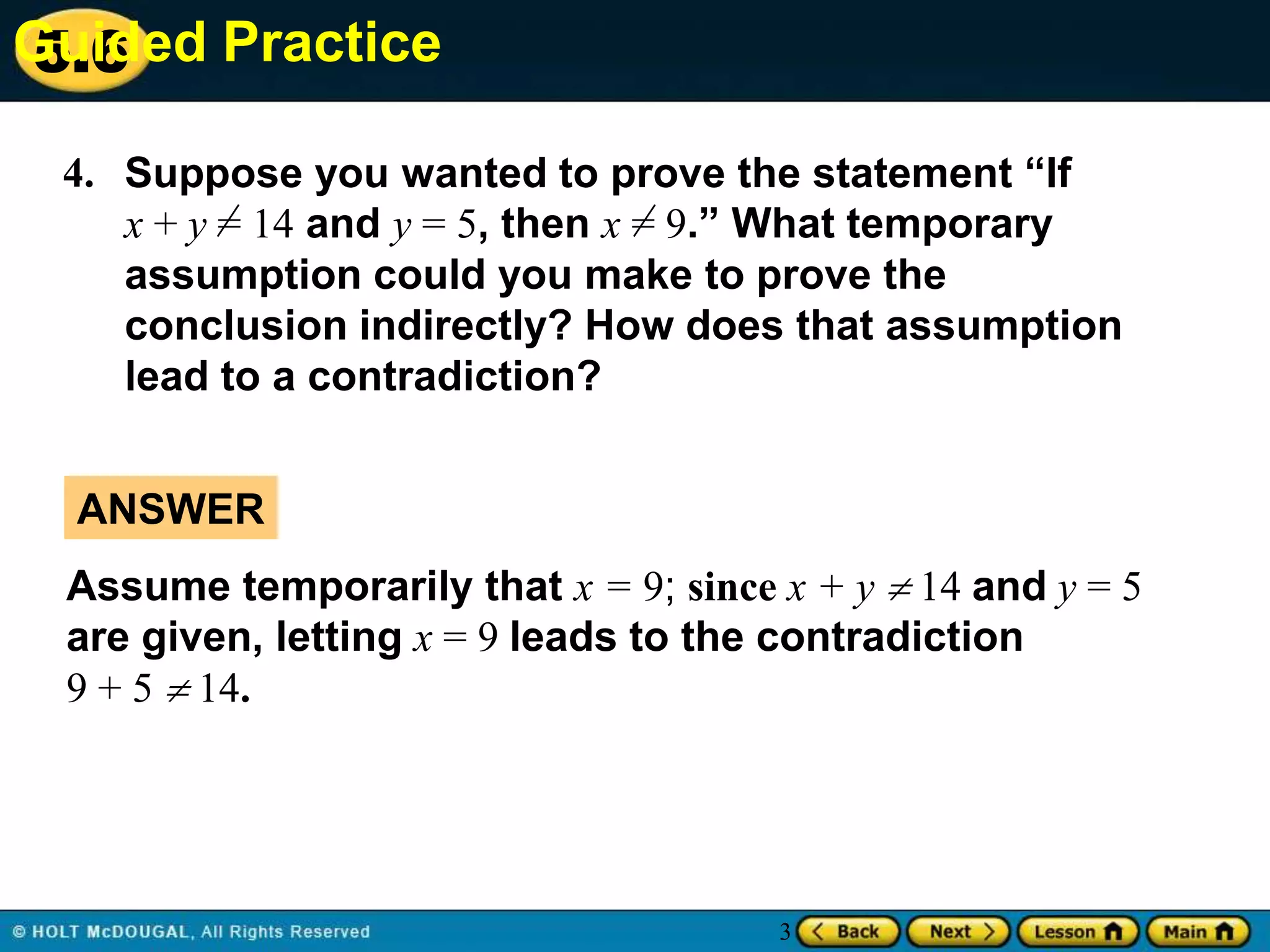
4. Suppose you wanted to prove the statement “If
x + y = 14 and y = 5, then x = 9.” What temporary
assumption could you make to prove the
conclusion indirectly? How does that assumption
lead to a contradiction?
ANSWER
Assume temporarily that x = 9; since x + y  14 and y = 5
are given, letting x = 9 leads to the contradiction
9 + 5  14.

3
Example 4
5.6
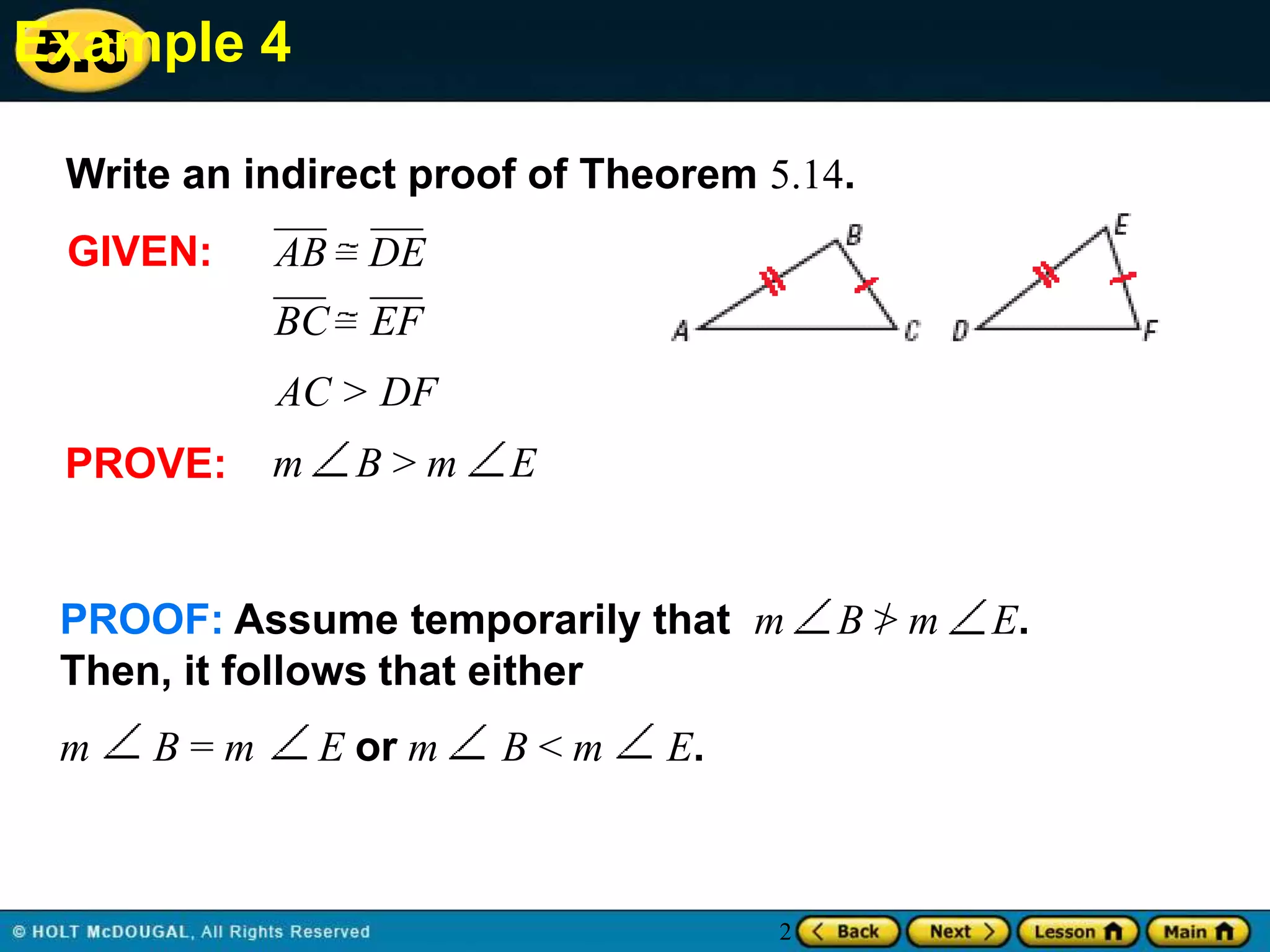
Write an indirect proof of Theorem 5.14.

GIVEN:

AB DE
BC EF

AC > DF
PROVE:

m

B>m

E

PROOF: Assume temporarily that m
Then, it follows that either
m

B=m

E or m

B<m

E.

2

B>m

E.
Example 4
5.6
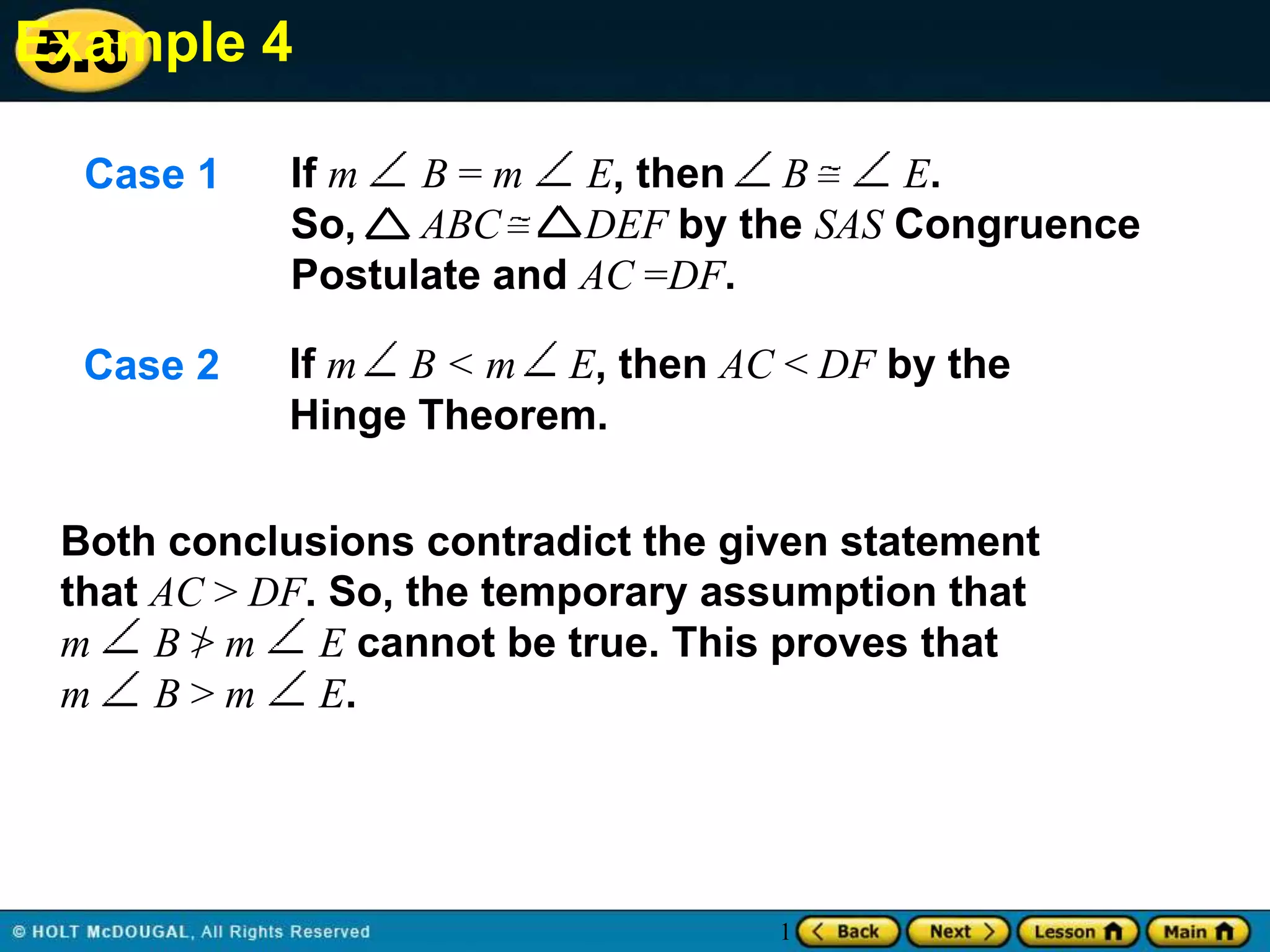
Case 1

If m
B=m
E, then B
E.
So,
ABC
DEF by the SAS Congruence
Postulate and AC =DF.

Case 2

If m B < m E, then AC < DF by the
Hinge Theorem.

Both conclusions contradict the given statement
that AC > DF. So, the temporary assumption that
m B>m
E cannot be true. This proves that
m
B>m
E.

1
Exit Slip
5.6
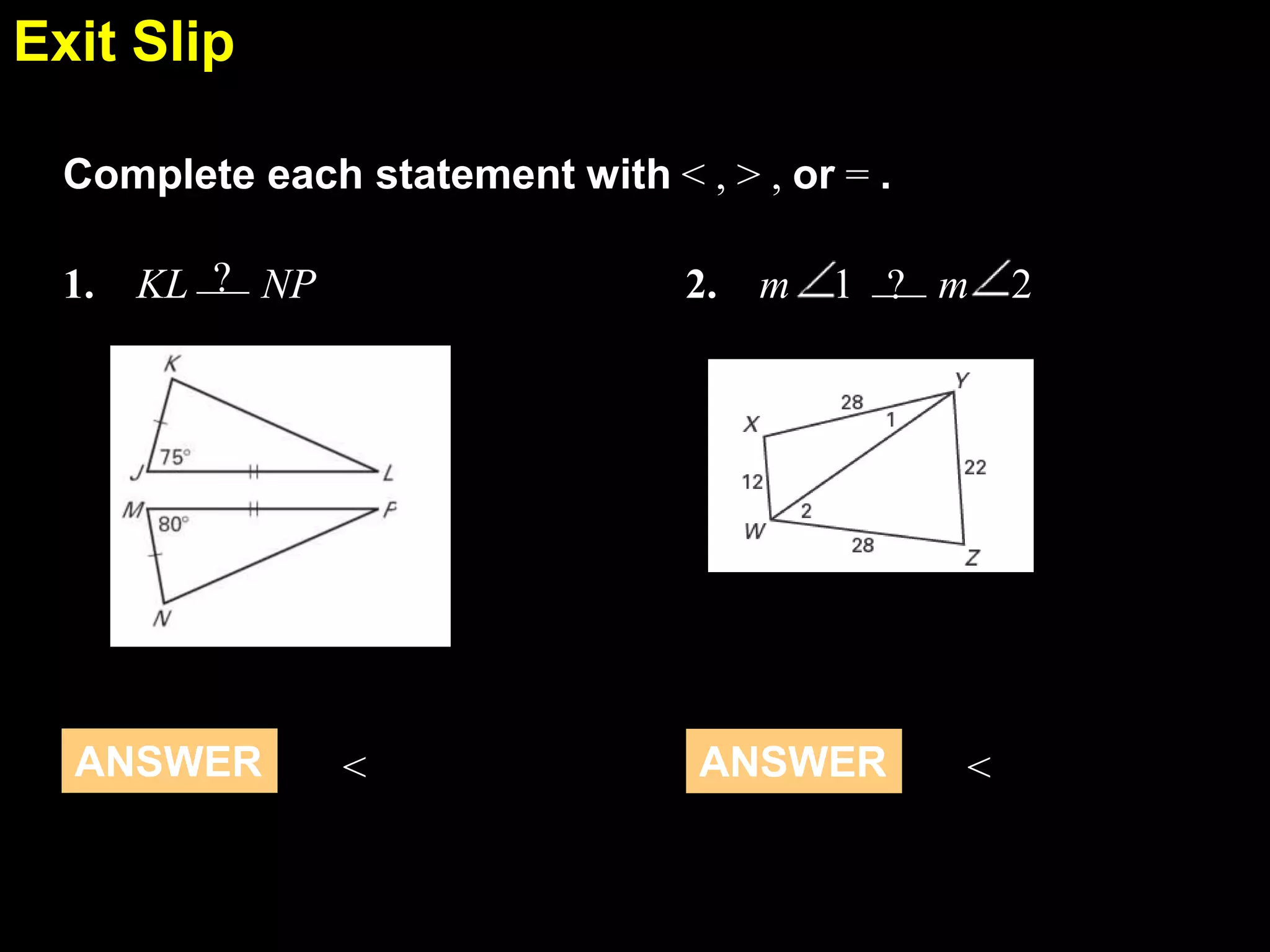
Complete each statement with < , > , or = .
1. KL ? NP

ANSWER

2. m

<

1 ? m

ANSWER

<

2
Exit Slip
5.6
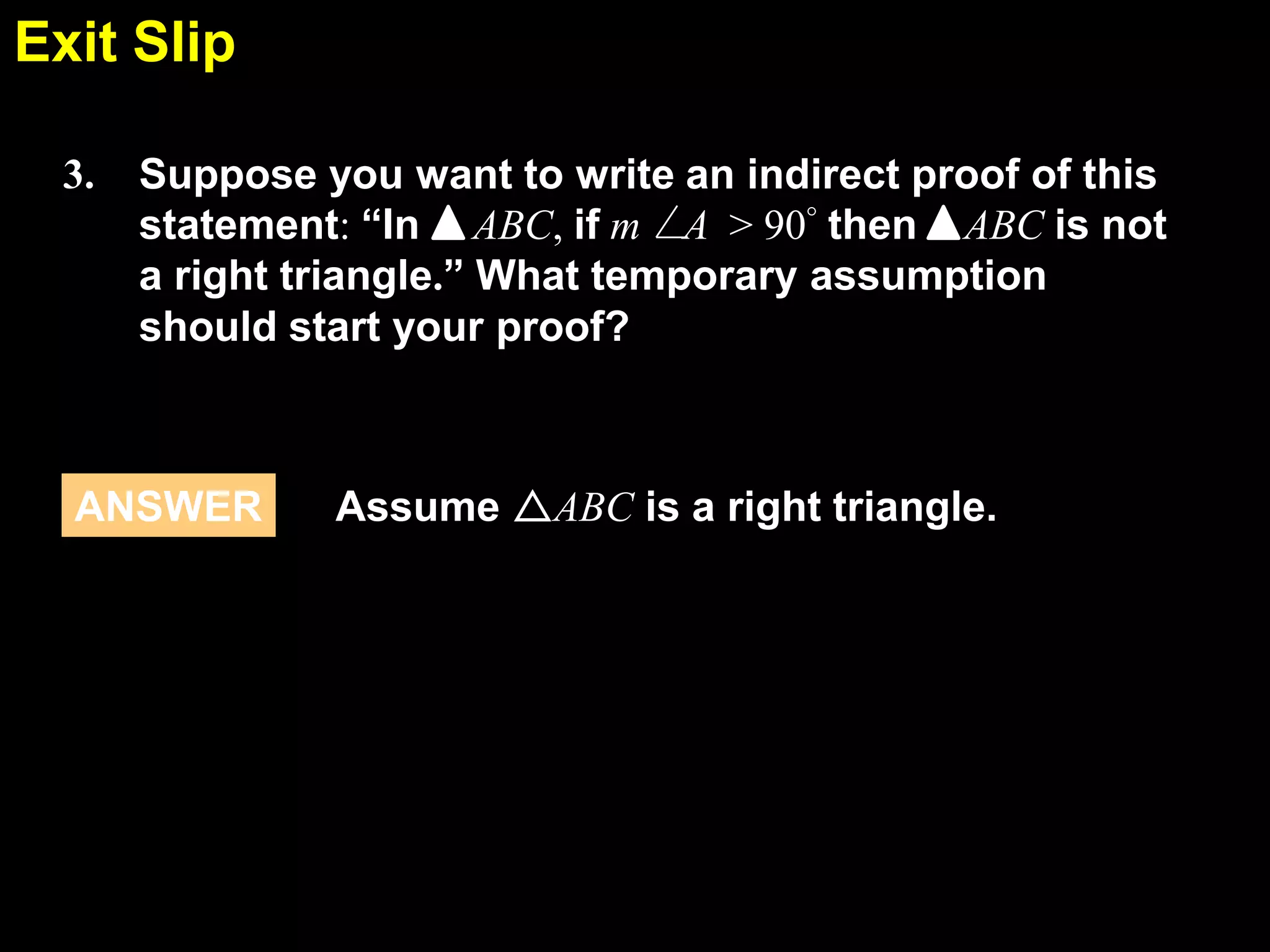
3.

Suppose you want to write an indirect proof of this
statement: “In ABC, if m A > 90° then ABC is not
a right triangle.” What temporary assumption
should start your proof?

ANSWER

Assume ABC is a right triangle.
5.6

Homework
Pg 352-355
#4, 6, 14, 17, 22

5.6 inequalities in two triangles and indirect proof

  • 1.
    5.6 Inequalities inTwo Triangles and Indirect Proof 5.6 Bell Thinger 1. Write the if-then form, converse, inverse, and contrapositive of the given statement. 3x – 8 = 22 because x = 10. ANSWER If x = 10, then 3x – 8 = 22. Con: If 3x – 8 = 22, then x = 10. Inv: If x ≠ 10, then 3x – 8 ≠ 22. Contra: If 3x – 8 ≠ 22, then x ≠ 10. 2. In ABC, BC = 18, AB = 13, and AC = 16. List the angles of the triangle from least to greatest. ANSWER C, B, A
  • 2.
  • 3.
    Example 1 5.6 Given thatST PR , how does PST compare to SPR? SOLUTION You are given that ST PR and you know that PS PS by the Reflexive Property. Because 24 inches > 23 inches, PT >RS. So, two sides of STP are congruent to two sides of PRS and the third side in STP is longer. By the Converse of the Hinge Theorem, mPST > m SPR. 12
  • 4.
    Example 2 5.6 BIKING Twogroups of bikers leave the same camp heading in opposite directions. Each group goes 2 miles, then changes direction and goes 1.2 miles. Group A starts due east and then turns 45 toward north as shown. Group B starts due west and then turns 30° toward south. Which group is farther from camp? Explain your reasoning. 11
  • 5.
    Example 2 5.6 SOLUTION Draw adiagram and mark the given measures. The distances biked and the distances back to camp form two triangles, with congruent 2 mile sides and congruent 1.2 mile sides. Add the third sides of the triangles to your diagram. Next use linear pairs to find and mark the included angles of 150° and 135°. Because 150° > 135°, Group B is farther from camp by the Hinge Theorem. 10
  • 6.
    Guided Practice 5.6 1. WHATIF? In Example 2, suppose Group C leaves camp and goes 2 miles due north. Then they turn 40 toward east and continue 1.2 miles. Compare the distances from camp for all three groups. ANSWER Group B is the farthest from camp, followed by Group C, and then Group A which is the closest. 9
  • 7.
    Guided Practice 5.6 Use thediagram at the right. 2. If PR = PS and mQPR > mQPS, which is longer, SQ or RQ ? ANSWER RQ 3. If PR = PS and RQ < SQ, which is larger, RPQ or SPQ? ANSWER SPQ 8
  • 8.
  • 9.
  • 10.
    Example 3 5.6 Write anindirect proof that an odd number is not divisible by 4. GIVEN: x is an odd number. PROVE: x is not divisible by 4. SOLUTION STEP 1 Assume temporarily that x is divisible by 4. This means that x = n for some whole 4 number n. So, multiplying both sides by 4 gives x = 4n. 5
  • 11.
    Example 3 5.6 STEP 2 Ifx is odd, then, by definition, x cannot be divided evenly by 2. However, x = 4n so x = 4n = 2n. 2 2 We know that 2n is a whole number because n is a whole number, so x can be divided evenly by 2. This contradicts the given statement that x is odd. STEP 3 Therefore, the assumption that x is divisible by 4 must be false, which proves that x is not divisible by 4. 4
  • 12.
    Guided Practice 5.6 4. Supposeyou wanted to prove the statement “If x + y = 14 and y = 5, then x = 9.” What temporary assumption could you make to prove the conclusion indirectly? How does that assumption lead to a contradiction? ANSWER Assume temporarily that x = 9; since x + y  14 and y = 5 are given, letting x = 9 leads to the contradiction 9 + 5  14. 3
  • 13.
    Example 4 5.6 Write anindirect proof of Theorem 5.14. GIVEN: AB DE BC EF AC > DF PROVE: m B>m E PROOF: Assume temporarily that m Then, it follows that either m B=m E or m B<m E. 2 B>m E.
  • 14.
    Example 4 5.6 Case 1 Ifm B=m E, then B E. So, ABC DEF by the SAS Congruence Postulate and AC =DF. Case 2 If m B < m E, then AC < DF by the Hinge Theorem. Both conclusions contradict the given statement that AC > DF. So, the temporary assumption that m B>m E cannot be true. This proves that m B>m E. 1
  • 15.
    Exit Slip 5.6 Complete eachstatement with < , > , or = . 1. KL ? NP ANSWER 2. m < 1 ? m ANSWER < 2
  • 16.
    Exit Slip 5.6 3. Suppose youwant to write an indirect proof of this statement: “In ABC, if m A > 90° then ABC is not a right triangle.” What temporary assumption should start your proof? ANSWER Assume ABC is a right triangle.
  • 17.