Course 3, Lesson 6-4
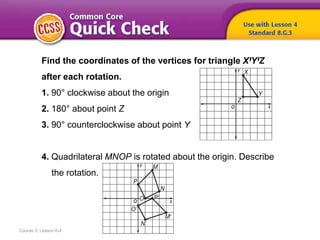
Find the coordinates of the vertices for triangle XꞋYꞋZ
after each rotation.
1. 90° clockwise about the origin
2. 180° about point Z
3. 90° counterclockwise about point Y
4. Quadrilateral MNOP is rotated about the origin. Describe
the rotation.
Course 3, Lesson 6-4
ANSWERS
1. XꞋ(1, −1), YꞋ (−1, 1), ZꞋ (4, −1)
2. XꞋ (1, −2), YꞋ (1, −3), ZꞋ (1, 1)
3. XꞋ (0, −1), YꞋ (3, 1), ZꞋ (3, −1)
4. 90° clockwise
HOW can we best show or describe the
change in position of a figure?
Geometry
Course 3, Lesson 6-4
Course 3, Lesson 6-4 Common Core State Standards © Copyright 2010. National Governors Association Center for Best Practices
and Council of Chief State School Officers. All rights reserved.
Geometry
• 8.G.3
Describe the effect of dilations, translations, rotations, and
reflections on two-dimensional figures using coordinates.
Mathematical Practices
1 Make sense of problems and persevere in solving them.
3 Construct viable arguments and critique the reasoning of others.
4 Model with mathematics.
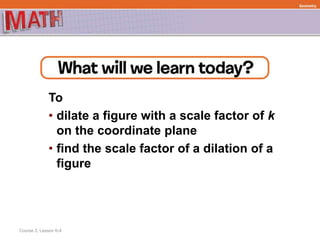
To
• dilate a figure with a scale factor of k
on the coordinate plane
• find the scale factor of a dilation of a
figure
Course 3, Lesson 6-4
Geometry
Symbols
• (x, y)  (kx, ky)
Course 3, Lesson 6-4
Geometry
Course 3, Lesson 6-4
Geometry
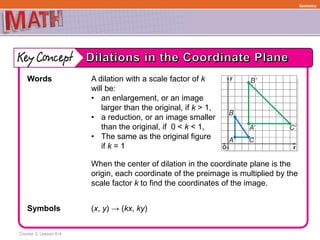
Words A dilation with a scale factor of k
will be:
• an enlargement, or an image
larger than the original, if k > 1,
• a reduction, or an image smaller
than the original, if 0 < k < 1,
• The same as the original figure
if k = 1
When the center of dilation in the coordinate plane is the
origin, each coordinate of the preimage is multiplied by the
scale factor k to find the coordinates of the image.
Symbols (x, y) → (kx, ky)
1
Need Another Example?
2
3
Step-by-Step Example
1. A triangle has vertices A(0, 0), B(8, 0), and C(3, –2).
Find the coordinates of the triangle after a dilation
with a scale factor of 4.
The dilation is (x, y) → (4x, 4y). Multiply
the coordinates of each vertex by 4.
So, the coordinates after the dilation are
A'(0, 0), B'(32, 0), and C'(12, –8).
A(0, 0) → (4 • 0, 4 • 0) → (0, 0)
B(8, 0) → (4 • 8, 4 • 0) → (32, 0)
C(3, –2) → [4 • 3, 4 • (–2)] → (12, –8)
Answer
Need Another Example?
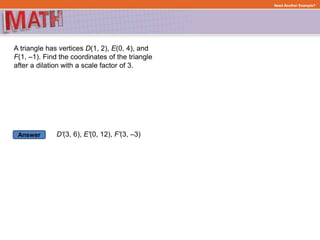
A triangle has vertices D(1, 2), E(0, 4), and
F(1, –1). Find the coordinates of the triangle
after a dilation with a scale factor of 3.
D'(3, 6), E'(0, 12), F'(3, –3)
1
Need Another Example?
2
3
4
5
Step-by-Step Example
2. A figure has vertices J(3, 8), K(10, 6), and L(8, 2).
Graph the figure and the image of the figure after a dilation
with a scale factor of .
The dilation is (x, y) → x, y .
Multiply the coordinates of each
vertex by . Then graph both figures
on the coordinate plane.
Check
J(3, 8) → →
K(10, 6) → → K'(5, 3)
L(8, 2) → → L'(4, 1)
J
K
L
J'
K'
L'
Draw lines through the origin and each of the
vertices of the original figure. The vertices of
the dilation should lie on those same lines.
Answer
Need Another Example?
A figure has vertices H(–8, 4), J(6, 4), K(6, –4), and
L(–8, –4). Graph the figure and the image of the
figure after a dilation with a scale factor of .
1
Need Another Example?
2
3
4
Step-by-Step Example
3. Through a microscope, the image of a grain of sand with a
0.25-millimeter diameter appears to have a diameter of
11.25 millimeters. What is the scale factor of the dilation?
Write a ratio comparing the diameters of the two images.
=
So, the scale factor of the dilation is 45.
= 45
Answer
Need Another Example?
The pupil of Josh’s eye is 6 millimeters in
diameter. His doctor uses medicine to dilate his
pupils so that they are 9 millimeters in diameter.
What is the scale factor of the dilation?
How did what you learned
today help you answer the
HOW can we best show or describe the
change in position of a figure?
Course 3, Lesson 6-4
Geometry
How did what you learned
today help you answer the
HOW can we best show or describe the
change in position of a figure?
Course 3, Lesson 6-4
Geometry
Sample answers:
• You can use symbolic notation (x, y) →(kx , ky) to
describe the dilations of a figure with a scale factor.
• You can graph the original figure and the image to
show the figure after a dilation with a scale factor of k.
If the scale factor of
a dilation is ,
is the dilation an
enlargement or
a reduction?
Course 3, Lesson 6-4
Ratios and Proportional RelationshipsFunctionsGeometry
3
2

(8) Lesson 6.4 - Dilations

  • 1.
    Course 3, Lesson6-4 Find the coordinates of the vertices for triangle XꞋYꞋZ after each rotation. 1. 90° clockwise about the origin 2. 180° about point Z 3. 90° counterclockwise about point Y 4. Quadrilateral MNOP is rotated about the origin. Describe the rotation.
  • 2.
    Course 3, Lesson6-4 ANSWERS 1. XꞋ(1, −1), YꞋ (−1, 1), ZꞋ (4, −1) 2. XꞋ (1, −2), YꞋ (1, −3), ZꞋ (1, 1) 3. XꞋ (0, −1), YꞋ (3, 1), ZꞋ (3, −1) 4. 90° clockwise
  • 3.
    HOW can webest show or describe the change in position of a figure? Geometry Course 3, Lesson 6-4
  • 4.
    Course 3, Lesson6-4 Common Core State Standards © Copyright 2010. National Governors Association Center for Best Practices and Council of Chief State School Officers. All rights reserved. Geometry • 8.G.3 Describe the effect of dilations, translations, rotations, and reflections on two-dimensional figures using coordinates. Mathematical Practices 1 Make sense of problems and persevere in solving them. 3 Construct viable arguments and critique the reasoning of others. 4 Model with mathematics.
  • 5.
    To • dilate afigure with a scale factor of k on the coordinate plane • find the scale factor of a dilation of a figure Course 3, Lesson 6-4 Geometry
  • 6.
    Symbols • (x, y) (kx, ky) Course 3, Lesson 6-4 Geometry
  • 7.
    Course 3, Lesson6-4 Geometry Words A dilation with a scale factor of k will be: • an enlargement, or an image larger than the original, if k > 1, • a reduction, or an image smaller than the original, if 0 < k < 1, • The same as the original figure if k = 1 When the center of dilation in the coordinate plane is the origin, each coordinate of the preimage is multiplied by the scale factor k to find the coordinates of the image. Symbols (x, y) → (kx, ky)
  • 8.
    1 Need Another Example? 2 3 Step-by-StepExample 1. A triangle has vertices A(0, 0), B(8, 0), and C(3, –2). Find the coordinates of the triangle after a dilation with a scale factor of 4. The dilation is (x, y) → (4x, 4y). Multiply the coordinates of each vertex by 4. So, the coordinates after the dilation are A'(0, 0), B'(32, 0), and C'(12, –8). A(0, 0) → (4 • 0, 4 • 0) → (0, 0) B(8, 0) → (4 • 8, 4 • 0) → (32, 0) C(3, –2) → [4 • 3, 4 • (–2)] → (12, –8)
  • 9.
    Answer Need Another Example? Atriangle has vertices D(1, 2), E(0, 4), and F(1, –1). Find the coordinates of the triangle after a dilation with a scale factor of 3. D'(3, 6), E'(0, 12), F'(3, –3)
  • 10.
    1 Need Another Example? 2 3 4 5 Step-by-StepExample 2. A figure has vertices J(3, 8), K(10, 6), and L(8, 2). Graph the figure and the image of the figure after a dilation with a scale factor of . The dilation is (x, y) → x, y . Multiply the coordinates of each vertex by . Then graph both figures on the coordinate plane. Check J(3, 8) → → K(10, 6) → → K'(5, 3) L(8, 2) → → L'(4, 1) J K L J' K' L' Draw lines through the origin and each of the vertices of the original figure. The vertices of the dilation should lie on those same lines.
  • 11.
    Answer Need Another Example? Afigure has vertices H(–8, 4), J(6, 4), K(6, –4), and L(–8, –4). Graph the figure and the image of the figure after a dilation with a scale factor of .
  • 12.
    1 Need Another Example? 2 3 4 Step-by-StepExample 3. Through a microscope, the image of a grain of sand with a 0.25-millimeter diameter appears to have a diameter of 11.25 millimeters. What is the scale factor of the dilation? Write a ratio comparing the diameters of the two images. = So, the scale factor of the dilation is 45. = 45
  • 13.
    Answer Need Another Example? Thepupil of Josh’s eye is 6 millimeters in diameter. His doctor uses medicine to dilate his pupils so that they are 9 millimeters in diameter. What is the scale factor of the dilation?
  • 14.
    How did whatyou learned today help you answer the HOW can we best show or describe the change in position of a figure? Course 3, Lesson 6-4 Geometry
  • 15.
    How did whatyou learned today help you answer the HOW can we best show or describe the change in position of a figure? Course 3, Lesson 6-4 Geometry Sample answers: • You can use symbolic notation (x, y) →(kx , ky) to describe the dilations of a figure with a scale factor. • You can graph the original figure and the image to show the figure after a dilation with a scale factor of k.
  • 16.
    If the scalefactor of a dilation is , is the dilation an enlargement or a reduction? Course 3, Lesson 6-4 Ratios and Proportional RelationshipsFunctionsGeometry 3 2