Coordinate Geometry
Class X
1. Cartesian Coordinate
system and Quadrants
2. Distance formula
3. Area of a triangle
4. Section formula
Objectives
• The use of algebra to study
geometric properties i.e.
operates on symbols is defined
as the coordinate system.
What is co-ordinate geometry ?
IntroductIon
Yes, co-ordinate
geometry play a very
important role in our
daily life !!!
Is co-ordinate
geometry important?
 A system of geometry where the position of points on the plane is described
using an ordered pair of numbers.
 The method of describing the location of points in this way was
 proposed by the French mathematician René Descartes .
 He proposed further that curves and lines could be described by
equations using this technique, thus being the first to link
algebra and geometry. 
 In honor of his work, the coordinates of a point are often referred to as
its Cartesian coordinates, and the coordinate plane as the Cartesian
Coordinate Plane.
Coordinate Geometry
SoME BASIc PoIntS
To locate the position of a point on a plane,we
require a pair of coordinate axes.
The distance of a point from the y-axis is called its
x-coordinate,OR abscissa.
The distance of a point from the x-axis is called its
y-coordinate,OR ordinate.
The coordinates of a point on the x-axis are
of the form (x, 0) and of a point on the y-axis
are of the form (0, y).
RECAP
Coordinate Plane
XX’
Y
Y’
O
Origin
1 2 3 4
+ve direction
-1-2-3-4
-ve direction
-1
-2
-3
-vedirection
1
2
3
+vedirection
X-axis : X’OX
Y-axis : Y’OY
Quadrants
XX’ O
Y
Y’
III
III IV
(+,+)(-,+)
(-,-) (+,-)
Coordinates
XX’
Y
Y’
O
1 2 3 4-1-2-3-4
-1
-2
-3
1
2
3
(2,1)
(-3,-2)
Ordinate
Abcissa
(?,?)
XX’ O
Y
Y’
III
III IV
(+,+)(-,+)
(-,-) (+,-)
Q : (1,0) lies in which Quadrant?
Ist? IInd?
A : None. Points which lie on the axes do not lie in any
quadrant.
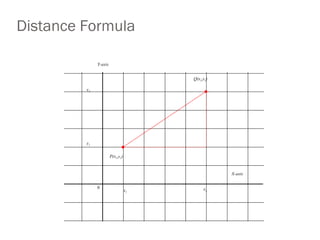
Distance Formula
0
x1
x2
y2
y1
P(x1,y1)
Q(x2,y2)
Y-axis
X-axis
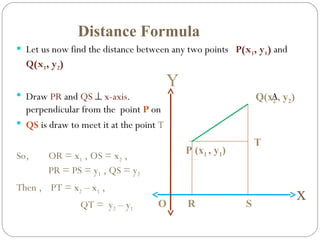
 Let us now find the distance between any two points P(x1, y1) and
Q(x1, y2)
 Draw PR and QS ⊥ x-axis. A
perpendicular from the point P on
 QS is draw to meet it at the point T
So, OR = x1 , OS = x2 ,
PR = PS = y1 , QS = y2
Then , PT = x2 – x1 ,
QT = y2 – y1
x
Y
P (x1 , y1)
Q(x2 , y2)
T
R SO
Distance Formula
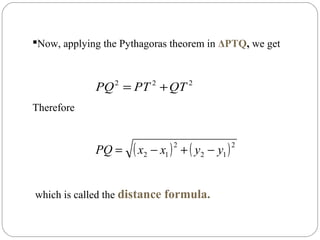
Now, applying the Pythagoras theorem in ΔPTQ, we get
Therefore
222
QTPTPQ +=
( ) ( )2
12
2
12 yyxxPQ −+−=
which is called the distance formula.
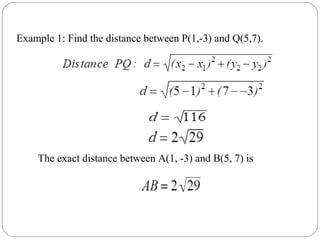
Example 1: Find the distance between P(1,-3) and Q(5,7).
The exact distance between A(1, -3) and B(5, 7) is
Distance From Origin
Distance of P(x, y) from the origin is
( ) ( )2 2
x 0 y 0= − + −
2 2
x y= +
Applications of Distance Formula
To check which type of triangle is
formed by given 3 coordinates.
and
To check which type of quadrilateral is
formed by given 4 coordinates.
Applications of Distance Formula
Parallelogram
Prove opposite sides are equal or diagonals bisect
each other
Applications of Distance Formula
Rhombus
Prove all 4 sides are equal
Applications of Distance Formula
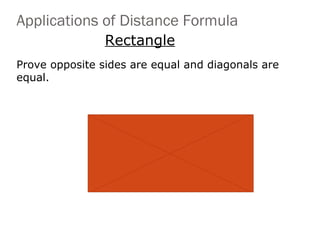
Rectangle
Prove opposite sides are equal and diagonals are
equal.
Applications of Distance Formula
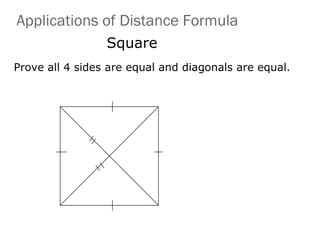
Square
Prove all 4 sides are equal and diagonals are equal.
Collinearity of Three Points
Use Distance Formula
a b
c
Show that a+b = c
Section Formula
2
1
m
m
PB
PA
=
 Consider any two points A(x1 , y1) and B(x1 ,y2) and assume that P (x, y)
divides AB internally in the ratio m1: m2 i.e.
 Draw AR, PS and BT ⊥ x-axis.
 Draw AQ and PC parallel to the x-axis.
Then,
by the AA similarity criterion,
x
Y
A (x1 , y1)
B(x2 , y2)
P (x , y)
R SO T
m1
m2
Q
C
Section Formula
ΔPAQ ~ ΔBPC
---------------- (1)
Now,
AQ = RS = OS – OR = x– x1
PC = ST = OT – OS = x2– x
PQ = PS – QS = PS – AR = y– y1
BC = BT– CT = BT – PS = y2– y
Substituting these values in (1), we get
BC
PQ
PC
AQ
BP
PA
==
( )
( )
( )
( )yy
yy
xx
xx
m
m
−
−
=
−
−
=
2
1
2
1
2
1 ( )
( )
( )
( )yy
yy
xx
xx
m
m
−
−
=
−
−
=
2
1
2
1
2
1
Section Formula
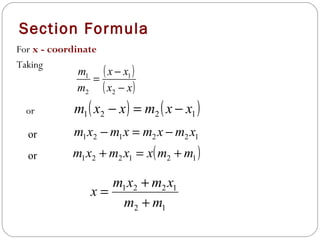
For x - coordinate
Taking
or
( )
( )xx
xx
m
m
−
−
=
2
1
2
1
( ) ( )1221 xxmxxm −=−
122121 xmxmxmxm −=−or
or ( )121221 mmxxmxm +=+
12
1221
mm
xmxm
x
+
+
=
Section Formula
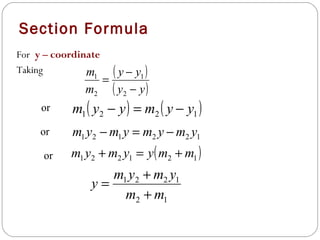
For y – coordinate
Taking ( )
( )yy
yy
m
m
−
−
=
2
1
2
1
( ) ( )1221 yymyym −=−
122121 ymymymym −=−
( )121221 mmyymym +=+
12
1221
mm
ymym
y
+
+
=
or
or
or
Midpoint
Midpoint of A(x1, y1) and B(x2,y2)
m:n ≡ 1:1
1 2 1 2x x y y
P ,
2 2
+ + 
∴ ≡  
 
Find the Mid-Point of P(1,-3) and Q(5,7).
Area of a Triangle
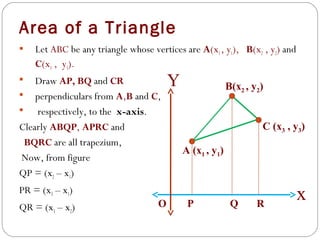
 Let ABC be any triangle whose vertices are A(x1, y1), B(x2 , y2) and
C(x3 , y3).
 Draw AP, BQ and CR
 perpendiculars from A,B and C,
 respectively, to the x-axis.
Clearly ABQP, APRC and
BQRC are all trapezium,
Now, from figure
QP = (x2 – x1)
PR = (x3 – x1)
QR = (x3 – x2)
x
Y
A (x1 , y1)
B(x2 , y2)
C (x3 , y3)
P QO R
Area of a Triangle
XX’
Y’
O
Y A(x1, y1)
C(x3, y3)
B(x2,y2)
M L N
Area of ∆ ABC =
Area of trapezium ABML + Area of trapezium ALNC
- Area of trapezium BMNC
Area of a Triangle
Area of ABCΔ = Area of trapezium ABQP + Area of
trapezium BQRC– Area of trapezium APRC.
We also know that ,
Area of trapezium =
Therefore,
Area of ABCΔ =
( )( )embetween thdistancesidesparallelofsum
2
1
( ) ( ) ( )PRCR+AP
2
1
CR+BQ
2
1
QPAP+BQ
2
1
−+ QR
( )( ) ( )( ) ( )( )133123321212
2
1
2
1
2
1
xxyyxxyyxxyy −+−−++−+=
( ) ( ) ( )[ ]133311312333223211211222
2
1
xyxyxyxyxyxyxyxyxyxyxyxy −+−−−+−+−+−=
( ) ( ) ( )[ ]123312231
2
1
yyxyyxyyx −+−+−=
Area of Δ ABC
PROJECT
Mark coordinate axes on your city map and
find distances between important landmarks-
bus stand, railway station, airport, hospital, school,
Your house, Any river etc.
THANK YOU

CLASS X MATHS

  • 1.
  • 2.
    1. Cartesian Coordinate systemand Quadrants 2. Distance formula 3. Area of a triangle 4. Section formula Objectives
  • 3.
    • The useof algebra to study geometric properties i.e. operates on symbols is defined as the coordinate system. What is co-ordinate geometry ? IntroductIon Yes, co-ordinate geometry play a very important role in our daily life !!! Is co-ordinate geometry important?
  • 4.
     A systemof geometry where the position of points on the plane is described using an ordered pair of numbers.  The method of describing the location of points in this way was  proposed by the French mathematician René Descartes .  He proposed further that curves and lines could be described by equations using this technique, thus being the first to link algebra and geometry.   In honor of his work, the coordinates of a point are often referred to as its Cartesian coordinates, and the coordinate plane as the Cartesian Coordinate Plane. Coordinate Geometry
  • 5.
    SoME BASIc PoIntS Tolocate the position of a point on a plane,we require a pair of coordinate axes. The distance of a point from the y-axis is called its x-coordinate,OR abscissa. The distance of a point from the x-axis is called its y-coordinate,OR ordinate. The coordinates of a point on the x-axis are of the form (x, 0) and of a point on the y-axis are of the form (0, y).
  • 6.
    RECAP Coordinate Plane XX’ Y Y’ O Origin 1 23 4 +ve direction -1-2-3-4 -ve direction -1 -2 -3 -vedirection 1 2 3 +vedirection X-axis : X’OX Y-axis : Y’OY
  • 7.
  • 8.
    Coordinates XX’ Y Y’ O 1 2 34-1-2-3-4 -1 -2 -3 1 2 3 (2,1) (-3,-2) Ordinate Abcissa (?,?)
  • 9.
    XX’ O Y Y’ III III IV (+,+)(-,+) (-,-)(+,-) Q : (1,0) lies in which Quadrant? Ist? IInd? A : None. Points which lie on the axes do not lie in any quadrant.
  • 10.
  • 11.
     Let usnow find the distance between any two points P(x1, y1) and Q(x1, y2)  Draw PR and QS ⊥ x-axis. A perpendicular from the point P on  QS is draw to meet it at the point T So, OR = x1 , OS = x2 , PR = PS = y1 , QS = y2 Then , PT = x2 – x1 , QT = y2 – y1 x Y P (x1 , y1) Q(x2 , y2) T R SO Distance Formula
  • 12.
    Now, applying thePythagoras theorem in ΔPTQ, we get Therefore 222 QTPTPQ += ( ) ( )2 12 2 12 yyxxPQ −+−= which is called the distance formula.
  • 13.
    Example 1: Findthe distance between P(1,-3) and Q(5,7). The exact distance between A(1, -3) and B(5, 7) is
  • 14.
    Distance From Origin Distanceof P(x, y) from the origin is ( ) ( )2 2 x 0 y 0= − + − 2 2 x y= +
  • 15.
    Applications of DistanceFormula To check which type of triangle is formed by given 3 coordinates. and To check which type of quadrilateral is formed by given 4 coordinates.
  • 16.
    Applications of DistanceFormula Parallelogram Prove opposite sides are equal or diagonals bisect each other
  • 17.
    Applications of DistanceFormula Rhombus Prove all 4 sides are equal
  • 18.
    Applications of DistanceFormula Rectangle Prove opposite sides are equal and diagonals are equal.
  • 19.
    Applications of DistanceFormula Square Prove all 4 sides are equal and diagonals are equal.
  • 20.
    Collinearity of ThreePoints Use Distance Formula a b c Show that a+b = c
  • 21.
    Section Formula 2 1 m m PB PA =  Considerany two points A(x1 , y1) and B(x1 ,y2) and assume that P (x, y) divides AB internally in the ratio m1: m2 i.e.  Draw AR, PS and BT ⊥ x-axis.  Draw AQ and PC parallel to the x-axis. Then, by the AA similarity criterion, x Y A (x1 , y1) B(x2 , y2) P (x , y) R SO T m1 m2 Q C
  • 22.
    Section Formula ΔPAQ ~ΔBPC ---------------- (1) Now, AQ = RS = OS – OR = x– x1 PC = ST = OT – OS = x2– x PQ = PS – QS = PS – AR = y– y1 BC = BT– CT = BT – PS = y2– y Substituting these values in (1), we get BC PQ PC AQ BP PA == ( ) ( ) ( ) ( )yy yy xx xx m m − − = − − = 2 1 2 1 2 1 ( ) ( ) ( ) ( )yy yy xx xx m m − − = − − = 2 1 2 1 2 1
  • 23.
    Section Formula For x- coordinate Taking or ( ) ( )xx xx m m − − = 2 1 2 1 ( ) ( )1221 xxmxxm −=− 122121 xmxmxmxm −=−or or ( )121221 mmxxmxm +=+ 12 1221 mm xmxm x + + =
  • 24.
    Section Formula For y– coordinate Taking ( ) ( )yy yy m m − − = 2 1 2 1 ( ) ( )1221 yymyym −=− 122121 ymymymym −=− ( )121221 mmyymym +=+ 12 1221 mm ymym y + + = or or or
  • 25.
    Midpoint Midpoint of A(x1,y1) and B(x2,y2) m:n ≡ 1:1 1 2 1 2x x y y P , 2 2 + +  ∴ ≡     Find the Mid-Point of P(1,-3) and Q(5,7).
  • 26.
    Area of aTriangle  Let ABC be any triangle whose vertices are A(x1, y1), B(x2 , y2) and C(x3 , y3).  Draw AP, BQ and CR  perpendiculars from A,B and C,  respectively, to the x-axis. Clearly ABQP, APRC and BQRC are all trapezium, Now, from figure QP = (x2 – x1) PR = (x3 – x1) QR = (x3 – x2) x Y A (x1 , y1) B(x2 , y2) C (x3 , y3) P QO R
  • 27.
    Area of aTriangle XX’ Y’ O Y A(x1, y1) C(x3, y3) B(x2,y2) M L N Area of ∆ ABC = Area of trapezium ABML + Area of trapezium ALNC - Area of trapezium BMNC
  • 28.
    Area of aTriangle Area of ABCΔ = Area of trapezium ABQP + Area of trapezium BQRC– Area of trapezium APRC. We also know that , Area of trapezium = Therefore, Area of ABCΔ = ( )( )embetween thdistancesidesparallelofsum 2 1 ( ) ( ) ( )PRCR+AP 2 1 CR+BQ 2 1 QPAP+BQ 2 1 −+ QR ( )( ) ( )( ) ( )( )133123321212 2 1 2 1 2 1 xxyyxxyyxxyy −+−−++−+= ( ) ( ) ( )[ ]133311312333223211211222 2 1 xyxyxyxyxyxyxyxyxyxyxyxy −+−−−+−+−+−= ( ) ( ) ( )[ ]123312231 2 1 yyxyyxyyx −+−+−= Area of Δ ABC
  • 29.
    PROJECT Mark coordinate axeson your city map and find distances between important landmarks- bus stand, railway station, airport, hospital, school, Your house, Any river etc.
  • 31.

Editor's Notes

  • #7 Description of axes. The axes are arbitrarily chosen mutually perpendicular lines passing through an arbitrarily chosen point identified as the origin. Left to right and bottom to top are positive directions.
  • #8 The cartesian plane is divided into four quadrants. Quadrants are numbered in anticlockwise direction. All abcissae in a given quadrant will have the same sign and all ordinates in a given quadrant will have the same sign.
  • #9 Any point on the plane can be uniquely identified by its x-coordinate and y-coordinate. The x-coordinate is also called the abcissa, the y coordinate the ordinate of the point. The point is identified as an ordered pair (abcissa, ordinate) or (x,y).
  • #11 Explain the derivation step by step according to animation.
  • #17 To show that a figure is a parallelogram, prove that opposite sides are equal.
  • #18 To show that a figure is a rhombus, prove all sides are equal.
  • #19 To show that a figure is a rectangle, prove that opposite sides are equal and the diagonals are equal. Corollary : Parellelogram but not rectangle  diagonals are unequal
  • #20 To show that a figure is a square, prove all sides are equal and the diagonals are equal. Corollary : Rhombus but not square  diagonals are unequal
  • #21 To show that three points are collinear, show that a+b = c