2.12.1 Use Inductive Reasoning
Bell Thinger
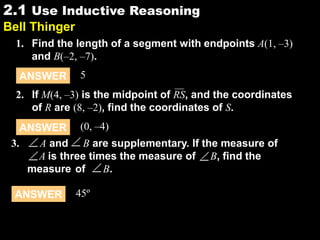
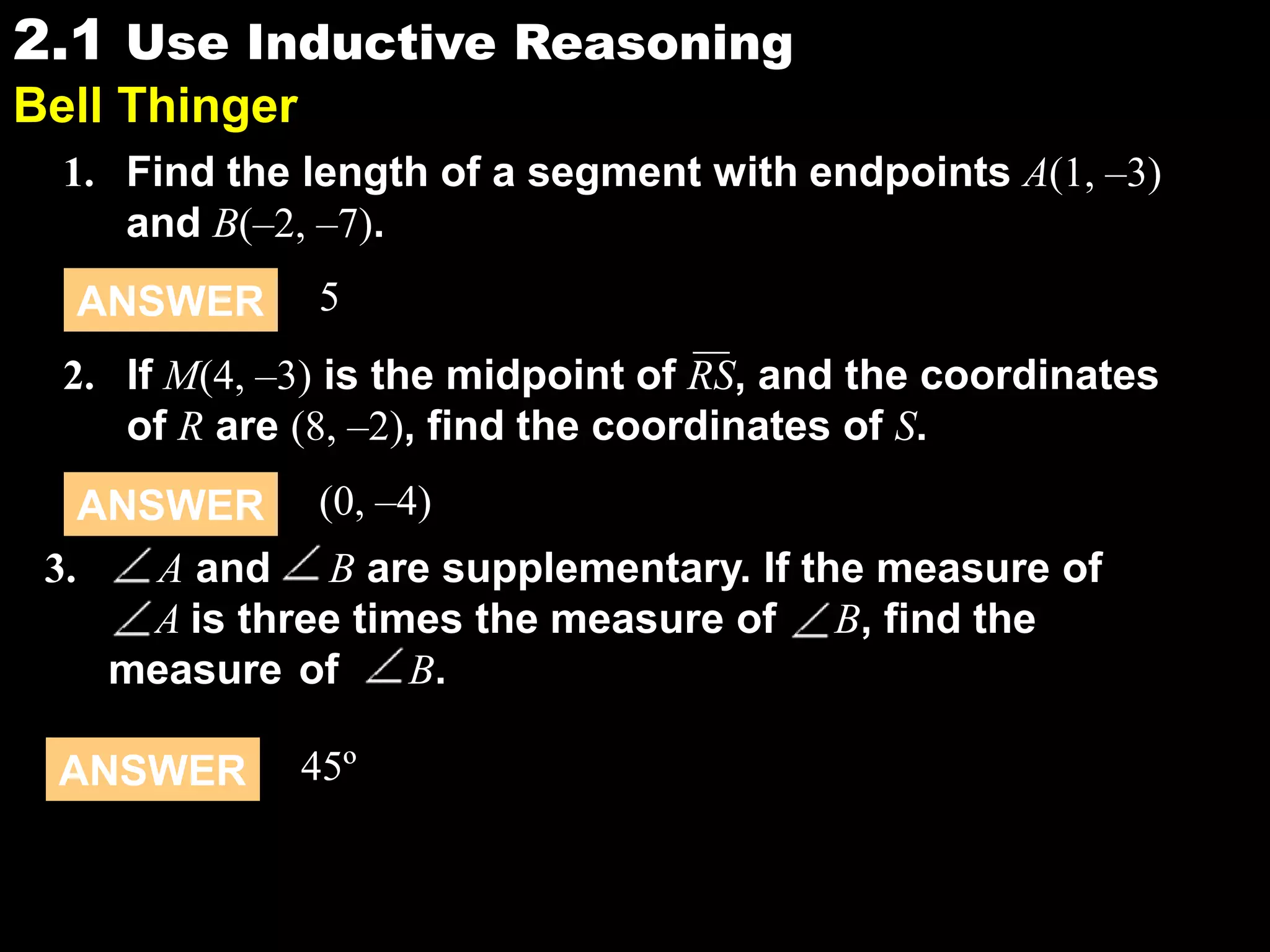
1. Find the length of a segment with endpoints A(1, –3)
and B(–2, –7).
ANSWER (0, –4)
2. If M(4, –3) is the midpoint of RS, and the coordinates
of R are (8, –2), find the coordinates of S.
ANSWER 5
3. A and B are supplementary. If the measure of
A is three times the measure of B, find the
measure of B.
ANSWER 45º
2.1
2.1Example 1
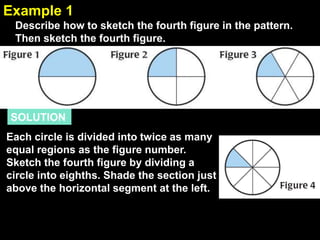
Describe how to sketch the fourth figure in the pattern.
Then sketch the fourth figure.
SOLUTION
Each circle is divided into twice as many
equal regions as the figure number.
Sketch the fourth figure by dividing a
circle into eighths. Shade the section just
above the horizontal segment at the left.
2.1Guided Practice
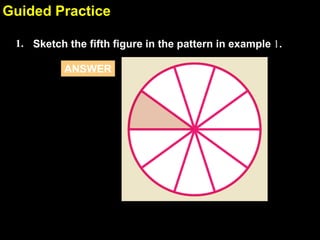
1. Sketch the fifth figure in the pattern in example 1.
ANSWER
2.1Example 2
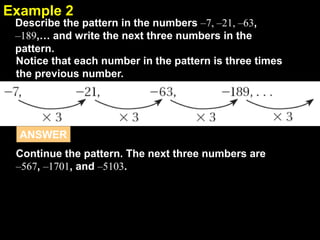
Describe the pattern in the numbers –7, –21, –63,
–189,… and write the next three numbers in the
pattern.
Notice that each number in the pattern is three times
the previous number.
Continue the pattern. The next three numbers are
–567, –1701, and –5103.
ANSWER
2.1Guided Practice
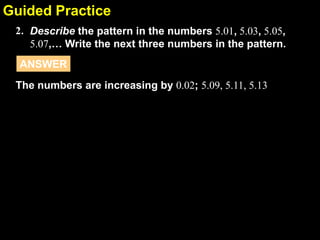
Describe the pattern in the numbers 5.01, 5.03, 5.05,
5.07,… Write the next three numbers in the pattern.
2.
The numbers are increasing by 0.02; 5.09, 5.11, 5.13
ANSWER
2.1Example 3
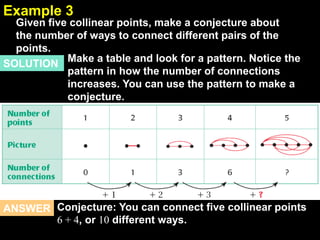
Given five collinear points, make a conjecture about
the number of ways to connect different pairs of the
points.
Make a table and look for a pattern. Notice the
pattern in how the number of connections
increases. You can use the pattern to make a
conjecture.
SOLUTION
Conjecture: You can connect five collinear points
6 + 4, or 10 different ways.
ANSWER
2.1
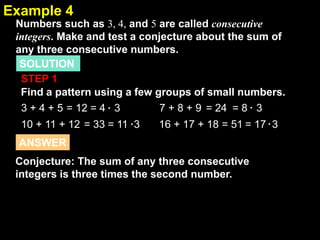
3 + 4 + 5 = 12 = 4 3 7 + 8 + 9 = 24 = 8 3
10 + 11 + 12 = 33 = 11 3 16 + 17 + 18 = 51 = 17 3
Example 4
Numbers such as 3, 4, and 5 are called consecutive
integers. Make and test a conjecture about the sum of
any three consecutive numbers.
SOLUTION
STEP 1
Find a pattern using a few groups of small numbers.
Conjecture: The sum of any three consecutive
integers is three times the second number.
ANSWER
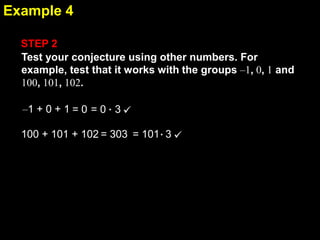
2.1Example 4
STEP 2
Test your conjecture using other numbers. For
example, test that it works with the groups –1, 0, 1 and
100, 101, 102.
–1 + 0 + 1 = 0 = 0 3 
100 + 101 + 102 = 303 = 101 3 
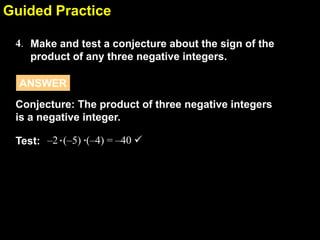
2.1Guided Practice
4. Make and test a conjecture about the sign of the
product of any three negative integers.
Conjecture: The product of three negative integers
is a negative integer.
ANSWER
–2 (–5) (–4) = –40 Test:
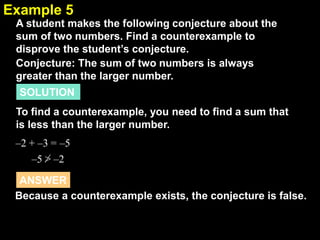
2.1Example 5
A student makes the following conjecture about the
sum of two numbers. Find a counterexample to
disprove the student’s conjecture.
Conjecture: The sum of two numbers is always
greater than the larger number.
SOLUTION
To find a counterexample, you need to find a sum that
is less than the larger number.
–2 + –3
–5 > –2
= –5
Because a counterexample exists, the conjecture is false.
ANSWER
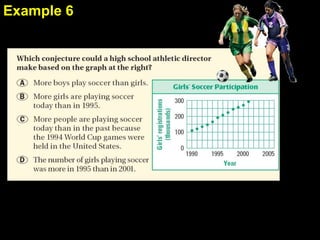
2.1Example 6
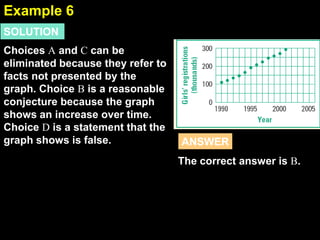
2.1Example 6
SOLUTION
The correct answer is B.
ANSWER
Choices A and C can be
eliminated because they refer to
facts not presented by the
graph. Choice B is a reasonable
conjecture because the graph
shows an increase over time.
Choice D is a statement that the
graph shows is false.
2.1Guided Practice
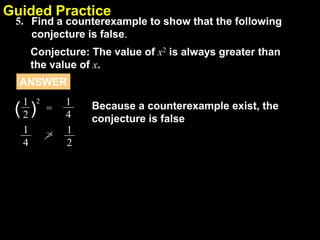
5. Find a counterexample to show that the following
conjecture is false.
Conjecture: The value of x2 is always greater than
the value of x.
( )
21
2
=
1
4
1
4
> 1
2
Because a counterexample exist, the
conjecture is false
ANSWER
2.1Exit Slip
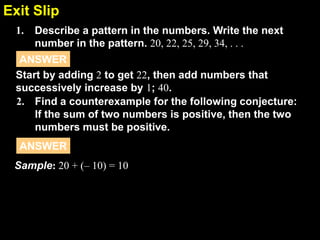
Describe a pattern in the numbers. Write the next
number in the pattern. 20, 22, 25, 29, 34, . . .
1.
ANSWER
Start by adding 2 to get 22, then add numbers that
successively increase by 1; 40.
2. Find a counterexample for the following conjecture:
If the sum of two numbers is positive, then the two
numbers must be positive.
ANSWER
Sample: 20 + (– 10) = 10
2.1
Homework
Pg 77-80
#5, 13, 14, 32, 38

2.1 use inductive reasoning

  • 1.
    2.12.1 Use InductiveReasoning Bell Thinger 1. Find the length of a segment with endpoints A(1, –3) and B(–2, –7). ANSWER (0, –4) 2. If M(4, –3) is the midpoint of RS, and the coordinates of R are (8, –2), find the coordinates of S. ANSWER 5 3. A and B are supplementary. If the measure of A is three times the measure of B, find the measure of B. ANSWER 45º
  • 2.
  • 3.
    2.1Example 1 Describe howto sketch the fourth figure in the pattern. Then sketch the fourth figure. SOLUTION Each circle is divided into twice as many equal regions as the figure number. Sketch the fourth figure by dividing a circle into eighths. Shade the section just above the horizontal segment at the left.
  • 4.
    2.1Guided Practice 1. Sketchthe fifth figure in the pattern in example 1. ANSWER
  • 5.
    2.1Example 2 Describe thepattern in the numbers –7, –21, –63, –189,… and write the next three numbers in the pattern. Notice that each number in the pattern is three times the previous number. Continue the pattern. The next three numbers are –567, –1701, and –5103. ANSWER
  • 6.
    2.1Guided Practice Describe thepattern in the numbers 5.01, 5.03, 5.05, 5.07,… Write the next three numbers in the pattern. 2. The numbers are increasing by 0.02; 5.09, 5.11, 5.13 ANSWER
  • 7.
    2.1Example 3 Given fivecollinear points, make a conjecture about the number of ways to connect different pairs of the points. Make a table and look for a pattern. Notice the pattern in how the number of connections increases. You can use the pattern to make a conjecture. SOLUTION Conjecture: You can connect five collinear points 6 + 4, or 10 different ways. ANSWER
  • 8.
    2.1 3 + 4+ 5 = 12 = 4 3 7 + 8 + 9 = 24 = 8 3 10 + 11 + 12 = 33 = 11 3 16 + 17 + 18 = 51 = 17 3 Example 4 Numbers such as 3, 4, and 5 are called consecutive integers. Make and test a conjecture about the sum of any three consecutive numbers. SOLUTION STEP 1 Find a pattern using a few groups of small numbers. Conjecture: The sum of any three consecutive integers is three times the second number. ANSWER
  • 9.
    2.1Example 4 STEP 2 Testyour conjecture using other numbers. For example, test that it works with the groups –1, 0, 1 and 100, 101, 102. –1 + 0 + 1 = 0 = 0 3  100 + 101 + 102 = 303 = 101 3 
  • 10.
    2.1Guided Practice 4. Makeand test a conjecture about the sign of the product of any three negative integers. Conjecture: The product of three negative integers is a negative integer. ANSWER –2 (–5) (–4) = –40 Test:
  • 11.
    2.1Example 5 A studentmakes the following conjecture about the sum of two numbers. Find a counterexample to disprove the student’s conjecture. Conjecture: The sum of two numbers is always greater than the larger number. SOLUTION To find a counterexample, you need to find a sum that is less than the larger number. –2 + –3 –5 > –2 = –5 Because a counterexample exists, the conjecture is false. ANSWER
  • 12.
  • 13.
    2.1Example 6 SOLUTION The correctanswer is B. ANSWER Choices A and C can be eliminated because they refer to facts not presented by the graph. Choice B is a reasonable conjecture because the graph shows an increase over time. Choice D is a statement that the graph shows is false.
  • 14.
    2.1Guided Practice 5. Finda counterexample to show that the following conjecture is false. Conjecture: The value of x2 is always greater than the value of x. ( ) 21 2 = 1 4 1 4 > 1 2 Because a counterexample exist, the conjecture is false ANSWER
  • 15.
    2.1Exit Slip Describe apattern in the numbers. Write the next number in the pattern. 20, 22, 25, 29, 34, . . . 1. ANSWER Start by adding 2 to get 22, then add numbers that successively increase by 1; 40. 2. Find a counterexample for the following conjecture: If the sum of two numbers is positive, then the two numbers must be positive. ANSWER Sample: 20 + (– 10) = 10
  • 16.