Obj. 38 Dilations
The student is able to (I can):
• Identify and draw dilations
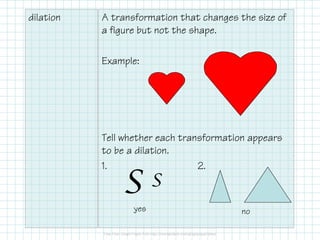
dilation

A transformation that changes the size of
a figure but not the shape.
Example:

Tell whether each transformation appears
to be a dilation.
1.
2.

S

yes

S
no
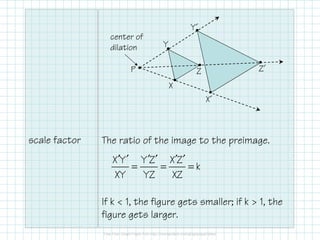
center of
dilation

Y´
•
Y•
•

•

P

Z´

Z
X

•
•

X´

scale factor

The ratio of the image to the preimage.

X′Y ′ Y ′Z′ X′Z′
=
=
=k
XY
YZ
XZ
If k < 1, the figure gets smaller; if k > 1, the
figure gets larger.
Example

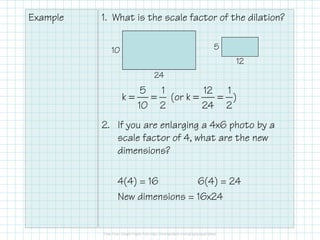
1. What is the scale factor of the dilation?
5

10

12
24

5 1
12 1
k=
= (or k =
= )
10 2
24 2
2. If you are enlarging a 4x6 photo by a
scale factor of 4, what are the new
dimensions?
4(4) = 16
6(4) = 24
New dimensions = 16x24
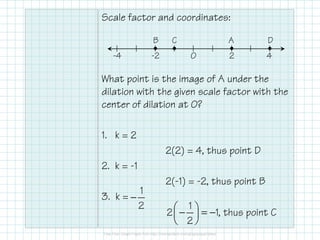
Scale factor and coordinates:
|
-4

B
•
|
-2

|

C
•
|

|
0

|

A
•
|
2

|

D
•
|
4

What point is the image of A under the
dilation with the given scale factor with the
center of dilation at 0?
1. k = 2
2(2) = 4, thus point D
2. k = -1
3. k = −

1
2

2(-1) = -2, thus point B
 − 1  = −1, thus point C
2

2

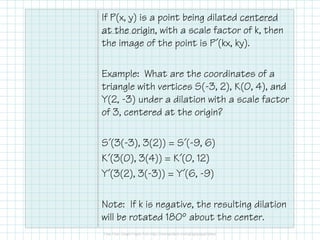
If P(x, y) is a point being dilated centered
at the origin, with a scale factor of k, then
the image of the point is P´(kx, ky).
Example: What are the coordinates of a
triangle with vertices S(-3, 2), K(0, 4), and
Y(2, -3) under a dilation with a scale factor
of 3, centered at the origin?
S´(3(-3), 3(2)) = S´(-9, 6)
K´(3(0), 3(4)) = K´(0, 12)
Y´(3(2), 3(-3)) = Y´(6, -9)
Note: If k is negative, the resulting dilation
will be rotated 180º about the center.
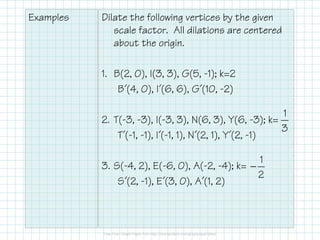
Examples

Dilate the following vertices by the given
scale factor. All dilations are centered
about the origin.
1. B(2, 0), I(3, 3), G(5, -1); k=2
B´(4, 0), I´(6, 6), G´(10, -2)

1
2. T(-3, -3), I(-3, 3), N(6, 3), Y(6, -3); k=
3
T´(-1, -1), I´(-1, 1), N´(2, 1), Y´(2, -1)
1
3. S(-4, 2), E(-6, 0), A(-2, -4); k= −
2
S´(2, -1), E´(3, 0), A´(1, 2)

Obj. 38 Dilations

  • 1.
    Obj. 38 Dilations Thestudent is able to (I can): • Identify and draw dilations
  • 2.
    dilation A transformation thatchanges the size of a figure but not the shape. Example: Tell whether each transformation appears to be a dilation. 1. 2. S yes S no
  • 3.
    center of dilation Y´ • Y• • • P Z´ Z X • • X´ scale factor Theratio of the image to the preimage. X′Y ′ Y ′Z′ X′Z′ = = =k XY YZ XZ If k < 1, the figure gets smaller; if k > 1, the figure gets larger.
  • 4.
    Example 1. What isthe scale factor of the dilation? 5 10 12 24 5 1 12 1 k= = (or k = = ) 10 2 24 2 2. If you are enlarging a 4x6 photo by a scale factor of 4, what are the new dimensions? 4(4) = 16 6(4) = 24 New dimensions = 16x24
  • 5.
    Scale factor andcoordinates: | -4 B • | -2 | C • | | 0 | A • | 2 | D • | 4 What point is the image of A under the dilation with the given scale factor with the center of dilation at 0? 1. k = 2 2(2) = 4, thus point D 2. k = -1 3. k = − 1 2 2(-1) = -2, thus point B  − 1  = −1, thus point C 2  2 
  • 6.
    If P(x, y)is a point being dilated centered at the origin, with a scale factor of k, then the image of the point is P´(kx, ky). Example: What are the coordinates of a triangle with vertices S(-3, 2), K(0, 4), and Y(2, -3) under a dilation with a scale factor of 3, centered at the origin? S´(3(-3), 3(2)) = S´(-9, 6) K´(3(0), 3(4)) = K´(0, 12) Y´(3(2), 3(-3)) = Y´(6, -9) Note: If k is negative, the resulting dilation will be rotated 180º about the center.
  • 7.
    Examples Dilate the followingvertices by the given scale factor. All dilations are centered about the origin. 1. B(2, 0), I(3, 3), G(5, -1); k=2 B´(4, 0), I´(6, 6), G´(10, -2) 1 2. T(-3, -3), I(-3, 3), N(6, 3), Y(6, -3); k= 3 T´(-1, -1), I´(-1, 1), N´(2, 1), Y´(2, -1) 1 3. S(-4, 2), E(-6, 0), A(-2, -4); k= − 2 S´(2, -1), E´(3, 0), A´(1, 2)