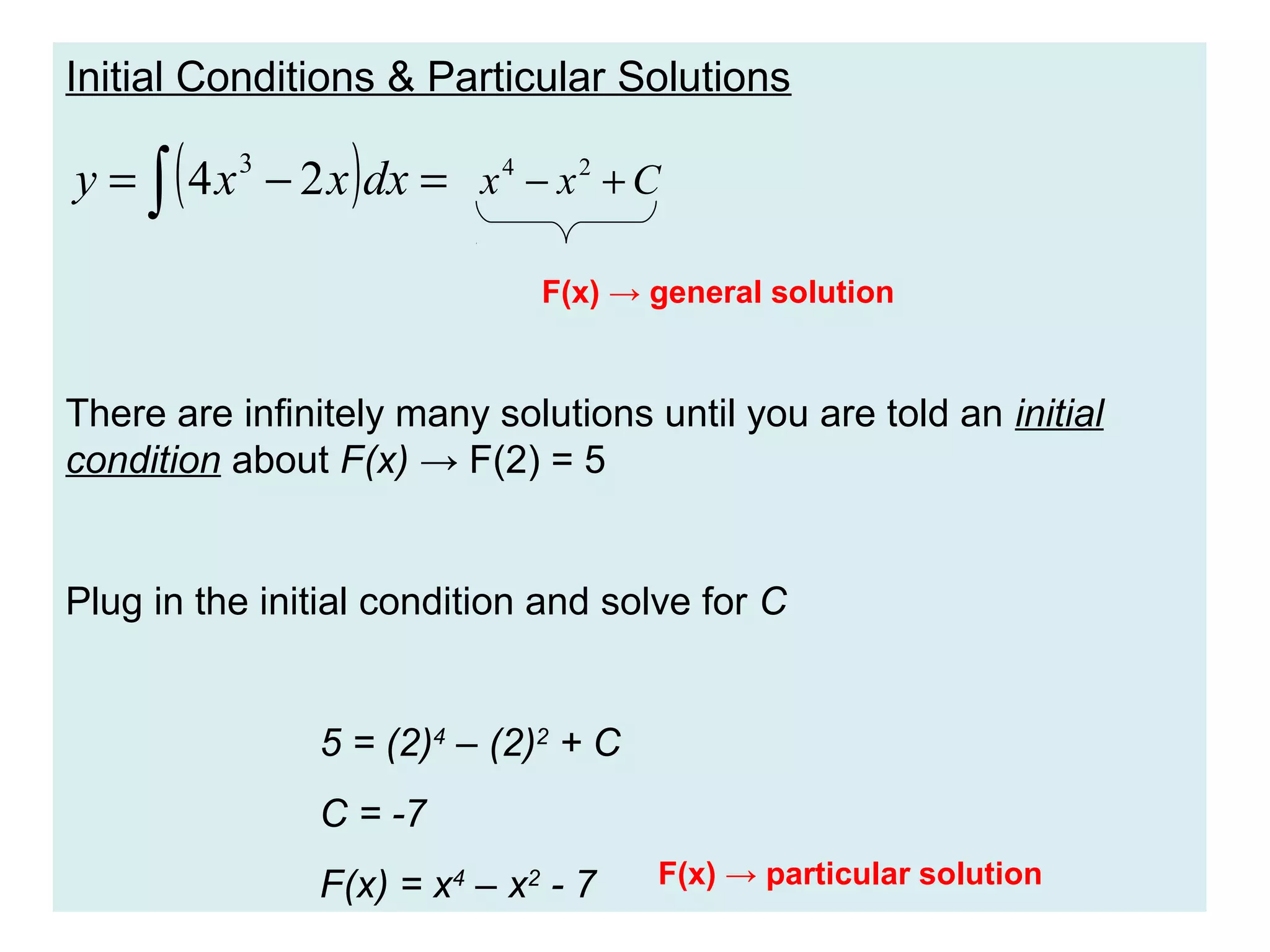
This document discusses the indefinite integral and antiderivatives. It defines an antiderivative as a function whose derivative is the original function, and notes that there are infinitely many antiderivatives that differ by a constant. The process of finding antiderivatives is called indefinite integration or antidifferentiation. Initial conditions can be used to determine a unique particular solution by solving for the constant of integration.


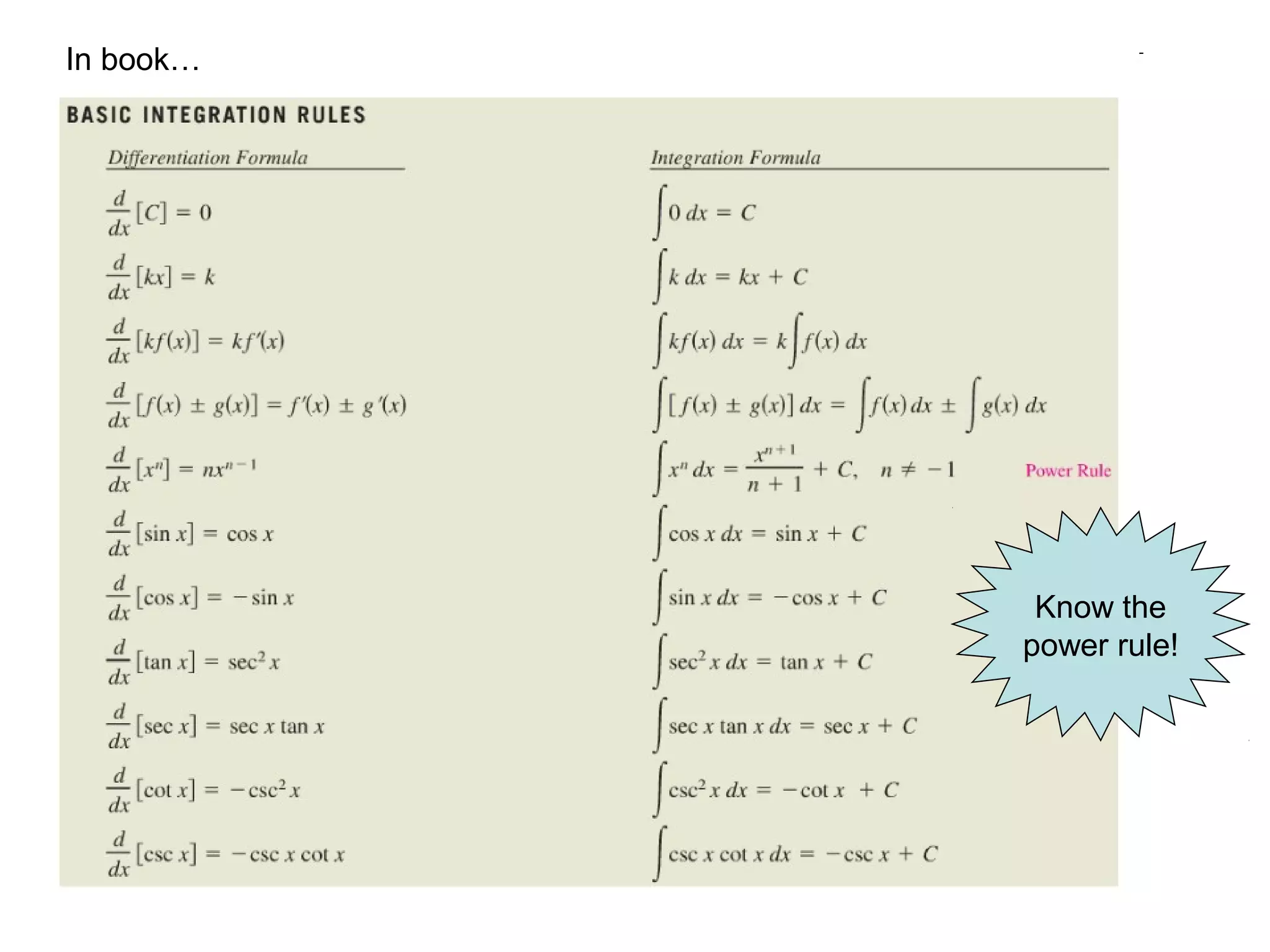
![∫ F ′( x)dx = F ( x) + C
d
dx
[∫ f ( x)dx] = f ( x)
Integration is the “inverse” of differentiation
Differentiation is the “inverse” of integration
4
Example: Describe the antiderivatives of 2
x
∫
4
1
dx = 4 ∫ 2 dx =
2
x
x
1
4
4 − ÷+ C = − + C
x
x](https://image.slidesharecdn.com/6-131206202557-phpapp02/75/6-2-the-indefinite-integral-6-2048.jpg)