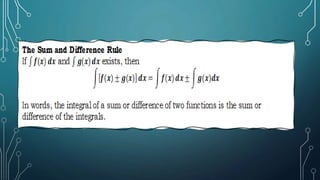
Review of the
Previous Lesson
ACTIVITY
JEOPARDY GAME:
THE TEACHER WILL GIVE YOU THE ANSWER, THE
STUDENT WILL IDENTIFY THE QUESTION.
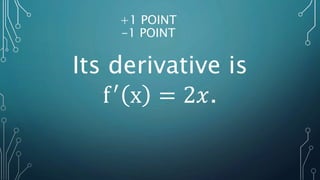
+1 POINT
-1 POINT
Its derivative is
f′
x = 2𝑥.
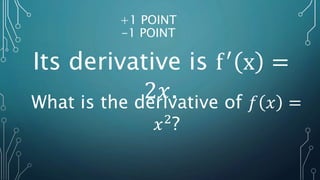
+1 POINT
-1 POINT
Its derivative is f′
x =
2𝑥.
What is the derivative of 𝑓 𝑥 =
𝑥2
?
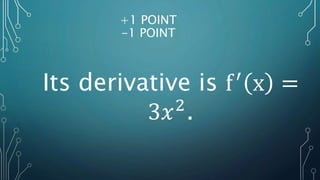
+1 POINT
-1 POINT
Its derivative is f′
x =
3𝑥2
.
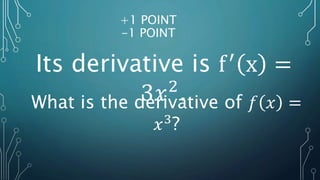
+1 POINT
-1 POINT
Its derivative is f′
x =
3𝑥2
.
What is the derivative of 𝑓 𝑥 =
𝑥3
?
+1 POINT
-1 POINT
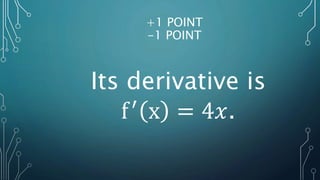
Its derivative is
f′
x = 4𝑥.
+1 POINT
-1 POINT
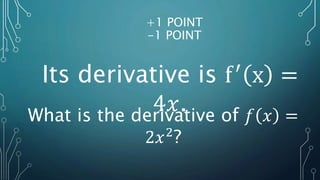
Its derivative is f′
x =
4𝑥.
What is the derivative of 𝑓 𝑥 =
2𝑥2
?
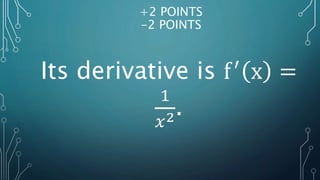
Its derivative is f′
x =
1
𝑥2.
+2 POINTS
-2 POINTS
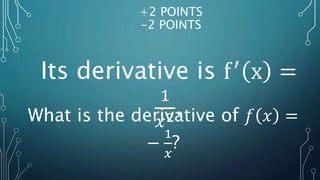
Its derivative is f′
x =
1
𝑥2.
+2 POINTS
-2 POINTS
What is the derivative of 𝑓 𝑥 =
−
1
𝑥
?
Its derivative is f′
x =
𝑥.
+2 POINTS
-2 POINTS
Its derivative is f′
x =
𝑥.
+2 POINTS
-2 POINTS
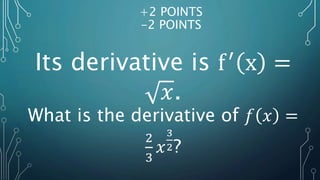
What is the derivative of 𝑓 𝑥 =
2
3
𝑥
3
2?
Antiderivatives and
Indefinite Integration
Learning Objectives:
1.Illustrate an antiderivative of a function.
2.Compute the general antiderivatives (indefinite
integrals) of polynomial, radical, rational,
exponential, logarithmic, and trigonometric
functions.
Integral Calculus is the branch of calculus where we study
integrals and their properties. Integration is an essential
concept which is the inverse process of differentiation.
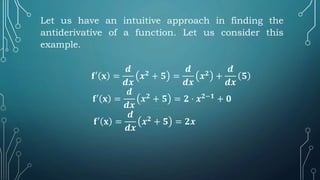
Let us have an intuitive approach in finding the
antiderivative of a function. Let us consider this
example.
𝐟′ 𝐱 =
𝒅
𝒅𝒙
𝒙𝟐
+ 𝟓 =
𝒅
𝒅𝒙
𝒙𝟐
+
𝒅
𝒅𝒙
𝟓
𝐟′ 𝐱 =
𝒅
𝒅𝒙
𝒙𝟐
+ 𝟓 = 𝟐 ⋅ 𝒙𝟐−𝟏
+ 𝟎
𝐟′ 𝐱 =
𝒅
𝒅𝒙
𝒙𝟐 + 𝟓 = 𝟐𝒙
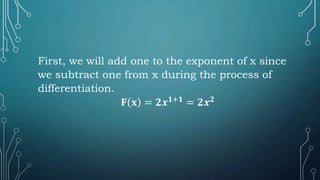
First, we will add one to the exponent of x since
we subtract one from x during the process of
differentiation.
𝐅 𝐱 = 𝟐𝒙𝟏+𝟏
= 𝟐𝒙𝟐
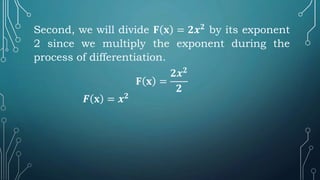
Second, we will divide 𝐅 𝐱 = 𝟐𝒙𝟐
by its exponent
2 since we multiply the exponent during the
process of differentiation.
𝐅 𝐱 =
𝟐𝒙𝟐
𝟐
𝑭 𝐱 = 𝒙𝟐
Did we already recover the original function?
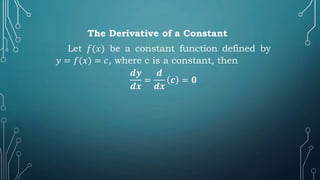
The Derivative of a Constant
Let 𝑓(𝑥) be a constant function defined by
𝑦 = 𝑓(𝑥) = 𝑐, where c is a constant, then
𝒅𝒚
𝒅𝒙
=
𝒅
𝒅𝒙
𝒄 = 𝟎
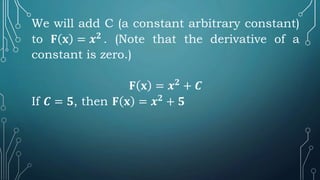
We will add C (a constant arbitrary constant)
to 𝐅 𝐱 = 𝒙𝟐
. (Note that the derivative of a
constant is zero.)
𝐅 𝐱 = 𝒙𝟐
+ 𝑪
If 𝑪 = 𝟓, then 𝐅 𝐱 = 𝒙𝟐
+ 𝟓
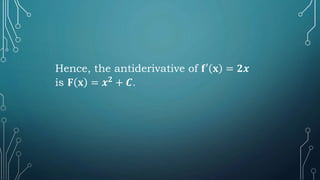
Hence, the antiderivative of 𝐟′ 𝐱 = 𝟐𝒙
is 𝐅 𝐱 = 𝒙𝟐
+ 𝑪.
ANTIDIFFERENTIATION
•This operation of determining the original function from
its derivative is the inverse operation of differentiation
and is called antidifferentiation.
•Antidifferentiation is a process or operation that reverses
differentiation.
ANTIDIFFERENTIATION
•Up to this point in Calculus, you have been concerned
primarily with this problem: given a function, find its
derivative
•Many important applications of calculus involve the
inverse problem: given the derivative of a function, find
the function
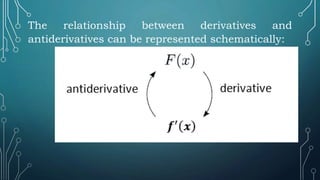
The relationship between derivatives and
antiderivatives can be represented schematically:
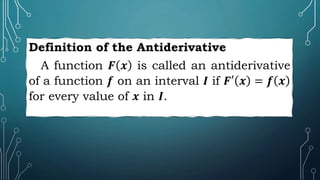
Definition of the Antiderivative
A function 𝑭 𝒙 is called an antiderivative
of a function 𝒇 on an interval 𝑰 if 𝑭′ 𝒙 = 𝒇 𝒙
for every value of 𝒙 in 𝑰.
Another term for antidifferentiation is
integration.
Another term for antiderivative is
integral.
Integration can be classified into two different
categories, namely,
•Definite Integral
•Indefinite Integral
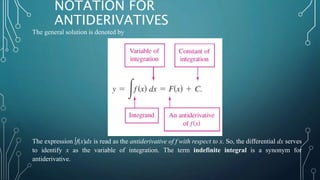
The general solution is denoted by
The expression ∫f(x)dx is read as the antiderivative of f with respect to x. So, the differential dx serves
to identify x as the variable of integration. The term indefinite integral is a synonym for
antiderivative.
NOTATION FOR
ANTIDERIVATIVES
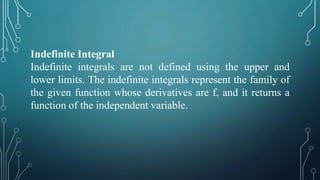
Indefinite Integral
Indefinite integrals are not defined using the upper and
lower limits. The indefinite integrals represent the family of
the given function whose derivatives are f, and it returns a
function of the independent variable.
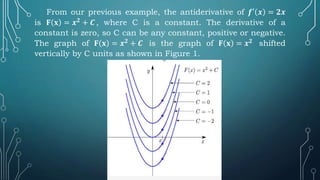
From our previous example, the antiderivative of 𝒇′ 𝒙 = 𝟐𝒙
is 𝐅 𝐱 = 𝒙𝟐 + 𝑪, where C is a constant. The derivative of a
constant is zero, so C can be any constant, positive or negative.
The graph of 𝐅 𝐱 = 𝒙𝟐 + 𝑪 is the graph of 𝐅 𝐱 = 𝒙𝟐 shifted
vertically by C units as shown in Figure 1.
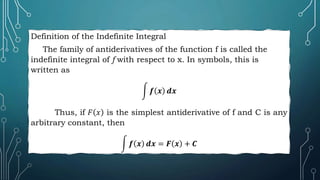
Definition of the Indefinite Integral
The family of antiderivatives of the function f is called the
indefinite integral of f with respect to x. In symbols, this is
written as
𝒇 𝒙 𝒅𝒙
Thus, if 𝐹 𝑥 is the simplest antiderivative of f and C is any
arbitrary constant, then
𝒇 𝒙 𝒅𝒙 = 𝑭 𝒙 + 𝑪
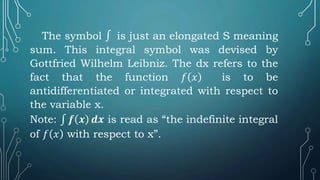
The symbol ∫ is just an elongated S meaning
sum. This integral symbol was devised by
Gottfried Wilhelm Leibniz. The dx refers to the
fact that the function 𝑓 𝑥 is to be
antidifferentiated or integrated with respect to
the variable x.
Note: ∫ 𝒇 𝒙 𝒅𝒙 is read as “the indefinite integral
of 𝑓 𝑥 with respect to x”.
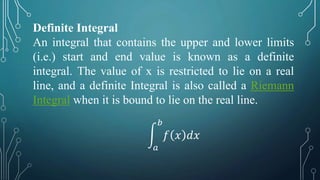
Definite Integral
An integral that contains the upper and lower limits
(i.e.) start and end value is known as a definite
integral. The value of x is restricted to lie on a real
line, and a definite Integral is also called a Riemann
Integral when it is bound to lie on the real line.
𝑎
𝑏
𝑓 𝑥 𝑑𝑥
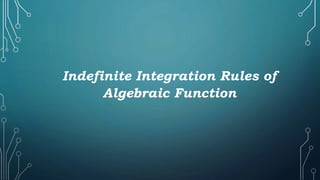
Indefinite Integration Rules of
Algebraic Function
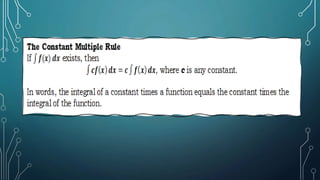
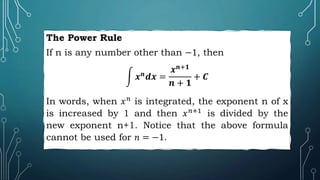
The Power Rule
If n is any number other than −1, then
𝒙𝒏𝒅𝒙 =
𝒙𝒏+𝟏
𝒏 + 𝟏
+ 𝑪
In words, when 𝑥𝑛
is integrated, the exponent n of x
is increased by 1 and then 𝑥𝑛+1
is divided by the
new exponent n+1. Notice that the above formula
cannot be used for 𝑛 = −1.

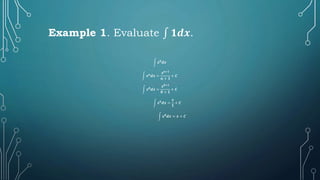
Example 1. Evaluate ∫ 𝟏𝒅𝒙.
𝒙𝟎
𝒅𝒙
𝒙𝒏
𝒅𝒙 =
𝒙𝒏+𝟏
𝒏 + 𝟏
+ 𝑪
𝒙𝟎
𝒅𝒙 =
𝒙𝟎+𝟏
𝟎 + 𝟏
+ 𝑪
𝒙𝟎
𝒅𝒙 =
𝒙
𝟏
+ 𝑪
𝒙𝟎
𝒅𝒙 = 𝒙 + 𝑪
Example 2. Evaluate ∫ 𝐱𝟓
𝐝𝐱.
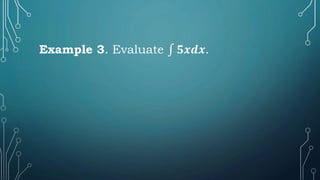
Example 3. Evaluate ∫ 𝟓𝒙𝒅𝒙.
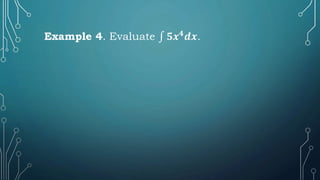
Example 4. Evaluate ∫ 𝟓𝒙𝟒
𝒅𝒙.
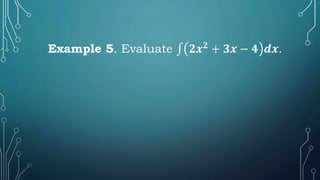
Example 5. Evaluate ∫ 𝟐𝒙𝟐
+ 𝟑𝒙 − 𝟒 𝒅𝒙.
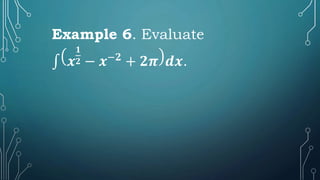
Example 6. Evaluate
∫ 𝒙
𝟏
𝟐 − 𝒙−𝟐 + 𝟐𝝅 𝒅𝒙.
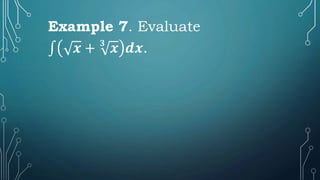
Example 7. Evaluate
∫ 𝒙 + 𝟑
𝒙 𝒅𝒙.
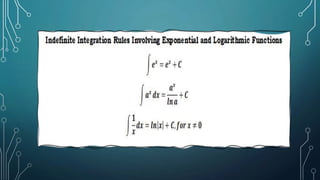
Indefinite Integration Rules
of Exponential and
Logarithmic Functions
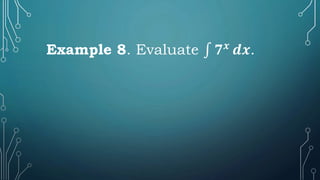
Example 8. Evaluate ∫ 𝟕𝒙
𝒅𝒙.
Example 9. Evaluate ∫ 𝟐𝒙+𝟑
𝒅𝒙.
Example 10. Evaluate ∫
𝟗
𝒙
𝒅𝒙.
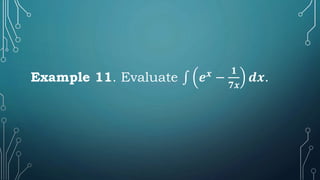
Example 11. Evaluate ∫ 𝒆𝒙
−
𝟏
𝟕𝒙
𝒅𝒙.
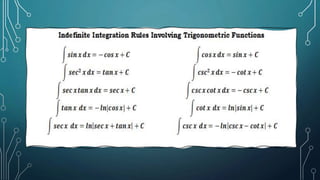
Indefinite Integration
Rules of Trigonometric
Functions
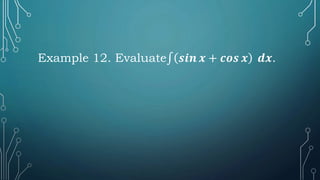
Example 12. Evaluate∫ 𝒔𝒊𝒏 𝒙 + 𝒄𝒐𝒔 𝒙 𝒅𝒙.
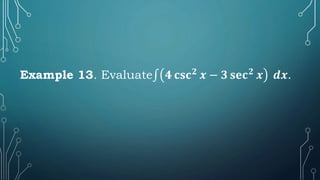
Example 13. Evaluate∫ 𝟒 𝐜𝐬𝐜𝟐
𝒙 − 𝟑 𝐬𝐞𝐜𝟐
𝒙 𝒅𝒙.
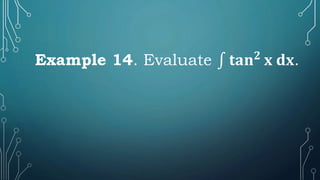
Example 14. Evaluate ∫ 𝐭𝐚𝐧𝟐 𝐱 𝐝𝐱.
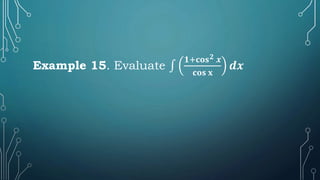
Example 15. Evaluate ∫
𝟏+𝐜𝐨𝐬𝟐 𝒙
𝐜𝐨𝐬 𝐱
𝒅𝒙
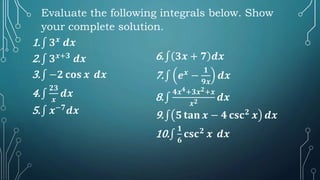
1.∫ 𝟑𝒙
𝒅𝒙
2.∫ 𝟑𝒙+𝟑
𝒅𝒙
3.∫ −𝟐 𝐜𝐨𝐬 𝒙 𝒅𝒙
4.∫
𝟐𝟑
𝒙
𝒅𝒙
5.∫ 𝒙−𝟕
𝒅𝒙
6.∫ 𝟑𝒙 + 𝟕 𝒅𝒙
7.∫ 𝒆𝒙
−
𝟏
𝟗𝒙
𝒅𝒙
8.∫
𝟒𝒙𝟒+𝟑𝒙𝟐+𝒙
𝒙𝟐 𝒅𝒙
9.∫ 𝟓 𝐭𝐚𝐧 𝒙 − 𝟒 𝐜𝐬𝐜𝟐
𝒙 𝒅𝒙
10.∫
𝟏
𝟔
𝐜𝐬𝐜𝟐
𝒙 𝒅𝒙
Evaluate the following integrals below. Show
your complete solution.

PPT Antiderivatives and Indefinite Integration.pptx

  • 1.
  • 2.
  • 4.
    JEOPARDY GAME: THE TEACHERWILL GIVE YOU THE ANSWER, THE STUDENT WILL IDENTIFY THE QUESTION.
  • 5.
    +1 POINT -1 POINT Itsderivative is f′ x = 2𝑥.
  • 6.
    +1 POINT -1 POINT Itsderivative is f′ x = 2𝑥. What is the derivative of 𝑓 𝑥 = 𝑥2 ?
  • 7.
    +1 POINT -1 POINT Itsderivative is f′ x = 3𝑥2 .
  • 8.
    +1 POINT -1 POINT Itsderivative is f′ x = 3𝑥2 . What is the derivative of 𝑓 𝑥 = 𝑥3 ?
  • 9.
    +1 POINT -1 POINT Itsderivative is f′ x = 4𝑥.
  • 10.
    +1 POINT -1 POINT Itsderivative is f′ x = 4𝑥. What is the derivative of 𝑓 𝑥 = 2𝑥2 ?
  • 11.
    Its derivative isf′ x = 1 𝑥2. +2 POINTS -2 POINTS
  • 12.
    Its derivative isf′ x = 1 𝑥2. +2 POINTS -2 POINTS What is the derivative of 𝑓 𝑥 = − 1 𝑥 ?
  • 13.
    Its derivative isf′ x = 𝑥. +2 POINTS -2 POINTS
  • 14.
    Its derivative isf′ x = 𝑥. +2 POINTS -2 POINTS What is the derivative of 𝑓 𝑥 = 2 3 𝑥 3 2?
  • 15.
  • 16.
    Learning Objectives: 1.Illustrate anantiderivative of a function. 2.Compute the general antiderivatives (indefinite integrals) of polynomial, radical, rational, exponential, logarithmic, and trigonometric functions.
  • 17.
    Integral Calculus isthe branch of calculus where we study integrals and their properties. Integration is an essential concept which is the inverse process of differentiation.
  • 18.
    Let us havean intuitive approach in finding the antiderivative of a function. Let us consider this example. 𝐟′ 𝐱 = 𝒅 𝒅𝒙 𝒙𝟐 + 𝟓 = 𝒅 𝒅𝒙 𝒙𝟐 + 𝒅 𝒅𝒙 𝟓 𝐟′ 𝐱 = 𝒅 𝒅𝒙 𝒙𝟐 + 𝟓 = 𝟐 ⋅ 𝒙𝟐−𝟏 + 𝟎 𝐟′ 𝐱 = 𝒅 𝒅𝒙 𝒙𝟐 + 𝟓 = 𝟐𝒙
  • 19.
    First, we willadd one to the exponent of x since we subtract one from x during the process of differentiation. 𝐅 𝐱 = 𝟐𝒙𝟏+𝟏 = 𝟐𝒙𝟐
  • 20.
    Second, we willdivide 𝐅 𝐱 = 𝟐𝒙𝟐 by its exponent 2 since we multiply the exponent during the process of differentiation. 𝐅 𝐱 = 𝟐𝒙𝟐 𝟐 𝑭 𝐱 = 𝒙𝟐
  • 21.
    Did we alreadyrecover the original function?
  • 22.
    The Derivative ofa Constant Let 𝑓(𝑥) be a constant function defined by 𝑦 = 𝑓(𝑥) = 𝑐, where c is a constant, then 𝒅𝒚 𝒅𝒙 = 𝒅 𝒅𝒙 𝒄 = 𝟎
  • 23.
    We will addC (a constant arbitrary constant) to 𝐅 𝐱 = 𝒙𝟐 . (Note that the derivative of a constant is zero.) 𝐅 𝐱 = 𝒙𝟐 + 𝑪 If 𝑪 = 𝟓, then 𝐅 𝐱 = 𝒙𝟐 + 𝟓
  • 24.
    Hence, the antiderivativeof 𝐟′ 𝐱 = 𝟐𝒙 is 𝐅 𝐱 = 𝒙𝟐 + 𝑪.
  • 25.
    ANTIDIFFERENTIATION •This operation ofdetermining the original function from its derivative is the inverse operation of differentiation and is called antidifferentiation. •Antidifferentiation is a process or operation that reverses differentiation.
  • 26.
    ANTIDIFFERENTIATION •Up to thispoint in Calculus, you have been concerned primarily with this problem: given a function, find its derivative •Many important applications of calculus involve the inverse problem: given the derivative of a function, find the function
  • 27.
    The relationship betweenderivatives and antiderivatives can be represented schematically:
  • 28.
    Definition of theAntiderivative A function 𝑭 𝒙 is called an antiderivative of a function 𝒇 on an interval 𝑰 if 𝑭′ 𝒙 = 𝒇 𝒙 for every value of 𝒙 in 𝑰.
  • 29.
    Another term forantidifferentiation is integration. Another term for antiderivative is integral.
  • 30.
    Integration can beclassified into two different categories, namely, •Definite Integral •Indefinite Integral
  • 31.
    The general solutionis denoted by The expression ∫f(x)dx is read as the antiderivative of f with respect to x. So, the differential dx serves to identify x as the variable of integration. The term indefinite integral is a synonym for antiderivative. NOTATION FOR ANTIDERIVATIVES
  • 32.
    Indefinite Integral Indefinite integralsare not defined using the upper and lower limits. The indefinite integrals represent the family of the given function whose derivatives are f, and it returns a function of the independent variable.
  • 33.
    From our previousexample, the antiderivative of 𝒇′ 𝒙 = 𝟐𝒙 is 𝐅 𝐱 = 𝒙𝟐 + 𝑪, where C is a constant. The derivative of a constant is zero, so C can be any constant, positive or negative. The graph of 𝐅 𝐱 = 𝒙𝟐 + 𝑪 is the graph of 𝐅 𝐱 = 𝒙𝟐 shifted vertically by C units as shown in Figure 1.
  • 34.
    Definition of theIndefinite Integral The family of antiderivatives of the function f is called the indefinite integral of f with respect to x. In symbols, this is written as 𝒇 𝒙 𝒅𝒙 Thus, if 𝐹 𝑥 is the simplest antiderivative of f and C is any arbitrary constant, then 𝒇 𝒙 𝒅𝒙 = 𝑭 𝒙 + 𝑪
  • 35.
    The symbol ∫is just an elongated S meaning sum. This integral symbol was devised by Gottfried Wilhelm Leibniz. The dx refers to the fact that the function 𝑓 𝑥 is to be antidifferentiated or integrated with respect to the variable x. Note: ∫ 𝒇 𝒙 𝒅𝒙 is read as “the indefinite integral of 𝑓 𝑥 with respect to x”.
  • 36.
    Definite Integral An integralthat contains the upper and lower limits (i.e.) start and end value is known as a definite integral. The value of x is restricted to lie on a real line, and a definite Integral is also called a Riemann Integral when it is bound to lie on the real line. 𝑎 𝑏 𝑓 𝑥 𝑑𝑥
  • 37.
    Indefinite Integration Rulesof Algebraic Function
  • 38.
    The Power Rule Ifn is any number other than −1, then 𝒙𝒏𝒅𝒙 = 𝒙𝒏+𝟏 𝒏 + 𝟏 + 𝑪 In words, when 𝑥𝑛 is integrated, the exponent n of x is increased by 1 and then 𝑥𝑛+1 is divided by the new exponent n+1. Notice that the above formula cannot be used for 𝑛 = −1.

  • 39.
    Example 1. Evaluate∫ 𝟏𝒅𝒙. 𝒙𝟎 𝒅𝒙 𝒙𝒏 𝒅𝒙 = 𝒙𝒏+𝟏 𝒏 + 𝟏 + 𝑪 𝒙𝟎 𝒅𝒙 = 𝒙𝟎+𝟏 𝟎 + 𝟏 + 𝑪 𝒙𝟎 𝒅𝒙 = 𝒙 𝟏 + 𝑪 𝒙𝟎 𝒅𝒙 = 𝒙 + 𝑪
  • 40.
    Example 2. Evaluate∫ 𝐱𝟓 𝐝𝐱.
  • 42.
    Example 3. Evaluate∫ 𝟓𝒙𝒅𝒙.
  • 43.
    Example 4. Evaluate∫ 𝟓𝒙𝟒 𝒅𝒙.
  • 45.
    Example 5. Evaluate∫ 𝟐𝒙𝟐 + 𝟑𝒙 − 𝟒 𝒅𝒙.
  • 46.
    Example 6. Evaluate ∫𝒙 𝟏 𝟐 − 𝒙−𝟐 + 𝟐𝝅 𝒅𝒙.
  • 47.
    Example 7. Evaluate ∫𝒙 + 𝟑 𝒙 𝒅𝒙.
  • 48.
    Indefinite Integration Rules ofExponential and Logarithmic Functions
  • 50.
    Example 8. Evaluate∫ 𝟕𝒙 𝒅𝒙.
  • 51.
    Example 9. Evaluate∫ 𝟐𝒙+𝟑 𝒅𝒙.
  • 52.
    Example 10. Evaluate∫ 𝟗 𝒙 𝒅𝒙.
  • 53.
    Example 11. Evaluate∫ 𝒆𝒙 − 𝟏 𝟕𝒙 𝒅𝒙.
  • 54.
    Indefinite Integration Rules ofTrigonometric Functions
  • 56.
    Example 12. Evaluate∫𝒔𝒊𝒏 𝒙 + 𝒄𝒐𝒔 𝒙 𝒅𝒙.
  • 57.
    Example 13. Evaluate∫𝟒 𝐜𝐬𝐜𝟐 𝒙 − 𝟑 𝐬𝐞𝐜𝟐 𝒙 𝒅𝒙.
  • 58.
    Example 14. Evaluate∫ 𝐭𝐚𝐧𝟐 𝐱 𝐝𝐱.
  • 59.
    Example 15. Evaluate∫ 𝟏+𝐜𝐨𝐬𝟐 𝒙 𝐜𝐨𝐬 𝐱 𝒅𝒙
  • 60.
    1.∫ 𝟑𝒙 𝒅𝒙 2.∫ 𝟑𝒙+𝟑 𝒅𝒙 3.∫−𝟐 𝐜𝐨𝐬 𝒙 𝒅𝒙 4.∫ 𝟐𝟑 𝒙 𝒅𝒙 5.∫ 𝒙−𝟕 𝒅𝒙 6.∫ 𝟑𝒙 + 𝟕 𝒅𝒙 7.∫ 𝒆𝒙 − 𝟏 𝟗𝒙 𝒅𝒙 8.∫ 𝟒𝒙𝟒+𝟑𝒙𝟐+𝒙 𝒙𝟐 𝒅𝒙 9.∫ 𝟓 𝐭𝐚𝐧 𝒙 − 𝟒 𝐜𝐬𝐜𝟐 𝒙 𝒅𝒙 10.∫ 𝟏 𝟔 𝐜𝐬𝐜𝟐 𝒙 𝒅𝒙 Evaluate the following integrals below. Show your complete solution.