WWW – History and Developmenthttp://webdesign.about.com/cs/historyofhtml/a/aawebhistory.htmhttp://www.walthowe.com/navnet/history.htmlhttp://en.wikipedia.org/wiki/Wwwhttp://en.wikipedia.org/wiki/Web_2.0
WWW – History and Developmentappropriate usagehttp://www.w3.org/“The social value of the Web is that it enables human communication, commerce, and opportunities to share knowledge. One of W3C's primary goals is to make these benefits available to all people, whatever their hardware, software, network infrastructure, native language, culture, geographical location, or physical or mental ability.”“W3C's vision for the Web involves participation, sharing knowledge, and thereby building trust on a global scale.”
WWW – History and Developmentappropriate usageCommon sense.  Follow laws of the country. (No online gambling in the US)BehaviourCopyrightAge restrictions
WWW – History and Developmenttargeted audienceThe www if for everyone.However, different sites (content) will be aimed at different people.What problems may arise here?
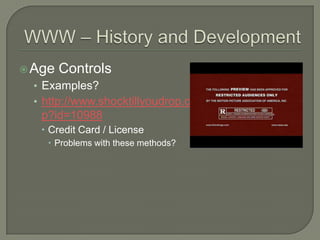
WWW – History and DevelopmentAge ControlsExamples?http://www.shocktillyoudrop.com/news/topnews.php?id=10988Credit Card / License Problems with these methods?
WWW – History and Developmentcensorship:violencesexLanguageThese issues have been in the news recently.R18 classification for video games.Government controlled mandatory internet filter proposed for 2010.Discuss.
WWW – History and DevelopmentCensorshipis the suppression of speech or deletion of communicative material which may be considered objectionable, harmful, sensitive, or inconvenient to the government or media organizations as determined by a censor.http://en.wikipedia.org/wiki/CensorshipThe Australian Communications and Media Authority (ACMA) maintains a blacklist (sites that cannot be viewed).http://www.efa.org.au/Issues/Censor/cens1.html
WWW - ImplicationsUsing the technical knowledge you have on these issues, look at how they relate to their use on the Web.TextGraphicsVideoAudio
WWW - ImplicationsTextfont compatibility, font sets, font substitutiontext as a graphic elementembedded text, eg: open typeTrue typeDef:http://www.dq.winsila.com/miscellaneous/postscript-vs-truetype-vs-opentype-know-the-difference.html
WWWCSS – Cascading Style Sheetsis a style sheet language used to describe the presentation semantics (that is, the look and formatting) of a document written in a mark-up language. Its most common application is to style web pages written in HTML and XHTML.CSS is designed primarily to enable the separation of document content (written in HTML or a similar mark-up language) from document presentation, including elements such as the layout, colours, and fonts. This separation can improve content accessibility, provide more flexibility and control in the specification of presentation characteristics, enable multiple pages to share formatting, and reduce complexity and repetition in the structural content (such as by allowing for tableless web design). http://en.wikipedia.org/wiki/Css
WWW	Hyperlinkis a reference to a document that the reader can directly follow, or that is followed automatically. The reference points to a whole document or to a specific element within a document. Hypertext is text with hyperlinks. Scroll Bar and Buttons
is a graphical object in a GUI with which continuous text, pictures or anything else can be scrolled.
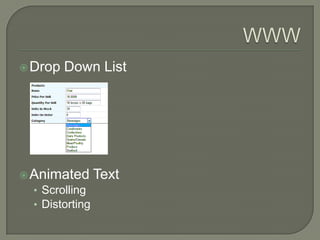
A defined area of the screen, usually designed to look like a pushbutton, which, when clicked with a mouse, will perform a given action, usually represented by an Icon on the button face.WWWDrop Down ListAnimated TextScrollingDistorting
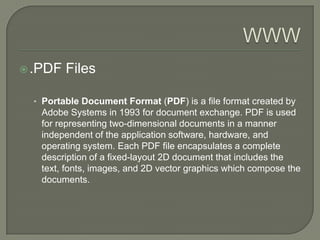
WWW.PDF FilesPortable Document Format (PDF) is a file format created by Adobe Systems in 1993 for document exchange. PDF is used for representing two-dimensional documents in a manner independent of the application software, hardware, and operating system. Each PDF file encapsulates a complete description of a fixed-layout 2D document that includes the text, fonts, images, and 2D vector graphics which compose the documents.
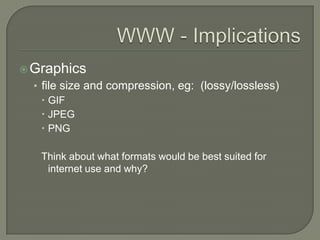
WWW - ImplicationsGraphicsfile size and compression, eg:  (lossy/lossless)GIFJPEGPNGThink about what formats would be best suited for internet use and why?
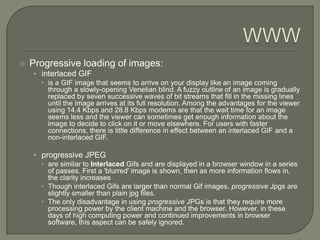
WWWProgressive loading of images: interlaced GIFis a GIF image that seems to arrive on your display like an image coming through a slowly-opening Venetian blind. A fuzzy outline of an image is gradually replaced by seven successive waves of bit streams that fill in the missing lines until the image arrives at its full resolution. Among the advantages for the viewer using 14.4 Kbps and 28.8 Kbps modems are that the wait time for an image seems less and the viewer can sometimes get enough information about the image to decide to click on it or move elsewhere. For users with faster connections, there is little difference in effect between an interlaced GIF and a non-interlaced GIF.progressive JPEGare similar to Interlaced Gifs and are displayed in a browser window in a series of passes. First a 'blurred' image is shown, then as more information flows in, the clarity increasesThough interlaced Gifs are larger than normal Gif images, progressiveJpgs are slightly smaller than plain jpg files. The only disadvantage in using progressive JPGs is that they require more processing power by the client machine and the browser. However, in these days of high computing power and continued improvements in browser software, this aspect can be safely ignored.
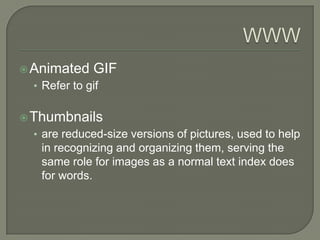
WWWAnimated GIFRefer to gifThumbnailsare reduced-size versions of pictures, used to help in recognizing and organizing them, serving the same role for images as a normal text index does for words.

6 multimedia elements - www

  • 1.
    WWW – Historyand Developmenthttp://webdesign.about.com/cs/historyofhtml/a/aawebhistory.htmhttp://www.walthowe.com/navnet/history.htmlhttp://en.wikipedia.org/wiki/Wwwhttp://en.wikipedia.org/wiki/Web_2.0
  • 2.
    WWW – Historyand Developmentappropriate usagehttp://www.w3.org/“The social value of the Web is that it enables human communication, commerce, and opportunities to share knowledge. One of W3C's primary goals is to make these benefits available to all people, whatever their hardware, software, network infrastructure, native language, culture, geographical location, or physical or mental ability.”“W3C's vision for the Web involves participation, sharing knowledge, and thereby building trust on a global scale.”
  • 3.
    WWW – Historyand Developmentappropriate usageCommon sense. Follow laws of the country. (No online gambling in the US)BehaviourCopyrightAge restrictions
  • 4.
    WWW – Historyand Developmenttargeted audienceThe www if for everyone.However, different sites (content) will be aimed at different people.What problems may arise here?
  • 5.
    WWW – Historyand DevelopmentAge ControlsExamples?http://www.shocktillyoudrop.com/news/topnews.php?id=10988Credit Card / License Problems with these methods?
  • 6.
    WWW – Historyand Developmentcensorship:violencesexLanguageThese issues have been in the news recently.R18 classification for video games.Government controlled mandatory internet filter proposed for 2010.Discuss.
  • 7.
    WWW – Historyand DevelopmentCensorshipis the suppression of speech or deletion of communicative material which may be considered objectionable, harmful, sensitive, or inconvenient to the government or media organizations as determined by a censor.http://en.wikipedia.org/wiki/CensorshipThe Australian Communications and Media Authority (ACMA) maintains a blacklist (sites that cannot be viewed).http://www.efa.org.au/Issues/Censor/cens1.html
  • 8.
    WWW - ImplicationsUsingthe technical knowledge you have on these issues, look at how they relate to their use on the Web.TextGraphicsVideoAudio
  • 9.
    WWW - ImplicationsTextfontcompatibility, font sets, font substitutiontext as a graphic elementembedded text, eg: open typeTrue typeDef:http://www.dq.winsila.com/miscellaneous/postscript-vs-truetype-vs-opentype-know-the-difference.html
  • 10.
    WWWCSS – CascadingStyle Sheetsis a style sheet language used to describe the presentation semantics (that is, the look and formatting) of a document written in a mark-up language. Its most common application is to style web pages written in HTML and XHTML.CSS is designed primarily to enable the separation of document content (written in HTML or a similar mark-up language) from document presentation, including elements such as the layout, colours, and fonts. This separation can improve content accessibility, provide more flexibility and control in the specification of presentation characteristics, enable multiple pages to share formatting, and reduce complexity and repetition in the structural content (such as by allowing for tableless web design). http://en.wikipedia.org/wiki/Css
  • 11.
    WWW Hyperlinkis a referenceto a document that the reader can directly follow, or that is followed automatically. The reference points to a whole document or to a specific element within a document. Hypertext is text with hyperlinks. Scroll Bar and Buttons
  • 12.
    is a graphicalobject in a GUI with which continuous text, pictures or anything else can be scrolled.
  • 13.
    A defined areaof the screen, usually designed to look like a pushbutton, which, when clicked with a mouse, will perform a given action, usually represented by an Icon on the button face.WWWDrop Down ListAnimated TextScrollingDistorting
  • 14.
    WWW.PDF FilesPortable DocumentFormat (PDF) is a file format created by Adobe Systems in 1993 for document exchange. PDF is used for representing two-dimensional documents in a manner independent of the application software, hardware, and operating system. Each PDF file encapsulates a complete description of a fixed-layout 2D document that includes the text, fonts, images, and 2D vector graphics which compose the documents.
  • 15.
    WWW - ImplicationsGraphicsfilesize and compression, eg: (lossy/lossless)GIFJPEGPNGThink about what formats would be best suited for internet use and why?
  • 16.
    WWWProgressive loading ofimages: interlaced GIFis a GIF image that seems to arrive on your display like an image coming through a slowly-opening Venetian blind. A fuzzy outline of an image is gradually replaced by seven successive waves of bit streams that fill in the missing lines until the image arrives at its full resolution. Among the advantages for the viewer using 14.4 Kbps and 28.8 Kbps modems are that the wait time for an image seems less and the viewer can sometimes get enough information about the image to decide to click on it or move elsewhere. For users with faster connections, there is little difference in effect between an interlaced GIF and a non-interlaced GIF.progressive JPEGare similar to Interlaced Gifs and are displayed in a browser window in a series of passes. First a 'blurred' image is shown, then as more information flows in, the clarity increasesThough interlaced Gifs are larger than normal Gif images, progressiveJpgs are slightly smaller than plain jpg files. The only disadvantage in using progressive JPGs is that they require more processing power by the client machine and the browser. However, in these days of high computing power and continued improvements in browser software, this aspect can be safely ignored.
  • 17.
    WWWAnimated GIFRefer togifThumbnailsare reduced-size versions of pictures, used to help in recognizing and organizing them, serving the same role for images as a normal text index does for words.