Introduction to Multimedia
What is Multimedia?
 Derived

from the word “Multi” and “Media”

 Multi
 Many,

Multiple,

 Media
 Tools

that is used to represent or do a certain
things, delivery medium, a form of mass
communication – newspaper, magazine / tv.
 Distribution tool & information presentation – text,
graphic, voice, images, music and etc.
Definition of Multimedia
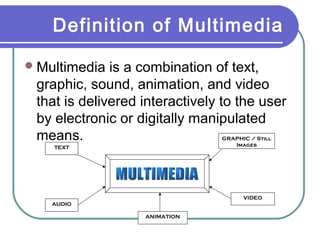
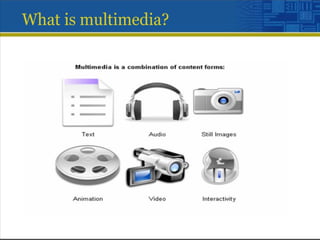
 Multimedia

is a combination of text,
graphic, sound, animation, and video
that is delivered interactively to the user
by electronic or digitally manipulated
means.
GRAPHIC / Still
Images

TEXT

VIDEO
AUDIO
ANIMATION
Elements of Multimedia
GRAPHIC /
Still Images

TEXT

TEXT
VIDEO

AUDIO
ANIMATION






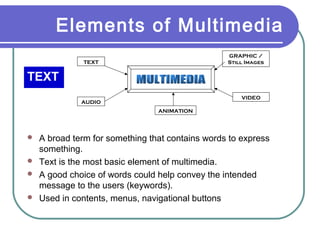
A broad term for something that contains words to express
something.
Text is the most basic element of multimedia.
A good choice of words could help convey the intended
message to the users (keywords).
Used in contents, menus, navigational buttons
Elements of Multimedia
GRAPHIC /
Still Images

TEXT

GRAPHIC
VIDEO

AUDIO
ANIMATION





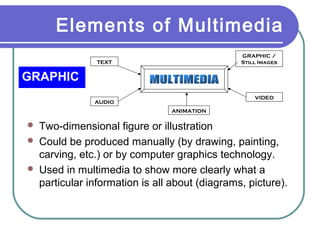
Two-dimensional figure or illustration
Could be produced manually (by drawing, painting,
carving, etc.) or by computer graphics technology.
Used in multimedia to show more clearly what a
particular information is all about (diagrams, picture).
Elements of Multimedia
AUDIO

GRAPHIC /
Still Images

TEXT

VIDEO

AUDIO
ANIMATION

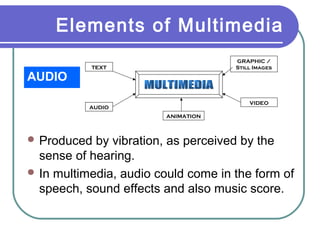
 Produced

by vibration, as perceived by the
sense of hearing.
 In multimedia, audio could come in the form of
speech, sound effects and also music score.
Elements of Multimedia
GRAPHIC /
Still Images

TEXT

ANIMATION
VIDEO

AUDIO
ANIMATION




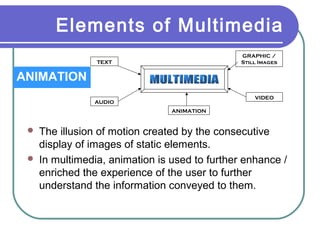
The illusion of motion created by the consecutive
display of images of static elements.
In multimedia, animation is used to further enhance /
enriched the experience of the user to further
understand the information conveyed to them.
Elements of Multimedia
GRAPHIC /
Still Images

TEXT

VIDEO
VIDEO

AUDIO
ANIMATION





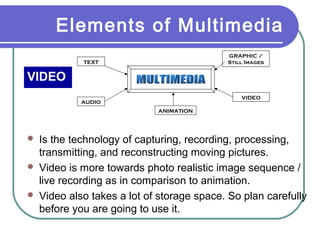
Is the technology of capturing, recording, processing,
transmitting, and reconstructing moving pictures.
Video is more towards photo realistic image sequence /
live recording as in comparison to animation.
Video also takes a lot of storage space. So plan carefully
before you are going to use it.
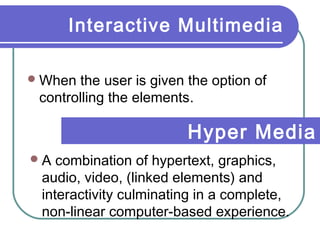
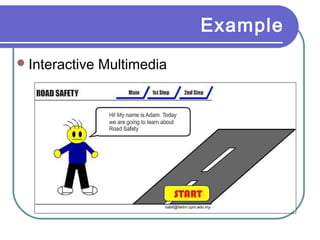
Interactive Multimedia
 When

the user is given the option of
controlling the elements.

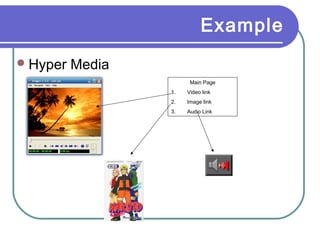
Hyper Media
A

combination of hypertext, graphics,
audio, video, (linked elements) and
interactivity culminating in a complete,
non-linear computer-based experience.
Example
 Interactive

Multimedia
Example
 Hyper

Media
Main Page
1.

Video link

2.

Image link

3.

Audio Link
Linear VS Non-Linear
LINEAR




A Multimedia Project is identified as Linear when:
 It is not interactive
 User have no control over the content that is being showed to
them.
Example:



A movie
A non-interactive lecture / demo show
Linear VS Non-Linear
NON-LINEAR
A Multimedia Project is identified as Non-Linear when:
 It is interactive
 Users have control over the content that is being showed to them.
 Users are given navigational control
 Example:
 Games
 Courseware
 Interactive CD

Authoring Tools




Use to merge multimedia elements (text,
audio, graphic, animation, video) into a
project.
Designed to manage individual multimedia
elements and provide user interaction (if
required).
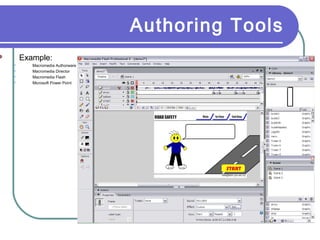
Authoring Tools
Example:







Macromedia Authorware
Macromedia Director
Macromedia Flash
Microsoft Power Point
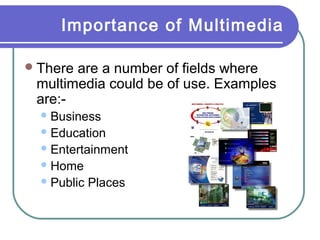
Importance of Multimedia
 There

are a number of fields where
multimedia could be of use. Examples
are: Business
 Education
 Entertainment
 Home
 Public

Places
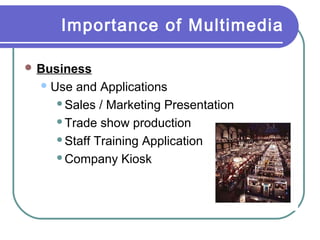
Importance of Multimedia
 Business
 Use

and Applications
Sales / Marketing Presentation
Trade show production
Staff Training Application
Company Kiosk
Importance of Multimedia
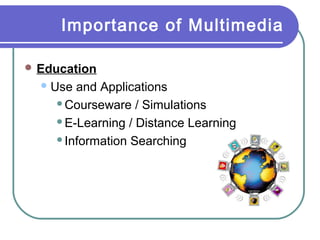
 Education
 Use

and Applications
Courseware / Simulations
E-Learning / Distance Learning
Information Searching
Importance of Multimedia
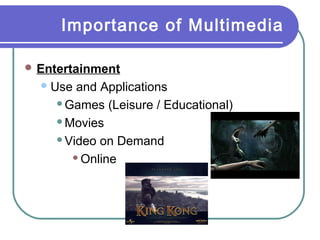
 Entertainment
 Use

and Applications
Games (Leisure / Educational)
Movies
Video on Demand
 Online
Importance of Multimedia
 Home
 Use

and Applications
Television
Satellite TV
SMS services (chats, voting, reality TV)
Importance of Multimedia
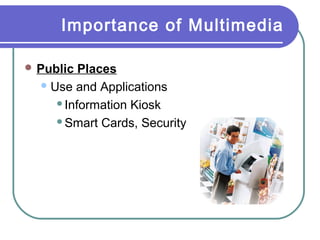
 Public

Places
 Use and Applications
Information Kiosk
Smart Cards, Security
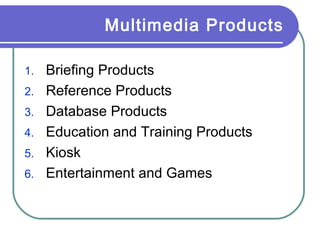
Multimedia Products
1.
2.
3.
4.
5.
6.

Briefing Products
Reference Products
Database Products
Education and Training Products
Kiosk
Entertainment and Games
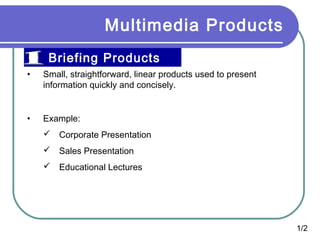
Multimedia Products
Briefing Products
•

Small, straightforward, linear products used to present
information quickly and concisely.

•

Example:
 Corporate Presentation
 Sales Presentation
 Educational Lectures

1/2
Multimedia Products
Reference Products
•
•

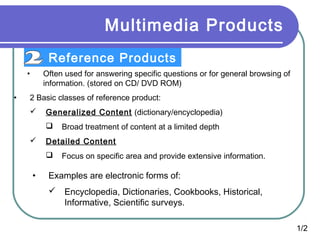
Often used for answering specific questions or for general browsing of
information. (stored on CD/ DVD ROM)

2 Basic classes of reference product:


Generalized Content (dictionary/encyclopedia)




Detailed Content


•

Broad treatment of content at a limited depth
Focus on specific area and provide extensive information.

Examples are electronic forms of:
 Encyclopedia, Dictionaries, Cookbooks, Historical,
Informative, Scientific surveys.
1/2
Multimedia Products
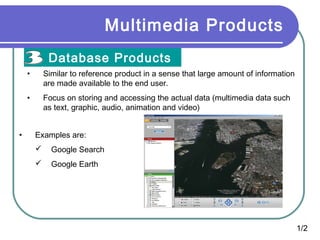
Database Products
•
•

•

Similar to reference product in a sense that large amount of information
are made available to the end user.
Focus on storing and accessing the actual data (multimedia data such
as text, graphic, audio, animation and video)
Examples are:


Google Search



Google Earth

1/2
Multimedia Products
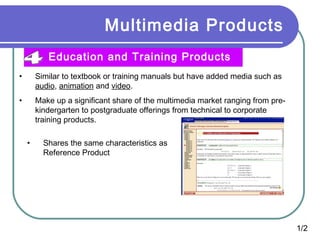
Education and Training Products
•

Similar to textbook or training manuals but have added media such as
audio, animation and video.

•

Make up a significant share of the multimedia market ranging from prekindergarten to postgraduate offerings from technical to corporate
training products.
•

Shares the same characteristics as
Reference Product

1/2
Multimedia Products
Education and Training Products
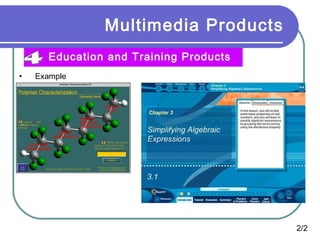
•

Example

2/2
Multimedia Products
Kiosk Products
•

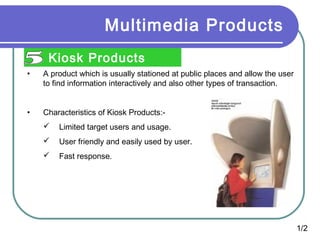
A product which is usually stationed at public places and allow the user
to find information interactively and also other types of transaction.

•

Characteristics of Kiosk Products:

Limited target users and usage.



User friendly and easily used by user.



Fast response.

1/2
Multimedia Products
Entertainment & Games
•

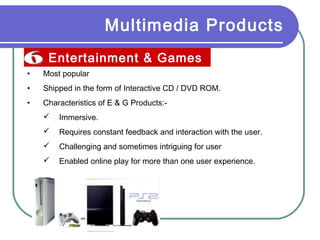
Most popular

•

Shipped in the form of Interactive CD / DVD ROM.

•

Characteristics of E & G Products:

Immersive.



Requires constant feedback and interaction with the user.



Challenging and sometimes intriguing for user


Enabled online play for more than one user experience.

Introduction to multimedia

  • 1.
  • 2.
    What is Multimedia? Derived from the word “Multi” and “Media”  Multi  Many, Multiple,  Media  Tools that is used to represent or do a certain things, delivery medium, a form of mass communication – newspaper, magazine / tv.  Distribution tool & information presentation – text, graphic, voice, images, music and etc.
  • 3.
    Definition of Multimedia Multimedia is a combination of text, graphic, sound, animation, and video that is delivered interactively to the user by electronic or digitally manipulated means. GRAPHIC / Still Images TEXT VIDEO AUDIO ANIMATION
  • 5.
    Elements of Multimedia GRAPHIC/ Still Images TEXT TEXT VIDEO AUDIO ANIMATION     A broad term for something that contains words to express something. Text is the most basic element of multimedia. A good choice of words could help convey the intended message to the users (keywords). Used in contents, menus, navigational buttons
  • 6.
    Elements of Multimedia GRAPHIC/ Still Images TEXT GRAPHIC VIDEO AUDIO ANIMATION    Two-dimensional figure or illustration Could be produced manually (by drawing, painting, carving, etc.) or by computer graphics technology. Used in multimedia to show more clearly what a particular information is all about (diagrams, picture).
  • 7.
    Elements of Multimedia AUDIO GRAPHIC/ Still Images TEXT VIDEO AUDIO ANIMATION  Produced by vibration, as perceived by the sense of hearing.  In multimedia, audio could come in the form of speech, sound effects and also music score.
  • 8.
    Elements of Multimedia GRAPHIC/ Still Images TEXT ANIMATION VIDEO AUDIO ANIMATION   The illusion of motion created by the consecutive display of images of static elements. In multimedia, animation is used to further enhance / enriched the experience of the user to further understand the information conveyed to them.
  • 9.
    Elements of Multimedia GRAPHIC/ Still Images TEXT VIDEO VIDEO AUDIO ANIMATION    Is the technology of capturing, recording, processing, transmitting, and reconstructing moving pictures. Video is more towards photo realistic image sequence / live recording as in comparison to animation. Video also takes a lot of storage space. So plan carefully before you are going to use it.
  • 19.
    Interactive Multimedia  When theuser is given the option of controlling the elements. Hyper Media A combination of hypertext, graphics, audio, video, (linked elements) and interactivity culminating in a complete, non-linear computer-based experience.
  • 20.
  • 21.
    Example  Hyper Media Main Page 1. Videolink 2. Image link 3. Audio Link
  • 22.
    Linear VS Non-Linear LINEAR   AMultimedia Project is identified as Linear when:  It is not interactive  User have no control over the content that is being showed to them. Example:   A movie A non-interactive lecture / demo show
  • 23.
    Linear VS Non-Linear NON-LINEAR AMultimedia Project is identified as Non-Linear when:  It is interactive  Users have control over the content that is being showed to them.  Users are given navigational control  Example:  Games  Courseware  Interactive CD 
  • 24.
    Authoring Tools   Use tomerge multimedia elements (text, audio, graphic, animation, video) into a project. Designed to manage individual multimedia elements and provide user interaction (if required).
  • 25.
  • 26.
    Importance of Multimedia There are a number of fields where multimedia could be of use. Examples are: Business  Education  Entertainment  Home  Public Places
  • 27.
    Importance of Multimedia Business  Use and Applications Sales / Marketing Presentation Trade show production Staff Training Application Company Kiosk
  • 28.
    Importance of Multimedia Education  Use and Applications Courseware / Simulations E-Learning / Distance Learning Information Searching
  • 29.
    Importance of Multimedia Entertainment  Use and Applications Games (Leisure / Educational) Movies Video on Demand  Online
  • 30.
    Importance of Multimedia Home  Use and Applications Television Satellite TV SMS services (chats, voting, reality TV)
  • 31.
    Importance of Multimedia Public Places  Use and Applications Information Kiosk Smart Cards, Security
  • 32.
    Multimedia Products 1. 2. 3. 4. 5. 6. Briefing Products ReferenceProducts Database Products Education and Training Products Kiosk Entertainment and Games
  • 33.
    Multimedia Products Briefing Products • Small,straightforward, linear products used to present information quickly and concisely. • Example:  Corporate Presentation  Sales Presentation  Educational Lectures 1/2
  • 34.
    Multimedia Products Reference Products • • Oftenused for answering specific questions or for general browsing of information. (stored on CD/ DVD ROM) 2 Basic classes of reference product:  Generalized Content (dictionary/encyclopedia)   Detailed Content  • Broad treatment of content at a limited depth Focus on specific area and provide extensive information. Examples are electronic forms of:  Encyclopedia, Dictionaries, Cookbooks, Historical, Informative, Scientific surveys. 1/2
  • 35.
    Multimedia Products Database Products • • • Similarto reference product in a sense that large amount of information are made available to the end user. Focus on storing and accessing the actual data (multimedia data such as text, graphic, audio, animation and video) Examples are:  Google Search  Google Earth 1/2
  • 36.
    Multimedia Products Education andTraining Products • Similar to textbook or training manuals but have added media such as audio, animation and video. • Make up a significant share of the multimedia market ranging from prekindergarten to postgraduate offerings from technical to corporate training products. • Shares the same characteristics as Reference Product 1/2
  • 37.
    Multimedia Products Education andTraining Products • Example 2/2
  • 38.
    Multimedia Products Kiosk Products • Aproduct which is usually stationed at public places and allow the user to find information interactively and also other types of transaction. • Characteristics of Kiosk Products: Limited target users and usage.  User friendly and easily used by user.  Fast response. 1/2
  • 39.
    Multimedia Products Entertainment &Games • Most popular • Shipped in the form of Interactive CD / DVD ROM. • Characteristics of E & G Products: Immersive.  Requires constant feedback and interaction with the user.  Challenging and sometimes intriguing for user  Enabled online play for more than one user experience.