AnimationAnimation is the rapid display of a sequence of images of 2-D or 3-D artwork or model positions in order to create an illusion of movement. It is an optical illusion of motion due to the phenomenon of persistence of vision, and can be created and demonstrated in a number of ways. Animation is the movement of a graphic that is the result of still images placed together in a sequence and run over time
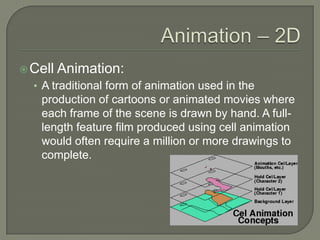
Animation – 2DCell Animation:A traditional form of animation used in the production of cartoons or animated movies where each frame of the scene is drawn by hand. A full-length feature film produced using cell animation would often require a million or more drawings to complete.
Animation – 2DStopmotion/Claymation:Stop-motionis an animation technique to make a physically manipulated object appear to move on its own. The object is moved in small increments between individually photographed frames, creating the illusion of movement when the series of frames is played as a continuous sequence. Clay figures are often used in stop-motion for their ease of repositioning. Stop-motion animation using clay is described as clay animation or clay-mation.http://en.wikipedia.org/wiki/Stop_motion
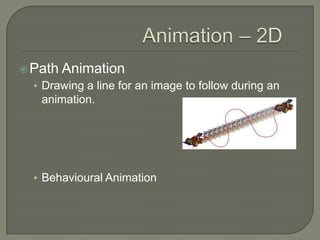
Animation – 2D	Path AnimationDrawing a line for an image to follow during an animation.Behavioural Animation
Animation – 2DMorphingis a special effect in animations that changes (or morphs) one image into another through a seamless transition. Tweening (inbetweening)
is the process of generating intermediate frames between two images to give the appearance that the first image evolves smoothly into the second image. Inbetweens are the drawings between the keyframeswhich help to create the illusion of motion.Animation - 2DFrame Ratesthe number of frames or images that are projected or displayed per second. The higher the number of frames playing per second, the smoother the video playback appears to the user. Lower rates result in a choppy playback. (As a reference point, film uses 24 frames per second to allow the viewer to perceive smooth playback.) Several factors affect the actual frame rate you get on your computer. For example, your PC processor or graphics hardware may only be capable of playing 10-15 frames per second without acceleration. http://searchnetworking.techtarget.com/sDefinition/0,,sid7_gci213531,00.html
Animation – 2DTransitionsWhen you set transitions, you control how animations/slides move from one another.Looping
Try these in flashAnimation – 3D3D animation are digitally modelled and manipulated by an animator. In order to manipulate a mesh, it is given a digital skeletal structure that can be used to control the mesh. This process is called rigging. Modelling3D models are created by manipulating polygon meshes and moulding them into objects, characters and scenes. Model animation is a form of stop motion animation designed to merge with live action footage to create the illusion of a real-world fantasy sequence.
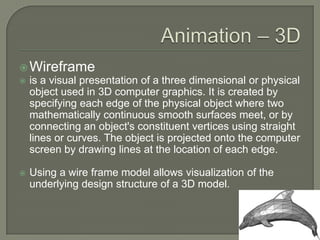
Animation – 3DWireframeis a visual presentation of a three dimensional or physical object used in 3D computer graphics. It is created by specifying each edge of the physical object where two mathematically continuous smooth surfaces meet, or by connecting an object's constituent vertices using straight lines or curves. The object is projected onto the computer screen by drawing lines at the location of each edge.Using a wire frame model allows visualization of the underlying design structure of a 3D model.
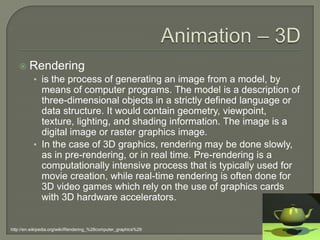
Animation – 3DRenderingis the process of generating an image from a model, by means of computer programs. The model is a description of three-dimensional objects in a strictly defined language or data structure. It would contain geometry, viewpoint, texture, lighting, and shading information. The image is a digital image or raster graphics image. In the case of 3D graphics, rendering may be done slowly, as in pre-rendering, or in real time. Pre-rendering is a computationally intensive process that is typically used for movie creation, while real-time rendering is often done for 3D video games which rely on the use of graphics cards with 3D hardware accelerators.http://en.wikipedia.org/wiki/Rendering_%28computer_graphics%29
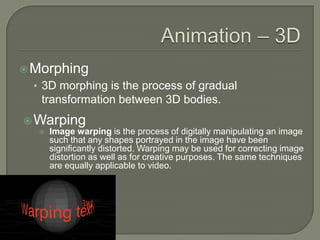
Animation – 3DMorphing3D morphing is the process of gradual transformation between 3D bodies.Warping
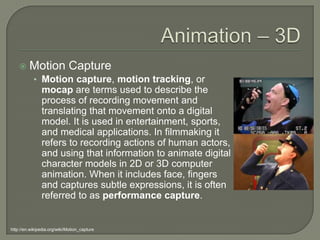
Image warping is the process of digitally manipulating an image such that any shapes portrayed in the image have been significantly distorted. Warping may be used for correcting image distortion as well as for creative purposes. The same techniques are equally applicable to video.Animation – 3DMotion CaptureMotion capture, motion tracking, or mocap are terms used to describe the process of recording movement and translating that movement onto a digital model. It is used in entertainment, sports, and medical applications. In filmmaking it refers to recording actions of human actors, and using that information to animate digital character models in 2D or 3D computer animation. When it includes face, fingers and captures subtle expressions, it is often referred to as performance capture.http://en.wikipedia.org/wiki/Motion_capture
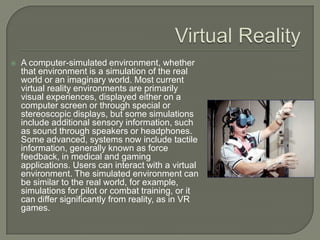
 Virtual RealityA computer-simulated environment, whether that environment is a simulation of the real world or an imaginary world. Most current virtual reality environments are primarily visual experiences, displayed either on a computer screen or through special or stereoscopic displays, but some simulations include additional sensory information, such as sound through speakers or headphones. Some advanced, systems now include tactile information, generally known as force feedback, in medical and gaming applications. Users can interact with a virtual environment. The simulated environment can be similar to the real world, for example, simulations for pilot or combat training, or it can differ significantly from reality, as in VR games.
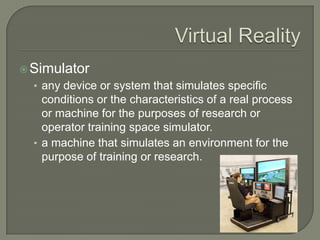
Virtual RealitySimulatorany device or system that simulates specific conditions or the characteristics of a real process or machine for the purposes of research or operator training space simulator.a machine that simulates an environment for the purpose of training or research.
Virtual RealityWalkthroughSee historical sites which allow a user to ‘walkthrough’ museums and castles without ever being there.Can now also be seen in the housing market.http://www.realestate.com.au/cgi-bin/rsearch?a=o&f=0&p=10&t=res&ty=&c=6547288&s=nsw&snf=rbs&tm=1263805478&id=106006416&gts=1&gts-suburb=ROSEBERY,ROSE+BAY|nsw,nsw
Virtual RealityNavigable SceneSee Google street.The ability to move in a virtual world.http://maps.google.com.au/help/maps/streetview/

5 multimedia elements - animation

  • 1.
    AnimationAnimation is therapid display of a sequence of images of 2-D or 3-D artwork or model positions in order to create an illusion of movement. It is an optical illusion of motion due to the phenomenon of persistence of vision, and can be created and demonstrated in a number of ways. Animation is the movement of a graphic that is the result of still images placed together in a sequence and run over time
  • 2.
    Animation – 2DCellAnimation:A traditional form of animation used in the production of cartoons or animated movies where each frame of the scene is drawn by hand. A full-length feature film produced using cell animation would often require a million or more drawings to complete.
  • 3.
    Animation – 2DStopmotion/Claymation:Stop-motionisan animation technique to make a physically manipulated object appear to move on its own. The object is moved in small increments between individually photographed frames, creating the illusion of movement when the series of frames is played as a continuous sequence. Clay figures are often used in stop-motion for their ease of repositioning. Stop-motion animation using clay is described as clay animation or clay-mation.http://en.wikipedia.org/wiki/Stop_motion
  • 4.
    Animation – 2D PathAnimationDrawing a line for an image to follow during an animation.Behavioural Animation
  • 5.
    Animation – 2DMorphingisa special effect in animations that changes (or morphs) one image into another through a seamless transition. Tweening (inbetweening)
  • 6.
    is the processof generating intermediate frames between two images to give the appearance that the first image evolves smoothly into the second image. Inbetweens are the drawings between the keyframeswhich help to create the illusion of motion.Animation - 2DFrame Ratesthe number of frames or images that are projected or displayed per second. The higher the number of frames playing per second, the smoother the video playback appears to the user. Lower rates result in a choppy playback. (As a reference point, film uses 24 frames per second to allow the viewer to perceive smooth playback.) Several factors affect the actual frame rate you get on your computer. For example, your PC processor or graphics hardware may only be capable of playing 10-15 frames per second without acceleration. http://searchnetworking.techtarget.com/sDefinition/0,,sid7_gci213531,00.html
  • 7.
    Animation – 2DTransitionsWhenyou set transitions, you control how animations/slides move from one another.Looping
  • 8.
    Try these inflashAnimation – 3D3D animation are digitally modelled and manipulated by an animator. In order to manipulate a mesh, it is given a digital skeletal structure that can be used to control the mesh. This process is called rigging. Modelling3D models are created by manipulating polygon meshes and moulding them into objects, characters and scenes. Model animation is a form of stop motion animation designed to merge with live action footage to create the illusion of a real-world fantasy sequence.
  • 9.
    Animation – 3DWireframeisa visual presentation of a three dimensional or physical object used in 3D computer graphics. It is created by specifying each edge of the physical object where two mathematically continuous smooth surfaces meet, or by connecting an object's constituent vertices using straight lines or curves. The object is projected onto the computer screen by drawing lines at the location of each edge.Using a wire frame model allows visualization of the underlying design structure of a 3D model.
  • 10.
    Animation – 3DRenderingisthe process of generating an image from a model, by means of computer programs. The model is a description of three-dimensional objects in a strictly defined language or data structure. It would contain geometry, viewpoint, texture, lighting, and shading information. The image is a digital image or raster graphics image. In the case of 3D graphics, rendering may be done slowly, as in pre-rendering, or in real time. Pre-rendering is a computationally intensive process that is typically used for movie creation, while real-time rendering is often done for 3D video games which rely on the use of graphics cards with 3D hardware accelerators.http://en.wikipedia.org/wiki/Rendering_%28computer_graphics%29
  • 11.
    Animation – 3DMorphing3Dmorphing is the process of gradual transformation between 3D bodies.Warping
  • 12.
    Image warping isthe process of digitally manipulating an image such that any shapes portrayed in the image have been significantly distorted. Warping may be used for correcting image distortion as well as for creative purposes. The same techniques are equally applicable to video.Animation – 3DMotion CaptureMotion capture, motion tracking, or mocap are terms used to describe the process of recording movement and translating that movement onto a digital model. It is used in entertainment, sports, and medical applications. In filmmaking it refers to recording actions of human actors, and using that information to animate digital character models in 2D or 3D computer animation. When it includes face, fingers and captures subtle expressions, it is often referred to as performance capture.http://en.wikipedia.org/wiki/Motion_capture
  • 13.
    Virtual RealityAcomputer-simulated environment, whether that environment is a simulation of the real world or an imaginary world. Most current virtual reality environments are primarily visual experiences, displayed either on a computer screen or through special or stereoscopic displays, but some simulations include additional sensory information, such as sound through speakers or headphones. Some advanced, systems now include tactile information, generally known as force feedback, in medical and gaming applications. Users can interact with a virtual environment. The simulated environment can be similar to the real world, for example, simulations for pilot or combat training, or it can differ significantly from reality, as in VR games.
  • 14.
    Virtual RealitySimulatorany deviceor system that simulates specific conditions or the characteristics of a real process or machine for the purposes of research or operator training space simulator.a machine that simulates an environment for the purpose of training or research.
  • 15.
    Virtual RealityWalkthroughSee historicalsites which allow a user to ‘walkthrough’ museums and castles without ever being there.Can now also be seen in the housing market.http://www.realestate.com.au/cgi-bin/rsearch?a=o&f=0&p=10&t=res&ty=&c=6547288&s=nsw&snf=rbs&tm=1263805478&id=106006416&gts=1&gts-suburb=ROSEBERY,ROSE+BAY|nsw,nsw
  • 16.
    Virtual RealityNavigable SceneSeeGoogle street.The ability to move in a virtual world.http://maps.google.com.au/help/maps/streetview/