11/21/2022
Solar Energy
3ME4-05: Renewable Energy Systems
Dr. Tarun Kumar Aseri
Asst. Prof.
Mechanical Engineering Department
Engineering College Ajmer
Email: tarunaseri[at]ecajmer.ac.in
1
Syllabus
• Solar radiation, solar radiation geometry, solar radiation on tilted
surface. Solar energy collector. Flat- plate collector, concentrating
collector - parabolic and heliostat. Solar pond. Basic solar power
plant. Solar cell, solar cell array, basic photo-voltaic power
generating system.
2
Learning Outcomes
Solar Radiation and its Different Angles
Types of Solar Collectors
About Solar Photovoltaic
Solar Power Plants
3
Introduction
• The sun radiates energy uniformly in all directions in the form of
electromagnetic waves.
• When absorbed by a body, it increases its temperature. It provides the
energy needed to sustain life in our solar system.
• It is a clean, inexhaustible, abundantly and universally available
renewable energy source.
• Major drawbacks of solar energy are: it is a dilute form of energy, which
is available intermittently, uncertainly and not steadily and continuously.
4
1 2
3 4
11/21/2022
Introduction
• The energy output of sun is 2.8×10²³kW.
• The energy reaching the earth is 1.5 × 10¹⁸ kWh/year.
• Solar energy can be utilized directly in two ways:
1. by collecting the radiant heat and using it in a thermal system or
2. by collecting and converting it directly to electrical energy
using Photovoltaic system.
• Various sources of energy find their origin in sun and are:
5
• Wind energy • Tidal energy • Hydro energy
• Biomass energy • Ocean wave/thermal
energy
• Fossil fuels and other
organic chemicals
THE SUN AS SOURCE OF ENERGY
• The diameter of sun is 1.39 × 10⁹ m
• An average distance of 1.495 × 10¹¹ m from the earth
• The diameter of earth is about 1.275 × 10⁷ m
• The earth reflects about 30 percent of the sunlight that fall on it and
is known as earth’s albedo
6
SUN, EARTH RADIATION SPECTRUM
• The wavelength distribution of radiation emitted by a black body is given by
Planck’s law:
• where, C1 (3.74 × 10⁻¹⁶ Wm2) and C2 (0.01439 mK) are often called Planck’s
first and second radiation constants respectively.
• λ is the wavelength in m and T is temperature in Kelvin.
• The surface temperature of the sun is considered at 5760 K.
• The surface temperature of the earth is considered at 288 K
7
Solar Constant (Isc)
• Solar Constant, (Isc) is defined as the energy received from the sun per
unit time, on a unit area of surface perpendicular to the direction of
propagation of the radiation, at the earth’s mean distance from the sun.
• The World Radiation Center (WRC) has adopted a value of solar
constant as 1367 W/m2
• This has been accepted universally as a standard value of solar constant.
8
5 6
7 8
11/21/2022
EXTRATERRESTRIAL AND TERRESTRIAL RADIATIONS
• Te extraterrestrial radiation, being outside the
atmosphere, is not affected by changes in atmospheric
conditions.
• While passing through the atmosphere it is subjected to
mechanisms of atmospheric absorption and scattering
depending on atmospheric conditions, depleting its
intensity.
• A fraction of scattered radiation is reflected back to
space while remaining is directed downwards.
• Solar radiation that reaches earth surface after passing
through the earth’s atmosphere is known as Terrestrial
Radiation.
9
• Solar radiation incident on the outer atmosphere of the earth is known as Extraterrestrial Radiation, Iext.
= + . ⁄
where, n is the day of the year starting from January 1
Solar Irradiance
and Solar Insolation
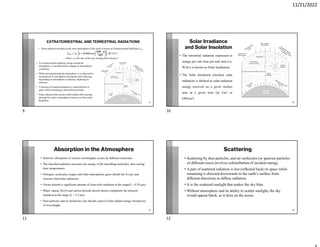
• The terrestrial radiation expressed as
energy per unit time per unit area (i.e.
W/m2) is known as Solar Irradiation.
• The Solar Insolation (incident solar
radiation) is defined as solar radiation
energy received on a given surface
area in a given time (in J/m2 or
kWh/m2)
10
Absorption in the Atmosphere
• Selective absorption of various wavelengths occurs by different molecules.
• The absorbed radiation increases the energy of the absorbing molecules, thus raising
their temperatures
• Nitrogen, molecular oxygen and other atmospheric gases absorb the X-rays and
extreme ultraviolet radiations.
• Ozone absorbs a significant amount of ultraviolet radiation in the range(λ < 0.38 μm)
• Water vapour (H2O) and carbon dioxide absorb almost completely the infrared
radiation in the range (λ > 2.3 μm)
• Dust particles and air molecules also absorb a part of solar radiant energy irrespective
of wavelength.
11
Scattering
• Scattering by dust particles, and air molecules (or gaseous particles
of different sizes) involves redistribution of incident energy.
• A part of scattered radiation is lost (reflected back) to space while
remaining is directed downwards to the earth’s surface from
different directions as diffuse radiation.
• It is the scattered sunlight that makes the sky blue.
• Without atmosphere and its ability to scatter sunlight, the sky
would appear black, as it does on the moon.
12
9 10
11 12
11/21/2022
Scattering
• In cloudy atmosphere
i. a major part of the incoming solar radiation is reflected back into the
atmosphere by the clouds,
ii. another part is absorbed by the clouds and
iii. the rest is transmitted downwards to the earth surface as diffuse
radiation.
• The energy is reflected back to the space by
i. reflection from clouds, plus
ii. scattering by the atmospheric gases and dust particles, plus
iii. the reflection from the earth’s surface is called the albedo of earth-
atmosphere system and has a value of about 30 per cent of the
incoming solar radiation for the earth as a whole.
13
Component of Solar Radiation
• Incoming solar radiation on the earth have following two components
i. direct or beam radiation, unchanged in direction and
ii. diffuse radiation, the direction of which is changed by scattering
and reflection.
• Total radiation at any location on the surface of earth is the sum of
beam radiation and diffuse radiation, what is known as global
radiation.
14
Beam, Diffuse and
Global Radiation
• Beam radiation: Solar radiation
propagating in a straight line and received at
the earth surface without change of
direction, i.e., in line with sun is called
beam or direct radiation.
• Diffuse radiation: Solar radiation scattered
by aerosols, dust and molecules is known as
diffuse radiation. It does not have a unique
direction.
• Global radiation: The sum of beam and
diffuse radiation is referred to as total or
global radiation.
15
Air Mass
• The radiation thus available on earth’s surface is less than that is
received outside the earth’s atmosphere
• Hence, reduction in intensity depends on the atmospheric
conditions (amount of dust particles, water vapour, ozone content,
cloudiness, etc.) and the distance traveled by beam radiation
through atmosphere before it reaches a location on earth’s surface.
Air Mass
16
13 14
15 16
11/21/2022
Air Mass
• The path length of solar beam through the atmosphere is accounted
for in the Air Mass’, which is defined as the ratio of the path length
through the atmosphere, which the solar beam actually traverses up
to the ground to the vertical path length (which is minimum)
through the atmosphere.
• Thus, at sea level the air mass is unity when the sun is at the
‘zenith’(highest position), i.e., when inclination angle α is 90°
17
Air Mass
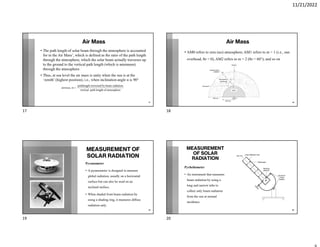
• AM0 refers to zero (no) atmosphere, AM1 refers to m = 1 (i.e., sun
overhead, θz = 0), AM2 refers to m = 2 (θz = 60°); and so on
18
MEASUREMENT OF
SOLAR RADIATION
Pyranometer
• A pyranometer is designed to measure
global radiation, usually on a horizontal
surface but can also be used on an
inclined surface.
• When shaded from beam radiation by
using a shading ring, it measures diffuse
radiation only.
19
MEASUREMENT
OF SOLAR
RADIATION
Pyrheliometer
• An instrument that measures
beam radiation by using a
long and narrow tube to
collect only beam radiation
from the sun at normal
incidence.
20
17 18
19 20
11/21/2022
MEASUREMENT
OF SOLAR
RADIATION
Sunshine recorder
• Tis instrument measures the
duration in hours, of bright
sunshine during the course of
the day
21
SOLAR TIME (LOCAL APPARENT TIME)
• Solar time is measured with reference to solar noon, which is the time when the sun
is crossing observer’s meridian.
• At solar noon the sun is at the highest position in the sky.
• The sun traverses each degree of longitude in 4 minutes (as earth takes 24 hours to
complete one revolution).
• The standard time is converted to solar time by incorporating two corrections, as
follows:
( ) = ± 4 − +
• where Lst and Lloc are the standard longitudes used for measuring standard time of
the country and the longitude of observer’s location, respectively.
• The (+ve) sign is used if the standard meridian of the country lies in western
hemisphere (with reference to prime meridian) and (–ve) if that lies in the eastern
hemisphere.
22
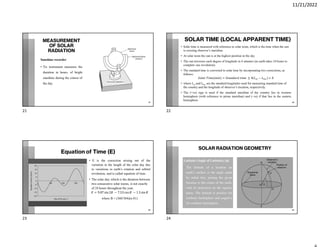
Equation of Time (E)
• E is the correction arising out of the
variation in the length of the solar day due
to variations in earth’s rotation and orbital
revolution, and is called equation of time.
• The solar day, which is the duration between
two consecutive solar noons, is not exactly
of 24 hours throughout the year.
= 9.87 sin 2 − 7.53 cos − 1.5 sin
where B = (360/364)(n-81)
23
SOLAR RADIATION GEOMETRY
Latitude (Angle of Latitude), (ϕ)
• The latitude of a location on
earth’s surface is the angle made
by radial line, joining the given
location to the center of the earth,
with its projection on the equator
plane. The latitude is positive for
northern hemisphere and negative
for southern hemisphere.
24
21 22
23 24
11/21/2022
SOLAR RADIATION GEOMETRY
Declination, (δ)
It is defined as the angular
displacement of the sun from
the plane of earth’s equator. It is
positive when measured above
equatorial plane in the northern
hemisphere.
25
= 23.45 ×
360
365
284 +
SOLAR RADIATION GEOMETRY
Declination, (δ)
It is defined as the angular
displacement of the sun from
the plane of earth’s equator. It is
positive when measured above
equatorial plane in the northern
hemisphere.
26
= 23.45 ×
360
365
284 +
SOLAR RADIATION GEOMETRY
Hour Angle, (ω)
• The hour angle at any moment
is the angle through which the
earth must turn to bring the
meridian of the observer
directly in line with sun’s rays.
• At any moment, it is the
angular displacement of the
sun towards east or west of
local meridian (due to rotation
of the earth on its axis).
27
= 12:00 − × 15
SOLAR RADIATION GEOMETRY
Inclination Angle (Altitude), (α)
• The angle between sun’s ray and its projection on
horizontal surface is known as inclination angle.
Zenith Angle, (θz)
• It is the angle between sun’s ray and
perpendicular (normal) to the horizontal plane.
Solar Azimuth Angle, (γs)
• It is the angle on a horizontal plane, between the
line due south and the projection of sun’s ray on
the horizontal plane. It is taken as +ve when
measured from south towards west.
28
25 26
27 28
11/21/2022
SOLAR RADIATION GEOMETRY
Slope (Tilt Angle), (β)
• It is the angle between inclined plane
surface, under consideration and the
horizontal. It is taken to be +ve for the
surface sloping towards south.
Surface Azimuth Angle, (γ)
• It is the angle in horizontal plane, between
the line due south (OS) and the horizontal
projection of normal to the inclined plane
surface (OQ). It is taken as +ve when
measured from south towards west.
29
SOLAR RADIATION GEOMETRY
30
W E
S
N
α
γs
θz
SOLAR RADIATION GEOMETRY
Angle of Incidence, (θi)
• It is the angle between sun’s ray
incident on the plane surface
(collector) and the normal to that
surface.
31
= cos cos cos cos + sin sin cos
+ cos sin sin sin
+ sin sin cos − cos sin cos
SOLAR RADIATION GEOMETRY
Angle of Incidence, (θi)
• Special Cases
• For surface facing due south, γ = 0
= cos cos cos − + sin sin −
• For horizontal surface, β =0, θi = θz (Zenith angle)
= cos cos cos + sin sin
• For a vertical surface facing due south, γ = 0, β = 90°
= − sin cos + cos cos sin 32
= cos cos cos cos + sin sin cos + cos sin sin sin
+ sin sin cos − cos sin cos
29 30
31 32
11/21/2022
SOLAR DAY LENGTH
• At sunrise the sunrays are parallel to the horizontal surface. Hence
the angle of incidence, θi = θz = 90°, the corresponding hour angle,
ωs
= 0 = cos cos cos + sin sin
= − tan tan
• The positive value corresponds to sunrise while the negative to
sunset
• The hour angle between sunrise and sunset is given by:
2 = 2 − tan tan
= − tan tan hours
33
Example 1
• Calculate the angle of incidence of beam radiation on a plane
surface, tilted by 45° from horizontal plane and pointing 30° west
of south located at Mumbai at 1:30 PM (IST) on 15th November.
The longitude and latitude of Mumbai are 72° 49’ E and 18° 54’ N
respectively. The standard longitude for IST is 81° 44’ E (Khan,
2017. p.135).
• Ans=37.23°
34
Example 2
• Calculate the angle of incidence of beam radiation on a surface
located at Madison, Wisconsin (ϕ=43° N,), at 10:30 (solar time) on
February 13 if the surface is tilted 45° from the horizontal and
pointed 15° west of south (Duffie and Backman, 2013. P.15)
• Ans=35°
35
Example 3 & 4
• Calculate the number of day light hours (sunshine hours) in Srinagar
on January 1 and July 1. The latitude of Srinagar is 34°05’N (Khan,
2017. p.136). Ans=9.77 and 14.24 hours
• For New Delhi (28° 35’ N, 77° 12’ E), calculate the zenith angle of
the sun at 2:30 P.M. on 20 February 2015. The standard IST latitude
for India is 81° 44’ E (Khan, 2017. p.136). Ans = 42.557°
36
33 34
35 36
11/21/2022
Extraterrestrial Solar Radiation on Horizontal Surface
• At any point of time, the solar radiation outside the atmosphere (Iext) incident on a
horizontal plane is:
= + .
Or = + . cos cos cos + sin sin
Radiation between sunrise to sunset
=
×
+ . cos sin cos
+
2
360
sin sin
37
SOLAR RADIATION ON INCLINED PLANE SURFACE
• Total radiation incident on an inclined surface consists of three
components:
• (i) beam radiation, (ii) diffuse radiation and (iii) radiation reflected
from ground and surroundings.
• Both beam and diffuse components of radiation undergo reflection
from the ground and surroundings. Total radiation on a surface of
arbitrary orientation may be evaluated as:
= + + +
• where rb, rd and rr are known as tilt factors for beam, diffuse and
reflected components respectively.
38
SOLAR RADIATION ON INCLINED PLANE SURFACE
• rb: It is defined as the ratio of flux of beam radiation
incident on an inclined surface (Ib’) to that on a
horizontal surface (Ib).
= cos
= cos
where, Ibn is the beam radiation on a surface normal to
the direction of sunrays
= =
cos
cos
• For a tilted surface facing south, γ = 0°
=
cos cos cos − + sin sin −
cos cos cos + sin sin
39
Ib
Ibn
Ib
’
Ibn
β
θi
θz
SOLAR RADIATION ON INCLINED PLANE SURFACE
• rd: It is defined as the ratio of flux of diffuse radiation
falling on inclined surface to that on the horizontal surface.
The value of this tilt factor depends upon the distribution of
diffuse radiation over the sky and on the portion of the sky
dome seen by the tilted surface.
=
1 + cos
2
• rr: The reflected component comes mainly from the ground
and surrounding objects. Assume that the reflection of the
beam and diffuse radiation falling on the ground is diffuse
and isotropic and the reflectivity is ρ, the tilt factor for
reflected radiation may be written as:
=
1 − cos
2
40
Ib
’
Ibn
β
θi
where r is reflection coefficient of the ground (equal to 0.2 for ordinary grass or concrete and 0.6
for snow-covered ground respectively)
37 38
39 40
11/21/2022
SOLAR RADIATION ON INCLINED PLANE SURFACE
• For vertical surface, b = 90°, rd = 0.5 and rr = 0.5ρ (This indicates that
half of the diffuse and half of the total reflected radiation is received
by a vertical surface).
• For horizontal plane, rd = 1 and rr = 0, which indicates that maximum
diffuse radiation is received by horizontal surface and that a
horizontal surface receives no ground reflected radiation.
• The ratio r’ of total solar energy incident on an inclined surface to
that on a horizontal surface is given as:
=
+
=
Replace = + + +
=
+
+
41
Ib
’
Ibn
Ib
Ibn
Example 5 & 6
• Calculate Rb for a surface at latitude 40° N at a tilt 30◦ toward the
south for the hour 9 to 10 solar time on February 16 (Duffie and
Backman, 2013. p.28). Ans – 1.61.
• Calculate Rb for a latitude 40° N at a tilt of 50° toward the south for
the hour 9 to 10 solar time on February 16 (Duffie and Backman,
2013. p.28). Ans – 1.79.
42
Example
• Determine the values of total incident radiation and ratio r’ with the following given data
• Latitude (ϕ) = 28°51’, Day of the year = October 6, 1995
• Surface azimuth angle (γ) = 0°, Inclination of the surface(β) =45°
• Reflectivity of ground (ρ) = 0.2 (Ref. Tiwari, 2013, p. 26)
43
Time
Radiation on horizontal surface
(W/m2)
Observed
radiation
on inclined
surface
(W/m2)
Hour angle
(deg)
Calculated
radiation
on inclined
surface
(W/m2)
Calculated
r’
Total Diffuse Beam
09 AM 472.44 174.94 297.50 570.65 -45
10 AM 647.41 203.30 444.11 753.70 -30
11 AM 752.40 222.22 530.18 839.83 -15
12 Noon 769.70 231.00 538.70 832.90 0
01PM 752.40 236.40 516.00 872.90 +15
Thank You
44
41 42
43 44

Solar Energy_Handouts.pdf

  • 1.
    11/21/2022 Solar Energy 3ME4-05: RenewableEnergy Systems Dr. Tarun Kumar Aseri Asst. Prof. Mechanical Engineering Department Engineering College Ajmer Email: tarunaseri[at]ecajmer.ac.in 1 Syllabus • Solar radiation, solar radiation geometry, solar radiation on tilted surface. Solar energy collector. Flat- plate collector, concentrating collector - parabolic and heliostat. Solar pond. Basic solar power plant. Solar cell, solar cell array, basic photo-voltaic power generating system. 2 Learning Outcomes Solar Radiation and its Different Angles Types of Solar Collectors About Solar Photovoltaic Solar Power Plants 3 Introduction • The sun radiates energy uniformly in all directions in the form of electromagnetic waves. • When absorbed by a body, it increases its temperature. It provides the energy needed to sustain life in our solar system. • It is a clean, inexhaustible, abundantly and universally available renewable energy source. • Major drawbacks of solar energy are: it is a dilute form of energy, which is available intermittently, uncertainly and not steadily and continuously. 4 1 2 3 4
  • 2.
    11/21/2022 Introduction • The energyoutput of sun is 2.8×10²³kW. • The energy reaching the earth is 1.5 × 10¹⁸ kWh/year. • Solar energy can be utilized directly in two ways: 1. by collecting the radiant heat and using it in a thermal system or 2. by collecting and converting it directly to electrical energy using Photovoltaic system. • Various sources of energy find their origin in sun and are: 5 • Wind energy • Tidal energy • Hydro energy • Biomass energy • Ocean wave/thermal energy • Fossil fuels and other organic chemicals THE SUN AS SOURCE OF ENERGY • The diameter of sun is 1.39 × 10⁹ m • An average distance of 1.495 × 10¹¹ m from the earth • The diameter of earth is about 1.275 × 10⁷ m • The earth reflects about 30 percent of the sunlight that fall on it and is known as earth’s albedo 6 SUN, EARTH RADIATION SPECTRUM • The wavelength distribution of radiation emitted by a black body is given by Planck’s law: • where, C1 (3.74 × 10⁻¹⁶ Wm2) and C2 (0.01439 mK) are often called Planck’s first and second radiation constants respectively. • λ is the wavelength in m and T is temperature in Kelvin. • The surface temperature of the sun is considered at 5760 K. • The surface temperature of the earth is considered at 288 K 7 Solar Constant (Isc) • Solar Constant, (Isc) is defined as the energy received from the sun per unit time, on a unit area of surface perpendicular to the direction of propagation of the radiation, at the earth’s mean distance from the sun. • The World Radiation Center (WRC) has adopted a value of solar constant as 1367 W/m2 • This has been accepted universally as a standard value of solar constant. 8 5 6 7 8
  • 3.
    11/21/2022 EXTRATERRESTRIAL AND TERRESTRIALRADIATIONS • Te extraterrestrial radiation, being outside the atmosphere, is not affected by changes in atmospheric conditions. • While passing through the atmosphere it is subjected to mechanisms of atmospheric absorption and scattering depending on atmospheric conditions, depleting its intensity. • A fraction of scattered radiation is reflected back to space while remaining is directed downwards. • Solar radiation that reaches earth surface after passing through the earth’s atmosphere is known as Terrestrial Radiation. 9 • Solar radiation incident on the outer atmosphere of the earth is known as Extraterrestrial Radiation, Iext. = + . ⁄ where, n is the day of the year starting from January 1 Solar Irradiance and Solar Insolation • The terrestrial radiation expressed as energy per unit time per unit area (i.e. W/m2) is known as Solar Irradiation. • The Solar Insolation (incident solar radiation) is defined as solar radiation energy received on a given surface area in a given time (in J/m2 or kWh/m2) 10 Absorption in the Atmosphere • Selective absorption of various wavelengths occurs by different molecules. • The absorbed radiation increases the energy of the absorbing molecules, thus raising their temperatures • Nitrogen, molecular oxygen and other atmospheric gases absorb the X-rays and extreme ultraviolet radiations. • Ozone absorbs a significant amount of ultraviolet radiation in the range(λ < 0.38 μm) • Water vapour (H2O) and carbon dioxide absorb almost completely the infrared radiation in the range (λ > 2.3 μm) • Dust particles and air molecules also absorb a part of solar radiant energy irrespective of wavelength. 11 Scattering • Scattering by dust particles, and air molecules (or gaseous particles of different sizes) involves redistribution of incident energy. • A part of scattered radiation is lost (reflected back) to space while remaining is directed downwards to the earth’s surface from different directions as diffuse radiation. • It is the scattered sunlight that makes the sky blue. • Without atmosphere and its ability to scatter sunlight, the sky would appear black, as it does on the moon. 12 9 10 11 12
  • 4.
    11/21/2022 Scattering • In cloudyatmosphere i. a major part of the incoming solar radiation is reflected back into the atmosphere by the clouds, ii. another part is absorbed by the clouds and iii. the rest is transmitted downwards to the earth surface as diffuse radiation. • The energy is reflected back to the space by i. reflection from clouds, plus ii. scattering by the atmospheric gases and dust particles, plus iii. the reflection from the earth’s surface is called the albedo of earth- atmosphere system and has a value of about 30 per cent of the incoming solar radiation for the earth as a whole. 13 Component of Solar Radiation • Incoming solar radiation on the earth have following two components i. direct or beam radiation, unchanged in direction and ii. diffuse radiation, the direction of which is changed by scattering and reflection. • Total radiation at any location on the surface of earth is the sum of beam radiation and diffuse radiation, what is known as global radiation. 14 Beam, Diffuse and Global Radiation • Beam radiation: Solar radiation propagating in a straight line and received at the earth surface without change of direction, i.e., in line with sun is called beam or direct radiation. • Diffuse radiation: Solar radiation scattered by aerosols, dust and molecules is known as diffuse radiation. It does not have a unique direction. • Global radiation: The sum of beam and diffuse radiation is referred to as total or global radiation. 15 Air Mass • The radiation thus available on earth’s surface is less than that is received outside the earth’s atmosphere • Hence, reduction in intensity depends on the atmospheric conditions (amount of dust particles, water vapour, ozone content, cloudiness, etc.) and the distance traveled by beam radiation through atmosphere before it reaches a location on earth’s surface. Air Mass 16 13 14 15 16
  • 5.
    11/21/2022 Air Mass • Thepath length of solar beam through the atmosphere is accounted for in the Air Mass’, which is defined as the ratio of the path length through the atmosphere, which the solar beam actually traverses up to the ground to the vertical path length (which is minimum) through the atmosphere. • Thus, at sea level the air mass is unity when the sun is at the ‘zenith’(highest position), i.e., when inclination angle α is 90° 17 Air Mass • AM0 refers to zero (no) atmosphere, AM1 refers to m = 1 (i.e., sun overhead, θz = 0), AM2 refers to m = 2 (θz = 60°); and so on 18 MEASUREMENT OF SOLAR RADIATION Pyranometer • A pyranometer is designed to measure global radiation, usually on a horizontal surface but can also be used on an inclined surface. • When shaded from beam radiation by using a shading ring, it measures diffuse radiation only. 19 MEASUREMENT OF SOLAR RADIATION Pyrheliometer • An instrument that measures beam radiation by using a long and narrow tube to collect only beam radiation from the sun at normal incidence. 20 17 18 19 20
  • 6.
    11/21/2022 MEASUREMENT OF SOLAR RADIATION Sunshine recorder •Tis instrument measures the duration in hours, of bright sunshine during the course of the day 21 SOLAR TIME (LOCAL APPARENT TIME) • Solar time is measured with reference to solar noon, which is the time when the sun is crossing observer’s meridian. • At solar noon the sun is at the highest position in the sky. • The sun traverses each degree of longitude in 4 minutes (as earth takes 24 hours to complete one revolution). • The standard time is converted to solar time by incorporating two corrections, as follows: ( ) = ± 4 − + • where Lst and Lloc are the standard longitudes used for measuring standard time of the country and the longitude of observer’s location, respectively. • The (+ve) sign is used if the standard meridian of the country lies in western hemisphere (with reference to prime meridian) and (–ve) if that lies in the eastern hemisphere. 22 Equation of Time (E) • E is the correction arising out of the variation in the length of the solar day due to variations in earth’s rotation and orbital revolution, and is called equation of time. • The solar day, which is the duration between two consecutive solar noons, is not exactly of 24 hours throughout the year. = 9.87 sin 2 − 7.53 cos − 1.5 sin where B = (360/364)(n-81) 23 SOLAR RADIATION GEOMETRY Latitude (Angle of Latitude), (ϕ) • The latitude of a location on earth’s surface is the angle made by radial line, joining the given location to the center of the earth, with its projection on the equator plane. The latitude is positive for northern hemisphere and negative for southern hemisphere. 24 21 22 23 24
  • 7.
    11/21/2022 SOLAR RADIATION GEOMETRY Declination,(δ) It is defined as the angular displacement of the sun from the plane of earth’s equator. It is positive when measured above equatorial plane in the northern hemisphere. 25 = 23.45 × 360 365 284 + SOLAR RADIATION GEOMETRY Declination, (δ) It is defined as the angular displacement of the sun from the plane of earth’s equator. It is positive when measured above equatorial plane in the northern hemisphere. 26 = 23.45 × 360 365 284 + SOLAR RADIATION GEOMETRY Hour Angle, (ω) • The hour angle at any moment is the angle through which the earth must turn to bring the meridian of the observer directly in line with sun’s rays. • At any moment, it is the angular displacement of the sun towards east or west of local meridian (due to rotation of the earth on its axis). 27 = 12:00 − × 15 SOLAR RADIATION GEOMETRY Inclination Angle (Altitude), (α) • The angle between sun’s ray and its projection on horizontal surface is known as inclination angle. Zenith Angle, (θz) • It is the angle between sun’s ray and perpendicular (normal) to the horizontal plane. Solar Azimuth Angle, (γs) • It is the angle on a horizontal plane, between the line due south and the projection of sun’s ray on the horizontal plane. It is taken as +ve when measured from south towards west. 28 25 26 27 28
  • 8.
    11/21/2022 SOLAR RADIATION GEOMETRY Slope(Tilt Angle), (β) • It is the angle between inclined plane surface, under consideration and the horizontal. It is taken to be +ve for the surface sloping towards south. Surface Azimuth Angle, (γ) • It is the angle in horizontal plane, between the line due south (OS) and the horizontal projection of normal to the inclined plane surface (OQ). It is taken as +ve when measured from south towards west. 29 SOLAR RADIATION GEOMETRY 30 W E S N α γs θz SOLAR RADIATION GEOMETRY Angle of Incidence, (θi) • It is the angle between sun’s ray incident on the plane surface (collector) and the normal to that surface. 31 = cos cos cos cos + sin sin cos + cos sin sin sin + sin sin cos − cos sin cos SOLAR RADIATION GEOMETRY Angle of Incidence, (θi) • Special Cases • For surface facing due south, γ = 0 = cos cos cos − + sin sin − • For horizontal surface, β =0, θi = θz (Zenith angle) = cos cos cos + sin sin • For a vertical surface facing due south, γ = 0, β = 90° = − sin cos + cos cos sin 32 = cos cos cos cos + sin sin cos + cos sin sin sin + sin sin cos − cos sin cos 29 30 31 32
  • 9.
    11/21/2022 SOLAR DAY LENGTH •At sunrise the sunrays are parallel to the horizontal surface. Hence the angle of incidence, θi = θz = 90°, the corresponding hour angle, ωs = 0 = cos cos cos + sin sin = − tan tan • The positive value corresponds to sunrise while the negative to sunset • The hour angle between sunrise and sunset is given by: 2 = 2 − tan tan = − tan tan hours 33 Example 1 • Calculate the angle of incidence of beam radiation on a plane surface, tilted by 45° from horizontal plane and pointing 30° west of south located at Mumbai at 1:30 PM (IST) on 15th November. The longitude and latitude of Mumbai are 72° 49’ E and 18° 54’ N respectively. The standard longitude for IST is 81° 44’ E (Khan, 2017. p.135). • Ans=37.23° 34 Example 2 • Calculate the angle of incidence of beam radiation on a surface located at Madison, Wisconsin (ϕ=43° N,), at 10:30 (solar time) on February 13 if the surface is tilted 45° from the horizontal and pointed 15° west of south (Duffie and Backman, 2013. P.15) • Ans=35° 35 Example 3 & 4 • Calculate the number of day light hours (sunshine hours) in Srinagar on January 1 and July 1. The latitude of Srinagar is 34°05’N (Khan, 2017. p.136). Ans=9.77 and 14.24 hours • For New Delhi (28° 35’ N, 77° 12’ E), calculate the zenith angle of the sun at 2:30 P.M. on 20 February 2015. The standard IST latitude for India is 81° 44’ E (Khan, 2017. p.136). Ans = 42.557° 36 33 34 35 36
  • 10.
    11/21/2022 Extraterrestrial Solar Radiationon Horizontal Surface • At any point of time, the solar radiation outside the atmosphere (Iext) incident on a horizontal plane is: = + . Or = + . cos cos cos + sin sin Radiation between sunrise to sunset = × + . cos sin cos + 2 360 sin sin 37 SOLAR RADIATION ON INCLINED PLANE SURFACE • Total radiation incident on an inclined surface consists of three components: • (i) beam radiation, (ii) diffuse radiation and (iii) radiation reflected from ground and surroundings. • Both beam and diffuse components of radiation undergo reflection from the ground and surroundings. Total radiation on a surface of arbitrary orientation may be evaluated as: = + + + • where rb, rd and rr are known as tilt factors for beam, diffuse and reflected components respectively. 38 SOLAR RADIATION ON INCLINED PLANE SURFACE • rb: It is defined as the ratio of flux of beam radiation incident on an inclined surface (Ib’) to that on a horizontal surface (Ib). = cos = cos where, Ibn is the beam radiation on a surface normal to the direction of sunrays = = cos cos • For a tilted surface facing south, γ = 0° = cos cos cos − + sin sin − cos cos cos + sin sin 39 Ib Ibn Ib ’ Ibn β θi θz SOLAR RADIATION ON INCLINED PLANE SURFACE • rd: It is defined as the ratio of flux of diffuse radiation falling on inclined surface to that on the horizontal surface. The value of this tilt factor depends upon the distribution of diffuse radiation over the sky and on the portion of the sky dome seen by the tilted surface. = 1 + cos 2 • rr: The reflected component comes mainly from the ground and surrounding objects. Assume that the reflection of the beam and diffuse radiation falling on the ground is diffuse and isotropic and the reflectivity is ρ, the tilt factor for reflected radiation may be written as: = 1 − cos 2 40 Ib ’ Ibn β θi where r is reflection coefficient of the ground (equal to 0.2 for ordinary grass or concrete and 0.6 for snow-covered ground respectively) 37 38 39 40
  • 11.
    11/21/2022 SOLAR RADIATION ONINCLINED PLANE SURFACE • For vertical surface, b = 90°, rd = 0.5 and rr = 0.5ρ (This indicates that half of the diffuse and half of the total reflected radiation is received by a vertical surface). • For horizontal plane, rd = 1 and rr = 0, which indicates that maximum diffuse radiation is received by horizontal surface and that a horizontal surface receives no ground reflected radiation. • The ratio r’ of total solar energy incident on an inclined surface to that on a horizontal surface is given as: = + = Replace = + + + = + + 41 Ib ’ Ibn Ib Ibn Example 5 & 6 • Calculate Rb for a surface at latitude 40° N at a tilt 30◦ toward the south for the hour 9 to 10 solar time on February 16 (Duffie and Backman, 2013. p.28). Ans – 1.61. • Calculate Rb for a latitude 40° N at a tilt of 50° toward the south for the hour 9 to 10 solar time on February 16 (Duffie and Backman, 2013. p.28). Ans – 1.79. 42 Example • Determine the values of total incident radiation and ratio r’ with the following given data • Latitude (ϕ) = 28°51’, Day of the year = October 6, 1995 • Surface azimuth angle (γ) = 0°, Inclination of the surface(β) =45° • Reflectivity of ground (ρ) = 0.2 (Ref. Tiwari, 2013, p. 26) 43 Time Radiation on horizontal surface (W/m2) Observed radiation on inclined surface (W/m2) Hour angle (deg) Calculated radiation on inclined surface (W/m2) Calculated r’ Total Diffuse Beam 09 AM 472.44 174.94 297.50 570.65 -45 10 AM 647.41 203.30 444.11 753.70 -30 11 AM 752.40 222.22 530.18 839.83 -15 12 Noon 769.70 231.00 538.70 832.90 0 01PM 752.40 236.40 516.00 872.90 +15 Thank You 44 41 42 43 44