From:- Amitesh 
kumar
 The World Meteorological Organization (WMO) 
defines “Sunshine” as direct irradiance from 
the sun measured on the ground of at least 120 
w/m². 
 Direct Sunlight gives about 93 lux of 
illumination per watt of electromagnetic power. 
 Bright sunlight provides illumination of approx. 
100,000 lux/Sq.m at Earth’s surface. 
 Sun’s surface temperature, T = 6000k. 
 About sun’s total radiated energy, 
Ultraviolet region(λ<0.40μm) - 8.73%. 
Visible region (o.40μm<λ<0.70μm) – 38.15%. 
Infrared region (λ>0.70μm) – 53.12%.
 Earth’s inner core is a solid made of iron and 
nickel. 
 2/3 of earth is covered with water rest 1/3 is 
land. 
 It reflects 1/3 of the sunlight received. 
 Earth is inclined about its axis at an angle of 
23.5º. 
 The earth’s atmosphere absorbs the UV & 
infrared radiation and allows only radiation 
having λ between 0.29μm and 2.3μm (Short 
wavelength radiation). 
 Radiation of λ>2.3μm is not allowed.
 Photovoltaic (PV device) – A device used to 
convert SWR into direct current(dc) electricity. 
 Solar still – used for desalination for saline 
water. 
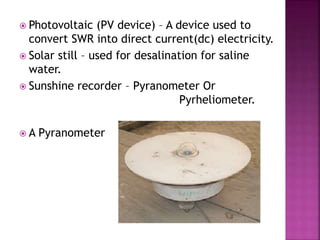
 Sunshine recorder – Pyranometer Or 
Pyrheliometer. 
 A Pyranometer
 Solar radiation reaching earth is classified into 
two components : Beam & Diffuse radiation. 
 Beam radiation(Iь) – Direct Sunlight. 
 Diffuse radiation (Id) – solar radiation scattered 
by aerosols, dust and molecules. 
 Total radiation (It) – (Iь+Id) also known as global 
radiation. 
 Pyrheliometer – broadband instrument that 
measures the direct component of solar 
radiation at normal incidence. It is sensitive to 
λ’s in the band from 0.284μm to 0.3μm. 
 Sensor - Thermopile.
 Pyranometer – is a type of actinometer used 
to measure solar irradiance. It is designed to 
measure solar radiation flux density (in 
w/m²) from a view of 180º. 
 Silicon solar cells have the property that the 
light current (approx. equal to Isc at normal 
radiation) is a linear function of the incident 
solar radiation. But their spectral response is 
not linear.
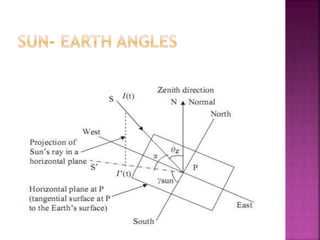
 Where, θz = is Zenith angle, 
α = solar altitude (is Zero at sunrise & 
sunset), 
α + θz = 90º. 
γsun = solar Azimuth angle. 
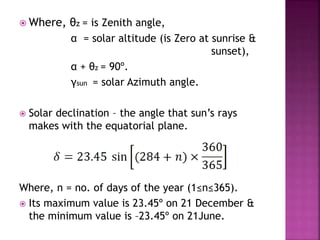
 Solar declination – the angle that sun’s rays 
makes with the equatorial plane. 
Where, n = no. of days of the year (1≤n≤365). 
 Its maximum value is 23.45º on 21 December & 
the minimum value is –23.45º on 21June.

Solar radiation -

  • 1.
  • 2.
     The WorldMeteorological Organization (WMO) defines “Sunshine” as direct irradiance from the sun measured on the ground of at least 120 w/m².  Direct Sunlight gives about 93 lux of illumination per watt of electromagnetic power.  Bright sunlight provides illumination of approx. 100,000 lux/Sq.m at Earth’s surface.  Sun’s surface temperature, T = 6000k.  About sun’s total radiated energy, Ultraviolet region(λ<0.40μm) - 8.73%. Visible region (o.40μm<λ<0.70μm) – 38.15%. Infrared region (λ>0.70μm) – 53.12%.
  • 3.
     Earth’s innercore is a solid made of iron and nickel.  2/3 of earth is covered with water rest 1/3 is land.  It reflects 1/3 of the sunlight received.  Earth is inclined about its axis at an angle of 23.5º.  The earth’s atmosphere absorbs the UV & infrared radiation and allows only radiation having λ between 0.29μm and 2.3μm (Short wavelength radiation).  Radiation of λ>2.3μm is not allowed.
  • 4.
     Photovoltaic (PVdevice) – A device used to convert SWR into direct current(dc) electricity.  Solar still – used for desalination for saline water.  Sunshine recorder – Pyranometer Or Pyrheliometer.  A Pyranometer
  • 5.
     Solar radiationreaching earth is classified into two components : Beam & Diffuse radiation.  Beam radiation(Iь) – Direct Sunlight.  Diffuse radiation (Id) – solar radiation scattered by aerosols, dust and molecules.  Total radiation (It) – (Iь+Id) also known as global radiation.  Pyrheliometer – broadband instrument that measures the direct component of solar radiation at normal incidence. It is sensitive to λ’s in the band from 0.284μm to 0.3μm.  Sensor - Thermopile.
  • 6.
     Pyranometer –is a type of actinometer used to measure solar irradiance. It is designed to measure solar radiation flux density (in w/m²) from a view of 180º.  Silicon solar cells have the property that the light current (approx. equal to Isc at normal radiation) is a linear function of the incident solar radiation. But their spectral response is not linear.
  • 8.
     Where, θz= is Zenith angle, α = solar altitude (is Zero at sunrise & sunset), α + θz = 90º. γsun = solar Azimuth angle.  Solar declination – the angle that sun’s rays makes with the equatorial plane. Where, n = no. of days of the year (1≤n≤365).  Its maximum value is 23.45º on 21 December & the minimum value is –23.45º on 21June.