Milankovitch Cycle 
Lecture 2
Milankovitch Cycle 
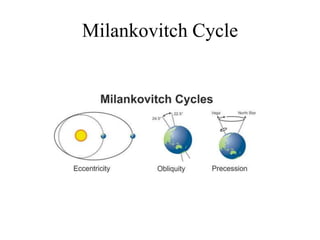
The Milankovitch or astronomical theory of 
climate change is an explanation for changes 
in the seasons which result from changes in the 
earth's orbit around the sun. The theory is 
named for Serbian astronomer Milutin 
Milankovitch
Milankovitch Cycle 
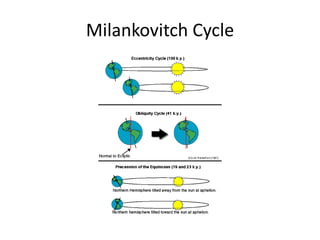
Eccentricity 
Obliquity 
Precession
Eccentricity 
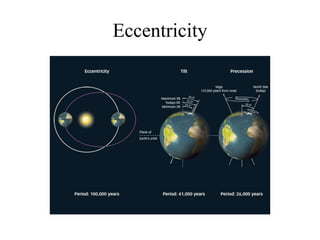
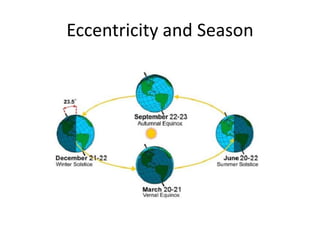
Eccentricity is a term used to describe the shape of Earth's orbit 
around the sun. The variation of Earth's orbit around the sun 
ranges from an almost exact circle (eccentricity = 0.0005) to a 
slightly elongated shape (eccentricity = 0.0607). 
The impact of the variation is a change in the amount of solar 
energy from perihelion (around January 3) to aphelion (around 
July 4).
Eccentricity
Eccentricity 
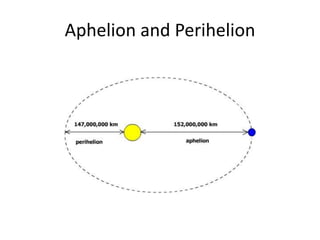
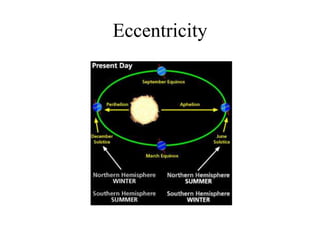
• The Earth's orbit around the Sun, like other 
planet's orbits, is not a perfect circle. It is an 
ellipse. This means that the Earth is closer to 
and further away from the Sun at different 
times in the year. 
• Perihelion - when the Earth is closest to the 
Sun (usually happens in January) 
• Aphelion - when the Earth is furthest from the 
Sun (usually happens in June)
Aphelion and Perihelion
Eccentricity
Eccentricity
Eccentricity
Eccentricity and Season
Eccentricity
Obliquity 
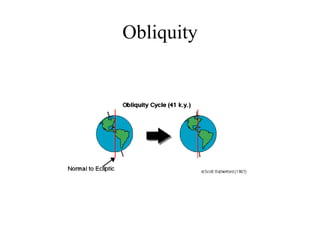
Obliquity is the variation of the tilt of the earth's 
axis away from the orbital plane. The tilt 
varies between 22.1o and 24.5o and the average 
is 23.5o 
The obliquity changes on a cycle taking 
approximately 40,000 years
Obliquity 
Currently, the axis of rotation for the earth is 
tilted at 23.5° 
However, this value changes from a minimum of 
22.5° to a maximum of 24.5° and takes 41,000 
years to complete one cycle
Obliquity
Obliquity
Obliquity
Obliquity 
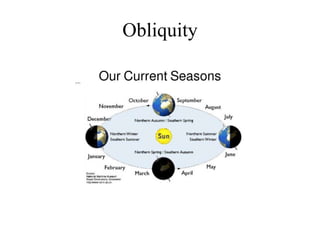
The more tilt means more severe seasons - 
warmer summers and colder winters; less tilt 
means less severe seasons - cooler summers 
and milder winters
Obliquity
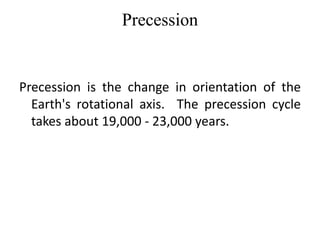
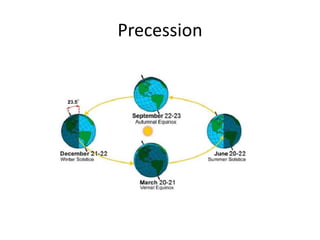
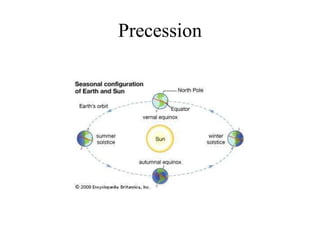
Precession 
Precession is the change in orientation of the 
Earth's rotational axis. The precession cycle 
takes about 19,000 - 23,000 years.
Precession
Precession
Precession
Precession
Milankovitch Cycle
Milankovitch Cycle
Milankovitch Cycle
Milankovitch Cycle
Milankovitch Cycle
References 
• http://www.physicalgeography.net/fundamen 
tals/7y.html

Milankovitch theory

Editor's Notes

  • #29 ptation   Climate mitigation is any action taken to permanently eliminate or reduce the long-term risk and hazards of climate change to human life, property. The International Panel on Climate Change (IPCC) defines mitigation as: “An anthropogenic intervention to reduce the sources or enhance the sinks of greenhouse gases.” Climate Mitigation and Adaptation Climate adaptation refers to the ability of a system to adjust to climate change (including climate variability and extremes) to moderate potential damage, to take advantage of opportunities, or to cope with the consequences. The IPCC defines adaptation as the, “adjustment in natural or human systems to a new or changing environment. Adaptation to climate change refers to adjustment in natural or human systems in response to actual or expected climatic stimuli or their effects, which moderates harm or exploits beneficial opportunities. Various types of adaptation can be distinguished, including anticipatory and reactive adaptation, private and public adaptation, and autonomous and planned adaptation.”