
SOLAR RADIATION
MEASUREMENT
-VANITA THAKKAR
ASSOCIATE PROFESSOR,
MECHANICAL ENGINEERING DEPARTMENT,
BABARIA INSTITUTE OF TECHNOLOGY, VARNAMA,
VADODARA.
VANITA N. THAKKAR - BIT, VARNAMA 2
PYRANOMETER
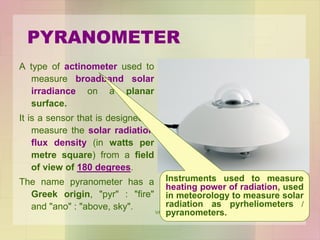
A type of actinometer used to
measure broadband solar
irradiance on a planar
surface.
It is a sensor that is designed to
measure the solar radiation
flux density (in watts per
metre square) from a field
of view of 180 degrees.
The name pyranometer has a
Greek origin, "pyr" : "fire"
and "ano" : "above, sky".
Instruments used to measure
heating power of radiation, used
in meteorology to measure solar
radiation as pyrheliometers /
pyranometers.
VANITA N. THAKKAR - BIT, VARNAMA 3
PYRANOMETER (contd.)
Full response when
solar radiation hits the
sensor perpendicularly
– normal to surface,
sun at zenith
Zero response when
sun is at the horizon
(angle of incidence =
zenith angle = 90o)
0.5 response at 60o
angle of incidence.
Solar radiation spectrum : ~ 300
to 2,800 nm.
Pyranometers have a spectral
sensitivity that is as “flat” as
possible.
For Irradiance measurement : by
definition – response to
“beam” radiation varies with
the cosine of angle of
incidence.
Thus, Pyranometer needs to
have a so-called “directional
response” or “cosine
response” that is close to the
ideal cosine characteristic.
VANITA N. THAKKAR - BIT, VARNAMA 4
PYRANOMETER (contd.)
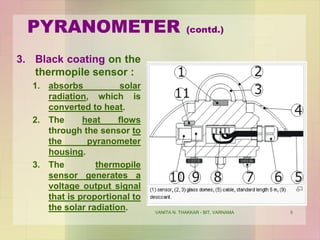
MAIN COMPONENTS :
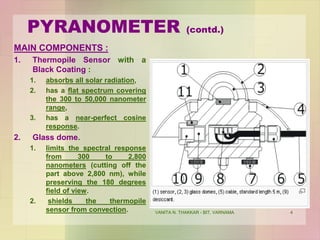
1. Thermopile Sensor with a
Black Coating :
1. absorbs all solar radiation,
2. has a flat spectrum covering
the 300 to 50,000 nanometer
range,
3. has a near-perfect cosine
response.
2. Glass dome.
1. limits the spectral response
from 300 to 2,800
nanometers (cutting off the
part above 2,800 nm), while
preserving the 180 degrees
field of view.
2. shields the thermopile
sensor from convection.
VANITA N. THAKKAR - BIT, VARNAMA 5
PYRANOMETER (contd.)
3. Black coating on the
thermopile sensor :
1. absorbs solar
radiation, which is
converted to heat.
2. The heat flows
through the sensor to
the pyranometer
housing.
3. The thermopile
sensor generates a
voltage output signal
that is proportional to
the solar radiation.
VANITA N. THAKKAR - BIT, VARNAMA 6
PYRANOMETER (contd.)
APPLICATIONS :
Pyranometers are frequently used in
1. Meteorology : They can be seen in many meteorological stations -
typically installed horizontally and next to solar panels - typically
mounted with the sensor surface in the plane of the panel.
2. Climatology
3. Solar Energy Studies
4. Building Physics
STANDARDIZATION :
• Pyranometers are standardized according to the ISO 9060 standard, that
is also adopted by the World Meteorological Organization (WMO).
• This standard discriminates three classes. The best is (confusingly) called
"secondary standard" the second best "first class" and the last one
"second class"
• Calibration is typically done relative to World Radiometric Reference
(WRR). This reference is maintained by in Davos, Switzerland.
VANITA N. THAKKAR - BIT, VARNAMA 7
PYRHELIOMETER
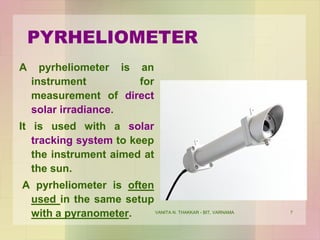
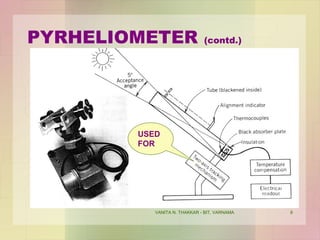
A pyrheliometer is an
instrument for
measurement of direct
solar irradiance.
It is used with a solar
tracking system to keep
the instrument aimed at
the sun.
A pyrheliometer is often
used in the same setup
with a pyranometer.
VANITA N. THAKKAR - BIT, VARNAMA 8
PYRHELIOMETER (contd.)
USED
FOR
VANITA N. THAKKAR - BIT, VARNAMA 9
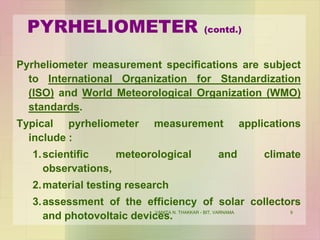
PYRHELIOMETER (contd.)
Pyrheliometer measurement specifications are subject
to International Organization for Standardization
(ISO) and World Meteorological Organization (WMO)
standards.
Typical pyrheliometer measurement applications
include :
1.scientific meteorological and climate
observations,
2.material testing research
3.assessment of the efficiency of solar collectors
and photovoltaic devices.
VANITA N. THAKKAR - BIT, VARNAMA 10
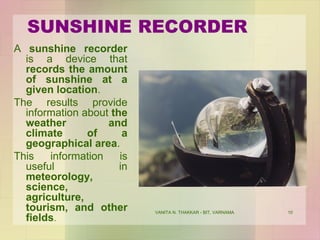
SUNSHINE RECORDER
A sunshine recorder
is a device that
records the amount
of sunshine at a
given location.
The results provide
information about the
weather and
climate of a
geographical area.
This information is
useful in
meteorology,
science,
agriculture,
tourism, and other
fields.
VANITA N. THAKKAR - BIT, VARNAMA 11
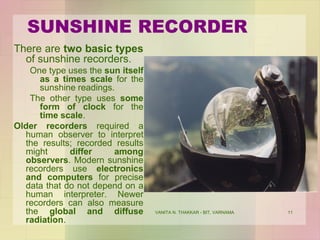
SUNSHINE RECORDER
There are two basic types
of sunshine recorders.
One type uses the sun itself
as a times scale for the
sunshine readings.
The other type uses some
form of clock for the
time scale.
Older recorders required a
human observer to interpret
the results; recorded results
might differ among
observers. Modern sunshine
recorders use electronics
and computers for precise
data that do not depend on a
human interpreter. Newer
recorders can also measure
the global and diffuse
radiation.
VANITA N. THAKKAR - BIT, VARNAMA 12
THANKS !!

SOLAR RADIATION MEASUREMENT

  • 1.
    SOLAR RADIATION MEASUREMENT -VANITA THAKKAR ASSOCIATEPROFESSOR, MECHANICAL ENGINEERING DEPARTMENT, BABARIA INSTITUTE OF TECHNOLOGY, VARNAMA, VADODARA.
  • 2.
    VANITA N. THAKKAR- BIT, VARNAMA 2 PYRANOMETER A type of actinometer used to measure broadband solar irradiance on a planar surface. It is a sensor that is designed to measure the solar radiation flux density (in watts per metre square) from a field of view of 180 degrees. The name pyranometer has a Greek origin, "pyr" : "fire" and "ano" : "above, sky". Instruments used to measure heating power of radiation, used in meteorology to measure solar radiation as pyrheliometers / pyranometers.
  • 3.
    VANITA N. THAKKAR- BIT, VARNAMA 3 PYRANOMETER (contd.) Full response when solar radiation hits the sensor perpendicularly – normal to surface, sun at zenith Zero response when sun is at the horizon (angle of incidence = zenith angle = 90o) 0.5 response at 60o angle of incidence. Solar radiation spectrum : ~ 300 to 2,800 nm. Pyranometers have a spectral sensitivity that is as “flat” as possible. For Irradiance measurement : by definition – response to “beam” radiation varies with the cosine of angle of incidence. Thus, Pyranometer needs to have a so-called “directional response” or “cosine response” that is close to the ideal cosine characteristic.
  • 4.
    VANITA N. THAKKAR- BIT, VARNAMA 4 PYRANOMETER (contd.) MAIN COMPONENTS : 1. Thermopile Sensor with a Black Coating : 1. absorbs all solar radiation, 2. has a flat spectrum covering the 300 to 50,000 nanometer range, 3. has a near-perfect cosine response. 2. Glass dome. 1. limits the spectral response from 300 to 2,800 nanometers (cutting off the part above 2,800 nm), while preserving the 180 degrees field of view. 2. shields the thermopile sensor from convection.
  • 5.
    VANITA N. THAKKAR- BIT, VARNAMA 5 PYRANOMETER (contd.) 3. Black coating on the thermopile sensor : 1. absorbs solar radiation, which is converted to heat. 2. The heat flows through the sensor to the pyranometer housing. 3. The thermopile sensor generates a voltage output signal that is proportional to the solar radiation.
  • 6.
    VANITA N. THAKKAR- BIT, VARNAMA 6 PYRANOMETER (contd.) APPLICATIONS : Pyranometers are frequently used in 1. Meteorology : They can be seen in many meteorological stations - typically installed horizontally and next to solar panels - typically mounted with the sensor surface in the plane of the panel. 2. Climatology 3. Solar Energy Studies 4. Building Physics STANDARDIZATION : • Pyranometers are standardized according to the ISO 9060 standard, that is also adopted by the World Meteorological Organization (WMO). • This standard discriminates three classes. The best is (confusingly) called "secondary standard" the second best "first class" and the last one "second class" • Calibration is typically done relative to World Radiometric Reference (WRR). This reference is maintained by in Davos, Switzerland.
  • 7.
    VANITA N. THAKKAR- BIT, VARNAMA 7 PYRHELIOMETER A pyrheliometer is an instrument for measurement of direct solar irradiance. It is used with a solar tracking system to keep the instrument aimed at the sun. A pyrheliometer is often used in the same setup with a pyranometer.
  • 8.
    VANITA N. THAKKAR- BIT, VARNAMA 8 PYRHELIOMETER (contd.) USED FOR
  • 9.
    VANITA N. THAKKAR- BIT, VARNAMA 9 PYRHELIOMETER (contd.) Pyrheliometer measurement specifications are subject to International Organization for Standardization (ISO) and World Meteorological Organization (WMO) standards. Typical pyrheliometer measurement applications include : 1.scientific meteorological and climate observations, 2.material testing research 3.assessment of the efficiency of solar collectors and photovoltaic devices.
  • 10.
    VANITA N. THAKKAR- BIT, VARNAMA 10 SUNSHINE RECORDER A sunshine recorder is a device that records the amount of sunshine at a given location. The results provide information about the weather and climate of a geographical area. This information is useful in meteorology, science, agriculture, tourism, and other fields.
  • 11.
    VANITA N. THAKKAR- BIT, VARNAMA 11 SUNSHINE RECORDER There are two basic types of sunshine recorders. One type uses the sun itself as a times scale for the sunshine readings. The other type uses some form of clock for the time scale. Older recorders required a human observer to interpret the results; recorded results might differ among observers. Modern sunshine recorders use electronics and computers for precise data that do not depend on a human interpreter. Newer recorders can also measure the global and diffuse radiation.
  • 12.
    VANITA N. THAKKAR- BIT, VARNAMA 12 THANKS !!