
Cardiopulmonary Resuscitation
(Basic and Advanced Cardiac Life
Support)
David Maldonado MD
Mayo Clinic
Rochester, MN, USA
Agenda
• Cardiac Arrest
• Basic Life Support
• Advanced Cardiac Life Support for
Pulseless Arrest
• Ventricular Fibrillation (VF)
• Pulseless Ventricular Tachycardia (VT)
• Asystole
• Pulseless Electrical Activity (PEA)
• Algorithms
Cardiac Arrest
• Sudden loss of heart function
• With or without prior history of heart
disease
• May lead to death within minutes
• In U.S. up to 750,000 cardiac arrests with
attempted resuscitation every year
• 225,000 deaths
Causes of Cardiac Arrest
• Most commonly coronary artery disease
• Electrical impulses become too rapid
(ventricular tachycardia) or chaotic
(ventricular fibrillation)
• Also from profound bradycardia,
respiratory arrest/choking/drowning,
electrocution, trauma and other causes
• May also occur without any known cause
Americanheart.org
• Brain death begins within 4-6 minutes
• Cardiac arrest can be reversed within
minutes
• Chances of survival decrease 7-10% every
minute without CPR or defibrillation (not
including cold-water drowning)
• Early & effective CPR and early &
appropriate defibrillation are keys to
management
Americanheart.org
Cardiopulmonary Resuscitation (CPR)
Basic Life Support (BLS)
• Chest Compressions and Rescue
Breathing for person felt to be in cardiac
arrest
• To provide blood flow to brain and heart
• Maintain end-organ perfusion during arrest
• May still likely require defibrillation or
definitive treatment of ACLS
(anti-arrhythmic medications, fluid
resuscitation, electrolyte restoration, etc.)
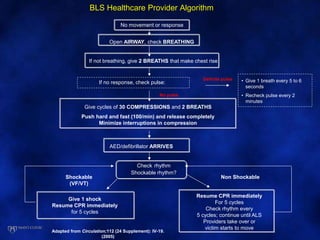
BLS Healthcare Provider Algorithm
No movement or response
Open AIRWAY, check BREATHING
If not breathing, give 2 BREATHS that make chest rise
• Give 1 breath every 5 to 6
seconds
• Recheck pulse every 2
minutes
If no response, check pulse:
Definite pulse
Give cycles of 30 COMPRESSIONS and 2 BREATHS
Push hard and fast (100/min) and release completely
Minimize interruptions in compression
No pulse
AED/defibrillator ARRIVES
Check rhythm
Shockable rhythm?
Give 1 shock
Resume CPR immediately
for 5 cycles
Resume CPR immediately
For 5 cycles
Check rhythm every
5 cycles; continue until ALS
Providers take over or
victim starts to move
Shockable
(VF/VT)
Non Shockable
Adapted from Circulation;112 (24 Supplement): IV-19.
(2005)
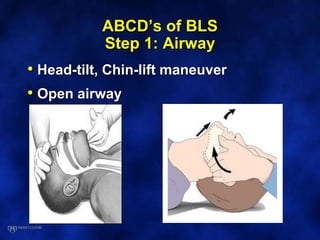
ABCD’s of BLS
Step 1: Airway
• Head-tilt, Chin-lift maneuver
• Open airway
Step 2: Breathing
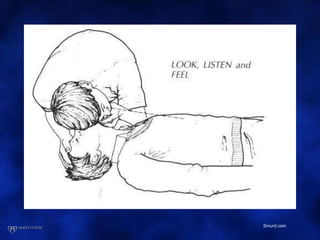
Look, listen, and feel
• Look for chest rise
• Listen for normal breath sounds
• Feel air flow with cheek or hand
• If not detected within 10 seconds, give 2
rescue breaths, then proceed to next step
• Each breath for 1 second
• Visible chest rise
• Bag-mask, mouth-to-mask, mouth-to-
mouth
Smurd.com
Step 3: Circulation
Check Pulse
• Pulse present: give 1 breath every 5-6
seconds
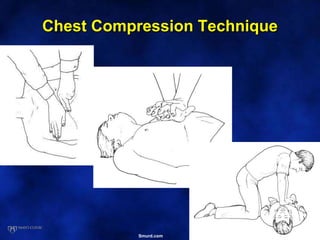
• Pulse absent: deliver effective chest
compressions
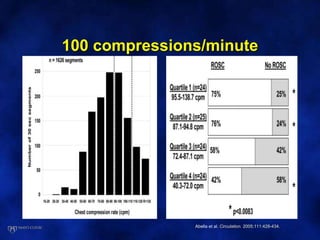
• “Push hard and fast”
• 100 compressions/minute
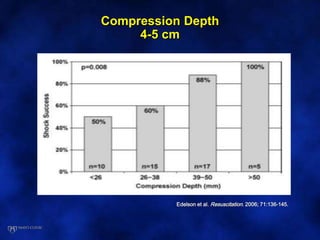
• 4-5 cm depth
• Complete chest recoil
• 30 compressions : 2 breaths = 1 cycle
Chest Compression Technique
Smurd.com
100 compressions/minute
Abella et al. Circulation. 2005;111:428-434.
Compression Depth
4-5 cm
Edelson et al. Resuscitation. 2006; 71:136-145.
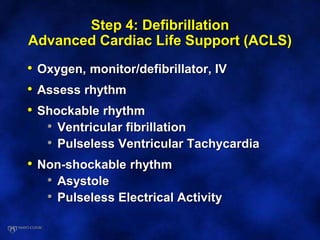
Step 4: Defibrillation
Advanced Cardiac Life Support (ACLS)
• Oxygen, monitor/defibrillator, IV
• Assess rhythm
• Shockable rhythm
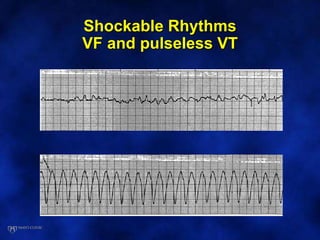
• Ventricular fibrillation
• Pulseless Ventricular Tachycardia
• Non-shockable rhythm
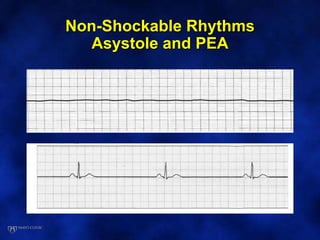
• Asystole
• Pulseless Electrical Activity
Shockable Rhythms
VF and pulseless VT
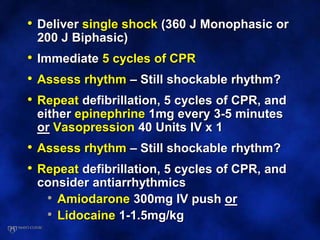
• Deliver single shock (360 J Monophasic or
200 J Biphasic)
• Immediate 5 cycles of CPR
• Assess rhythm – Still shockable rhythm?
• Repeat defibrillation, 5 cycles of CPR, and
either epinephrine 1mg every 3-5 minutes
or Vasopression 40 Units IV x 1
• Assess rhythm – Still shockable rhythm?
• Repeat defibrillation, 5 cycles of CPR, and
consider antiarrhythmics
• Amiodarone 300mg IV push or
• Lidocaine 1-1.5mg/kg
Non-Shockable Rhythms
Asystole and PEA
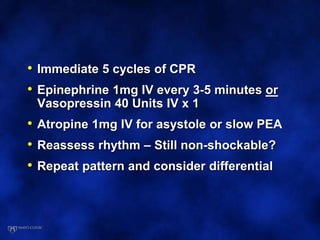
• Immediate 5 cycles of CPR
• Epinephrine 1mg IV every 3-5 minutes or
Vasopressin 40 Units IV x 1
• Atropine 1mg IV for asystole or slow PEA
• Reassess rhythm – Still non-shockable?
• Repeat pattern and consider differential
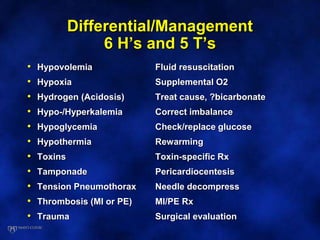
Differential/Management
6 H’s and 5 T’s
• Hypovolemia Fluid resuscitation
• Hypoxia Supplemental O2
• Hydrogen (Acidosis) Treat cause, ?bicarbonate
• Hypo-/Hyperkalemia Correct imbalance
• Hypoglycemia Check/replace glucose
• Hypothermia Rewarming
• Toxins Toxin-specific Rx
• Tamponade Pericardiocentesis
• Tension Pneumothorax Needle decompress
• Thrombosis (MI or PE) MI/PE Rx
• Trauma Surgical evaluation
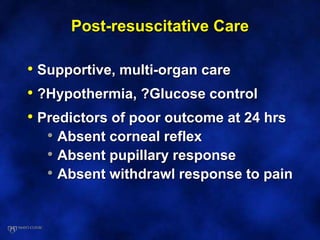
Post-resuscitative Care
• Supportive, multi-organ care
• ?Hypothermia, ?Glucose control
• Predictors of poor outcome at 24 hrs
• Absent corneal reflex
• Absent pupillary response
• Absent withdrawl response to pain
6  acls

6 acls

  • 1.
    Cardiopulmonary Resuscitation (Basic andAdvanced Cardiac Life Support) David Maldonado MD Mayo Clinic Rochester, MN, USA
  • 2.
    Agenda • Cardiac Arrest •Basic Life Support • Advanced Cardiac Life Support for Pulseless Arrest • Ventricular Fibrillation (VF) • Pulseless Ventricular Tachycardia (VT) • Asystole • Pulseless Electrical Activity (PEA) • Algorithms
  • 3.
    Cardiac Arrest • Suddenloss of heart function • With or without prior history of heart disease • May lead to death within minutes • In U.S. up to 750,000 cardiac arrests with attempted resuscitation every year • 225,000 deaths
  • 4.
    Causes of CardiacArrest • Most commonly coronary artery disease • Electrical impulses become too rapid (ventricular tachycardia) or chaotic (ventricular fibrillation) • Also from profound bradycardia, respiratory arrest/choking/drowning, electrocution, trauma and other causes • May also occur without any known cause Americanheart.org
  • 5.
    • Brain deathbegins within 4-6 minutes • Cardiac arrest can be reversed within minutes • Chances of survival decrease 7-10% every minute without CPR or defibrillation (not including cold-water drowning) • Early & effective CPR and early & appropriate defibrillation are keys to management Americanheart.org
  • 6.
    Cardiopulmonary Resuscitation (CPR) BasicLife Support (BLS) • Chest Compressions and Rescue Breathing for person felt to be in cardiac arrest • To provide blood flow to brain and heart • Maintain end-organ perfusion during arrest • May still likely require defibrillation or definitive treatment of ACLS (anti-arrhythmic medications, fluid resuscitation, electrolyte restoration, etc.)
  • 7.
    BLS Healthcare ProviderAlgorithm No movement or response Open AIRWAY, check BREATHING If not breathing, give 2 BREATHS that make chest rise • Give 1 breath every 5 to 6 seconds • Recheck pulse every 2 minutes If no response, check pulse: Definite pulse Give cycles of 30 COMPRESSIONS and 2 BREATHS Push hard and fast (100/min) and release completely Minimize interruptions in compression No pulse AED/defibrillator ARRIVES Check rhythm Shockable rhythm? Give 1 shock Resume CPR immediately for 5 cycles Resume CPR immediately For 5 cycles Check rhythm every 5 cycles; continue until ALS Providers take over or victim starts to move Shockable (VF/VT) Non Shockable Adapted from Circulation;112 (24 Supplement): IV-19. (2005)
  • 8.
    ABCD’s of BLS Step1: Airway • Head-tilt, Chin-lift maneuver • Open airway
  • 9.
    Step 2: Breathing Look,listen, and feel • Look for chest rise • Listen for normal breath sounds • Feel air flow with cheek or hand • If not detected within 10 seconds, give 2 rescue breaths, then proceed to next step • Each breath for 1 second • Visible chest rise • Bag-mask, mouth-to-mask, mouth-to- mouth
  • 10.
  • 11.
    Step 3: Circulation CheckPulse • Pulse present: give 1 breath every 5-6 seconds • Pulse absent: deliver effective chest compressions • “Push hard and fast” • 100 compressions/minute • 4-5 cm depth • Complete chest recoil • 30 compressions : 2 breaths = 1 cycle
  • 12.
  • 13.
    100 compressions/minute Abella etal. Circulation. 2005;111:428-434.
  • 14.
    Compression Depth 4-5 cm Edelsonet al. Resuscitation. 2006; 71:136-145.
  • 15.
    Step 4: Defibrillation AdvancedCardiac Life Support (ACLS) • Oxygen, monitor/defibrillator, IV • Assess rhythm • Shockable rhythm • Ventricular fibrillation • Pulseless Ventricular Tachycardia • Non-shockable rhythm • Asystole • Pulseless Electrical Activity
  • 16.
  • 17.
    • Deliver singleshock (360 J Monophasic or 200 J Biphasic) • Immediate 5 cycles of CPR • Assess rhythm – Still shockable rhythm? • Repeat defibrillation, 5 cycles of CPR, and either epinephrine 1mg every 3-5 minutes or Vasopression 40 Units IV x 1 • Assess rhythm – Still shockable rhythm? • Repeat defibrillation, 5 cycles of CPR, and consider antiarrhythmics • Amiodarone 300mg IV push or • Lidocaine 1-1.5mg/kg
  • 18.
  • 19.
    • Immediate 5cycles of CPR • Epinephrine 1mg IV every 3-5 minutes or Vasopressin 40 Units IV x 1 • Atropine 1mg IV for asystole or slow PEA • Reassess rhythm – Still non-shockable? • Repeat pattern and consider differential
  • 20.
    Differential/Management 6 H’s and5 T’s • Hypovolemia Fluid resuscitation • Hypoxia Supplemental O2 • Hydrogen (Acidosis) Treat cause, ?bicarbonate • Hypo-/Hyperkalemia Correct imbalance • Hypoglycemia Check/replace glucose • Hypothermia Rewarming • Toxins Toxin-specific Rx • Tamponade Pericardiocentesis • Tension Pneumothorax Needle decompress • Thrombosis (MI or PE) MI/PE Rx • Trauma Surgical evaluation
  • 21.
    Post-resuscitative Care • Supportive,multi-organ care • ?Hypothermia, ?Glucose control • Predictors of poor outcome at 24 hrs • Absent corneal reflex • Absent pupillary response • Absent withdrawl response to pain