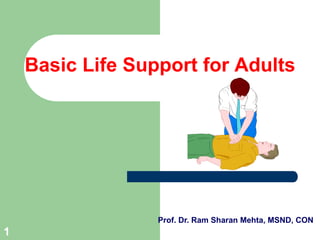
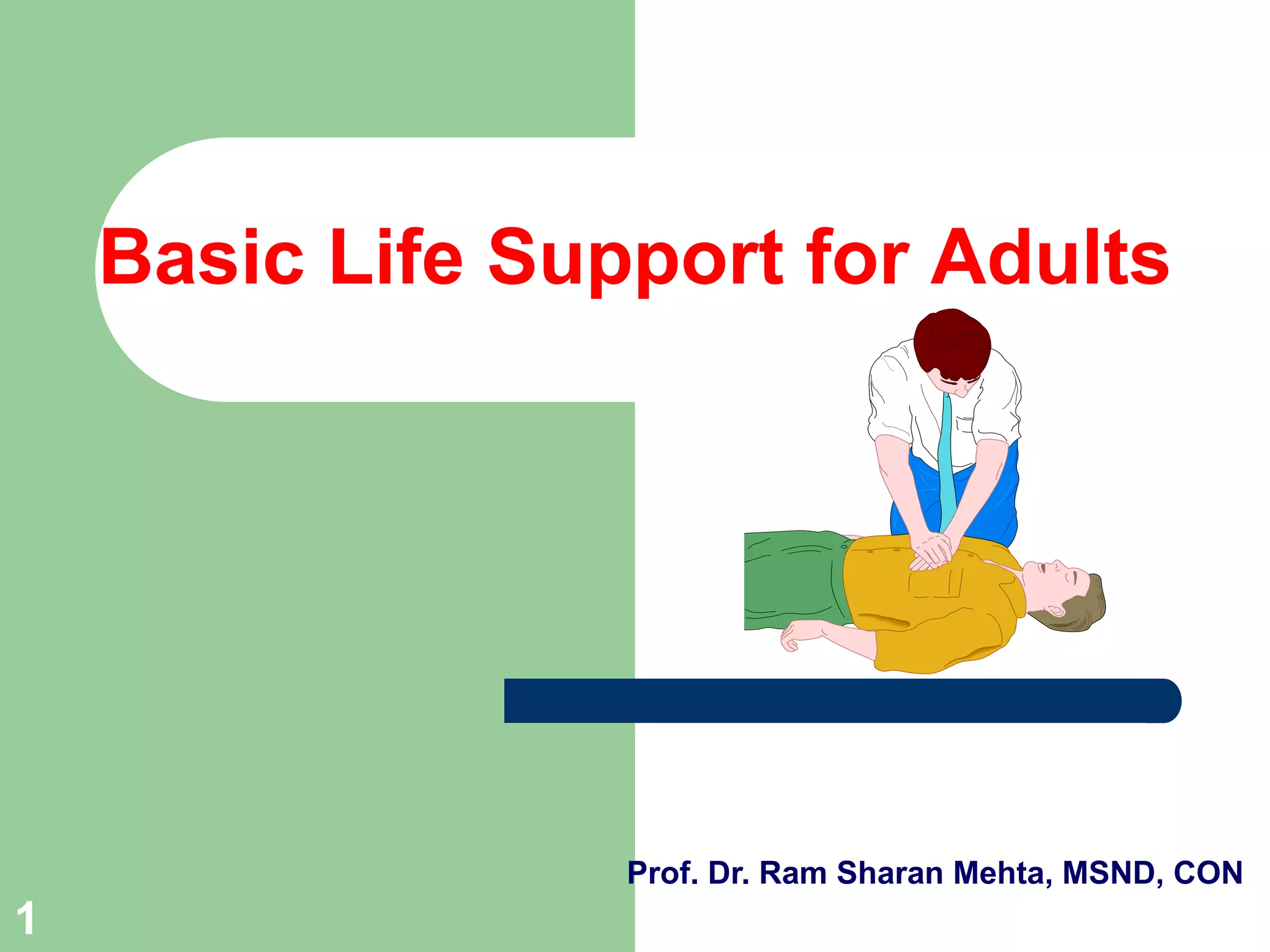
Basic Life Support for Adults
Prof. Dr. Ram Sharan Mehta, MSND, CON
1
OBJECTIVES
Participants should be able to demonstrate:
– How to assess the collapsed victim
– How to perform chest compression and
rescue breathing
– How to place an unconscious breathing
victim in the recovery position.
2
How many times does the human
Heart beat in a day ?
1,00,800 beats per day
(70 beats x 60 minutes x 24
hours = 1,00,800 beats)
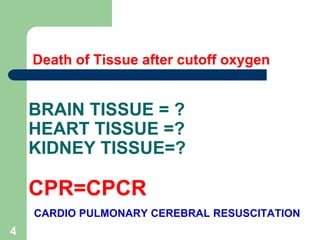
BRAIN TISSUE = ?
HEART TISSUE =?
KIDNEY TISSUE=?
CPR=CPCR
CARDIO PULMONARY CEREBRAL RESUSCITATION
Death of Tissue after cutoff oxygen
4
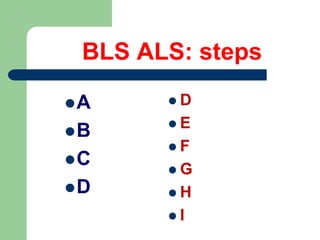
BLS ALS: steps
A
B
C
D
 D
 E
 F
 G
 H
 I
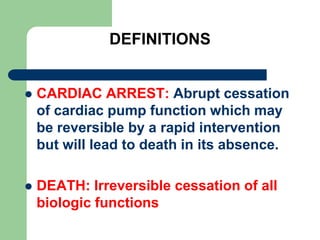
DEFINITIONS
 CARDIAC ARREST: Abrupt cessation
of cardiac pump function which may
be reversible by a rapid intervention
but will lead to death in its absence.
 DEATH: Irreversible cessation of all
biologic functions
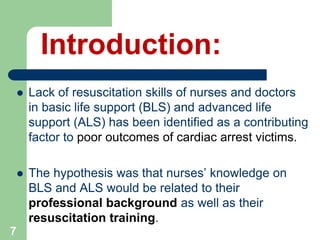
Introduction:
 Lack of resuscitation skills of nurses and doctors
in basic life support (BLS) and advanced life
support (ALS) has been identified as a contributing
factor to poor outcomes of cardiac arrest victims.
 The hypothesis was that nurses’ knowledge on
BLS and ALS would be related to their
professional background as well as their
resuscitation training.
7
Introduction...
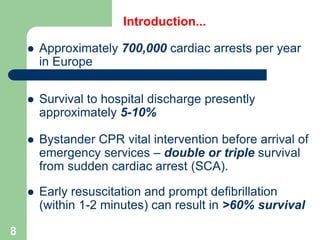
 Approximately 700,000 cardiac arrests per year
in Europe
 Survival to hospital discharge presently
approximately 5-10%
 Bystander CPR vital intervention before arrival of
emergency services – double or triple survival
from sudden cardiac arrest (SCA).
 Early resuscitation and prompt defibrillation
(within 1-2 minutes) can result in >60% survival
8
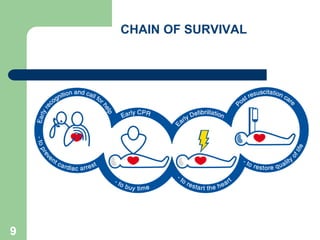
CHAIN OF SURVIVAL
9
BASIC LIFE SUPPORT
 Sequences of procedures performed to restore
the circulation of oxygenated blood after a
sudden pulmonary and/or cardiac arrest
 Chest compressions and pulmonary ventilation
performed by anyone who knows how to do it,
anywhere, immediately, without any other
equipment
Protective devices
10
BLS
 Its Cardiopulmonary Resuscitation (CPR).
 Combines rescue breathing and chest
compressions
 Revives heart (cardio) and lung
(pulmonary) functioning
– Use when there is no breathing and no pulse
 Provides O2 to the brain until ACLS
arrives
11
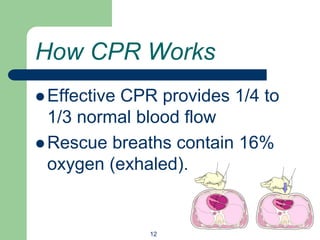
How CPR Works
 Effective CPR provides 1/4 to
1/3 normal blood flow
 Rescue breaths contain 16%
oxygen (exhaled).
12
Start CPR Immediately
 Better chance of survival
 Brain damage starts in 4-6
minutes
 Brain damage is certain after
10 minutes without CPR
13
Do Not Move the Victim Until CPR is
Given and Qualified Help Arrives…
 unless the scene dictates
otherwise
– threat of fire or explosion
– victim must be on a hard surface
– Place victim level or head slightly
lower than body
14
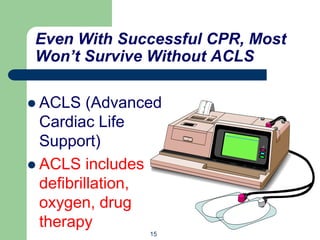
Even With Successful CPR, Most
Won’t Survive Without ACLS
 ACLS (Advanced
Cardiac Life
Support)
 ACLS includes
defibrillation,
oxygen, drug
therapy
15
16
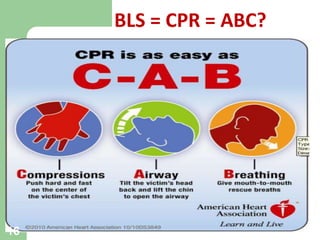
BLS = CPR = ABC?
Basic Life Support (BLS)
ABCs - Airway, Breathing, Circulation
 Steps to follow in BLS
– Approach Safely
– 1. Check the responsiveness of the victim
– 2. Call for Help
– 3. Position victim on his or her back
– 4. Open the airway
– 5. Assess breathing
– 6. Assess circulation
– 7. Stay with the victim until help arrives.
17
Details of the Steps:
18
APPROACH SAFELY!
Scene
Rescuer
Victim
19
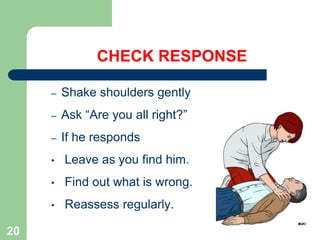
CHECK RESPONSE
– Shake shoulders gently
– Ask “Are you all right?”
– If he responds
• Leave as you find him.
• Find out what is wrong.
• Reassess regularly.
20
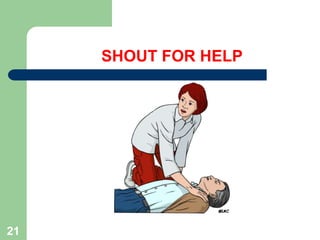
SHOUT FOR HELP
21
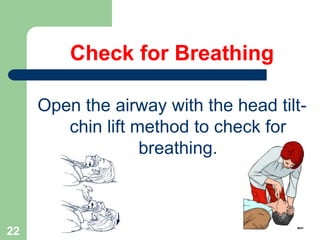
Open the airway with the head tilt-
chin lift method to check for
breathing.
Check for Breathing
22
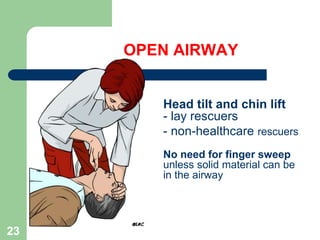
OPEN AIRWAY
Head tilt and chin lift
- lay rescuers
- non-healthcare rescuers
No need for finger sweep
unless solid material can be
seen in the airway
23
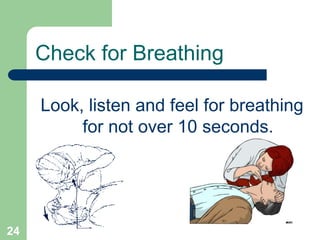
Look, listen and feel for breathing
for not over 10 seconds.
Check for Breathing
24
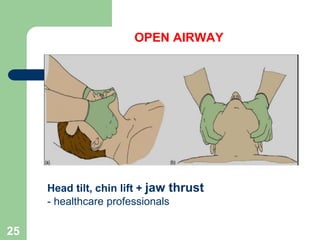
OPEN AIRWAY
Head tilt, chin lift + jaw thrust
- healthcare professionals
25
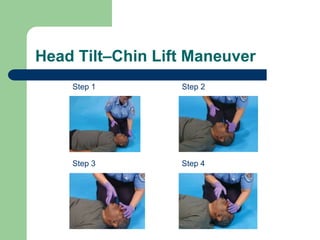
Head Tilt–Chin Lift Maneuver
Step 1 Step 2
Step 3 Step 4
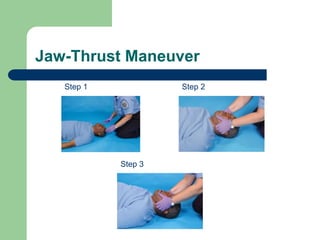
Jaw-Thrust Maneuver
Step 1 Step 2
Step 3
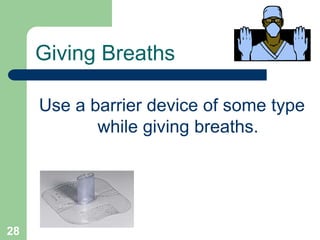
Use a barrier device of some type
while giving breaths.
Giving Breaths
28
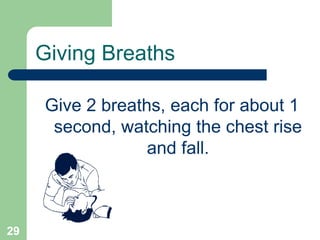
Give 2 breaths, each for about 1
second, watching the chest rise
and fall.
Giving Breaths
29
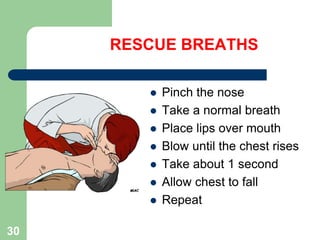
RESCUE BREATHS
 Pinch the nose
 Take a normal breath
 Place lips over mouth
 Blow until the chest rises
 Take about 1 second
 Allow chest to fall
 Repeat
30
RESCUE BREATHS
RECOMMENDATIONS:
- Tidal volume
500 – 600 ml
- Respiratory rate
give each breaths over about 1s with enough
volume to make the victim’s chest rise
- Chest-compression-only
continuously at a rate of 100 min
31
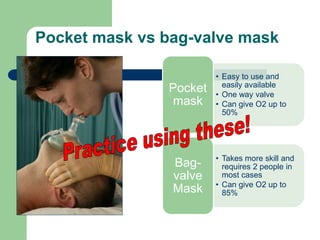
Pocket mask vs bag-valve mask
• Easy to use and
easily available
• One way valve
• Can give O2 up to
50%
Pocket
mask
• Takes more skill and
requires 2 people in
most cases
• Can give O2 up to
85%
Bag-
valve
Mask
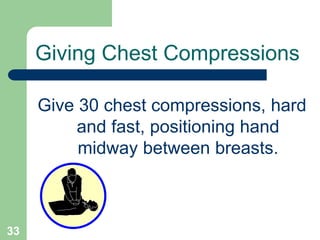
Give 30 chest compressions, hard
and fast, positioning hand
midway between breasts.
Giving Chest Compressions
33
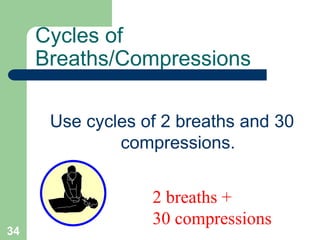
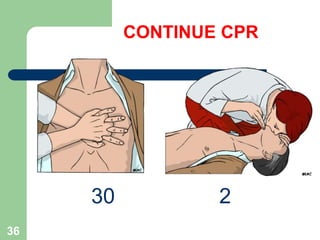
Use cycles of 2 breaths and 30
compressions.
Cycles of
Breaths/Compressions
2 breaths +
30 compressions
34
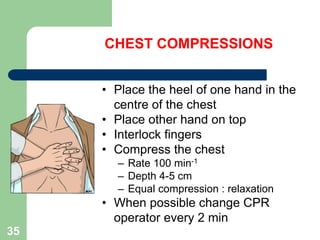
• Place the heel of one hand in the
centre of the chest
• Place other hand on top
• Interlock fingers
• Compress the chest
– Rate 100 min-1
– Depth 4-5 cm
– Equal compression : relaxation
• When possible change CPR
operator every 2 min
CHEST COMPRESSIONS
35
CONTINUE CPR
30 2
36
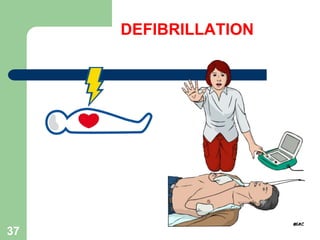
DEFIBRILLATION
37
Date
East of England Ambulance Service
NHS Trust
BLS & AED
12/02/201538
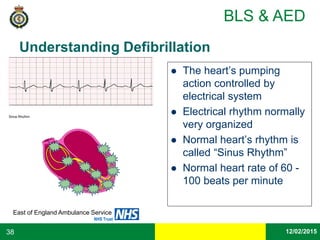
Understanding Defibrillation
 The heart’s pumping
action controlled by
electrical system
 Electrical rhythm normally
very organized
 Normal heart’s rhythm is
called “Sinus Rhythm”
 Normal heart rate of 60 -
100 beats per minute
Sinus Rhythm
Date
East of England Ambulance Service
NHS Trust
BLS & AED
12/02/201539
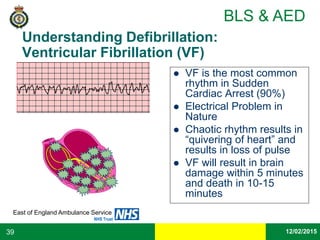
Understanding Defibrillation:
Ventricular Fibrillation (VF)
 VF is the most common
rhythm in Sudden
Cardiac Arrest (90%)
 Electrical Problem in
Nature
 Chaotic rhythm results in
“quivering of heart” and
results in loss of pulse
 VF will result in brain
damage within 5 minutes
and death in 10-15
minutes
Date
East of England Ambulance Service
NHS Trust
BLS & AED
12/02/201540
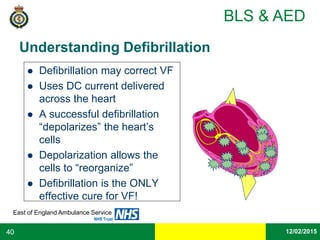
Understanding Defibrillation
 Defibrillation may correct VF
 Uses DC current delivered
across the heart
 A successful defibrillation
“depolarizes” the heart’s
cells
 Depolarization allows the
cells to “reorganize”
 Defibrillation is the ONLY
effective cure for VF!
DC Shock: Joules
AED OR Defibrillation Machine
 150-360 Joules: Monophasic
 150-270 Joules: Biphasic
41
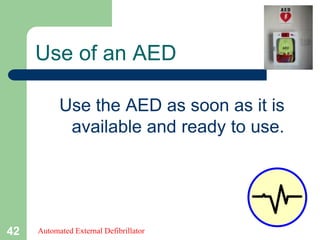
Use the AED as soon as it is
available and ready to use.
Use of an AED
Automated External Defibrillator42
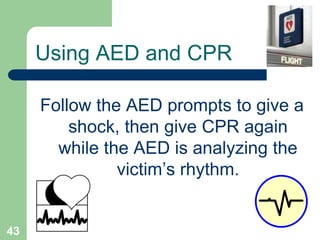
Follow the AED prompts to give a
shock, then give CPR again
while the AED is analyzing the
victim’s rhythm.
Using AED and CPR
43
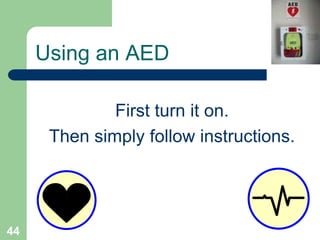
First turn it on.
Then simply follow instructions.
Using an AED
44
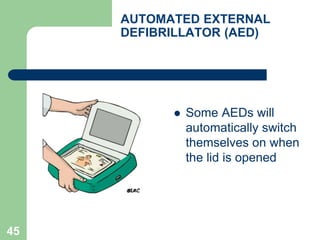
AUTOMATED EXTERNAL
DEFIBRILLATOR (AED)
 Some AEDs will
automatically switch
themselves on when
the lid is opened
45
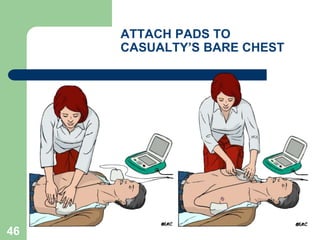
ATTACH PADS TO
CASUALTY’S BARE CHEST
46
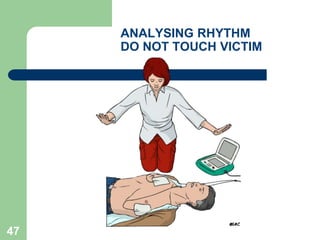
ANALYSING RHYTHM
DO NOT TOUCH VICTIM
47
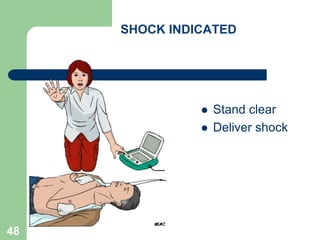
SHOCK INDICATED
 Stand clear
 Deliver shock
48
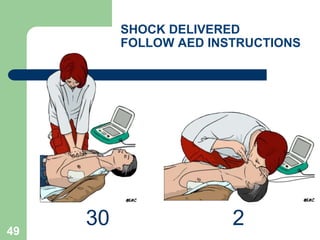
SHOCK DELIVERED
FOLLOW AED INSTRUCTIONS
30 249
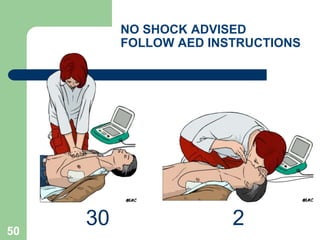
NO SHOCK ADVISED
FOLLOW AED INSTRUCTIONS
30 250
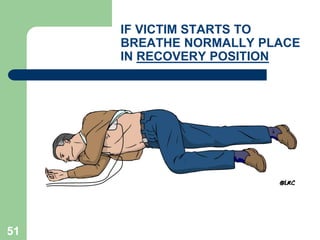
IF VICTIM STARTS TO
BREATHE NORMALLY PLACE
IN RECOVERY POSITION
51
52
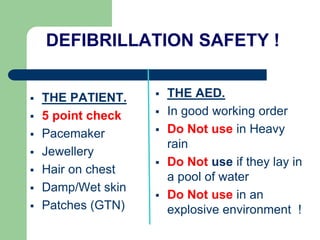
DEFIBRILLATION SAFETY !
 THE PATIENT.
 5 point check
 Pacemaker
 Jewellery
 Hair on chest
 Damp/Wet skin
 Patches (GTN)
 THE AED.
 In good working order
 Do Not use in Heavy
rain
 Do Not use if they lay in
a pool of water
 Do Not use in an
explosive environment !
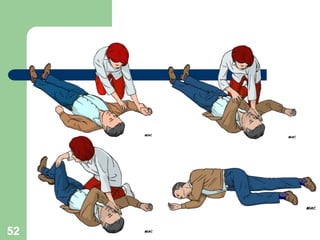
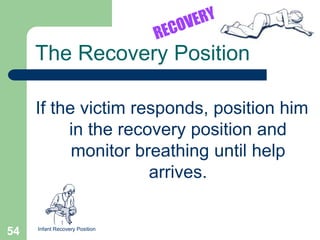
If the victim responds, position him
in the recovery position and
monitor breathing until help
arrives.
The Recovery Position
Infant Recovery Position
54
Complications of CPR
 Skeletal injuries especially rib#
 Visceral injuries- myocardial and pulmonary
contusions, blood in pericardial sac,
pneumothorax, liver and spleen rupture, gastric
perforation
 Airway injuries- tracheal & laryngeal injuries
 Skin and integument damage
Immediately after CPR…
 Laryngoscopy; 100% oxygen
 Urinary catheter
 NG tube
 establish or verify existing intravenous
access; start with NS
 Transfer to a special care unit for
continuous monitoring and therapy.
After CPR…
Complete exam including
– serial vitals
– urine output
– 12-lead ECG
– Chest x-ray
– Blood glucose
– Serum urea,
creatinine
– serum electrolytes
(+Mg++ and Ca++)
– Cardiac markers
Atropine, Adrenaline, CaCl2,
Digoxin
 Atropine: 5 amp (3 mg) single bolus dose to
increase heart rate
 Adrenaline: 1 ml=1mg, 1amp=1:1000 dilution,
1gm=1000mg, 1000mg=1000ml 1mg every 2-3
min till B P is maintained
 Cacl 2= 5-10 mmol
 Digoxin = 0.5 mg stat then 0.25 mg 6hrly
Factors contributing to cardiac arrest or complicating
resuscitation or post-resuscitation care
H’s
 Hypovolemia
 Hypoxia
 H+ (acidosis)
 hyper-/hypokalemia
 Hypoglycemia
 hypothermia
T’s
 Toxins
 tamponade (cardiac)
 tension pneumothorax
 thrombosis of coronary or
pulmonary vasculature
 trauma
Prognosis
5 clinical signs strongly predicting death or
poor neurological outcome:
No corneal reflex at 24 hours
No pupillary response at 24 hours
No withdrawal response to pain at 24hours
No motor response at 24 hours
No motor response at 72 hours
 Stroke (first 2 hours are critical)
 Asthma (check for inhalers)
 Fainting (look for injuries from fall)
 Seizures (check for medication)
 Diabetic emergencies
 Chocking
 Poisoning
First Aid Management for Common Problems:
61
CONTINUE RESUSCITATION UNTIL
– Qualified help arrives and takes over
– Victim revives: The victim starts
breathing normally
– Rescuer becomes exhausted
– Cardiac arrest of longer than 30 minutes
(controversial)
62
Summary
63
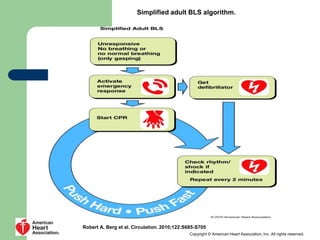
Simplified adult BLS algorithm.
Robert A. Berg et al. Circulation. 2010;122:S685-S705
Copyright © American Heart Association, Inc. All rights reserved.
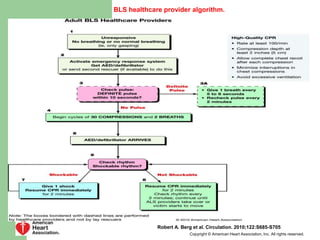
BLS healthcare provider algorithm.
Robert A. Berg et al. Circulation. 2010;122:S685-S705
Copyright © American Heart Association, Inc. All rights reserved.
66
Next Session: ALS
67
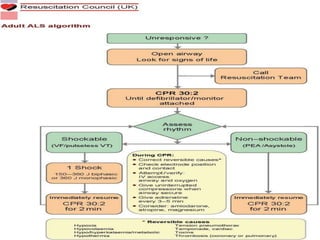
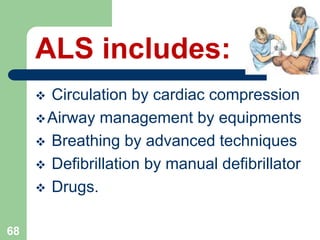
 Circulation by cardiac compression
Airway management by equipments
 Breathing by advanced techniques
 Defibrillation by manual defibrillator
 Drugs.
68
ALS includes:
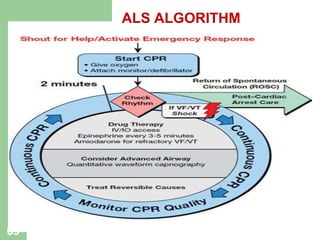
ALS ALGORITHM
69
Thank you
70
The woods are lovely dark and
deep but, I have promises to keep
and miles to go before I sleep and
miles to go before I sleep
-Robert Frost

Bls & als rs mehta

  • 1.
    Basic Life Supportfor Adults Prof. Dr. Ram Sharan Mehta, MSND, CON 1
  • 2.
    OBJECTIVES Participants should beable to demonstrate: – How to assess the collapsed victim – How to perform chest compression and rescue breathing – How to place an unconscious breathing victim in the recovery position. 2
  • 3.
    How many timesdoes the human Heart beat in a day ? 1,00,800 beats per day (70 beats x 60 minutes x 24 hours = 1,00,800 beats)
  • 4.
    BRAIN TISSUE =? HEART TISSUE =? KIDNEY TISSUE=? CPR=CPCR CARDIO PULMONARY CEREBRAL RESUSCITATION Death of Tissue after cutoff oxygen 4
  • 5.
    BLS ALS: steps A B C D D  E  F  G  H  I
  • 6.
    DEFINITIONS  CARDIAC ARREST:Abrupt cessation of cardiac pump function which may be reversible by a rapid intervention but will lead to death in its absence.  DEATH: Irreversible cessation of all biologic functions
  • 7.
    Introduction:  Lack ofresuscitation skills of nurses and doctors in basic life support (BLS) and advanced life support (ALS) has been identified as a contributing factor to poor outcomes of cardiac arrest victims.  The hypothesis was that nurses’ knowledge on BLS and ALS would be related to their professional background as well as their resuscitation training. 7
  • 8.
    Introduction...  Approximately 700,000cardiac arrests per year in Europe  Survival to hospital discharge presently approximately 5-10%  Bystander CPR vital intervention before arrival of emergency services – double or triple survival from sudden cardiac arrest (SCA).  Early resuscitation and prompt defibrillation (within 1-2 minutes) can result in >60% survival 8
  • 9.
  • 10.
    BASIC LIFE SUPPORT Sequences of procedures performed to restore the circulation of oxygenated blood after a sudden pulmonary and/or cardiac arrest  Chest compressions and pulmonary ventilation performed by anyone who knows how to do it, anywhere, immediately, without any other equipment Protective devices 10
  • 11.
    BLS  Its CardiopulmonaryResuscitation (CPR).  Combines rescue breathing and chest compressions  Revives heart (cardio) and lung (pulmonary) functioning – Use when there is no breathing and no pulse  Provides O2 to the brain until ACLS arrives 11
  • 12.
    How CPR Works Effective CPR provides 1/4 to 1/3 normal blood flow  Rescue breaths contain 16% oxygen (exhaled). 12
  • 13.
    Start CPR Immediately Better chance of survival  Brain damage starts in 4-6 minutes  Brain damage is certain after 10 minutes without CPR 13
  • 14.
    Do Not Movethe Victim Until CPR is Given and Qualified Help Arrives…  unless the scene dictates otherwise – threat of fire or explosion – victim must be on a hard surface – Place victim level or head slightly lower than body 14
  • 15.
    Even With SuccessfulCPR, Most Won’t Survive Without ACLS  ACLS (Advanced Cardiac Life Support)  ACLS includes defibrillation, oxygen, drug therapy 15
  • 16.
  • 17.
    Basic Life Support(BLS) ABCs - Airway, Breathing, Circulation  Steps to follow in BLS – Approach Safely – 1. Check the responsiveness of the victim – 2. Call for Help – 3. Position victim on his or her back – 4. Open the airway – 5. Assess breathing – 6. Assess circulation – 7. Stay with the victim until help arrives. 17
  • 18.
    Details of theSteps: 18
  • 19.
  • 20.
    CHECK RESPONSE – Shakeshoulders gently – Ask “Are you all right?” – If he responds • Leave as you find him. • Find out what is wrong. • Reassess regularly. 20
  • 21.
  • 22.
    Open the airwaywith the head tilt- chin lift method to check for breathing. Check for Breathing 22
  • 23.
    OPEN AIRWAY Head tiltand chin lift - lay rescuers - non-healthcare rescuers No need for finger sweep unless solid material can be seen in the airway 23
  • 24.
    Look, listen andfeel for breathing for not over 10 seconds. Check for Breathing 24
  • 25.
    OPEN AIRWAY Head tilt,chin lift + jaw thrust - healthcare professionals 25
  • 26.
    Head Tilt–Chin LiftManeuver Step 1 Step 2 Step 3 Step 4
  • 27.
  • 28.
    Use a barrierdevice of some type while giving breaths. Giving Breaths 28
  • 29.
    Give 2 breaths,each for about 1 second, watching the chest rise and fall. Giving Breaths 29
  • 30.
    RESCUE BREATHS  Pinchthe nose  Take a normal breath  Place lips over mouth  Blow until the chest rises  Take about 1 second  Allow chest to fall  Repeat 30
  • 31.
    RESCUE BREATHS RECOMMENDATIONS: - Tidalvolume 500 – 600 ml - Respiratory rate give each breaths over about 1s with enough volume to make the victim’s chest rise - Chest-compression-only continuously at a rate of 100 min 31
  • 32.
    Pocket mask vsbag-valve mask • Easy to use and easily available • One way valve • Can give O2 up to 50% Pocket mask • Takes more skill and requires 2 people in most cases • Can give O2 up to 85% Bag- valve Mask
  • 33.
    Give 30 chestcompressions, hard and fast, positioning hand midway between breasts. Giving Chest Compressions 33
  • 34.
    Use cycles of2 breaths and 30 compressions. Cycles of Breaths/Compressions 2 breaths + 30 compressions 34
  • 35.
    • Place theheel of one hand in the centre of the chest • Place other hand on top • Interlock fingers • Compress the chest – Rate 100 min-1 – Depth 4-5 cm – Equal compression : relaxation • When possible change CPR operator every 2 min CHEST COMPRESSIONS 35
  • 36.
  • 37.
  • 38.
    Date East of EnglandAmbulance Service NHS Trust BLS & AED 12/02/201538 Understanding Defibrillation  The heart’s pumping action controlled by electrical system  Electrical rhythm normally very organized  Normal heart’s rhythm is called “Sinus Rhythm”  Normal heart rate of 60 - 100 beats per minute Sinus Rhythm
  • 39.
    Date East of EnglandAmbulance Service NHS Trust BLS & AED 12/02/201539 Understanding Defibrillation: Ventricular Fibrillation (VF)  VF is the most common rhythm in Sudden Cardiac Arrest (90%)  Electrical Problem in Nature  Chaotic rhythm results in “quivering of heart” and results in loss of pulse  VF will result in brain damage within 5 minutes and death in 10-15 minutes
  • 40.
    Date East of EnglandAmbulance Service NHS Trust BLS & AED 12/02/201540 Understanding Defibrillation  Defibrillation may correct VF  Uses DC current delivered across the heart  A successful defibrillation “depolarizes” the heart’s cells  Depolarization allows the cells to “reorganize”  Defibrillation is the ONLY effective cure for VF!
  • 41.
    DC Shock: Joules AEDOR Defibrillation Machine  150-360 Joules: Monophasic  150-270 Joules: Biphasic 41
  • 42.
    Use the AEDas soon as it is available and ready to use. Use of an AED Automated External Defibrillator42
  • 43.
    Follow the AEDprompts to give a shock, then give CPR again while the AED is analyzing the victim’s rhythm. Using AED and CPR 43
  • 44.
    First turn iton. Then simply follow instructions. Using an AED 44
  • 45.
    AUTOMATED EXTERNAL DEFIBRILLATOR (AED) Some AEDs will automatically switch themselves on when the lid is opened 45
  • 46.
  • 47.
    ANALYSING RHYTHM DO NOTTOUCH VICTIM 47
  • 48.
    SHOCK INDICATED  Standclear  Deliver shock 48
  • 49.
    SHOCK DELIVERED FOLLOW AEDINSTRUCTIONS 30 249
  • 50.
    NO SHOCK ADVISED FOLLOWAED INSTRUCTIONS 30 250
  • 51.
    IF VICTIM STARTSTO BREATHE NORMALLY PLACE IN RECOVERY POSITION 51
  • 52.
  • 53.
    DEFIBRILLATION SAFETY ! THE PATIENT.  5 point check  Pacemaker  Jewellery  Hair on chest  Damp/Wet skin  Patches (GTN)  THE AED.  In good working order  Do Not use in Heavy rain  Do Not use if they lay in a pool of water  Do Not use in an explosive environment !
  • 54.
    If the victimresponds, position him in the recovery position and monitor breathing until help arrives. The Recovery Position Infant Recovery Position 54
  • 55.
    Complications of CPR Skeletal injuries especially rib#  Visceral injuries- myocardial and pulmonary contusions, blood in pericardial sac, pneumothorax, liver and spleen rupture, gastric perforation  Airway injuries- tracheal & laryngeal injuries  Skin and integument damage
  • 56.
    Immediately after CPR… Laryngoscopy; 100% oxygen  Urinary catheter  NG tube  establish or verify existing intravenous access; start with NS  Transfer to a special care unit for continuous monitoring and therapy.
  • 57.
    After CPR… Complete examincluding – serial vitals – urine output – 12-lead ECG – Chest x-ray – Blood glucose – Serum urea, creatinine – serum electrolytes (+Mg++ and Ca++) – Cardiac markers
  • 58.
    Atropine, Adrenaline, CaCl2, Digoxin Atropine: 5 amp (3 mg) single bolus dose to increase heart rate  Adrenaline: 1 ml=1mg, 1amp=1:1000 dilution, 1gm=1000mg, 1000mg=1000ml 1mg every 2-3 min till B P is maintained  Cacl 2= 5-10 mmol  Digoxin = 0.5 mg stat then 0.25 mg 6hrly
  • 59.
    Factors contributing tocardiac arrest or complicating resuscitation or post-resuscitation care H’s  Hypovolemia  Hypoxia  H+ (acidosis)  hyper-/hypokalemia  Hypoglycemia  hypothermia T’s  Toxins  tamponade (cardiac)  tension pneumothorax  thrombosis of coronary or pulmonary vasculature  trauma
  • 60.
    Prognosis 5 clinical signsstrongly predicting death or poor neurological outcome: No corneal reflex at 24 hours No pupillary response at 24 hours No withdrawal response to pain at 24hours No motor response at 24 hours No motor response at 72 hours
  • 61.
     Stroke (first2 hours are critical)  Asthma (check for inhalers)  Fainting (look for injuries from fall)  Seizures (check for medication)  Diabetic emergencies  Chocking  Poisoning First Aid Management for Common Problems: 61
  • 62.
    CONTINUE RESUSCITATION UNTIL –Qualified help arrives and takes over – Victim revives: The victim starts breathing normally – Rescuer becomes exhausted – Cardiac arrest of longer than 30 minutes (controversial) 62
  • 63.
  • 64.
    Simplified adult BLSalgorithm. Robert A. Berg et al. Circulation. 2010;122:S685-S705 Copyright © American Heart Association, Inc. All rights reserved.
  • 65.
    BLS healthcare provideralgorithm. Robert A. Berg et al. Circulation. 2010;122:S685-S705 Copyright © American Heart Association, Inc. All rights reserved.
  • 66.
  • 67.
  • 68.
     Circulation bycardiac compression Airway management by equipments  Breathing by advanced techniques  Defibrillation by manual defibrillator  Drugs. 68 ALS includes:
  • 69.
  • 70.
    Thank you 70 The woodsare lovely dark and deep but, I have promises to keep and miles to go before I sleep and miles to go before I sleep -Robert Frost