Bsc.Nsg 4th year   1   4/6/2013
Objectives


            At the end of this educational program, participants will be
               able to:
            - Review cardiac arrest
            - Review basic life support
            - Describe Advanced Life Support
            - Demonstrate
              - Basic life support
               - Airway insertion
               - Defibrillation

Bsc.Nsg 4th year                          2                                4/6/2013
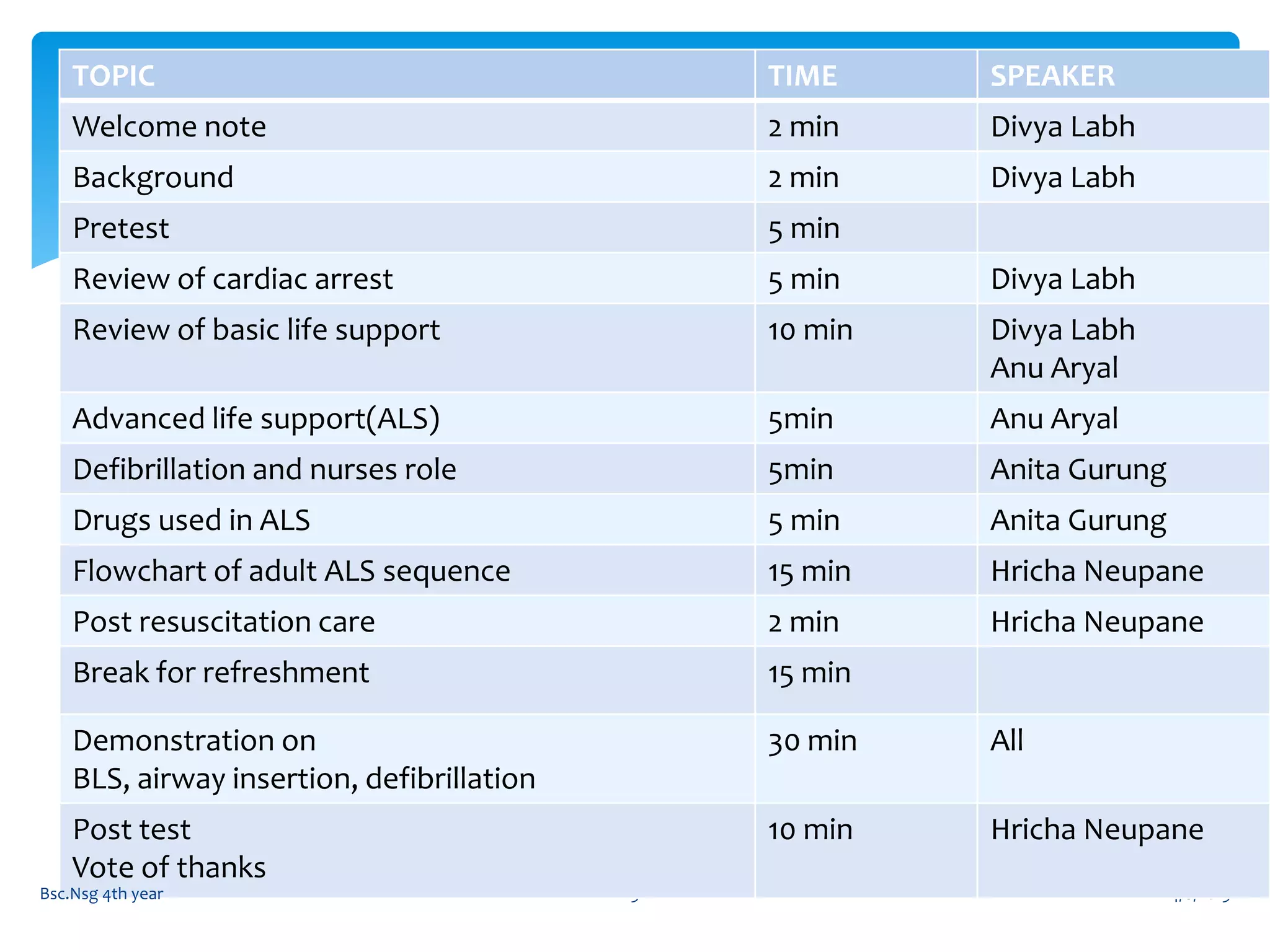
TOPIC                                       TIME     SPEAKER
    Welcome note                                2 min    Divya Labh
    Background                                  2 min    Divya Labh
    Pretest                                     5 min
    Review of cardiac arrest                    5 min    Divya Labh
    Review of basic life support                10 min   Divya Labh
                                                         Anu Aryal
    Advanced life support(ALS)                  5min     Anu Aryal
    Defibrillation and nurses role              5min     Anita Gurung
    Drugs used in ALS                           5 min    Anita Gurung
    Flowchart of adult ALS sequence             15 min   Hricha Neupane
    Post resuscitation care                     2 min    Hricha Neupane
    Break for refreshment                       15 min

    Demonstration on                            30 min   All
    BLS, airway insertion, defibrillation
    Post test                                   10 min   Hricha Neupane
    Vote of thanks
Bsc.Nsg 4th year                            3                           4/6/2013
Bsc.Nsg 4th year   4   4/6/2013
Cardiac arrest


            Cardiac arrest is the abrupt cessation of cardiac pump
              function, which may be reversible by a prompt
              intervention but will lead to death in its absence.

                   It is due to asystole, pulseless electrical activity,
                   ventricular tachycardia or fibrillation.


Bsc.Nsg 4th year                            5                              4/6/2013
CAUSES OF CARDIAC ARREST
    CARDIAC:
    Coronary artery         OTHERS
     disease                 Severe anaphylaxis
    M.I.                    Suffocation
    Arrhythmia              Electrocution
    Low                     Trauma
     C.O.,failure,shock      Stroke
    Cardiomyopathy          Exsanguinations
    Myocarditis             Drowning
    Massive pulmonary
     emboli
Bsc.Nsg 4th year              6                    4/6/2013
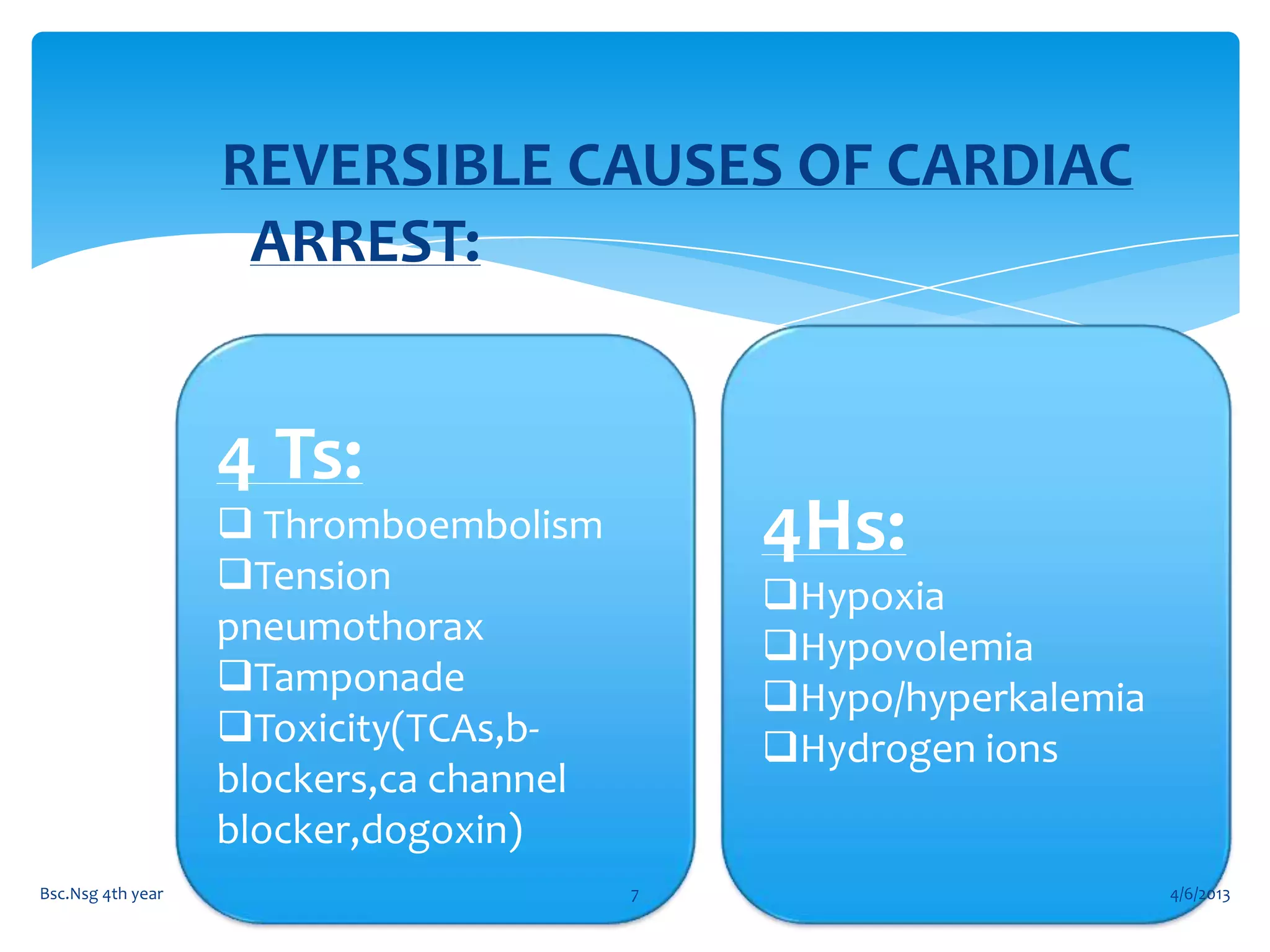
REVERSIBLE CAUSES OF CARDIAC
                    ARREST:


                   4 Ts:
                    Thromboembolism         4Hs:
                   Tension                  Hypoxia
                   pneumothorax              Hypovolemia
                   Tamponade                Hypo/hyperkalemia
                   Toxicity(TCAs,b-         Hydrogen ions
                   blockers,ca channel
                   blocker,dogoxin)
Bsc.Nsg 4th year                         7                        4/6/2013
CLINICAL MANIFESTATIONS:
            Consciousness , pulse ,and blood pressure are lost
             immediately.
            Pupil start dilating within 45 seconds.
            Seizure may or may not occur.

                                       !        Nursing alert

                     The most reliable sign of cardiac arrest is absence of
                    pulse. In adult &child carotid pulse is assessed while in
                    infant brachial pulse is assessed. Valuable time not to
                       be wasted taking BP, listening for heartbeat, or
                             checking proper contact of electrode.
Bsc.Nsg 4th year                            8                               4/6/2013
MANAGEMENT :
                   Basic Life Support (BLS)
                    Advanced Cardiac Life Support (ACLS)
                    Post Resuscitation Care


      The urgency of cardio respiratory arrest & the fact that
          brain damage can occur within 4-6 mins without
       circulation (except in hypothermia)make it necessary
       to start early BLS within 4 mins and rapid ACLS within
       8 min to establish neurological recovery and survival.
Bsc.Nsg 4th year                     9                      4/6/2013
Chain of survival


Bsc.Nsg 4th year           10          4/6/2013
Bsc.Nsg 4th year   11   4/6/2013
BASIC LIFE SUPPORT (BLS)


            It comprises of cardiopulmonary resuscitation(CPR)
              which is a series of measures aimed at delivery of
              oxygenated blood to the heart and brain until further
              therapy can restore spontaneous and effective
              circulation.


Bsc.Nsg 4th year                       12                             4/6/2013
Bsc.Nsg 4th year   13   4/6/2013
WHY C-A-B ?


Bsc.Nsg 4th year        14       4/6/2013
ADULT BLS Sequence


            • Recognize unresponsive adult with no breathing or no
              normal breathing (ie, only agonal gasps)


Bsc.Nsg 4th year                      15                             4/6/2013
Activate emergency
            response, retrieve
             AED (or send
             someone to do this)


Bsc.Nsg 4th year                   16   4/6/2013
• Check for pulse (no more than 10 seconds)
            • If no pulse, begin sets of 30 chest compressions and
               2 breaths
            • Use AED as soon as available


Bsc.Nsg 4th year                       17                            4/6/2013
Bsc.Nsg 4th year   18   4/6/2013
Before you begin


            Check for:
              Is the person conscious or unconscious?
              If the person appears unconscious, tap or shake his or
              her shoulder and ask loudly, "Are you OK?“
              If the person doesn't respond and two people are
              available, one should begin CPR another should call
              Emergency team.


Bsc.Nsg 4th year                       19                              4/6/2013
If an AED is immediately
            available, deliver one shock
            if instructed by the device,
            then begin CPR immediately.


Bsc.Nsg 4th year                      20   4/6/2013
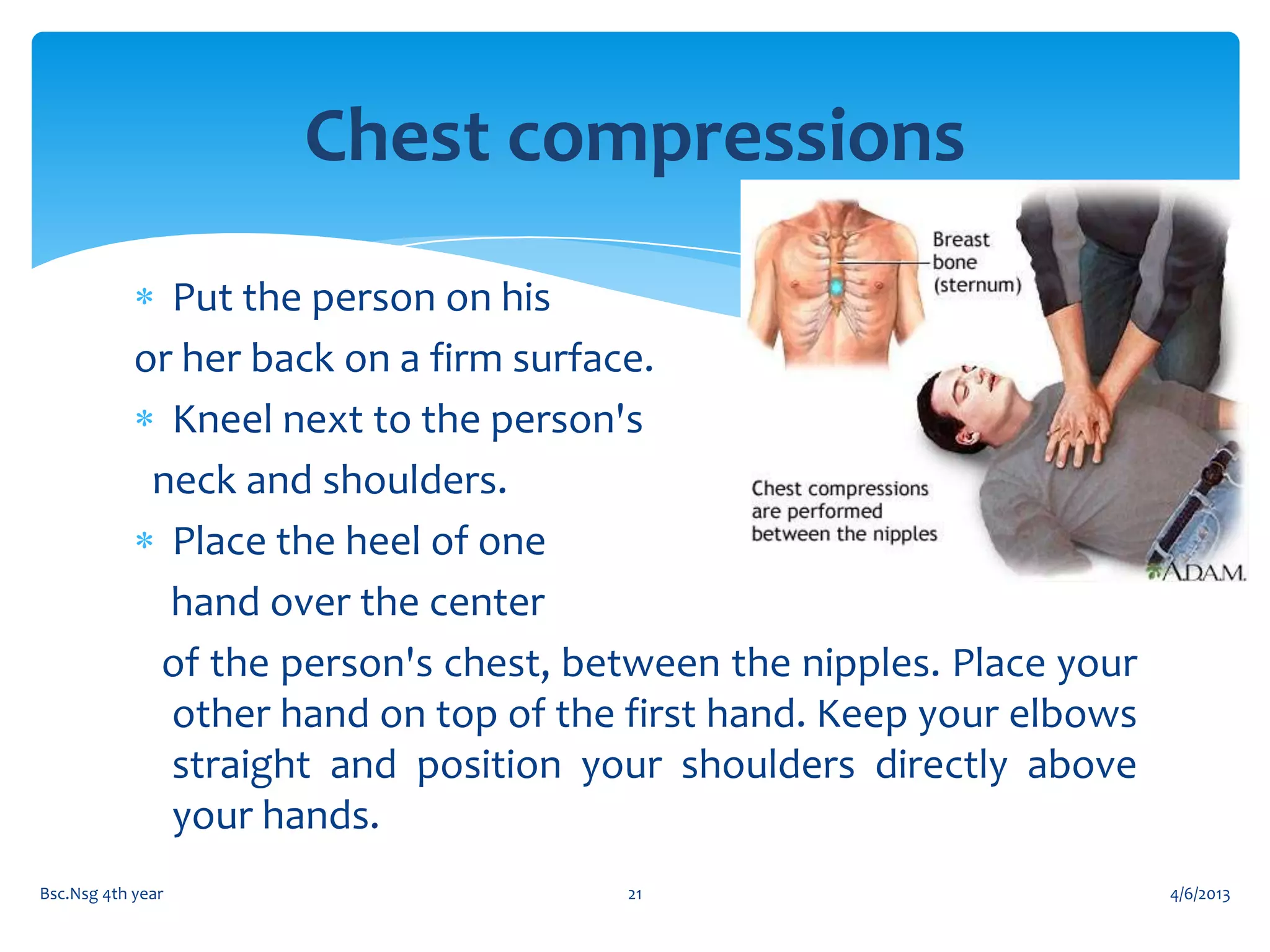
Chest compressions
              Put the person on his
            or her back on a firm surface.
              Kneel next to the person's
             neck and shoulders.
              Place the heel of one
              hand over the center
             of the person's chest, between the nipples. Place your
              other hand on top of the first hand. Keep your elbows
              straight and position your shoulders directly above
              your hands.
Bsc.Nsg 4th year                       21                             4/6/2013
Chest compressions


            Use your upper body weight (not just your arms) as you
              push straight down on (compress) the chest at least 2
              inches (approximately 5 centimeters). Push hard at a
              rate of about 30compressions:2 breath.


Bsc.Nsg 4th year                       22                             4/6/2013
Chest compressions


                   If you haven't been trained in CPR, continue chest
                   compressions until there are signs of movement or
                   until emergency medical personnel take over. If you
                   have been trained in CPR, go on to checking the
                   airway and rescue breathing.


Bsc.Nsg 4th year                            23                           4/6/2013
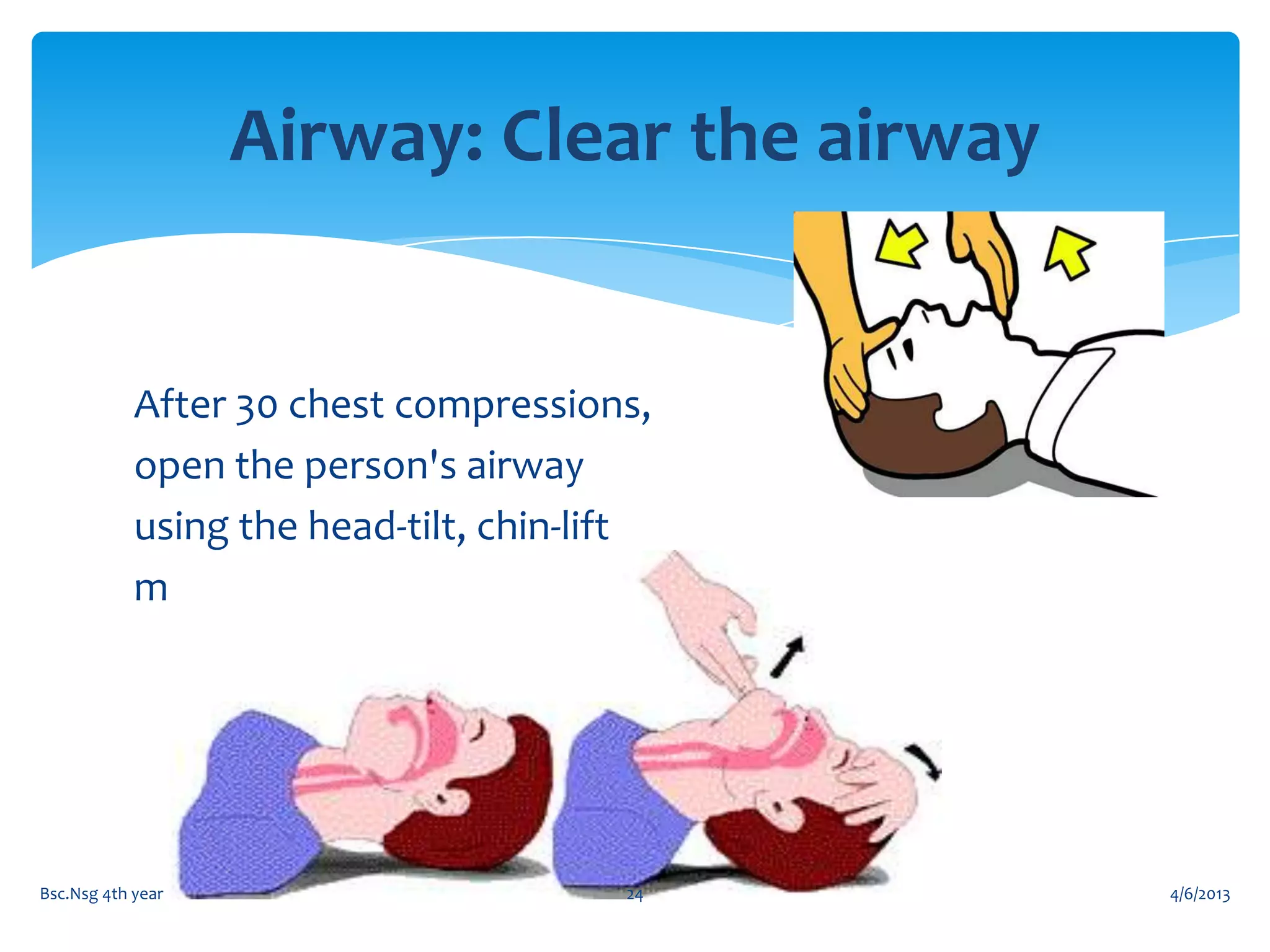
Airway: Clear the airway


            After 30 chest compressions,
            open the person's airway
            using the head-tilt, chin-lift
            maneuver.


Bsc.Nsg 4th year                        24    4/6/2013
Jaw thrust


Bsc.Nsg 4th year       25       4/6/2013
Breathing: Breathe for the person

            Rescue breathing can be mouth-to-mouth breathing or
              mouth-to-nose breathing if the mouth is seriously
              injured or can't be opened.


Bsc.Nsg 4th year                     26                           4/6/2013
RESCUE BREATH


                   Prepare to give two rescue breaths. Give the first
                   rescue breath — lasting one second — and watch to
                   see if the chest rises. If it does rise, give the second
                   breath.
                    If the chest doesn't rise, repeat the maneuver and
                   then give the second breath. 30 chest compressions
                   followed by 2 rescue breaths is considered one cycle.
                   Resume chest compressions to restore circulation.

Bsc.Nsg 4th year                             27                               4/6/2013
If the person has not begun moving after five cycles
                   (about two minutes) and an automatic external
                   defibrillator (AED) is available, apply it and follow the
                   prompts.

                   Administer one shock, then resume CPR — starting
                   with chest compressions — for two more minutes
                   before administering a second shock.

Bsc.Nsg 4th year                             28                                4/6/2013
Continue CPR until there are signs of movement or
                   until the patient is taken to emergency.


Bsc.Nsg 4th year                           29                          4/6/2013
Key Issues and Major Changes


            • “Look, listen, and feel for breathing” has been
             removed from the algorithm.
            • Continued emphasis has been placed on high-quality
             CPR (with chest compressions of adequate rate and
             depth, allowing complete chest recoil after each
             compression minimizing interruptions in
             compressions, and avoiding excessive ventilation).


Bsc.Nsg 4th year                     30                            4/6/2013
To initiate chest compressions before giving rescue
                   breaths (C-A-B rather than A-B-C).
                   Compression rate should be at least 100/min (rather
                   than “approximately” 100/min).
                     Compression depth for adults has been changed
                   from the range of 1½ to 2 inches to at least 2 inches (5
                   cm).


Bsc.Nsg 4th year                             31                               4/6/2013
BLS only provides 15 to 20% of normal cardiac output and
         should be regarded as “buying time” until the
         commencement of ALS.

          If there is more than one rescuer present , another should
         take over the CPR every 1 to 2 minute to prevent fatigue.


Bsc.Nsg 4th year                     32                           4/6/2013
ADVANCED LIFE SUPPORT


            Advanced life support (ALS) includes use of adjunctive
              equipment and techniques for
             assisting ventilation and circulation
             ECG monitoring with dysrrhythmia recognition and
              defibrillation
             establishment of I.V. access and pharmacologic
              therapy in addition to BLS skills.


Bsc.Nsg 4th year                       33                            4/6/2013
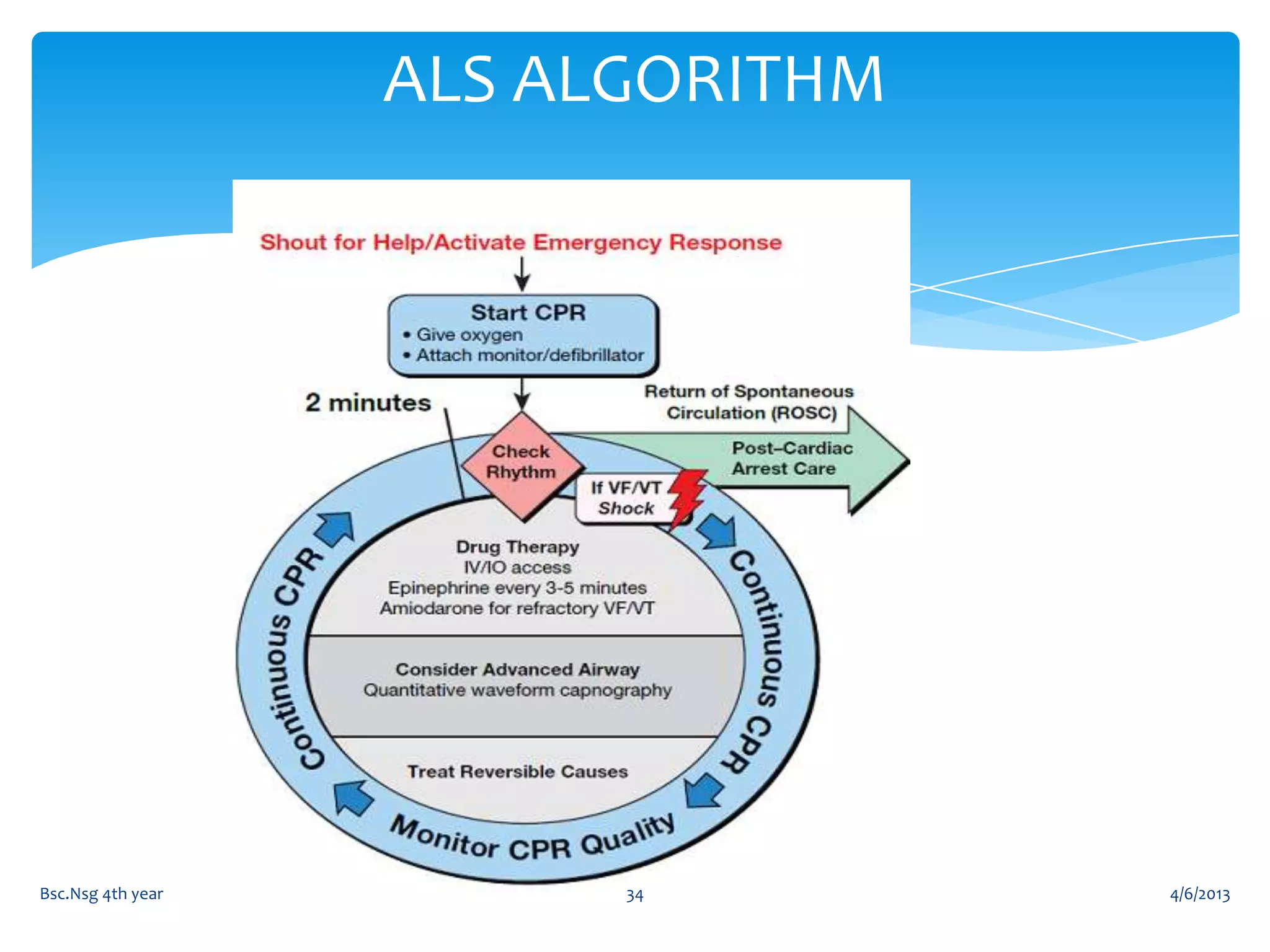
ALS ALGORITHM


Bsc.Nsg 4th year         34        4/6/2013
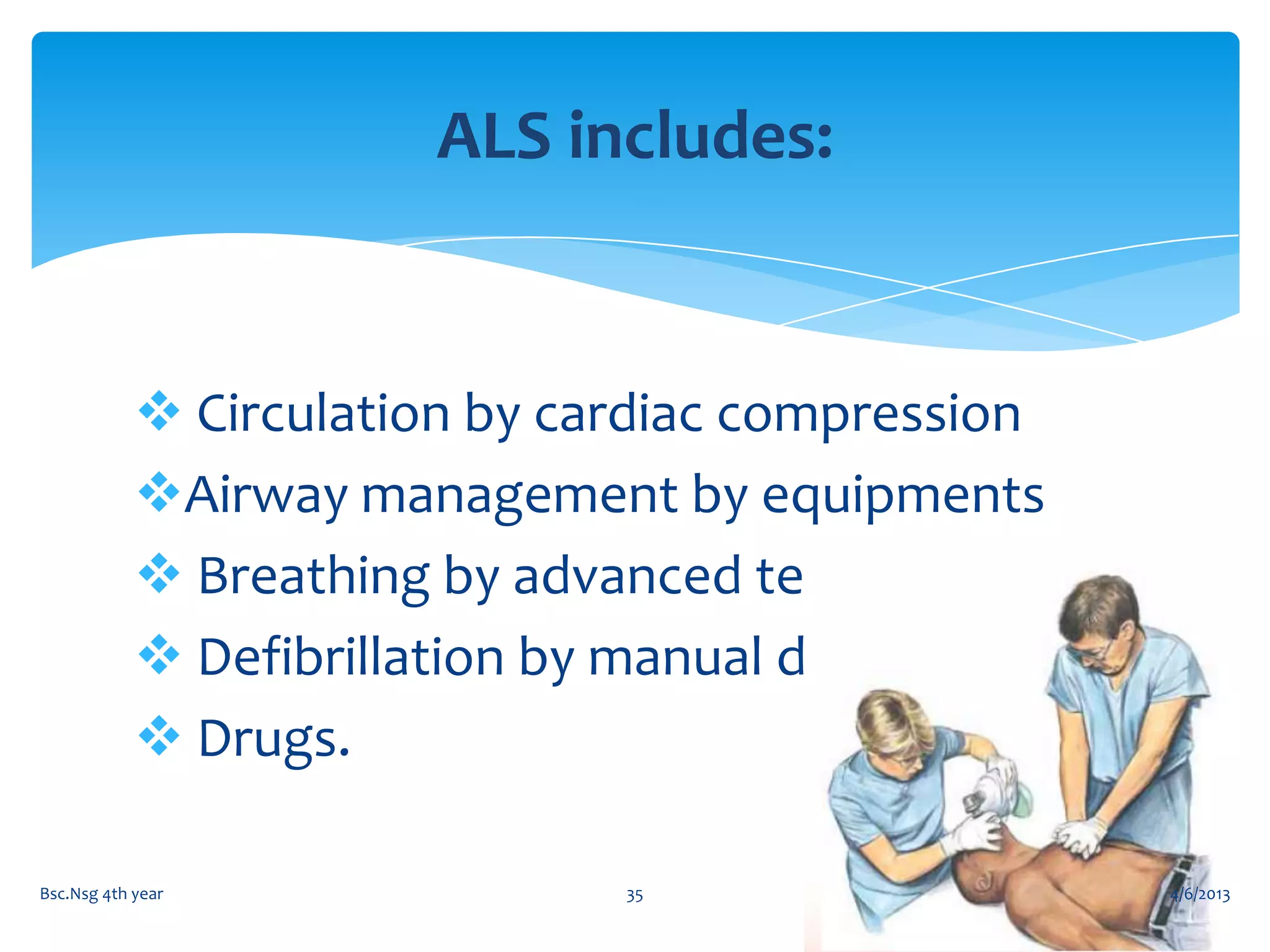
ALS includes:


             Circulation by cardiac compression
            Airway management by equipments
             Breathing by advanced techniques
             Defibrillation by manual defibrillator
             Drugs.

Bsc.Nsg 4th year                 35                    4/6/2013
Circulation


            Chest compression:
            - rate- 100/min
            - Place- mid of sternum
            - Depth- at least 5 cm
              (2inches)
            - or 1/3rd of AP diameter of chest
            - No synchrony with respiration

Bsc.Nsg 4th year                        36       4/6/2013
Precordial Thump


            • The precordial thump should not be used for
              unwitnessed out-of-hospital cardiac arrest.
            • The precordial thump may be considered for patients
              with witnessed, monitored, unstable VT (including
              pulseless VT) if a defibrillator is not immediately ready
              for use, but it should not delay CPR and shock
              delivery.


Bsc.Nsg 4th year                         37                               4/6/2013
A. Airway management
 1) Guedel’s airways- Most commonly used


Bsc.Nsg 4th year            38             4/6/2013
Airway management


            2) Laryngeal Mask Airways


Bsc.Nsg 4th year                        39   4/6/2013
Airway management
      3) Endotracheal tube


Bsc.Nsg 4th year             40        4/6/2013
B. Breathing:
         Breathing can be accomplished by
         1.Bag and mask ventilation
         2.Ventilation by advanced method:
              a.ET tube: Intubation is most definitive
                and best method for ventilation.
              b.LMA
              c.Tracheostomy tube
         3. Ventilation by automatic ventilators.
Bsc.Nsg 4th year               41                        4/6/2013
Bag and Mask Ventillation


Bsc.Nsg 4th year               42              4/6/2013
Artificial Manual Breathing
                           Unit(AMBU)
   It consists of self inflating bag made up of
     rubber or silicon, connector, safety valve,
     mouth piece.100% oxygen can be delivered by
     AMBU bag by attaching oxygen source and
     oxygen reservoir.


Bsc.Nsg 4th year                43               4/6/2013
Defibrillation

      These are the treatment for tachydysrhythmias.

      Defibrillation depolarize the critical mass of
      myocardial cell at once. When they repolarize the
      sinus node recapture its role as the pacemaker .
      Is treatment of choice for pulseless VT/VF.


Bsc.Nsg 4th year                                          4/6/2013
Ventricular tachycardia


Bsc.Nsg 4th year              45             4/6/2013
Ventricular fibrillation


Bsc.Nsg 4th year              46              4/6/2013
Defibrillator


    Defibrillators can be classified as :
     Monophasic(delivers          current        of
      one polarity only and

    Biphasic (deliver current of 2 polarity)


Bsc.Nsg 4th year                            47        4/6/2013
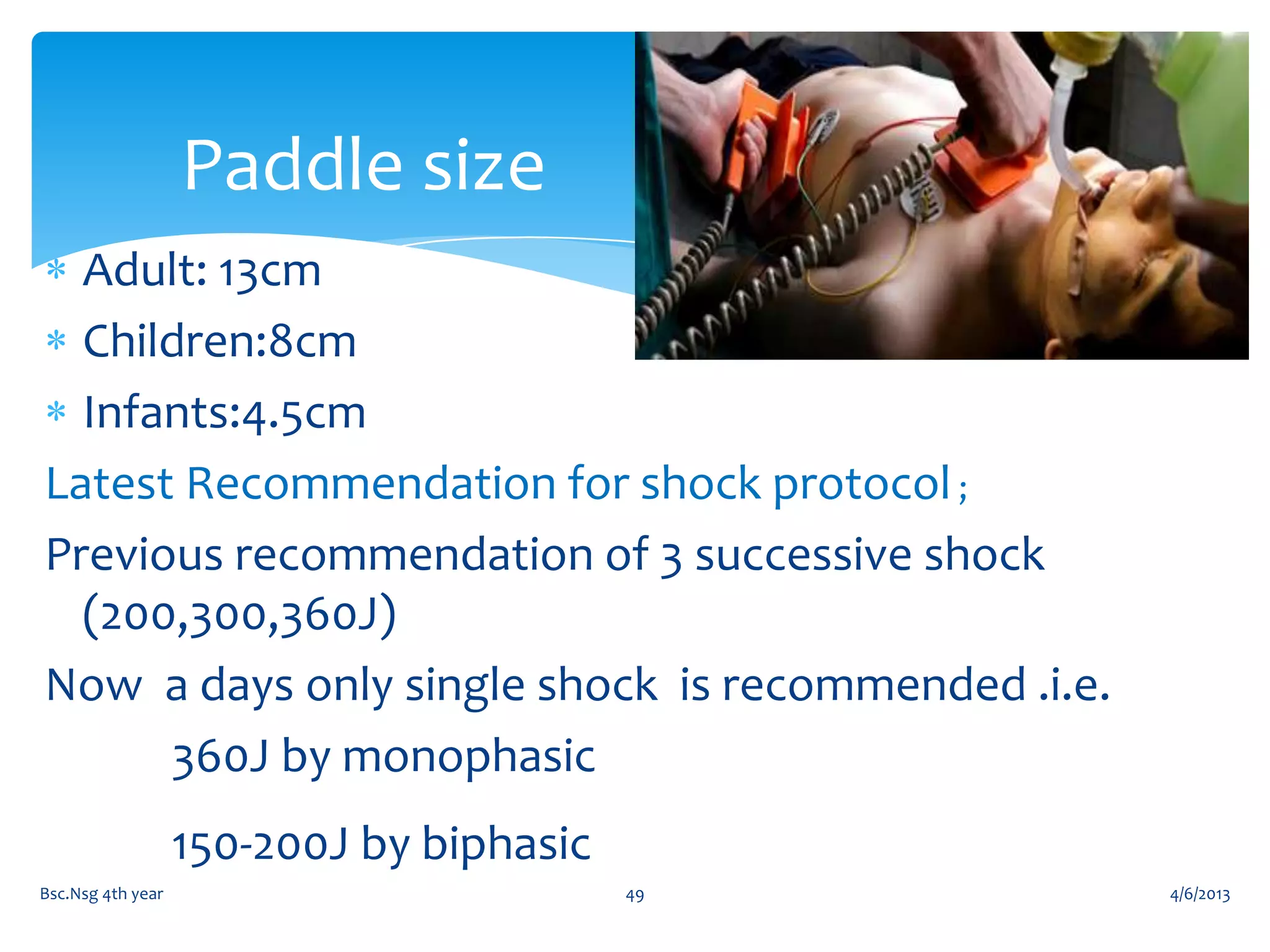
Position of defibrillator paddle:
  1st paddle - on the
   right side of the
   chest just below the
   clavicle
  2nd at precordial,
   region.
   Paddle should be
   applied with pressure
   equivalent to 10 kg.
Bsc.Nsg 4th year            48                 4/6/2013
Paddle size
  Adult: 13cm
  Children:8cm
  Infants:4.5cm
Latest Recommendation for shock protocol ;
Previous recommendation of 3 successive shock
  (200,300,360J)
Now a days only single shock is recommended .i.e.
      360J by monophasic
                   150-200J by biphasic
Bsc.Nsg 4th year                          49        4/6/2013
Nurses role while performing
                           defibrillation
 Apply conducting jelly between the paddle and the
 skin.
 Place the paddle so that they don't touch patient’s
 clothing and bed linen and aren't near medication
 and direct oxygen flow.
 Ensure that defibrillator is not in synchronized mode.
 Don't charge the device until ready to shock; then
 keep the thumbs and fingers off discharge button
 until paddle are on the chest.
Bsc.Nsg 4th year                 50                 4/6/2013
Nurses role in defibrillation

    Before pressing the discharge button call “ all clear” 3
    times
 1st clear: Ensures you aren’t touching patient,bed,
    equipment
 2nd clear: Ensures no one is touching patient, bed ,
    equipment
 3rd clear: Ensures you and everyone else are clear off
    the patient and anything touching the patient.

Bsc.Nsg 4th year                 51                      4/6/2013
Nurses role in defibrillation
  Record the delivered energy and the
  results (cardiac rhythm and pulse).
  After the event is complete inspect the
  skin under the pads and paddles for burns ,
  and if any detected consult about the
  treatment.

Bsc.Nsg 4th year                 52                4/6/2013
DRUGS

    1. Adrenaline(all types of cardiac arrest)- 1mg every
       3-5 mins
    2. Amidarone(VF,VT)- 1st dose:300mg IV bolus, 2nd
       dose 150 mg
    3. Lidocaine(If Amidarone isn’t available)
    4. Sodium bicarbonate(only if cardiac arrest is
       associated with hyperkalemia or tricyclic anti-
       depressent overdose)
    5. Calcium gluconate
Bsc.Nsg 4th year              53                            4/6/2013
Adrenaline (Epinephrine):
         Class : Adrenergic
         MOA : Causes Cardiac stimulation
         Indication : cardiac arrest
         Dose : Adults – 0.5-1 mg IV
               - repeat every 5min
               - Children – 10 mcg/kg
         Adverse reaction : nervousness , tremor,
         headache, drowsiness , palpitation , tachycardia
         , dyspnea .
Bsc.Nsg 4th year               54                      4/6/2013
Amiodarone:
         Class : Ventricular antiarrhythmic
         MOA : abolishes ventricular arrhythmia
         Indication : recurrent VF , unstable VT , atrial
         fibrillation
         Dose : 300mg IV ; further 150mg may be given ,
         followed by an infusion of 900mg for 24 hour.


Bsc.Nsg 4th year                  55                        4/6/2013
FLOWCHART OF ACLS


Bsc.Nsg 4th year           56          4/6/2013
Unresponsive

                            Call for
                    help(monitor/defribillator)

                        Start BLS algorithm

                   Attach monitor & defibrillator
                          when available

                          Check rhythm
Bsc.Nsg 4th year                 57                 4/6/2013
Rythm


                                      Non-
                   Shockable
                                    shockable

                       VT            Asystole


                       VF              PEA
Bsc.Nsg 4th year               58               4/6/2013
VF and VT


Bsc.Nsg 4th year       59      4/6/2013
Asystole and PEA


Bsc.Nsg 4th year          60          4/6/2013
SHOCKABLE(pulseless VF/VT)


                   1stShock (150-200 biphasic, 360 monophasic)


                                 CPR 30:2(2min)


                                 If VF,VT persists


                   2nd Shock( 150-360 biphasic, 360 monophasic)


                                 CPR30:2(2 min)
Bsc.Nsg 4th year                       61                         4/6/2013
Check monitor(if VT,VF
                          persists)

                      Adrenaline 1mg IV
                        every 3-5min
                          3rd
                         Shock

                     CPR 30:2(2 min)

                   Check monitor(if VT,VF
                         persists)

                   Amidarone(300 mgIV)

                        4th Shock
                    CPR 30:2 (2 min)
Bsc.Nsg 4th year             62              4/6/2013
                     Adrenaline 1mg IV
5th shock


                                  Further shock after each 2
                                      min period of CPR

                                    If organised electrical
                                    activity seen,check for
                                              pulse


                      If   pulse present:start post resuscitation care


                   If no pulse and asystole seen :continue CPR and switch
Bsc.Nsg 4th year                 on to non shockable rhythm
                                             63                             4/6/2013
Management of Asystole and PEA


                   Start CPR 30:2
                   Give adrenaline 1mg as soon as intravascular access is
                   achieved.
                   Continue CPR 30:2 until the airway is secured, then
                   continue chest compressions without pausing during
                   ventilation
                   Consider possible reversible causes and correct any
                   that are identified

Bsc.Nsg 4th year                            64                              4/6/2013
Management of Asystole and PEA


                Recheck the patient after 2 min:
                If there is still no pulse and no change in the ECG
                appearance:
            - Continue CPR.
            - Recheck the patient after 2 min and proceed accordingly.
            - Give further adrenaline 1 mg every 3-5 min (alternate loops).
            - If VF/VT, change to the shockable rhythm algorithm.
            - If a pulse is present, start post-resuscitation care.

Bsc.Nsg 4th year                           65                                 4/6/2013
WHEN TO STOP RESUSCITATION


Bsc.Nsg 4th year    66               4/6/2013
POST RESUSCITATION CARE
           Optimizing vital organ perfusion
           Maintain o2 saturation more than or equal to 94%
           Transport to comprehensive post arrest system of care
           Emergent coronary reperfusion for high suspicion of
           STEMI or AMI
           Temperature control
           Aniticipation, treatment and prevention of multi organ
           dysfunction


Bsc.Nsg 4th year                      67                            4/6/2013
Bsc.Nsg 4th year   68   4/6/2013
References:
         American Heart Association “Guidelines for CPR
         and ECC, 2010”
         Aitkenhead AR, Rowbotham DJ, Smith G. Textbook
         of    Anesthesia,        4th     Edition   Churchill
         Livingstone:2001;748-757
         Barash PG, Cullen BF, Stoclting RK, Clinical
         Anesthesia, 5th Edition, Lippincott, Williams and
         Wilkins:2006; 1390-1404
         Stoclting Rk, Miler RD. Basics of Anesthesia, 4th
         Edition, Churchill Lvingstone:2000479-492
         Harrison's, Principle of internal medicine, 16th
Bsc.Nsg 4th year                 69                        4/6/2013
         Edition, Vol II, 1621-1622.

Advancd life support inservice

  • 1.
    Bsc.Nsg 4th year 1 4/6/2013
  • 2.
    Objectives At the end of this educational program, participants will be able to: - Review cardiac arrest - Review basic life support - Describe Advanced Life Support - Demonstrate - Basic life support - Airway insertion - Defibrillation Bsc.Nsg 4th year 2 4/6/2013
  • 3.
    TOPIC TIME SPEAKER Welcome note 2 min Divya Labh Background 2 min Divya Labh Pretest 5 min Review of cardiac arrest 5 min Divya Labh Review of basic life support 10 min Divya Labh Anu Aryal Advanced life support(ALS) 5min Anu Aryal Defibrillation and nurses role 5min Anita Gurung Drugs used in ALS 5 min Anita Gurung Flowchart of adult ALS sequence 15 min Hricha Neupane Post resuscitation care 2 min Hricha Neupane Break for refreshment 15 min Demonstration on 30 min All BLS, airway insertion, defibrillation Post test 10 min Hricha Neupane Vote of thanks Bsc.Nsg 4th year 3 4/6/2013
  • 4.
    Bsc.Nsg 4th year 4 4/6/2013
  • 5.
    Cardiac arrest Cardiac arrest is the abrupt cessation of cardiac pump function, which may be reversible by a prompt intervention but will lead to death in its absence. It is due to asystole, pulseless electrical activity, ventricular tachycardia or fibrillation. Bsc.Nsg 4th year 5 4/6/2013
  • 6.
    CAUSES OF CARDIACARREST CARDIAC: Coronary artery OTHERS disease Severe anaphylaxis M.I. Suffocation Arrhythmia Electrocution Low Trauma C.O.,failure,shock Stroke Cardiomyopathy Exsanguinations Myocarditis Drowning Massive pulmonary emboli Bsc.Nsg 4th year 6 4/6/2013
  • 7.
    REVERSIBLE CAUSES OFCARDIAC ARREST: 4 Ts:  Thromboembolism 4Hs: Tension Hypoxia pneumothorax Hypovolemia Tamponade Hypo/hyperkalemia Toxicity(TCAs,b- Hydrogen ions blockers,ca channel blocker,dogoxin) Bsc.Nsg 4th year 7 4/6/2013
  • 8.
    CLINICAL MANIFESTATIONS: Consciousness , pulse ,and blood pressure are lost immediately. Pupil start dilating within 45 seconds. Seizure may or may not occur. ! Nursing alert The most reliable sign of cardiac arrest is absence of pulse. In adult &child carotid pulse is assessed while in infant brachial pulse is assessed. Valuable time not to be wasted taking BP, listening for heartbeat, or checking proper contact of electrode. Bsc.Nsg 4th year 8 4/6/2013
  • 9.
    MANAGEMENT : Basic Life Support (BLS)  Advanced Cardiac Life Support (ACLS)  Post Resuscitation Care The urgency of cardio respiratory arrest & the fact that brain damage can occur within 4-6 mins without circulation (except in hypothermia)make it necessary to start early BLS within 4 mins and rapid ACLS within 8 min to establish neurological recovery and survival. Bsc.Nsg 4th year 9 4/6/2013
  • 10.
    Chain of survival Bsc.Nsg4th year 10 4/6/2013
  • 11.
    Bsc.Nsg 4th year 11 4/6/2013
  • 12.
    BASIC LIFE SUPPORT(BLS) It comprises of cardiopulmonary resuscitation(CPR) which is a series of measures aimed at delivery of oxygenated blood to the heart and brain until further therapy can restore spontaneous and effective circulation. Bsc.Nsg 4th year 12 4/6/2013
  • 13.
    Bsc.Nsg 4th year 13 4/6/2013
  • 14.
    WHY C-A-B ? Bsc.Nsg4th year 14 4/6/2013
  • 15.
    ADULT BLS Sequence • Recognize unresponsive adult with no breathing or no normal breathing (ie, only agonal gasps) Bsc.Nsg 4th year 15 4/6/2013
  • 16.
    Activate emergency response, retrieve AED (or send someone to do this) Bsc.Nsg 4th year 16 4/6/2013
  • 17.
    • Check forpulse (no more than 10 seconds) • If no pulse, begin sets of 30 chest compressions and 2 breaths • Use AED as soon as available Bsc.Nsg 4th year 17 4/6/2013
  • 18.
    Bsc.Nsg 4th year 18 4/6/2013
  • 19.
    Before you begin Check for: Is the person conscious or unconscious? If the person appears unconscious, tap or shake his or her shoulder and ask loudly, "Are you OK?“ If the person doesn't respond and two people are available, one should begin CPR another should call Emergency team. Bsc.Nsg 4th year 19 4/6/2013
  • 20.
    If an AEDis immediately available, deliver one shock if instructed by the device, then begin CPR immediately. Bsc.Nsg 4th year 20 4/6/2013
  • 21.
    Chest compressions Put the person on his or her back on a firm surface. Kneel next to the person's neck and shoulders. Place the heel of one hand over the center of the person's chest, between the nipples. Place your other hand on top of the first hand. Keep your elbows straight and position your shoulders directly above your hands. Bsc.Nsg 4th year 21 4/6/2013
  • 22.
    Chest compressions Use your upper body weight (not just your arms) as you push straight down on (compress) the chest at least 2 inches (approximately 5 centimeters). Push hard at a rate of about 30compressions:2 breath. Bsc.Nsg 4th year 22 4/6/2013
  • 23.
    Chest compressions If you haven't been trained in CPR, continue chest compressions until there are signs of movement or until emergency medical personnel take over. If you have been trained in CPR, go on to checking the airway and rescue breathing. Bsc.Nsg 4th year 23 4/6/2013
  • 24.
    Airway: Clear theairway After 30 chest compressions, open the person's airway using the head-tilt, chin-lift maneuver. Bsc.Nsg 4th year 24 4/6/2013
  • 25.
    Jaw thrust Bsc.Nsg 4thyear 25 4/6/2013
  • 26.
    Breathing: Breathe forthe person Rescue breathing can be mouth-to-mouth breathing or mouth-to-nose breathing if the mouth is seriously injured or can't be opened. Bsc.Nsg 4th year 26 4/6/2013
  • 27.
    RESCUE BREATH Prepare to give two rescue breaths. Give the first rescue breath — lasting one second — and watch to see if the chest rises. If it does rise, give the second breath. If the chest doesn't rise, repeat the maneuver and then give the second breath. 30 chest compressions followed by 2 rescue breaths is considered one cycle. Resume chest compressions to restore circulation. Bsc.Nsg 4th year 27 4/6/2013
  • 28.
    If the personhas not begun moving after five cycles (about two minutes) and an automatic external defibrillator (AED) is available, apply it and follow the prompts. Administer one shock, then resume CPR — starting with chest compressions — for two more minutes before administering a second shock. Bsc.Nsg 4th year 28 4/6/2013
  • 29.
    Continue CPR untilthere are signs of movement or until the patient is taken to emergency. Bsc.Nsg 4th year 29 4/6/2013
  • 30.
    Key Issues andMajor Changes • “Look, listen, and feel for breathing” has been removed from the algorithm. • Continued emphasis has been placed on high-quality CPR (with chest compressions of adequate rate and depth, allowing complete chest recoil after each compression minimizing interruptions in compressions, and avoiding excessive ventilation). Bsc.Nsg 4th year 30 4/6/2013
  • 31.
    To initiate chestcompressions before giving rescue breaths (C-A-B rather than A-B-C). Compression rate should be at least 100/min (rather than “approximately” 100/min). Compression depth for adults has been changed from the range of 1½ to 2 inches to at least 2 inches (5 cm). Bsc.Nsg 4th year 31 4/6/2013
  • 32.
    BLS only provides15 to 20% of normal cardiac output and should be regarded as “buying time” until the commencement of ALS. If there is more than one rescuer present , another should take over the CPR every 1 to 2 minute to prevent fatigue. Bsc.Nsg 4th year 32 4/6/2013
  • 33.
    ADVANCED LIFE SUPPORT Advanced life support (ALS) includes use of adjunctive equipment and techniques for  assisting ventilation and circulation  ECG monitoring with dysrrhythmia recognition and defibrillation  establishment of I.V. access and pharmacologic therapy in addition to BLS skills. Bsc.Nsg 4th year 33 4/6/2013
  • 34.
    ALS ALGORITHM Bsc.Nsg 4thyear 34 4/6/2013
  • 35.
    ALS includes:  Circulation by cardiac compression Airway management by equipments  Breathing by advanced techniques  Defibrillation by manual defibrillator  Drugs. Bsc.Nsg 4th year 35 4/6/2013
  • 36.
    Circulation Chest compression: - rate- 100/min - Place- mid of sternum - Depth- at least 5 cm (2inches) - or 1/3rd of AP diameter of chest - No synchrony with respiration Bsc.Nsg 4th year 36 4/6/2013
  • 37.
    Precordial Thump • The precordial thump should not be used for unwitnessed out-of-hospital cardiac arrest. • The precordial thump may be considered for patients with witnessed, monitored, unstable VT (including pulseless VT) if a defibrillator is not immediately ready for use, but it should not delay CPR and shock delivery. Bsc.Nsg 4th year 37 4/6/2013
  • 38.
    A. Airway management 1) Guedel’s airways- Most commonly used Bsc.Nsg 4th year 38 4/6/2013
  • 39.
    Airway management 2) Laryngeal Mask Airways Bsc.Nsg 4th year 39 4/6/2013
  • 40.
    Airway management 3) Endotracheal tube Bsc.Nsg 4th year 40 4/6/2013
  • 41.
    B. Breathing: Breathing can be accomplished by 1.Bag and mask ventilation 2.Ventilation by advanced method: a.ET tube: Intubation is most definitive and best method for ventilation. b.LMA c.Tracheostomy tube 3. Ventilation by automatic ventilators. Bsc.Nsg 4th year 41 4/6/2013
  • 42.
    Bag and MaskVentillation Bsc.Nsg 4th year 42 4/6/2013
  • 43.
    Artificial Manual Breathing Unit(AMBU) It consists of self inflating bag made up of rubber or silicon, connector, safety valve, mouth piece.100% oxygen can be delivered by AMBU bag by attaching oxygen source and oxygen reservoir. Bsc.Nsg 4th year 43 4/6/2013
  • 44.
    Defibrillation These are the treatment for tachydysrhythmias. Defibrillation depolarize the critical mass of myocardial cell at once. When they repolarize the sinus node recapture its role as the pacemaker . Is treatment of choice for pulseless VT/VF. Bsc.Nsg 4th year 4/6/2013
  • 45.
  • 46.
  • 47.
    Defibrillator Defibrillators can be classified as : Monophasic(delivers current of one polarity only and Biphasic (deliver current of 2 polarity) Bsc.Nsg 4th year 47 4/6/2013
  • 48.
    Position of defibrillatorpaddle: 1st paddle - on the right side of the chest just below the clavicle 2nd at precordial, region. Paddle should be applied with pressure equivalent to 10 kg. Bsc.Nsg 4th year 48 4/6/2013
  • 49.
    Paddle size Adult: 13cm Children:8cm Infants:4.5cm Latest Recommendation for shock protocol ; Previous recommendation of 3 successive shock (200,300,360J) Now a days only single shock is recommended .i.e. 360J by monophasic 150-200J by biphasic Bsc.Nsg 4th year 49 4/6/2013
  • 50.
    Nurses role whileperforming defibrillation Apply conducting jelly between the paddle and the skin. Place the paddle so that they don't touch patient’s clothing and bed linen and aren't near medication and direct oxygen flow. Ensure that defibrillator is not in synchronized mode. Don't charge the device until ready to shock; then keep the thumbs and fingers off discharge button until paddle are on the chest. Bsc.Nsg 4th year 50 4/6/2013
  • 51.
    Nurses role indefibrillation Before pressing the discharge button call “ all clear” 3 times 1st clear: Ensures you aren’t touching patient,bed, equipment 2nd clear: Ensures no one is touching patient, bed , equipment 3rd clear: Ensures you and everyone else are clear off the patient and anything touching the patient. Bsc.Nsg 4th year 51 4/6/2013
  • 52.
    Nurses role indefibrillation Record the delivered energy and the results (cardiac rhythm and pulse). After the event is complete inspect the skin under the pads and paddles for burns , and if any detected consult about the treatment. Bsc.Nsg 4th year 52 4/6/2013
  • 53.
    DRUGS 1. Adrenaline(all types of cardiac arrest)- 1mg every 3-5 mins 2. Amidarone(VF,VT)- 1st dose:300mg IV bolus, 2nd dose 150 mg 3. Lidocaine(If Amidarone isn’t available) 4. Sodium bicarbonate(only if cardiac arrest is associated with hyperkalemia or tricyclic anti- depressent overdose) 5. Calcium gluconate Bsc.Nsg 4th year 53 4/6/2013
  • 54.
    Adrenaline (Epinephrine): Class : Adrenergic MOA : Causes Cardiac stimulation Indication : cardiac arrest Dose : Adults – 0.5-1 mg IV - repeat every 5min - Children – 10 mcg/kg Adverse reaction : nervousness , tremor, headache, drowsiness , palpitation , tachycardia , dyspnea . Bsc.Nsg 4th year 54 4/6/2013
  • 55.
    Amiodarone: Class : Ventricular antiarrhythmic MOA : abolishes ventricular arrhythmia Indication : recurrent VF , unstable VT , atrial fibrillation Dose : 300mg IV ; further 150mg may be given , followed by an infusion of 900mg for 24 hour. Bsc.Nsg 4th year 55 4/6/2013
  • 56.
    FLOWCHART OF ACLS Bsc.Nsg4th year 56 4/6/2013
  • 57.
    Unresponsive Call for help(monitor/defribillator) Start BLS algorithm Attach monitor & defibrillator when available Check rhythm Bsc.Nsg 4th year 57 4/6/2013
  • 58.
    Rythm Non- Shockable shockable VT Asystole VF PEA Bsc.Nsg 4th year 58 4/6/2013
  • 59.
    VF and VT Bsc.Nsg4th year 59 4/6/2013
  • 60.
    Asystole and PEA Bsc.Nsg4th year 60 4/6/2013
  • 61.
    SHOCKABLE(pulseless VF/VT) 1stShock (150-200 biphasic, 360 monophasic) CPR 30:2(2min) If VF,VT persists 2nd Shock( 150-360 biphasic, 360 monophasic) CPR30:2(2 min) Bsc.Nsg 4th year 61 4/6/2013
  • 62.
    Check monitor(if VT,VF persists) Adrenaline 1mg IV every 3-5min 3rd Shock CPR 30:2(2 min) Check monitor(if VT,VF persists) Amidarone(300 mgIV) 4th Shock CPR 30:2 (2 min) Bsc.Nsg 4th year 62 4/6/2013 Adrenaline 1mg IV
  • 63.
    5th shock Further shock after each 2 min period of CPR If organised electrical activity seen,check for pulse If pulse present:start post resuscitation care If no pulse and asystole seen :continue CPR and switch Bsc.Nsg 4th year on to non shockable rhythm 63 4/6/2013
  • 64.
    Management of Asystoleand PEA Start CPR 30:2 Give adrenaline 1mg as soon as intravascular access is achieved. Continue CPR 30:2 until the airway is secured, then continue chest compressions without pausing during ventilation Consider possible reversible causes and correct any that are identified Bsc.Nsg 4th year 64 4/6/2013
  • 65.
    Management of Asystoleand PEA Recheck the patient after 2 min: If there is still no pulse and no change in the ECG appearance: - Continue CPR. - Recheck the patient after 2 min and proceed accordingly. - Give further adrenaline 1 mg every 3-5 min (alternate loops). - If VF/VT, change to the shockable rhythm algorithm. - If a pulse is present, start post-resuscitation care. Bsc.Nsg 4th year 65 4/6/2013
  • 66.
    WHEN TO STOPRESUSCITATION Bsc.Nsg 4th year 66 4/6/2013
  • 67.
    POST RESUSCITATION CARE Optimizing vital organ perfusion Maintain o2 saturation more than or equal to 94% Transport to comprehensive post arrest system of care Emergent coronary reperfusion for high suspicion of STEMI or AMI Temperature control Aniticipation, treatment and prevention of multi organ dysfunction Bsc.Nsg 4th year 67 4/6/2013
  • 68.
    Bsc.Nsg 4th year 68 4/6/2013
  • 69.
    References: American Heart Association “Guidelines for CPR and ECC, 2010” Aitkenhead AR, Rowbotham DJ, Smith G. Textbook of Anesthesia, 4th Edition Churchill Livingstone:2001;748-757 Barash PG, Cullen BF, Stoclting RK, Clinical Anesthesia, 5th Edition, Lippincott, Williams and Wilkins:2006; 1390-1404 Stoclting Rk, Miler RD. Basics of Anesthesia, 4th Edition, Churchill Lvingstone:2000479-492 Harrison's, Principle of internal medicine, 16th Bsc.Nsg 4th year 69 4/6/2013 Edition, Vol II, 1621-1622.