Basic and Advanced
Cardiovascular Life Support
By: Dr. Ram Gopal Maurya
MBBS,MD,PDCC
Dept. of Anaesthesiology
HIMS, Ataria, Sitapur
 It is sudden cessation of mechanical activity of heart
with some or no electrical activity leading to cessation
of blood circulation.
 Cardiac arrest may be
out-of-hospital cardiac arrest
or
in-hospital cardiac arrest
What is cardiac arrest?
 Management of out-of-hospital cardiac arrest.
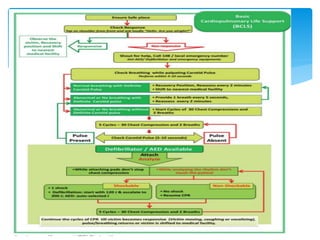
Basic cardiopulmonary life support
(BCLS)
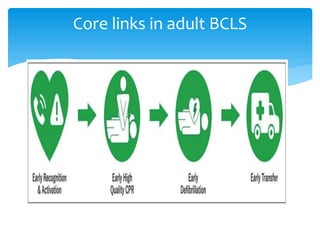
Core links in adult BCLS
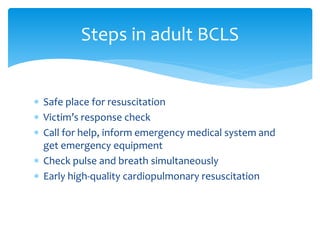
 Safe place for resuscitation
 Victim’s response check
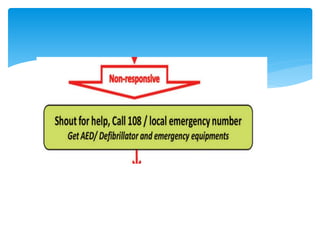
 Call for help, inform emergency medical system and
get emergency equipment
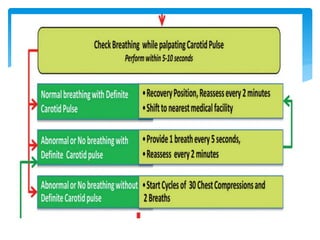
 Check pulse and breath simultaneously
 Early high-quality cardiopulmonary resuscitation
Steps in adult BCLS
 Early defibrillation
 Recovery position
 Transfer
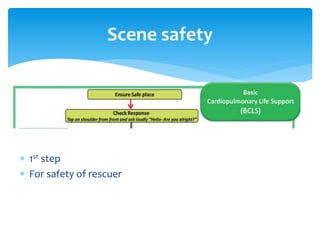
 1st step
 For safety of rescuer
Scene safety
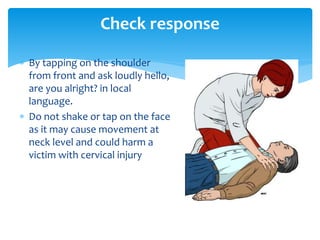
 By tapping on the shoulder
from front and ask loudly hello,
are you alright? in local
language.
 Do not shake or tap on the face
as it may cause movement at
neck level and could harm a
victim with cervical injury
Check response
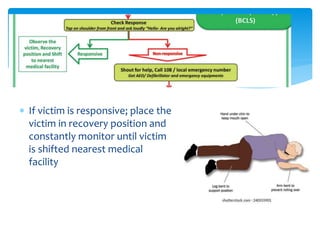
 If victim is responsive; place the
victim in recovery position and
constantly monitor until victim
is shifted nearest medical
facility
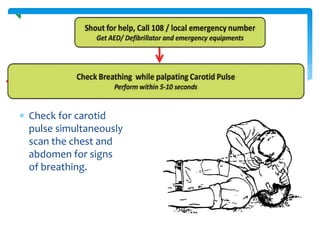
 Check for carotid
pulse simultaneously
scan the chest and
abdomen for signs
of breathing.
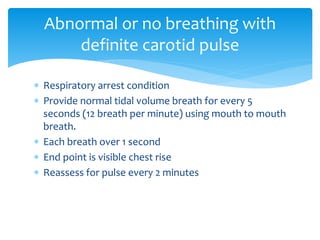
 Respiratory arrest condition
 Provide normal tidal volume breath for every 5
seconds (12 breath per minute) using mouth to mouth
breath.
 Each breath over 1 second
 End point is visible chest rise
 Reassess for pulse every 2 minutes
Abnormal or no breathing with
definite carotid pulse
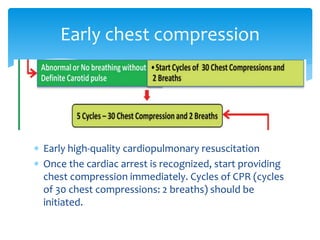
 Early high-quality cardiopulmonary resuscitation
 Once the cardiac arrest is recognized, start providing
chest compression immediately. Cycles of CPR (cycles
of 30 chest compressions: 2 breaths) should be
initiated.
Early chest compression
 High-quality chest compressions
• Ensure a chest compression speed of 120
compressions/minute to a depth of 5–6 cm.
• Allow complete chest recoil between compression
without lifting hand from the chest (do not lean on
the victim’s chest)
• Avoid unnecessary interruption of chest
compressions.
High-quality cardiopulmonary
resuscitation
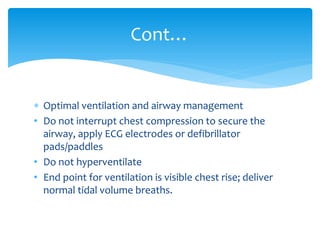
 Optimal ventilation and airway management
• Do not interrupt chest compression to secure the
airway, apply ECG electrodes or defibrillator
pads/paddles
• Do not hyperventilate
• End point for ventilation is visible chest rise; deliver
normal tidal volume breaths.
Cont…
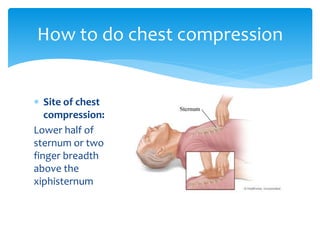
 Site of chest
compression:
Lower half of
sternum or two
finger breadth
above the
xiphisternum
How to do chest compression
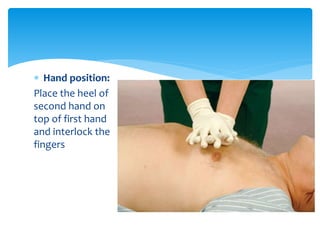
 Hand position:
Place the heel of
second hand on
top of first hand
and interlock the
fingers
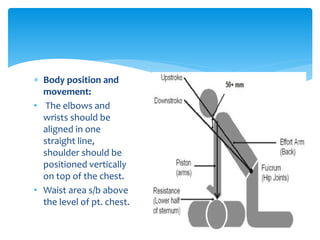
 Body position and
movement:
• The elbows and
wrists should be
aligned in one
straight line,
shoulder should be
positioned vertically
on top of the chest.
• Waist area s/b above
the level of pt. chest.
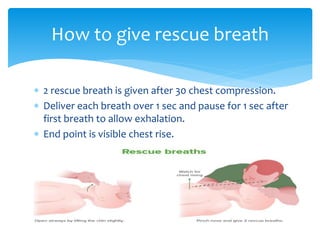
 2 rescue breath is given after 30 chest compression.
 Deliver each breath over 1 sec and pause for 1 sec after
first breath to allow exhalation.
 End point is visible chest rise.
How to give rescue breath
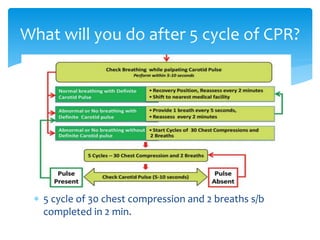
What will you do after 5 cycle of CPR?
 5 cycle of 30 chest compression and 2 breaths s/b
completed in 2 min.
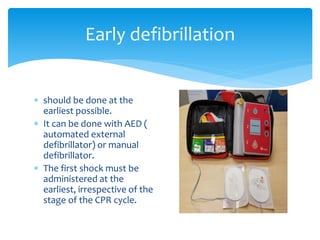
 should be done at the
earliest possible.
 It can be done with AED (
automated external
defibrillator) or manual
defibrillator.
 The first shock must be
administered at the
earliest, irrespective of the
stage of the CPR cycle.
Early defibrillation
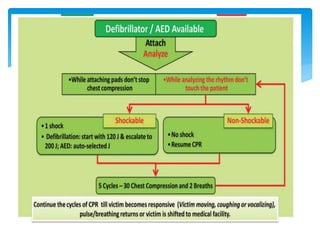
 Switch ON the AED
 Follow the voice prompts
• Attach AED pads without interrupting the chest
compressions
• Analyze the rhythm by AED for need of electric shock.
Do not touch the victim during rhythm analysis
• Administer electric shock if prompted by AED
• Resume CPR, starting with chest compression
steps of using automated external
defibrillator
 In case of return of spontaneous circulation and normal
breathing, the victim should be positioned in recovery
position till the medical help arrives and the victim is to be
shifted to medical facility.
 The recovery position can be either left or right lateral.
 The recovery position allows maintenance of the airway
and drainage of any oral secretions.
 Victim should be reassessed every 2 min or earlier if
required.
Recovery position
 should be shifted to the nearest suitable healthcare
facility for definite management of underling
etiology.
Transfer
 For management of in-hospital cardiac arrest by
trained medics and paramedics.
 CCLS incorporation of airway management, drugs,
and identification of the cause of arrest and its
correction, while chest compression and ventilation
are ongoing.
Comprehensive cardiopulmonary life support
(CCLS) or Advanced Cardiovascular Life
Support
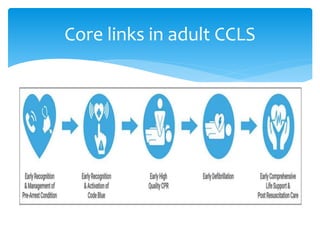
Core links in adult CCLS
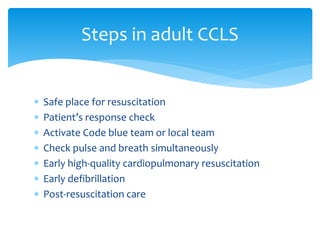
 Safe place for resuscitation
 Patient’s response check
 Activate Code blue team or local team
 Check pulse and breath simultaneously
 Early high-quality cardiopulmonary resuscitation
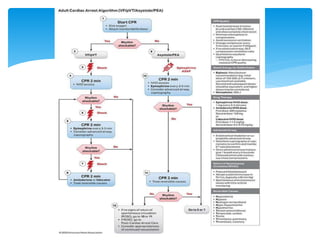
 Early defibrillation
 Post-resuscitation care
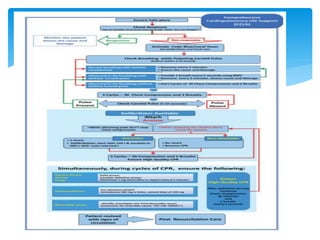
Steps in adult CCLS
 simultaneously
• Venous access
• Airway management
• Drugs including antiarrhythmics
• Assess and manage the reversible causes
Cont...
 Non invasive BP
 ECG
 Pulse oxymeter
 Capnography (EtCO2 )
Attach monitors
 Peripheral venous access most prefered
 The second choice remains intraosseous (IO)
cannulation. All drugs and fluids may be administered
through the IO route similar to intravenous access.
 Endotracheal route can also be used. Naloxone,
adrenaline, atropine and lidocaine can be given. The
intratracheal dose should be 2–2½ times that of
intravenous dose and diluted to 10 mL.
Venous access
 The definitive airway may be secured with an
endotracheal tube or supraglottic devices.
 However, if the BMV is optimal, then securing
definitive airway can be deferred to prevent
unnecessary interruption of chest compression.
 “After definite airway continue high
quality cpr with chest compression at
120/min and 1 breath at every 6 sec.”
Airway management
 Adrenaline: 1 mg diluted in 10 mL should be
administered as bolus, repeated every 3–5
min.
 Antiarrhythmics: Amiodarone 300 mg slow
over few min. If arrhythmias persist even after
initial 2–3 cycles of CPR. A second intravenous
dose of amiodarone 150 mg may be
administered if arrhythmias persist.
 Lignocaine may be considered as an alternate
drug in patients with persistent arrhythmia.
Drugs including antiarrhythmics
Team formation
 ‘HIT THE TARGET’
• H – Hypoxia,
• I – Increased H Ions [Acidosis],
• T – Tension Pneumothorax,
• T – Toxins/Poisons
• H – Hypovolaemia,
• E – Electrolyte Imbalance [Hypo-/Hyperkalaemia],
• T – Tamponade Cardiac,
• A – Acute Coronary Syndrome,
• R – Raised Intracranial Pressure [Subarachnoid Haemorrhage],
• G – Glucose [Hypo-/hyperglycaemia],
• E – Embolism (Pulmonary Thrombosis),
• T – Temperature [Hypothermia]).
Assess and manage the reversible
causes
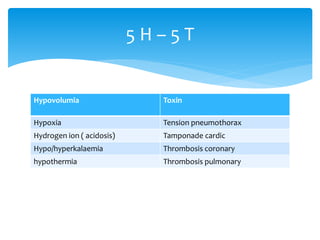
Hypovolumia Toxin
Hypoxia Tension pneumothorax
Hydrogen ion ( acidosis) Tamponade cardic
Hypo/hyperkalaemia Thrombosis coronary
hypothermia Thrombosis pulmonary
5 H – 5 T
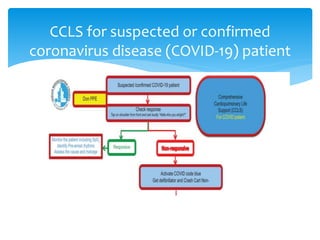
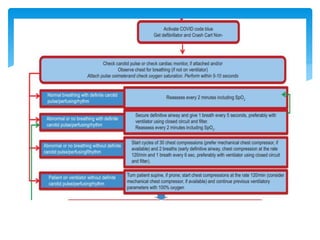
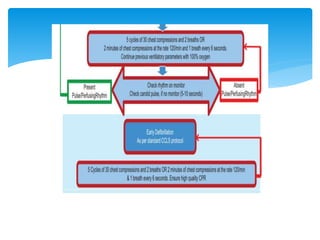
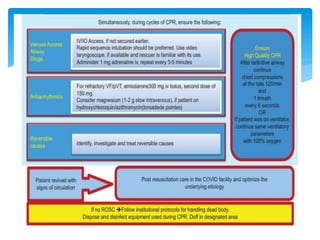
CCLS for suspected or confirmed
coronavirus disease (COVID-19) patient
Thank you
 Ref:
• Garg R, Ahmed SM, Kapoor MC, Mishra BB, Rao SC, Kalandoor MV, et al. Basic cardiopulmonary life support (BCLS) for cardiopulmonary resuscitation by trained
paramedics and medics outside the hospital. Indian J Anaesth 2017;61:874-82.
• Garg R, Ahmed SM, Kapoor MC, Rao SC, Mishra BB, Kalandoor MV, et al. Comprehensive cardiopulmonary life support (CCLS) for cardiopulmonary resuscitation
by trained paramedics and medics inside the hospital. Indian J Anaesth 2017;61:883-94
• Singh B, Garg R, Chakra Rao SS, Ahmed SM, Divatia JV, Ramakrishnan TV, et al. Indian Resuscitation Council (IRC) suggested guidelines for Comprehensive
Cardiopulmonary Life Support (CCLS) for suspected or confirmed coronavirus disease (COVID-19) patient. Indian J Anaesth 2020;64:S91-6.
• www.cprindia.in

Basic and advance cardiac life support

  • 1.
    Basic and Advanced CardiovascularLife Support By: Dr. Ram Gopal Maurya MBBS,MD,PDCC Dept. of Anaesthesiology HIMS, Ataria, Sitapur
  • 2.
     It issudden cessation of mechanical activity of heart with some or no electrical activity leading to cessation of blood circulation.  Cardiac arrest may be out-of-hospital cardiac arrest or in-hospital cardiac arrest What is cardiac arrest?
  • 3.
     Management ofout-of-hospital cardiac arrest. Basic cardiopulmonary life support (BCLS)
  • 4.
    Core links inadult BCLS
  • 6.
     Safe placefor resuscitation  Victim’s response check  Call for help, inform emergency medical system and get emergency equipment  Check pulse and breath simultaneously  Early high-quality cardiopulmonary resuscitation Steps in adult BCLS
  • 7.
     Early defibrillation Recovery position  Transfer
  • 8.
     1st step For safety of rescuer Scene safety
  • 9.
     By tappingon the shoulder from front and ask loudly hello, are you alright? in local language.  Do not shake or tap on the face as it may cause movement at neck level and could harm a victim with cervical injury Check response
  • 10.
     If victimis responsive; place the victim in recovery position and constantly monitor until victim is shifted nearest medical facility
  • 12.
     Check forcarotid pulse simultaneously scan the chest and abdomen for signs of breathing.
  • 14.
     Respiratory arrestcondition  Provide normal tidal volume breath for every 5 seconds (12 breath per minute) using mouth to mouth breath.  Each breath over 1 second  End point is visible chest rise  Reassess for pulse every 2 minutes Abnormal or no breathing with definite carotid pulse
  • 15.
     Early high-qualitycardiopulmonary resuscitation  Once the cardiac arrest is recognized, start providing chest compression immediately. Cycles of CPR (cycles of 30 chest compressions: 2 breaths) should be initiated. Early chest compression
  • 16.
     High-quality chestcompressions • Ensure a chest compression speed of 120 compressions/minute to a depth of 5–6 cm. • Allow complete chest recoil between compression without lifting hand from the chest (do not lean on the victim’s chest) • Avoid unnecessary interruption of chest compressions. High-quality cardiopulmonary resuscitation
  • 17.
     Optimal ventilationand airway management • Do not interrupt chest compression to secure the airway, apply ECG electrodes or defibrillator pads/paddles • Do not hyperventilate • End point for ventilation is visible chest rise; deliver normal tidal volume breaths. Cont…
  • 18.
     Site ofchest compression: Lower half of sternum or two finger breadth above the xiphisternum How to do chest compression
  • 19.
     Hand position: Placethe heel of second hand on top of first hand and interlock the fingers
  • 20.
     Body positionand movement: • The elbows and wrists should be aligned in one straight line, shoulder should be positioned vertically on top of the chest. • Waist area s/b above the level of pt. chest.
  • 21.
     2 rescuebreath is given after 30 chest compression.  Deliver each breath over 1 sec and pause for 1 sec after first breath to allow exhalation.  End point is visible chest rise. How to give rescue breath
  • 22.
    What will youdo after 5 cycle of CPR?  5 cycle of 30 chest compression and 2 breaths s/b completed in 2 min.
  • 23.
     should bedone at the earliest possible.  It can be done with AED ( automated external defibrillator) or manual defibrillator.  The first shock must be administered at the earliest, irrespective of the stage of the CPR cycle. Early defibrillation
  • 25.
     Switch ONthe AED  Follow the voice prompts • Attach AED pads without interrupting the chest compressions • Analyze the rhythm by AED for need of electric shock. Do not touch the victim during rhythm analysis • Administer electric shock if prompted by AED • Resume CPR, starting with chest compression steps of using automated external defibrillator
  • 26.
     In caseof return of spontaneous circulation and normal breathing, the victim should be positioned in recovery position till the medical help arrives and the victim is to be shifted to medical facility.  The recovery position can be either left or right lateral.  The recovery position allows maintenance of the airway and drainage of any oral secretions.  Victim should be reassessed every 2 min or earlier if required. Recovery position
  • 27.
     should beshifted to the nearest suitable healthcare facility for definite management of underling etiology. Transfer
  • 28.
     For managementof in-hospital cardiac arrest by trained medics and paramedics.  CCLS incorporation of airway management, drugs, and identification of the cause of arrest and its correction, while chest compression and ventilation are ongoing. Comprehensive cardiopulmonary life support (CCLS) or Advanced Cardiovascular Life Support
  • 29.
    Core links inadult CCLS
  • 31.
     Safe placefor resuscitation  Patient’s response check  Activate Code blue team or local team  Check pulse and breath simultaneously  Early high-quality cardiopulmonary resuscitation  Early defibrillation  Post-resuscitation care Steps in adult CCLS
  • 32.
     simultaneously • Venousaccess • Airway management • Drugs including antiarrhythmics • Assess and manage the reversible causes Cont...
  • 33.
     Non invasiveBP  ECG  Pulse oxymeter  Capnography (EtCO2 ) Attach monitors
  • 34.
     Peripheral venousaccess most prefered  The second choice remains intraosseous (IO) cannulation. All drugs and fluids may be administered through the IO route similar to intravenous access.  Endotracheal route can also be used. Naloxone, adrenaline, atropine and lidocaine can be given. The intratracheal dose should be 2–2½ times that of intravenous dose and diluted to 10 mL. Venous access
  • 35.
     The definitiveairway may be secured with an endotracheal tube or supraglottic devices.  However, if the BMV is optimal, then securing definitive airway can be deferred to prevent unnecessary interruption of chest compression.  “After definite airway continue high quality cpr with chest compression at 120/min and 1 breath at every 6 sec.” Airway management
  • 36.
     Adrenaline: 1mg diluted in 10 mL should be administered as bolus, repeated every 3–5 min.  Antiarrhythmics: Amiodarone 300 mg slow over few min. If arrhythmias persist even after initial 2–3 cycles of CPR. A second intravenous dose of amiodarone 150 mg may be administered if arrhythmias persist.  Lignocaine may be considered as an alternate drug in patients with persistent arrhythmia. Drugs including antiarrhythmics
  • 37.
  • 38.
     ‘HIT THETARGET’ • H – Hypoxia, • I – Increased H Ions [Acidosis], • T – Tension Pneumothorax, • T – Toxins/Poisons • H – Hypovolaemia, • E – Electrolyte Imbalance [Hypo-/Hyperkalaemia], • T – Tamponade Cardiac, • A – Acute Coronary Syndrome, • R – Raised Intracranial Pressure [Subarachnoid Haemorrhage], • G – Glucose [Hypo-/hyperglycaemia], • E – Embolism (Pulmonary Thrombosis), • T – Temperature [Hypothermia]). Assess and manage the reversible causes
  • 39.
    Hypovolumia Toxin Hypoxia Tensionpneumothorax Hydrogen ion ( acidosis) Tamponade cardic Hypo/hyperkalaemia Thrombosis coronary hypothermia Thrombosis pulmonary 5 H – 5 T
  • 42.
    CCLS for suspectedor confirmed coronavirus disease (COVID-19) patient
  • 46.
    Thank you  Ref: •Garg R, Ahmed SM, Kapoor MC, Mishra BB, Rao SC, Kalandoor MV, et al. Basic cardiopulmonary life support (BCLS) for cardiopulmonary resuscitation by trained paramedics and medics outside the hospital. Indian J Anaesth 2017;61:874-82. • Garg R, Ahmed SM, Kapoor MC, Rao SC, Mishra BB, Kalandoor MV, et al. Comprehensive cardiopulmonary life support (CCLS) for cardiopulmonary resuscitation by trained paramedics and medics inside the hospital. Indian J Anaesth 2017;61:883-94 • Singh B, Garg R, Chakra Rao SS, Ahmed SM, Divatia JV, Ramakrishnan TV, et al. Indian Resuscitation Council (IRC) suggested guidelines for Comprehensive Cardiopulmonary Life Support (CCLS) for suspected or confirmed coronavirus disease (COVID-19) patient. Indian J Anaesth 2020;64:S91-6. • www.cprindia.in