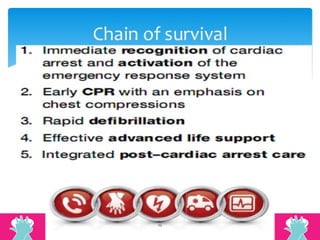
BASIC LIFE SUPPORT ( BLS)
ADVANCE LIFE SUPPORT ( ALS)
Dr. Adenwali Hassan Ahmed:
(Mwn, Medical Doctor, Public Health Officer,
Msc-Gyn/Obest.
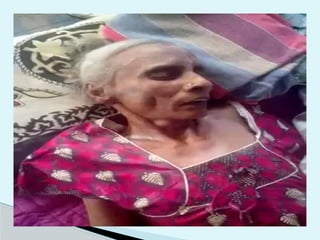
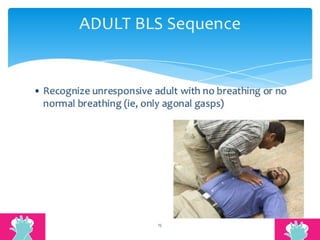
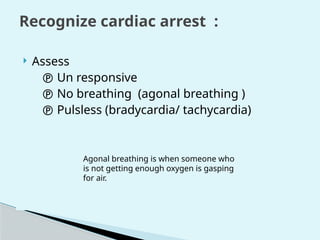
Recognize cardiac arrest:
 Assess
 Un responsive
 No breathing (a gonal breathing )
 Pulsless (tachycardia, bradycardia)
Reversible Causes of
Cardiac Arrest
Dr. Adanwali
 4 TS
 Thromboembolism
 Tension pneumothrax
 Tamponade
 Toxicity drugs: ( beta
blockers, ca channel
blockers, Dogoxin
 4 HS
 Hypoxia
 Hypovolemia
 Hypo/Hyperkalemia
 Hypothermia
 Basic Life Support
 Advance Life Support
 Post resuscitation care
Management:
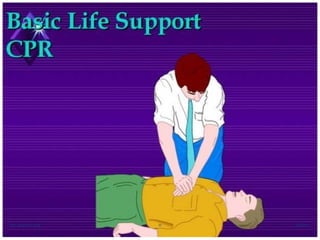
 Basic life support (BLS) is a level of medical
care which is used for patients with life-
threatening illnesses or injuries until they can
be given full medical care by advanced life
support providers (paramedics, nurses,
physicians).
◦ It can be provided by trained medical personnel,
such as emergency medical technicians and by
qualified bystanders.
Basic life support
 ALS providers perform invasive procedures and
administer a wide array of medications.
 An ALS unit is equipped with advanced airway
equipment, a cardiac monitor/defibrillator, IV
fluids, medications and more.
Advance Life Support
 Post-resuscitation care involves the care of
post-arrest brain and cardiac dysfunctions and
the ensuing systemic ischemia or reperfusion
response.
 This is an essential component in the
management of Sudden Cardiac Death (SCD)
because anoxic brain injury is a significant
cause of morbidity and mortality in these
patients.
Post resuscitation care
Anoxic: severe deficiency of oxygen in
tissues or organs
 Post-resuscitation care is meant to optimize
ventilation and circulation, preserve
organ/tissue function and maintain
recommended blood glucose levels.
 Below find a systematic approach followed by a
post-resuscitation care algorithm (set of rules)
to guide you in your treatment.:
Cont---
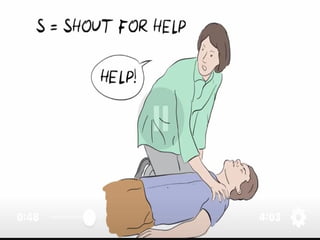
CPR Started out side the hospital:
Cont---
Cont---
AIRWAY:
 Maintain the airway patent and remove any
obstruction.
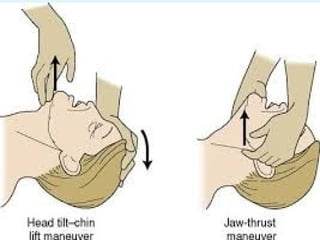
Technique:
1- Head tilt- chin lift
2- jaw thrust
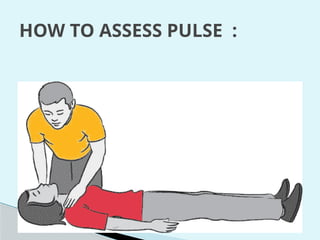
HOW TO ASSESS PULSE :
Cont---
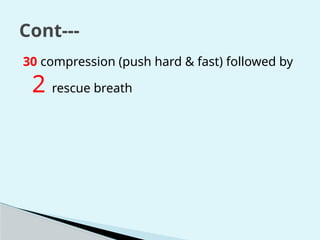
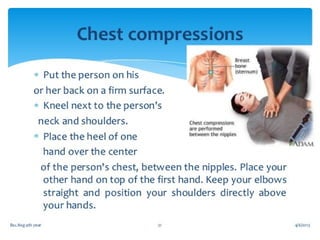
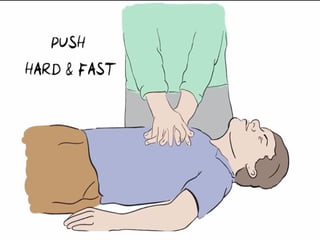
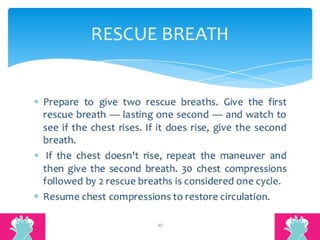
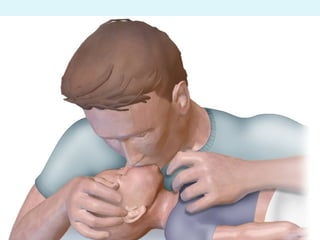
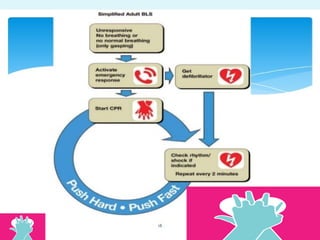
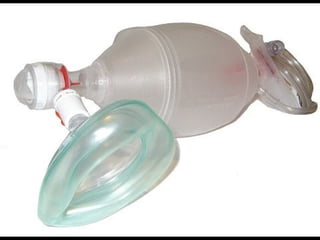
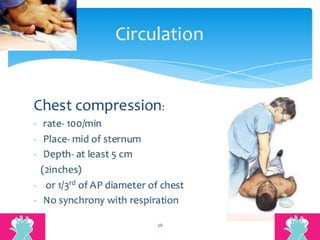
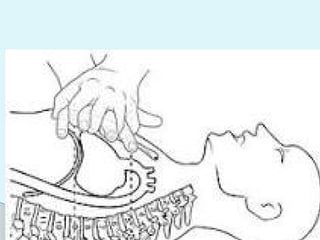
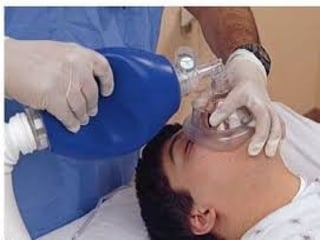
30 compression (push hard & fast) followed by
2 rescue breath
Cont---
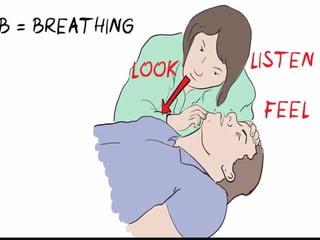
 Pulse normal  Rescue Breath
 Breathing normal  chest compression
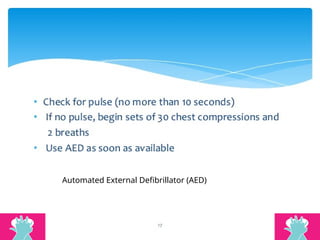
Automated External Defibrillator (AED)
Cont---
How to know the rhythm:
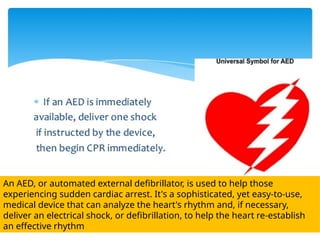
An AED, or automated external defibrillator, is used to help those
experiencing sudden cardiac arrest. It's a sophisticated, yet easy-to-use,
medical device that can analyze the heart's rhythm and, if necessary,
deliver an electrical shock, or defibrillation, to help the heart re-establish
an effective rhythm
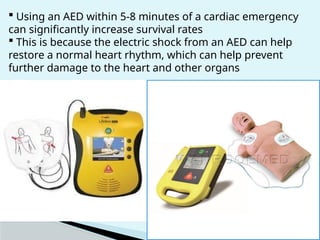
 Using an AED within 5-8 minutes of a cardiac emergency
can significantly increase survival rates
 This is because the electric shock from an AED can help
restore a normal heart rhythm, which can help prevent
further damage to the heart and other organs
In the hospital:
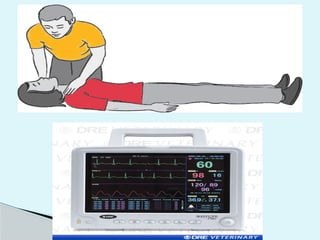
Recognize cardiac arrest :
 Assess
 Un responsive
 No breathing (agonal breathing )
 Pulsless (bradycardia/ tachycardia)
Agonal breathing is when someone who
is not getting enough oxygen is gasping
for air.
 Circulation by cardiac compression.
 Air management by equipment.
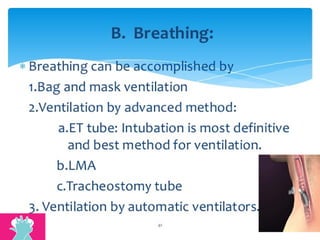
 Breathing by advanced technique.
 Defibrillatoration by manual defibrillator.
 Drugs
Aim to maintain:
ASSESS: ABC
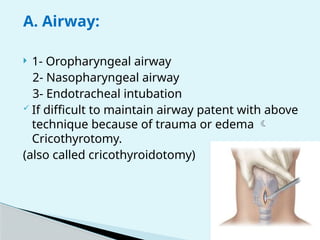
A. Airway:
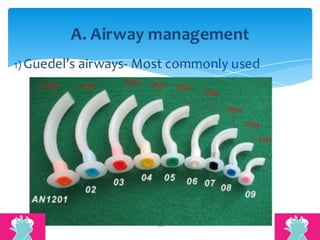
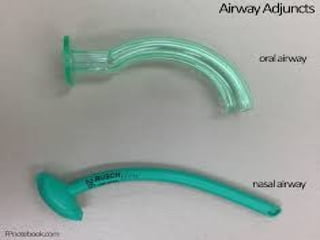
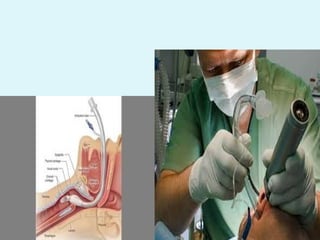
 1- Oropharyngeal airway
2- Nasopharyngeal airway
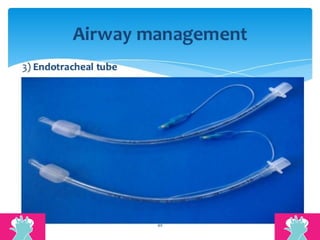
3- Endotracheal intubation
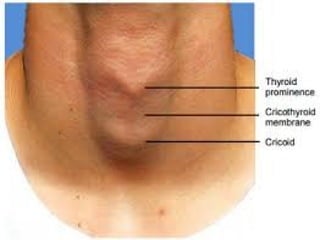
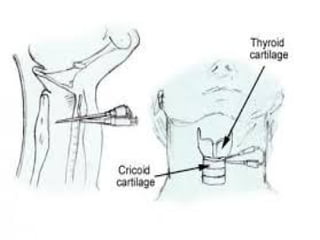
 If difficult to maintain airway patent with above
technique because of trauma or edema 
Cricothyrotomy.
(also called cricothyroidotomy)
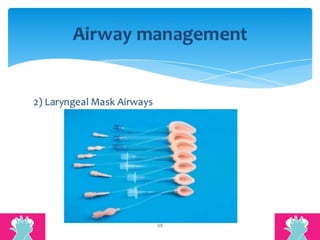
LMA
Circulation:
 Consist of 2 basic component:
~ Oxygen caring capacity  Hb
~ Contractility  heart pump
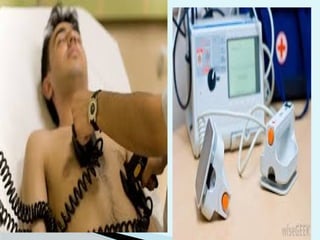
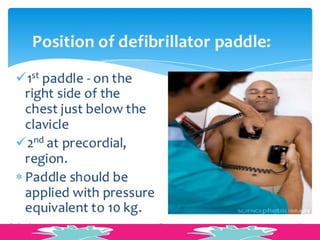
DEFIBRILLATOR:
 An electronic device that administers an
electric shock of preset voltage to the heart
through the chest wall in an attempt to
restore the normal rhythm of the heart
during ventricular fibrillation
Using an AED within 5-8 minutes of a
cardiac emergency can
significantly increase survival rates. This
is because the electric shock from an
AED can help restore a normal heart
rhythm, which can help prevent further
damage to the heart and other organs
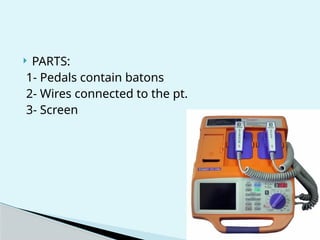
 PARTS:
1- Pedals contain batons
2- Wires connected to the pt.
3- Screen
DEFINITION:
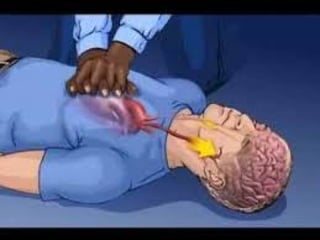
 Cardiopulmonary resuscitation (CPR) is an
emergency procedure that combines chest
compressions often with artificial ventilation in
an effort to manually preserve intact brain
function until further measures are taken to
restore spontaneous blood circulation and
breathing in a person who is in cardiac arrest.
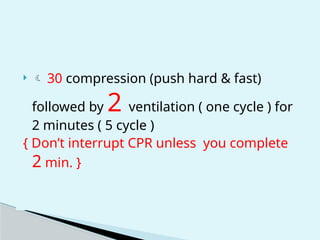
  30 compression (push hard & fast)
followed by 2 ventilation ( one cycle ) for
2 minutes ( 5 cycle )
{ Don’t interrupt CPR unless you complete
2 min. }
Cont---

 30 compression followed by 2
ventilation ( one cycle ) for 2 minutes ( 5
cycle )
{ Don’t interrupt CPR unless you complete 2
min. }
Stop for 10 sec. to assess :
1/ Carotid pulse :
2/ Monitor: compatible with pulse .
RESULT :
A) Shokable rhythm: shock
B) Non shockable rhythm: continue CPR
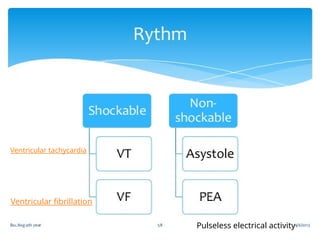
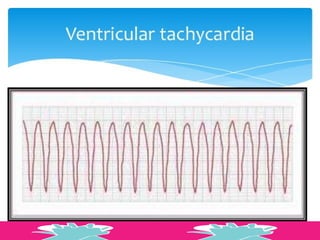
 Shockable Rhythms V-Tach is an abnormal heart rhythm marked by an
uncharacteristically fast heartbeat. Instead of beating 60-100 times per minute, a
heart in Ventricular Tachycardia usually beats over 100 times or more per minute.
 VT is caused by irregular electrical impulses within the heart's lower chambers
VT: Ventricular tachycardia
WHAT IS THE RUNING RHYTHM
 Running rhythm is the control of your movements.
 In other words to make them consistent and in
conjunction with all parts of the body.
 Most importantly, as running rhythm is also
associated with the respiratory system, it also includes
a breathing pattern.
Pulseless electrical activity
Ventricular tachycardia
Ventricular fibrillation
 Shockable Rhythm: Pulseless V-tachycardia is
a poorly perfusing rhythm and patients may
present with or without a pulse.
 Most patients with this rhythm are pulseless
and unconscious and defibrillation is necessary
to reset the heart so that the primary
pacemaker (usually the SA node) can take over
Cont---
 Asystole is when there's no electricity or
movement in your heart. That means you don't
have a heartbeat.
 It's also known as flatline. That's because
doctors check the rhythm of your heart with a
machine called an electrocardiogram -- also
called an ECG
Cont---
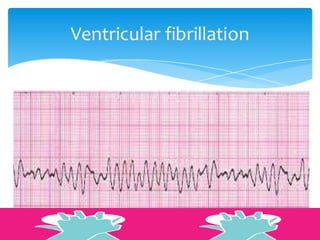
 Ventricular fibrillation is a type of arrhythmia,
or irregular heartbeat, that affects your heart's
ventricles.
 Ventricular fibrillation is life-threatening and
requires immediate medical attention.
 CPR and defibrillation can restore your heart to
its normal rhythm and may be life saving
Cont---
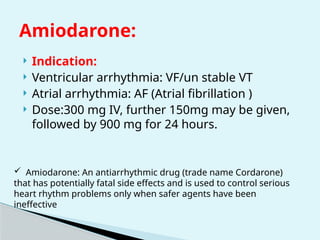
 Indication:
 Ventricular arrhythmia: VF/un stable VT
 Atrial arrhythmia: AF (Atrial fibrillation )
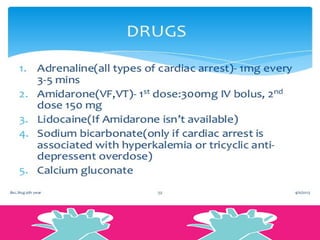
 Dose:300 mg IV, further 150mg may be given,
followed by 900 mg for 24 hours.
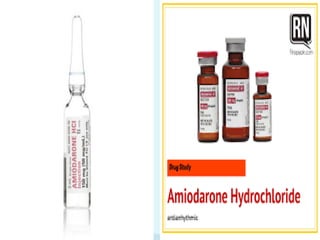
Amiodarone:
 Amiodarone: An antiarrhythmic drug (trade name Cordarone)
that has potentially fatal side effects and is used to control serious
heart rhythm problems only when safer agents have been
ineffective
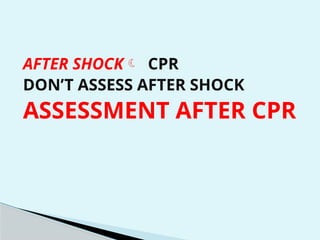
AFTER SHOCK CPR
DON’T ASSESS AFTER SHOCK
ASSESSMENT AFTER CPR
NON SHOCKABLE
RHYTHM:
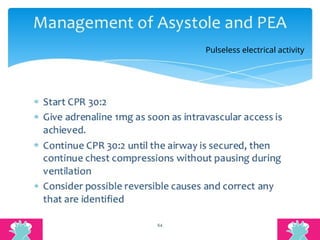
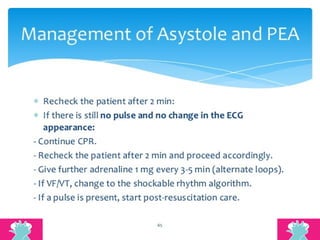
Pulseless electrical activity
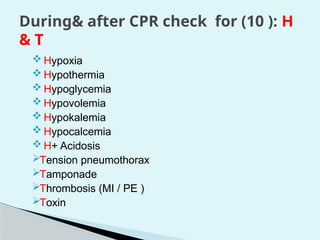
During& after CPR check for (10 ): H
& T
 Hypoxia
 Hypothermia
 Hypoglycemia
 Hypovolemia
 Hypokalemia
 Hypocalcemia
 H+ Acidosis
Tension pneumothorax
Tamponade
Thrombosis (MI / PE )
Toxin
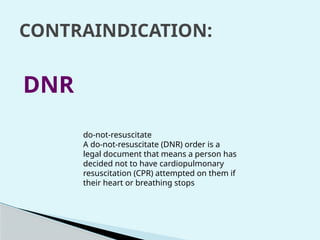
CONTRAINDICATION:
DNR
do-not-resuscitate
A do-not-resuscitate (DNR) order is a
legal document that means a person has
decided not to have cardiopulmonary
resuscitation (CPR) attempted on them if
their heart or breathing stops
BASIC LIFE SUPPORT and ALS.pptx. Dr adenwali

BASIC LIFE SUPPORT and ALS.pptx. Dr adenwali

  • 1.
    BASIC LIFE SUPPORT( BLS) ADVANCE LIFE SUPPORT ( ALS) Dr. Adenwali Hassan Ahmed: (Mwn, Medical Doctor, Public Health Officer, Msc-Gyn/Obest.
  • 2.
    Recognize cardiac arrest: Assess  Un responsive  No breathing (a gonal breathing )  Pulsless (tachycardia, bradycardia)
  • 4.
    Reversible Causes of CardiacArrest Dr. Adanwali  4 TS  Thromboembolism  Tension pneumothrax  Tamponade  Toxicity drugs: ( beta blockers, ca channel blockers, Dogoxin  4 HS  Hypoxia  Hypovolemia  Hypo/Hyperkalemia  Hypothermia
  • 5.
     Basic LifeSupport  Advance Life Support  Post resuscitation care Management:
  • 6.
     Basic lifesupport (BLS) is a level of medical care which is used for patients with life- threatening illnesses or injuries until they can be given full medical care by advanced life support providers (paramedics, nurses, physicians). ◦ It can be provided by trained medical personnel, such as emergency medical technicians and by qualified bystanders. Basic life support
  • 7.
     ALS providersperform invasive procedures and administer a wide array of medications.  An ALS unit is equipped with advanced airway equipment, a cardiac monitor/defibrillator, IV fluids, medications and more. Advance Life Support
  • 8.
     Post-resuscitation careinvolves the care of post-arrest brain and cardiac dysfunctions and the ensuing systemic ischemia or reperfusion response.  This is an essential component in the management of Sudden Cardiac Death (SCD) because anoxic brain injury is a significant cause of morbidity and mortality in these patients. Post resuscitation care Anoxic: severe deficiency of oxygen in tissues or organs
  • 9.
     Post-resuscitation careis meant to optimize ventilation and circulation, preserve organ/tissue function and maintain recommended blood glucose levels.  Below find a systematic approach followed by a post-resuscitation care algorithm (set of rules) to guide you in your treatment.: Cont---
  • 11.
    CPR Started outside the hospital: Cont---
  • 16.
  • 19.
    AIRWAY:  Maintain theairway patent and remove any obstruction. Technique: 1- Head tilt- chin lift 2- jaw thrust
  • 22.
  • 23.
    Cont--- 30 compression (pushhard & fast) followed by 2 rescue breath
  • 28.
    Cont---  Pulse normal Rescue Breath  Breathing normal  chest compression
  • 29.
  • 30.
  • 31.
    An AED, orautomated external defibrillator, is used to help those experiencing sudden cardiac arrest. It's a sophisticated, yet easy-to-use, medical device that can analyze the heart's rhythm and, if necessary, deliver an electrical shock, or defibrillation, to help the heart re-establish an effective rhythm
  • 32.
     Using anAED within 5-8 minutes of a cardiac emergency can significantly increase survival rates  This is because the electric shock from an AED can help restore a normal heart rhythm, which can help prevent further damage to the heart and other organs
  • 34.
  • 35.
    Recognize cardiac arrest:  Assess  Un responsive  No breathing (agonal breathing )  Pulsless (bradycardia/ tachycardia) Agonal breathing is when someone who is not getting enough oxygen is gasping for air.
  • 37.
     Circulation bycardiac compression.  Air management by equipment.  Breathing by advanced technique.  Defibrillatoration by manual defibrillator.  Drugs Aim to maintain:
  • 38.
  • 40.
    A. Airway:  1-Oropharyngeal airway 2- Nasopharyngeal airway 3- Endotracheal intubation  If difficult to maintain airway patent with above technique because of trauma or edema  Cricothyrotomy. (also called cricothyroidotomy)
  • 42.
  • 51.
    Circulation:  Consist of2 basic component: ~ Oxygen caring capacity  Hb ~ Contractility  heart pump
  • 53.
    DEFIBRILLATOR:  An electronicdevice that administers an electric shock of preset voltage to the heart through the chest wall in an attempt to restore the normal rhythm of the heart during ventricular fibrillation Using an AED within 5-8 minutes of a cardiac emergency can significantly increase survival rates. This is because the electric shock from an AED can help restore a normal heart rhythm, which can help prevent further damage to the heart and other organs
  • 54.
     PARTS: 1- Pedalscontain batons 2- Wires connected to the pt. 3- Screen
  • 57.
    DEFINITION:  Cardiopulmonary resuscitation(CPR) is an emergency procedure that combines chest compressions often with artificial ventilation in an effort to manually preserve intact brain function until further measures are taken to restore spontaneous blood circulation and breathing in a person who is in cardiac arrest.
  • 59.
      30compression (push hard & fast) followed by 2 ventilation ( one cycle ) for 2 minutes ( 5 cycle ) { Don’t interrupt CPR unless you complete 2 min. }
  • 62.
    Cont---   30 compressionfollowed by 2 ventilation ( one cycle ) for 2 minutes ( 5 cycle ) { Don’t interrupt CPR unless you complete 2 min. }
  • 63.
    Stop for 10sec. to assess : 1/ Carotid pulse : 2/ Monitor: compatible with pulse . RESULT : A) Shokable rhythm: shock B) Non shockable rhythm: continue CPR  Shockable Rhythms V-Tach is an abnormal heart rhythm marked by an uncharacteristically fast heartbeat. Instead of beating 60-100 times per minute, a heart in Ventricular Tachycardia usually beats over 100 times or more per minute.  VT is caused by irregular electrical impulses within the heart's lower chambers VT: Ventricular tachycardia
  • 64.
    WHAT IS THERUNING RHYTHM  Running rhythm is the control of your movements.  In other words to make them consistent and in conjunction with all parts of the body.  Most importantly, as running rhythm is also associated with the respiratory system, it also includes a breathing pattern.
  • 65.
    Pulseless electrical activity Ventriculartachycardia Ventricular fibrillation
  • 66.
     Shockable Rhythm:Pulseless V-tachycardia is a poorly perfusing rhythm and patients may present with or without a pulse.  Most patients with this rhythm are pulseless and unconscious and defibrillation is necessary to reset the heart so that the primary pacemaker (usually the SA node) can take over Cont---
  • 67.
     Asystole iswhen there's no electricity or movement in your heart. That means you don't have a heartbeat.  It's also known as flatline. That's because doctors check the rhythm of your heart with a machine called an electrocardiogram -- also called an ECG Cont---
  • 69.
     Ventricular fibrillationis a type of arrhythmia, or irregular heartbeat, that affects your heart's ventricles.  Ventricular fibrillation is life-threatening and requires immediate medical attention.  CPR and defibrillation can restore your heart to its normal rhythm and may be life saving Cont---
  • 73.
     Indication:  Ventriculararrhythmia: VF/un stable VT  Atrial arrhythmia: AF (Atrial fibrillation )  Dose:300 mg IV, further 150mg may be given, followed by 900 mg for 24 hours. Amiodarone:  Amiodarone: An antiarrhythmic drug (trade name Cordarone) that has potentially fatal side effects and is used to control serious heart rhythm problems only when safer agents have been ineffective
  • 75.
    AFTER SHOCK CPR DON’TASSESS AFTER SHOCK ASSESSMENT AFTER CPR
  • 76.
  • 77.
  • 80.
    During& after CPRcheck for (10 ): H & T  Hypoxia  Hypothermia  Hypoglycemia  Hypovolemia  Hypokalemia  Hypocalcemia  H+ Acidosis Tension pneumothorax Tamponade Thrombosis (MI / PE ) Toxin
  • 82.
    CONTRAINDICATION: DNR do-not-resuscitate A do-not-resuscitate (DNR)order is a legal document that means a person has decided not to have cardiopulmonary resuscitation (CPR) attempted on them if their heart or breathing stops

Editor's Notes

  • #4 Betablockers: atenolol…. Ca channel blockers: Amlodipine, Nifedipine… Digoxin is a medication used to manage and treat heart failure and certain arrhythmias,
  • #5 ALS providers perform invasive procedures and administer a wide array of medications. A BLS unit includes two emergency medical technicians, while an ALS unit also has at least one paramedic. An ALS unit is equipped with advanced airway equipment, a cardiac monitor/defibrillator, IV fluids, medications, and more.
  • #6 Introduction. Cardiac tamponade is a medical or traumatic emergency that happens when enough fluid accumulates in the pericardial sac compressing the heart and leading to a decrease in cardiac output and shock.
  • #8 blood glucose levels: 100 to 125 mg/dL
  • #41 Laryngeal mask airways (LMA) are supraglottic airway devices. They may be used as a temporary method to maintain an open airway during the administration of anesthesia or as an immediate life-saving measure in a patient with a difficult or failed airway.
  • #53 A defibrillator is a device that gives a high energy electric shock to the heart of someone who is in cardiac arrest. This high energy shock is called defibrillation, and it's an essential part in trying to save the life of someone who's in cardiac arrest
  • #54 The “Universal AED”: Common Steps to Operate All AEDs Step 1: POWER ON the AED. The first step in operating an AED is to turn the power on. ... Step 2: Attach electrode pads. ... Step 3: Analyze the rhythm. ... Step 4: Clear the victim and press the SHOCK button
  • #64 Running rhythm is the control of your movements. In other words to make them consistent and in conjunction with all parts of the body. This includes striding methods and arm swing. Most importantly, as running rhythm is also associated with the respiratory system, it also includes a breathing pattern.
  • #65 The two shockable rhythms are ventricular fibrillation (VF) and pulseless ventricular tachycardia (VT) while the non–shockable rhythms include sinus rhythm (SR), supraventricular tachycardia (SVT), premature ventricualr contraction (PVC), atrial fibrilation (AF) and so on.
  • #72 Tricyclic antidepressants (TCAs) constitute a class of medications used to manage and treat major depressive disorder (MDD). These medications function by inhibiting the reuptake of neurotransmitters, such as serotonin and norepinephrine, which can modulate mood, attention, and pain in individuals.
  • #79 STEMI Segment Elevation myocarial infraction,,,, AMI: Acute myocarial infraction
  • #81 Dynamic Neural Retraining System DNRs