BLS AND ACLS
BASIC LIFE SUPPORT
What is BLS ??
 Basic life support refers to the type of care that first responders, healthcare
providers and public safety professionals provide to anyone who is
experiencing cardiac arrest , respiratory arrest and obstructed airway.
-American Red Cross
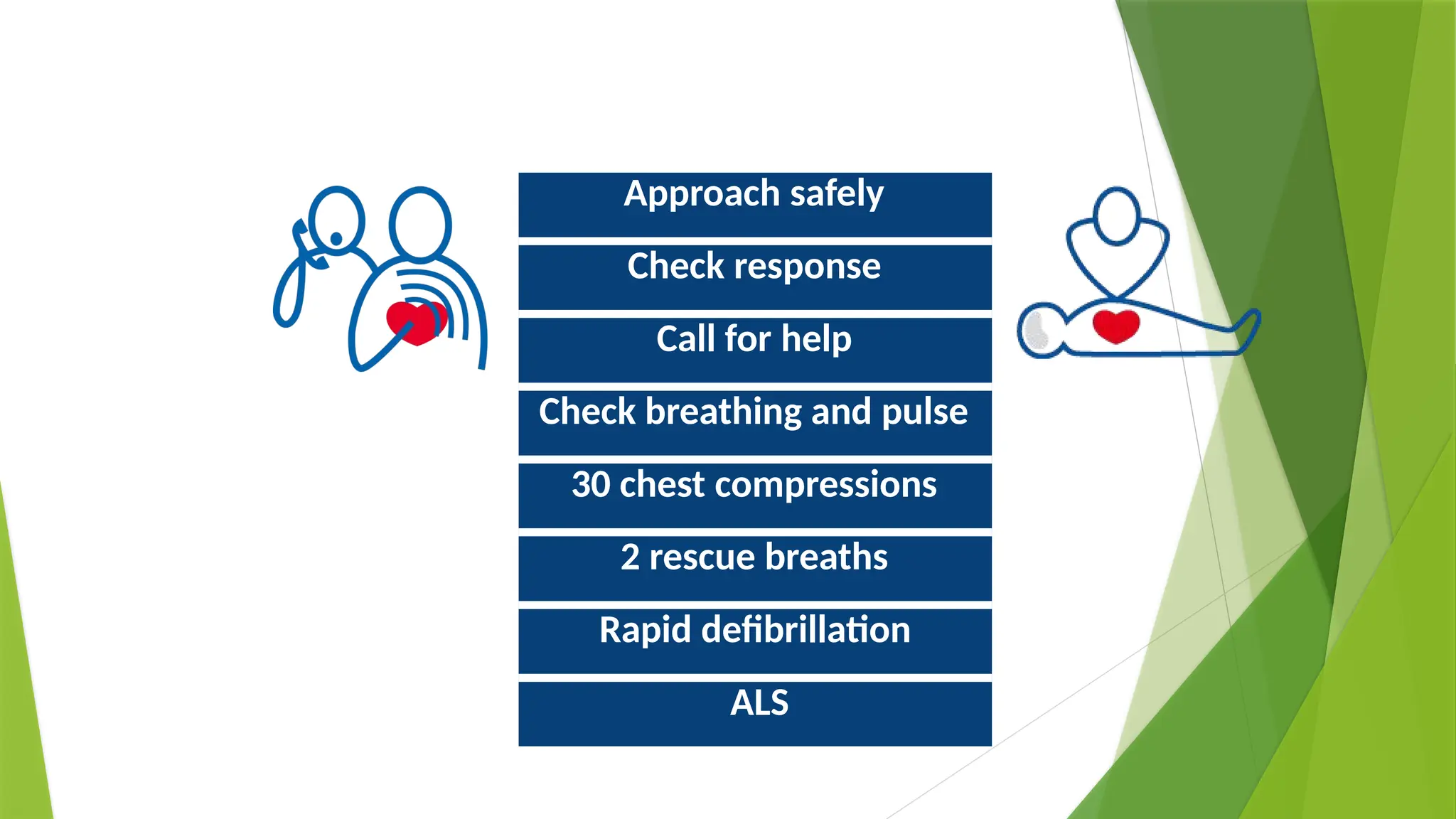
Approach safely
Check response
Call for help
Check breathing and pulse
30 chest compressions
2 rescue breaths
Rapid defibrillation
ALS
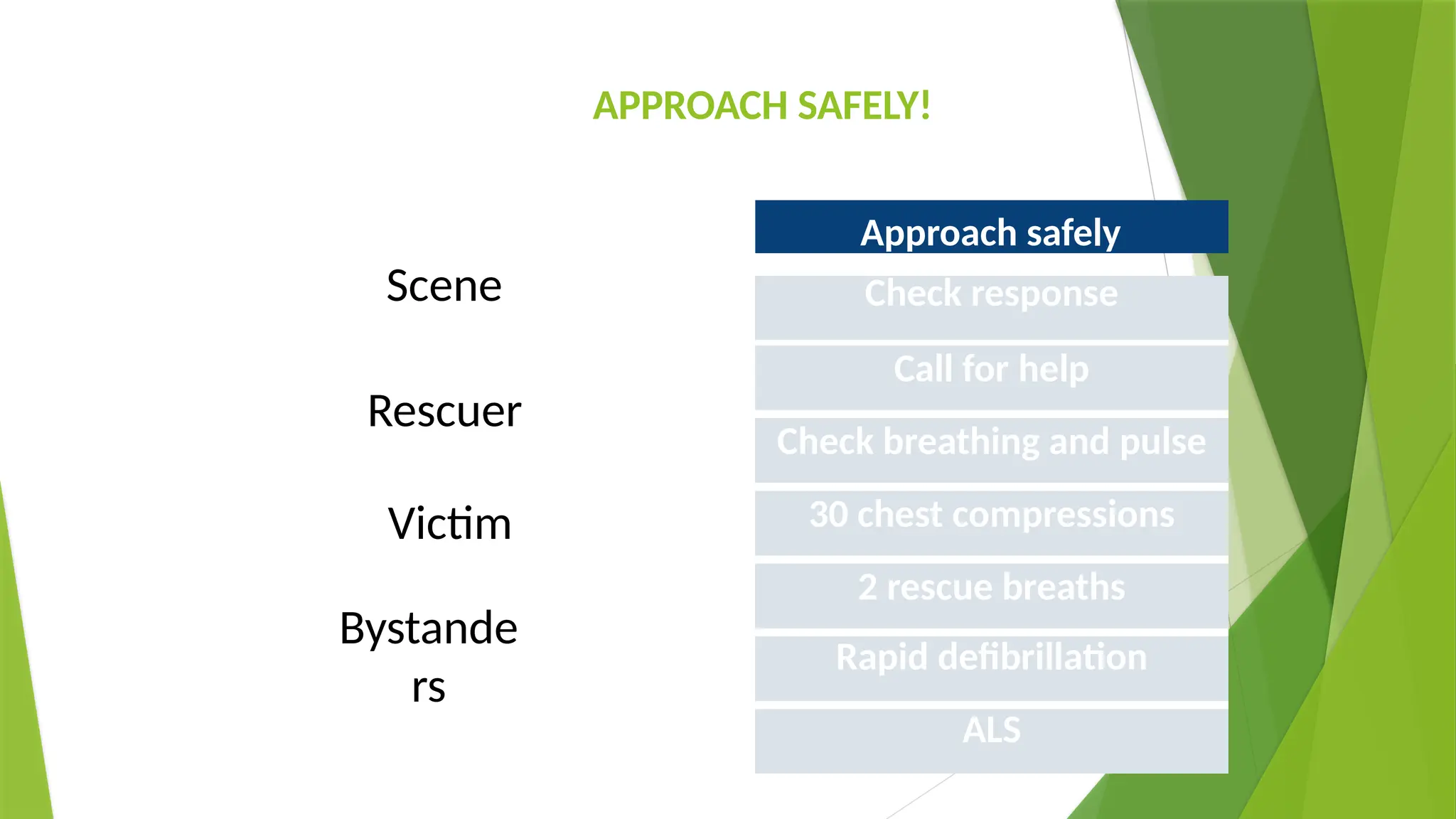
APPROACH SAFELY!
Scene
Rescuer
Victim
Bystande
rs
Approach safely
Check response
Call for help
Check breathing and pulse
30 chest compressions
2 rescue breaths
Rapid defibrillation
ALS
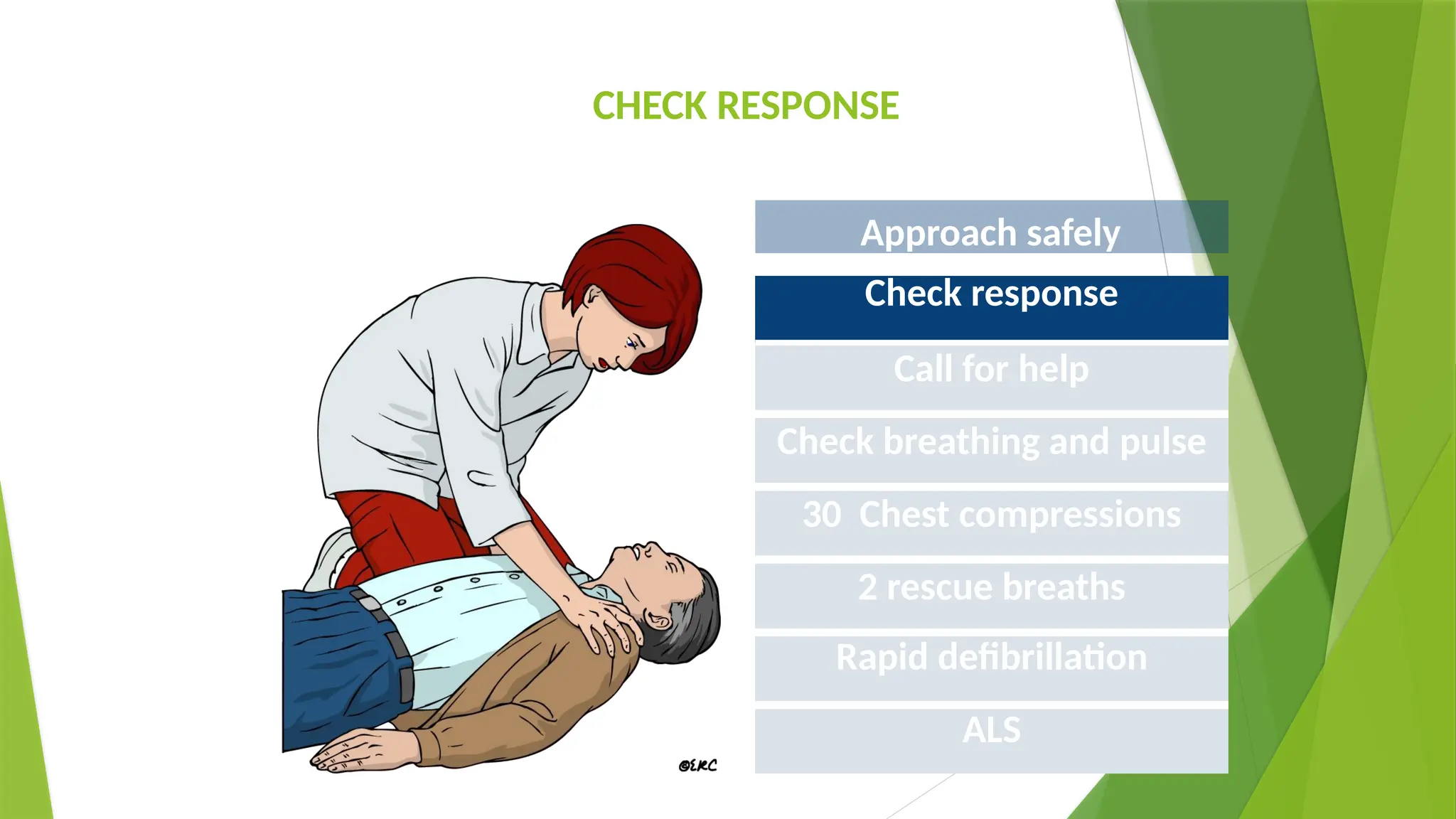
CHECK RESPONSE
Approach safely
Check response
Call for help
Check breathing and pulse
30 Chest compressions
2 rescue breaths
Rapid defibrillation
ALS
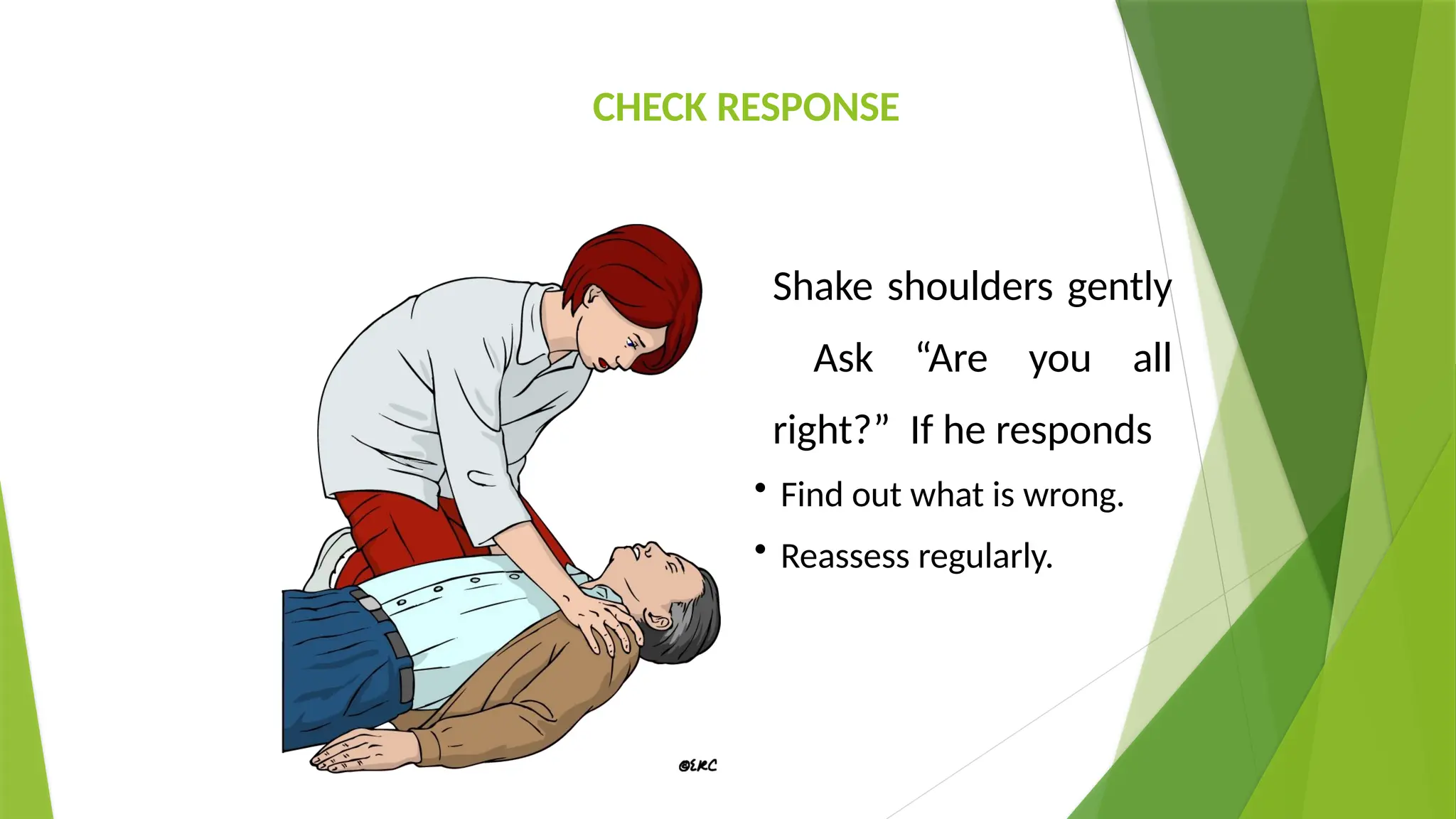
Shake shoulders gently
Ask “Are you all
right?” If he responds
• Find out what is wrong.
• Reassess regularly.
CHECK RESPONSE
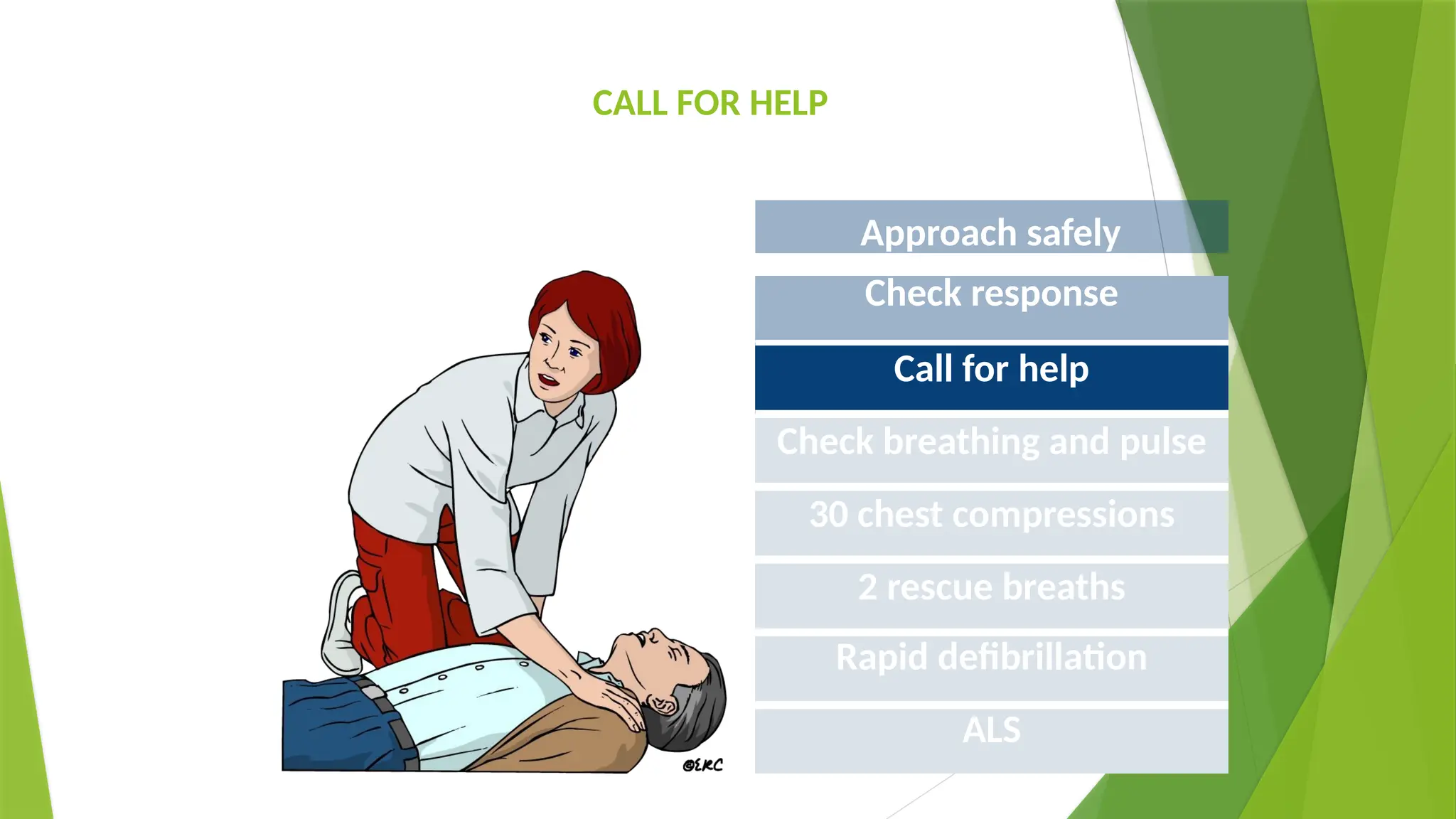
CALL FOR HELP
Approach safely
Check response
Call for help
Check breathing and pulse
30 chest compressions
2 rescue breaths
Rapid defibrillation
ALS
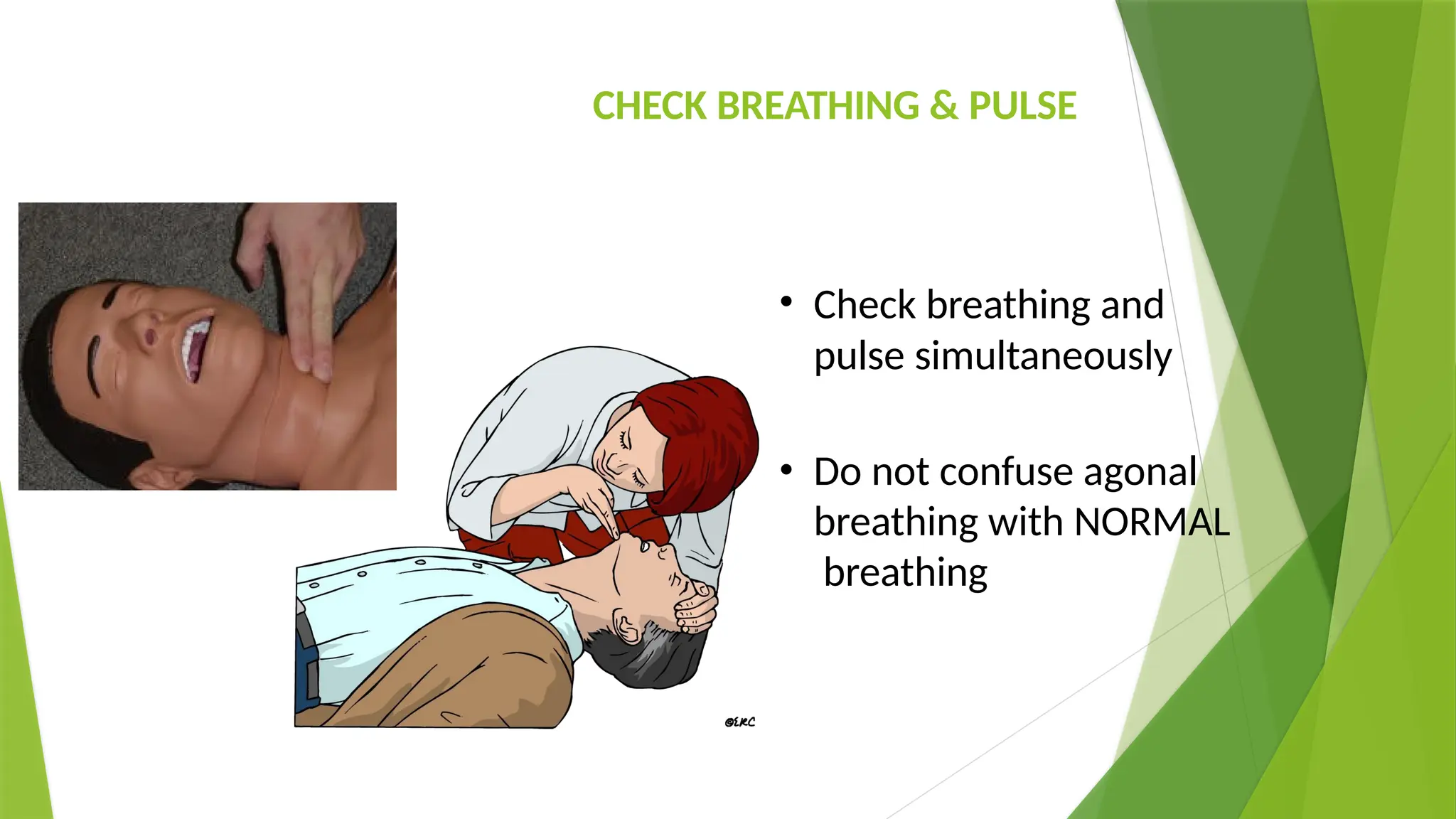
CHECK BREATHING & PULSE
• Check breathing and
pulse simultaneously
• Do not confuse agonal
breathing with NORMAL
breathing
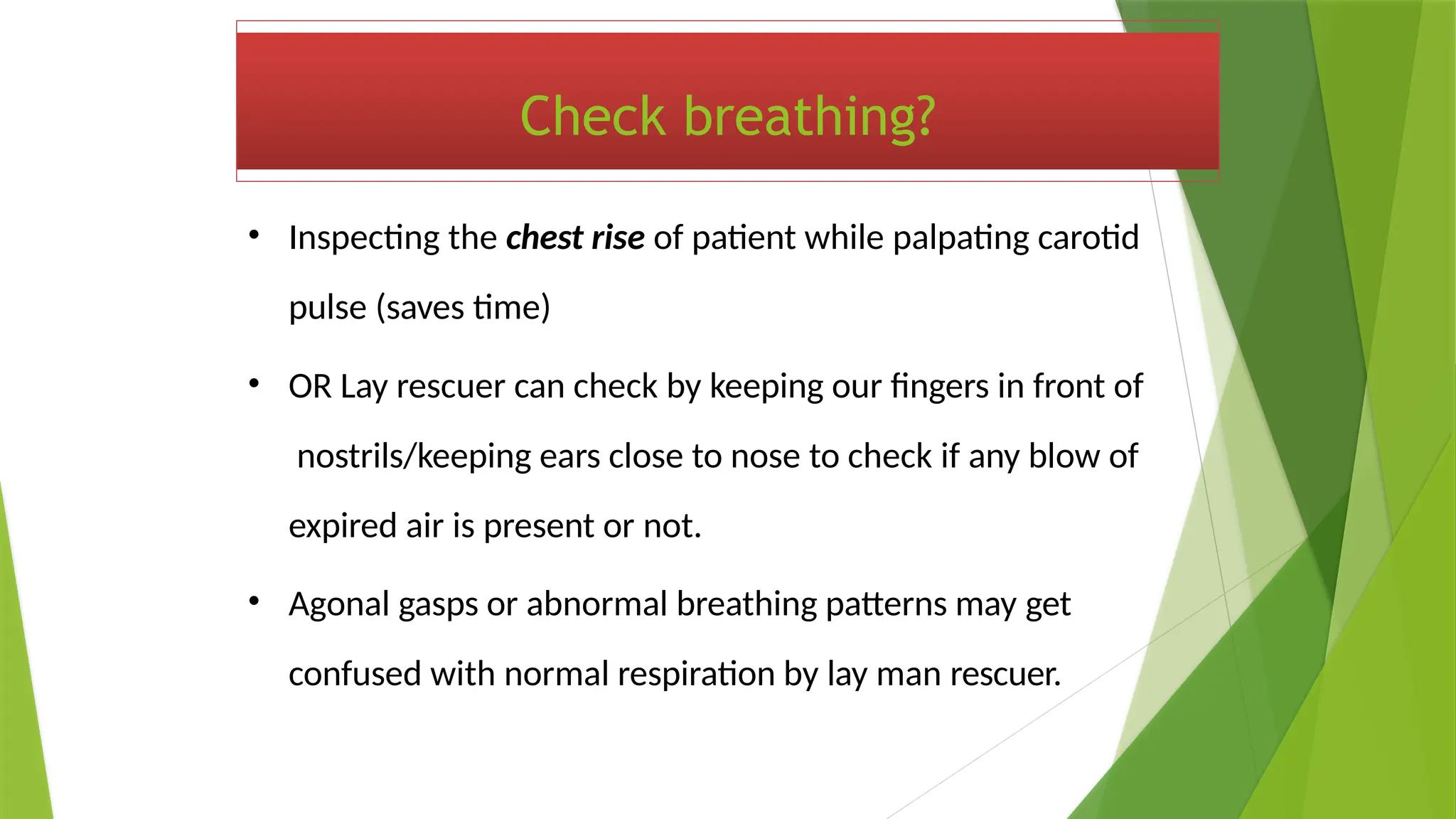
Check breathing?
• Inspecting the chest rise of patient while palpating carotid
pulse (saves time)
• OR Lay rescuer can check by keeping our fingers in front of
nostrils/keeping ears close to nose to check if any blow of
expired air is present or not.
• Agonal gasps or abnormal breathing patterns may get
confused with normal respiration by lay man rescuer.
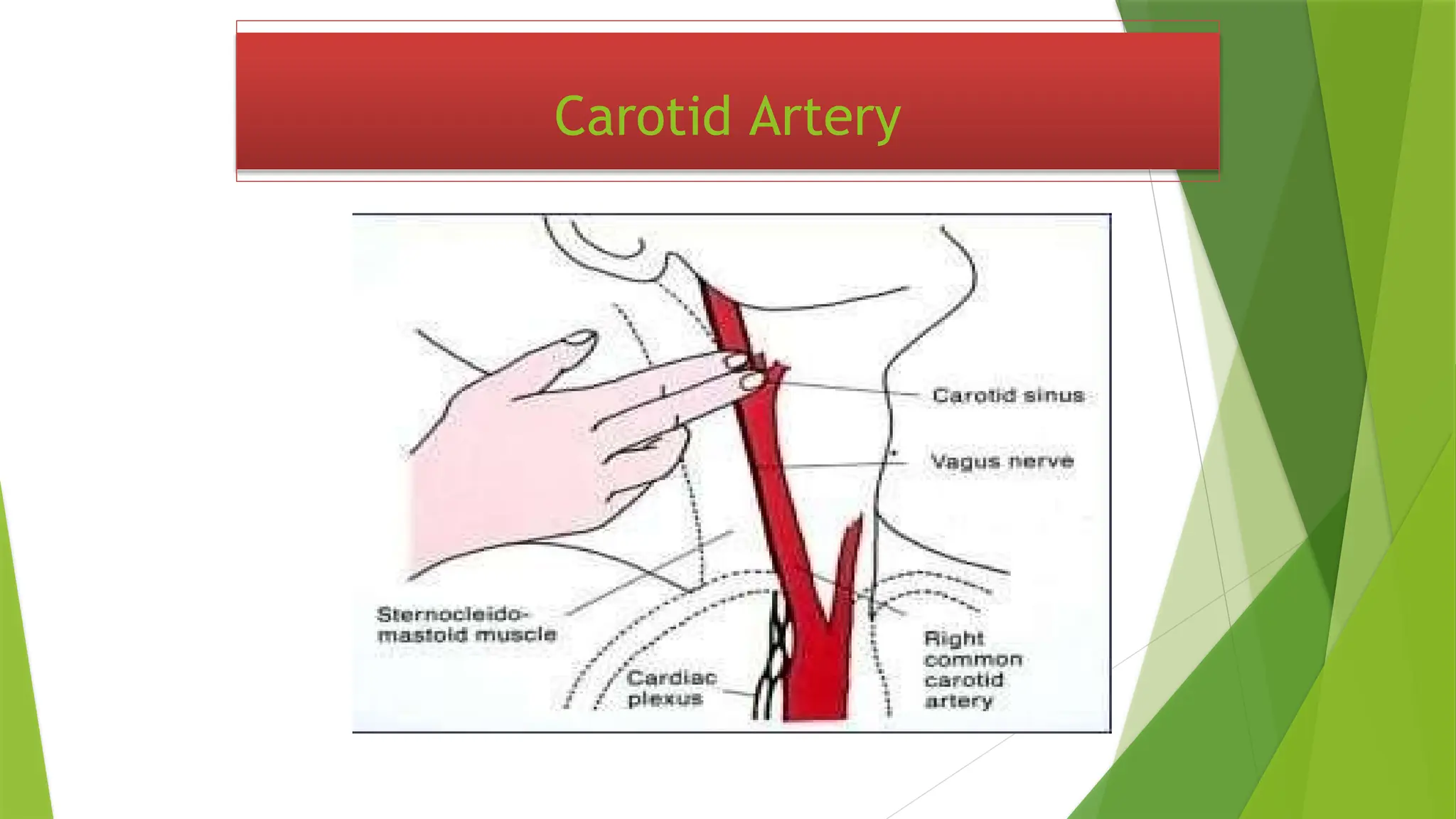
Carotid Artery
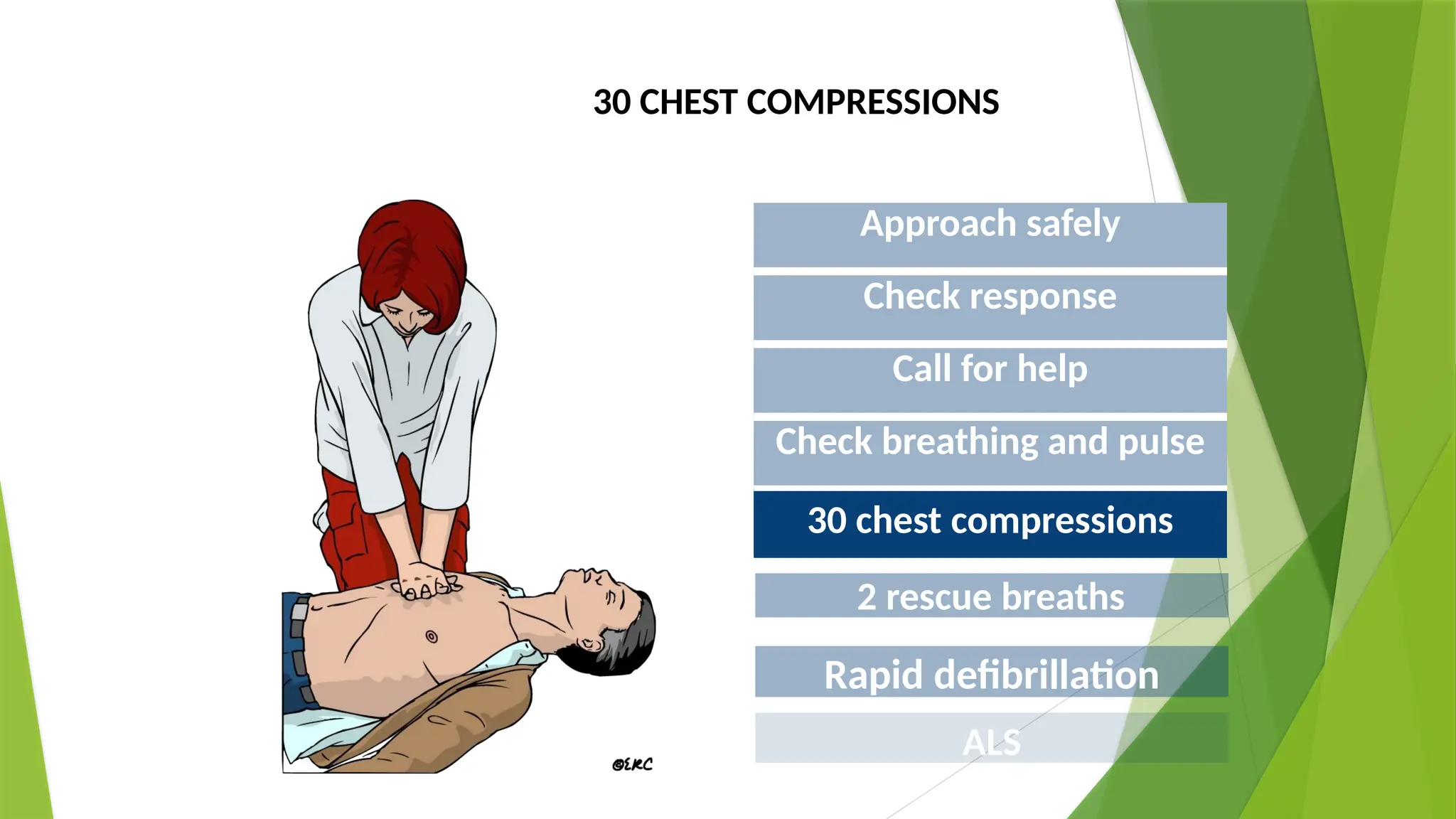
30 CHEST COMPRESSIONS
Approach safely
Check response
Call for help
Check breathing and pulse
30 chest compressions
2 rescue breaths
ALS
Rapid defibrillation
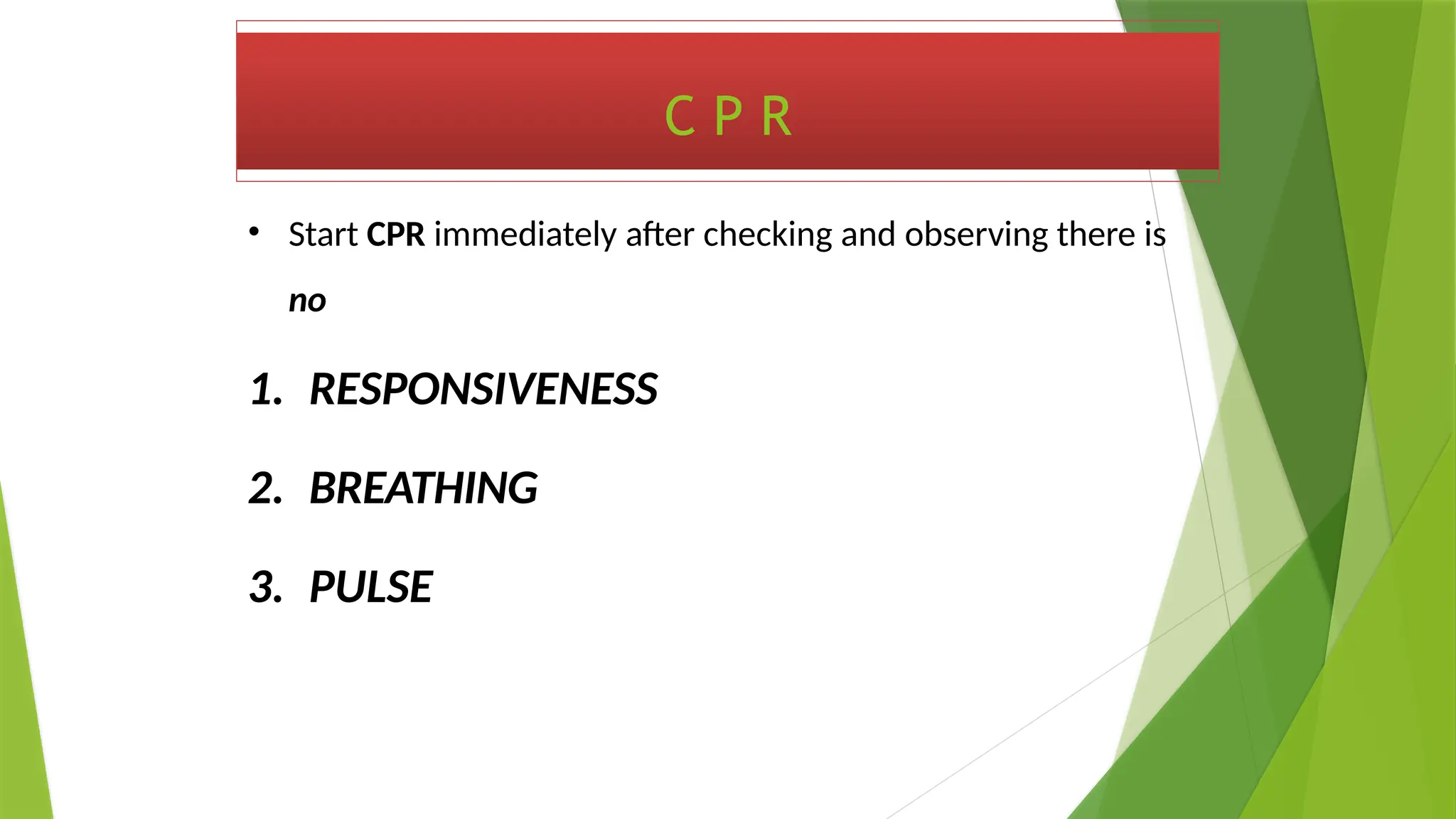
C P R
• Start CPR immediately after checking and observing there is
no
1. RESPONSIVENESS
2. BREATHING
3. PULSE
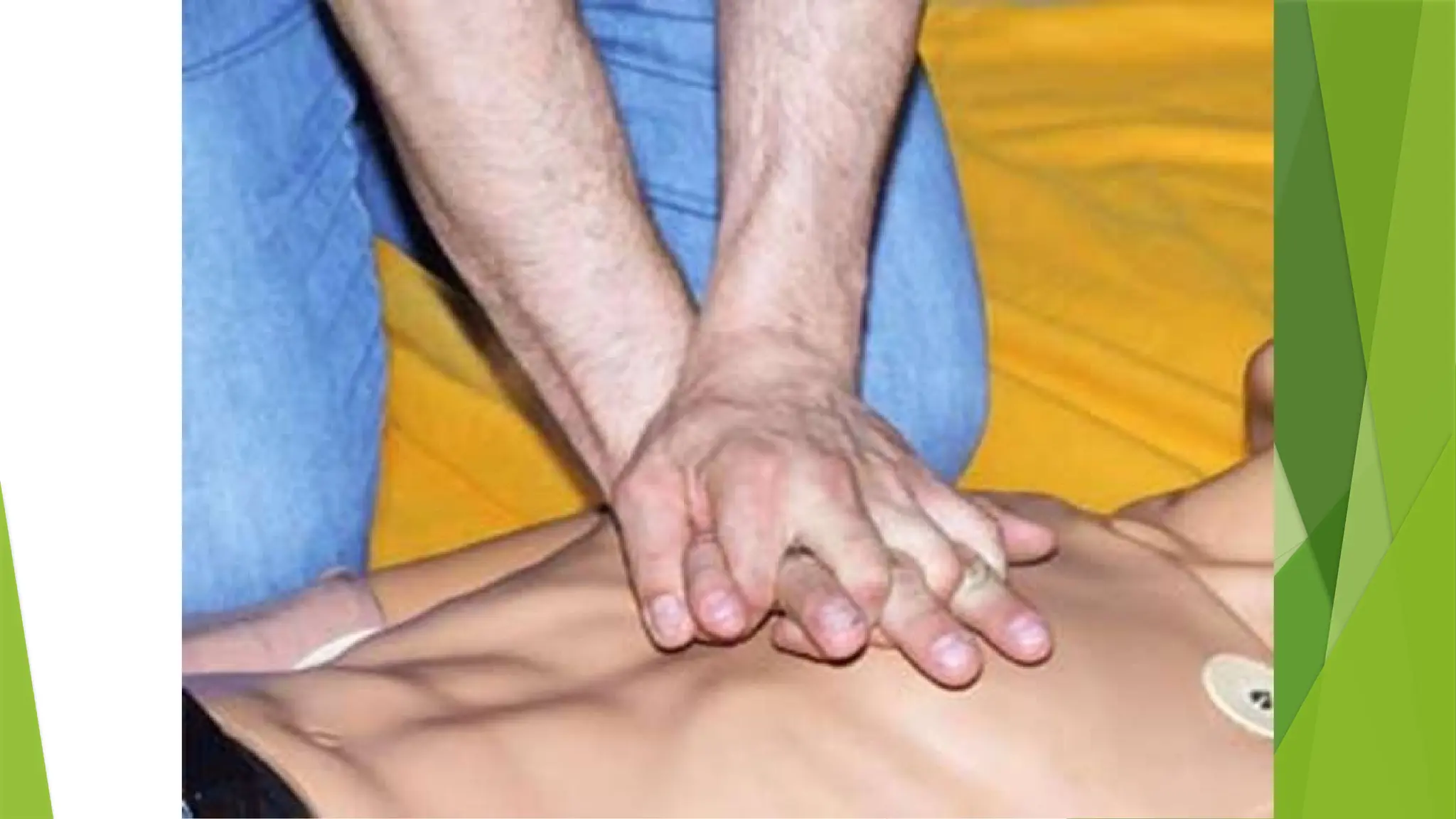
Chest Compressions
• Technique-
o Position yourself at patient’s side
o firm, flat surface and
o remove all the clothings
o Put the heel of one hand on the centre of chest (sternum) at
the level of nipples and put your other hand on the top of that
hand.
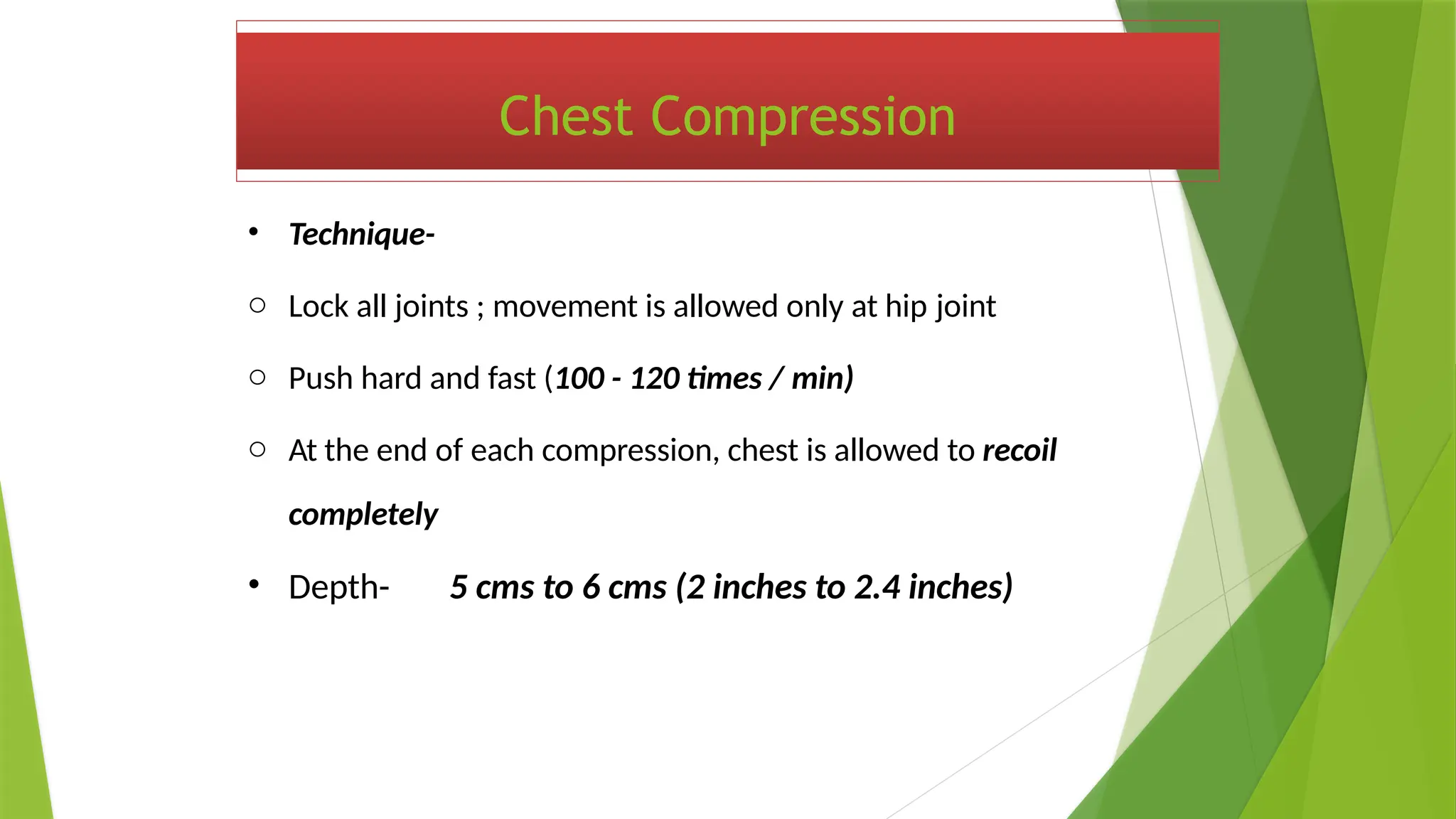
Chest Compression
• Technique-
o Lock all joints ; movement is allowed only at hip joint
o Push hard and fast (100 - 120 times / min)
o At the end of each compression, chest is allowed to recoil
completely
• Depth- 5 cms to 6 cms (2 inches to 2.4 inches)
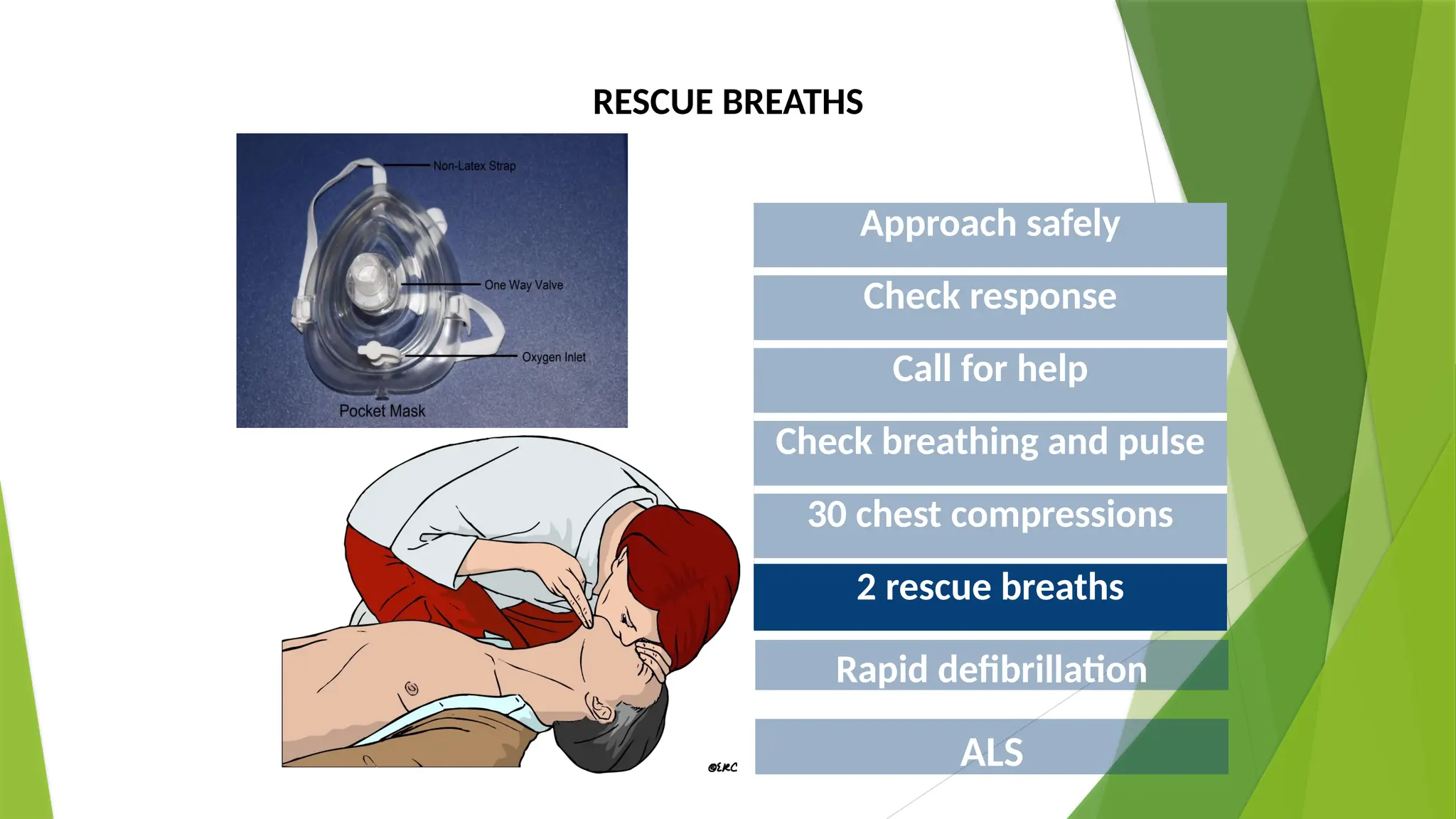
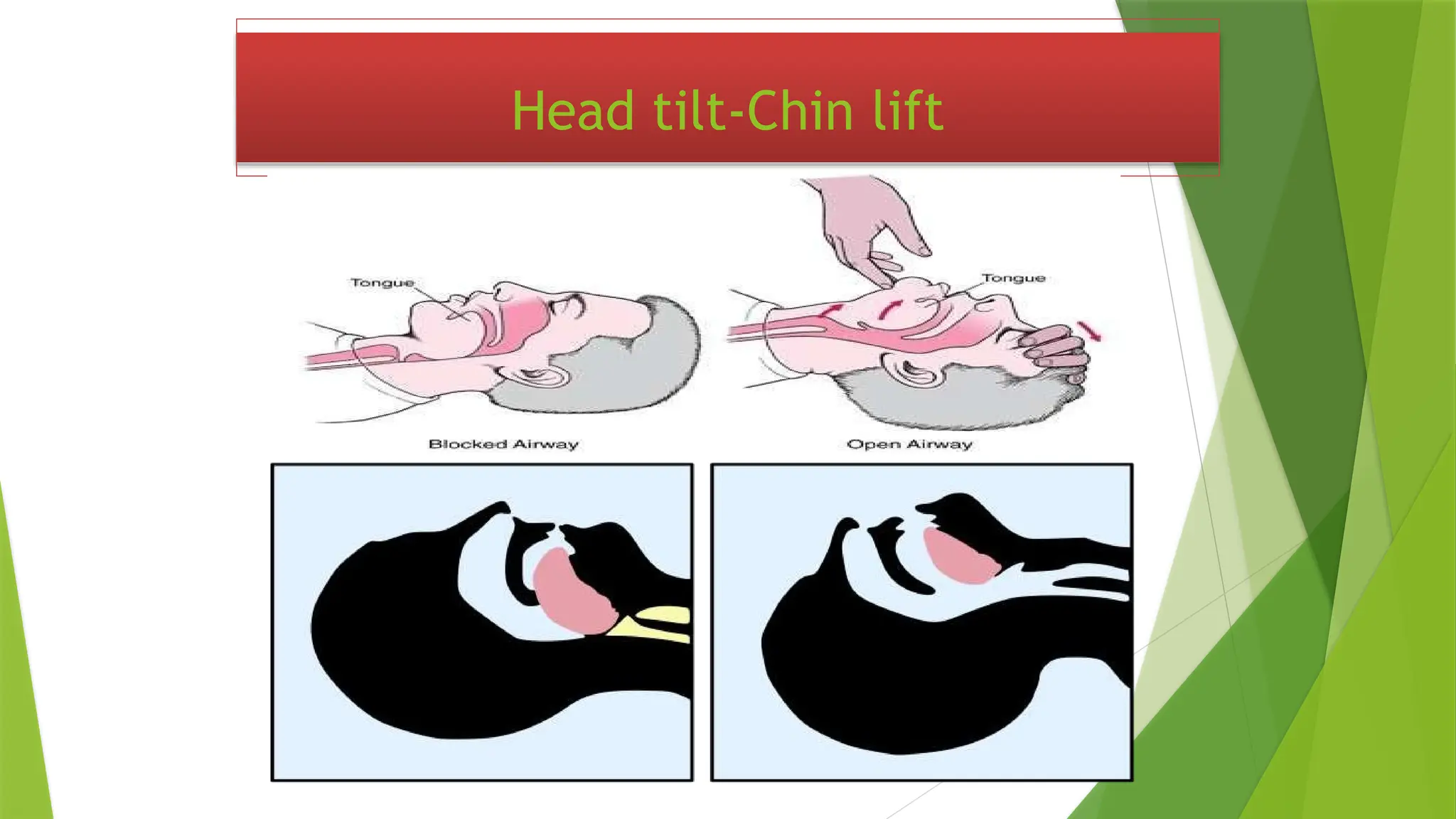
RESCUE BREATHS
Approach safely
Check response
Call for help
Check breathing and pulse
30 chest compressions
2 rescue breaths
Rapid defibrillation
ALS
Head tilt-Chin lift
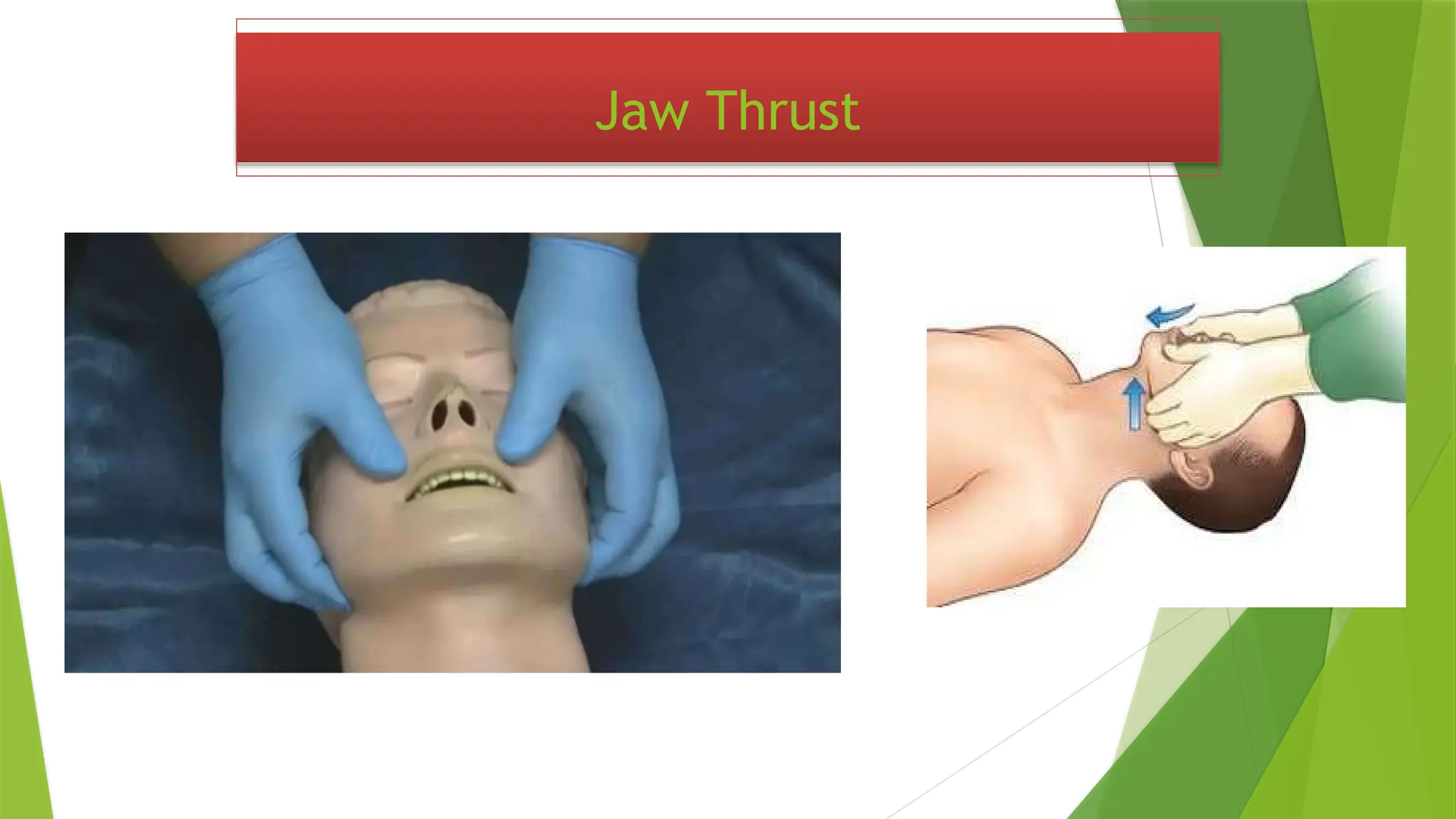
Jaw Thrust
Rescue Breath
• Each rescue breath over 1 second
• Visible chest rise
• 30 compression: 2 breaths (no advanced aiway)
• Advanced airway-
o Give 1 breath every 6 to 8 seconds without attempting to
synchronise breaths between compressions
o 8-10 breaths per min
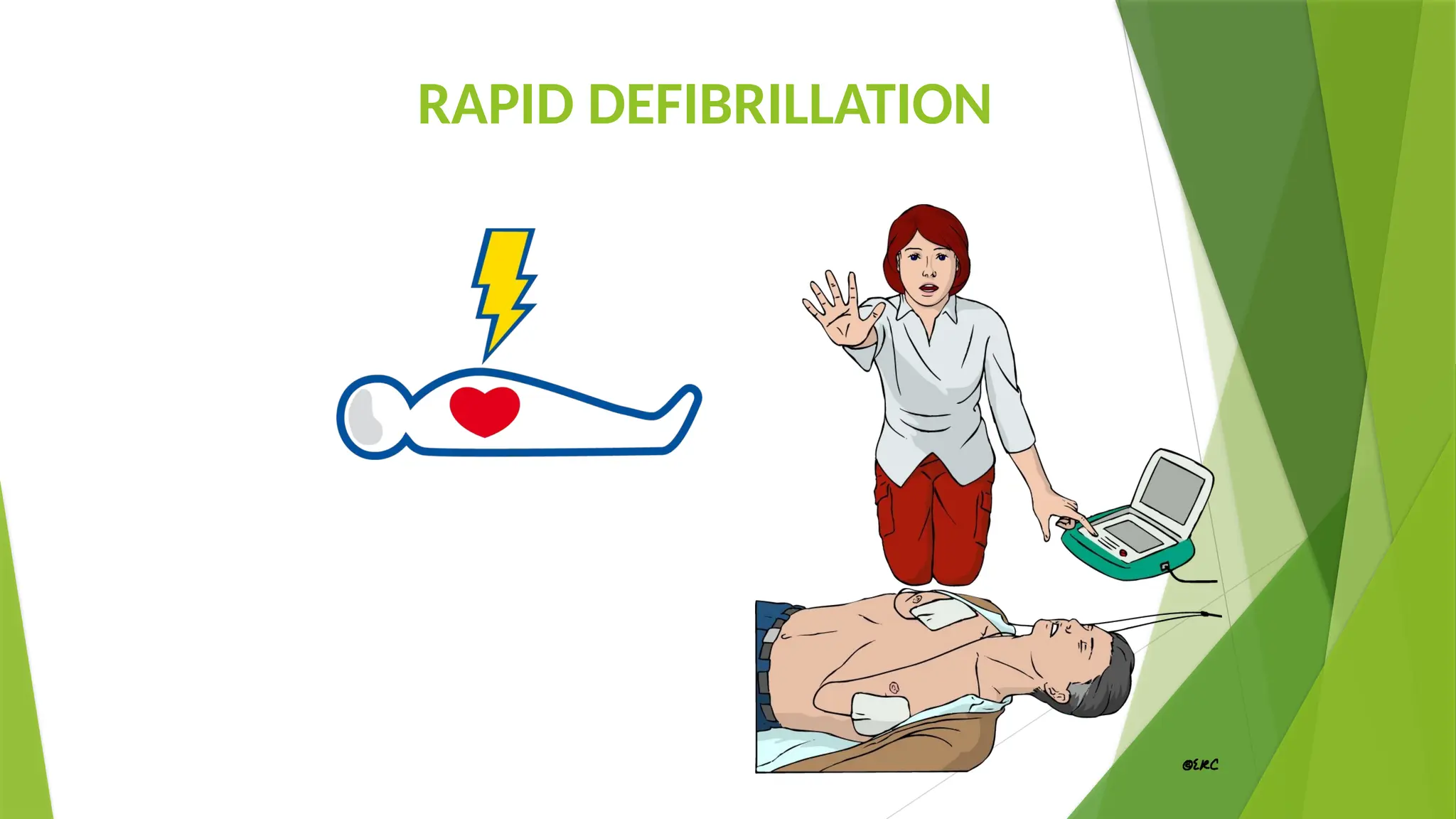
RAPID DEFIBRILLATION
Defibrillation
• Important in saving patient of cardiac arrest
• Mechanism-
A defibrillation shock must be strong enough to stun or excite
a large majority of the cardiac tissue. If a sufficient portion of
the cardiac tissue were made temporarily unexcitable by a
shock, the uncoordinated wavefronts of excitation that
perpetuate VF would be extinguished, and would allow
normal cardiac excitation and contraction to resume.
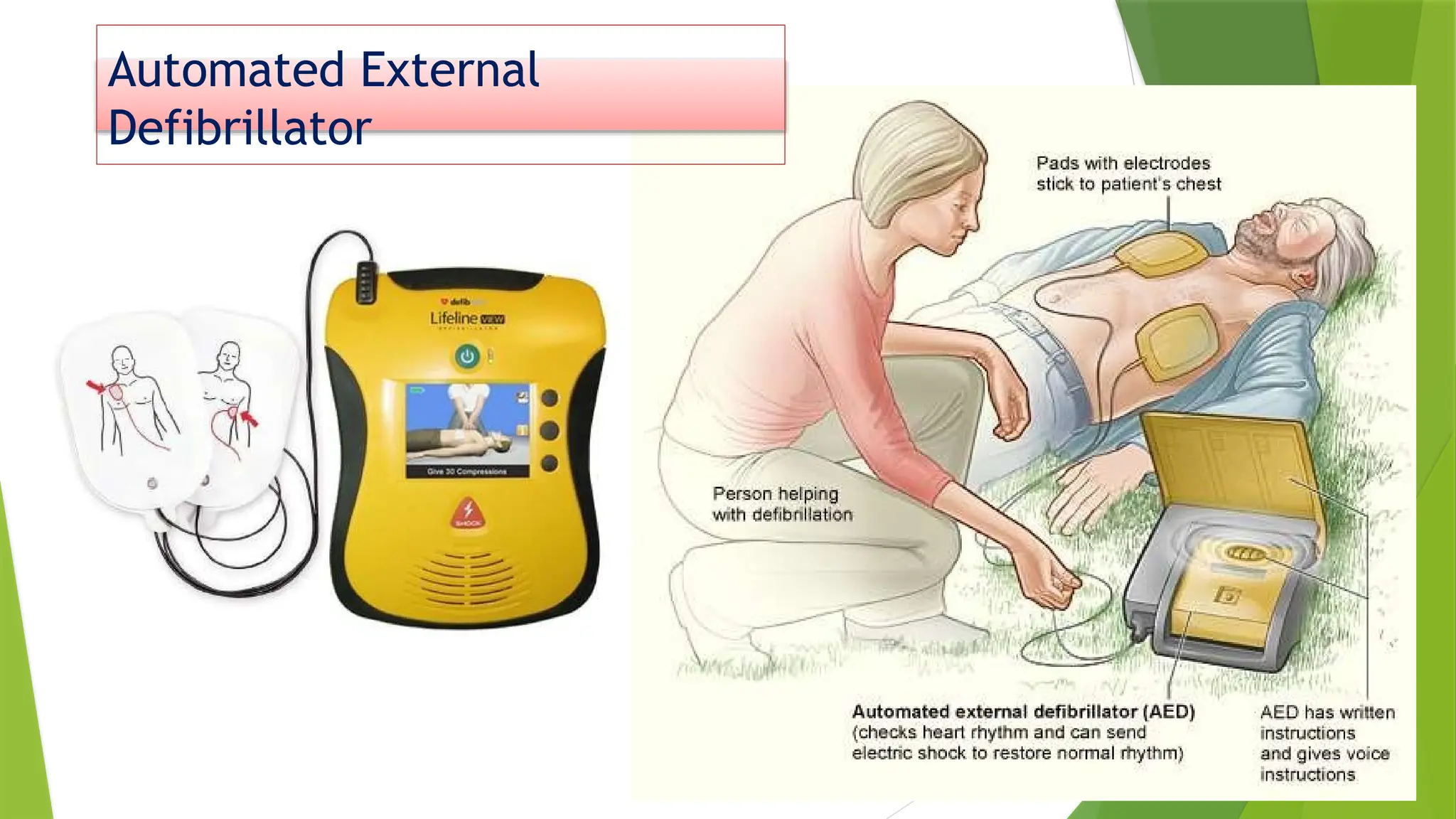
What is AED?
• Automated External Defibrillator
• A portable electronic device that automatically diagnose the life-
threatening cardiac arrhythmias of ventricular defibrillation and
pulseless VT and is able to treat them through defibrillation.
• Possible for more people to respond to medical emergency
where defibrillation is required
• Can be used by lay-rescuer trained in CPR
AEDs
AEDs
• Made part of emergency response program
• Gives simple audio and visual commands,making its use easy
• Should be available at public places like stations, stadiums,
airports, malls etc.
• Can’t be overriden manually and takes upto 10-20 sec to
detect arrhythmias
• Now a part of BLS program because early
defibrillation is found to increase survival rate of patient
Automated External
Defibrillator
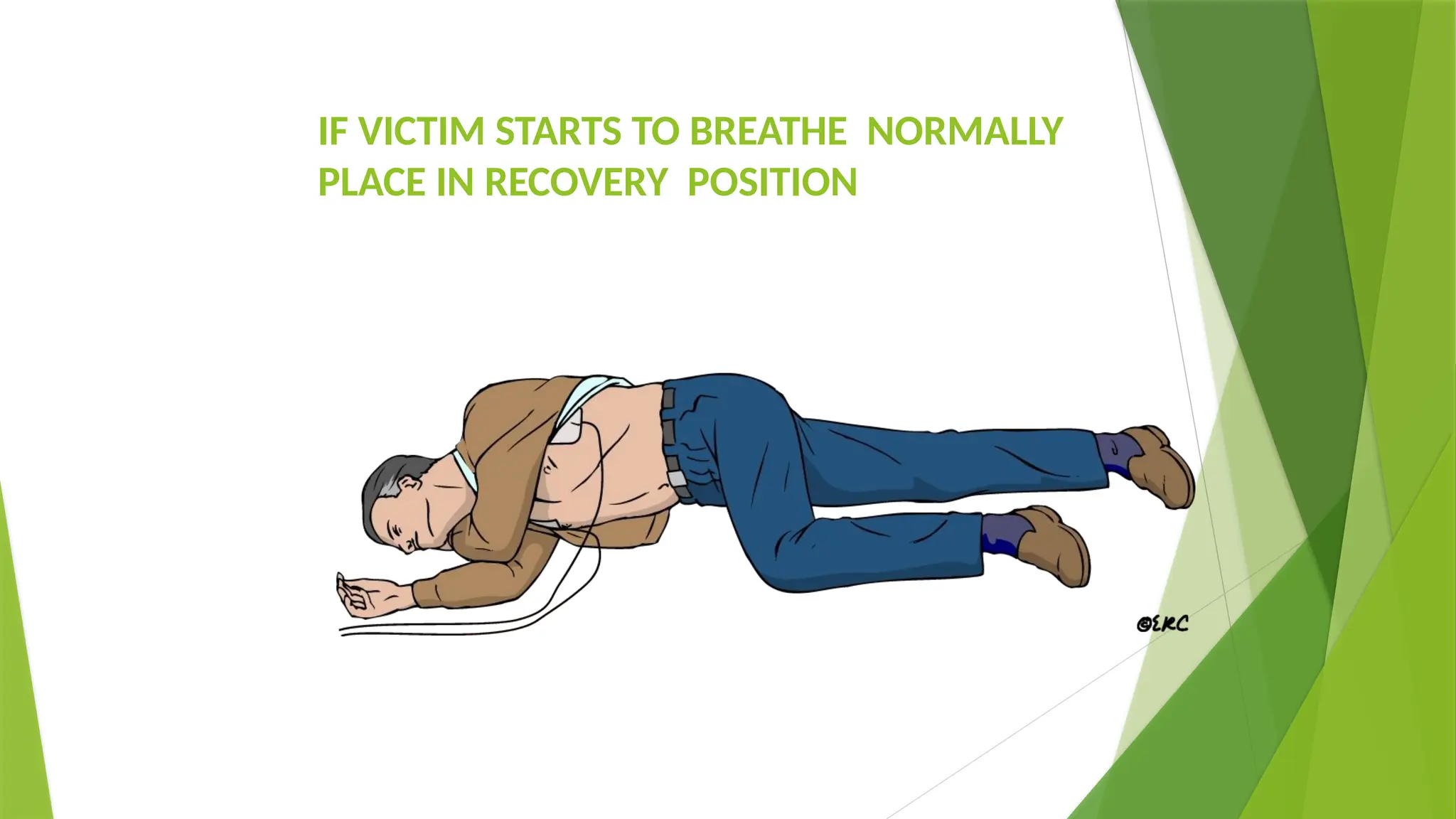
IF VICTIM STARTS TO BREATHE NORMALLY
PLACE IN RECOVERY POSITION
ADVANCED CARDIAC LIFE SUPPORT
What is ACLS??
 Advanced cardiac life support or advanced cardiovascular
life support refers to a set of clinical guidelines for the
urgent and emergent treatment of life threatening
cardiovascular conditions that will cause or have caused
cardiac arrest , using advanced medical procedures,
medications and techniques.
-AMERICAN HEART ASSOCIATION
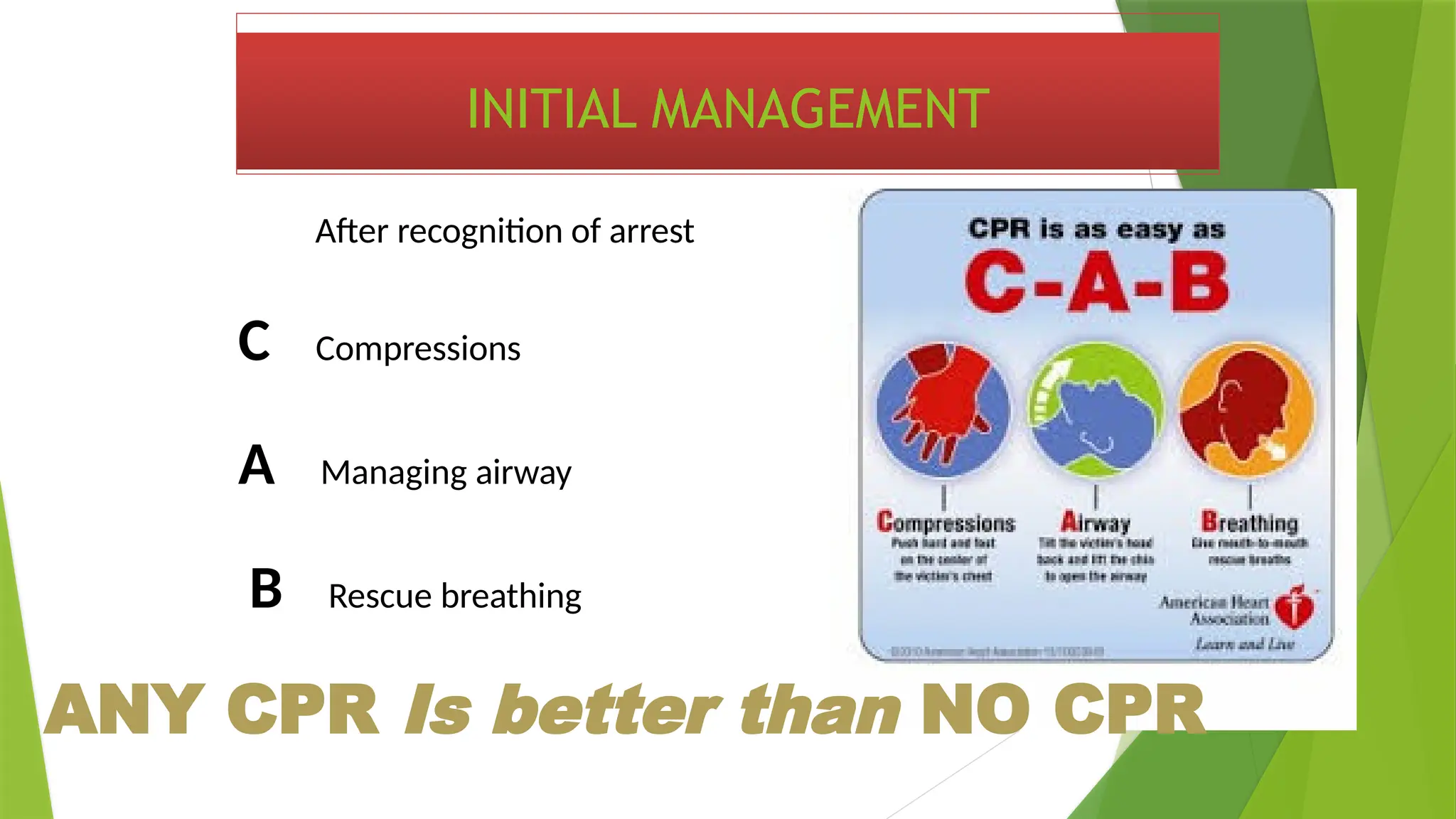
INITIAL MANAGEMENT
After recognition of arrest
C Compressions
A Managing airway
B Rescue breathing
ANY CPR Is better than NO CPR
Advanced Airway
 Endotracheal intubation or supraglottic
advanced airway
 Once advanced airway in place, give 1
breath every 6 seconds (10 breaths/min)
with continuous chest compressions
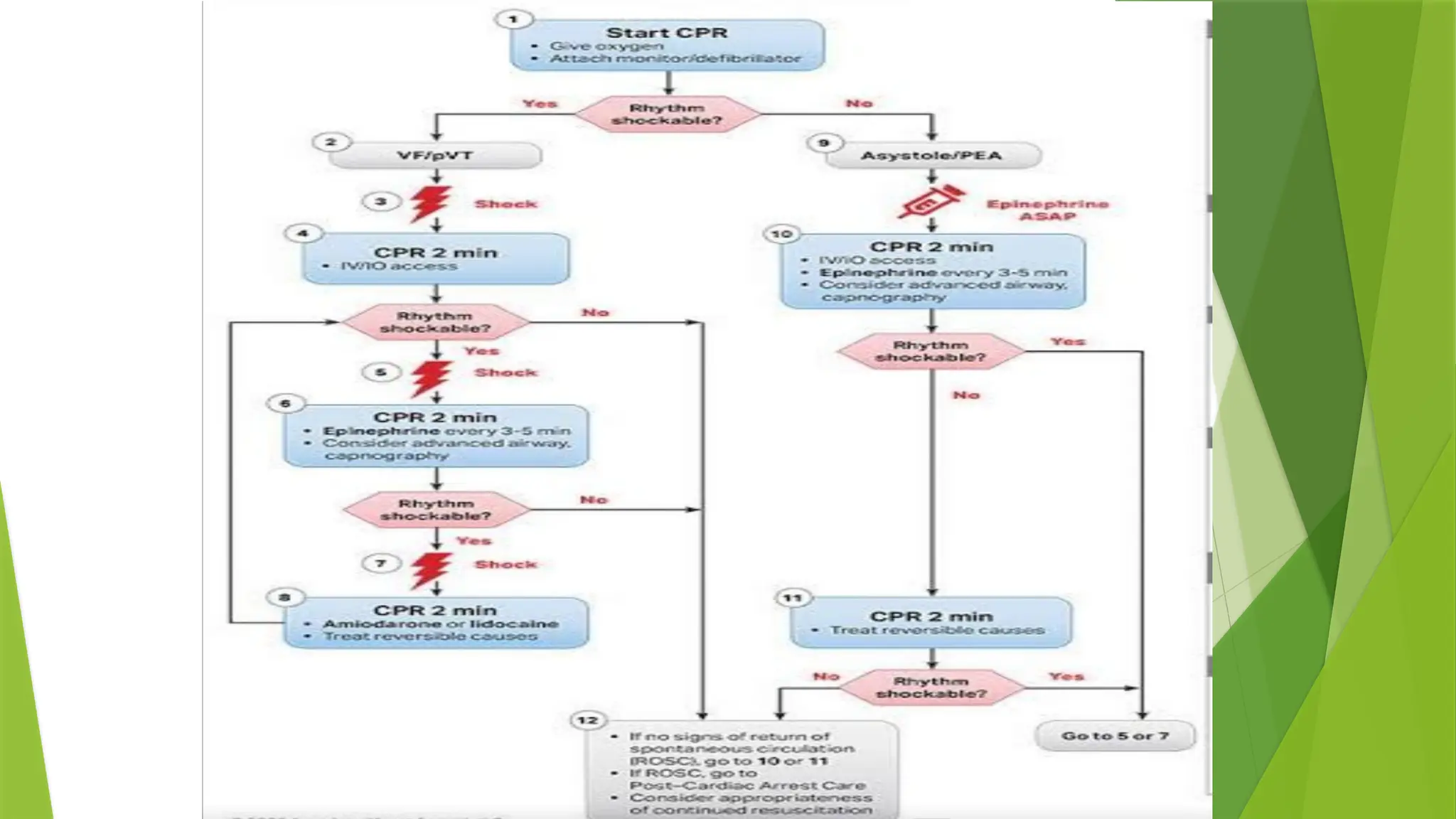
Is the rhythm shockable?
 Continue performing excellent chest compressions while
the defibrillator or AED is being attached. Reassume CPR
immediately after any shock is given .
 Biphasic defibrillation are recommended because of their
increased efficacy at lower energy level. Start with the
dose recommended by the manufacturer which is typically
120-200J
MANAGEMENT OF SPECIFIC ARRHYTHMIAS
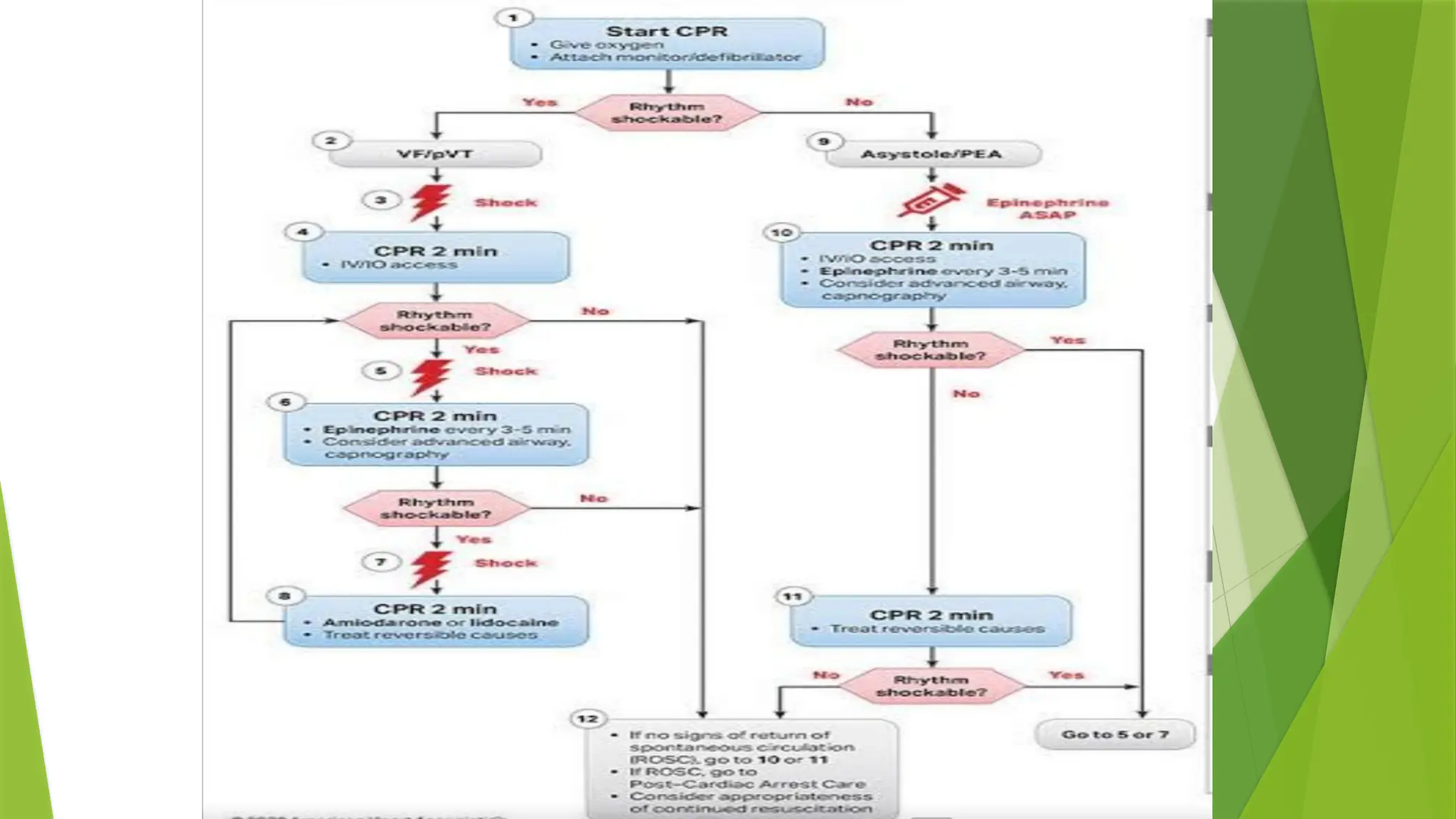
VF and PULSELSS VT are nonperfusing rhythms,
emanating from the ventricles for which early rhythm
identification , defibrillation and CPR are the mainstays of
treatment.
 Early defibrillation is the most critical action in the resuscitation
effort, followed by the performance of the excellent CPR.
 Every shock after the initial shock should be of equal
or greater strength
 If VF or pulseless VT persists after at least one
attempt at defibrillation and two minutes of CPR ,
give epinephrine (1mg IV every 3 to 5 mins) while
CPR is performed continuously
 Amiodarone is given in case of persistent shockable
rhythm
Shock Energy for Defibrillation
 Biphasic: Manufacturer recommendation
(eg, initial dose of 120-200 J); if unknown,
use maximum available. Second and
subsequent doses should be equivalent, and
higher doses may be considered.
 • Monophasic: 360 J
ASYSTOLE AND PULSELESS ELECTRICAL ACTIVITY
Asystole is defined as a complete absence of demonstrable
electrical and mechanical cardiac activity
Pulseless electrical activity (PEA) is defined
as any of a heterogenous group of organized
electrocardiographic rhythm without sufficient mechanical
contraction of the heart to produce a palpable pulse or
measurable blood pressure.
 After initiating CPR, treat reversible cause
as appropriate and administer epinephrine
(1mg IV every 3 to 5minutes)
 Atropine is no longer recommended for the
treatment of asystole or PEA.
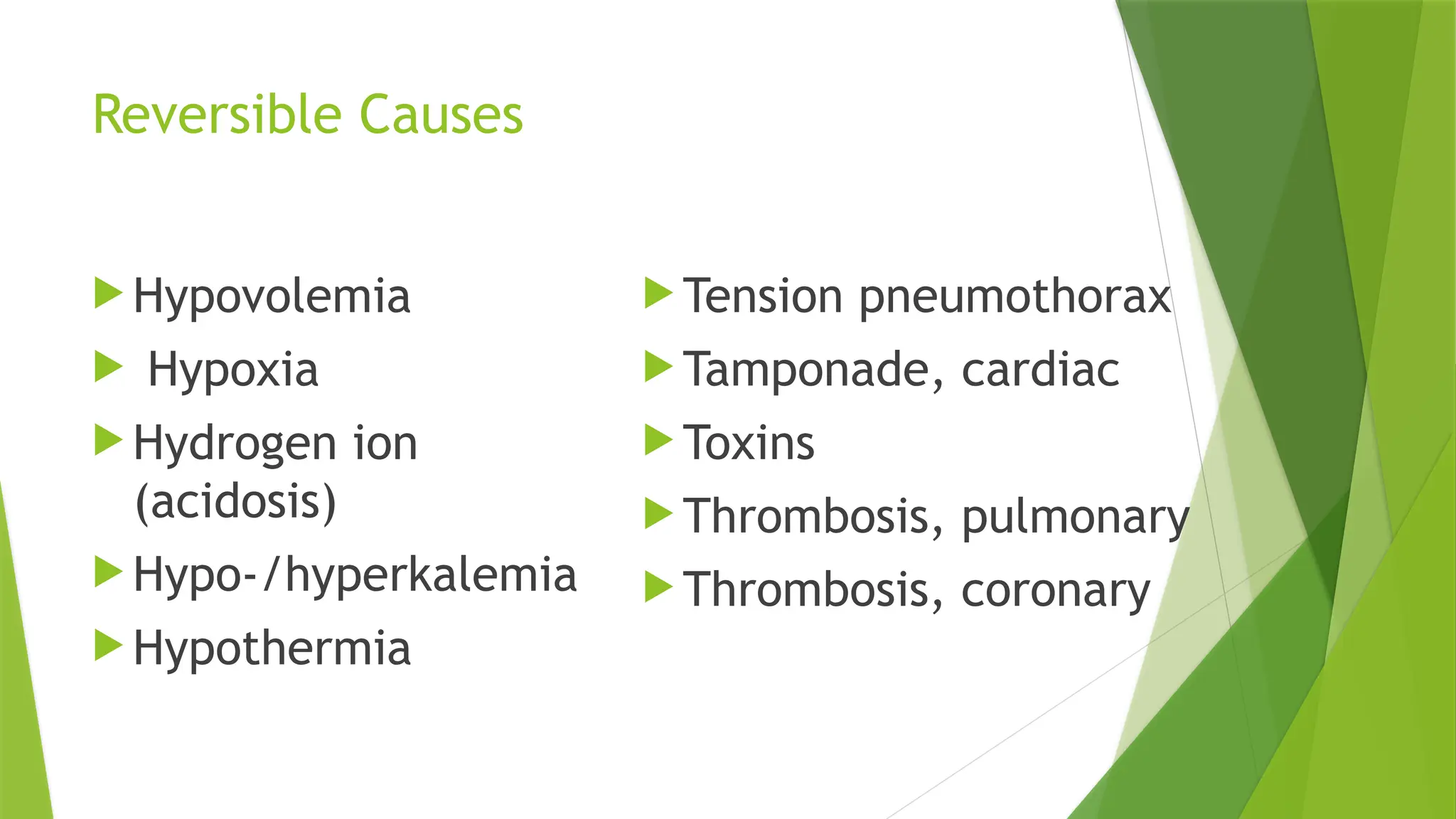
Reversible Causes
 Hypovolemia
 Hypoxia
 Hydrogen ion
(acidosis)
 Hypo-/hyperkalemia
 Hypothermia
 Tension pneumothorax
 Tamponade, cardiac
 Toxins
 Thrombosis, pulmonary
 Thrombosis, coronary
Return of Spontaneous Circulation
(ROSC)
 Pulse and blood pressure can be
observed on the monitor
 Spontaneous arterial pressure waves
with intra-arterial monitorin
POST CARDIAC ARREST CARE
The following summarizes the AHA algorithm for adult post cardiac
arrest care :
 Optimize ventilation and oxygenation
 Treat hypotension
 Perform a 12 lead ECG to determine whether acute ST elevation or
ischemia is present
 For ST elevation myocardial infarction (STEMI) , perform coronary
reperfusion with PCI.
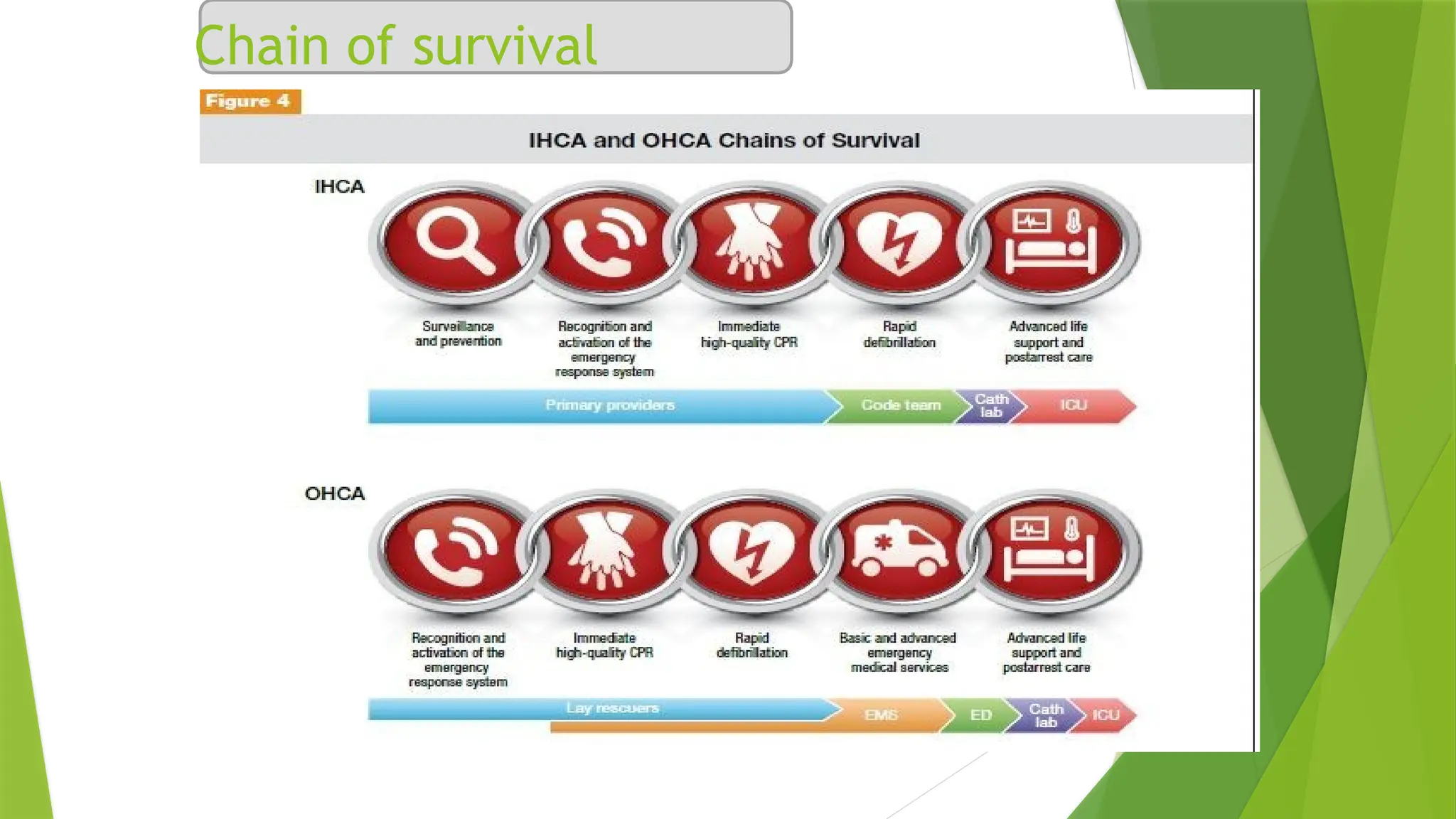
Chain of survival
Thankyou

bls and acls_124320.pptx It will help in better understanding of the topic

  • 1.
  • 2.
  • 3.
    What is BLS??  Basic life support refers to the type of care that first responders, healthcare providers and public safety professionals provide to anyone who is experiencing cardiac arrest , respiratory arrest and obstructed airway. -American Red Cross
  • 4.
    Approach safely Check response Callfor help Check breathing and pulse 30 chest compressions 2 rescue breaths Rapid defibrillation ALS
  • 5.
    APPROACH SAFELY! Scene Rescuer Victim Bystande rs Approach safely Checkresponse Call for help Check breathing and pulse 30 chest compressions 2 rescue breaths Rapid defibrillation ALS
  • 6.
    CHECK RESPONSE Approach safely Checkresponse Call for help Check breathing and pulse 30 Chest compressions 2 rescue breaths Rapid defibrillation ALS
  • 7.
    Shake shoulders gently Ask“Are you all right?” If he responds • Find out what is wrong. • Reassess regularly. CHECK RESPONSE
  • 8.
    CALL FOR HELP Approachsafely Check response Call for help Check breathing and pulse 30 chest compressions 2 rescue breaths Rapid defibrillation ALS
  • 9.
    CHECK BREATHING &PULSE • Check breathing and pulse simultaneously • Do not confuse agonal breathing with NORMAL breathing
  • 10.
    Check breathing? • Inspectingthe chest rise of patient while palpating carotid pulse (saves time) • OR Lay rescuer can check by keeping our fingers in front of nostrils/keeping ears close to nose to check if any blow of expired air is present or not. • Agonal gasps or abnormal breathing patterns may get confused with normal respiration by lay man rescuer.
  • 11.
  • 12.
    30 CHEST COMPRESSIONS Approachsafely Check response Call for help Check breathing and pulse 30 chest compressions 2 rescue breaths ALS Rapid defibrillation
  • 13.
    C P R •Start CPR immediately after checking and observing there is no 1. RESPONSIVENESS 2. BREATHING 3. PULSE
  • 14.
    Chest Compressions • Technique- oPosition yourself at patient’s side o firm, flat surface and o remove all the clothings o Put the heel of one hand on the centre of chest (sternum) at the level of nipples and put your other hand on the top of that hand.
  • 16.
    Chest Compression • Technique- oLock all joints ; movement is allowed only at hip joint o Push hard and fast (100 - 120 times / min) o At the end of each compression, chest is allowed to recoil completely • Depth- 5 cms to 6 cms (2 inches to 2.4 inches)
  • 17.
    RESCUE BREATHS Approach safely Checkresponse Call for help Check breathing and pulse 30 chest compressions 2 rescue breaths Rapid defibrillation ALS
  • 18.
  • 19.
  • 20.
    Rescue Breath • Eachrescue breath over 1 second • Visible chest rise • 30 compression: 2 breaths (no advanced aiway) • Advanced airway- o Give 1 breath every 6 to 8 seconds without attempting to synchronise breaths between compressions o 8-10 breaths per min
  • 21.
  • 22.
    Defibrillation • Important insaving patient of cardiac arrest • Mechanism- A defibrillation shock must be strong enough to stun or excite a large majority of the cardiac tissue. If a sufficient portion of the cardiac tissue were made temporarily unexcitable by a shock, the uncoordinated wavefronts of excitation that perpetuate VF would be extinguished, and would allow normal cardiac excitation and contraction to resume.
  • 23.
    What is AED? •Automated External Defibrillator • A portable electronic device that automatically diagnose the life- threatening cardiac arrhythmias of ventricular defibrillation and pulseless VT and is able to treat them through defibrillation. • Possible for more people to respond to medical emergency where defibrillation is required • Can be used by lay-rescuer trained in CPR
  • 24.
  • 25.
    AEDs • Made partof emergency response program • Gives simple audio and visual commands,making its use easy • Should be available at public places like stations, stadiums, airports, malls etc. • Can’t be overriden manually and takes upto 10-20 sec to detect arrhythmias • Now a part of BLS program because early defibrillation is found to increase survival rate of patient
  • 26.
  • 27.
    IF VICTIM STARTSTO BREATHE NORMALLY PLACE IN RECOVERY POSITION
  • 28.
  • 29.
    What is ACLS?? Advanced cardiac life support or advanced cardiovascular life support refers to a set of clinical guidelines for the urgent and emergent treatment of life threatening cardiovascular conditions that will cause or have caused cardiac arrest , using advanced medical procedures, medications and techniques. -AMERICAN HEART ASSOCIATION
  • 31.
    INITIAL MANAGEMENT After recognitionof arrest C Compressions A Managing airway B Rescue breathing ANY CPR Is better than NO CPR
  • 32.
    Advanced Airway  Endotrachealintubation or supraglottic advanced airway  Once advanced airway in place, give 1 breath every 6 seconds (10 breaths/min) with continuous chest compressions
  • 33.
    Is the rhythmshockable?  Continue performing excellent chest compressions while the defibrillator or AED is being attached. Reassume CPR immediately after any shock is given .  Biphasic defibrillation are recommended because of their increased efficacy at lower energy level. Start with the dose recommended by the manufacturer which is typically 120-200J
  • 34.
    MANAGEMENT OF SPECIFICARRHYTHMIAS VF and PULSELSS VT are nonperfusing rhythms, emanating from the ventricles for which early rhythm identification , defibrillation and CPR are the mainstays of treatment.  Early defibrillation is the most critical action in the resuscitation effort, followed by the performance of the excellent CPR.
  • 35.
     Every shockafter the initial shock should be of equal or greater strength  If VF or pulseless VT persists after at least one attempt at defibrillation and two minutes of CPR , give epinephrine (1mg IV every 3 to 5 mins) while CPR is performed continuously  Amiodarone is given in case of persistent shockable rhythm
  • 36.
    Shock Energy forDefibrillation  Biphasic: Manufacturer recommendation (eg, initial dose of 120-200 J); if unknown, use maximum available. Second and subsequent doses should be equivalent, and higher doses may be considered.  • Monophasic: 360 J
  • 37.
    ASYSTOLE AND PULSELESSELECTRICAL ACTIVITY Asystole is defined as a complete absence of demonstrable electrical and mechanical cardiac activity Pulseless electrical activity (PEA) is defined as any of a heterogenous group of organized electrocardiographic rhythm without sufficient mechanical contraction of the heart to produce a palpable pulse or measurable blood pressure.
  • 38.
     After initiatingCPR, treat reversible cause as appropriate and administer epinephrine (1mg IV every 3 to 5minutes)  Atropine is no longer recommended for the treatment of asystole or PEA.
  • 39.
    Reversible Causes  Hypovolemia Hypoxia  Hydrogen ion (acidosis)  Hypo-/hyperkalemia  Hypothermia  Tension pneumothorax  Tamponade, cardiac  Toxins  Thrombosis, pulmonary  Thrombosis, coronary
  • 40.
    Return of SpontaneousCirculation (ROSC)  Pulse and blood pressure can be observed on the monitor  Spontaneous arterial pressure waves with intra-arterial monitorin
  • 42.
    POST CARDIAC ARRESTCARE The following summarizes the AHA algorithm for adult post cardiac arrest care :  Optimize ventilation and oxygenation  Treat hypotension  Perform a 12 lead ECG to determine whether acute ST elevation or ischemia is present  For ST elevation myocardial infarction (STEMI) , perform coronary reperfusion with PCI.
  • 43.
  • 44.

Editor's Notes

  • #3 A level of medical care which is used for victims of life- threatening illnesses or injuries until they can be given full medical care at a hospital. It can be provided by trained medical personnel, including emergency medical technicians, paramedics, and by qualified bystanders.