1 ACLS – Advanced Cardiac Life Support
ProviderHandbook
By Dr. Karl Disque
Advanced Cardiac
Life Support
ACLS
2020
-2025
Guidelinesand
Standards
2 ACLS – Advanced Cardiac Life Support
Copyright © 2021 Satori Continuum Publishing
All rights reserved. Except as permitted under the U.S. Copyright Act of 1976, no part of this publication
can be reproduced, distributed, or transmitted in any form or by any means, or stored in a database
or retrieval system, without the prior consent of the publisher.
Satori Continuum Publishing
1810 E Sahara Ave. Suite 1507
Las Vegas, NV 89104
Printed in the United States of America
Educational Service Disclaimer
This Provider Handbook is an educational service provided by Satori Continuum Publishing. Use of this
service is governed by the terms and conditions provided below. Please read the statements below
carefully before accessing or using the service. By accessing or using this service, you agree to be bound
by all of the terms and conditions herein.
The material contained in this Provider Handbook does not contain standards that are intended to be
applied rigidly and explicitly followed in all cases. A health care professional’s judgment must remain
central to the selection of diagnostic tests and therapy options of a specific patient’s medical condition.
Ultimately, all liability associated with the utilization of any of the information presented here rests
solely and completely with the health care provider utilizing the service.
Version 2021.01
3 ACLS – Advanced Cardiac Life Support
Introduction to ACLS . . . . . . . 5
The Initial Assessment . . . . . . . 6
Basic Life Support . . . . . . . 7
Initiating the Chain of Survival – 7
2020 BLS Guideline Changes – 8
BLS for Adults – 9
One-Rescuer Adult BLS/CPR
Two-Rescuer Adult BLS/CPR
Adult Mouth-to-MaskVentilation
Adult Bag-MaskVentilation in Two-Rescuer CPR
BLS for Children/Infants – 15
One-Rescuer Child BLS/CPR
One-Rescuer Infant BLS/CPR
Child/Infant Mouth-to-MaskVentilation
Child/Infant Bag-Valve-MaskVentilation in Two-Rescuer CPR
Self-Assessment for BLS – 20
Advanced Cardiac Life Support . . . . . . . 22
Normal Heart Anatomy and Physiology – 22
The ACLS Survey (ABCD) – 23
Airway Management – 24
Basic Airway Adjuncts
Basic Airway Technique
Advanced Airway Adjuncts
Routes of Access – 28
Intravenous Route
Intraosseous Route
Pharmacological Tools – 29
Self-Assessment for ACLS – 30
Principles of Early Defibrillation . . . . . . . 31
Keys to Using an Automated External Defibrillator – 32
Criteria to Apply AED
Basic AED Operation
Chapter 1
2
3
4
5
TABLEof CONTENTS
4 ACLS – Advanced Cardiac Life Support
Systems of Care . . . . . . . 34
Cardiopulmonary Resuscitation – 35
Initiating the Chain of Survival
Post-Cardiac Arrest Care – 36
Therapeutic Hypothermia
Optimization of Hemodynamics andVentilation
Percutaneous Coronary Intervention
Neurologic Care
Acute Coronary Syndrome – 37
Goals of ACS Treatment
Acute Stroke – 38
Goals of Acute Ischemic Stroke Care
The Resuscitation Team – 39
Education, Implementation, Teams – 40
Self-Assessment for Systems of Care – 41
ACLS Cases . . . . . . . 42
Respiratory Arrest – 42
Ventricular Fibrillation and Pulseless Ventricular Tachycardia – 46
Pulseless Electrical Activity and Asystole – 48
Post-Cardiac Arrest Care – 52
Blood Pressure Support andVasopressors
Hypothermia
Airway Management
Symptomatic Bradycardia – 55
Tachycardia – 58
Symptomatic Tachycardia
Stable and Unstable Tachycardia
Acute Coronary Syndrome – 62
Acute Stroke – 64
Self-Assessment for ACLS Cases – 68
ACLS Essentials . . . . . . . 71
Additional Tools . . . . . . . 72
MediCode – 72
CertAlert+ – 72
ACLS Review Questions . . . . . . . 73
Chapter 6
8
9
10
TABLEof CONTENTS
7
5 ACLS – Advanced Cardiac Life Support
The goal of Advanced Cardiovascular Life Support (ACLS) is to achieve the best possible outcome
for individuals who are experiencing a life-threatening event. ACLS is a series of evidence-based
responses simple enough to be committed to memory and recalled under moments of stress. These
ACLS protocols have been developed through research, patient case studies, clinical studies, and
opinions of experts in the field. The gold standard in the United States and other countries is the
course curriculum published by the International Liaison Committee on Resuscitation (ILCOR).
Previously, the ILCOR published periodic updates to their Cardiopulmonary Resuscitation (CPR)
and Emergency Cardiovascular Care (ECC) guidelines on a five-year cycle, with the most recent
update published in 2020. Moving forward, the ILCOR will no longer wait five years between updates;
instead, it will maintain the most up-to-date recommendations online at ECCguidelines.heart.org.
Health care providers are recommended to supplement the materials presented in this handbook
with the guidelines published by the ILCOR and refer to the most current interventions and
rationales throughout their study of ACLS.
While ACLS providers should always be mindful of
timeliness, it is important to provide the intervention that
most appropriately fits the needs of the individual. Proper
utilization of ACLS requires rapid and accurate assessment
of the individual’s condition. This not only applies to the
provider’s initial assessment of an individual in distress,
but also to the reassessment throughout the course of
treatment with ACLS.
ACLS protocols assume that the provider may not have all
of the information needed from the individual or all of the
resources needed to properly use ACLS in all cases. For
example, if a provider is utilizing ACLS on the side of the
road, they will not have access to sophisticated devices to
measure breathing or arterial blood pressure. Nevertheless,
in such situations, ACLS providers have the framework to
provide the best possible care in the given circumstances.
ACLS algorithms are based on past performances and
results in similar life-threatening cases and are intended to achieve the best possible outcome for the
individual during emergencies. The foundation of all algorithms involves the systematic approach of
the BLS Survey and the ACLS Survey (using steps ABCD) that you will find later in this handbook.
INTRODUCTION
TO ACLS
1
CHAPTER
Refer to the Basic Life Support (BLS)
Provider Handbook,also Presented by
the Save a Life Initiative,for a more
comprehensive review of the BLS
Survey.This handbook specifically
covers ACLS algorithms and only
briefly describes BLS.All ACLS
providers are presumed capable of
performing BLS correctly.While this
handbook covers BLS basics,it
is essential that ACLS providers be
proficient in BLS first.
6 ACLS – Advanced Cardiac Life Support
Determining whether an individual is conscious or unconscious can be done very quickly. If you
notice someone in distress, lying down in a public place, or possibly injured, call out to them.
If the individual is unconscious, then start with the BLS
Survey (Figure 20) and move on to the ACLS Survey (Figure 9).
If they are conscious and responsive, obtain consent to
provide care and continue assessment and questioning to
determine next steps.
THE INITIAL
ASSESSMENT
2
CHAPTER
• 
Make sure the scene is safe before
approaching the individual and
conducting the BLS or ACLS Survey.
•
When encountering an individual
who is“down,”the first assessment to
make is whether they are conscious or
unconscious.
7 ACLS – Advanced Cardiac Life Support
The ILCOR has updated the Basic Life Support (BLS) course over the years as new research in cardiac
care has become available. Cardiac arrest continues to be a leading cause of death in the United
States. BLS guidelines have changed dramatically, and the elements of BLS continue to be some of
the most important steps in initial treatment. General concepts of BLS include:
• Quickly starting the Chain of Survival.
• Delivering high-quality chest compressions for adults, children, and infants.
• 
Knowing where to locate and understanding how to use an Automated External
Defibrillator (AED).
• Providing rescue breathing when appropriate.
• Understanding how to perform as a team.
• Knowing how to treat choking.
INITIATING THE CHAIN OF SURVIVAL
Early initiation of BLS has been shown to increase the probability of survival for an individual dealing
with cardiac arrest. To increase the odds of surviving a cardiac event, the rescuer should follow the
steps in the Adult Chain of Survival (Figure 1).
Adult Chain of Survival
Figure 1
RECOVERY
POST
CARDIAC
ARREST
CARE
ADVANCED
LIFE
SUPPORT
DEFIBRILLATE
WITH
AED
PERFORM
EARLY CPR
ACTIVATION
OF EMERGENCY
RESPONSE
BASIC LIFE
SUPPORT
3
CHAPTER
8 ACLS – Advanced Cardiac Life Support
Emergencies in children and infants are not usually caused by the heart. Children and infants most
often have breathing problems that trigger cardiac arrest. The first and most important step of the
Pediatric Chain of Survival (Figure 2) is prevention.
Pediatric Chain of Survival
2020 CPR GUIDELINE CHANGES
Approximately every five years the International Liaison Committee on Resuscitation (ILCOR),
updates the guidelines for CPR and ECC (Emergency Cardiac Care).
The content contained herein is based on the most recent ILCOR publications on BLS.
Recommendations for adult basic life support (BLS) from the 2020 Guidelines for CPR and ECC
include the following:
• The importance of early initiation of CPR by lay rescuers has been re-emphasized. The risk of
harm to the patient is low if the patient is not in cardiac arrest. Bystanders should not be afraid
to start CPR even if they are not sure whether the victim is breathing or in Cardiac Arrest.
• A sixth link, Recovery, was added to the Chains of Survival for both Pediatric and Adults.
• Care of the patient after return of spontaneous circulation (ROSC) requires close attention
to oxygenation, blood pressure control, evaluation for percutaneous coronary intervention,
targeted temperature management, and multimodal neuroprognostication.
• Because recovery from cardiac arrest continues long after the initial hospitalization, patients
should have formal assessment and support for their physical, cognitive, and psychosocial
needs.
• After a resuscitation, debriefing for lay rescuers, EMS providers, and hospital-based healthcare
workers may be beneficial to support their mental health and well-being.
• Management of cardiac arrest in pregnancy focuses on maternal resuscitation, with preparation
for early perimortem cesarean delivery if necessary to save the infant and improve the chances
of successful resuscitation of the mother.
Figure 2
RECOVERY
POST-CARDIAC
ARREST
CARE
ADVANCED
LIFE
SUPPORT
PERFORM
EARLY CPR
ACTIVATE
EMS
PREVENT
ARREST
9 ACLS – Advanced Cardiac Life Support
BLS FOR ADULTS
BLS for adults focuses on doing several tasks simultaneously. In many situations, more than one
person is available to do CPR. This choreographed method includes performing chest compressions,
managing the airway, delivering rescue breaths, and using the AED, all as a team.
By coordinating efforts, a team of rescuers can save valuable seconds when time lost equals damage
to the heart and brain.
SimpleAdult BLSAlgorithm
- MONITOR RHYTHM
- SHOCK IF NEEDED
- REPEAT AFTER 2 MIN
GET AED AND
START CPR
ACTIVATE
EMERGENCY
RESPONSE
UNRESPONSIVE: NO
BREATHING OR ONLY
GASPING
PushHardAndFast
Figure 3
3
BASIC LIFE
SUPPORT
10 ACLS – Advanced Cardiac Life Support
ONE-RESCUER BLS/CPR FOR ADULTS
Be Safe
• If inside, watch for dangers such as construction debris, unsecured weapons, violent individuals,
electrical hazards.
• If outside, watch out for downed electrical wires, leaking fuel from car accidents, building
collapse, or natural disaster/dangerous weather conditions. (Drowning persons should be
removed from the water and dried off; they should also be removed from standing water, such as
puddles, pools, gutters, etc.).
•Be sure you do not become injured yourself.
Assess the Person
• Tap hard on their shoulder and shout “Hey, are you OK?” Yell their name if you know it.
• 
Check to see if the person is breathing. (Agonal breathing, which is occasional gasping and is
ineffective, does not count as breathing.)
Call EMS
• Send someone for help and to get an AED.
• 
If alone, call for help while assessing for breathing and pulse. (The ILCOR emphasizes that cell
phones are available everywhere now and most have a built-in speakerphone. Call for help
without leaving the person.)
CPR
• Check pulse simultaneously with checking for breathing. Do not pause more than 10 seconds to
check for breathing and pulse.
• Begin chest compressions and delivering breaths.
Defibrillate
• Attach the AED when available.
• Listen and perform the steps as directed.
11 ACLS – Advanced Cardiac Life Support
CPR Steps forAdults
1. Check for the carotid pulse on the side of the neck (Figure 4a). Keep in mind not to waste time
trying to feel for a pulse; feel for no more than 10 seconds. If you are not sure you feel a pulse,
begin CPR with a cycle of 30 chest compressions and two breaths.
2. Use the heel of one hand on the lower half of the sternum in the middle of the chest (Figure 4b).
3. Put your other hand on top of the first hand (Figure 4b).
4. Straighten your arms and press straight down (Figure 4c). Compressions should be 2 to 2.4” (5 to
6 cm) into the person’s chest and at a rate of 100 to 120 compressions per minute.
5. Be sure that between each compression you completely stop pressing on the chest and allow
the chest wall to return to its natural position. Leaning or resting on the chest between
compressions can keep the heart from refilling in between each compression and make CPR
less effective.
6. After 30 compressions, stop compressions and open the airway by tilting the head and lifting
the chin (Figure 4d  4e).
a. Put your hand on the person’s forehead and tilt the head back.
b. Lift the person’s jaw by placing your index and middle fingers on the lower jaw; lift up.
c. Do not perform the head-tilt/chin-lift maneuver if you suspect the person may have a
neck injury. In that case, the jaw-thrust is used.
d. For the jaw-thrust maneuver, grasp the angles of the lower jaw and lift it with both
hands, one on each side, moving the jaw forward. If their lips are closed, open the lower
lip using your thumb (Figure 4f).
7. Give a breath while watching the chest rise. Repeat while giving a second breath. Breaths
should be delivered over one second.
8. Resume chest compressions. Switch quickly between compressions and rescue breaths to
minimize interruptions in chest compressions.
Figure 4
A B C
D E F
3
BASIC LIFE
SUPPORT
12 ACLS – Advanced Cardiac Life Support
TWO-RESCUER BLS/CPR FOR ADULTS
Many times there will be a second person available who can act as a rescuer. The ILCOR emphasizes
that cell phones are available everywhere now and most have a built-in speakerphone. Direct the
second rescuer to call 911 or your local EMS number without leaving the person while you begin
CPR. This second rescuer can also find an AED while you stay with the person. When the second
rescuer returns, the CPR tasks can be shared:
1. The second rescuer prepares the AED for use.
2. You begin chest compressions and count the compressions out loud.
3. The second rescuer applies the AED pads.
4. The second rescuer opens the person’s airway and gives rescue breaths.
5. 
Switch roles after every five cycles of compressions and breaths. One cycle consists of 30
compressions and two breaths for Adults.
6. 
Be sure that between each compression you completely stop pressing on the chest and
allow the chest wall to return to its natural position. Leaning or resting on the chest between
compressions can keep the heart from refilling in between each compression and make
CPR less effective. Rescuers who become tired may tend to lean on the chest more during
compressions; switching roles helps rescuers perform high-quality compressions.
7. Quickly switch between roles to minimize interruptions in delivering chest compressions.
8. 
When the AED is connected, minimize interruptions of CPR by switching rescuers while the
AED analyzes the heart rhythm. If a shock is indicated, minimize interruptions in CPR.
Resume CPR as soon as possible with chest compressions.
13 ACLS – Advanced Cardiac Life Support
Figure 5
ADULT MOUTH-TO-MASK VENTILATION
In one-rescuer CPR, breaths should be supplied using a pocket mask, if available.
1. Give 30 high-quality chest compressions.
2. 
Seal the mask against the person’s face by placing four fingers of one hand across the top
of the mask and the thumb of the other hand along the bottom edge of the mask (Figure 5a).
3. 
Using the fingers of your hand on the bottom of the mask, open the airway using the
head-tilt/chin-lift maneuver. (Don’t do this if you suspect the person may have a neck
injury) (Figure 5b).
4. 
Press firmly around the edges of the mask and ventilate by delivering a breath over one
second as you watch the person’s chest rise (Figure 5c).
ADULT BAG-MASK VENTILATION IN TWO-RESCUER CPR
If two people are present and a bag-mask device is available, the second rescuer is positioned at
the victim’s head while the other rescuer performs high-quality chest compressions. Give 30 high-
quality chest compressions.
1. Deliver 30 high-quality chest compressions while counting out loud (Figure 6a).
2. 
The second rescuer holds the bag-mask with one hand using the thumb and index finger
in the shape of a “C” on one side of the mask to form a seal between the mask and the face,
while the other fingers open the airway by lifting the person’s lower jaw (Figure 6b).
3. The second rescuer gives two breaths over one second each as you watch the person’s chest
rise (Figure 6c).
4. Practice using the bag valve mask; it is essential to forming a tight seal and delivering 		
effective breaths.
Figure 6
A B C
A B C
3
BASIC LIFE
SUPPORT
14 ACLS – Advanced Cardiac Life Support
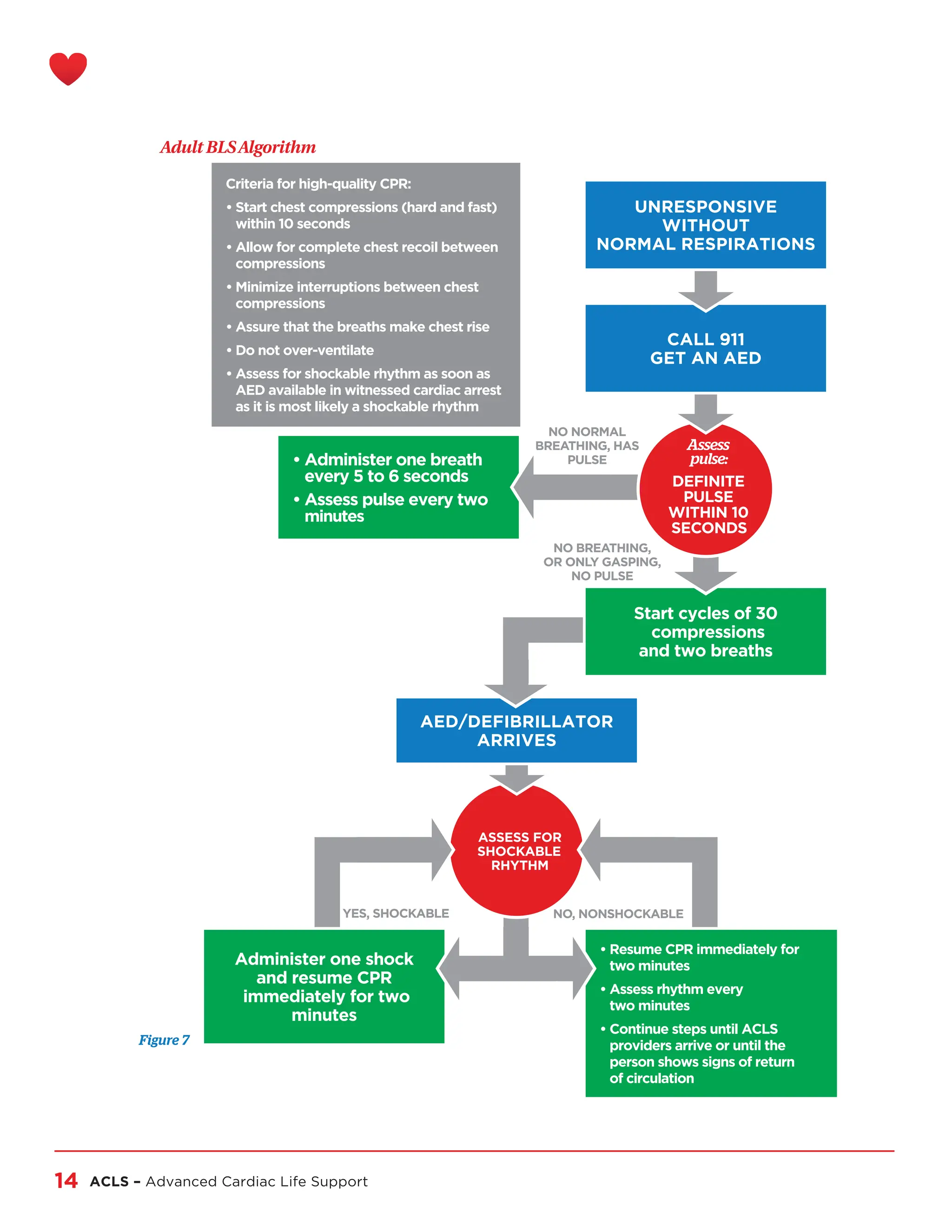
Adult BLSAlgorithm
NO NORMAL
BREATHING, HAS
PULSE
NO BREATHING,
OR ONLY GASPING,
NO PULSE
Figure 7
ASSESS FOR
SHOCKABLE
RHYTHM
• 
Resume CPR immediately for
two minutes
• 
Assess rhythm every
two minutes
• 
Continue steps until ACLS
providers arrive or until the
person shows signs of return
of circulation
Administer one shock
and resume CPR
immediately for two
minutes
AED/DEFIBRILLATOR
ARRIVES
Start cycles of 30
compressions
and two breaths
• 
Administer one breath
every 5 to 6 seconds
• 
Assess pulse every two
minutes
Criteria for high-quality CPR:
• 
Start chest compressions (hard and fast)
within 10 seconds
• 
Allow for complete chest recoil between
compressions
• 
Minimize interruptions between chest
compressions
• Assure that the breaths make chest rise
• Do not over-ventilate
• 
Assess for shockable rhythm as soon as
AED available in witnessed cardiac arrest
as it is most likely a shockable rhythm
Assess
pulse:
DEFINITE
PULSE
WITHIN 10
SECONDS
ACTIVATE EMERGENCY
RESPONSE SYSTEM,
GET AED/DEFIBRILLATOR
CALL 911
GET AN AED
UNRESPONSIVE
WITHOUT
NORMAL RESPIRATIONS
YES, SHOCKABLE NO, NONSHOCKABLE
15 ACLS – Advanced Cardiac Life Support
3
BASIC LIFE
SUPPORT
BLS FOR CHILDREN/INFANTS
BLS for children and infants also focuses on doing several tasks simultaneously. In many situations,
more than one person is available to do CPR.
This simultaneous and choreographed method includes performing chest compressions, managing
the airway, delivering rescue breaths, and using the AED, all as a team. By coordinating efforts, a
team of rescuers can save valuable seconds when time lost equals damage to the heart and brain.
ONE-RESCUER BLS/CPR FOR CHILDREN (AGE 1 TO PUBERTY)
Be Safe
• Move the child out of traffic or any unsafe situation.
• Move the child out of water and dry the child. (Drowning children should be removed from
the water and dried off; they should also be removed from standing water, such as puddles,
pools, gutters, etc.)
• Be sure you do not become injured yourself.
Assess the Child
• Shake the child and talk to them loudly. Also tap their shoulder and shout their name.
• Check to see if the child is breathing while simultaneously checking their carotid pulse.
(Agonal breathing, which is occasional gasping and is ineffective, does not count as
breathing.)
• Keep in mind not to waste time trying to feel for a pulse; feel for at least 5 seconds but no
more than 10 seconds. If you are not sure you feel a pulse, begin CPR with a cycle of 15 chest
compressions and two breaths.
Call EMS
• Send someone for help and to get an AED.
• If alone, shout for help while assessing for breathing and pulse. (The ILCOR emphasizes that
cell phones are available everywhere now and most have a built-in speakerphone. Call for
help without leaving the child.)
• If no one answers and you do not have a cell phone available, perform 2 minutes of CPR
before taking a moment to find help.
CPR
• Begin CPR with chest compressions and delivering breaths in a ratio of 15:2.
Defibrillate
• Attach the AED when it becomes available. Use pediatric pads for children under the age of 8
and less than 55 pounds (25 kg).
• Listen to the AED and perform the steps as directed.
16 ACLS – Advanced Cardiac Life Support
CPR STEPS FOR CHILDREN
1. Use the heel of one hand on the lower half of the sternum in the middle of the chest.
2. 
Put your other hand on top of the first hand.
3. Straighten your arms and press straight down. Compressions should be about two
inches (5 cm) into the child’s chest and at a rate of 100 to 120 compressions per minute.
4. Be sure that between each compression you completely stop pressing on the chest and
allow the chest wall to return to its natural position. Leaning or resting on the chest between
compressions can keep the heart from refilling in between each compression and make CPR
less effective.
5. After 15 compressions, stop compressions and open the airway by tilting the head and lifting
the chin.
		a. Put your hand on the child’s forehead and tilt the head back. Lift the child’s jaw by
		 placing your index and middle fingers on the lower jaw; lift up.
		 b. Do not perform the head-tilt/chin-lift maneuver if you suspect the child may have
		 a neck injury. In that case, the jaw-thrust is used. Lift the child’s jaw by placing
		 your index and middle fingers on the lower jaw; lift straight up. If their lips are
		 closed, open the lower lip using your thumb.
6. Give a breath while watching the chest rise. Repeat while giving a second breath. Breaths
should be delivered over one second.
7. Resume chest compressions. Switch quickly between compressions and rescue breaths to
minimize interruptions in chest compressions.
17 ACLS – Advanced Cardiac Life Support
ONE-RESCUER BLS/CPR FOR INFANT (NEWBORN TO AGE 12 MONTHS)
Be Safe
• Move the infant out of traffic or any unsafe situation.
• Move the infant out of water and dry the infant. (Drowning infants should be removed
from the water and dried off; they should also be removed from standing water, such as
puddles, pools, gutters, etc.)
• Be sure you do not become injured yourself.
Assess the Infant
• Shake the infant and talk to them loudly. Also tap the bottom of their foot and shout their 		
name.
• Check to see if the infant is breathing while simultaneously checking their brachial pulse.
(Agonal breathing, which is occasional gasping and is ineffective, does not count as
breathing.)
• Keep in mind not to waste time trying to feel for a pulse; feel for at least 5 seconds but no
more than 10 seconds. If you are not sure you feel a pulse, begin CPR with a
cycle of 15 chest compressions and two breaths.
Call EMS
• Send someone for help and to get an AED.
• If alone, shout for help while assessing for breathing and pulse. (The ILCOR emphasizes that
cell phones are available everywhere now and most have a built-in speakerphone. Call for
help without leaving the infant.)
• If no one answers and you do not have a cell phone available, perform 2 minutes of CPR
before taking a moment to find help.
CPR
• Begin CPR with chest compressions and delivering breaths in a ratio of 15:2.
Defibrillate
• Attach the AED when it becomes available. Use pediatric pads for infants and place the pads
in an anterior-posterior position if they would overlap on the front of the chest.
• Listen to the AED and perform the steps as directed.
3
BASIC LIFE
SUPPORT
18 ACLS – Advanced Cardiac Life Support
CPR STEPS FOR INFANTS
1. Place 2 or 3 fingers of one hand on the sternum in the
middle of the nipple line (Figure 47).
2. 
Press straight down. Compressions should be 1.5 inches
(4 cm) into the infant’s chest (or about 1/3 the diameter
of the chest) and at a rate of 100 to 120 compressions per
minute.
3. Be sure that between each compression you completely
stop pressing on the chest and allow the chest wall to
return to its natural position. Leaning or resting on the
chest between compressions can keep the heart from
refilling in between each compression and make CPR
less effective.
4. After 15 compressions, stop compressions and open the
airway by tilting the head and lifting the chin.
		a. Put your hand on the infant’s forehead and tilt the head back. Lift the infant’s jaw
by placing your index and middle fingers on the lower jaw; lift up. Aim for a
		 neutral neck position and do not overextend the neck.		
		 b. Do not perform the head-tilt/chin-lift maneuver if you suspect the infant may
		 have a neck injury. In that case, the jaw-thrust is used. Lift the infant’s jaw by
		 placing your index and middle fingers on the lower jaw; lift straight up. If their lips
		 are closed, open the lower lip using your thumb.
5. Give a breath while watching the chest rise. Repeat while giving a second breath. Breaths
should be delivered over one second.
6. Resume chest compressions. Switch quickly between compressions and rescue breaths to
minimize interruptions in chest compressions.
Figure 47
19 ACLS – Advanced Cardiac Life Support 19
3
BASIC LIFE
SUPPORT
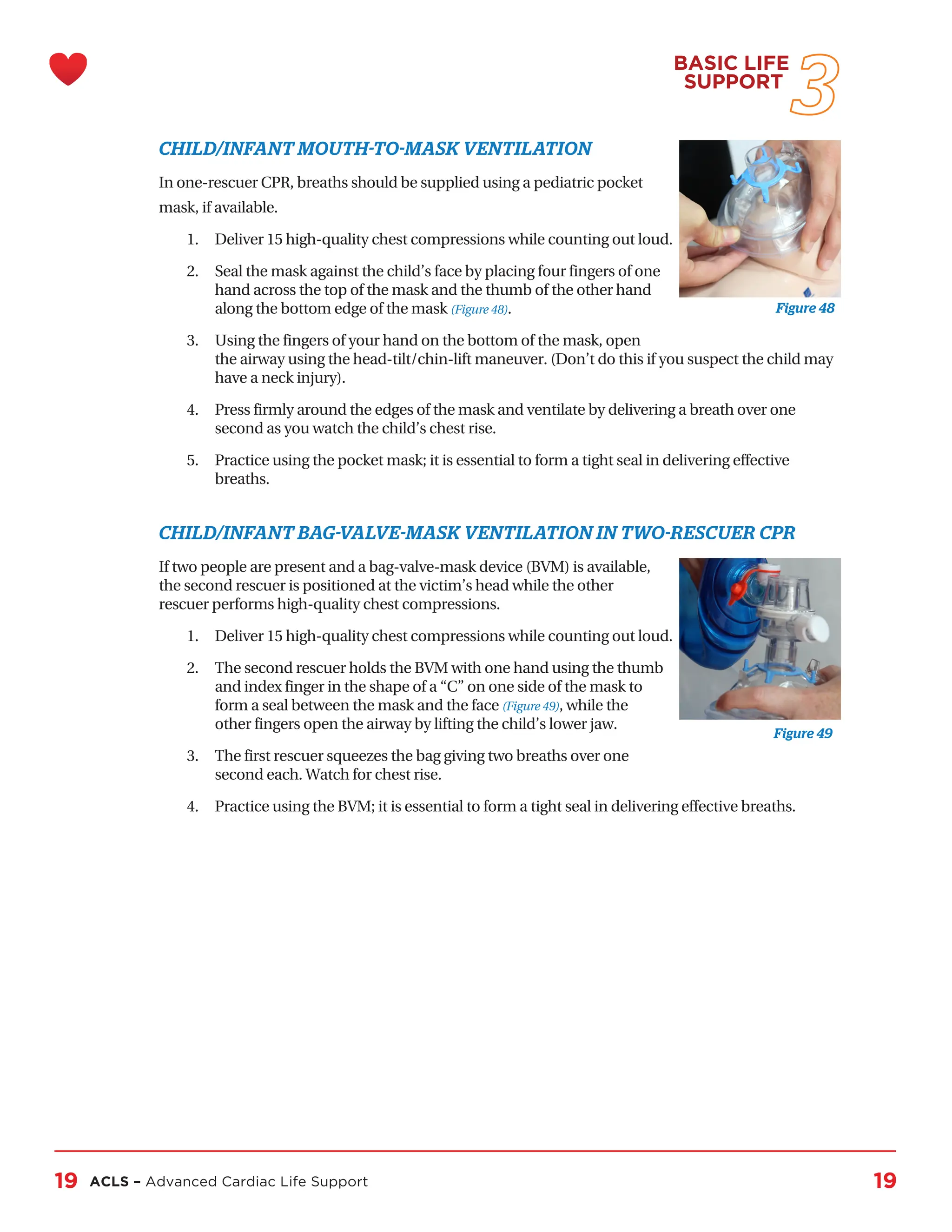
Figure 48
Figure 49
CHILD/INFANT MOUTH-TO-MASK VENTILATION
In one-rescuer CPR, breaths should be supplied using a pediatric pocket
mask, if available.
1. 
Deliver 15 high-quality chest compressions while counting out loud.
2. Seal the mask against the child’s face by placing four fingers of one
hand across the top of the mask and the thumb of the other hand
along the bottom edge of the mask (Figure 48).
3. 
Using the fingers of your hand on the bottom of the mask, open
the airway using the head-tilt/chin-lift maneuver. (Don’t do this if you suspect the child may
have a neck injury).
4. 
Press firmly around the edges of the mask and ventilate by delivering a breath over one
second as you watch the child’s chest rise.
5. Practice using the pocket mask; it is essential to form a tight seal in delivering effective
breaths.
CHILD/INFANT BAG-VALVE-MASK VENTILATION IN TWO-RESCUER CPR
If two people are present and a bag-valve-mask device (BVM) is available,
the second rescuer is positioned at the victim’s head while the other
rescuer performs high-quality chest compressions.
1. Deliver 15 high-quality chest compressions while counting out loud.
2. The second rescuer holds the BVM with one hand using the thumb
and index finger in the shape of a “C” on one side of the mask to
form a seal between the mask and the face (Figure 49), while the
other fingers open the airway by lifting the child’s lower jaw.
3. 
The first rescuer squeezes the bag giving two breaths over one
second each. Watch for chest rise.
4. 
Practice using the BVM; it is essential to form a tight seal in delivering effective breaths.
20 ACLS – Advanced Cardiac Life Support
SELF-ASSESSMENT FOR BLS
1. 
Which of the following is true regarding BLS?
a. It is obsolete.
b. Recent changes prohibit mouth-to-mouth.
c. It should be mastered prior to ACLS.
d. It has little impact on survival.
2. What is the first step in the assessment of an individual found “down”?
a. Check their blood pressure.
b. Check their heart rate.
c. Check to see if they are conscious or unconscious.
d. Check their pupil size.
3. 
What factor is critical in any emergency situation?
a. Scene safety
b. Age of the individual
c. Resuscitation status
d. Pregnancy status
4. CPR is initiated on an Adult and the person’s pulse returns, but he is not breathing. What
ventilation rate should be used for this person?
a. 6-8 breaths per minute
b. 10-12 breaths per minute
c. 18-20 breaths per minute
d. Depends on his color
5. Arrange the BLS Chain of Survival in the proper order:
a. Look, listen, and feel
b. Check responsiveness, call EMS and get AED, defibrillation, and recovery
c. Check responsiveness, call EMS and get AED, chest compressions, early
defibrillation, and recovery
d. Call for help, shock, check pulse, shock, and transport
6. 
After activating EMS and sending someone for an AED, which of the following is correct for
one-rescuer BLS of an unresponsive individual with no pulse?
a. Start rescue breathing.
b. Apply AED pads.
c. Run to get help.
d. Begin chest compressions.
21 ACLS – Advanced Cardiac Life Support
ANSWERS
1. C
ACLS providers are presumed to have mastered BLS skills. CPR is a critical part of
resuscitating cardiac arrest victims.
2. C
When responding to an individual who is “down,” first determine if they are conscious or
not.
3. A
Always assess the safety of the scene in any emergency situation. Do not become injured
yourself.
4. B
Most experts recommend a ventilation rate of 10-12 breaths per minute for adults.
5. C
The focus is on early CPR and defibrillation.
6. D
An unresponsive adult without a pulse must receive CPR, and chest compressions should be
initiated immediately followed by ventilation.
22 ACLS – Advanced Cardiac Life Support
NORMAL HEART ANATOMY AND PHYSIOLOGY
Understanding normal cardiac anatomy and
physiology is an important component of
performing ACLS. The heart is a hollow muscle
comprised of four chambers surrounded by thick
walls of tissue (septum). The atria are the two upper
chambers and the ventricles are the two lower
chambers. The left and right halves of the heart work
together to pump blood throughout the body. The
right atrium (RA) and the right ventricle (RV) pump
deoxygenated blood to the lungs where it becomes
oxygenated. This oxygen-rich blood returns to the
left atrium (LA) and then enters the left ventricle
(LV). The LV is the main pump that delivers the
newly oxygenated blood to the rest of the body.
Blood leaves the heart through a large vessel known
as the aorta. Valves between each pair of connected
chambers prevent the backflow of blood. The two
atria contract simultaneously, as do the ventricles,
making the contractions of the heart go from top to
bottom. Each beat begins in the RA. The LV is the
largest and thickest-walled of the four chambers, as
it is responsible for pumping the newly oxygenated
blood to the rest of the body. The sinoatrial (SA)
node in the RA creates the electrical activity that
acts as the heart’s natural pacemaker. This electrical
impulse then travels to the atrioventricular (AV) node, which lies between the atria and ventricles.
After pausing there briefly, the electrical impulse moves on to the His – Purkinje system, which acts
like wiring to conduct the electrical signal into the LV and RV. This electrical signal causes the heart
muscle to contract and pump blood.
By understanding the normal electrical function of the heart, it will be easy to understand abnormal
functions. When blood enters the atria of the heart, an electrical impulse that is sent out from the SA
node conducts through the atria resulting in atrial contraction.
R
T
P
Q
S
QRS
Complex
ST
Segment
PR
Segment
PR Interval
QT Interval
Figure 8
ADVANCED
CARDIAC LIFE
SUPPORT
4
CHAPTER
23 ACLS – Advanced Cardiac Life Support
4
ADVANCED CARDIAC
LIFE SUPPORT
This atrial contraction registers on an electrocardiogram (ECG) strip as the P wave. This impulse
then travels to the AV node, which in turn conducts the electrical impulse through the Bundle of
His, bundle branches, and Purkinje fibers of the ventricles causing ventricular contraction. The
time between the start of atrial contraction and the start of ventricular contraction registers on
an ECG strip as the PR interval. The ventricular contraction registers on the ECG strip as the QRS
complex. Following ventricular contraction, the ventricles rest and repolarize, which is registered
on the ECG strip as the T wave. The atria also repolarize, but this coincides with the QRS complex,
and therefore, cannot be observed on the ECG strip. Together a P wave, QRS complex, and T wave at
proper intervals are indicative of normal sinus rhythm (NSR) (Figure 8). Abnormalities that are in the
conduction system can cause delays in the transmission of the electrical impulse and are detected on
the ECG. These deviations from normal conduction can result in dysrhythmias such as heart blocks,
pauses, tachycardias and bradycardias, blocks, and dropped beats. These rhythm disturbances will
be covered in more detail further in the handbook.
THE ACLS SURVEY (A-B-C-D)
AIRWAY
Monitor and maintain an open airway at all times.
The provider must decide if the benefit of adding an
advanced airway outweighs the risk of pausing CPR.
If the individual’s chest is rising without using an
advanced airway, continue giving CPR without
pausing. However, if you are in a hospital or near
trained professionals who can efficiently insert and
use the airway, consider pausing CPR.
BREATHING
In cardiac arrest, administer 100% oxygen. Keep blood
O2 saturation (sats) greater than or equal to 94 percent
as measured by a pulse oximeter. Use quantitative
waveform capnography when possible. Normal partial
pressure of CO2 is between 35 to 40 mmHg.
High-quality CPR should produce a ETCO2 between
10 to 20 mmHg. If the ETCO2 reading is less than
10 mmHg after 20 minutes of CPR for an intubated
individual, then you may consider stopping
resuscitation attempts.
CIRCULATION
Obtain intravenous (IV) access, when possible;
intraosseous access (IO) is also acceptable. Monitor
blood pressure with a blood pressure cuff or intra-arterial line if available. Monitor the heart rhythm
using pads and a cardiac monitor. When using an AED, follow the directions (i.e., shock a shockable
rhythm). Give fluids when appropriate. Use cardiovascular medications when indicated.
DIFFERENTIAL DIAGNOSIS
Start with the most likely cause of the arrest and then assess for less likely causes. Treat reversible
causes and continue CPR as you create a differential diagnosis. Stop only briefly to confirm a
diagnosis or to treat reversible causes. Minimizing interruptions in perfusion is key.
Figure 9
• Identify and treat reversible causes
• 
Cardiac rhythm and patient history are
the keys to differential diagnosis
• Assess when to shock versus medicate
• Evaluate rhythm and pulse
• Defibrillation/cardioversion
• Obtain IV/IO access
• Give rhythm-specific medications
• Give IV/IO fluids if needed
• Give 100% oxygen
• 
Assess effective ventilation with
quantitative waveform capnography
• Do NOT over-ventilate
• Maintain airway in unconscious patient
• Consider advanced airway
• 
Monitor advanced airway if placed with
quantitative waveform capnography
A
B
C
D
24 ACLS – Advanced Cardiac Life Support
AIRWAY MANAGEMENT
If bag-mask ventilation is adequate, providers may defer insertion of an advanced airway. Health care
providers should make the decision as to the appropriateness of placing an advanced airway during
the ACLS Survey. The value of securing the airway must be balanced against the need to minimize
the interruption in perfusion that results in halting compressions during airway placement.
Basic airway equipment includes the oropharyngeal airway (OPA) and the nasopharyngeal airway
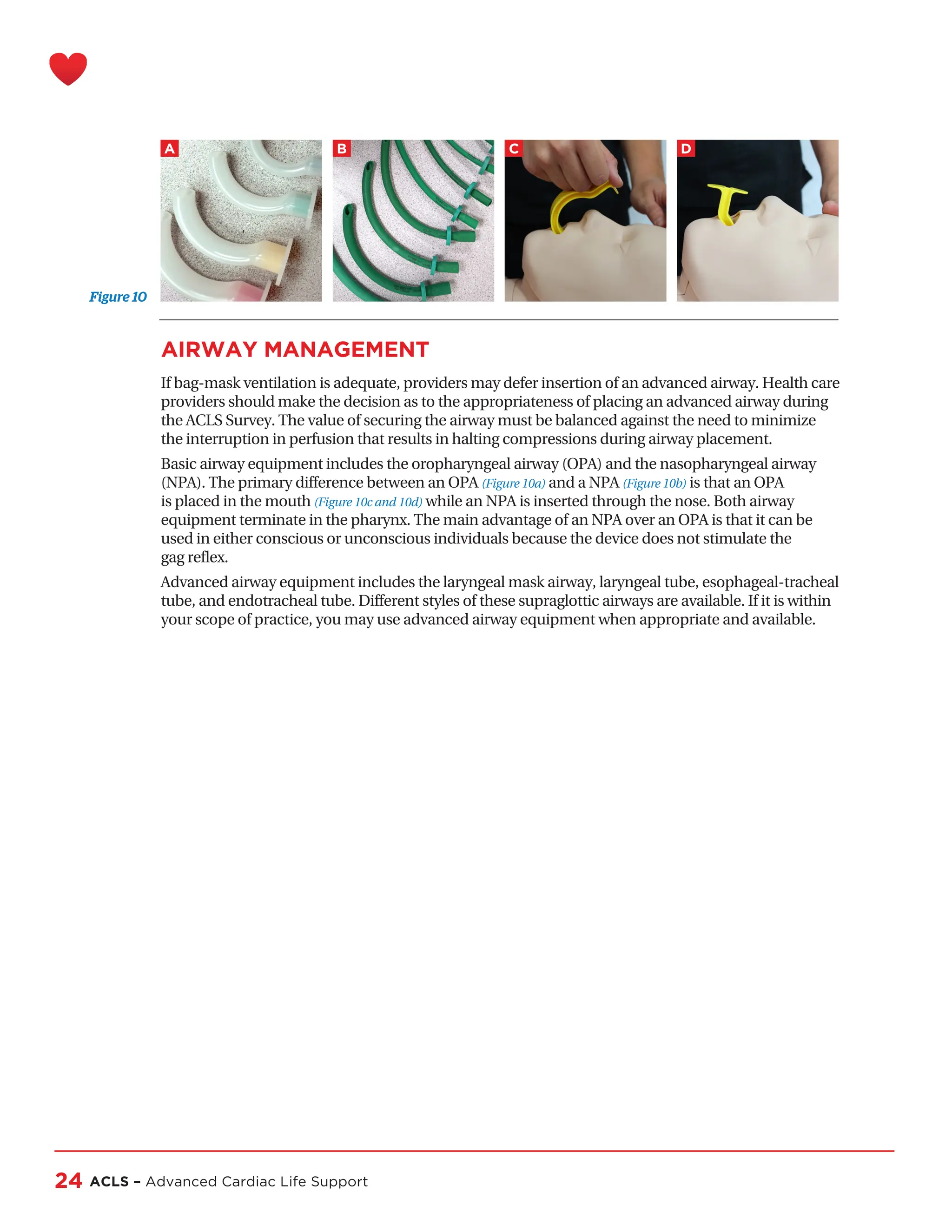
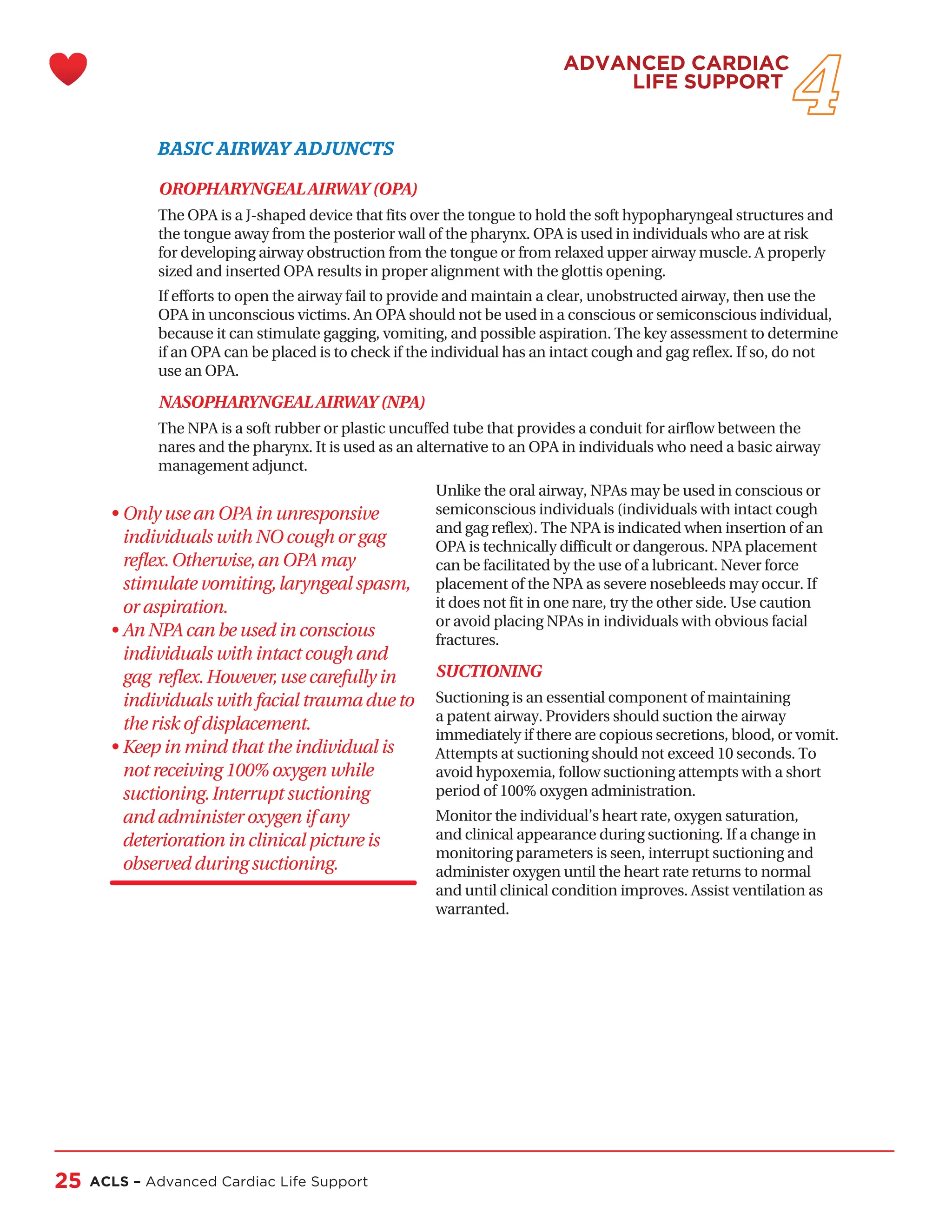
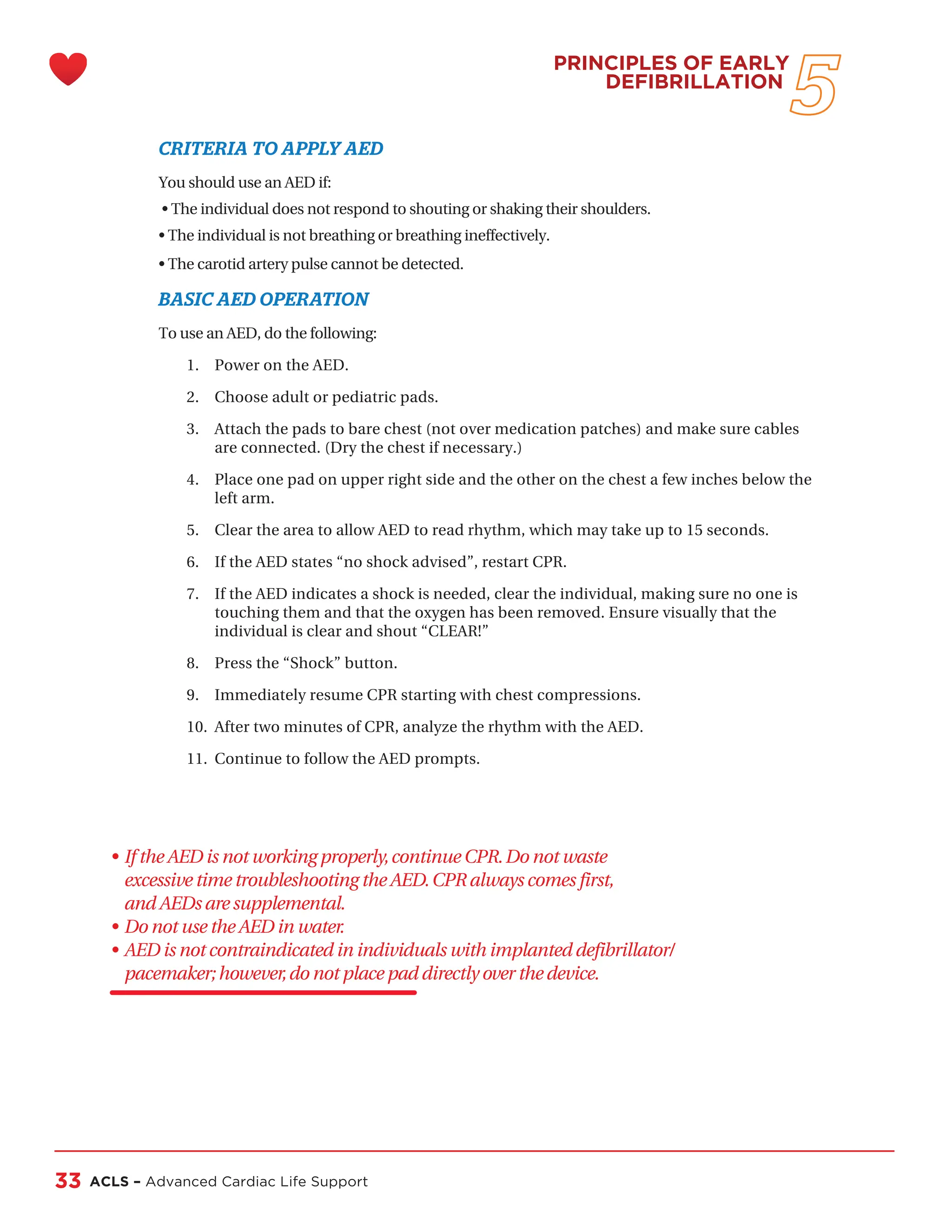
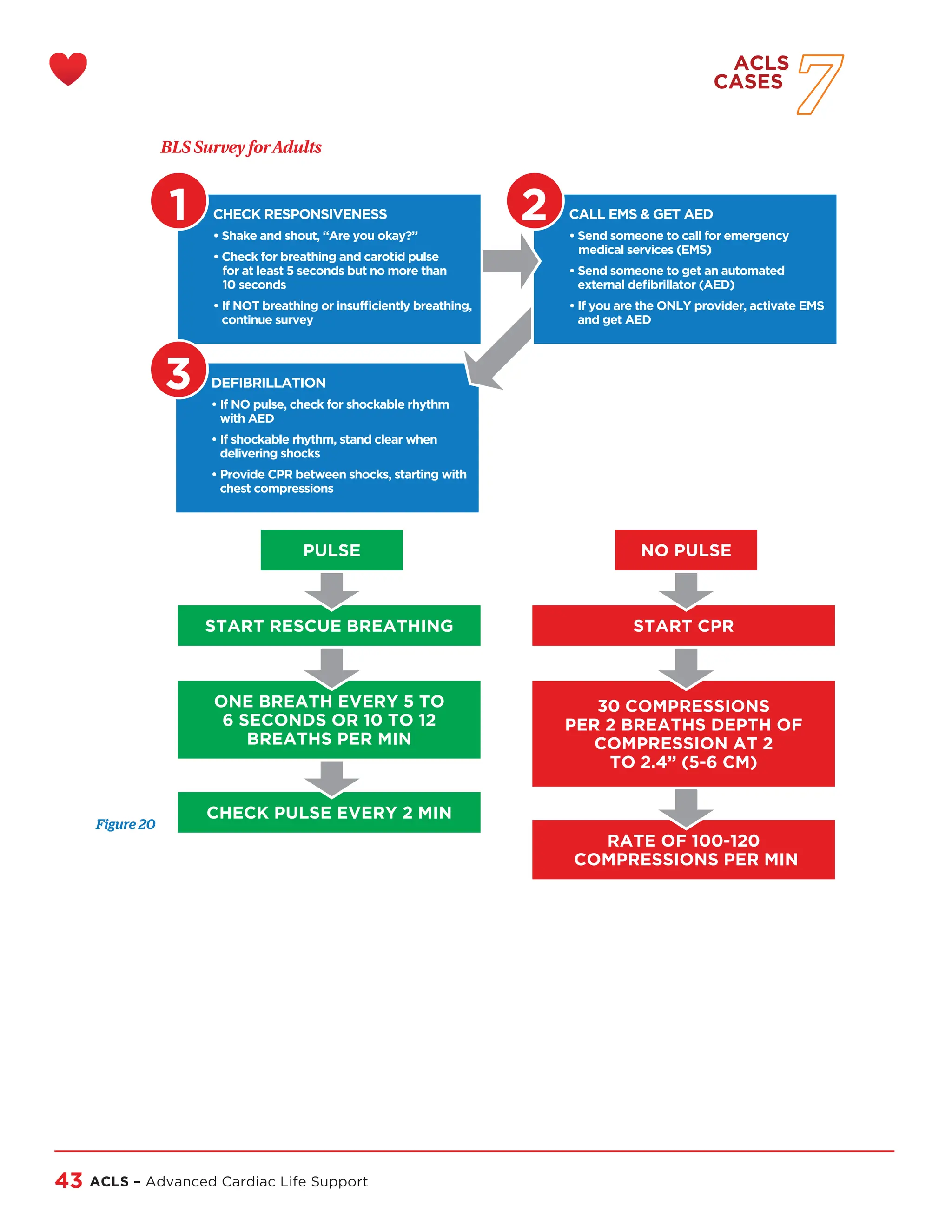
(NPA). The primary difference between an OPA (Figure 10a) and a NPA (Figure 10b) is that an OPA
is placed in the mouth (Figure 10c and 10d) while an NPA is inserted through the nose. Both airway
equipment terminate in the pharynx. The main advantage of an NPA over an OPA is that it can be
used in either conscious or unconscious individuals because the device does not stimulate the
gag reflex.
Advanced airway equipment includes the laryngeal mask airway, laryngeal tube, esophageal-tracheal
tube, and endotracheal tube. Different styles of these supraglottic airways are available. If it is within
your scope of practice, you may use advanced airway equipment when appropriate and available.
Figure 10
A B C D
25 ACLS – Advanced Cardiac Life Support
BASIC AIRWAY ADJUNCTS
OROPHARYNGEALAIRWAY (OPA)
The OPA is a J-shaped device that fits over the tongue to hold the soft hypopharyngeal structures and
the tongue away from the posterior wall of the pharynx. OPA is used in individuals who are at risk
for developing airway obstruction from the tongue or from relaxed upper airway muscle. A properly
sized and inserted OPA results in proper alignment with the glottis opening.
If efforts to open the airway fail to provide and maintain a clear, unobstructed airway, then use the
OPA in unconscious victims. An OPA should not be used in a conscious or semiconscious individual,
because it can stimulate gagging, vomiting, and possible aspiration. The key assessment to determine
if an OPA can be placed is to check if the individual has an intact cough and gag reflex. If so, do not
use an OPA.
NASOPHARYNGEALAIRWAY (NPA)
The NPA is a soft rubber or plastic uncuffed tube that provides a conduit for airflow between the
nares and the pharynx. It is used as an alternative to an OPA in individuals who need a basic airway
management adjunct.
Unlike the oral airway, NPAs may be used in conscious or
semiconscious individuals (individuals with intact cough
and gag reflex). The NPA is indicated when insertion of an
OPA is technically difficult or dangerous. NPA placement
can be facilitated by the use of a lubricant. Never force
placement of the NPA as severe nosebleeds may occur. If
it does not fit in one nare, try the other side. Use caution
or avoid placing NPAs in individuals with obvious facial
fractures.
SUCTIONING
Suctioning is an essential component of maintaining
a patent airway. Providers should suction the airway
immediately if there are copious secretions, blood, or vomit.
Attempts at suctioning should not exceed 10 seconds. To
avoid hypoxemia, follow suctioning attempts with a short
period of 100% oxygen administration.
Monitor the individual’s heart rate, oxygen saturation,
and clinical appearance during suctioning. If a change in
monitoring parameters is seen, interrupt suctioning and
administer oxygen until the heart rate returns to normal
and until clinical condition improves. Assist ventilation as
warranted.
4
ADVANCED CARDIAC
LIFE SUPPORT
• 
Only use an OPA in unresponsive
individuals with NO cough or gag
reflex.Otherwise,an OPA may
stimulate vomiting,laryngeal spasm,
or aspiration.
• 
An NPA can be used in conscious
individuals with intact cough and
gag reflex.However,use carefully in
individuals with facial trauma due to
the risk of displacement.
• 
Keep in mind that the individual is
not receiving 100% oxygen while
suctioning.Interrupt suctioning
and administer oxygen if any
deterioration in clinical picture is
observed during suctioning.
26 ACLS – Advanced Cardiac Life Support
BASIC AIRWAY TECHNIQUE
INSERTINGAN OPA
STEP 1: Clear the mouth of blood and secretions with suction if possible.
STEP 2: Select an airway device that is the correct size for the person.
		 • Too large of an airway device can damage the throat.
		 • Too small of an airway device can press the tongue into the airway.
STEP 3: 
Place the device at the side of the person’s face. Choose the device that extends from the
		 corner of the mouth to the earlobe.
STEP 4: Insert the device into the mouth so the point is toward the roof of the mouth or parallel to
		 the teeth.
		 • Do not press the tongue back into the throat.
STEP 5: Once the device is almost fully inserted, turn it until the tongue is cupped by the interior
		 curve of the device.
INSERTINGAN NPA
STEP 1: Select an airway device that is the correct size for the person.
STEP 2: Place the device at the side of the person’s face. Choose the device that extends from the tip
of the nose to the earlobe. Use the largest diameter device that will fit.
STEP 3: Lubricate the airway with a water-soluble lubricant or anesthetic jelly.
STEP 4: Insert the device slowly, moving straight into the face (not toward the brain).
STEP 5: It should feel snug; do not force the device into the nostril. If it feels stuck, remove it and try
the other nostril.
• OPAs too large or too small may
obstruct the airway.
• NPAs sized incorrectly may enter
the esophagus.
• Always check for spontaneous
respirations after insertion
of either device.
TIPS ON SUCTIONING
• 
When suctioning the oropharynx, do not insert the
catheter too deeply. Extend the catheter to the maxi-
mum safe depth and suction as you withdraw.
• 
When suctioning an endotracheal (ET) tube, keep in
mind the tube is within the trachea and that you may
be suctioning near the bronchi or lung. Therefore,
sterile technique should be used.
• 
Each suction attempt should be for no longer than 10
seconds. Remember the person will not get oxygen
during suctioning.
• 
Monitor vital signs during suctioning and stop suc-
tioning immediately if the person
experiences hypoxemia (oxygen sats less than 94%),
has a new arrhythmia or becomes cyanotic.
27 ACLS – Advanced Cardiac Life Support
ADVANCED AIRWAY ADJUNCTS
ENDOTRACHEALTUBE
The endotracheal (ET) tube is an advanced airway alternative. It is a specific type of tracheal tube that
is inserted through the mouth or nose. It is the most technically difficult airway to place; however, it
is the most secure airway available. Only experienced providers should perform ET intubation. This
technique requires the use of a laryngoscope. Fiber optic portable laryngoscopes have a video screen,
improve success, and are gaining popularity for field use.
LARYNGEAL MASKAIRWAY
The laryngeal mask airway (LMA) is an advanced airway alternative to ET intubation and provides
comparable ventilation. It is acceptable to use the LMA as an alternative to an esophageal-tracheal
tube for airway management in cardiac arrest. Experience will allow rapid placement of the LMA
device by an ACLS provider.
LARYNGEALTUBE
The advantages of the laryngeal tube are similar to those of the esophageal-tracheal tube; however,
the laryngeal tube is more compact and less complicated to insert. This tube has only one larger
balloon to inflate and can be inserted blindly.
ESOPHAGEAL-TRACHEALTUBE
The esophageal-tracheal tube (sometimes referred to
as a combitube) is an advanced airway alternative to ET
intubation. This device provides adequate ventilation
comparable to an ET tube. The combitube has two separate
balloons that must be inflated and two separate ports.
The provider must correctly determine which port to
ventilate through to provide adequate oxygenation.
4
ADVANCED CARDIAC
LIFE SUPPORT
• During CPR,the chest compression
to ventilation rate for adults is 30:2.
• 
If advanced airway is placed,do
not interrupt chest compressions
for breaths.Give one breath every
6 seconds with continuous chest
compressions.
28 ACLS – Advanced Cardiac Life Support
ROUTES OF ACCESS
Historically in ACLS, providers have administered drugs via the intravenous (IV) or the ET route. ET
absorption of drugs is poor, and optimal drug dosing is unknown. Therefore, the intraosseous (IO)
route is now preferred when IV access is not available. Below are the priorities for vascular access.
INTRAVENOUS ROUTE
A peripheral IV is preferred for drug and fluid administration unless central line access is already
available. Central line access is not necessary during most resuscitation attempts, as it may cause
interruptions in CPR and complications during insertion. Placing a peripheral line does not require
CPR interruption.
If a drug is given via peripheral route of administration, do the following:
1. Intravenously push bolus injection (unless otherwise indicated).
2. Flush with 20 mL of fluid or saline.
3. Raise extremity for 10 to 20 seconds to enhance delivery of drug to circulation.
INTRAOSSEOUS ROUTE
Drugs and fluids can be delivered safely and effectively
during resuscitation via the IO route if IV access is not
available.
IO access can be used for all age groups, can be placed in
less than one minute, and has more predictable absorption
than the ET route.
• When using peripheral IV route of
administration,drugs can take up to
two minutes or more to reach central
circulation.The effect of
medications given may not be seen
until even longer.High-quality CPR
helps circulate these drugs and is an
important part of resuscitation.
• Any ACLS drug or fluid that can be
administered intravenously can also
be given intraosseously.
29 ACLS – Advanced Cardiac Life Support
PHARMACOLOGICAL TOOLS
Use of any of the ALCS medication in Table 1 should be done within your scope of practice and after
thorough study of the actions and side effects. This table only provides a brief reminder for those who
are already knowledgeable in the use of these medications. Moreover, Table 1 contains only adult
doses, indications, and routes of administration for the most common ACLS drugs.
Doses,Routes,and Uses of Common Drug
DRUG MAIN ACLS USE DOSE/ROUTE NOTES
Adenosine
• Narrow PSVT/SVT
•
Wide QRS tachycardia,
avoid adenosine in
irregular wide QRS
• 
6 mg IV bolus,may repeat with 12 mg in
1 to 2 min.
• 
Rapid IV push close to the hub,followed by a
saline bolus
• 
Continuous cardiac monitoring during
administration
• Causes flushing and chest heaviness
Amiodarone
•VF/pulselessVT
•VT with pulse
• Tachycardia
rate control
•
VF/VT: 300 mg dilute in 20 to 30 mL,may
repeat 150 mg in 3 to 5 min
• 
Anticipate hypotension,bradycardia,and
gastrointestinal toxicity
• Continuous cardiac monitoring
•Very long half-life (up to 40 days)
• Do not use in 2nd or 3rd-degree heart block
• Do not administer via the ET tube route
Atropine
• Symptomatic
bradycardia
• 0.5 mg IV/IO every 3 to 5 minutes
• Max dose: 3 mg
• 
Cardiac and BP monitoring
• 
Do not use in glaucoma or
tachyarrhythmias
• Minimum dose 0.5 mg
• 
Specific toxins/overdose
(e.g. organophosphates)
• 
2 to 4 mg IV/IO may be needed
Dopamine
• Shock/CHF
• Symptomatic
bradycardia
• 2 to 20 mcg/kg/min
• Titrate to desired blood pressure
• 
Fluid resuscitation first
• Cardiac and BP monitoring
Epinephrine
• 
Cardiac Arrest
• 
Initial: 1.0 mg (1:10000) IV or 2 to 2.5 mg
(1:1000)
• 
Maintain: 0.1 to 0.5 mcg/kg/min Titrate to
desire blood pressure • 
Continuous cardiac monitoring
• 
Note: Distinguish between 1:1000 and 1:10000
concentrations
• Give via central line when possible
• Anaphylaxis
• 
0.3-0.5 mg IM
• Repeat every five minutes as needed
• Symptomatic
bradycardia/Shock
• 
2 to 10 mcg/min infusion
• Titrate to response
Lidocaine
(Lidocaine is
recommended when
Amiodarone is not
available)
• 
Cardiac Arrest (VF/VT)
• 
Initial: 1 to 1.5 mg/kg IV loading
• Second: Half of first dose in 5 to 10 min
• Maintain: 1 to 4 mg/min
• 
Cardiac and BP monitoring
• 
Rapid bolus can cause hypotension and
bradycardia
• Use with caution in renal failure
•Wide complex
tachycardia with pulse
• 
Initial: 0.5 to 1.5 mg/kg IV
• 
Second: Half of first dose in 5 to 10 min
• Maintain: 1 to 4 mg/min
Magnesium Sulfate
• 
Cardiac arrest/
Pulseless torsades
• 
Cardiac Arrest: 1 to 2 gm diluted in 10 mL
D5W IVP
• 
Cardiac and BP monitoring
• 
Rapid bolus can cause hypotension and
bradycardia
• Use with caution in renal failure
• 
Calcium chloride can reverse
hypermagnesemia
• 
Torsades de Pointes
with pulse
• 
If not cardiac arrest: 1 to 2 gm IV over 5 to 60
min
• 
Maintain: 0.5 to 1 gm/hr IV
Procainamide
•Wide QRS tachycardia
• 
Preferred forVT with
pulse (stable)
• 
20 to 50 mg/min IV until rhythm improves,
hypotension occurs,QRS widens by 50%
or MAX dose is given
• MAX dose: 17 mg/kg
• 
Drip: 1 to 2 gm in 250 to 500 mL at
1 to 4 mg/min
• 
Cardiac and BP monitoring
• Caution with acute MI
• May reduce dose with renal failure
• Do not give with amiodarone
• Do not use in prolonged QT or CHF
Sotalol
• Tachyarrhythmia
• MonomorphicVT
• 3rd line anti-arrhythmic
• 
100 mg (1.5 mg/kg) IV over 5 min • 
Do not use in prolonged QT
Table 1
4
ADVANCED CARDIAC
LIFE SUPPORT
30 ACLS – Advanced Cardiac Life Support
SELF-ASSESSMENT FOR ACLS
1. 
An individual presents with symptomatic bradycardia. Her heart rate is 32. Which of the
following are acceptable therapeutic options?
a. Atropine
b. Epinephrine
c. Dopamine
d. All of the above
2. 
A person with alcoholism collapses and is found to be in Torsades de Pointes. What
intervention is most likely to correct the underlying problem?
a. Rewarm the individual to correct hypothermia.
b. Administer magnesium sulfate 1 to 2 gm IV diluted in 10 mL D5W to correct
low magnesium.
c. Administer glucose to correct hypoglycemia.
d. Administer naloxone to correct narcotic overdose.
3. 
You have just administered a drug for an individual in supraventricular tachycardia (SVT).
She complains of flushing and chest heaviness. Which drug is the most likely cause?
a. Aspirin
b. Adenosine
c. Amiodarone
d. Amitriptyline
ANSWERS
1. D
Atropine is the initial treatment for symptomatic bradycardia. If unresponsive, IV dopamine
or epinephrine is the next step. Pacing may be effective if other measures fail to improve the
rate.
2. B
Hypomagnesemia or low Mg++ is commonly caused by alcoholism and malnutrition.
Administration of IV magnesium may prevent or terminate Torsades de Pointes.
3. B
Adenosine is the correct choice for SVT treatment and commonly results in reactions such as
flushing, dyspnea, chest pressure, and lightheadedness.
31 ACLS – Advanced Cardiac Life Support
The earlier the defibrillation occurs, the higher the survival rate. When a fatal arrhythmia is present,
CPR can provide a small amount of blood flow to the heart and the brain, but it cannot directly
restore an organized rhythm. The likelihood of restoring a perfusing rhythm is optimized with
immediate CPR and defibrillation. The purpose of defibrillation is to disrupt a chaotic rhythm and
allow the heart’s normal pacemakers to resume effective electrical activity.
The appropriate energy dose is determined by the design of the defibrillator—monophasic or
biphasic. If you are using a monophasic defibrillator, give a single 360 J shock. Use the same energy
dose on subsequent shocks. Biphasic defibrillators use a variety of waveforms and have been
shown to be more effective for terminating a fatal arrhythmia. When using biphasic defibrillators,
providers should use the manufacturer’s recommended energy dose. Many biphasic defibrillator
manufacturers display the effective energy dose range on the face of the device. If the first shock does
not terminate the arrhythmia, it may be reasonable to escalate the energy delivered if the defibrillator
allows it.
To minimize interruptions in chest compressions during CPR, continue CPR while the defibrillator is
charging. Be sure to clear the individual by ensuring that oxygen is removed, and no one is touching
the individual prior to delivering the shock. Immediately after the shock, resume CPR, beginning
with chest compressions. Give CPR for two minutes (approximately five cycles). A cycle consists of 30
compressions followed by two breaths for an adult without an advanced airway. Those individuals
with an advanced airway device in place can be ventilated at a rate of one breath every 5 to 6 seconds
(or 10 to 12 breaths per minute).
PRINCIPLES
OF EARLY
DEFIBRILLATION
5
CHAPTER
32 ACLS – Advanced Cardiac Life Support
KEYS TO USING AN AUTOMATED EXTERNAL DEFIBRILLATOR
If you look around the public places you visit, you are
likely to find an Automated External Defibrillator (AED).
An AED is both sophisticated and easy to use, providing
life-saving power in a user-friendly device which makes
it useful for people who have never operated one and for
anyone in stressful scenarios. However, proper use of an
AED is very important.
Attach the pads to the upper right side and lower left
side of the individual’s chest (Figure 11). Once the pads
are attached correctly, the device will read the heart
rhythm. If the pads are not attached appropriately, the
device will indicate so with prompts. Once the rhythm
is analyzed, the device will direct you to shock the
individual if a shock is indicated. A shock depolarizes
all heart muscle cells at once, attempting to organize its
electrical activity. In other words, the shock is
intended to reset the heart’s abnormal electrical
activity into a normal rhythm.
AED Key Points
Assure oxygen is NOT flowing across the patient’s
chest when delivering shock
Do NOT stop chest compressions for more than
10 seconds when assessing the rhythm
Stay clear of patient when delivering shock
Assess pulse after the first two minutes of CPR
If the end-tidal CO2 is less than 10 mmHg during CPR, consider
adding a vasopressor and improve chest compressions. However, after
20 minutes of CPR for an intubated individual, you may consider
stopping resuscitation attempts.
FPO
Figure 12
Figure 11
33 ACLS – Advanced Cardiac Life Support
CRITERIA TO APPLY AED
You should use an AED if:
• The individual does not respond to shouting or shaking their shoulders.
• The individual is not breathing or breathing ineffectively.
• The carotid artery pulse cannot be detected.
BASIC AED OPERATION
To use an AED, do the following:
1. Power on the AED.
2. Choose adult or pediatric pads.
3. 
Attach the pads to bare chest (not over medication patches) and make sure cables
are connected. (Dry the chest if necessary.)
4. 
Place one pad on upper right side and the other on the chest a few inches below the
left arm.
5. Clear the area to allow AED to read rhythm, which may take up to 15 seconds.
6. If the AED states “no shock advised”, restart CPR.
7. 
If the AED indicates a shock is needed, clear the individual, making sure no one is
touching them and that the oxygen has been removed. Ensure visually that the
individual is clear and shout “CLEAR!”
8. Press the “Shock” button.
9. Immediately resume CPR starting with chest compressions.
10. After two minutes of CPR, analyze the rhythm with the AED.
11. Continue to follow the AED prompts.
5
PRINCIPLES OF EARLY
DEFIBRILLATION
• If the AED is not working properly,continue CPR.Do not waste
excessive time troubleshooting the AED.CPR always comes first,
and AEDs are supplemental.
• Do not use the AED in water.
• AED is not contraindicated in individuals with implanted defibrillator/
pacemaker;however,do not place pad directly over the device.
34 ACLS – Advanced Cardiac Life Support
Figure 13
FPO
The ILCOR guidelines describe Systems of Care as
a separate and important part of ACLS provider
training. These Systems of Care describe the
organization of professionals necessary to achieve
the best possible result for a given individual’s
circumstances. They include an overview of the
ways life-saving interventions should be organized
to ensure they are delivered efficiently and
effectively. Hospitals, EMS staff, and communities
that follow comprehensive Systems of Care
demonstrate better outcomes for their patients
than those who do not.
Rapid
Response
Team (RRT)
Code
Team
Critical Care
Team
Unstable Patient
SYSTEMS
OF CARE
6
CHAPTER
• Management of life-threatening emergencies requires the integration
of a multidisciplinary team that can involve rapid response teams (RRTs),
cardiac arrest teams,and intensive care specialists to increase survival rates.
35 ACLS – Advanced Cardiac Life Support
CARDIOPULMONARY RESUSCITATION
Successful cardiopulmonary resuscitation (CPR) requires the use of it as part of a system of care
called the Chain of Survival (Figure 14). As with any chain, it is only as strong as its weakest link. Thus,
everyone must strive to make sure each link is strong. For instance, community leaders can work to
increase awareness of the signs and symptoms of cardiac arrest and make AEDs available in public
places. EMS crews must stay abreast of updates and innovations in resuscitation and hone the skills
required to deliver CPR quickly and effectively. Hospitals should be ready to receive patients in
cardiac arrest and provide excellent care. Critical care and reperfusion centers should be staffed by
experts and equipped with the latest technology. Because recovery from cardiac arrest continues
long after the initial hospitalization, patients should have formal assessment and support for their
physical, cognitive, and psychosocial needs.
INITIATING THE CHAIN OF SURVIVAL
Early initiation of BLS has been shown to increase the probability of survival for a person dealing with
cardiac arrest. To increase the odds of surviving a cardiac event, the rescuer should follow the steps in
the Adult Chain of Survival (Figure 14).
Adult Chain of Survival
Figure 14
RECOVERY
POST
CARDIAC
ARREST
CARE
ADVANCED
LIFE
SUPPORT
DEFIBRILLATE
WITH
AED
PERFORM
EARLY CPR
ACTIVATION
OF EMERGENCY
RESPONSE
6
SYSTEMS
OF CARE
36 ACLS – Advanced Cardiac Life Support
POST-CARDIAC ARREST CARE
Integrated post-cardiac arrest care is the fifth link in the Adult Chain of Survival. The quality of
this care is critical to providing resuscitated individuals with the best possible results. When the
interventions below are provided, there is an increased likelihood of survival.
Care of the patient after the return of spontaneous circulation (ROSC) requires close attention
to oxygenation, blood pressure control, evaluation
for percutaneous coronary intervention, targeted
temperature management, and multimodal
neuroprognostication. Because recovery from cardiac
arrest continues long after the initial hospitalization,
patients should have formal assessment and support for
their physical, cognitive, and psychosocial needs.nes
update rommends a focused debriefing of
THERAPEUTIC HYPOTHERMIA
• 
Recommended for comatose individuals with return of spontaneous circulation after a cardiac
arrest event.
• Individuals should be cooled to 89.6 to 93.2 degrees F (32 to 36 degrees C) for at least 24 hours.
OPTIMIZATION OF HEMODYNAMICS AND VENTILATION
• 
100% oxygen is acceptable for early intervention but not for extended periods of time.
• 
Oxygen should be titrated, so that individual’s pulse oximetry is greater than 94% to avoid
oxygen toxicity.
• Do not over ventilate to avoid potential adverse hemodynamic effects.
• Ventilation rates of 10 to 12 breaths per minute to achieve ETCO2 at 35 to 40 mmHg.
• IV fluids and vasoactive medications should be titrated for hemodynamic stability.
PERCUTANEOUS CORONARY INTERVENTION
• 
Percutaneous coronary intervention (PCI) is preferred over thrombolytics.
• Individual should be taken by EMS directly to a hospital that performs PCI.
• 
If the individual is delivered to a center that only delivers thrombolytics, they should be transferred
to a center that offers PCI if time permits.
NEUROLOGICAL CARE
• 
Neurologic assessment is key, especially when withdrawing care (i.e., brain death) to decrease
false-positive rates. Specialty consultation should be obtained to monitor neurologic signs and
symptoms throughout the post-resuscitation period.
After a resuscitation,debriefing for
lay rescuers,EMS providers,and
hospital-based healthcare workers
may be beneficial to support their
mental health and well-being.
37 ACLS – Advanced Cardiac Life Support
ACUTE CORONARY SYNDROME
For individuals with acute coronary syndrome (ACS), proper care starts during the call to EMS.
First responders must be aware of and look for signs of ACS. Quick diagnosis and treatment yield
the best chance to preserve healthy heart tissue. It is very important that health care providers
recognize individuals with potential ACS in order to initiate evaluation, appropriate triage, and
time management.
ACS Chain of Survival
GOALS OF ACS TREATMENT
Early EMS communication allows for
preparation of emergency department
personnel and cardiac catheterization lab
and staff. Once the ACS patient arrives at
the receiving facility, established protocols
should direct care. The shorter the time is
until reperfusion, the greater the amount
of heart tissue that can be saved, and the
more optimal the overall outcome.
Major adverse cardiac events (MACE)
includes death and non-fatal myocardial
infarction. Life-threatening complications
of ACS include ventricular fibrillation,
pulseless ventricular tachycardia,
bradyarrhythmias, cardiogenic shock,
and pulmonary edema. EMS should
have the capacity to perform ECGs on
scene and on the way to the hospital. The receiving hospital should be made aware of
possible ACS, especially ST-elevation myocardial infarction elevation (STEMI) and
non-ST-elevation myocardial infarction (NSTEMI).
QUALITY
POST-MI CARE
REPERFUSION
WITH PCI OR
FIBRINOLYTICS
ED EVIDENCE
BASED CARE
EMS
PRE-HOSPITAL
MANAGEMENT
RECOGNIZE
SYMPTOMS 
ACTIVATE EMS
Figure 15
Figure 16
REDUCE
MYOCARDIAL
NECROSIS TO
PRESERVE HEART
FUNCTION
PREVENT MAJOR
ADVERSE CARDIAC
EVENTS (MACE)
TREAT ACS
COMPLICATIONS
(VF, VT, SHOCK)
6
SYSTEMS
OF CARE
38 ACLS – Advanced Cardiac Life Support
ACUTE STROKE
Outcomes for individuals with stroke have improved significantly due to the implementation of
Acute Stroke System of Care. The community is better equipped to recognize stroke as a “brain
attack,” and there is greater awareness of the importance of medical care within one hour of
symptom onset. Likewise, EMS systems have been enhanced to transport individuals to regional
stroke care centers that are equipped to administer fibrinolytics.
Stroke Chain of Survival
GOALS OF ACUTE ISCHEMIC STROKE CARE
The overall goal of stroke care is to minimize brain injury and optimize the individual’s recovery.
Preferential transport to stroke-capable centers has been shown to improve outcomes. Stroke
centers are equipped with resources often not available at smaller community hospitals. The
presence of specialists, including neurologists and stroke care specialists, multidisciplinary teams
experienced in stroke care, advanced imaging modalities,
and other therapeutic options make transport to stroke
centers the most suitable option. The goal of the stroke
team, emergency physician, or other experts should be to
assess the individual with suspected stroke within
ten minutes.
The 8 D’s of Stroke Care
DETECTION Rapid recognition of stroke symptoms
DISPATCH Early activation and dispatch of EMS
DELIVERY Rapid EMS identification,management,and transport
DOOR Transport to stroke center
DATA Rapid triage,evaluation,and management in ED
DECISION Stroke expertise and therapy selection
DRUG Fibrinolytic therapy,intra-arterial strategies
DISPOSITION Rapid admission to the stroke unit or critical care unit
Table 2
Figure 17
QUALITY
POST-STROKE
CARE
GUIDELINE
BASED STROKE
CARE
TRANPORT
TO  NOTIFY
STROKE
CENTER
TIMELY EMS
RESPONSE
RECOGNIZE
SYMPTOMS 
ACTIVATE EMS
The 8 D’s of Stroke Care (Table 2)
highlight the major steps of diagnosis
and treatment of stroke and key points
at which delays can occur.
39 ACLS – Advanced Cardiac Life Support
THE RESUSCITATION TEAM
The ILCOR guidelines for ACLS highlight the importance of effective team dynamics during
resuscitation. In the community (outside a health care facility), the first rescuer on the scene may be
performing CPR alone. However, a Code Blue in a hospital may bring dozens of responders/providers
to a patient’s room. It is important to quickly and efficiently organize team members to effectively
participate in ACLS. The ILCOR suggests a team structure with each provider assuming a specific role
during the resuscitation; this consists of a team leader and several team members. (Table 3)
It is important to know your own clinical limitations.
Resuscitation is the time for implementing acquired skills,
not trying new ones. Only take on tasks you can perform
successfully. Clearly state when you need help and call
for help early in the care of the individual. Resuscitation
demands mutual respect, knowledge sharing, constructive
criticism, and follow-up discussion (debriefing) after the
event.
Table 3
• Organize the group
• Monitor performance
• Be able to perform all skills
• Direct team members
• 
Provide critique of group performance
after the resuscitation effort
• Understand their role
• 
Be willing, able, and skilled
to perform the role
• 
Understand the ACLS sequences
• 
Be committed to the success
of the team
TEAM MEMBER
TEAM LEADER
Figure 18
Closed-Loop
Communication
TEAM LEADER GIVES
CLEAR ASSIGNMENT
TO TEAM MEMBER
TEAM LEADER LISTENS
FOR CONFIRMATION
TEAM MEMBER
RESPONDS WITH VOICE
AND EYE CONTACT
TEAM MEMBER
REPORTS WHEN TASK
IS COMPLETE AND
REPORTS THE RESULT
6
SYSTEMS
OF CARE
Clear communication between
team leaders and team members
is essential.
40 ACLS – Advanced Cardiac Life Support
EDUCATION, IMPLEMENTATION, TEAMS
Only about 20% of the individuals who have a cardiac arrest inside a hospital will survive. This
statistic prompted the development of a Cardiac Arrest System of Care. Four out of five individuals
with cardiopulmonary arrest have changes in vital signs prior to the arrest. Therefore, most
individuals who eventually have a cardiac arrest showed signs of impending cardiac arrest. Survival
rates could be improved if individuals are identified and treated with ACLS protocols sooner.
Originally, specialized groups of responders within a hospital, called Cardiac Arrest Teams, attended
to a patient with recognized cardiac arrest. These teams responded to a Code Blue after someone
presumably recognized an active cardiac arrest and sought help. Many believed Cardiac Arrest
Teams would improve survival rates, but the results were disappointing. Studies show that survival
rates were the same in hospitals with Cardiac Arrest Teams as in those without a team. As a result,
hospitals are replacing Cardiac Arrest Teams with Rapid Response Teams (RRTs) or Medical
Emergency Teams (METs).
Rather than waiting for loss of consciousness and full cardiopulmonary arrest, RRTs/METs closely
monitor patients in order to treat them before the cardiac arrest occurs. These teams combine the
efforts of nurses, physicians, and family members to detect an impending cardiac arrest.
RRT/MET ALERT CRITERIA
Figure 19
THREATENED AIRWAY OR
LABORED BREATHING
BRADYCARDIA ( 40 BPM) OR
TACHYCARDIA ( 100 BPM)
HYPOTENSION OR
SYMPTOMATIC HYPERTENSION
ALTERED MENTAL STATUS
SEIZURE
SUDDEN AND LARGE
DECREASE IN URINE OUTPUT
When hospitals implement RRTs/METs,there are fewer
cardiac arrests,fewer ICU transfers,improved survival rates,
and shorter lengths of inpatient stay.
41 ACLS – Advanced Cardiac Life Support
1. What is the longest a rescuer should pause to check for a pulse?
a. 20 seconds
b. 10 seconds
c. 5 seconds
d. Less than two seconds
2. 
Select the proper pairing regarding CPR for an adult:
a. Chest compressions 60 to 80/minute; 2 inches deep (5cm)
b. Chest compressions 80/minute; 1.5 inches deep (4cm)
c. Chest compressions 100/minute; 3 inches deep (8cm)
d. Chest compression 100 to 120 per minute; 2 to 2.4 inches deep (5-6cm)
3. What is the role of the second rescuer during a cardiac arrest scenario?
a. Summon help.
b. Retrieve AED.
c. Perform ventilations.
d. All of the above
ANSWERS
1. B
Pulse checks are limited to no more than 10 seconds. If you are unsure whether a pulse is
present, begin CPR.
2. D
Chest compression 100 to 120 per minute; 2 to 2.4 inches deep (5-6cm).
3. D
Take advantage of any bystander and enlist their help based on their skill level.
SELF-ASSESSMENT FOR
SYSTEMS OF CARE
42 ACLS – Advanced Cardiac Life Support
RESPIRATORY ARREST
Individuals with ineffective breathing patterns are considered to be in respiratory arrest and require
immediate attention. There are many causes of respiratory arrest, including but not limited to
cardiac arrest and cardiogenic shock. Resuscitate individuals in apparent respiratory arrest following
BLS or ACLS protocols.
ACLS
CASES
7
CHAPTER
Respiratory arrest is an emergent condition in which the
individual is either not breathing or is breathing ineffectively.
43 ACLS – Advanced Cardiac Life Support
BLS Survey forAdults
Figure 20
CHECK PULSE EVERY 2 MIN
ONE BREATH EVERY 5 TO
6 SECONDS OR 10 TO 12
BREATHS PER MIN
START RESCUE BREATHING
DEFIBRILLATION
• 
If NO pulse, check for shockable rhythm
with AED
• 
If shockable rhythm, stand clear when
delivering shocks
• 
Provide CPR between shocks, starting with
chest compressions
CALL EMS  GET AED
• Send someone to call for emergency
medical services (EMS)
• 
Send someone to get an automated
external defibrillator (AED)
• 
If you are the ONLY provider, activate EMS
and get AED
2
CHECK RESPONSIVENESS
• Shake and shout, “Are you okay?”
• Check for breathing and carotid pulse
for at least 5 seconds but no more than
10 seconds
• 
If NOT breathing or insufficiently breathing,
continue survey
1
3
PULSE
RATE OF 100-120
COMPRESSIONS PER MIN
30 COMPRESSIONS
PER 2 BREATHS DEPTH OF
COMPRESSION AT 2
TO 2.4” (5-6 CM)
START RESCUE BREATHING
START CPR
NO PULSE
7
ACLS
CASES
44 ACLS – Advanced Cardiac Life Support
ACLS Survey
TYPES OFAIRWAYS
Figure 21
Table 4
• Identify and treat reversible causes
• 
Cardiac rhythm and patient history are
the keys to differential diagnosis
• Assess when to shock versus medicate
• Evaluate rhythm and pulse
• Defibrillation/cardioversion
• Obtain IV/IO access
• Give rhythm-specific medications
• Give IV/IO fluids if needed
• Give 100% oxygen
• 
Assess effective ventilation with
quantitative waveform capnography
• Do NOT over ventilate
• Maintain airway in unconscious patient
• Consider advanced airway
• 
Monitor advanced airway if placed with
quantitative waveform capnography
A
B
C
D
ADVANCED
ESOPHAGAL-TRACHEAL TUBE
ET
LARYNGEAL TUBE
LMA
BASIC
MOUTH-TO-MOUTH/NOSE
BAG-MASK VENTILATION
OPA
NPA
45 ACLS – Advanced Cardiac Life Support
In Table 4, the airways listed in the left column are
considered advanced airways, while those in the right
column are basic airways. Although OPAs and NPAs
are considered to be basic airways, they require proper
placement by an experienced provider. Advanced
airway placement requires specialized training which
is beyond the scope of ACLS certification. However,
all ACLS providers should be familiar with the proper
management of advanced airways in order to be part of
an effective life support team.
CPR is performed with the individual lying on their back;
gravity will cause the jaw, the tongue, and the tissues
of the throat to fall back and obstruct the airway. The
airway rarely remains open in an unconscious individual
without external support.
The first step in any airway intervention is to open the
airway. This is accomplished by lifting the chin upward
while tilting the forehead back (Figure 22). The goal is to
create a straighter path from the nose to the trachea.
In individuals with suspected neck injury, the cervical
spine should be protected and a jaw thrust alone is used
to open the airway (Figure 23). While the standard practice
in a suspected neck injury is to place a cervical collar,
this should not be done in BLS or ACLS. Cervical collars
can compress the airway and interfere with resuscitation
efforts. The provider must ensure an open airway
regardless of the basic airway used. The provider is
obligated to stabilize the head or ask for assistance while
maintaining control of the airway.
Figure 22
Figure 23
7
ACLS
CASES
Do not over ventilate (i.e.,give too many breaths per minute or too large
volume per breath).Both can increase intrathoracic pressure,decrease venous
return to heart,diminish cardiac output,as well as predispose individuals to
vomit and aspirate gastrointestinal contents.
46 ACLS – Advanced Cardiac Life Support
VENTRICULAR FIBRILLATION AND PULSELESS
VENTRICULAR TACHYCARDIA
Ventricular fibrillation (VF) and pulseless ventricular tachycardia (VT) are life-threatening cardiac
rhythms that result in ineffective ventricular contractions. VF or VFib (Figure 24) is a rapid quivering
of the ventricular walls that prevents them from pumping. The ventricular motion of VF is not
synchronized with atrial contractions. VT or VTach (Figure 25) is a condition in which the ventricles
contract more than 100 times per minute. The emergency condition, pulseless VT, occurs when
ventricular contraction is so rapid that there is no time for the heart to refill, resulting in undetectable
pulse. In both cases, individuals are not receiving adequate blood flow to the tissues. Despite being
different pathological phenomena and having different ECG rhythms, the ACLS management of VF
and VT are essentially the same. Resuscitation for VF and pulseless VT starts with the BLS Survey.
An AED reads and analyzes the rhythm and determines if a shock is needed. The AED is programmed
to only prompt the user to shock VF and VT rhythms. The machine does not know if the individual
has a pulse or not. This is the primary reason you should not use an AED in someone with a palpable
pulse. ACLS responses to VF and pulseless VT within a hospital will likely be conducted using a
cardiac monitor and a manual defibrillator. Thus, the ACLS provider must read and analyze the
rhythm. Shocks should only be delivered for VF and pulseless VT. Likewise, antiarrhythmic drugs and
drugs to support blood pressure may be used.
RULES FORVENTRICULAR
FIBRILLATION (VF)
Table 5
Figure 24
FPO
REGULARITY
There is no regular shape of the QRS complex because all electrical
activity is disorganized.
RATE
The rate appears rapid,but the disorganized electrical activity prevents
the heart from pumping.
P WAVE There are no P waves present.
PR INTERVAL There are no PR intervals present.
QRS COMPLEX The ventricle complex varies.
47 ACLS – Advanced Cardiac Life Support
RULES FOR
VENTRICULAR TACHYCARDIA
(REGULAR/RAPID WIDE
COMPLEX TACHYCARDIA)
REGULARITY R-R intervals are usual,but not always,regular.
RATE
The atrial rate cannot be determined.Ventricular rate is usually between
150 and 250 beats per minute.
P WAVE
QRS complexes are not preceded by P waves.There are occasionally
P waves in the strip,but they are not associated with the
ventricular rhythm.
PR INTERVAL PR interval is not measured since this is a ventricular rhythm.
QRS COMPLEX
QRS complex measures more than 0.12 seconds.The QRS will usually be
wide and bizarre.It is usually difficult to see a separation between the
QRS complex and the T wave.
RULES FOR
TORSADES DE POINTES
(IRREGULAR WIDE
COMPLEX TACHYCARDIA)
REGULARITY There is no regularity.
RATE
The atrial rate cannot be determined.Ventricular rate is usually between
150 and 250 beats per minute.
P WAVE There are no P waves present.
PR INTERVAL There are no PR intervals present.
QRS COMPLEX The ventricle complex varies.
Table 6
Table 7
Figure 26
Figure 25
7
ACLS
CASES
VF and pulselessVT are both shockable rhythms.The AED cannot tell
if the individual has a pulse or not.
48 ACLS – Advanced Cardiac Life Support
PULSELESS ELECTRICAL ACTIVITY AND ASYSTOLE
Pulseless electrical activity (PEA) and asystole are related cardiac rhythms in that they are both
life-threatening and unshockable cardiac rhythms. Asystole is a flat-line ECG (Figure 27). There may be
subtle movement away from baseline (drifting flat-line), but there is no perceptible cardiac electrical
activity. Always ensure that a reading of asystole is not a user or technical error. Make sure pads have
good contact with the individual, leads are connected, gain is set appropriately, and the power is on.
PEA is one of many waveforms by ECG (including sinus rhythm) without a detectable pulse. PEA may
include any pulseless waveform with the exception of VF, VT, or asystole (Figure 28).
Hypovolemia and hypoxia are the two most common causes of PEA. They are also the most easily
reversible and should be at the top of any differential diagnosis.
If the individual has return of spontaneous circulation (ROSC), proceed to post-cardiac arrest care.
RULES FOR
ASYSTOLE AND PEA
A “flat line” is reserved for Asystole
definition but PEA includes flat line as
well as any other wave (except VF, VT,
and SVT). Figure 27
ASYSTOLE REGULARITY The rhythm will be a nearly flat line.
RATE There is no rate.
P WAVE There are no P waves present.
PR INTERVAL PR interval is unable to be measured due to no P waves being present.
QRS COMPLEX There are no QRS complexes present.
Table 8
PEA REGULARITY Any rhythm including a flat line (asystole).
RATE Any rate or no rate.
P WAVE Possible P wave or none detectable.
PR INTERVAL Possible PR wave or none detectable.
QRS COMPLEX Possible QRS complex or none detectable.
49 ACLS – Advanced Cardiac Life Support
REVERSIBLE CAUSES
STANDARD DOSE EPINEPHRINE IS
VASOPRESSOR OF CHOICE
Epinephrine is still the best choice according to 2020
guidelines. Of sixteen observational studies on timing
in the recent systematic review, all found an association
between earlier epinephrine and ROSC for patients with
nonshockable rhythms, although improvements in survival
were not universally seen.
For patients with shockable rhythm, the literature supports
prioritizing defibrillation and CPR initially and giving
epinephrine if initial attempts with CPR and defibrillation
are not successful.
Table 9
Figure 28
REVERSIBLE CAUSES OF CARDIAC ARREST
THE H’S THE T’S
Hypovolemia Tension pneumothorax
Hypoxia Tamponade
H+ (acidosis) Toxins
Hypo/Hyperkalemia Thrombosis (coronary)
Hypoglycemia Thrombosis (pulmonary)
Hypothermia Trauma (unrecognized)
7
ACLS
CASES
• 
Always verify that a reading of
asystole is not equipment failure.
Make sure pads make good contact
with the individual,all cables are
connected,gain is set appropriately,
and the power is on.
• 
Hypovolemia and hypoxia are easily
reversed and are the two most
common causes of PEA.
50 ACLS – Advanced Cardiac Life Support
Adult CardiacArrestAlgorithm
Figure 29
GO TO STEP 5 OR 7
• 
If no signs of ROSC,
go to step 10 or 11
• 
If signs of ROSC, go to
Post-Cardiac Arrest Care
• 
Consider appropriateness
of continued resuscitation
YES
YES
NO
CPR FOR TWO MINUTES
• Amiodarone or Lidocaine
• Treat reversible causes
ADMINISTER SHOCK
7
8
YES
SHOCKABLE RHYTHM?
CPR TWO MINUTES
• Treat reversible causes
NO
11
SHOCKABLE RHYTHM?
CPR FOR TWO MINUTES
• IV/IO Access
• Epinephrine every 3 to 5 min
• 
Consider advanced airway
and capnography
ASYSTOLE/PEA
SHOCKABLE RHYTHM?
CPR FOR TWO MINUTES
• Epinephrine every 3 to 5 min
• 
Consider advanced airway
and capnography
ADMINISTER SHOCK
SHOCKABLE RHYTHM?
CPR FOR TWO MINUTES
• 
IV/IO access
ADMINISTER SHOCK
VF/PVT
SHOCKABLE RHYTHM?
START CPR
• Give oxygen
• Attach monitor/defibrillator
ACTIVATE EMERGENCY RESPONSE
1
2
3
4
5
6
9
YES NO
NO
YES
NO
10
EPINEPHRINE ASAP
51 ACLS – Advanced Cardiac Life Support
ADULT CARDIAC ARREST
CPR Quality
• Push hard (2-2.4” (5-6 cm)) and fast (100-120 bpm) and allow chest recoil
• 
Minimize interruptions
•Do not over ventilate
• If no advanced airway, 30:2 compression to ventilation ratio
• 
Quantitative waveform capnography
		 - If ETCO2 10 mmHg, attempt to improve CPR quality
Shock Energy
• 
Biphasic: Biphasic delivery of energy during defibrillation has been shown to be more effective
than older monophasic waveforms. Follow manufacturer recommendation (e.g., initial dose
of 120 to 200 J); if unknown, use the maximum dose available. Second and subsequent doses
should be equivalent and higher doses should be considered.
• 
Monophasic: 360 J
Return of Spontaneous Circulation
• Return of pulse and blood pressure
• Sudden sustained increase in PETCO2 (typically ≥ 40 mmHg)
• Spontaneous arterial pressure waves with intra-arterial monitoring
AdvancedAirway
• Supraglottic advanced airway or ET intubation
• Waveform capnography to confirm and monitor ET tube placement
• 10 breaths per minute with continuous chest compressions
DrugTherapy
• Epinephrine IV/IO Dose: 1 mg, administer as soon as possible then every 3 to 5 minutes after
• Amiodarone IV/IO Dose: first dose is 300 mg bolus, second dose is 150 mg
• Lidocaine: 1st dose: 1-1.5 mg/kg, second dose: 0.5-0.75 mg/kg
Reversible Causes
• Hypovolemia
• Hypoxia
• H+(acidosis)
• Hypothermia
• Hypo-/hyperkalemia
• Hypoglycemia
• Tamponade, cardiac
• Toxins
• Tension pneumothorax
• Thrombosis, pulmonary or coronary
• Trauma
7
ACLS
CASES
52 ACLS – Advanced Cardiac Life Support
POST-CARDIAC ARREST CARE
If an individual has a return of spontaneous circulation (ROSC), start post-cardiac arrest care
immediately. The initial BLS/ACLS processes are meant to save an individual’s life, while
post-cardiac arrest care is meant to optimize ventilation and circulation, preserve heart and
brain tissue/function, and to maintain recommended blood glucose levels. Pay close attention
to oxygenation, blood pressure control, need for percutaneous coronary intervention, and
ideal temperature management. The 2020 ILCOR Guidelines recommend formal assessment
and support for an individual’s continued physical, cognitive, and psychosocial needs because
recovery from a cardiac arrest event continues long after the initial hospitalization. Be sure
to remember to address the mental health needs of the First Responders also, and schedule
a debriefing for lay rescuers, EMS providers, and hospital-based healthcare workers after a
resuscitation event.
delines update rommends a focused debriefing of
AIRWAY MANAGEMENT
• 
Early placement of advanced airway
• Manage respiratory parameters:
- 
Keep 10 breaths per minute
- 
Pulse Ox goal 92-98%
- 
Titrate to PaCO2 35-45 mm Hg
- 
Waveform capnography (capnometry) to confirm ETT placement
BLOOD PRESSURE SUPPORT AND VASOPRESSORS
• 
Obtain early ECG.
• Consider blood pressure support in any individual with systolic blood pressure less than
90 mmHg or mean arterial pressure (MAP) less than 65.
• Unless contraindicated, 1 to 2 liters of IV saline or Lactated Ringer’s is the first intervention.
• When blood pressure is very low, consider vasopressors (commonly referred to as “pressors”).
Vasopressors and inotropes are medications used to create vasoconstriction or increase cardiac
contractility, respectively. Consider using the following:
- Epinephrine is the pressor of choice for individuals who are not in cardiac arrest.
- Dopamine and phenylephrine are alternatives to epinephrine.
- Norepinephrine is generally reserved for severe hypotension or as a last-line agent.
• Titrate the infusion rate to maintain the desired blood pressure.
The Post–Cardiac Arrest Care Algorithm (Figure 30) was updated to emphasize the need to prevent
hyperoxia, hypoxemia, and hypotension.
HYPOTHERMIA
Hypothermia is the only documented intervention that improves/enhances brain recovery after
cardiac arrest. Induced hypothermia can be performed in unresponsive individuals and should
be continued for at least 24 hours. The goal of induced hypothermia is to maintain a core body
temperature between 89.6 to 96.8 degrees F (32 to 36 degrees C) for at least 24 hours by using a
cooling device with a feedback loop. Device manufacturers have developed several innovative
technologies that improve the ability to affect and manage hypothermia in the post-arrest
individual. Hypothermia should be induced and monitored by trained professionals. Induced
hypothermia should not affect the decision to perform percutaneous coronary intervention (PCI),
because concurrent PCI and hypothermia are reported to be feasible and safe.
53 ACLS – Advanced Cardiac Life Support
7
ACLS
CASES
Adult Immediate Post-Cardiac Arrest Care Algorithm
Figure 30
EVALUATE AND TREAT RAPIDLY
REVERSIBLE ETIOLOGIES
INVOLVE EXPERT CONSULTATION FOR
CONTINUED MANAGEMENT
Comatose
• TTM
• Obtain brain CT
• EEG monitoring
• Other critical care
management
Awake
Other critical care
management
FOLLOW COMMANDS?
Consider for emergency cardiac
Intervention if:
• STEMI present
• Unstable cardiogenic shock
• Mechanical circulatory support required
VENTILATION/
OXYGENATION:
Avoid excessive ventilation. Start
at 10 to 12 breaths per minute
and titrate to target PACO2 of 35
to 45 mmHg.
DOSES/DETAILS
IV Bolus:
1 to 2 liters normal saline or
Lactated Ringer’s.
Epinephrine IV Infusion:
0.1 to 0.5 mcg/kg per minute
Dopamine IV Infusion:
5 to 10 mcg/kg per minute
Norepinephrine IV Infusion:
0.1 to 0.5 mcg/kg per minute
REVERSIBLE CAUSES:
• Hypovolemia
• Hypoxia
• H+ (acidosis)
• Hypothermia
• Hypo-/hyperkalemia
• Tamponade, cardiac
• Toxins
• Tension pneumothorax
• Thrombosis, pulmonary,
or coronary
OBTAIN 12-LEAD ECG
Manage Airway
• Early placement of Endotracheal Tube
Manage Respiratory Parameters
• Start 10 breaths a min
• Sp02 92-98%
• PaC02 35-45 mmHg
Manage Hemodynamic Parameters
• Systolic blood pressure 90 mmHg
• Mean arterial pressure 65 mmHg
RETURN OF
SPONTANEOUS
CIRCULATION
YES
NO
54 ACLS – Advanced Cardiac Life Support
REGULARITY
If there is a consistent conduction
ratio,then the R-R interval will be
regular. If the conduction ratio is
not constant,the R-R interval will
be irregular.
RATE
The atrial rate is normal.The
ventricular rate is slower,usually
1/2 to 1/3 slower than the
atrial rate.
P WAVE
P waves are upright and uniform.
There is not a QRS following every
P wave.
PR INTERVAL
PR interval can only be measured
on conducted beats,and it is
usually constant across the strip.
It may or may not be longer than a
normal PR interval (0.12 seconds).
QRS COMPLEX Measures less than 0.12 seconds.
REGULARITY
R-R intervals are regular,overall
rhythm is regular.
RATE
The rate depends on the
underlying rhythm.
P WAVE
There is one P wave in front
of every QRS.The P waves
appear uniform.
PR INTERVAL
Measures more than 0.20 seconds
in duration.PR interval is
consistent.
QRS COMPLEX Measures less than 0.12 seconds.
REGULARITY
R-R intervals are regular,overall
rhythm is regular.
RATE
The rate is less than 60 bpm,but
usually more than 40 bpm.
P WAVE
There is one P wave in front
of every QRS.The P waves
appear uniform.
PR INTERVAL
Measures between 0.12 and
0.20 seconds in duration.PR
interval is consistent.
QRS COMPLEX Measures less than 0.12 seconds.
RULES FOR SINUS BRADYCARDIA
RULES FOR FIRST DEGREE
HEART BLOCK
RULES FOR 2ND DEGREE TYPE I AV
BLOCK (WENCKEBACH/MOBITZ I)
RULES FOR 2ND DEGREE TYPE II AV
BLOCK (MOBITZ II)
Figure 31 Figure 32
Figure 33 Figure 34
Table 10  11
Table 12  13
REGULARITY
R-R interval is irregular,but there
is usually a pattern to it.The R-R
interval gets longer as the PR
interval gets longer.
RATE
The ventricular rate is usually
slightly higher than the atrial
rate due to some atrial beats not
being conducted.The atrial rate is
usually normal.
P WAVE
P waves are upright and uniform.
Most complexes will have a P
wave in front of them; however,
there will be some that do not
have a P wave.
PR INTERVAL
PR interval gets progressively
longer until there is a dropped
QRS complex.
QRS COMPLEX Measures less than 0.12 seconds.
55 ACLS – Advanced Cardiac Life Support
SYMPTOMATIC BRADYCARDIA
Bradycardia is defined as a heart rate of less than 60 beats per minute. While any heart rate less
than 60 beats per minute is considered bradycardia, not every individual with bradycardia is
symptomatic or having a pathological event. Individuals in excellent physical shape often have
sinus bradycardia. Symptomatic bradycardia may cause a number of signs and symptoms
including low blood pressure, pulmonary edema, and congestion, abnormal rhythm, chest
discomfort, shortness of breath, lightheadedness, and/or confusion. Symptomatic bradycardia
should be treated with the ACLS Survey. If bradycardia is asymptomatic but occurs with an
arrhythmia listed below, obtain a consultation from a cardiologist experienced in treating
rhythm disorders.
SYMPTOMS OF BRADYCARDIA
• 
Shortness of breath
• 
Altered mental status
• Hypotension
• Pulmonary edema/congestion
• Weakness/dizziness/lightheadedness
REGULARITY R-R interval is regular.P-P interval is also regular.
RATE
The atrial rate is regular and normally 60 to 100.
Rate of QRS complexes is dependent on the focus.
If the focus is ventricular,the rate will be 20 to 40.
If the focus is junctional,the rate will be 40 to 60.
P WAVE
P waves are upright and uniform.There is not a QRS following
every P wave.
PR INTERVAL
PR interval can only be measured on conducted beats,and it is usually
constant across the strip.It may or may not be longer than a
normal PR interval (0.12 seconds).
QRS COMPLEX Interval may be normal but is more likely to be prolonged.
Table 14
Figure 35
RULES FOR 3RD
DEGREE AV BLOCK
(COMPLETE HEART BLOCK)
7
ACLS
CASES
56 ACLS – Advanced Cardiac Life Support
SYMPTOMATIC BRADYCARDIA REVIEW
Sinus Bradycardia
• Normal rhythm with slow rate
First DegreeAV Block
• PR interval is longer than 0.20 seconds
Type I Second DegreeAV Block
• PR interval increases in length until QRS
complex is dropped
Type II Second DegreeAV Block
• 
Constant PR intervals (may be prolonged)
before a random QRS is dropped
Third DegreeAV Block
• 
PR and QRS are not coordinated
with each other
57 ACLS – Advanced Cardiac Life Support
7
ACLS
CASES
Adult Bradycardia with PulseAlgorithm
Figure 36
CONSIDER:
• Specialist consultation
• Transvenous pacing
MONITOR AND OBSERVE
ATROPINE (See Doses/Details)
IF ATROPINE INEFFECTIVE:
• 
Transcutaneous pacing
OR
• 
Dopamine infusion: 5 to 20
mcg/kg per minute
OR
• 
Epinephrine infusion: 2 to 10
mcg per minute
PERSISTENTBRADYARRHYHMIA
CAUSING:
• Hypotension?
• 
Acutely altered mental status?
• Signs of shock?
• Chest pain?
• Acute heart failure?
IDENTIFY AND TREAT UNDERLYING
CAUSE:
• 
Maintain patent airway; assist
breathing if necessary
• 
If hypoxemic, administer oxygen
• 
Cardiac monitor to identify rhythm;
Monitor blood pressure and
pulse oximetry

• IV access
• Assess 12-lead ECG; don’t delay
therapy
• Consider possible hypoxic and
toxicologic causes
Assess signs/symptoms
Heart rate typically 50 beats per
minute if bradyarrhythmia
VENTILATION/OXYGENATION:
Avoid excessive ventilation. Start at 10
to 12 breaths/min and titrate to target
PETCO2 of 35 to 40 mmHg
DOSES/DETAILS
Atropine IV Dose:
Initial dose of 1 mg bolus.
Repeat every 3 to 5 minutes up to 3 mg
max dose
Dopamine IV infusion:
5 to 20 mcg/kg per minute. Titrate to
patient response; taper slowly.
Epinephrine IV infusion:
2 to 10 mcg per minute. Titrate to
patient response.
NO
58 ACLS – Advanced Cardiac Life Support
TACHYCARDIA
Tachycardia is a heart rate of greater than 100 beats per minute. When the heart beats too quickly,
there is a shortened relaxation phase. This causes two main problems: the ventricles are unable to fill
completely, causing cardiac output to decrease; and the coronary arteries receive less blood, causing
supply to the heart to decrease.
• 
Tachycardia is classified as stable or unstable.
• 
Heart rates greater than or equal to 150 beats per minute usually cause symptoms.
•Unstable tachycardia always requires prompt attention.
• Stable tachycardia can become unstable.
SYMPTOMS OF TACHYCARDIA
• Hypotension
• Sweating
•Pulmonary edema/congestion
• Jugular venous distension
SYMPTOMATIC TACHYCARDIA WITH HEART RATE  150 BPM
1. 
If the individual is unstable, provide immediate
synchronized cardioversion.
• Is the individual’s tachycardia producing
hemodynamic instability and serious symptoms?
• 
Are the symptoms (i.e., pain and distress of acute
myocardial infarction (AMI)) producing the
tachycardia?
2. 
Assess the individual’s hemodynamic status
and begin treatment by establishing IV, giving
supplementary oxygen and monitoring the heart.
• Heart rate of 100 to 130 bpm is usually the result of
underlying process and often represents sinus
tachycardia. In sinus tachycardia, the goal is to identify
and treat the underlying systemic cause.
• 
Heart rate greater than 150 bpm may be symptomatic;
the higher the rate, the more likely the symptoms are
due to the tachycardia.
3. Assess the QRS Complex.
REGULAR NARROW COMPLEXTACHYCARDIA
(PROBABLE SVT)
• Attempt vagal maneuvers.
• Obtain 12-lead ECG; consider expert consultation.
• 
Adenosine 6 mg rapid IVP; if no conversion, give 12 mg IVP
(second dose); may attempt 12 mg once.
• Chest pain/discomfort
• Shortness of breath
• Weakness/dizziness/lightheadedness
• Altered mental state
If at any point you become
uncertain or uncomfortable
during the treatment of a stable
patient,seek expert
consultation.
Adenosine may cause
bronchospasm; therefore,
adenosine should be given
with caution to patients with
asthma.
Synchronized cardioversion is
appropriate for treating wide
complex tachycardia of
unknown type. Prepare for
synchronized cardioversion as
soon as a wide complex
tachycardia is detected.
59 ACLS – Advanced Cardiac Life Support
IRREGULAR NARROW COMPLEXTACHYCARDIA (PROBABLEA-FIB)
• Obtain 12-lead ECG; consider expert consultation.
• 
Control rate with diltiazem 15 to 20 mg (0.25 mg/kg) IV over two minutes or beta-blockers.
REGULARWIDE COMPLEXTACHYCARDIA (PROBABLEVT)
• Obtain 12-lead ECG; consider expert consultation.
• Convert rhythm using amiodarone 150 mg IV over 10 minutes.
• Perform elective cardioversion.
IRREGULARWIDE COMPLEXTACHYCARDIA
• Obtain 12-lead ECG; consider expert consultation.
• Consider anti-arrhythmic.
• 
If Torsades de Pointes, give magnesium sulfate 1 to 2 gm IV; may follow with 0.5 to 1 gm
over 60 minutes.
STABLE AND UNSTABLE TACHYCARDIA
RULES FOR SINUS TACHYCARDIA
Figure 37
Table 15
REGULARITY R-R intervals are regular,overall rhythm is regular.
RATE The rate is over 100 bpm but usually less than 150 bpm.
P WAVE There is one P wave in front of every QRS.The P waves appear uniform.
PR INTERVAL
Measures between 0.12-0.20 seconds in duration.PR interval is
consistent.
QRS COMPLEX Measures less than 0.12 seconds.
7
ACLS
CASES
60 ACLS – Advanced Cardiac Life Support
RULES FOR ATRIAL FLUTTER
RULES FOR ATRIAL FIBRILLATION
(A-FIB) IRREGULAR NARROW
COMPLEX TACHYCARDIA
Figure 38 Figure 39
Table 15  16
REGULARITY
The R-R intervals are
irregular; therefore,overall
rhythm is irregularly irregular.
The ventricles conduct from
different atrial foci causing the
irregularity.
RATE
Atrial rate usually exceeds
350. If the ventricular rate
is between 60 and 100 bpm,
this is known as“controlled”
A-Fib.If the ventricular rate is
more than 100,it is considered
A-Fib with RapidVentricular
Response (RVR),also known as
uncontrolled A-Fib.
P WAVE
Due to the atria firing so
rapidly from multiple foci,
there are no obvious P waves
in the rhythm.The baseline
appears chaotic because the
atria are fibrillating,therefore
no P waves are produced.
PR INTERVAL
Because there are no
P waves,PR interval cannot
be measured.
QRS COMPLEX
QRS measures less than
0.12 seconds.
REGULARITY
The atrial rate is regular.
The ventricular rate will
usually be regular,but only
if the AV node conducts the
impulses in a consistent
manner.Otherwise,the
ventricular rate will be
irregular.
RATE
The atrial rate is normally
between 250 to 350.
Ventricular rate depends on
conduction through the AV
node to the ventricles.
P WAVE
The P waves will be well
defined and have a“sawtooth”
pattern to them.
PR INTERVAL
Due to the unusual
configuration of P waves,the
interval is not measured with
atrial flutter.
QRS COMPLEX
QRS measures less than 0.12
seconds.
61 ACLS – Advanced Cardiac Life Support
7
ACLS
CASES
Figure 40
• Vagal maneuvers
• Adenosine (if regular)
• 
β-Blocker or calcium
channel blocker
• 
Consider expert consultation
NO
• Consider
adenosine only
if regular and
monomorphic
• Consider
antiarrhythmic
infusion
• Consider
expert
consultation
YES
Wide QRS? ≥
0.12 seconds
Synchronized
cardioversion
• Consider
sedation
• Consider
adenosine if
regular narrow
complex
AdultTachycardia with PulseAlgorithm
Persistent
tachyarrhythmia
causing:
• Hypotension?
• 
Acutely altered
mental status?
• Signs of shock?
• Chest pain?
• 
Acute heart
failure?
Identify and treat underlying
cause
• 
Maintain patent airway;
assist breathing if necessary
• 
If hypoxemic, administer
oxygen
• 
Cardiac monitor to
identify rhythm
• 
Monitor blood pressure and
pulse oximetry
• IV access
• Assess 12-lead ECG
Assess signs and symptoms
Heart rate typically  150
beats per minute
DOSES/DETAILS
Synchronized Cardioversion:
Narrow regular: 50 to 100J
Narrow irregular: Biphasic
120J to 200J Monophasic
200J
Wide regular: 100J
Wide irregular:
defibrillation dose (NOT
synchronized)
Adenosine IV Dose:
Initial dose of 6 mg rapid IV
push; follow with NS flush.
Follow with second dose of
12 mg if required.
Antiarrhythmic Infusions for
stable wide QRS tachycardia:
Procainamide IV Dose:
20 to 50 mg per minute
until arrhythmia suppressed,
hypotension ensues, or
QRS duration increases
50%, maximum dose
17 mg/kg given.
Maintenance infusion: 1 to 4
mg per minute. Avoid if
prolonged QT or CHF
Amiodarone IV Dose:
Initial dose: 150 mg over 10
minutes. Repeat as needed if
VT recurs.
Maintenance infusion: 1 mg
per minute for first six hours
Sotalol IV Dose:
100 mg (1.5 mg/kg) over
five minutes. Avoid if
prolonged QT
YES
NO
62 ACLS – Advanced Cardiac Life Support
ACUTE CORONARY SYNDROME
Acute coronary syndrome (ACS) is a collection of clinical presentations including unstable angina,
non-ST-elevation myocardial infarction (NSTEMI) and ST-elevation myocardial infarction (STEMI).
ACS is classically recognized by one or more of the following symptoms: crushing chest pain,
shortness of breath, pain that radiates to the jaw, arm or shoulder, sweating, and/or nausea or
vomiting. It is important to note that not all individuals with ACS will present with these classic
findings, particularly women and individuals with diabetes mellitus. It is impossible to determine a
specific cardiac event from the ACS symptoms; therefore, ACS symptoms are managed in the
same way.
Every individual with these symptoms should be evaluated immediately. If an individual appears to
be unconscious, begin with the BLS Survey and follow the appropriate pathway for advanced care. If
the individual is conscious, proceed with the pathway below.
Figure 41
• Use four liters per minute nasal cannula; titrate as needed
• If no allergy, give 160 to 325 mg ASA to chew. Avoid coated ASA
• Give 0.3 to 0.4 mg SL/spray x two doses at 3 to 5-minute intervals
• Do not use if SBP  90 mmHg
• 
Do not use if phosphodiesterase inhibitor, like Viagra, taken within
24 hours
• 
Give 1 to 5 mg IV only if symptoms not relieved by nitrates or if
symptoms recur. Monitor blood pressure closely
• 
Evaluate for MI: ST elevation or depression, and poor R
wave progression
• Large gauge IV in antecubital fossa
• Take to PCI center if probable STEMI
• Activate ACS protocol at hospital
EMS
OXYGEN
ASPIRIN
NITROGLYCERIN
MORPHINE
12-LEAD ECG
IV ACCESS
NOTIFY HOSPITAL
63 ACLS – Advanced Cardiac Life Support
Adult Coronary SyndromeAlgorithm
Figure 42
Monitored bed admission.
Determine risk status.
Continue heparin, ASA, other therapies
• Statin therapy
• 
ACE inhibitor/ARB
• 
Cardiology to risk stratify if not
at high risk
Begin adjunctive treatments
• Heparin (UFH or LMWH)
• Nitroglycerin
• Consider clopidogrel
• Consider PO β-blockers
• 
Consider Glycoprotein
llb/lla inhibitor
Discharge with follow-up
if no evidence of
infarction or ischemia
by testing
Physiologic testing/
abnormal diagnostic
noninvasive imaging?
Develops:
• 
Elevated troponin
and/or
• 
Clinical high-risk
features and/or
• 
ECG changes consistent
with ischemia
Elevated troponin or high-risk patient
Early invasive strategy if:
• Ventricular tachycardia
• Signs of heart failure
• Hemodynamic instability
• 
Refractory ischemic
chest discomfort
• Persistent/recurrent ST deviation
Reperfusion goals:
Patient and center
defined therapy criteria:
• Fibrinolysis
(door-to-needle) goal
less than 30 minutes
• 
PCI (door-to-balloon
inflation) goal less than
90 minutes
Onset time ≤12 hours?
• 
Begin adjunctive
therapies
• Do not delay reperfusion
ST-elevation or new
LBBB; high possibility for
injury (STEMI)
Admit to ED chest pain
unit and follow:
• 
Cardiac marker numbers
(troponin)
• 
Continuous ST-segment
• Repeat ECG monitor
• Noninvasive
diagnostic test
Normal/nondiagnostic
changes in T
wave/ST segment
Low-intermediate
risk ACS
ST depression/dynamic T-wave inversion;
high possibility for ischemia. High-risk
unstable angina/non-ST-elevation
MI (UA/NSTEMI)
EMS Assessment/Hospital Care
• Check vitals/O2 saturation
• IV access
• Perform targeted history/physical exam
• 
Complete fibrinolytic checklist, check
contraindications
• 
Obtain preliminary cardiac marker levels,
electrolyte and coagulation studies
• Obtain portable chest x-ray (30min)
Immediate ED Treatment
• 
If O2 saturation 94%, start O2 at
4 L per minute, titrate
• Aspirin 160 to 325 mg PO
• Nitroglycerin spray or sublingual
• Morphine IV if nitroglycerin not effective
EMS Assessment/Hospital Care
• Support airway; prepare for CPR/defibrillation
• MONA: Morphine, Oxygen, Nitroglycerin, Aspirin
• Obtain 12-lead ECG
• If ST elevation:
• Notify hospital; note first medical contact and onset time
• Hospital should prepare to respond to STEMI
• If prehospital fibrinolysis is desired use fibrinolytic checklist
SYMPTOMS OF INFARCTION OR ISCHEMIA
12 HR
NO
INTERPRET ECG
≤12 HR
YES
YES
YES
NO
NO
7
ACLS
CASES
64 ACLS – Advanced Cardiac Life Support
ACUTE STROKE
Stroke is a condition in which normal blood flow to the brain is interrupted. Strokes can occur in two
variations: ischemic and hemorrhagic. In ischemic stroke, a clot lodges in one of the brain’s blood
vessels, blocking blood flow through the blood vessel. In hemorrhagic stroke, a blood vessel in the
brain ruptures, spilling blood into the brain tissue. Ischemic stroke and hemorrhagic stroke account
for 87% and 13% of the total incidents, respectively. In general, the symptoms of ischemic and
hemorrhagic strokes are similar. However, the treatments are very different.
SYMPTOMS OF STROKE
• Weakness in the arm and leg or face
• Vision problems
• Confusion
• Nausea or vomiting
• Trouble speaking or forming the correct words
•Problems walking or moving
• Severe headache (hemorrhagic)
Figure 43
• Use 100% oxygen initially; titrate when possible
• Check glucose; hypoglycemia can mimic acute stroke
• 
Determine precise time of symptom onset from
patient and witnesses
• 
Determine patient deficits (gross motor, gross sensory,
cranial nerves)
• Institute seizure precautions
• Large gauge IV in antecubital fossa
• Take to stroke center if possible
EMS
OXYGEN
FINGERSTICK
HISTORY
EXAM
SEIZURE
IV ACCESS
NOTIFY HOSPITAL
65 ACLS – Advanced Cardiac Life Support
Clinical signs of stroke depend on the region of the brain affected by decreased or blocked blood
flow. Signs and symptoms can include: weakness or numbness of the face, arm, or leg, difficulty
walking, difficulty with balance, vision loss, slurred or absent speech, facial droop, headache,
vomiting, and change in level of consciousness. Not all of these symptoms are present, and the exam
findings depend on the cerebral artery affected.
The Cincinnati Prehospital Stroke Scale (CPSS) is used to diagnose the presence of stroke in an
individual if any of the following physical findings are seen: facial droop, arm drift, or abnormal
speech. Individuals with one of these three findings as a new event have a 72% probability of an
ischemic stroke. If all three findings are present, the probability of an acute stroke is more than
85%. Becoming familiar and proficient with the tool FAST utilized by the rescuers’ EMS system is
recommended. Mock scenarios and practice will facilitate the use of these valuable screening tools.
FAST: Face Drooping, Arm Weakness, Speech, and Time Symptoms Started
Individuals with ischemic stroke who are not candidates for fibrinolytic therapy should receive
aspirin unless contraindicated by true allergy to aspirin. All individuals with confirmed stroke should
be admitted to Neurologic Intensive Care Unit if available. Stroke treatment includes blood pressure
monitoring and regulation per protocol, seizure precautions, frequent neurological checks, airway
support as needed, physical/occupational/speech therapy evaluation, body temperature checks, and
blood glucose monitoring. Individuals who received fibrinolytic therapy should be followed for signs
of bleeding or hemorrhage. Certain individuals (age 18 to 79 years with mild to moderate stroke) may
be able to receive tPA (tissue plasminogen activator) up to 4.5 hours after symptom onset. Under
certain circumstances, intra-arterial tPA is possible up to six hours after symptom onset. When
the time of symptom onset is unknown, it is considered an automatic exclusion for tPA. If time of
symptom onset is known, the National Institute of Neurological Disorders and Stroke (NINDS) has
established the time goals below.
Figure 44
• 
General assessment
by expert
• 
Order urgent CT scan
without contrast
• 
Perform CT scan
without contrast
• Neurological
assessment
• 
Read CT scan within
45 minutes
• 
Evaluate criteria for
use and administer
fibrinolytic therapy
(clot buster)
• 
Fibrinolytic therapy
may be used within
three hours of
symptom onset (4.5
hours in some cases)
• 
Admission to
stroke unit
10 MINUTES
OF ARRIVAL
25 MINUTES
OF ARRIVAL
60 MINUTES
OF ARRIVAL
180 MINUTES
OF ARRIVAL
7
ACLS
CASES
• 
Before giving anything (medication or food) by mouth,you must perform a bedside swallow
screening.All acute stroke individuals are considered NPO on admission.
•
Thegoalofthestroketeam,emergencyphysician,orotherexpertsshouldbetoassessthe
individualwithsuspectedstrokewithin10minutesofarrivalintheemergencydepartment(ED).
• 
The CT scan should be completed within 25 minutes of the individual’s arrival in the ED and
should be read within 45 minutes.
66 ACLS – Advanced Cardiac Life Support
EMERGENCY DEPARTMENT STAFF
Figure 45
COMPLETE
EMS CARE
TARGETED
STROKE
EVALUATION
ESTABLISH
SYMPTOM
ONSET TIME
CT SCAN OF
BRAIN STAT
OBTAIN
12-LEAD ECG
CHECK
GLUCOSE
AND LIPIDS
CONTACT
STROKE
TEAM
ISCHEMIC
Confirm time of symptom onset
Perform targeted neurological
exam (NIH Stroke Scale)
Complete fibrinolytic checklist
HEMORRHAGIC
Consult Neurosurgery
Coagulation panel, type, and screen
• 
Symptom onset within the
last three hours (unless
special circumstances)
• 18 years or older
• 
Ischemic stroke with
neurologic defect
• 
BP is  185 mmHg systolic
and  110 mmHg diastolic
• 
Very minor/resolving
symptoms
• 
Seizure may be affecting
neurological exam
• 
Surgery or trauma in last
14 days
• 
Major hemorrhage in last
21 days
• 
Myocardial Infarction in last
three months
• 
Head trauma in last
three months
• Stroke in last three months
• Subarachnoid hemorrhage
• 
Arterial puncture in last
seven days
• 
Previous Intracranial
Hemorrhage (ICH)
• Active bleeding
• Heparin in last two days
• Elevated INR
• Hypoglycemia
• 
Very large brain infarct
(multilobe)
• Platelets  100,000/mm3
NO FIBRINOLYTIC NO FIBRINOLYTIC FIBRINOLYTIC
INCLUSION
CRITERIA
RELATIVE
EXCLUSIONS
ABSOLUTE
EXCLUSIONS
67 ACLS – Advanced Cardiac Life Support
Acute StrokeAlgorithm
ED ARRIVAL
WITHIN 60
MINUTES
OR LESS
ED ARRIVAL
WITHIN 3 HOURS
OR LESS
• Start post-tPA stroke pathway
• 
Admit to stroke or intensive care unit
• Frequently monitor:
• Neurologic deterioration
• BP per protocol
GO OVER RISKS/BENEFITS
WITH PATIENT/FAMILY
If satisfactory:
• No antiplatelet/anticoagulant
treatment 24 hours
• Administer tPA
ED ARRIVAL
WITHIN 45
MINUTES OR LESS
• 
Admit to stroke or intensive care unit
• 
Start stroke or hemorrhage pathway
Fibrinolytic therapy
still possible?
ACUTE ISCHEMIC STROKE LIKELY;
PREPARE FOR FIBRINOLYTIC THERAPY
• 
Repeat neurologic exam; deficits
improving to normal?
• Search for fibrinolytic exclusions
SEE NEUROSURGEON/NEUROLOGIST;
TRANSFER IF NOT AVAILABLE
ED ARRIVAL
WITHIN 25
MINUTES OR LESS
NEUROLOGIC ASSESSMENT BY STROKE TEAM
• Go over patient history
• 
Complete neurologic examination
(CPSS neurological scale or NIH Stroke Scale)
• 
Note last known normal or symptom
onset time
ED ARRIVAL
WITHIN 10
MINUTES OR LESS
NATIONAL INSTITUTE
OF NEUROLOGICAL
DISORDERS AND
STROKE (NINDS)
TIME GOALS
Figure 46
GENERAL ASSESSMENT/STABILIZATION
• Evaluate vital signs/airway
• Attain IV access/perform lab assessments
• Attain 12-lead ECG
• Give O2 if hypoxemic
• Check glucose; treat if needed
• Complete neurologic screening assessment
• Order MRI of brain/emergency CT scan
• Activate stroke team
IMPORTANT EMS ASSESSMENT/ACTIONS
• Complete prehospital stroke assessment
• Note time of symptom onset (last normal)
• Support airway; give O2
• Check glucose
• Triage to stroke center
• Alert hospital
Activate Emergency Response
Identify symptoms/signs of stroke
CT scan displays hemorrhage?
Give aspirin
NO
YES
7
ACLS
CASES
NON-CANDIDATE
CANDIDATE
68 ACLS – Advanced Cardiac Life Support
SELF-ASSESSMENT FOR ACLS CASES
1. Which of the following is the correct next step in management after delivery of a shock?
a. Check pulse.
b. Ventilate only.
c. Do chest compressions.
d. Shock again.
2. Where does the electrical impulse for normal cardiac activity originate?
a. Unknown
b. SA node
c. AV node
d. Purkinje fibers
3. Choose the correct sequence of electrical activity in the heart for normal sinus rhythm?
a. SA node, Purkinje, AV node, Bundle of His
b. Purkinje, Bundle of His, AV node, SA node
c. SA node, AV node, Bundle of His, Purkinje fibers
d. AV node, SA node, Bundle of Hers, Purkinje fibers
4. What does the QRS complex on an ECG represent?
a. Ventricular contraction
b. AV valve closure
c. Atrial contraction
d. Septum relaxation
5. What is the recommended method to monitor breathing during ACLS care?
a. Look, listen, and feel
b. Capnography
c. Venous blood gas
d. Monitoring chest rise
6. 
You are transporting an individual who goes into cardiac arrest during transport. IV access is
unsuccessful. What is the next step?
a. Terminate resuscitation.
b. Obtain intraosseous access.
c. Place a central line.
d. Administer all medications through ET tube.
7. 
An individual has been ill, and the monitor reveals sinus tachycardia with a heart rate of 135.
What is the primary goal in treating this individual?
a. Determine the underlying cause.
b. Prepare for synchronized cardioversion.
c. Transfuse packed red blood cells.
d. Administer Adenosine.
69 ACLS – Advanced Cardiac Life Support
8. 
A 79-year-old individual is in SVT. BP is 80/50, and he is complaining of chest discomfort and
feels like passing out. What is the next appropriate step?
a. Carotid massage
b. Synchronized cardioversion
c. Amiodarone
d. Lidocaine
9. 
You are treating an individual who presented in ventricular fibrillation. After CPR and one
attempt at defibrillation, his new rhythm is third-degree AV block. What is the next step in
management?
a. Repeat defibrillation
b. Vasopressin
c. Transcutaneous pacing
d. High dose epinephrine
10. 
A 55-year-old male has stroke symptoms, and the CT scan shows multilobar infarction (more
than one-third of the cerebral hemisphere). What therapy is contraindicated?
a. Oxygen
b. Monitoring glucose
c. Thrombolytic therapy
d. Blood pressure monitoring
11. 
What piece of data is critical to obtain in all stroke individuals?
a. Date of birth
b. Hemoglobin A1c
c. Bilateral arm blood pressure
d. Time last seen normal
12. 
True or False: The goal of stroke care is to complete the ED initial evaluation within 10
minutes, the neurologic evaluation within 25 minutes of arrival, and have the head CT read
within 45 minutes of arrival.
70 ACLS – Advanced Cardiac Life Support
ANSWERS
1. C
CPR is resumed for two minutes before any reassessment is performed. Begin with
compression followed by ventilation in a 30:2 ratio for adults.
2. B
The SA node generates electrical impulse in normal cardiac activity. The impulse then travels
to the rest of the conduction system and facilitates contraction of the atria and ventricles.
3. C
Normal cardiac electrical impulse travels in a consistent pattern producing normal sinus
rhythm.
4. A
	
The QRS represents ventricular contraction. The T wave represents repolarization of the
ventricles.
5. B
Quantitative waveform capnography is the recommended method to assess breathing/
ventilation during ACLS. In addition, pulse oximetry should be assessed, and clinical
assessment plays a role as well.
6. B
An intraosseous line can be placed rapidly and is the next best route for drug delivery.
Absorption after ET tube delivery is unreliable.
7. A
The primary objective of treating sinus tachycardia is to determine the underlying cause.
Appropriate treatment decisions can then be made.
8. B
This individual is symptomatic with hypotension and chest pain. Adenosine could be
considered if IV access is already in place, while preparation is made for cardioversion.
Carotid massage may cause complications in elderly individuals.
9. C
	
Transcutaneous pacing is indicated for Mobitz Type II second degree AV block, third-degree
AV block, and bradycardia with symptomatic ventricular escape rhythm.
10. C
Thrombolytic therapy is contraindicated in large strokes that involve more than one-third of
a cerebral hemisphere.
11. D
Eligibility for thrombolytic therapy hinges on the time of onset of symptoms. Current
guidelines support administering tPA for eligible individuals with symptom onset of three
hours or fewer. Selected individuals may be eligible for up to 4.5 hours from onset.
12. True
	
Stroke is a neurologic emergency and rapid evaluation and treatment may improve
outcomes. The mantra “Time is Brain” should be used here.
71 ACLS – Advanced Cardiac Life Support
• 
Prompt recognition and intervention with high-quality CPR is
critical in any arrest situation.
• Mentally prepare for resuscitation as you approach the scene and the individual.
• Scene safety is critical; do not get injured yourself.
• BLS focus is early CPR and early defibrillation.
• Do not attempt to place an oropharyngeal airway in an awake individual.
• 
Pull the jaw up into the mask; do not push the mask onto the face as it may
close the airway.
• IV or IO is the preferred routes for drug delivery; ET tube absorption is unpredictable.
• The dose of amiodarone is different for VF and VT with a pulse.
• Resume chest compressions immediately after delivering a shock.
• Therapeutic hypothermia is utilized after return of spontaneous circulation.
• 
Learn specific cardiac rhythms: sinus tachycardia, SVT, atrial fibrillation/flutter,
VF, VT, torsades de pointes, and asystole.
• Confirm asystole in two separate leads.
• VF and pulseless VT are treated the same: deliver a shock.
• Remember the causes of PEA: the H’s and the T’s.
• 
Capnography is a valuable tool in resuscitation. If PETCO2 is greater than 10, attempt to
improve CPR quality.
• 
Use nitroglycerin with caution in individuals with inferior myocardial infarction; avoid if
systolic blood pressure (SBP) is less than 90 mmHg, or if taking erectile dysfunction
medications (phosphodiesterase inhibitors) within 24 hours.
• Confusion may be a presenting sign of a stroke.
ACLS
ESSENTIALS
8
CHAPTER
72 ACLS – Advanced Cardiac Life Support
MEDICODE
With MediCode, you no longer will have to carry a set of expandable cards
with you at all times while at work. You will never have to waste valuable
time in an emergency situation searching through multiple algorithms
until you find the right one. All of the algorithms are now accessible from
the palm of your hand, and you will be selecting your desired algorithm
by memory in no time. Choose between multiple viewing options and
easily share algorithms with co-workers and friends through email and
social media.
To improve functionality and speed in obtaining your desired algorithm
as quickly as possible in an emergency, they have been divided between
BLS, ACLS, PALS, and CPR. All are accessible from the home screen.
The individual algorithms included in this app are:
• Basic Life Support (BLS)
• Advanced Cardiac Life Support (ACLS)
• Pediatric Advanced Life Support (PALS)
• Cardiopulmonary Resuscitation (CPR) AED, and First Aid
CERTALERT+
CertAlert+ is the perfect app to minimize a potential area of stress and
distraction in your life. With CertAlert+, you will have all your licenses and
certifications in one place anytime you need them. We will keep track and
remind you when your expiration date approaches, and we will help you
with your registration whenever possible.
With CertAlert+, you can:
• Compile all required licenses and certifications in one location.
• 
Take photos (front and back) of certification cards and licenses for
simple reference.
• Record all expiration dates and store with ease.
• 
Choose when you want to be reminded of your approaching
expiration dates.
• 
Send all license or certification information directly to your email
after exporting from the app.
• Quick access to easily register for online certification
and recertification courses.
ADDITIONAL
TOOLS
9
CHAPTER
73 ACLS – Advanced Cardiac Life Support
1. The following are included in the ACLS Survey:
a. Airway, Breathing, Circulation, Differential Diagnosis
b. Airway, Breathing, Circulation, Defibrillation
c. Assessment, Breathing, Circulation, Defibrillation
d. Airway, Breathing, CPR, Differential Diagnosis
2. The primary focus of treating cardiac arrest is:
a. Effective CPR
b. Early defibrillation
c. Drug administration
d. Both A and B
3. Which of the following is not an example of an advanced airway?
a. Oropharyngeal airway
b. Esophageal-tracheal tube
c. Laryngeal mask airway
d. Combitube
4. The following are possible effects of hyperventilation:
a. Increased intrathoracic pressure
b. Decreased venous return to the heart
c. Both A and B
d. None of the above
5. The normal sinus rhythm of the heart starts in the:
a. Left ventricle
b. Atrioventricular node
c. Sinoatrial node
d. Right ventricle
6. What is high-quality CPR?
a. 80 compressions per minute at a depth of at least one-inch (2.5 cm)
b. 100 to 120 compressions per minute at a depth of 2 to 2.4 inches (5 to 6 cm)
c. 80 compressions per minute at a depth of at least two inches (5 cm)
d. 100 compressions per minute at a depth of at least one inch (2.5 cm)
ACLS REVIEW
QUESTIONS
10
CHAPTER
74 ACLS – Advanced Cardiac Life Support
7. Before placement of an advanced airway, the compression to ventilation ratio during adult
CPR is:
a. 30:1
b. 30:2
c. 15:1
d. 20:2
8. You should_____ in an individual with ventricular fibrillation immediately following a shock.
a. Resume CPR
b. Check heart rate
c. Analyze rhythm
d. Give amiodarone
9. _____ joules (J) are delivered per shock when using a monophasic defibrillator.
a. 380
b. 320
c. 340
d. 360
10. 
The following medication(s) can be used to treat hypotension during the post-cardiac arrest
phase:
a. Dopamine
b. Milrinone
c. Amiodarone
d. Both A and B
11. 
The following antiarrhythmic drug(s) can be used for persistent ventricular fibrillation or
pulseless ventricular tachycardia, except:
a. Amiodarone
b. Lidocaine
c. Atropine
d. Epinephrine
12. Which of the following is not a potential cause of PEA?
a. Toxins
b. Hyperkalemia
c. Hyperventilation
d. Trauma
13. Which of the following is a shockable rhythm?
a. Ventricular fibrillation
b. Ventricular tachycardia (pulseless)
c. Torsades de Pointes
d. All of the above
75 ACLS – Advanced Cardiac Life Support
14. The following drug(s) may be used in an ACS individual for cardiac reperfusion:
a. Fibrinolytic therapy
b. Epinephrine
c. Atropine
d. Both A and C
15. All of the following are bradycardic rhythms except:
a. Atrial fibrillation
b. First-degree heart block
c. Mobitz Type I
d. Third-degree heart block
16. _____ access is preferred in arrest due to easy access and no interruption in CPR.
a. Central
b. Peripheral
c. Intraosseous
d. Endotracheal
17. 
Which of the following is first-line treatment for ACS?
a. Morphine
b. Aspirin
c. Nitroglycerin
d. All of the above
18. 
The following are classic signs of an acute stroke except:
a. Facial droop
b. Arm drift
c. Abnormal speech
d. Seizure
19. Which of the following is not found within the 8 D’s of stroke care?
a. Detection
b. Dispatch
c. Delivery
d. Defibrillate
76 ACLS – Advanced Cardiac Life Support
ANSWERS
1. A
Airway, Breathing, Circulation, Differential Diagnosis
2. D
Both A and B
3. A
Oropharyngeal airway
4. C
Both A and B
5. C
Sinoatrial node
6. B
100 to 120 compressions per minute at a depth of 2 to 2.4 inches (5 to 6 cm)
7. B
30:2
8. A
Resume CPR
9. D
360
10. A
Dopamine
11. C
Atropine
12. C
Hyperventilation
13. D
All of the above
14. A
Fibrinolytic therapy
15. A
Atrial fibrillation
16. B
Peripheral
17. D
All of the above
18. D.
Seizure
19. D
Defibrillate
77 ACLS – Advanced Cardiac Life Support
Whois the
DisqueFoundation?
The Disque Foundation was created
for the sole purpose of empowering
others to save lives! We do this by
providing advanced healthcare
education to underserved
populations of the U.S. and the
world through technology.
To fulfill this mission, we have
created the Save a Life Initiative.
We offer the world’s first free life
support training courses online
through our partnership with
SaveaLife.com (Save a Life
Certifications by NHCPS). Saving
lives means giving others the
chance to make a difference in the
world. Our goal is to empower 10
million people with the ability to
save a life by 2025.
How can I help?
Through the help of committed supporters like
yourself, the Disque Foundation will have the ability to
grow and expand our cause across the globe. Please
help us by making a tax-deductible gift to the Disque
Foundation. A donation of any size will help support
our mission and your generous contribution will go
directly to strengthening our efforts to empower
others to save lives.
Donations can be made at DisqueFoundation.org
or by mailing a check to:
Disque Foundation Donations Department
1609 W 100 S.
Brownstown, IN 47220
The idea behind the Save a Life
Initiative is simple – take the
same advanced life-saving
training we developed for health
care providers, and give it to
the underserved, at home and
abroad. We work in conjunction
with SaveaLife.com to fulfill its
mission of advancing health care
education to the underserved
through advanced technology.
When we put the knowledge,
skills, and ability to perform CPR
and other proven techniques
in people’s hands around the
world, the power to save lives is
possible.
Learn more at
DisqueFoundation.org
78 ACLS – Advanced Cardiac Life Support
Presented by the:

ACLS Handbook, Advanced Cardiac Life Support

  • 1.
    1 ACLS –Advanced Cardiac Life Support ProviderHandbook By Dr. Karl Disque Advanced Cardiac Life Support ACLS 2020 -2025 Guidelinesand Standards
  • 2.
    2 ACLS –Advanced Cardiac Life Support Copyright © 2021 Satori Continuum Publishing All rights reserved. Except as permitted under the U.S. Copyright Act of 1976, no part of this publication can be reproduced, distributed, or transmitted in any form or by any means, or stored in a database or retrieval system, without the prior consent of the publisher. Satori Continuum Publishing 1810 E Sahara Ave. Suite 1507 Las Vegas, NV 89104 Printed in the United States of America Educational Service Disclaimer This Provider Handbook is an educational service provided by Satori Continuum Publishing. Use of this service is governed by the terms and conditions provided below. Please read the statements below carefully before accessing or using the service. By accessing or using this service, you agree to be bound by all of the terms and conditions herein. The material contained in this Provider Handbook does not contain standards that are intended to be applied rigidly and explicitly followed in all cases. A health care professional’s judgment must remain central to the selection of diagnostic tests and therapy options of a specific patient’s medical condition. Ultimately, all liability associated with the utilization of any of the information presented here rests solely and completely with the health care provider utilizing the service. Version 2021.01
  • 3.
    3 ACLS –Advanced Cardiac Life Support Introduction to ACLS . . . . . . . 5 The Initial Assessment . . . . . . . 6 Basic Life Support . . . . . . . 7 Initiating the Chain of Survival – 7 2020 BLS Guideline Changes – 8 BLS for Adults – 9 One-Rescuer Adult BLS/CPR Two-Rescuer Adult BLS/CPR Adult Mouth-to-MaskVentilation Adult Bag-MaskVentilation in Two-Rescuer CPR BLS for Children/Infants – 15 One-Rescuer Child BLS/CPR One-Rescuer Infant BLS/CPR Child/Infant Mouth-to-MaskVentilation Child/Infant Bag-Valve-MaskVentilation in Two-Rescuer CPR Self-Assessment for BLS – 20 Advanced Cardiac Life Support . . . . . . . 22 Normal Heart Anatomy and Physiology – 22 The ACLS Survey (ABCD) – 23 Airway Management – 24 Basic Airway Adjuncts Basic Airway Technique Advanced Airway Adjuncts Routes of Access – 28 Intravenous Route Intraosseous Route Pharmacological Tools – 29 Self-Assessment for ACLS – 30 Principles of Early Defibrillation . . . . . . . 31 Keys to Using an Automated External Defibrillator – 32 Criteria to Apply AED Basic AED Operation Chapter 1 2 3 4 5 TABLEof CONTENTS
  • 4.
    4 ACLS –Advanced Cardiac Life Support Systems of Care . . . . . . . 34 Cardiopulmonary Resuscitation – 35 Initiating the Chain of Survival Post-Cardiac Arrest Care – 36 Therapeutic Hypothermia Optimization of Hemodynamics andVentilation Percutaneous Coronary Intervention Neurologic Care Acute Coronary Syndrome – 37 Goals of ACS Treatment Acute Stroke – 38 Goals of Acute Ischemic Stroke Care The Resuscitation Team – 39 Education, Implementation, Teams – 40 Self-Assessment for Systems of Care – 41 ACLS Cases . . . . . . . 42 Respiratory Arrest – 42 Ventricular Fibrillation and Pulseless Ventricular Tachycardia – 46 Pulseless Electrical Activity and Asystole – 48 Post-Cardiac Arrest Care – 52 Blood Pressure Support andVasopressors Hypothermia Airway Management Symptomatic Bradycardia – 55 Tachycardia – 58 Symptomatic Tachycardia Stable and Unstable Tachycardia Acute Coronary Syndrome – 62 Acute Stroke – 64 Self-Assessment for ACLS Cases – 68 ACLS Essentials . . . . . . . 71 Additional Tools . . . . . . . 72 MediCode – 72 CertAlert+ – 72 ACLS Review Questions . . . . . . . 73 Chapter 6 8 9 10 TABLEof CONTENTS 7
  • 5.
    5 ACLS –Advanced Cardiac Life Support The goal of Advanced Cardiovascular Life Support (ACLS) is to achieve the best possible outcome for individuals who are experiencing a life-threatening event. ACLS is a series of evidence-based responses simple enough to be committed to memory and recalled under moments of stress. These ACLS protocols have been developed through research, patient case studies, clinical studies, and opinions of experts in the field. The gold standard in the United States and other countries is the course curriculum published by the International Liaison Committee on Resuscitation (ILCOR). Previously, the ILCOR published periodic updates to their Cardiopulmonary Resuscitation (CPR) and Emergency Cardiovascular Care (ECC) guidelines on a five-year cycle, with the most recent update published in 2020. Moving forward, the ILCOR will no longer wait five years between updates; instead, it will maintain the most up-to-date recommendations online at ECCguidelines.heart.org. Health care providers are recommended to supplement the materials presented in this handbook with the guidelines published by the ILCOR and refer to the most current interventions and rationales throughout their study of ACLS. While ACLS providers should always be mindful of timeliness, it is important to provide the intervention that most appropriately fits the needs of the individual. Proper utilization of ACLS requires rapid and accurate assessment of the individual’s condition. This not only applies to the provider’s initial assessment of an individual in distress, but also to the reassessment throughout the course of treatment with ACLS. ACLS protocols assume that the provider may not have all of the information needed from the individual or all of the resources needed to properly use ACLS in all cases. For example, if a provider is utilizing ACLS on the side of the road, they will not have access to sophisticated devices to measure breathing or arterial blood pressure. Nevertheless, in such situations, ACLS providers have the framework to provide the best possible care in the given circumstances. ACLS algorithms are based on past performances and results in similar life-threatening cases and are intended to achieve the best possible outcome for the individual during emergencies. The foundation of all algorithms involves the systematic approach of the BLS Survey and the ACLS Survey (using steps ABCD) that you will find later in this handbook. INTRODUCTION TO ACLS 1 CHAPTER Refer to the Basic Life Support (BLS) Provider Handbook,also Presented by the Save a Life Initiative,for a more comprehensive review of the BLS Survey.This handbook specifically covers ACLS algorithms and only briefly describes BLS.All ACLS providers are presumed capable of performing BLS correctly.While this handbook covers BLS basics,it is essential that ACLS providers be proficient in BLS first.
  • 6.
    6 ACLS –Advanced Cardiac Life Support Determining whether an individual is conscious or unconscious can be done very quickly. If you notice someone in distress, lying down in a public place, or possibly injured, call out to them. If the individual is unconscious, then start with the BLS Survey (Figure 20) and move on to the ACLS Survey (Figure 9). If they are conscious and responsive, obtain consent to provide care and continue assessment and questioning to determine next steps. THE INITIAL ASSESSMENT 2 CHAPTER • Make sure the scene is safe before approaching the individual and conducting the BLS or ACLS Survey. • When encountering an individual who is“down,”the first assessment to make is whether they are conscious or unconscious.
  • 7.
    7 ACLS –Advanced Cardiac Life Support The ILCOR has updated the Basic Life Support (BLS) course over the years as new research in cardiac care has become available. Cardiac arrest continues to be a leading cause of death in the United States. BLS guidelines have changed dramatically, and the elements of BLS continue to be some of the most important steps in initial treatment. General concepts of BLS include: • Quickly starting the Chain of Survival. • Delivering high-quality chest compressions for adults, children, and infants. • Knowing where to locate and understanding how to use an Automated External Defibrillator (AED). • Providing rescue breathing when appropriate. • Understanding how to perform as a team. • Knowing how to treat choking. INITIATING THE CHAIN OF SURVIVAL Early initiation of BLS has been shown to increase the probability of survival for an individual dealing with cardiac arrest. To increase the odds of surviving a cardiac event, the rescuer should follow the steps in the Adult Chain of Survival (Figure 1). Adult Chain of Survival Figure 1 RECOVERY POST CARDIAC ARREST CARE ADVANCED LIFE SUPPORT DEFIBRILLATE WITH AED PERFORM EARLY CPR ACTIVATION OF EMERGENCY RESPONSE BASIC LIFE SUPPORT 3 CHAPTER
  • 8.
    8 ACLS –Advanced Cardiac Life Support Emergencies in children and infants are not usually caused by the heart. Children and infants most often have breathing problems that trigger cardiac arrest. The first and most important step of the Pediatric Chain of Survival (Figure 2) is prevention. Pediatric Chain of Survival 2020 CPR GUIDELINE CHANGES Approximately every five years the International Liaison Committee on Resuscitation (ILCOR), updates the guidelines for CPR and ECC (Emergency Cardiac Care). The content contained herein is based on the most recent ILCOR publications on BLS. Recommendations for adult basic life support (BLS) from the 2020 Guidelines for CPR and ECC include the following: • The importance of early initiation of CPR by lay rescuers has been re-emphasized. The risk of harm to the patient is low if the patient is not in cardiac arrest. Bystanders should not be afraid to start CPR even if they are not sure whether the victim is breathing or in Cardiac Arrest. • A sixth link, Recovery, was added to the Chains of Survival for both Pediatric and Adults. • Care of the patient after return of spontaneous circulation (ROSC) requires close attention to oxygenation, blood pressure control, evaluation for percutaneous coronary intervention, targeted temperature management, and multimodal neuroprognostication. • Because recovery from cardiac arrest continues long after the initial hospitalization, patients should have formal assessment and support for their physical, cognitive, and psychosocial needs. • After a resuscitation, debriefing for lay rescuers, EMS providers, and hospital-based healthcare workers may be beneficial to support their mental health and well-being. • Management of cardiac arrest in pregnancy focuses on maternal resuscitation, with preparation for early perimortem cesarean delivery if necessary to save the infant and improve the chances of successful resuscitation of the mother. Figure 2 RECOVERY POST-CARDIAC ARREST CARE ADVANCED LIFE SUPPORT PERFORM EARLY CPR ACTIVATE EMS PREVENT ARREST
  • 9.
    9 ACLS –Advanced Cardiac Life Support BLS FOR ADULTS BLS for adults focuses on doing several tasks simultaneously. In many situations, more than one person is available to do CPR. This choreographed method includes performing chest compressions, managing the airway, delivering rescue breaths, and using the AED, all as a team. By coordinating efforts, a team of rescuers can save valuable seconds when time lost equals damage to the heart and brain. SimpleAdult BLSAlgorithm - MONITOR RHYTHM - SHOCK IF NEEDED - REPEAT AFTER 2 MIN GET AED AND START CPR ACTIVATE EMERGENCY RESPONSE UNRESPONSIVE: NO BREATHING OR ONLY GASPING PushHardAndFast Figure 3 3 BASIC LIFE SUPPORT
  • 10.
    10 ACLS –Advanced Cardiac Life Support ONE-RESCUER BLS/CPR FOR ADULTS Be Safe • If inside, watch for dangers such as construction debris, unsecured weapons, violent individuals, electrical hazards. • If outside, watch out for downed electrical wires, leaking fuel from car accidents, building collapse, or natural disaster/dangerous weather conditions. (Drowning persons should be removed from the water and dried off; they should also be removed from standing water, such as puddles, pools, gutters, etc.). •Be sure you do not become injured yourself. Assess the Person • Tap hard on their shoulder and shout “Hey, are you OK?” Yell their name if you know it. • Check to see if the person is breathing. (Agonal breathing, which is occasional gasping and is ineffective, does not count as breathing.) Call EMS • Send someone for help and to get an AED. • If alone, call for help while assessing for breathing and pulse. (The ILCOR emphasizes that cell phones are available everywhere now and most have a built-in speakerphone. Call for help without leaving the person.) CPR • Check pulse simultaneously with checking for breathing. Do not pause more than 10 seconds to check for breathing and pulse. • Begin chest compressions and delivering breaths. Defibrillate • Attach the AED when available. • Listen and perform the steps as directed.
  • 11.
    11 ACLS –Advanced Cardiac Life Support CPR Steps forAdults 1. Check for the carotid pulse on the side of the neck (Figure 4a). Keep in mind not to waste time trying to feel for a pulse; feel for no more than 10 seconds. If you are not sure you feel a pulse, begin CPR with a cycle of 30 chest compressions and two breaths. 2. Use the heel of one hand on the lower half of the sternum in the middle of the chest (Figure 4b). 3. Put your other hand on top of the first hand (Figure 4b). 4. Straighten your arms and press straight down (Figure 4c). Compressions should be 2 to 2.4” (5 to 6 cm) into the person’s chest and at a rate of 100 to 120 compressions per minute. 5. Be sure that between each compression you completely stop pressing on the chest and allow the chest wall to return to its natural position. Leaning or resting on the chest between compressions can keep the heart from refilling in between each compression and make CPR less effective. 6. After 30 compressions, stop compressions and open the airway by tilting the head and lifting the chin (Figure 4d 4e). a. Put your hand on the person’s forehead and tilt the head back. b. Lift the person’s jaw by placing your index and middle fingers on the lower jaw; lift up. c. Do not perform the head-tilt/chin-lift maneuver if you suspect the person may have a neck injury. In that case, the jaw-thrust is used. d. For the jaw-thrust maneuver, grasp the angles of the lower jaw and lift it with both hands, one on each side, moving the jaw forward. If their lips are closed, open the lower lip using your thumb (Figure 4f). 7. Give a breath while watching the chest rise. Repeat while giving a second breath. Breaths should be delivered over one second. 8. Resume chest compressions. Switch quickly between compressions and rescue breaths to minimize interruptions in chest compressions. Figure 4 A B C D E F 3 BASIC LIFE SUPPORT
  • 12.
    12 ACLS –Advanced Cardiac Life Support TWO-RESCUER BLS/CPR FOR ADULTS Many times there will be a second person available who can act as a rescuer. The ILCOR emphasizes that cell phones are available everywhere now and most have a built-in speakerphone. Direct the second rescuer to call 911 or your local EMS number without leaving the person while you begin CPR. This second rescuer can also find an AED while you stay with the person. When the second rescuer returns, the CPR tasks can be shared: 1. The second rescuer prepares the AED for use. 2. You begin chest compressions and count the compressions out loud. 3. The second rescuer applies the AED pads. 4. The second rescuer opens the person’s airway and gives rescue breaths. 5. Switch roles after every five cycles of compressions and breaths. One cycle consists of 30 compressions and two breaths for Adults. 6. Be sure that between each compression you completely stop pressing on the chest and allow the chest wall to return to its natural position. Leaning or resting on the chest between compressions can keep the heart from refilling in between each compression and make CPR less effective. Rescuers who become tired may tend to lean on the chest more during compressions; switching roles helps rescuers perform high-quality compressions. 7. Quickly switch between roles to minimize interruptions in delivering chest compressions. 8. When the AED is connected, minimize interruptions of CPR by switching rescuers while the AED analyzes the heart rhythm. If a shock is indicated, minimize interruptions in CPR. Resume CPR as soon as possible with chest compressions.
  • 13.
    13 ACLS –Advanced Cardiac Life Support Figure 5 ADULT MOUTH-TO-MASK VENTILATION In one-rescuer CPR, breaths should be supplied using a pocket mask, if available. 1. Give 30 high-quality chest compressions. 2. Seal the mask against the person’s face by placing four fingers of one hand across the top of the mask and the thumb of the other hand along the bottom edge of the mask (Figure 5a). 3. Using the fingers of your hand on the bottom of the mask, open the airway using the head-tilt/chin-lift maneuver. (Don’t do this if you suspect the person may have a neck injury) (Figure 5b). 4. Press firmly around the edges of the mask and ventilate by delivering a breath over one second as you watch the person’s chest rise (Figure 5c). ADULT BAG-MASK VENTILATION IN TWO-RESCUER CPR If two people are present and a bag-mask device is available, the second rescuer is positioned at the victim’s head while the other rescuer performs high-quality chest compressions. Give 30 high- quality chest compressions. 1. Deliver 30 high-quality chest compressions while counting out loud (Figure 6a). 2. The second rescuer holds the bag-mask with one hand using the thumb and index finger in the shape of a “C” on one side of the mask to form a seal between the mask and the face, while the other fingers open the airway by lifting the person’s lower jaw (Figure 6b). 3. The second rescuer gives two breaths over one second each as you watch the person’s chest rise (Figure 6c). 4. Practice using the bag valve mask; it is essential to forming a tight seal and delivering effective breaths. Figure 6 A B C A B C 3 BASIC LIFE SUPPORT
  • 14.
    14 ACLS –Advanced Cardiac Life Support Adult BLSAlgorithm NO NORMAL BREATHING, HAS PULSE NO BREATHING, OR ONLY GASPING, NO PULSE Figure 7 ASSESS FOR SHOCKABLE RHYTHM • Resume CPR immediately for two minutes • Assess rhythm every two minutes • Continue steps until ACLS providers arrive or until the person shows signs of return of circulation Administer one shock and resume CPR immediately for two minutes AED/DEFIBRILLATOR ARRIVES Start cycles of 30 compressions and two breaths • Administer one breath every 5 to 6 seconds • Assess pulse every two minutes Criteria for high-quality CPR: • Start chest compressions (hard and fast) within 10 seconds • Allow for complete chest recoil between compressions • Minimize interruptions between chest compressions • Assure that the breaths make chest rise • Do not over-ventilate • Assess for shockable rhythm as soon as AED available in witnessed cardiac arrest as it is most likely a shockable rhythm Assess pulse: DEFINITE PULSE WITHIN 10 SECONDS ACTIVATE EMERGENCY RESPONSE SYSTEM, GET AED/DEFIBRILLATOR CALL 911 GET AN AED UNRESPONSIVE WITHOUT NORMAL RESPIRATIONS YES, SHOCKABLE NO, NONSHOCKABLE
  • 15.
    15 ACLS –Advanced Cardiac Life Support 3 BASIC LIFE SUPPORT BLS FOR CHILDREN/INFANTS BLS for children and infants also focuses on doing several tasks simultaneously. In many situations, more than one person is available to do CPR. This simultaneous and choreographed method includes performing chest compressions, managing the airway, delivering rescue breaths, and using the AED, all as a team. By coordinating efforts, a team of rescuers can save valuable seconds when time lost equals damage to the heart and brain. ONE-RESCUER BLS/CPR FOR CHILDREN (AGE 1 TO PUBERTY) Be Safe • Move the child out of traffic or any unsafe situation. • Move the child out of water and dry the child. (Drowning children should be removed from the water and dried off; they should also be removed from standing water, such as puddles, pools, gutters, etc.) • Be sure you do not become injured yourself. Assess the Child • Shake the child and talk to them loudly. Also tap their shoulder and shout their name. • Check to see if the child is breathing while simultaneously checking their carotid pulse. (Agonal breathing, which is occasional gasping and is ineffective, does not count as breathing.) • Keep in mind not to waste time trying to feel for a pulse; feel for at least 5 seconds but no more than 10 seconds. If you are not sure you feel a pulse, begin CPR with a cycle of 15 chest compressions and two breaths. Call EMS • Send someone for help and to get an AED. • If alone, shout for help while assessing for breathing and pulse. (The ILCOR emphasizes that cell phones are available everywhere now and most have a built-in speakerphone. Call for help without leaving the child.) • If no one answers and you do not have a cell phone available, perform 2 minutes of CPR before taking a moment to find help. CPR • Begin CPR with chest compressions and delivering breaths in a ratio of 15:2. Defibrillate • Attach the AED when it becomes available. Use pediatric pads for children under the age of 8 and less than 55 pounds (25 kg). • Listen to the AED and perform the steps as directed.
  • 16.
    16 ACLS –Advanced Cardiac Life Support CPR STEPS FOR CHILDREN 1. Use the heel of one hand on the lower half of the sternum in the middle of the chest. 2. Put your other hand on top of the first hand. 3. Straighten your arms and press straight down. Compressions should be about two inches (5 cm) into the child’s chest and at a rate of 100 to 120 compressions per minute. 4. Be sure that between each compression you completely stop pressing on the chest and allow the chest wall to return to its natural position. Leaning or resting on the chest between compressions can keep the heart from refilling in between each compression and make CPR less effective. 5. After 15 compressions, stop compressions and open the airway by tilting the head and lifting the chin. a. Put your hand on the child’s forehead and tilt the head back. Lift the child’s jaw by placing your index and middle fingers on the lower jaw; lift up. b. Do not perform the head-tilt/chin-lift maneuver if you suspect the child may have a neck injury. In that case, the jaw-thrust is used. Lift the child’s jaw by placing your index and middle fingers on the lower jaw; lift straight up. If their lips are closed, open the lower lip using your thumb. 6. Give a breath while watching the chest rise. Repeat while giving a second breath. Breaths should be delivered over one second. 7. Resume chest compressions. Switch quickly between compressions and rescue breaths to minimize interruptions in chest compressions.
  • 17.
    17 ACLS –Advanced Cardiac Life Support ONE-RESCUER BLS/CPR FOR INFANT (NEWBORN TO AGE 12 MONTHS) Be Safe • Move the infant out of traffic or any unsafe situation. • Move the infant out of water and dry the infant. (Drowning infants should be removed from the water and dried off; they should also be removed from standing water, such as puddles, pools, gutters, etc.) • Be sure you do not become injured yourself. Assess the Infant • Shake the infant and talk to them loudly. Also tap the bottom of their foot and shout their name. • Check to see if the infant is breathing while simultaneously checking their brachial pulse. (Agonal breathing, which is occasional gasping and is ineffective, does not count as breathing.) • Keep in mind not to waste time trying to feel for a pulse; feel for at least 5 seconds but no more than 10 seconds. If you are not sure you feel a pulse, begin CPR with a cycle of 15 chest compressions and two breaths. Call EMS • Send someone for help and to get an AED. • If alone, shout for help while assessing for breathing and pulse. (The ILCOR emphasizes that cell phones are available everywhere now and most have a built-in speakerphone. Call for help without leaving the infant.) • If no one answers and you do not have a cell phone available, perform 2 minutes of CPR before taking a moment to find help. CPR • Begin CPR with chest compressions and delivering breaths in a ratio of 15:2. Defibrillate • Attach the AED when it becomes available. Use pediatric pads for infants and place the pads in an anterior-posterior position if they would overlap on the front of the chest. • Listen to the AED and perform the steps as directed. 3 BASIC LIFE SUPPORT
  • 18.
    18 ACLS –Advanced Cardiac Life Support CPR STEPS FOR INFANTS 1. Place 2 or 3 fingers of one hand on the sternum in the middle of the nipple line (Figure 47). 2. Press straight down. Compressions should be 1.5 inches (4 cm) into the infant’s chest (or about 1/3 the diameter of the chest) and at a rate of 100 to 120 compressions per minute. 3. Be sure that between each compression you completely stop pressing on the chest and allow the chest wall to return to its natural position. Leaning or resting on the chest between compressions can keep the heart from refilling in between each compression and make CPR less effective. 4. After 15 compressions, stop compressions and open the airway by tilting the head and lifting the chin. a. Put your hand on the infant’s forehead and tilt the head back. Lift the infant’s jaw by placing your index and middle fingers on the lower jaw; lift up. Aim for a neutral neck position and do not overextend the neck. b. Do not perform the head-tilt/chin-lift maneuver if you suspect the infant may have a neck injury. In that case, the jaw-thrust is used. Lift the infant’s jaw by placing your index and middle fingers on the lower jaw; lift straight up. If their lips are closed, open the lower lip using your thumb. 5. Give a breath while watching the chest rise. Repeat while giving a second breath. Breaths should be delivered over one second. 6. Resume chest compressions. Switch quickly between compressions and rescue breaths to minimize interruptions in chest compressions. Figure 47
  • 19.
    19 ACLS –Advanced Cardiac Life Support 19 3 BASIC LIFE SUPPORT Figure 48 Figure 49 CHILD/INFANT MOUTH-TO-MASK VENTILATION In one-rescuer CPR, breaths should be supplied using a pediatric pocket mask, if available. 1. Deliver 15 high-quality chest compressions while counting out loud. 2. Seal the mask against the child’s face by placing four fingers of one hand across the top of the mask and the thumb of the other hand along the bottom edge of the mask (Figure 48). 3. Using the fingers of your hand on the bottom of the mask, open the airway using the head-tilt/chin-lift maneuver. (Don’t do this if you suspect the child may have a neck injury). 4. Press firmly around the edges of the mask and ventilate by delivering a breath over one second as you watch the child’s chest rise. 5. Practice using the pocket mask; it is essential to form a tight seal in delivering effective breaths. CHILD/INFANT BAG-VALVE-MASK VENTILATION IN TWO-RESCUER CPR If two people are present and a bag-valve-mask device (BVM) is available, the second rescuer is positioned at the victim’s head while the other rescuer performs high-quality chest compressions. 1. Deliver 15 high-quality chest compressions while counting out loud. 2. The second rescuer holds the BVM with one hand using the thumb and index finger in the shape of a “C” on one side of the mask to form a seal between the mask and the face (Figure 49), while the other fingers open the airway by lifting the child’s lower jaw. 3. The first rescuer squeezes the bag giving two breaths over one second each. Watch for chest rise. 4. Practice using the BVM; it is essential to form a tight seal in delivering effective breaths.
  • 20.
    20 ACLS –Advanced Cardiac Life Support SELF-ASSESSMENT FOR BLS 1. Which of the following is true regarding BLS? a. It is obsolete. b. Recent changes prohibit mouth-to-mouth. c. It should be mastered prior to ACLS. d. It has little impact on survival. 2. What is the first step in the assessment of an individual found “down”? a. Check their blood pressure. b. Check their heart rate. c. Check to see if they are conscious or unconscious. d. Check their pupil size. 3. What factor is critical in any emergency situation? a. Scene safety b. Age of the individual c. Resuscitation status d. Pregnancy status 4. CPR is initiated on an Adult and the person’s pulse returns, but he is not breathing. What ventilation rate should be used for this person? a. 6-8 breaths per minute b. 10-12 breaths per minute c. 18-20 breaths per minute d. Depends on his color 5. Arrange the BLS Chain of Survival in the proper order: a. Look, listen, and feel b. Check responsiveness, call EMS and get AED, defibrillation, and recovery c. Check responsiveness, call EMS and get AED, chest compressions, early defibrillation, and recovery d. Call for help, shock, check pulse, shock, and transport 6. After activating EMS and sending someone for an AED, which of the following is correct for one-rescuer BLS of an unresponsive individual with no pulse? a. Start rescue breathing. b. Apply AED pads. c. Run to get help. d. Begin chest compressions.
  • 21.
    21 ACLS –Advanced Cardiac Life Support ANSWERS 1. C ACLS providers are presumed to have mastered BLS skills. CPR is a critical part of resuscitating cardiac arrest victims. 2. C When responding to an individual who is “down,” first determine if they are conscious or not. 3. A Always assess the safety of the scene in any emergency situation. Do not become injured yourself. 4. B Most experts recommend a ventilation rate of 10-12 breaths per minute for adults. 5. C The focus is on early CPR and defibrillation. 6. D An unresponsive adult without a pulse must receive CPR, and chest compressions should be initiated immediately followed by ventilation.
  • 22.
    22 ACLS –Advanced Cardiac Life Support NORMAL HEART ANATOMY AND PHYSIOLOGY Understanding normal cardiac anatomy and physiology is an important component of performing ACLS. The heart is a hollow muscle comprised of four chambers surrounded by thick walls of tissue (septum). The atria are the two upper chambers and the ventricles are the two lower chambers. The left and right halves of the heart work together to pump blood throughout the body. The right atrium (RA) and the right ventricle (RV) pump deoxygenated blood to the lungs where it becomes oxygenated. This oxygen-rich blood returns to the left atrium (LA) and then enters the left ventricle (LV). The LV is the main pump that delivers the newly oxygenated blood to the rest of the body. Blood leaves the heart through a large vessel known as the aorta. Valves between each pair of connected chambers prevent the backflow of blood. The two atria contract simultaneously, as do the ventricles, making the contractions of the heart go from top to bottom. Each beat begins in the RA. The LV is the largest and thickest-walled of the four chambers, as it is responsible for pumping the newly oxygenated blood to the rest of the body. The sinoatrial (SA) node in the RA creates the electrical activity that acts as the heart’s natural pacemaker. This electrical impulse then travels to the atrioventricular (AV) node, which lies between the atria and ventricles. After pausing there briefly, the electrical impulse moves on to the His – Purkinje system, which acts like wiring to conduct the electrical signal into the LV and RV. This electrical signal causes the heart muscle to contract and pump blood. By understanding the normal electrical function of the heart, it will be easy to understand abnormal functions. When blood enters the atria of the heart, an electrical impulse that is sent out from the SA node conducts through the atria resulting in atrial contraction. R T P Q S QRS Complex ST Segment PR Segment PR Interval QT Interval Figure 8 ADVANCED CARDIAC LIFE SUPPORT 4 CHAPTER
  • 23.
    23 ACLS –Advanced Cardiac Life Support 4 ADVANCED CARDIAC LIFE SUPPORT This atrial contraction registers on an electrocardiogram (ECG) strip as the P wave. This impulse then travels to the AV node, which in turn conducts the electrical impulse through the Bundle of His, bundle branches, and Purkinje fibers of the ventricles causing ventricular contraction. The time between the start of atrial contraction and the start of ventricular contraction registers on an ECG strip as the PR interval. The ventricular contraction registers on the ECG strip as the QRS complex. Following ventricular contraction, the ventricles rest and repolarize, which is registered on the ECG strip as the T wave. The atria also repolarize, but this coincides with the QRS complex, and therefore, cannot be observed on the ECG strip. Together a P wave, QRS complex, and T wave at proper intervals are indicative of normal sinus rhythm (NSR) (Figure 8). Abnormalities that are in the conduction system can cause delays in the transmission of the electrical impulse and are detected on the ECG. These deviations from normal conduction can result in dysrhythmias such as heart blocks, pauses, tachycardias and bradycardias, blocks, and dropped beats. These rhythm disturbances will be covered in more detail further in the handbook. THE ACLS SURVEY (A-B-C-D) AIRWAY Monitor and maintain an open airway at all times. The provider must decide if the benefit of adding an advanced airway outweighs the risk of pausing CPR. If the individual’s chest is rising without using an advanced airway, continue giving CPR without pausing. However, if you are in a hospital or near trained professionals who can efficiently insert and use the airway, consider pausing CPR. BREATHING In cardiac arrest, administer 100% oxygen. Keep blood O2 saturation (sats) greater than or equal to 94 percent as measured by a pulse oximeter. Use quantitative waveform capnography when possible. Normal partial pressure of CO2 is between 35 to 40 mmHg. High-quality CPR should produce a ETCO2 between 10 to 20 mmHg. If the ETCO2 reading is less than 10 mmHg after 20 minutes of CPR for an intubated individual, then you may consider stopping resuscitation attempts. CIRCULATION Obtain intravenous (IV) access, when possible; intraosseous access (IO) is also acceptable. Monitor blood pressure with a blood pressure cuff or intra-arterial line if available. Monitor the heart rhythm using pads and a cardiac monitor. When using an AED, follow the directions (i.e., shock a shockable rhythm). Give fluids when appropriate. Use cardiovascular medications when indicated. DIFFERENTIAL DIAGNOSIS Start with the most likely cause of the arrest and then assess for less likely causes. Treat reversible causes and continue CPR as you create a differential diagnosis. Stop only briefly to confirm a diagnosis or to treat reversible causes. Minimizing interruptions in perfusion is key. Figure 9 • Identify and treat reversible causes • Cardiac rhythm and patient history are the keys to differential diagnosis • Assess when to shock versus medicate • Evaluate rhythm and pulse • Defibrillation/cardioversion • Obtain IV/IO access • Give rhythm-specific medications • Give IV/IO fluids if needed • Give 100% oxygen • Assess effective ventilation with quantitative waveform capnography • Do NOT over-ventilate • Maintain airway in unconscious patient • Consider advanced airway • Monitor advanced airway if placed with quantitative waveform capnography A B C D
  • 24.
    24 ACLS –Advanced Cardiac Life Support AIRWAY MANAGEMENT If bag-mask ventilation is adequate, providers may defer insertion of an advanced airway. Health care providers should make the decision as to the appropriateness of placing an advanced airway during the ACLS Survey. The value of securing the airway must be balanced against the need to minimize the interruption in perfusion that results in halting compressions during airway placement. Basic airway equipment includes the oropharyngeal airway (OPA) and the nasopharyngeal airway (NPA). The primary difference between an OPA (Figure 10a) and a NPA (Figure 10b) is that an OPA is placed in the mouth (Figure 10c and 10d) while an NPA is inserted through the nose. Both airway equipment terminate in the pharynx. The main advantage of an NPA over an OPA is that it can be used in either conscious or unconscious individuals because the device does not stimulate the gag reflex. Advanced airway equipment includes the laryngeal mask airway, laryngeal tube, esophageal-tracheal tube, and endotracheal tube. Different styles of these supraglottic airways are available. If it is within your scope of practice, you may use advanced airway equipment when appropriate and available. Figure 10 A B C D
  • 25.
    25 ACLS –Advanced Cardiac Life Support BASIC AIRWAY ADJUNCTS OROPHARYNGEALAIRWAY (OPA) The OPA is a J-shaped device that fits over the tongue to hold the soft hypopharyngeal structures and the tongue away from the posterior wall of the pharynx. OPA is used in individuals who are at risk for developing airway obstruction from the tongue or from relaxed upper airway muscle. A properly sized and inserted OPA results in proper alignment with the glottis opening. If efforts to open the airway fail to provide and maintain a clear, unobstructed airway, then use the OPA in unconscious victims. An OPA should not be used in a conscious or semiconscious individual, because it can stimulate gagging, vomiting, and possible aspiration. The key assessment to determine if an OPA can be placed is to check if the individual has an intact cough and gag reflex. If so, do not use an OPA. NASOPHARYNGEALAIRWAY (NPA) The NPA is a soft rubber or plastic uncuffed tube that provides a conduit for airflow between the nares and the pharynx. It is used as an alternative to an OPA in individuals who need a basic airway management adjunct. Unlike the oral airway, NPAs may be used in conscious or semiconscious individuals (individuals with intact cough and gag reflex). The NPA is indicated when insertion of an OPA is technically difficult or dangerous. NPA placement can be facilitated by the use of a lubricant. Never force placement of the NPA as severe nosebleeds may occur. If it does not fit in one nare, try the other side. Use caution or avoid placing NPAs in individuals with obvious facial fractures. SUCTIONING Suctioning is an essential component of maintaining a patent airway. Providers should suction the airway immediately if there are copious secretions, blood, or vomit. Attempts at suctioning should not exceed 10 seconds. To avoid hypoxemia, follow suctioning attempts with a short period of 100% oxygen administration. Monitor the individual’s heart rate, oxygen saturation, and clinical appearance during suctioning. If a change in monitoring parameters is seen, interrupt suctioning and administer oxygen until the heart rate returns to normal and until clinical condition improves. Assist ventilation as warranted. 4 ADVANCED CARDIAC LIFE SUPPORT • Only use an OPA in unresponsive individuals with NO cough or gag reflex.Otherwise,an OPA may stimulate vomiting,laryngeal spasm, or aspiration. • An NPA can be used in conscious individuals with intact cough and gag reflex.However,use carefully in individuals with facial trauma due to the risk of displacement. • Keep in mind that the individual is not receiving 100% oxygen while suctioning.Interrupt suctioning and administer oxygen if any deterioration in clinical picture is observed during suctioning.
  • 26.
    26 ACLS –Advanced Cardiac Life Support BASIC AIRWAY TECHNIQUE INSERTINGAN OPA STEP 1: Clear the mouth of blood and secretions with suction if possible. STEP 2: Select an airway device that is the correct size for the person. • Too large of an airway device can damage the throat. • Too small of an airway device can press the tongue into the airway. STEP 3: Place the device at the side of the person’s face. Choose the device that extends from the corner of the mouth to the earlobe. STEP 4: Insert the device into the mouth so the point is toward the roof of the mouth or parallel to the teeth. • Do not press the tongue back into the throat. STEP 5: Once the device is almost fully inserted, turn it until the tongue is cupped by the interior curve of the device. INSERTINGAN NPA STEP 1: Select an airway device that is the correct size for the person. STEP 2: Place the device at the side of the person’s face. Choose the device that extends from the tip of the nose to the earlobe. Use the largest diameter device that will fit. STEP 3: Lubricate the airway with a water-soluble lubricant or anesthetic jelly. STEP 4: Insert the device slowly, moving straight into the face (not toward the brain). STEP 5: It should feel snug; do not force the device into the nostril. If it feels stuck, remove it and try the other nostril. • OPAs too large or too small may obstruct the airway. • NPAs sized incorrectly may enter the esophagus. • Always check for spontaneous respirations after insertion of either device. TIPS ON SUCTIONING • When suctioning the oropharynx, do not insert the catheter too deeply. Extend the catheter to the maxi- mum safe depth and suction as you withdraw. • When suctioning an endotracheal (ET) tube, keep in mind the tube is within the trachea and that you may be suctioning near the bronchi or lung. Therefore, sterile technique should be used. • Each suction attempt should be for no longer than 10 seconds. Remember the person will not get oxygen during suctioning. • Monitor vital signs during suctioning and stop suc- tioning immediately if the person experiences hypoxemia (oxygen sats less than 94%), has a new arrhythmia or becomes cyanotic.
  • 27.
    27 ACLS –Advanced Cardiac Life Support ADVANCED AIRWAY ADJUNCTS ENDOTRACHEALTUBE The endotracheal (ET) tube is an advanced airway alternative. It is a specific type of tracheal tube that is inserted through the mouth or nose. It is the most technically difficult airway to place; however, it is the most secure airway available. Only experienced providers should perform ET intubation. This technique requires the use of a laryngoscope. Fiber optic portable laryngoscopes have a video screen, improve success, and are gaining popularity for field use. LARYNGEAL MASKAIRWAY The laryngeal mask airway (LMA) is an advanced airway alternative to ET intubation and provides comparable ventilation. It is acceptable to use the LMA as an alternative to an esophageal-tracheal tube for airway management in cardiac arrest. Experience will allow rapid placement of the LMA device by an ACLS provider. LARYNGEALTUBE The advantages of the laryngeal tube are similar to those of the esophageal-tracheal tube; however, the laryngeal tube is more compact and less complicated to insert. This tube has only one larger balloon to inflate and can be inserted blindly. ESOPHAGEAL-TRACHEALTUBE The esophageal-tracheal tube (sometimes referred to as a combitube) is an advanced airway alternative to ET intubation. This device provides adequate ventilation comparable to an ET tube. The combitube has two separate balloons that must be inflated and two separate ports. The provider must correctly determine which port to ventilate through to provide adequate oxygenation. 4 ADVANCED CARDIAC LIFE SUPPORT • During CPR,the chest compression to ventilation rate for adults is 30:2. • If advanced airway is placed,do not interrupt chest compressions for breaths.Give one breath every 6 seconds with continuous chest compressions.
  • 28.
    28 ACLS –Advanced Cardiac Life Support ROUTES OF ACCESS Historically in ACLS, providers have administered drugs via the intravenous (IV) or the ET route. ET absorption of drugs is poor, and optimal drug dosing is unknown. Therefore, the intraosseous (IO) route is now preferred when IV access is not available. Below are the priorities for vascular access. INTRAVENOUS ROUTE A peripheral IV is preferred for drug and fluid administration unless central line access is already available. Central line access is not necessary during most resuscitation attempts, as it may cause interruptions in CPR and complications during insertion. Placing a peripheral line does not require CPR interruption. If a drug is given via peripheral route of administration, do the following: 1. Intravenously push bolus injection (unless otherwise indicated). 2. Flush with 20 mL of fluid or saline. 3. Raise extremity for 10 to 20 seconds to enhance delivery of drug to circulation. INTRAOSSEOUS ROUTE Drugs and fluids can be delivered safely and effectively during resuscitation via the IO route if IV access is not available. IO access can be used for all age groups, can be placed in less than one minute, and has more predictable absorption than the ET route. • When using peripheral IV route of administration,drugs can take up to two minutes or more to reach central circulation.The effect of medications given may not be seen until even longer.High-quality CPR helps circulate these drugs and is an important part of resuscitation. • Any ACLS drug or fluid that can be administered intravenously can also be given intraosseously.
  • 29.
    29 ACLS –Advanced Cardiac Life Support PHARMACOLOGICAL TOOLS Use of any of the ALCS medication in Table 1 should be done within your scope of practice and after thorough study of the actions and side effects. This table only provides a brief reminder for those who are already knowledgeable in the use of these medications. Moreover, Table 1 contains only adult doses, indications, and routes of administration for the most common ACLS drugs. Doses,Routes,and Uses of Common Drug DRUG MAIN ACLS USE DOSE/ROUTE NOTES Adenosine • Narrow PSVT/SVT • Wide QRS tachycardia, avoid adenosine in irregular wide QRS • 6 mg IV bolus,may repeat with 12 mg in 1 to 2 min. • Rapid IV push close to the hub,followed by a saline bolus • Continuous cardiac monitoring during administration • Causes flushing and chest heaviness Amiodarone •VF/pulselessVT •VT with pulse • Tachycardia rate control • VF/VT: 300 mg dilute in 20 to 30 mL,may repeat 150 mg in 3 to 5 min • Anticipate hypotension,bradycardia,and gastrointestinal toxicity • Continuous cardiac monitoring •Very long half-life (up to 40 days) • Do not use in 2nd or 3rd-degree heart block • Do not administer via the ET tube route Atropine • Symptomatic bradycardia • 0.5 mg IV/IO every 3 to 5 minutes • Max dose: 3 mg • Cardiac and BP monitoring • Do not use in glaucoma or tachyarrhythmias • Minimum dose 0.5 mg • Specific toxins/overdose (e.g. organophosphates) • 2 to 4 mg IV/IO may be needed Dopamine • Shock/CHF • Symptomatic bradycardia • 2 to 20 mcg/kg/min • Titrate to desired blood pressure • Fluid resuscitation first • Cardiac and BP monitoring Epinephrine • Cardiac Arrest • Initial: 1.0 mg (1:10000) IV or 2 to 2.5 mg (1:1000) • Maintain: 0.1 to 0.5 mcg/kg/min Titrate to desire blood pressure • Continuous cardiac monitoring • Note: Distinguish between 1:1000 and 1:10000 concentrations • Give via central line when possible • Anaphylaxis • 0.3-0.5 mg IM • Repeat every five minutes as needed • Symptomatic bradycardia/Shock • 2 to 10 mcg/min infusion • Titrate to response Lidocaine (Lidocaine is recommended when Amiodarone is not available) • Cardiac Arrest (VF/VT) • Initial: 1 to 1.5 mg/kg IV loading • Second: Half of first dose in 5 to 10 min • Maintain: 1 to 4 mg/min • Cardiac and BP monitoring • Rapid bolus can cause hypotension and bradycardia • Use with caution in renal failure •Wide complex tachycardia with pulse • Initial: 0.5 to 1.5 mg/kg IV • Second: Half of first dose in 5 to 10 min • Maintain: 1 to 4 mg/min Magnesium Sulfate • Cardiac arrest/ Pulseless torsades • Cardiac Arrest: 1 to 2 gm diluted in 10 mL D5W IVP • Cardiac and BP monitoring • Rapid bolus can cause hypotension and bradycardia • Use with caution in renal failure • Calcium chloride can reverse hypermagnesemia • Torsades de Pointes with pulse • If not cardiac arrest: 1 to 2 gm IV over 5 to 60 min • Maintain: 0.5 to 1 gm/hr IV Procainamide •Wide QRS tachycardia • Preferred forVT with pulse (stable) • 20 to 50 mg/min IV until rhythm improves, hypotension occurs,QRS widens by 50% or MAX dose is given • MAX dose: 17 mg/kg • Drip: 1 to 2 gm in 250 to 500 mL at 1 to 4 mg/min • Cardiac and BP monitoring • Caution with acute MI • May reduce dose with renal failure • Do not give with amiodarone • Do not use in prolonged QT or CHF Sotalol • Tachyarrhythmia • MonomorphicVT • 3rd line anti-arrhythmic • 100 mg (1.5 mg/kg) IV over 5 min • Do not use in prolonged QT Table 1 4 ADVANCED CARDIAC LIFE SUPPORT
  • 30.
    30 ACLS –Advanced Cardiac Life Support SELF-ASSESSMENT FOR ACLS 1. An individual presents with symptomatic bradycardia. Her heart rate is 32. Which of the following are acceptable therapeutic options? a. Atropine b. Epinephrine c. Dopamine d. All of the above 2. A person with alcoholism collapses and is found to be in Torsades de Pointes. What intervention is most likely to correct the underlying problem? a. Rewarm the individual to correct hypothermia. b. Administer magnesium sulfate 1 to 2 gm IV diluted in 10 mL D5W to correct low magnesium. c. Administer glucose to correct hypoglycemia. d. Administer naloxone to correct narcotic overdose. 3. You have just administered a drug for an individual in supraventricular tachycardia (SVT). She complains of flushing and chest heaviness. Which drug is the most likely cause? a. Aspirin b. Adenosine c. Amiodarone d. Amitriptyline ANSWERS 1. D Atropine is the initial treatment for symptomatic bradycardia. If unresponsive, IV dopamine or epinephrine is the next step. Pacing may be effective if other measures fail to improve the rate. 2. B Hypomagnesemia or low Mg++ is commonly caused by alcoholism and malnutrition. Administration of IV magnesium may prevent or terminate Torsades de Pointes. 3. B Adenosine is the correct choice for SVT treatment and commonly results in reactions such as flushing, dyspnea, chest pressure, and lightheadedness.
  • 31.
    31 ACLS –Advanced Cardiac Life Support The earlier the defibrillation occurs, the higher the survival rate. When a fatal arrhythmia is present, CPR can provide a small amount of blood flow to the heart and the brain, but it cannot directly restore an organized rhythm. The likelihood of restoring a perfusing rhythm is optimized with immediate CPR and defibrillation. The purpose of defibrillation is to disrupt a chaotic rhythm and allow the heart’s normal pacemakers to resume effective electrical activity. The appropriate energy dose is determined by the design of the defibrillator—monophasic or biphasic. If you are using a monophasic defibrillator, give a single 360 J shock. Use the same energy dose on subsequent shocks. Biphasic defibrillators use a variety of waveforms and have been shown to be more effective for terminating a fatal arrhythmia. When using biphasic defibrillators, providers should use the manufacturer’s recommended energy dose. Many biphasic defibrillator manufacturers display the effective energy dose range on the face of the device. If the first shock does not terminate the arrhythmia, it may be reasonable to escalate the energy delivered if the defibrillator allows it. To minimize interruptions in chest compressions during CPR, continue CPR while the defibrillator is charging. Be sure to clear the individual by ensuring that oxygen is removed, and no one is touching the individual prior to delivering the shock. Immediately after the shock, resume CPR, beginning with chest compressions. Give CPR for two minutes (approximately five cycles). A cycle consists of 30 compressions followed by two breaths for an adult without an advanced airway. Those individuals with an advanced airway device in place can be ventilated at a rate of one breath every 5 to 6 seconds (or 10 to 12 breaths per minute). PRINCIPLES OF EARLY DEFIBRILLATION 5 CHAPTER
  • 32.
    32 ACLS –Advanced Cardiac Life Support KEYS TO USING AN AUTOMATED EXTERNAL DEFIBRILLATOR If you look around the public places you visit, you are likely to find an Automated External Defibrillator (AED). An AED is both sophisticated and easy to use, providing life-saving power in a user-friendly device which makes it useful for people who have never operated one and for anyone in stressful scenarios. However, proper use of an AED is very important. Attach the pads to the upper right side and lower left side of the individual’s chest (Figure 11). Once the pads are attached correctly, the device will read the heart rhythm. If the pads are not attached appropriately, the device will indicate so with prompts. Once the rhythm is analyzed, the device will direct you to shock the individual if a shock is indicated. A shock depolarizes all heart muscle cells at once, attempting to organize its electrical activity. In other words, the shock is intended to reset the heart’s abnormal electrical activity into a normal rhythm. AED Key Points Assure oxygen is NOT flowing across the patient’s chest when delivering shock Do NOT stop chest compressions for more than 10 seconds when assessing the rhythm Stay clear of patient when delivering shock Assess pulse after the first two minutes of CPR If the end-tidal CO2 is less than 10 mmHg during CPR, consider adding a vasopressor and improve chest compressions. However, after 20 minutes of CPR for an intubated individual, you may consider stopping resuscitation attempts. FPO Figure 12 Figure 11
  • 33.
    33 ACLS –Advanced Cardiac Life Support CRITERIA TO APPLY AED You should use an AED if: • The individual does not respond to shouting or shaking their shoulders. • The individual is not breathing or breathing ineffectively. • The carotid artery pulse cannot be detected. BASIC AED OPERATION To use an AED, do the following: 1. Power on the AED. 2. Choose adult or pediatric pads. 3. Attach the pads to bare chest (not over medication patches) and make sure cables are connected. (Dry the chest if necessary.) 4. Place one pad on upper right side and the other on the chest a few inches below the left arm. 5. Clear the area to allow AED to read rhythm, which may take up to 15 seconds. 6. If the AED states “no shock advised”, restart CPR. 7. If the AED indicates a shock is needed, clear the individual, making sure no one is touching them and that the oxygen has been removed. Ensure visually that the individual is clear and shout “CLEAR!” 8. Press the “Shock” button. 9. Immediately resume CPR starting with chest compressions. 10. After two minutes of CPR, analyze the rhythm with the AED. 11. Continue to follow the AED prompts. 5 PRINCIPLES OF EARLY DEFIBRILLATION • If the AED is not working properly,continue CPR.Do not waste excessive time troubleshooting the AED.CPR always comes first, and AEDs are supplemental. • Do not use the AED in water. • AED is not contraindicated in individuals with implanted defibrillator/ pacemaker;however,do not place pad directly over the device.
  • 34.
    34 ACLS –Advanced Cardiac Life Support Figure 13 FPO The ILCOR guidelines describe Systems of Care as a separate and important part of ACLS provider training. These Systems of Care describe the organization of professionals necessary to achieve the best possible result for a given individual’s circumstances. They include an overview of the ways life-saving interventions should be organized to ensure they are delivered efficiently and effectively. Hospitals, EMS staff, and communities that follow comprehensive Systems of Care demonstrate better outcomes for their patients than those who do not. Rapid Response Team (RRT) Code Team Critical Care Team Unstable Patient SYSTEMS OF CARE 6 CHAPTER • Management of life-threatening emergencies requires the integration of a multidisciplinary team that can involve rapid response teams (RRTs), cardiac arrest teams,and intensive care specialists to increase survival rates.
  • 35.
    35 ACLS –Advanced Cardiac Life Support CARDIOPULMONARY RESUSCITATION Successful cardiopulmonary resuscitation (CPR) requires the use of it as part of a system of care called the Chain of Survival (Figure 14). As with any chain, it is only as strong as its weakest link. Thus, everyone must strive to make sure each link is strong. For instance, community leaders can work to increase awareness of the signs and symptoms of cardiac arrest and make AEDs available in public places. EMS crews must stay abreast of updates and innovations in resuscitation and hone the skills required to deliver CPR quickly and effectively. Hospitals should be ready to receive patients in cardiac arrest and provide excellent care. Critical care and reperfusion centers should be staffed by experts and equipped with the latest technology. Because recovery from cardiac arrest continues long after the initial hospitalization, patients should have formal assessment and support for their physical, cognitive, and psychosocial needs. INITIATING THE CHAIN OF SURVIVAL Early initiation of BLS has been shown to increase the probability of survival for a person dealing with cardiac arrest. To increase the odds of surviving a cardiac event, the rescuer should follow the steps in the Adult Chain of Survival (Figure 14). Adult Chain of Survival Figure 14 RECOVERY POST CARDIAC ARREST CARE ADVANCED LIFE SUPPORT DEFIBRILLATE WITH AED PERFORM EARLY CPR ACTIVATION OF EMERGENCY RESPONSE 6 SYSTEMS OF CARE
  • 36.
    36 ACLS –Advanced Cardiac Life Support POST-CARDIAC ARREST CARE Integrated post-cardiac arrest care is the fifth link in the Adult Chain of Survival. The quality of this care is critical to providing resuscitated individuals with the best possible results. When the interventions below are provided, there is an increased likelihood of survival. Care of the patient after the return of spontaneous circulation (ROSC) requires close attention to oxygenation, blood pressure control, evaluation for percutaneous coronary intervention, targeted temperature management, and multimodal neuroprognostication. Because recovery from cardiac arrest continues long after the initial hospitalization, patients should have formal assessment and support for their physical, cognitive, and psychosocial needs.nes update rommends a focused debriefing of THERAPEUTIC HYPOTHERMIA • Recommended for comatose individuals with return of spontaneous circulation after a cardiac arrest event. • Individuals should be cooled to 89.6 to 93.2 degrees F (32 to 36 degrees C) for at least 24 hours. OPTIMIZATION OF HEMODYNAMICS AND VENTILATION • 100% oxygen is acceptable for early intervention but not for extended periods of time. • Oxygen should be titrated, so that individual’s pulse oximetry is greater than 94% to avoid oxygen toxicity. • Do not over ventilate to avoid potential adverse hemodynamic effects. • Ventilation rates of 10 to 12 breaths per minute to achieve ETCO2 at 35 to 40 mmHg. • IV fluids and vasoactive medications should be titrated for hemodynamic stability. PERCUTANEOUS CORONARY INTERVENTION • Percutaneous coronary intervention (PCI) is preferred over thrombolytics. • Individual should be taken by EMS directly to a hospital that performs PCI. • If the individual is delivered to a center that only delivers thrombolytics, they should be transferred to a center that offers PCI if time permits. NEUROLOGICAL CARE • Neurologic assessment is key, especially when withdrawing care (i.e., brain death) to decrease false-positive rates. Specialty consultation should be obtained to monitor neurologic signs and symptoms throughout the post-resuscitation period. After a resuscitation,debriefing for lay rescuers,EMS providers,and hospital-based healthcare workers may be beneficial to support their mental health and well-being.
  • 37.
    37 ACLS –Advanced Cardiac Life Support ACUTE CORONARY SYNDROME For individuals with acute coronary syndrome (ACS), proper care starts during the call to EMS. First responders must be aware of and look for signs of ACS. Quick diagnosis and treatment yield the best chance to preserve healthy heart tissue. It is very important that health care providers recognize individuals with potential ACS in order to initiate evaluation, appropriate triage, and time management. ACS Chain of Survival GOALS OF ACS TREATMENT Early EMS communication allows for preparation of emergency department personnel and cardiac catheterization lab and staff. Once the ACS patient arrives at the receiving facility, established protocols should direct care. The shorter the time is until reperfusion, the greater the amount of heart tissue that can be saved, and the more optimal the overall outcome. Major adverse cardiac events (MACE) includes death and non-fatal myocardial infarction. Life-threatening complications of ACS include ventricular fibrillation, pulseless ventricular tachycardia, bradyarrhythmias, cardiogenic shock, and pulmonary edema. EMS should have the capacity to perform ECGs on scene and on the way to the hospital. The receiving hospital should be made aware of possible ACS, especially ST-elevation myocardial infarction elevation (STEMI) and non-ST-elevation myocardial infarction (NSTEMI). QUALITY POST-MI CARE REPERFUSION WITH PCI OR FIBRINOLYTICS ED EVIDENCE BASED CARE EMS PRE-HOSPITAL MANAGEMENT RECOGNIZE SYMPTOMS ACTIVATE EMS Figure 15 Figure 16 REDUCE MYOCARDIAL NECROSIS TO PRESERVE HEART FUNCTION PREVENT MAJOR ADVERSE CARDIAC EVENTS (MACE) TREAT ACS COMPLICATIONS (VF, VT, SHOCK) 6 SYSTEMS OF CARE
  • 38.
    38 ACLS –Advanced Cardiac Life Support ACUTE STROKE Outcomes for individuals with stroke have improved significantly due to the implementation of Acute Stroke System of Care. The community is better equipped to recognize stroke as a “brain attack,” and there is greater awareness of the importance of medical care within one hour of symptom onset. Likewise, EMS systems have been enhanced to transport individuals to regional stroke care centers that are equipped to administer fibrinolytics. Stroke Chain of Survival GOALS OF ACUTE ISCHEMIC STROKE CARE The overall goal of stroke care is to minimize brain injury and optimize the individual’s recovery. Preferential transport to stroke-capable centers has been shown to improve outcomes. Stroke centers are equipped with resources often not available at smaller community hospitals. The presence of specialists, including neurologists and stroke care specialists, multidisciplinary teams experienced in stroke care, advanced imaging modalities, and other therapeutic options make transport to stroke centers the most suitable option. The goal of the stroke team, emergency physician, or other experts should be to assess the individual with suspected stroke within ten minutes. The 8 D’s of Stroke Care DETECTION Rapid recognition of stroke symptoms DISPATCH Early activation and dispatch of EMS DELIVERY Rapid EMS identification,management,and transport DOOR Transport to stroke center DATA Rapid triage,evaluation,and management in ED DECISION Stroke expertise and therapy selection DRUG Fibrinolytic therapy,intra-arterial strategies DISPOSITION Rapid admission to the stroke unit or critical care unit Table 2 Figure 17 QUALITY POST-STROKE CARE GUIDELINE BASED STROKE CARE TRANPORT TO NOTIFY STROKE CENTER TIMELY EMS RESPONSE RECOGNIZE SYMPTOMS ACTIVATE EMS The 8 D’s of Stroke Care (Table 2) highlight the major steps of diagnosis and treatment of stroke and key points at which delays can occur.
  • 39.
    39 ACLS –Advanced Cardiac Life Support THE RESUSCITATION TEAM The ILCOR guidelines for ACLS highlight the importance of effective team dynamics during resuscitation. In the community (outside a health care facility), the first rescuer on the scene may be performing CPR alone. However, a Code Blue in a hospital may bring dozens of responders/providers to a patient’s room. It is important to quickly and efficiently organize team members to effectively participate in ACLS. The ILCOR suggests a team structure with each provider assuming a specific role during the resuscitation; this consists of a team leader and several team members. (Table 3) It is important to know your own clinical limitations. Resuscitation is the time for implementing acquired skills, not trying new ones. Only take on tasks you can perform successfully. Clearly state when you need help and call for help early in the care of the individual. Resuscitation demands mutual respect, knowledge sharing, constructive criticism, and follow-up discussion (debriefing) after the event. Table 3 • Organize the group • Monitor performance • Be able to perform all skills • Direct team members • Provide critique of group performance after the resuscitation effort • Understand their role • Be willing, able, and skilled to perform the role • Understand the ACLS sequences • Be committed to the success of the team TEAM MEMBER TEAM LEADER Figure 18 Closed-Loop Communication TEAM LEADER GIVES CLEAR ASSIGNMENT TO TEAM MEMBER TEAM LEADER LISTENS FOR CONFIRMATION TEAM MEMBER RESPONDS WITH VOICE AND EYE CONTACT TEAM MEMBER REPORTS WHEN TASK IS COMPLETE AND REPORTS THE RESULT 6 SYSTEMS OF CARE Clear communication between team leaders and team members is essential.
  • 40.
    40 ACLS –Advanced Cardiac Life Support EDUCATION, IMPLEMENTATION, TEAMS Only about 20% of the individuals who have a cardiac arrest inside a hospital will survive. This statistic prompted the development of a Cardiac Arrest System of Care. Four out of five individuals with cardiopulmonary arrest have changes in vital signs prior to the arrest. Therefore, most individuals who eventually have a cardiac arrest showed signs of impending cardiac arrest. Survival rates could be improved if individuals are identified and treated with ACLS protocols sooner. Originally, specialized groups of responders within a hospital, called Cardiac Arrest Teams, attended to a patient with recognized cardiac arrest. These teams responded to a Code Blue after someone presumably recognized an active cardiac arrest and sought help. Many believed Cardiac Arrest Teams would improve survival rates, but the results were disappointing. Studies show that survival rates were the same in hospitals with Cardiac Arrest Teams as in those without a team. As a result, hospitals are replacing Cardiac Arrest Teams with Rapid Response Teams (RRTs) or Medical Emergency Teams (METs). Rather than waiting for loss of consciousness and full cardiopulmonary arrest, RRTs/METs closely monitor patients in order to treat them before the cardiac arrest occurs. These teams combine the efforts of nurses, physicians, and family members to detect an impending cardiac arrest. RRT/MET ALERT CRITERIA Figure 19 THREATENED AIRWAY OR LABORED BREATHING BRADYCARDIA ( 40 BPM) OR TACHYCARDIA ( 100 BPM) HYPOTENSION OR SYMPTOMATIC HYPERTENSION ALTERED MENTAL STATUS SEIZURE SUDDEN AND LARGE DECREASE IN URINE OUTPUT When hospitals implement RRTs/METs,there are fewer cardiac arrests,fewer ICU transfers,improved survival rates, and shorter lengths of inpatient stay.
  • 41.
    41 ACLS –Advanced Cardiac Life Support 1. What is the longest a rescuer should pause to check for a pulse? a. 20 seconds b. 10 seconds c. 5 seconds d. Less than two seconds 2. Select the proper pairing regarding CPR for an adult: a. Chest compressions 60 to 80/minute; 2 inches deep (5cm) b. Chest compressions 80/minute; 1.5 inches deep (4cm) c. Chest compressions 100/minute; 3 inches deep (8cm) d. Chest compression 100 to 120 per minute; 2 to 2.4 inches deep (5-6cm) 3. What is the role of the second rescuer during a cardiac arrest scenario? a. Summon help. b. Retrieve AED. c. Perform ventilations. d. All of the above ANSWERS 1. B Pulse checks are limited to no more than 10 seconds. If you are unsure whether a pulse is present, begin CPR. 2. D Chest compression 100 to 120 per minute; 2 to 2.4 inches deep (5-6cm). 3. D Take advantage of any bystander and enlist their help based on their skill level. SELF-ASSESSMENT FOR SYSTEMS OF CARE
  • 42.
    42 ACLS –Advanced Cardiac Life Support RESPIRATORY ARREST Individuals with ineffective breathing patterns are considered to be in respiratory arrest and require immediate attention. There are many causes of respiratory arrest, including but not limited to cardiac arrest and cardiogenic shock. Resuscitate individuals in apparent respiratory arrest following BLS or ACLS protocols. ACLS CASES 7 CHAPTER Respiratory arrest is an emergent condition in which the individual is either not breathing or is breathing ineffectively.
  • 43.
    43 ACLS –Advanced Cardiac Life Support BLS Survey forAdults Figure 20 CHECK PULSE EVERY 2 MIN ONE BREATH EVERY 5 TO 6 SECONDS OR 10 TO 12 BREATHS PER MIN START RESCUE BREATHING START RESCUE BREATHING DEFIBRILLATION • If NO pulse, check for shockable rhythm with AED • If shockable rhythm, stand clear when delivering shocks • Provide CPR between shocks, starting with chest compressions CALL EMS GET AED • Send someone to call for emergency medical services (EMS) • Send someone to get an automated external defibrillator (AED) • If you are the ONLY provider, activate EMS and get AED 2 CHECK RESPONSIVENESS • Shake and shout, “Are you okay?” • Check for breathing and carotid pulse for at least 5 seconds but no more than 10 seconds • If NOT breathing or insufficiently breathing, continue survey 1 3 PULSE RATE OF 100-120 COMPRESSIONS PER MIN 30 COMPRESSIONS PER 2 BREATHS DEPTH OF COMPRESSION AT 2 TO 2.4” (5-6 CM) START RESCUE BREATHING START CPR NO PULSE 7 ACLS CASES
  • 44.
    44 ACLS –Advanced Cardiac Life Support ACLS Survey TYPES OFAIRWAYS Figure 21 Table 4 • Identify and treat reversible causes • Cardiac rhythm and patient history are the keys to differential diagnosis • Assess when to shock versus medicate • Evaluate rhythm and pulse • Defibrillation/cardioversion • Obtain IV/IO access • Give rhythm-specific medications • Give IV/IO fluids if needed • Give 100% oxygen • Assess effective ventilation with quantitative waveform capnography • Do NOT over ventilate • Maintain airway in unconscious patient • Consider advanced airway • Monitor advanced airway if placed with quantitative waveform capnography A B C D ADVANCED ESOPHAGAL-TRACHEAL TUBE ET LARYNGEAL TUBE LMA BASIC MOUTH-TO-MOUTH/NOSE BAG-MASK VENTILATION OPA NPA
  • 45.
    45 ACLS –Advanced Cardiac Life Support In Table 4, the airways listed in the left column are considered advanced airways, while those in the right column are basic airways. Although OPAs and NPAs are considered to be basic airways, they require proper placement by an experienced provider. Advanced airway placement requires specialized training which is beyond the scope of ACLS certification. However, all ACLS providers should be familiar with the proper management of advanced airways in order to be part of an effective life support team. CPR is performed with the individual lying on their back; gravity will cause the jaw, the tongue, and the tissues of the throat to fall back and obstruct the airway. The airway rarely remains open in an unconscious individual without external support. The first step in any airway intervention is to open the airway. This is accomplished by lifting the chin upward while tilting the forehead back (Figure 22). The goal is to create a straighter path from the nose to the trachea. In individuals with suspected neck injury, the cervical spine should be protected and a jaw thrust alone is used to open the airway (Figure 23). While the standard practice in a suspected neck injury is to place a cervical collar, this should not be done in BLS or ACLS. Cervical collars can compress the airway and interfere with resuscitation efforts. The provider must ensure an open airway regardless of the basic airway used. The provider is obligated to stabilize the head or ask for assistance while maintaining control of the airway. Figure 22 Figure 23 7 ACLS CASES Do not over ventilate (i.e.,give too many breaths per minute or too large volume per breath).Both can increase intrathoracic pressure,decrease venous return to heart,diminish cardiac output,as well as predispose individuals to vomit and aspirate gastrointestinal contents.
  • 46.
    46 ACLS –Advanced Cardiac Life Support VENTRICULAR FIBRILLATION AND PULSELESS VENTRICULAR TACHYCARDIA Ventricular fibrillation (VF) and pulseless ventricular tachycardia (VT) are life-threatening cardiac rhythms that result in ineffective ventricular contractions. VF or VFib (Figure 24) is a rapid quivering of the ventricular walls that prevents them from pumping. The ventricular motion of VF is not synchronized with atrial contractions. VT or VTach (Figure 25) is a condition in which the ventricles contract more than 100 times per minute. The emergency condition, pulseless VT, occurs when ventricular contraction is so rapid that there is no time for the heart to refill, resulting in undetectable pulse. In both cases, individuals are not receiving adequate blood flow to the tissues. Despite being different pathological phenomena and having different ECG rhythms, the ACLS management of VF and VT are essentially the same. Resuscitation for VF and pulseless VT starts with the BLS Survey. An AED reads and analyzes the rhythm and determines if a shock is needed. The AED is programmed to only prompt the user to shock VF and VT rhythms. The machine does not know if the individual has a pulse or not. This is the primary reason you should not use an AED in someone with a palpable pulse. ACLS responses to VF and pulseless VT within a hospital will likely be conducted using a cardiac monitor and a manual defibrillator. Thus, the ACLS provider must read and analyze the rhythm. Shocks should only be delivered for VF and pulseless VT. Likewise, antiarrhythmic drugs and drugs to support blood pressure may be used. RULES FORVENTRICULAR FIBRILLATION (VF) Table 5 Figure 24 FPO REGULARITY There is no regular shape of the QRS complex because all electrical activity is disorganized. RATE The rate appears rapid,but the disorganized electrical activity prevents the heart from pumping. P WAVE There are no P waves present. PR INTERVAL There are no PR intervals present. QRS COMPLEX The ventricle complex varies.
  • 47.
    47 ACLS –Advanced Cardiac Life Support RULES FOR VENTRICULAR TACHYCARDIA (REGULAR/RAPID WIDE COMPLEX TACHYCARDIA) REGULARITY R-R intervals are usual,but not always,regular. RATE The atrial rate cannot be determined.Ventricular rate is usually between 150 and 250 beats per minute. P WAVE QRS complexes are not preceded by P waves.There are occasionally P waves in the strip,but they are not associated with the ventricular rhythm. PR INTERVAL PR interval is not measured since this is a ventricular rhythm. QRS COMPLEX QRS complex measures more than 0.12 seconds.The QRS will usually be wide and bizarre.It is usually difficult to see a separation between the QRS complex and the T wave. RULES FOR TORSADES DE POINTES (IRREGULAR WIDE COMPLEX TACHYCARDIA) REGULARITY There is no regularity. RATE The atrial rate cannot be determined.Ventricular rate is usually between 150 and 250 beats per minute. P WAVE There are no P waves present. PR INTERVAL There are no PR intervals present. QRS COMPLEX The ventricle complex varies. Table 6 Table 7 Figure 26 Figure 25 7 ACLS CASES VF and pulselessVT are both shockable rhythms.The AED cannot tell if the individual has a pulse or not.
  • 48.
    48 ACLS –Advanced Cardiac Life Support PULSELESS ELECTRICAL ACTIVITY AND ASYSTOLE Pulseless electrical activity (PEA) and asystole are related cardiac rhythms in that they are both life-threatening and unshockable cardiac rhythms. Asystole is a flat-line ECG (Figure 27). There may be subtle movement away from baseline (drifting flat-line), but there is no perceptible cardiac electrical activity. Always ensure that a reading of asystole is not a user or technical error. Make sure pads have good contact with the individual, leads are connected, gain is set appropriately, and the power is on. PEA is one of many waveforms by ECG (including sinus rhythm) without a detectable pulse. PEA may include any pulseless waveform with the exception of VF, VT, or asystole (Figure 28). Hypovolemia and hypoxia are the two most common causes of PEA. They are also the most easily reversible and should be at the top of any differential diagnosis. If the individual has return of spontaneous circulation (ROSC), proceed to post-cardiac arrest care. RULES FOR ASYSTOLE AND PEA A “flat line” is reserved for Asystole definition but PEA includes flat line as well as any other wave (except VF, VT, and SVT). Figure 27 ASYSTOLE REGULARITY The rhythm will be a nearly flat line. RATE There is no rate. P WAVE There are no P waves present. PR INTERVAL PR interval is unable to be measured due to no P waves being present. QRS COMPLEX There are no QRS complexes present. Table 8 PEA REGULARITY Any rhythm including a flat line (asystole). RATE Any rate or no rate. P WAVE Possible P wave or none detectable. PR INTERVAL Possible PR wave or none detectable. QRS COMPLEX Possible QRS complex or none detectable.
  • 49.
    49 ACLS –Advanced Cardiac Life Support REVERSIBLE CAUSES STANDARD DOSE EPINEPHRINE IS VASOPRESSOR OF CHOICE Epinephrine is still the best choice according to 2020 guidelines. Of sixteen observational studies on timing in the recent systematic review, all found an association between earlier epinephrine and ROSC for patients with nonshockable rhythms, although improvements in survival were not universally seen. For patients with shockable rhythm, the literature supports prioritizing defibrillation and CPR initially and giving epinephrine if initial attempts with CPR and defibrillation are not successful. Table 9 Figure 28 REVERSIBLE CAUSES OF CARDIAC ARREST THE H’S THE T’S Hypovolemia Tension pneumothorax Hypoxia Tamponade H+ (acidosis) Toxins Hypo/Hyperkalemia Thrombosis (coronary) Hypoglycemia Thrombosis (pulmonary) Hypothermia Trauma (unrecognized) 7 ACLS CASES • Always verify that a reading of asystole is not equipment failure. Make sure pads make good contact with the individual,all cables are connected,gain is set appropriately, and the power is on. • Hypovolemia and hypoxia are easily reversed and are the two most common causes of PEA.
  • 50.
    50 ACLS –Advanced Cardiac Life Support Adult CardiacArrestAlgorithm Figure 29 GO TO STEP 5 OR 7 • If no signs of ROSC, go to step 10 or 11 • If signs of ROSC, go to Post-Cardiac Arrest Care • Consider appropriateness of continued resuscitation YES YES NO CPR FOR TWO MINUTES • Amiodarone or Lidocaine • Treat reversible causes ADMINISTER SHOCK 7 8 YES SHOCKABLE RHYTHM? CPR TWO MINUTES • Treat reversible causes NO 11 SHOCKABLE RHYTHM? CPR FOR TWO MINUTES • IV/IO Access • Epinephrine every 3 to 5 min • Consider advanced airway and capnography ASYSTOLE/PEA SHOCKABLE RHYTHM? CPR FOR TWO MINUTES • Epinephrine every 3 to 5 min • Consider advanced airway and capnography ADMINISTER SHOCK SHOCKABLE RHYTHM? CPR FOR TWO MINUTES • IV/IO access ADMINISTER SHOCK VF/PVT SHOCKABLE RHYTHM? START CPR • Give oxygen • Attach monitor/defibrillator ACTIVATE EMERGENCY RESPONSE 1 2 3 4 5 6 9 YES NO NO YES NO 10 EPINEPHRINE ASAP
  • 51.
    51 ACLS –Advanced Cardiac Life Support ADULT CARDIAC ARREST CPR Quality • Push hard (2-2.4” (5-6 cm)) and fast (100-120 bpm) and allow chest recoil • Minimize interruptions •Do not over ventilate • If no advanced airway, 30:2 compression to ventilation ratio • Quantitative waveform capnography - If ETCO2 10 mmHg, attempt to improve CPR quality Shock Energy • Biphasic: Biphasic delivery of energy during defibrillation has been shown to be more effective than older monophasic waveforms. Follow manufacturer recommendation (e.g., initial dose of 120 to 200 J); if unknown, use the maximum dose available. Second and subsequent doses should be equivalent and higher doses should be considered. • Monophasic: 360 J Return of Spontaneous Circulation • Return of pulse and blood pressure • Sudden sustained increase in PETCO2 (typically ≥ 40 mmHg) • Spontaneous arterial pressure waves with intra-arterial monitoring AdvancedAirway • Supraglottic advanced airway or ET intubation • Waveform capnography to confirm and monitor ET tube placement • 10 breaths per minute with continuous chest compressions DrugTherapy • Epinephrine IV/IO Dose: 1 mg, administer as soon as possible then every 3 to 5 minutes after • Amiodarone IV/IO Dose: first dose is 300 mg bolus, second dose is 150 mg • Lidocaine: 1st dose: 1-1.5 mg/kg, second dose: 0.5-0.75 mg/kg Reversible Causes • Hypovolemia • Hypoxia • H+(acidosis) • Hypothermia • Hypo-/hyperkalemia • Hypoglycemia • Tamponade, cardiac • Toxins • Tension pneumothorax • Thrombosis, pulmonary or coronary • Trauma 7 ACLS CASES
  • 52.
    52 ACLS –Advanced Cardiac Life Support POST-CARDIAC ARREST CARE If an individual has a return of spontaneous circulation (ROSC), start post-cardiac arrest care immediately. The initial BLS/ACLS processes are meant to save an individual’s life, while post-cardiac arrest care is meant to optimize ventilation and circulation, preserve heart and brain tissue/function, and to maintain recommended blood glucose levels. Pay close attention to oxygenation, blood pressure control, need for percutaneous coronary intervention, and ideal temperature management. The 2020 ILCOR Guidelines recommend formal assessment and support for an individual’s continued physical, cognitive, and psychosocial needs because recovery from a cardiac arrest event continues long after the initial hospitalization. Be sure to remember to address the mental health needs of the First Responders also, and schedule a debriefing for lay rescuers, EMS providers, and hospital-based healthcare workers after a resuscitation event. delines update rommends a focused debriefing of AIRWAY MANAGEMENT • Early placement of advanced airway • Manage respiratory parameters: - Keep 10 breaths per minute - Pulse Ox goal 92-98% - Titrate to PaCO2 35-45 mm Hg - Waveform capnography (capnometry) to confirm ETT placement BLOOD PRESSURE SUPPORT AND VASOPRESSORS • Obtain early ECG. • Consider blood pressure support in any individual with systolic blood pressure less than 90 mmHg or mean arterial pressure (MAP) less than 65. • Unless contraindicated, 1 to 2 liters of IV saline or Lactated Ringer’s is the first intervention. • When blood pressure is very low, consider vasopressors (commonly referred to as “pressors”). Vasopressors and inotropes are medications used to create vasoconstriction or increase cardiac contractility, respectively. Consider using the following: - Epinephrine is the pressor of choice for individuals who are not in cardiac arrest. - Dopamine and phenylephrine are alternatives to epinephrine. - Norepinephrine is generally reserved for severe hypotension or as a last-line agent. • Titrate the infusion rate to maintain the desired blood pressure. The Post–Cardiac Arrest Care Algorithm (Figure 30) was updated to emphasize the need to prevent hyperoxia, hypoxemia, and hypotension. HYPOTHERMIA Hypothermia is the only documented intervention that improves/enhances brain recovery after cardiac arrest. Induced hypothermia can be performed in unresponsive individuals and should be continued for at least 24 hours. The goal of induced hypothermia is to maintain a core body temperature between 89.6 to 96.8 degrees F (32 to 36 degrees C) for at least 24 hours by using a cooling device with a feedback loop. Device manufacturers have developed several innovative technologies that improve the ability to affect and manage hypothermia in the post-arrest individual. Hypothermia should be induced and monitored by trained professionals. Induced hypothermia should not affect the decision to perform percutaneous coronary intervention (PCI), because concurrent PCI and hypothermia are reported to be feasible and safe.
  • 53.
    53 ACLS –Advanced Cardiac Life Support 7 ACLS CASES Adult Immediate Post-Cardiac Arrest Care Algorithm Figure 30 EVALUATE AND TREAT RAPIDLY REVERSIBLE ETIOLOGIES INVOLVE EXPERT CONSULTATION FOR CONTINUED MANAGEMENT Comatose • TTM • Obtain brain CT • EEG monitoring • Other critical care management Awake Other critical care management FOLLOW COMMANDS? Consider for emergency cardiac Intervention if: • STEMI present • Unstable cardiogenic shock • Mechanical circulatory support required VENTILATION/ OXYGENATION: Avoid excessive ventilation. Start at 10 to 12 breaths per minute and titrate to target PACO2 of 35 to 45 mmHg. DOSES/DETAILS IV Bolus: 1 to 2 liters normal saline or Lactated Ringer’s. Epinephrine IV Infusion: 0.1 to 0.5 mcg/kg per minute Dopamine IV Infusion: 5 to 10 mcg/kg per minute Norepinephrine IV Infusion: 0.1 to 0.5 mcg/kg per minute REVERSIBLE CAUSES: • Hypovolemia • Hypoxia • H+ (acidosis) • Hypothermia • Hypo-/hyperkalemia • Tamponade, cardiac • Toxins • Tension pneumothorax • Thrombosis, pulmonary, or coronary OBTAIN 12-LEAD ECG Manage Airway • Early placement of Endotracheal Tube Manage Respiratory Parameters • Start 10 breaths a min • Sp02 92-98% • PaC02 35-45 mmHg Manage Hemodynamic Parameters • Systolic blood pressure 90 mmHg • Mean arterial pressure 65 mmHg RETURN OF SPONTANEOUS CIRCULATION YES NO
  • 54.
    54 ACLS –Advanced Cardiac Life Support REGULARITY If there is a consistent conduction ratio,then the R-R interval will be regular. If the conduction ratio is not constant,the R-R interval will be irregular. RATE The atrial rate is normal.The ventricular rate is slower,usually 1/2 to 1/3 slower than the atrial rate. P WAVE P waves are upright and uniform. There is not a QRS following every P wave. PR INTERVAL PR interval can only be measured on conducted beats,and it is usually constant across the strip. It may or may not be longer than a normal PR interval (0.12 seconds). QRS COMPLEX Measures less than 0.12 seconds. REGULARITY R-R intervals are regular,overall rhythm is regular. RATE The rate depends on the underlying rhythm. P WAVE There is one P wave in front of every QRS.The P waves appear uniform. PR INTERVAL Measures more than 0.20 seconds in duration.PR interval is consistent. QRS COMPLEX Measures less than 0.12 seconds. REGULARITY R-R intervals are regular,overall rhythm is regular. RATE The rate is less than 60 bpm,but usually more than 40 bpm. P WAVE There is one P wave in front of every QRS.The P waves appear uniform. PR INTERVAL Measures between 0.12 and 0.20 seconds in duration.PR interval is consistent. QRS COMPLEX Measures less than 0.12 seconds. RULES FOR SINUS BRADYCARDIA RULES FOR FIRST DEGREE HEART BLOCK RULES FOR 2ND DEGREE TYPE I AV BLOCK (WENCKEBACH/MOBITZ I) RULES FOR 2ND DEGREE TYPE II AV BLOCK (MOBITZ II) Figure 31 Figure 32 Figure 33 Figure 34 Table 10 11 Table 12 13 REGULARITY R-R interval is irregular,but there is usually a pattern to it.The R-R interval gets longer as the PR interval gets longer. RATE The ventricular rate is usually slightly higher than the atrial rate due to some atrial beats not being conducted.The atrial rate is usually normal. P WAVE P waves are upright and uniform. Most complexes will have a P wave in front of them; however, there will be some that do not have a P wave. PR INTERVAL PR interval gets progressively longer until there is a dropped QRS complex. QRS COMPLEX Measures less than 0.12 seconds.
  • 55.
    55 ACLS –Advanced Cardiac Life Support SYMPTOMATIC BRADYCARDIA Bradycardia is defined as a heart rate of less than 60 beats per minute. While any heart rate less than 60 beats per minute is considered bradycardia, not every individual with bradycardia is symptomatic or having a pathological event. Individuals in excellent physical shape often have sinus bradycardia. Symptomatic bradycardia may cause a number of signs and symptoms including low blood pressure, pulmonary edema, and congestion, abnormal rhythm, chest discomfort, shortness of breath, lightheadedness, and/or confusion. Symptomatic bradycardia should be treated with the ACLS Survey. If bradycardia is asymptomatic but occurs with an arrhythmia listed below, obtain a consultation from a cardiologist experienced in treating rhythm disorders. SYMPTOMS OF BRADYCARDIA • Shortness of breath • Altered mental status • Hypotension • Pulmonary edema/congestion • Weakness/dizziness/lightheadedness REGULARITY R-R interval is regular.P-P interval is also regular. RATE The atrial rate is regular and normally 60 to 100. Rate of QRS complexes is dependent on the focus. If the focus is ventricular,the rate will be 20 to 40. If the focus is junctional,the rate will be 40 to 60. P WAVE P waves are upright and uniform.There is not a QRS following every P wave. PR INTERVAL PR interval can only be measured on conducted beats,and it is usually constant across the strip.It may or may not be longer than a normal PR interval (0.12 seconds). QRS COMPLEX Interval may be normal but is more likely to be prolonged. Table 14 Figure 35 RULES FOR 3RD DEGREE AV BLOCK (COMPLETE HEART BLOCK) 7 ACLS CASES
  • 56.
    56 ACLS –Advanced Cardiac Life Support SYMPTOMATIC BRADYCARDIA REVIEW Sinus Bradycardia • Normal rhythm with slow rate First DegreeAV Block • PR interval is longer than 0.20 seconds Type I Second DegreeAV Block • PR interval increases in length until QRS complex is dropped Type II Second DegreeAV Block • Constant PR intervals (may be prolonged) before a random QRS is dropped Third DegreeAV Block • PR and QRS are not coordinated with each other
  • 57.
    57 ACLS –Advanced Cardiac Life Support 7 ACLS CASES Adult Bradycardia with PulseAlgorithm Figure 36 CONSIDER: • Specialist consultation • Transvenous pacing MONITOR AND OBSERVE ATROPINE (See Doses/Details) IF ATROPINE INEFFECTIVE: • Transcutaneous pacing OR • Dopamine infusion: 5 to 20 mcg/kg per minute OR • Epinephrine infusion: 2 to 10 mcg per minute PERSISTENTBRADYARRHYHMIA CAUSING: • Hypotension? • Acutely altered mental status? • Signs of shock? • Chest pain? • Acute heart failure? IDENTIFY AND TREAT UNDERLYING CAUSE: • Maintain patent airway; assist breathing if necessary • If hypoxemic, administer oxygen • Cardiac monitor to identify rhythm; Monitor blood pressure and pulse oximetry • IV access • Assess 12-lead ECG; don’t delay therapy • Consider possible hypoxic and toxicologic causes Assess signs/symptoms Heart rate typically 50 beats per minute if bradyarrhythmia VENTILATION/OXYGENATION: Avoid excessive ventilation. Start at 10 to 12 breaths/min and titrate to target PETCO2 of 35 to 40 mmHg DOSES/DETAILS Atropine IV Dose: Initial dose of 1 mg bolus. Repeat every 3 to 5 minutes up to 3 mg max dose Dopamine IV infusion: 5 to 20 mcg/kg per minute. Titrate to patient response; taper slowly. Epinephrine IV infusion: 2 to 10 mcg per minute. Titrate to patient response. NO
  • 58.
    58 ACLS –Advanced Cardiac Life Support TACHYCARDIA Tachycardia is a heart rate of greater than 100 beats per minute. When the heart beats too quickly, there is a shortened relaxation phase. This causes two main problems: the ventricles are unable to fill completely, causing cardiac output to decrease; and the coronary arteries receive less blood, causing supply to the heart to decrease. • Tachycardia is classified as stable or unstable. • Heart rates greater than or equal to 150 beats per minute usually cause symptoms. •Unstable tachycardia always requires prompt attention. • Stable tachycardia can become unstable. SYMPTOMS OF TACHYCARDIA • Hypotension • Sweating •Pulmonary edema/congestion • Jugular venous distension SYMPTOMATIC TACHYCARDIA WITH HEART RATE 150 BPM 1. If the individual is unstable, provide immediate synchronized cardioversion. • Is the individual’s tachycardia producing hemodynamic instability and serious symptoms? • Are the symptoms (i.e., pain and distress of acute myocardial infarction (AMI)) producing the tachycardia? 2. Assess the individual’s hemodynamic status and begin treatment by establishing IV, giving supplementary oxygen and monitoring the heart. • Heart rate of 100 to 130 bpm is usually the result of underlying process and often represents sinus tachycardia. In sinus tachycardia, the goal is to identify and treat the underlying systemic cause. • Heart rate greater than 150 bpm may be symptomatic; the higher the rate, the more likely the symptoms are due to the tachycardia. 3. Assess the QRS Complex. REGULAR NARROW COMPLEXTACHYCARDIA (PROBABLE SVT) • Attempt vagal maneuvers. • Obtain 12-lead ECG; consider expert consultation. • Adenosine 6 mg rapid IVP; if no conversion, give 12 mg IVP (second dose); may attempt 12 mg once. • Chest pain/discomfort • Shortness of breath • Weakness/dizziness/lightheadedness • Altered mental state If at any point you become uncertain or uncomfortable during the treatment of a stable patient,seek expert consultation. Adenosine may cause bronchospasm; therefore, adenosine should be given with caution to patients with asthma. Synchronized cardioversion is appropriate for treating wide complex tachycardia of unknown type. Prepare for synchronized cardioversion as soon as a wide complex tachycardia is detected.
  • 59.
    59 ACLS –Advanced Cardiac Life Support IRREGULAR NARROW COMPLEXTACHYCARDIA (PROBABLEA-FIB) • Obtain 12-lead ECG; consider expert consultation. • Control rate with diltiazem 15 to 20 mg (0.25 mg/kg) IV over two minutes or beta-blockers. REGULARWIDE COMPLEXTACHYCARDIA (PROBABLEVT) • Obtain 12-lead ECG; consider expert consultation. • Convert rhythm using amiodarone 150 mg IV over 10 minutes. • Perform elective cardioversion. IRREGULARWIDE COMPLEXTACHYCARDIA • Obtain 12-lead ECG; consider expert consultation. • Consider anti-arrhythmic. • If Torsades de Pointes, give magnesium sulfate 1 to 2 gm IV; may follow with 0.5 to 1 gm over 60 minutes. STABLE AND UNSTABLE TACHYCARDIA RULES FOR SINUS TACHYCARDIA Figure 37 Table 15 REGULARITY R-R intervals are regular,overall rhythm is regular. RATE The rate is over 100 bpm but usually less than 150 bpm. P WAVE There is one P wave in front of every QRS.The P waves appear uniform. PR INTERVAL Measures between 0.12-0.20 seconds in duration.PR interval is consistent. QRS COMPLEX Measures less than 0.12 seconds. 7 ACLS CASES
  • 60.
    60 ACLS –Advanced Cardiac Life Support RULES FOR ATRIAL FLUTTER RULES FOR ATRIAL FIBRILLATION (A-FIB) IRREGULAR NARROW COMPLEX TACHYCARDIA Figure 38 Figure 39 Table 15 16 REGULARITY The R-R intervals are irregular; therefore,overall rhythm is irregularly irregular. The ventricles conduct from different atrial foci causing the irregularity. RATE Atrial rate usually exceeds 350. If the ventricular rate is between 60 and 100 bpm, this is known as“controlled” A-Fib.If the ventricular rate is more than 100,it is considered A-Fib with RapidVentricular Response (RVR),also known as uncontrolled A-Fib. P WAVE Due to the atria firing so rapidly from multiple foci, there are no obvious P waves in the rhythm.The baseline appears chaotic because the atria are fibrillating,therefore no P waves are produced. PR INTERVAL Because there are no P waves,PR interval cannot be measured. QRS COMPLEX QRS measures less than 0.12 seconds. REGULARITY The atrial rate is regular. The ventricular rate will usually be regular,but only if the AV node conducts the impulses in a consistent manner.Otherwise,the ventricular rate will be irregular. RATE The atrial rate is normally between 250 to 350. Ventricular rate depends on conduction through the AV node to the ventricles. P WAVE The P waves will be well defined and have a“sawtooth” pattern to them. PR INTERVAL Due to the unusual configuration of P waves,the interval is not measured with atrial flutter. QRS COMPLEX QRS measures less than 0.12 seconds.
  • 61.
    61 ACLS –Advanced Cardiac Life Support 7 ACLS CASES Figure 40 • Vagal maneuvers • Adenosine (if regular) • β-Blocker or calcium channel blocker • Consider expert consultation NO • Consider adenosine only if regular and monomorphic • Consider antiarrhythmic infusion • Consider expert consultation YES Wide QRS? ≥ 0.12 seconds Synchronized cardioversion • Consider sedation • Consider adenosine if regular narrow complex AdultTachycardia with PulseAlgorithm Persistent tachyarrhythmia causing: • Hypotension? • Acutely altered mental status? • Signs of shock? • Chest pain? • Acute heart failure? Identify and treat underlying cause • Maintain patent airway; assist breathing if necessary • If hypoxemic, administer oxygen • Cardiac monitor to identify rhythm • Monitor blood pressure and pulse oximetry • IV access • Assess 12-lead ECG Assess signs and symptoms Heart rate typically 150 beats per minute DOSES/DETAILS Synchronized Cardioversion: Narrow regular: 50 to 100J Narrow irregular: Biphasic 120J to 200J Monophasic 200J Wide regular: 100J Wide irregular: defibrillation dose (NOT synchronized) Adenosine IV Dose: Initial dose of 6 mg rapid IV push; follow with NS flush. Follow with second dose of 12 mg if required. Antiarrhythmic Infusions for stable wide QRS tachycardia: Procainamide IV Dose: 20 to 50 mg per minute until arrhythmia suppressed, hypotension ensues, or QRS duration increases 50%, maximum dose 17 mg/kg given. Maintenance infusion: 1 to 4 mg per minute. Avoid if prolonged QT or CHF Amiodarone IV Dose: Initial dose: 150 mg over 10 minutes. Repeat as needed if VT recurs. Maintenance infusion: 1 mg per minute for first six hours Sotalol IV Dose: 100 mg (1.5 mg/kg) over five minutes. Avoid if prolonged QT YES NO
  • 62.
    62 ACLS –Advanced Cardiac Life Support ACUTE CORONARY SYNDROME Acute coronary syndrome (ACS) is a collection of clinical presentations including unstable angina, non-ST-elevation myocardial infarction (NSTEMI) and ST-elevation myocardial infarction (STEMI). ACS is classically recognized by one or more of the following symptoms: crushing chest pain, shortness of breath, pain that radiates to the jaw, arm or shoulder, sweating, and/or nausea or vomiting. It is important to note that not all individuals with ACS will present with these classic findings, particularly women and individuals with diabetes mellitus. It is impossible to determine a specific cardiac event from the ACS symptoms; therefore, ACS symptoms are managed in the same way. Every individual with these symptoms should be evaluated immediately. If an individual appears to be unconscious, begin with the BLS Survey and follow the appropriate pathway for advanced care. If the individual is conscious, proceed with the pathway below. Figure 41 • Use four liters per minute nasal cannula; titrate as needed • If no allergy, give 160 to 325 mg ASA to chew. Avoid coated ASA • Give 0.3 to 0.4 mg SL/spray x two doses at 3 to 5-minute intervals • Do not use if SBP 90 mmHg • Do not use if phosphodiesterase inhibitor, like Viagra, taken within 24 hours • Give 1 to 5 mg IV only if symptoms not relieved by nitrates or if symptoms recur. Monitor blood pressure closely • Evaluate for MI: ST elevation or depression, and poor R wave progression • Large gauge IV in antecubital fossa • Take to PCI center if probable STEMI • Activate ACS protocol at hospital EMS OXYGEN ASPIRIN NITROGLYCERIN MORPHINE 12-LEAD ECG IV ACCESS NOTIFY HOSPITAL
  • 63.
    63 ACLS –Advanced Cardiac Life Support Adult Coronary SyndromeAlgorithm Figure 42 Monitored bed admission. Determine risk status. Continue heparin, ASA, other therapies • Statin therapy • ACE inhibitor/ARB • Cardiology to risk stratify if not at high risk Begin adjunctive treatments • Heparin (UFH or LMWH) • Nitroglycerin • Consider clopidogrel • Consider PO β-blockers • Consider Glycoprotein llb/lla inhibitor Discharge with follow-up if no evidence of infarction or ischemia by testing Physiologic testing/ abnormal diagnostic noninvasive imaging? Develops: • Elevated troponin and/or • Clinical high-risk features and/or • ECG changes consistent with ischemia Elevated troponin or high-risk patient Early invasive strategy if: • Ventricular tachycardia • Signs of heart failure • Hemodynamic instability • Refractory ischemic chest discomfort • Persistent/recurrent ST deviation Reperfusion goals: Patient and center defined therapy criteria: • Fibrinolysis (door-to-needle) goal less than 30 minutes • PCI (door-to-balloon inflation) goal less than 90 minutes Onset time ≤12 hours? • Begin adjunctive therapies • Do not delay reperfusion ST-elevation or new LBBB; high possibility for injury (STEMI) Admit to ED chest pain unit and follow: • Cardiac marker numbers (troponin) • Continuous ST-segment • Repeat ECG monitor • Noninvasive diagnostic test Normal/nondiagnostic changes in T wave/ST segment Low-intermediate risk ACS ST depression/dynamic T-wave inversion; high possibility for ischemia. High-risk unstable angina/non-ST-elevation MI (UA/NSTEMI) EMS Assessment/Hospital Care • Check vitals/O2 saturation • IV access • Perform targeted history/physical exam • Complete fibrinolytic checklist, check contraindications • Obtain preliminary cardiac marker levels, electrolyte and coagulation studies • Obtain portable chest x-ray (30min) Immediate ED Treatment • If O2 saturation 94%, start O2 at 4 L per minute, titrate • Aspirin 160 to 325 mg PO • Nitroglycerin spray or sublingual • Morphine IV if nitroglycerin not effective EMS Assessment/Hospital Care • Support airway; prepare for CPR/defibrillation • MONA: Morphine, Oxygen, Nitroglycerin, Aspirin • Obtain 12-lead ECG • If ST elevation: • Notify hospital; note first medical contact and onset time • Hospital should prepare to respond to STEMI • If prehospital fibrinolysis is desired use fibrinolytic checklist SYMPTOMS OF INFARCTION OR ISCHEMIA 12 HR NO INTERPRET ECG ≤12 HR YES YES YES NO NO 7 ACLS CASES
  • 64.
    64 ACLS –Advanced Cardiac Life Support ACUTE STROKE Stroke is a condition in which normal blood flow to the brain is interrupted. Strokes can occur in two variations: ischemic and hemorrhagic. In ischemic stroke, a clot lodges in one of the brain’s blood vessels, blocking blood flow through the blood vessel. In hemorrhagic stroke, a blood vessel in the brain ruptures, spilling blood into the brain tissue. Ischemic stroke and hemorrhagic stroke account for 87% and 13% of the total incidents, respectively. In general, the symptoms of ischemic and hemorrhagic strokes are similar. However, the treatments are very different. SYMPTOMS OF STROKE • Weakness in the arm and leg or face • Vision problems • Confusion • Nausea or vomiting • Trouble speaking or forming the correct words •Problems walking or moving • Severe headache (hemorrhagic) Figure 43 • Use 100% oxygen initially; titrate when possible • Check glucose; hypoglycemia can mimic acute stroke • Determine precise time of symptom onset from patient and witnesses • Determine patient deficits (gross motor, gross sensory, cranial nerves) • Institute seizure precautions • Large gauge IV in antecubital fossa • Take to stroke center if possible EMS OXYGEN FINGERSTICK HISTORY EXAM SEIZURE IV ACCESS NOTIFY HOSPITAL
  • 65.
    65 ACLS –Advanced Cardiac Life Support Clinical signs of stroke depend on the region of the brain affected by decreased or blocked blood flow. Signs and symptoms can include: weakness or numbness of the face, arm, or leg, difficulty walking, difficulty with balance, vision loss, slurred or absent speech, facial droop, headache, vomiting, and change in level of consciousness. Not all of these symptoms are present, and the exam findings depend on the cerebral artery affected. The Cincinnati Prehospital Stroke Scale (CPSS) is used to diagnose the presence of stroke in an individual if any of the following physical findings are seen: facial droop, arm drift, or abnormal speech. Individuals with one of these three findings as a new event have a 72% probability of an ischemic stroke. If all three findings are present, the probability of an acute stroke is more than 85%. Becoming familiar and proficient with the tool FAST utilized by the rescuers’ EMS system is recommended. Mock scenarios and practice will facilitate the use of these valuable screening tools. FAST: Face Drooping, Arm Weakness, Speech, and Time Symptoms Started Individuals with ischemic stroke who are not candidates for fibrinolytic therapy should receive aspirin unless contraindicated by true allergy to aspirin. All individuals with confirmed stroke should be admitted to Neurologic Intensive Care Unit if available. Stroke treatment includes blood pressure monitoring and regulation per protocol, seizure precautions, frequent neurological checks, airway support as needed, physical/occupational/speech therapy evaluation, body temperature checks, and blood glucose monitoring. Individuals who received fibrinolytic therapy should be followed for signs of bleeding or hemorrhage. Certain individuals (age 18 to 79 years with mild to moderate stroke) may be able to receive tPA (tissue plasminogen activator) up to 4.5 hours after symptom onset. Under certain circumstances, intra-arterial tPA is possible up to six hours after symptom onset. When the time of symptom onset is unknown, it is considered an automatic exclusion for tPA. If time of symptom onset is known, the National Institute of Neurological Disorders and Stroke (NINDS) has established the time goals below. Figure 44 • General assessment by expert • Order urgent CT scan without contrast • Perform CT scan without contrast • Neurological assessment • Read CT scan within 45 minutes • Evaluate criteria for use and administer fibrinolytic therapy (clot buster) • Fibrinolytic therapy may be used within three hours of symptom onset (4.5 hours in some cases) • Admission to stroke unit 10 MINUTES OF ARRIVAL 25 MINUTES OF ARRIVAL 60 MINUTES OF ARRIVAL 180 MINUTES OF ARRIVAL 7 ACLS CASES • Before giving anything (medication or food) by mouth,you must perform a bedside swallow screening.All acute stroke individuals are considered NPO on admission. • Thegoalofthestroketeam,emergencyphysician,orotherexpertsshouldbetoassessthe individualwithsuspectedstrokewithin10minutesofarrivalintheemergencydepartment(ED). • The CT scan should be completed within 25 minutes of the individual’s arrival in the ED and should be read within 45 minutes.
  • 66.
    66 ACLS –Advanced Cardiac Life Support EMERGENCY DEPARTMENT STAFF Figure 45 COMPLETE EMS CARE TARGETED STROKE EVALUATION ESTABLISH SYMPTOM ONSET TIME CT SCAN OF BRAIN STAT OBTAIN 12-LEAD ECG CHECK GLUCOSE AND LIPIDS CONTACT STROKE TEAM ISCHEMIC Confirm time of symptom onset Perform targeted neurological exam (NIH Stroke Scale) Complete fibrinolytic checklist HEMORRHAGIC Consult Neurosurgery Coagulation panel, type, and screen • Symptom onset within the last three hours (unless special circumstances) • 18 years or older • Ischemic stroke with neurologic defect • BP is 185 mmHg systolic and 110 mmHg diastolic • Very minor/resolving symptoms • Seizure may be affecting neurological exam • Surgery or trauma in last 14 days • Major hemorrhage in last 21 days • Myocardial Infarction in last three months • Head trauma in last three months • Stroke in last three months • Subarachnoid hemorrhage • Arterial puncture in last seven days • Previous Intracranial Hemorrhage (ICH) • Active bleeding • Heparin in last two days • Elevated INR • Hypoglycemia • Very large brain infarct (multilobe) • Platelets 100,000/mm3 NO FIBRINOLYTIC NO FIBRINOLYTIC FIBRINOLYTIC INCLUSION CRITERIA RELATIVE EXCLUSIONS ABSOLUTE EXCLUSIONS
  • 67.
    67 ACLS –Advanced Cardiac Life Support Acute StrokeAlgorithm ED ARRIVAL WITHIN 60 MINUTES OR LESS ED ARRIVAL WITHIN 3 HOURS OR LESS • Start post-tPA stroke pathway • Admit to stroke or intensive care unit • Frequently monitor: • Neurologic deterioration • BP per protocol GO OVER RISKS/BENEFITS WITH PATIENT/FAMILY If satisfactory: • No antiplatelet/anticoagulant treatment 24 hours • Administer tPA ED ARRIVAL WITHIN 45 MINUTES OR LESS • Admit to stroke or intensive care unit • Start stroke or hemorrhage pathway Fibrinolytic therapy still possible? ACUTE ISCHEMIC STROKE LIKELY; PREPARE FOR FIBRINOLYTIC THERAPY • Repeat neurologic exam; deficits improving to normal? • Search for fibrinolytic exclusions SEE NEUROSURGEON/NEUROLOGIST; TRANSFER IF NOT AVAILABLE ED ARRIVAL WITHIN 25 MINUTES OR LESS NEUROLOGIC ASSESSMENT BY STROKE TEAM • Go over patient history • Complete neurologic examination (CPSS neurological scale or NIH Stroke Scale) • Note last known normal or symptom onset time ED ARRIVAL WITHIN 10 MINUTES OR LESS NATIONAL INSTITUTE OF NEUROLOGICAL DISORDERS AND STROKE (NINDS) TIME GOALS Figure 46 GENERAL ASSESSMENT/STABILIZATION • Evaluate vital signs/airway • Attain IV access/perform lab assessments • Attain 12-lead ECG • Give O2 if hypoxemic • Check glucose; treat if needed • Complete neurologic screening assessment • Order MRI of brain/emergency CT scan • Activate stroke team IMPORTANT EMS ASSESSMENT/ACTIONS • Complete prehospital stroke assessment • Note time of symptom onset (last normal) • Support airway; give O2 • Check glucose • Triage to stroke center • Alert hospital Activate Emergency Response Identify symptoms/signs of stroke CT scan displays hemorrhage? Give aspirin NO YES 7 ACLS CASES NON-CANDIDATE CANDIDATE
  • 68.
    68 ACLS –Advanced Cardiac Life Support SELF-ASSESSMENT FOR ACLS CASES 1. Which of the following is the correct next step in management after delivery of a shock? a. Check pulse. b. Ventilate only. c. Do chest compressions. d. Shock again. 2. Where does the electrical impulse for normal cardiac activity originate? a. Unknown b. SA node c. AV node d. Purkinje fibers 3. Choose the correct sequence of electrical activity in the heart for normal sinus rhythm? a. SA node, Purkinje, AV node, Bundle of His b. Purkinje, Bundle of His, AV node, SA node c. SA node, AV node, Bundle of His, Purkinje fibers d. AV node, SA node, Bundle of Hers, Purkinje fibers 4. What does the QRS complex on an ECG represent? a. Ventricular contraction b. AV valve closure c. Atrial contraction d. Septum relaxation 5. What is the recommended method to monitor breathing during ACLS care? a. Look, listen, and feel b. Capnography c. Venous blood gas d. Monitoring chest rise 6. You are transporting an individual who goes into cardiac arrest during transport. IV access is unsuccessful. What is the next step? a. Terminate resuscitation. b. Obtain intraosseous access. c. Place a central line. d. Administer all medications through ET tube. 7. An individual has been ill, and the monitor reveals sinus tachycardia with a heart rate of 135. What is the primary goal in treating this individual? a. Determine the underlying cause. b. Prepare for synchronized cardioversion. c. Transfuse packed red blood cells. d. Administer Adenosine.
  • 69.
    69 ACLS –Advanced Cardiac Life Support 8. A 79-year-old individual is in SVT. BP is 80/50, and he is complaining of chest discomfort and feels like passing out. What is the next appropriate step? a. Carotid massage b. Synchronized cardioversion c. Amiodarone d. Lidocaine 9. You are treating an individual who presented in ventricular fibrillation. After CPR and one attempt at defibrillation, his new rhythm is third-degree AV block. What is the next step in management? a. Repeat defibrillation b. Vasopressin c. Transcutaneous pacing d. High dose epinephrine 10. A 55-year-old male has stroke symptoms, and the CT scan shows multilobar infarction (more than one-third of the cerebral hemisphere). What therapy is contraindicated? a. Oxygen b. Monitoring glucose c. Thrombolytic therapy d. Blood pressure monitoring 11. What piece of data is critical to obtain in all stroke individuals? a. Date of birth b. Hemoglobin A1c c. Bilateral arm blood pressure d. Time last seen normal 12. True or False: The goal of stroke care is to complete the ED initial evaluation within 10 minutes, the neurologic evaluation within 25 minutes of arrival, and have the head CT read within 45 minutes of arrival.
  • 70.
    70 ACLS –Advanced Cardiac Life Support ANSWERS 1. C CPR is resumed for two minutes before any reassessment is performed. Begin with compression followed by ventilation in a 30:2 ratio for adults. 2. B The SA node generates electrical impulse in normal cardiac activity. The impulse then travels to the rest of the conduction system and facilitates contraction of the atria and ventricles. 3. C Normal cardiac electrical impulse travels in a consistent pattern producing normal sinus rhythm. 4. A The QRS represents ventricular contraction. The T wave represents repolarization of the ventricles. 5. B Quantitative waveform capnography is the recommended method to assess breathing/ ventilation during ACLS. In addition, pulse oximetry should be assessed, and clinical assessment plays a role as well. 6. B An intraosseous line can be placed rapidly and is the next best route for drug delivery. Absorption after ET tube delivery is unreliable. 7. A The primary objective of treating sinus tachycardia is to determine the underlying cause. Appropriate treatment decisions can then be made. 8. B This individual is symptomatic with hypotension and chest pain. Adenosine could be considered if IV access is already in place, while preparation is made for cardioversion. Carotid massage may cause complications in elderly individuals. 9. C Transcutaneous pacing is indicated for Mobitz Type II second degree AV block, third-degree AV block, and bradycardia with symptomatic ventricular escape rhythm. 10. C Thrombolytic therapy is contraindicated in large strokes that involve more than one-third of a cerebral hemisphere. 11. D Eligibility for thrombolytic therapy hinges on the time of onset of symptoms. Current guidelines support administering tPA for eligible individuals with symptom onset of three hours or fewer. Selected individuals may be eligible for up to 4.5 hours from onset. 12. True Stroke is a neurologic emergency and rapid evaluation and treatment may improve outcomes. The mantra “Time is Brain” should be used here.
  • 71.
    71 ACLS –Advanced Cardiac Life Support • Prompt recognition and intervention with high-quality CPR is critical in any arrest situation. • Mentally prepare for resuscitation as you approach the scene and the individual. • Scene safety is critical; do not get injured yourself. • BLS focus is early CPR and early defibrillation. • Do not attempt to place an oropharyngeal airway in an awake individual. • Pull the jaw up into the mask; do not push the mask onto the face as it may close the airway. • IV or IO is the preferred routes for drug delivery; ET tube absorption is unpredictable. • The dose of amiodarone is different for VF and VT with a pulse. • Resume chest compressions immediately after delivering a shock. • Therapeutic hypothermia is utilized after return of spontaneous circulation. • Learn specific cardiac rhythms: sinus tachycardia, SVT, atrial fibrillation/flutter, VF, VT, torsades de pointes, and asystole. • Confirm asystole in two separate leads. • VF and pulseless VT are treated the same: deliver a shock. • Remember the causes of PEA: the H’s and the T’s. • Capnography is a valuable tool in resuscitation. If PETCO2 is greater than 10, attempt to improve CPR quality. • Use nitroglycerin with caution in individuals with inferior myocardial infarction; avoid if systolic blood pressure (SBP) is less than 90 mmHg, or if taking erectile dysfunction medications (phosphodiesterase inhibitors) within 24 hours. • Confusion may be a presenting sign of a stroke. ACLS ESSENTIALS 8 CHAPTER
  • 72.
    72 ACLS –Advanced Cardiac Life Support MEDICODE With MediCode, you no longer will have to carry a set of expandable cards with you at all times while at work. You will never have to waste valuable time in an emergency situation searching through multiple algorithms until you find the right one. All of the algorithms are now accessible from the palm of your hand, and you will be selecting your desired algorithm by memory in no time. Choose between multiple viewing options and easily share algorithms with co-workers and friends through email and social media. To improve functionality and speed in obtaining your desired algorithm as quickly as possible in an emergency, they have been divided between BLS, ACLS, PALS, and CPR. All are accessible from the home screen. The individual algorithms included in this app are: • Basic Life Support (BLS) • Advanced Cardiac Life Support (ACLS) • Pediatric Advanced Life Support (PALS) • Cardiopulmonary Resuscitation (CPR) AED, and First Aid CERTALERT+ CertAlert+ is the perfect app to minimize a potential area of stress and distraction in your life. With CertAlert+, you will have all your licenses and certifications in one place anytime you need them. We will keep track and remind you when your expiration date approaches, and we will help you with your registration whenever possible. With CertAlert+, you can: • Compile all required licenses and certifications in one location. • Take photos (front and back) of certification cards and licenses for simple reference. • Record all expiration dates and store with ease. • Choose when you want to be reminded of your approaching expiration dates. • Send all license or certification information directly to your email after exporting from the app. • Quick access to easily register for online certification and recertification courses. ADDITIONAL TOOLS 9 CHAPTER
  • 73.
    73 ACLS –Advanced Cardiac Life Support 1. The following are included in the ACLS Survey: a. Airway, Breathing, Circulation, Differential Diagnosis b. Airway, Breathing, Circulation, Defibrillation c. Assessment, Breathing, Circulation, Defibrillation d. Airway, Breathing, CPR, Differential Diagnosis 2. The primary focus of treating cardiac arrest is: a. Effective CPR b. Early defibrillation c. Drug administration d. Both A and B 3. Which of the following is not an example of an advanced airway? a. Oropharyngeal airway b. Esophageal-tracheal tube c. Laryngeal mask airway d. Combitube 4. The following are possible effects of hyperventilation: a. Increased intrathoracic pressure b. Decreased venous return to the heart c. Both A and B d. None of the above 5. The normal sinus rhythm of the heart starts in the: a. Left ventricle b. Atrioventricular node c. Sinoatrial node d. Right ventricle 6. What is high-quality CPR? a. 80 compressions per minute at a depth of at least one-inch (2.5 cm) b. 100 to 120 compressions per minute at a depth of 2 to 2.4 inches (5 to 6 cm) c. 80 compressions per minute at a depth of at least two inches (5 cm) d. 100 compressions per minute at a depth of at least one inch (2.5 cm) ACLS REVIEW QUESTIONS 10 CHAPTER
  • 74.
    74 ACLS –Advanced Cardiac Life Support 7. Before placement of an advanced airway, the compression to ventilation ratio during adult CPR is: a. 30:1 b. 30:2 c. 15:1 d. 20:2 8. You should_____ in an individual with ventricular fibrillation immediately following a shock. a. Resume CPR b. Check heart rate c. Analyze rhythm d. Give amiodarone 9. _____ joules (J) are delivered per shock when using a monophasic defibrillator. a. 380 b. 320 c. 340 d. 360 10. The following medication(s) can be used to treat hypotension during the post-cardiac arrest phase: a. Dopamine b. Milrinone c. Amiodarone d. Both A and B 11. The following antiarrhythmic drug(s) can be used for persistent ventricular fibrillation or pulseless ventricular tachycardia, except: a. Amiodarone b. Lidocaine c. Atropine d. Epinephrine 12. Which of the following is not a potential cause of PEA? a. Toxins b. Hyperkalemia c. Hyperventilation d. Trauma 13. Which of the following is a shockable rhythm? a. Ventricular fibrillation b. Ventricular tachycardia (pulseless) c. Torsades de Pointes d. All of the above
  • 75.
    75 ACLS –Advanced Cardiac Life Support 14. The following drug(s) may be used in an ACS individual for cardiac reperfusion: a. Fibrinolytic therapy b. Epinephrine c. Atropine d. Both A and C 15. All of the following are bradycardic rhythms except: a. Atrial fibrillation b. First-degree heart block c. Mobitz Type I d. Third-degree heart block 16. _____ access is preferred in arrest due to easy access and no interruption in CPR. a. Central b. Peripheral c. Intraosseous d. Endotracheal 17. Which of the following is first-line treatment for ACS? a. Morphine b. Aspirin c. Nitroglycerin d. All of the above 18. The following are classic signs of an acute stroke except: a. Facial droop b. Arm drift c. Abnormal speech d. Seizure 19. Which of the following is not found within the 8 D’s of stroke care? a. Detection b. Dispatch c. Delivery d. Defibrillate
  • 76.
    76 ACLS –Advanced Cardiac Life Support ANSWERS 1. A Airway, Breathing, Circulation, Differential Diagnosis 2. D Both A and B 3. A Oropharyngeal airway 4. C Both A and B 5. C Sinoatrial node 6. B 100 to 120 compressions per minute at a depth of 2 to 2.4 inches (5 to 6 cm) 7. B 30:2 8. A Resume CPR 9. D 360 10. A Dopamine 11. C Atropine 12. C Hyperventilation 13. D All of the above 14. A Fibrinolytic therapy 15. A Atrial fibrillation 16. B Peripheral 17. D All of the above 18. D. Seizure 19. D Defibrillate
  • 77.
    77 ACLS –Advanced Cardiac Life Support Whois the DisqueFoundation? The Disque Foundation was created for the sole purpose of empowering others to save lives! We do this by providing advanced healthcare education to underserved populations of the U.S. and the world through technology. To fulfill this mission, we have created the Save a Life Initiative. We offer the world’s first free life support training courses online through our partnership with SaveaLife.com (Save a Life Certifications by NHCPS). Saving lives means giving others the chance to make a difference in the world. Our goal is to empower 10 million people with the ability to save a life by 2025. How can I help? Through the help of committed supporters like yourself, the Disque Foundation will have the ability to grow and expand our cause across the globe. Please help us by making a tax-deductible gift to the Disque Foundation. A donation of any size will help support our mission and your generous contribution will go directly to strengthening our efforts to empower others to save lives. Donations can be made at DisqueFoundation.org or by mailing a check to: Disque Foundation Donations Department 1609 W 100 S. Brownstown, IN 47220 The idea behind the Save a Life Initiative is simple – take the same advanced life-saving training we developed for health care providers, and give it to the underserved, at home and abroad. We work in conjunction with SaveaLife.com to fulfill its mission of advancing health care education to the underserved through advanced technology. When we put the knowledge, skills, and ability to perform CPR and other proven techniques in people’s hands around the world, the power to save lives is possible. Learn more at DisqueFoundation.org
  • 78.
    78 ACLS –Advanced Cardiac Life Support Presented by the: