This document provides a summary of basic life support (BLS) and advanced cardiovascular life support (ACLS) protocols for treating cardiac arrest. It outlines the key steps in BLS including checking for response, activating emergency services, providing rescue breathing and chest compressions. It emphasizes the importance of high-quality chest compressions during CPR. The document also summarizes ACLS protocols for defibrillation, cardioversion, management of various cardiac rhythms like ventricular fibrillation and asystole, and administering appropriate drug therapies.
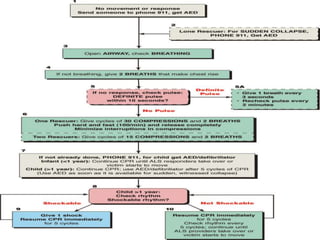
Check for responseTocheck for response, tap the victim on the shoulder and ask, “Are you all right?”.
8.
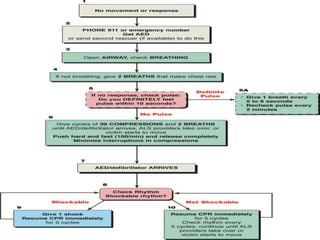
Activate the EMSIfa lone rescuer finds an unresponsive adult (ie, no movement or response to stimulation), the rescuer should activate the EMS system, get an AED (if available), and return to the victim to provide CPR and defibrillation if needed.
9.
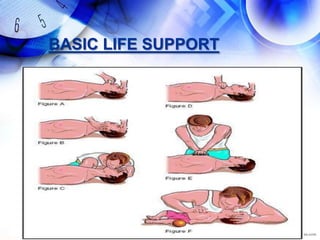
Open the Airwayand Check Breathinghead tilt– chin lift maneuversuspects a cervical spine injury open the airway using a jaw thrust without head extension fails use a head tilt–chin lift maneuver if the jaw thrust does not open the airway
Give rescue breathsIfyou do not detect adequate breathing within 10 seconds Give 2 rescue breaths, each over 1 second, with enough volume to produce visible chest rise.
12.
Pulse checkshould takeno more than 10 seconds to check for a pulseRescue Breathing Without Chest CompressionsIf an adult victim with spontaneous circulation (ie, palpable pulses) requires support of ventilation, give rescue breaths at a rate of 10 to 12 breaths per minute, or about 1 breath every 5 to 6 seconds
13.
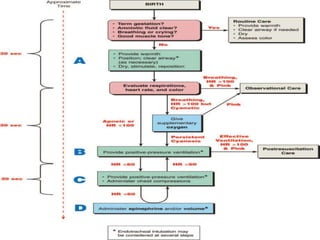
CPRIn victims ofVF SCA, chest compressions increase the likelihood that a shock (ie, attempted defibrillation) will be successful. Chest compressions are especially important if the first shock is delivered 4 minutes after collapseGive CPR ( about 5 cycles or about 2 minutes) A compression-ventilation ratio of 30:2 is recommendedIn infants and children,2 rescuers should use a ratio of 15:2
14.
CPROne cycle ofCPR consists of 30 compressions and 2 breaths. When compressions are delivered at a rate of about 100 per minute, 5 cycles of CPR should take roughly 2 minutes (range: about 11⁄2 to 3 minutes)
15.
Later…..When an advancedairway is in place [ETT/LMA/COMBITUBE]the compressing rescuer should give continuous chest compressions at a rate of 100 per minute without pauses for ventilation. The rescuer delivering ventilation provides 8 to10 breaths per minute.
16.
PUSH HARD ANDFASTFAST100 compressions per minute, HARD with a compression depth of 11⁄2 to 2 inches (approximately 4 to 5 cm). Allow the chest to recoil completely after each compression, and allow approximately equal compression and relaxation timesMinimize interruptions[Ideally, compression should be interrupted only for ventilation (until an advanced airway is placed), rhythm check, or shock delivery].
17.
Techniquerescuer kneeling besidethe victim’s thorax.The rescuer should place the heel of the hand on the in the lower half of the victim’s sternum in the center (middle) of the chest between the nipples and then place the heel of the second hand on top of the first so that the hands are overlapped and parallel
18.
Breath Vs CompressionDuringthe first minutes of VF SCA diminished cardiac output more significant than a lack of oxygen in the blood.Both ventilations and compressions are important for victims of prolonged VF SCADuring CPR blood flow to the lungs is substantially reduced low Tv & RR will suffice (6-7ml/kg or 500 to 600 mL)Avoid delivering breaths that are too large or too forceful (gastric distension)
19.
Breath Vs CompressionRate>12 breaths per minute during CPRleads to increased intrathoracic pressure, impeding venous return to the heart during chest compressions diminished cardiac output decreased coronary and cerebral perfusion.
20.
oxygenO2 >40%, aminimum flow rate of 10 to 12 L/min when available. Ideally the bag should be attached to an oxygen reservoir to enable delivery of 100%oxygen.LMA and the esophageal-tracheal combitube are currently within the scope of BLS practice
21.
Keep your reserves…..The2 rescuers should change compressor and ventilator roles approximately every 2 minutes to prevent compressor fatigue and deterioration in quality and rate of chest compressions
22.
Also note…Lay rescuersshould continue CPR until an AED arrives/the victim begins to move/EMS personnel take over CPRpatients not be moved while CPR is in progress unless the patient is in a dangerous environment or is a trauma patient in need of surgical intervention.
23.
Defibrillation Early defibrillationis critical to survival from sudden cardiac arrest (SCA) for several reasons: (1) the most frequent initial rhythm in witnessed SCA is ventricular fibrillation (2)the treatment for VF is electrical defibrillation, (3) the probability of successful defibrillation diminishes rapidly over time(4) VF tends to deteriorate to asystolewithin a few minutes
24.
What it doesto heart…?defibrillation “stuns” the heart, briefly stopping VF and other cardiac electrical activity
25.
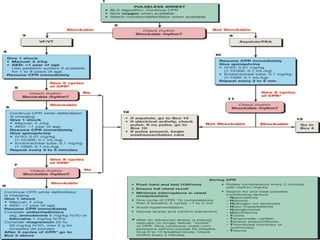
1 shock followedby immediate CPRBiphasic high first dose efficacy1st fails=VF of low amplitude incremental benefit less for repeated shocksTermination of VF non perfusing rhythms Rx is CPR ; not another shock!Next step is not a rhythm check; but CPR x 5The goal is to minimize the time between chest compressions and shock delivery and between shock delivery and resumption of chest compressions(<15 sec)
26.
Energy selectionBiphasic truncatedexponential waveform150-200JBiphasic rectilinear120JMonophasic 360JChild (initial)2J/KgChild (subsequent)4J/Kg
27.
Also note..If aprovider is operating a manual biphasic defibrillator and is unaware of the effective dose range for that device to terminate VF, the rescuer may use a selected dose of 200 J for the first shock and an equal or higher dose for the second and subsequent shocksIf VF is initially terminated by a shock but then recurs later in the arrest, deliver subsequent shocks at the previously successful energy level.
28.
DefibrillationThere is noevidence that attempting to “defibrillate” asystoleis beneficial.It is difficult to justify any interruption in chest compressions to attempt shock delivery for asystole.
29.
Don’t give up!Inthe first few minutes after successful defibrillation, asystoleor bradycardia may be present and the heart may pump ineffectively.Therefore, CPR may be needed for several minutes following defibrillation until adequate perfusion is present.
30.
WHICH FIRST?There isinsufficient evidence to support or refute CPR before defibrillation for in-hospital cardiac arrestOut of hospital witnessed SCA AED firstOut-of-hospital cardiac arrest is not witnessed give about 5 cycles of CPR before checking the ECG rhythm and attempting defibrillation
31.
Whats AED?Lay rescuerscan be trained to use a computerized device called an AED to analyze the victim’s rhythm and deliver a shock if the victim has VF or rapid VT.The AED uses audio and visual prompts to guide the rescuer.extremely accuratecpr\YouTube - High-quality CPR and AED.flv
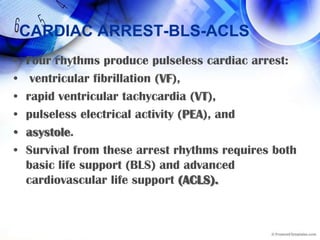
CARDIAC ARREST-BLS-ACLSFour rhythmsproduce pulseless cardiac arrest: ventricular fibrillation (VF), rapid ventricular tachycardia (VT),pulselesselectrical activity (PEA), and asystole. Survival from these arrest rhythms requires both basic life support (BLS) and advanced cardiovascular life support (ACLS).
ACCESS tocirculationperipheral venous routebolusinjection andfollowwith a 20-mL bolus of IV fluid. Intraosseous (IO) cannulation provides access to a noncollapsiblevenous plexusspontaneous circulation does not returncentral lineEndotracheal route2 - 2 ½ times iv dose dilute the recommended dose in 5 to 10 mL of water or normal saline
VF/VTDRUGSIf VF/VT persistsafter delivery of 1 or 2 shocks plus CPR, give a vasopressor (epinephrine every 3 to 5 minutes during cardiac arrest; one dose of vasopressinmay replace either the first or second dose of epinephrineWhen VF/pulseless VT persists after 2 to 3 shocks plus CPR and administration of a vasopressor, consider administering an antiarrhythmic such as amiodarone[ if unavailablelignocaine]magnesium for torsades de pointes associated with a long QT interval
38.
Drugs when?Drug dosesshould be prepared before the rhythm check so they can be administered as soon as possible after the rhythm check,Do not interrupt CPR to give medicationsThe drug should be administered during CPR and as soon as possible after the rhythm is checked If a drug is administered immediately after the rhythm check (before or after the shock) it will be circulated by the CPR given before and after the shock.
39.
Tips…perfusing rhythm istransiently restored but not successfully maintained early treatment with antiarrhythmicsshorter the time between chest compression and shock delivery, the more likely the shock will be successful
40.
PEA and ASYSTOLEPEA:pseudo-electromechanicaldissociation(pseudo-EMD), idioventricular rhythms, ventricular escape rhythms, postdefibrillationidioventricular rhythms, and bradyasystolic rhythms.Too weak contractions to produce a BP detectable with NIBPoften caused by reversible conditionsThe survival rate from cardiac arrest with asystoleis dismal.similarity in causes and management
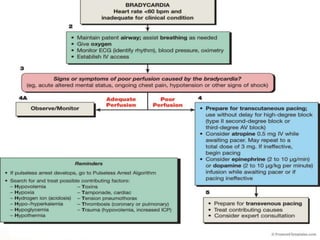
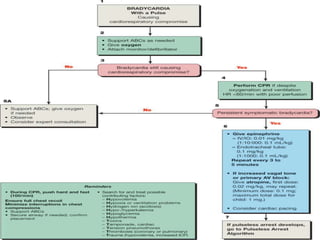
BRADYCARDIAATROPINE :dose forbradycardia is 0.5 mg IV every 3 to 5 minutes to a maximum total dose of 3 mg.Doses of atropine of 0.5 mg may paradoxically result in further slowing of the heart rate.EPINEPHRINE :Begin the infusion at 2 to 10 g/min and titrate to patient responseDOPAMINE :2 to 10 g/kg per minute)
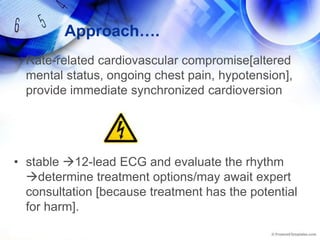
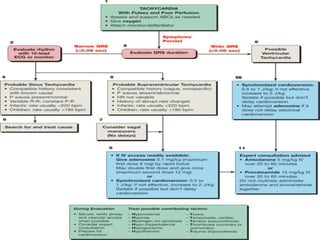
Approach….Rate-related cardiovascular compromise[alteredmental status, ongoing chest pain, hypotension], provide immediate synchronized cardioversionstable 12-lead ECG and evaluate the rhythm determine treatment options/may await expert consultation [because treatment has the potential for harm].
49.
Synchronized Cardioversionsynchronized withthe QRS complex avoids shock delivery during the relative refractory period of the cardiac cycleLow-energyshocks should always be delivered as synchronized shocks because delivery of low energy unsynchronized shocks is likely to induce VF.If cardioversionneeded,but cant synchronize give high energy unsynchronized shock
50.
CARDIOVERSION- indications(1)unstable SVTdue to reentry, (2) unstable atrial fibrillation,(3) unstable atrial flutter.(4) unstable monomorphic VTadminister sedation if the patient is consciousDon’t delay it…..
51.
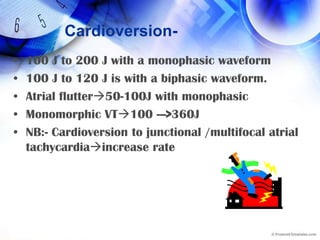
Cardioversion- 100 Jto 200 J with a monophasicwaveform100 J to 120 J is with a biphasic waveform.Atrial flutter50-100J with monophasicMonomorphic VT100 --->360JNB:- Cardioversion to junctional /multifocal atrialtachycardiaincrease rate