Advanced Life Support
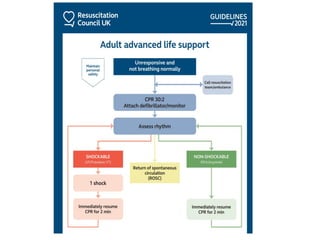
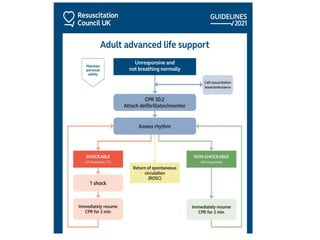
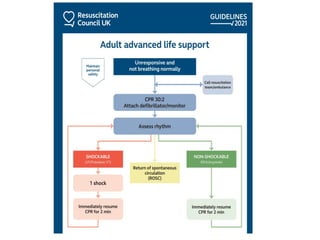
ALS Algorithm
Learning outcomes
• The ALS algorithm
• Importance of high quality chest compressions
• Treatment of shockable and non-shockable rhythms
• Administration of drugs during cardiac arrest
• Potentially reversible causes of cardiac arrest
• Role of resuscitation team
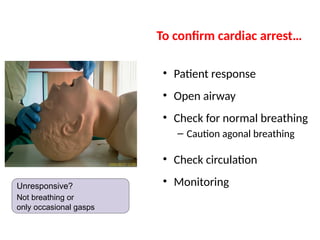
• Patient response
• Open airway
• Check for normal breathing
– Caution agonal breathing
• Check circulation
• Monitoring
To confirm cardiac arrest…
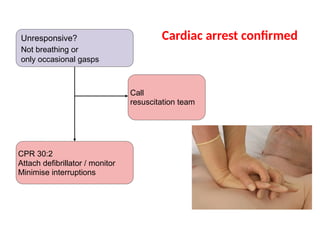
Unresponsive?
Not breathing or
only occasional gasps
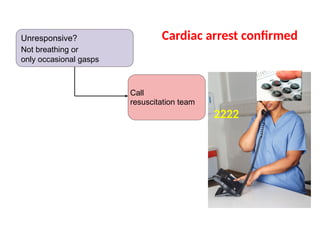
Cardiac arrest confirmed
2222
Unresponsive?
Not breathing or
only occasional gasps
Call
resuscitation team
Cardiac arrest confirmed
Unresponsive?
Not breathing or
only occasional gasps
Call
resuscitation team
CPR 30:2
Attach defibrillator / monitor
Minimise interruptions
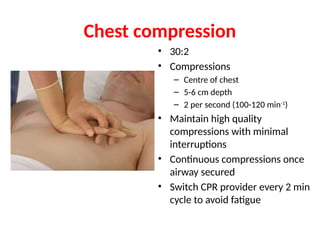
Chest compression
• 30:2
• Compressions
– Centre of chest
– 5-6 cm depth
– 2 per second (100-120 min-1
)
• Maintain high quality
compressions with minimal
interruptions
• Continuous compressions once
airway secured
• Switch CPR provider every 2 min
cycle to avoid fatigue
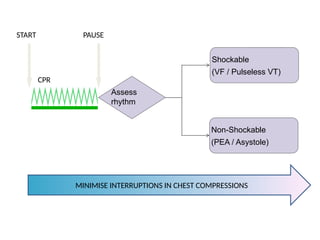
Shockable and Non-Shockable
MINIMISE INTERRUPTIONS IN CHEST COMPRESSIONS
START PAUSE
Assess
rhythm
Shockable
(VF / Pulseless VT)
Non-Shockable
(PEA / Asystole)
CPR
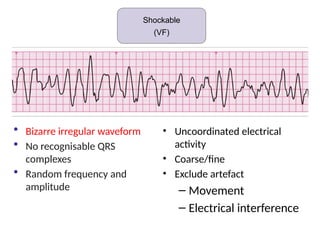
• Uncoordinated electrical
activity
• Coarse/fine
• Exclude artefact
– Movement
– Electrical interference
Shockable (VF)
Shockable
(VF)
• Bizarre irregular waveform
• No recognisable QRS
complexes
• Random frequency and
amplitude
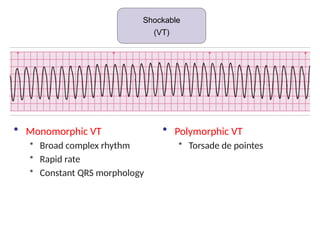
Shockable (VT)
Shockable
(VT)
• Polymorphic VT
• Torsade de pointes
• Monomorphic VT
• Broad complex rhythm
• Rapid rate
• Constant QRS morphology
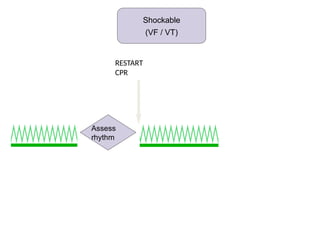
Shockable (VF / VT)
RESTART
CPR
Assess
rhythm
Shockable
(VF / VT)
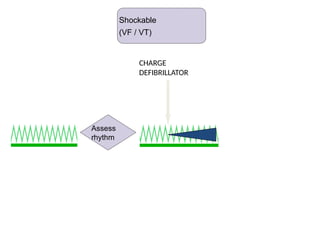
Shockable (VT)
CHARGE
DEFIBRILLATOR
Assess
rhythm
Shockable
(VF / VT)
Shockable (VF / VT)
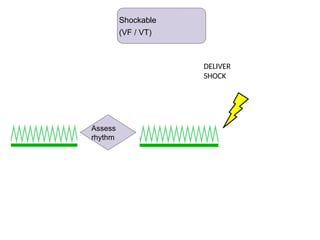
DELIVER
SHOCK
Assess
rhythm
Shockable
(VF / VT)
Shockable (VF / VT)
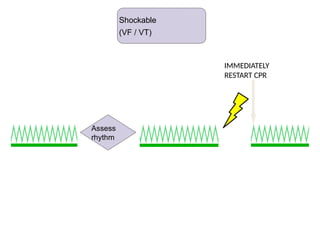
IMMEDIATELY
RESTART CPR
Assess
rhythm
Shockable
(VF / VT)
Shockable (VF / VT)
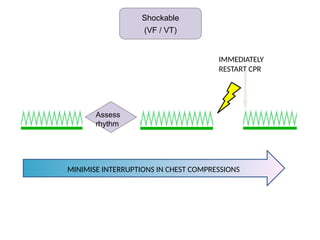
MINIMISE INTERRUPTIONS IN CHEST COMPRESSIONS
Assess
rhythm
Shockable
(VF / VT)
IMMEDIATELY
RESTART CPR
MINIMISE INTERRUPTIONS IN CHEST COMPRESSIONS
• Vary with manufacturer
• Check local equipment
• If unsure, deliver highest available energy
• DO NOT DELAY SHOCK
• Energy levels for defibrillators on this course…
Defibrillation energies
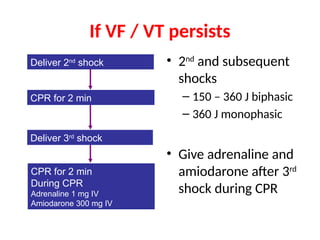
• 2nd
and subsequent
shocks
– 150 – 360 J biphasic
– 360 J monophasic
• Give adrenaline and
amiodarone after 3rd
shock during CPR
If VF / VT persists
CPR for 2 min
CPR for 2 min
During CPR
Adrenaline 1 mg IV
Amiodarone 300 mg IV
Deliver 2nd
shock
Deliver 3rd
shock
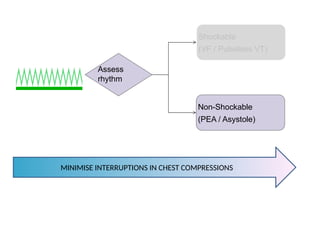
Non-Shockable
Assess
rhythm
Shockable
(VF / Pulseless VT)
Non-Shockable
(PEA / Asystole)
MINIMISE INTERRUPTIONS IN CHEST COMPRESSIONS
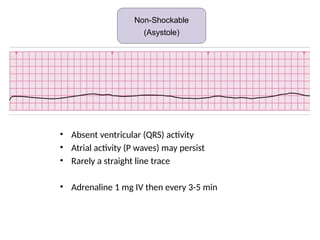
• Absent ventricular (QRS) activity
• Atrial activity (P waves) may persist
• Rarely a straight line trace
• Adrenaline 1 mg IV then every 3-5 min
Non-shockable (Asystole)
Non-Shockable
(Asystole)
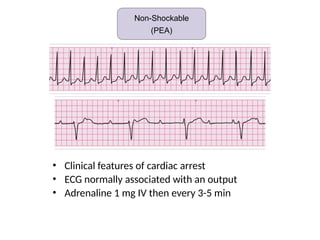
• Clinical features of cardiac arrest
• ECG normally associated with an output
• Adrenaline 1 mg IV then every 3-5 min
Non-shockable (Asystole)
Non-Shockable
(PEA)
During CPR
During CPR
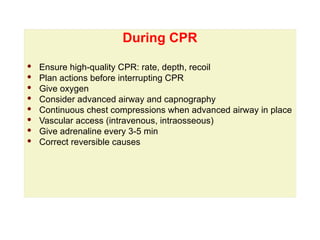
· Ensure high-quality CPR: rate, depth, recoil
· Plan actions before interrupting CPR
· Give oxygen
· Consider advanced airway and capnography
· Continuous chest compressions when advanced airway in place
· Vascular access (intravenous, intraosseous)
· Give adrenaline every 3-5 min
· Correct reversible causes
Airway and ventilation
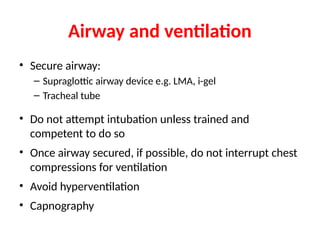
• Secure airway:
– Supraglottic airway device e.g. LMA, i-gel
– Tracheal tube
• Do not attempt intubation unless trained and
competent to do so
• Once airway secured, if possible, do not interrupt chest
compressions for ventilation
• Avoid hyperventilation
• Capnography
Vascular access
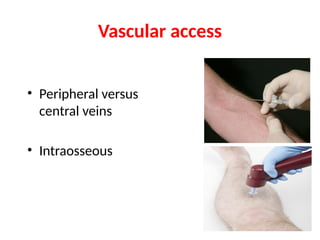
• Peripheral versus
central veins
• Intraosseous
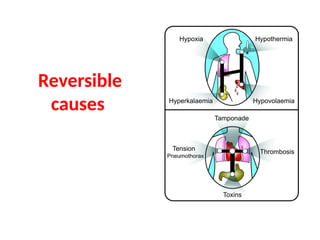
Reversible
causes
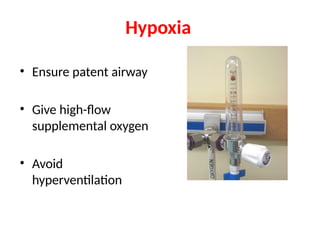
Hypoxia
• Ensure patent airway
• Give high-flow
supplemental oxygen
• Avoid
hyperventilation
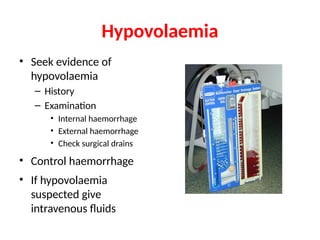
Hypovolaemia
• Seek evidence of
hypovolaemia
– History
– Examination
• Internal haemorrhage
• External haemorrhage
• Check surgical drains
• Control haemorrhage
• If hypovolaemia
suspected give
intravenous fluids
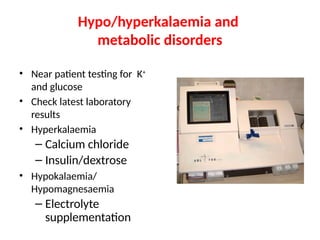
Hypo/hyperkalaemia and
metabolic disorders
• Near patient testing for K+
and glucose
• Check latest laboratory
results
• Hyperkalaemia
– Calcium chloride
– Insulin/dextrose
• Hypokalaemia/
Hypomagnesaemia
– Electrolyte
supplementation
Hypothermia
• Rare if patient is an
in-patient
• Use low reading
thermometer
• Treat with active
rewarming techniques
• Consider
cardiopulmonary
bypass
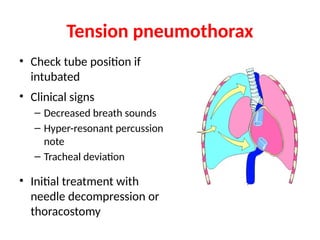
Tension pneumothorax
• Check tube position if
intubated
• Clinical signs
– Decreased breath sounds
– Hyper-resonant percussion
note
– Tracheal deviation
• Initial treatment with
needle decompression or
thoracostomy
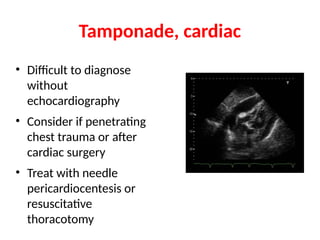
Tamponade, cardiac
• Difficult to diagnose
without
echocardiography
• Consider if penetrating
chest trauma or after
cardiac surgery
• Treat with needle
pericardiocentesis or
resuscitative
thoracotomy
Toxins
• Rare unless evidence
of deliberate overdose
• Review drug chart
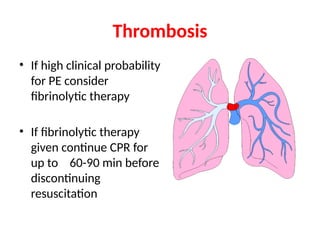
Thrombosis
• If high clinical probability
for PE consider
fibrinolytic therapy
• If fibrinolytic therapy
given continue CPR for
up to 60-90 min before
discontinuing
resuscitation
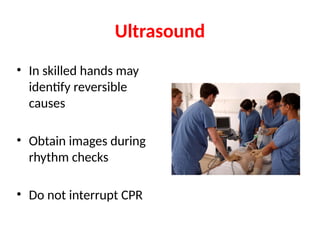
Ultrasound
• In skilled hands may
identify reversible
causes
• Obtain images during
rhythm checks
• Do not interrupt CPR
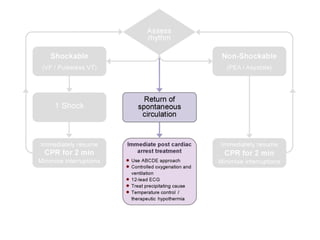
Immediate post-cardiac arrest treatment
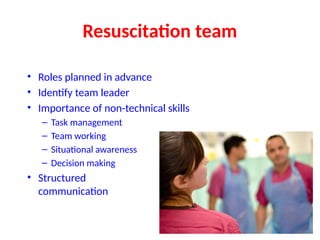
Resuscitation team
• Roles planned in advance
• Identify team leader
• Importance of non-technical skills
– Task management
– Team working
– Situational awareness
– Decision making
• Structured
communication
Any questions?
• The ALS algorithm
• Importance of high quality chest compressions
• Treatment of shockable and non-shockable
rhythms
• Administration of drugs during cardiac arrest
• Potentially reversible causes of cardiac arrest
• Role of resuscitation team
Summary
Advanced Life Support Course
Slide set

ALS cardiac arrest algorithm and legal.pptx

  • 1.
  • 2.
    Learning outcomes • TheALS algorithm • Importance of high quality chest compressions • Treatment of shockable and non-shockable rhythms • Administration of drugs during cardiac arrest • Potentially reversible causes of cardiac arrest • Role of resuscitation team
  • 4.
    • Patient response •Open airway • Check for normal breathing – Caution agonal breathing • Check circulation • Monitoring To confirm cardiac arrest… Unresponsive? Not breathing or only occasional gasps
  • 5.
    Cardiac arrest confirmed 2222 Unresponsive? Notbreathing or only occasional gasps Call resuscitation team
  • 6.
    Cardiac arrest confirmed Unresponsive? Notbreathing or only occasional gasps Call resuscitation team CPR 30:2 Attach defibrillator / monitor Minimise interruptions
  • 7.
    Chest compression • 30:2 •Compressions – Centre of chest – 5-6 cm depth – 2 per second (100-120 min-1 ) • Maintain high quality compressions with minimal interruptions • Continuous compressions once airway secured • Switch CPR provider every 2 min cycle to avoid fatigue
  • 8.
    Shockable and Non-Shockable MINIMISEINTERRUPTIONS IN CHEST COMPRESSIONS START PAUSE Assess rhythm Shockable (VF / Pulseless VT) Non-Shockable (PEA / Asystole) CPR
  • 10.
    • Uncoordinated electrical activity •Coarse/fine • Exclude artefact – Movement – Electrical interference Shockable (VF) Shockable (VF) • Bizarre irregular waveform • No recognisable QRS complexes • Random frequency and amplitude
  • 11.
    Shockable (VT) Shockable (VT) • PolymorphicVT • Torsade de pointes • Monomorphic VT • Broad complex rhythm • Rapid rate • Constant QRS morphology
  • 12.
    Shockable (VF /VT) RESTART CPR Assess rhythm Shockable (VF / VT)
  • 13.
  • 14.
    Shockable (VF /VT) DELIVER SHOCK Assess rhythm Shockable (VF / VT)
  • 15.
    Shockable (VF /VT) IMMEDIATELY RESTART CPR Assess rhythm Shockable (VF / VT)
  • 16.
    Shockable (VF /VT) MINIMISE INTERRUPTIONS IN CHEST COMPRESSIONS Assess rhythm Shockable (VF / VT) IMMEDIATELY RESTART CPR MINIMISE INTERRUPTIONS IN CHEST COMPRESSIONS
  • 17.
    • Vary withmanufacturer • Check local equipment • If unsure, deliver highest available energy • DO NOT DELAY SHOCK • Energy levels for defibrillators on this course… Defibrillation energies
  • 18.
    • 2nd and subsequent shocks –150 – 360 J biphasic – 360 J monophasic • Give adrenaline and amiodarone after 3rd shock during CPR If VF / VT persists CPR for 2 min CPR for 2 min During CPR Adrenaline 1 mg IV Amiodarone 300 mg IV Deliver 2nd shock Deliver 3rd shock
  • 19.
    Non-Shockable Assess rhythm Shockable (VF / PulselessVT) Non-Shockable (PEA / Asystole) MINIMISE INTERRUPTIONS IN CHEST COMPRESSIONS
  • 20.
    • Absent ventricular(QRS) activity • Atrial activity (P waves) may persist • Rarely a straight line trace • Adrenaline 1 mg IV then every 3-5 min Non-shockable (Asystole) Non-Shockable (Asystole)
  • 21.
    • Clinical featuresof cardiac arrest • ECG normally associated with an output • Adrenaline 1 mg IV then every 3-5 min Non-shockable (Asystole) Non-Shockable (PEA)
  • 23.
    During CPR During CPR ·Ensure high-quality CPR: rate, depth, recoil · Plan actions before interrupting CPR · Give oxygen · Consider advanced airway and capnography · Continuous chest compressions when advanced airway in place · Vascular access (intravenous, intraosseous) · Give adrenaline every 3-5 min · Correct reversible causes
  • 24.
    Airway and ventilation •Secure airway: – Supraglottic airway device e.g. LMA, i-gel – Tracheal tube • Do not attempt intubation unless trained and competent to do so • Once airway secured, if possible, do not interrupt chest compressions for ventilation • Avoid hyperventilation • Capnography
  • 25.
    Vascular access • Peripheralversus central veins • Intraosseous
  • 26.
  • 27.
    Hypoxia • Ensure patentairway • Give high-flow supplemental oxygen • Avoid hyperventilation
  • 28.
    Hypovolaemia • Seek evidenceof hypovolaemia – History – Examination • Internal haemorrhage • External haemorrhage • Check surgical drains • Control haemorrhage • If hypovolaemia suspected give intravenous fluids
  • 29.
    Hypo/hyperkalaemia and metabolic disorders •Near patient testing for K+ and glucose • Check latest laboratory results • Hyperkalaemia – Calcium chloride – Insulin/dextrose • Hypokalaemia/ Hypomagnesaemia – Electrolyte supplementation
  • 30.
    Hypothermia • Rare ifpatient is an in-patient • Use low reading thermometer • Treat with active rewarming techniques • Consider cardiopulmonary bypass
  • 31.
    Tension pneumothorax • Checktube position if intubated • Clinical signs – Decreased breath sounds – Hyper-resonant percussion note – Tracheal deviation • Initial treatment with needle decompression or thoracostomy
  • 32.
    Tamponade, cardiac • Difficultto diagnose without echocardiography • Consider if penetrating chest trauma or after cardiac surgery • Treat with needle pericardiocentesis or resuscitative thoracotomy
  • 33.
    Toxins • Rare unlessevidence of deliberate overdose • Review drug chart
  • 34.
    Thrombosis • If highclinical probability for PE consider fibrinolytic therapy • If fibrinolytic therapy given continue CPR for up to 60-90 min before discontinuing resuscitation
  • 35.
    Ultrasound • In skilledhands may identify reversible causes • Obtain images during rhythm checks • Do not interrupt CPR
  • 36.
  • 37.
    Resuscitation team • Rolesplanned in advance • Identify team leader • Importance of non-technical skills – Task management – Team working – Situational awareness – Decision making • Structured communication
  • 38.
  • 39.
    • The ALSalgorithm • Importance of high quality chest compressions • Treatment of shockable and non-shockable rhythms • Administration of drugs during cardiac arrest • Potentially reversible causes of cardiac arrest • Role of resuscitation team Summary

  • 40.
    Advanced Life SupportCourse Slide set

Editor's Notes