S OCIOLINGUISTICS ,
ORIGINS AND
DEFINITIONS


This document explains how and when sociolinguistic become an
important area of the language field in relation with society.


Eduardo Hernández Rangel
29/08/2009
29-8-2009


SOCIOLINGUISTICS, ORIGINS AND
DEFINITIONS

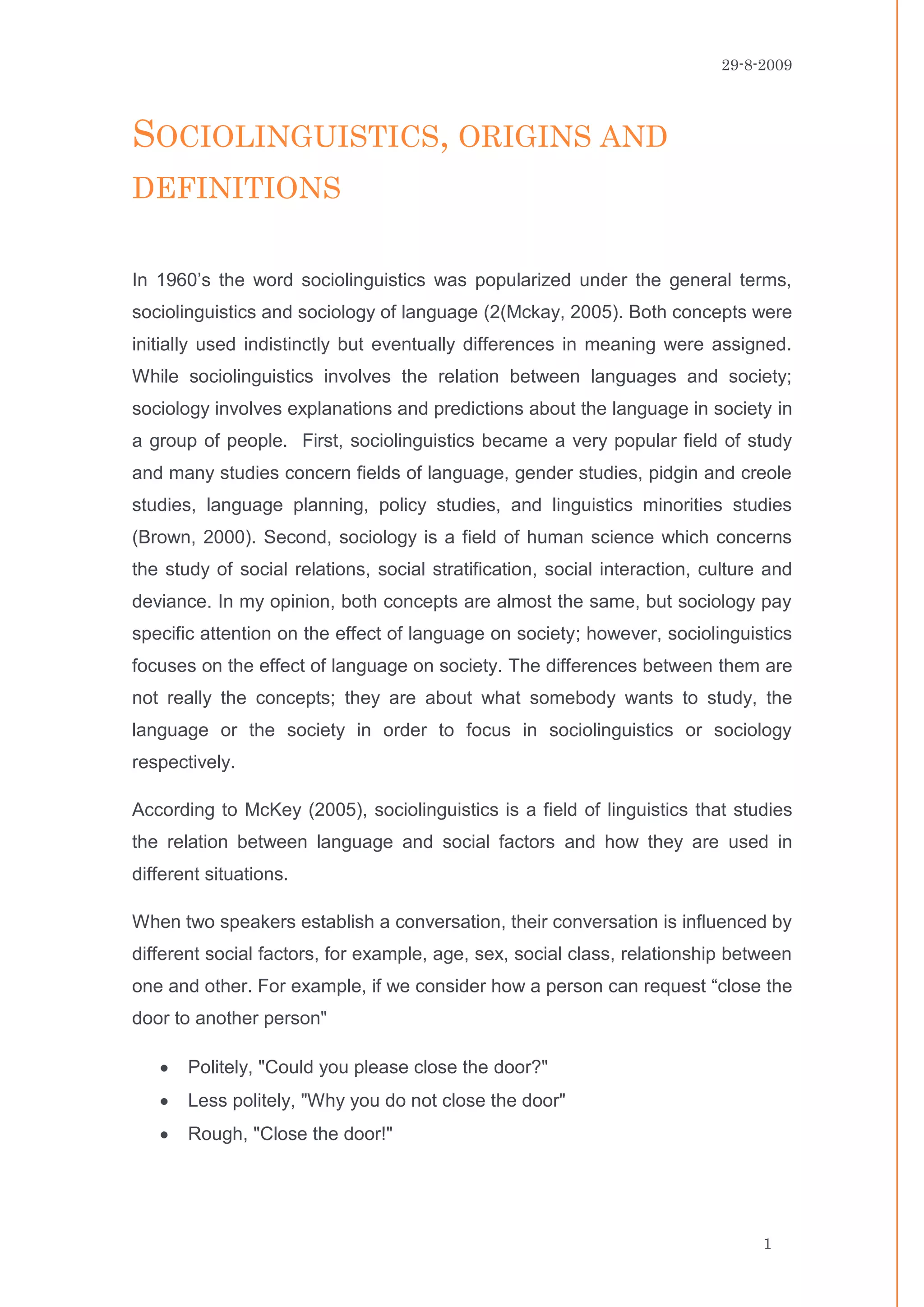
In 1960’s the word sociolinguistics was popularized under the general terms,
sociolinguistics and sociology of language (2(Mckay, 2005). Both concepts were
initially used indistinctly but eventually differences in meaning were assigned.
While sociolinguistics involves the relation between languages and society;
sociology involves explanations and predictions about the language in society in
a group of people. First, sociolinguistics became a very popular field of study
and many studies concern fields of language, gender studies, pidgin and creole
studies, language planning, policy studies, and linguistics minorities studies
(Brown, 2000). Second, sociology is a field of human science which concerns
the study of social relations, social stratification, social interaction, culture and
deviance. In my opinion, both concepts are almost the same, but sociology pay
specific attention on the effect of language on society; however, sociolinguistics
focuses on the effect of language on society. The differences between them are
not really the concepts; they are about what somebody wants to study, the
language or the society in order to focus in sociolinguistics or sociology
respectively.

According to McKey (2005), sociolinguistics is a field of linguistics that studies
the relation between language and social factors and how they are used in
different situations.

When two speakers establish a conversation, their conversation is influenced by
different social factors, for example, age, sex, social class, relationship between
one and other. For example, if we consider how a person can request “close the
door to another person"

       Politely, "Could you please close the door?"
       Less politely, "Why you do not close the door"
       Rough, "Close the door!"


                                                                                 1
29-8-2009


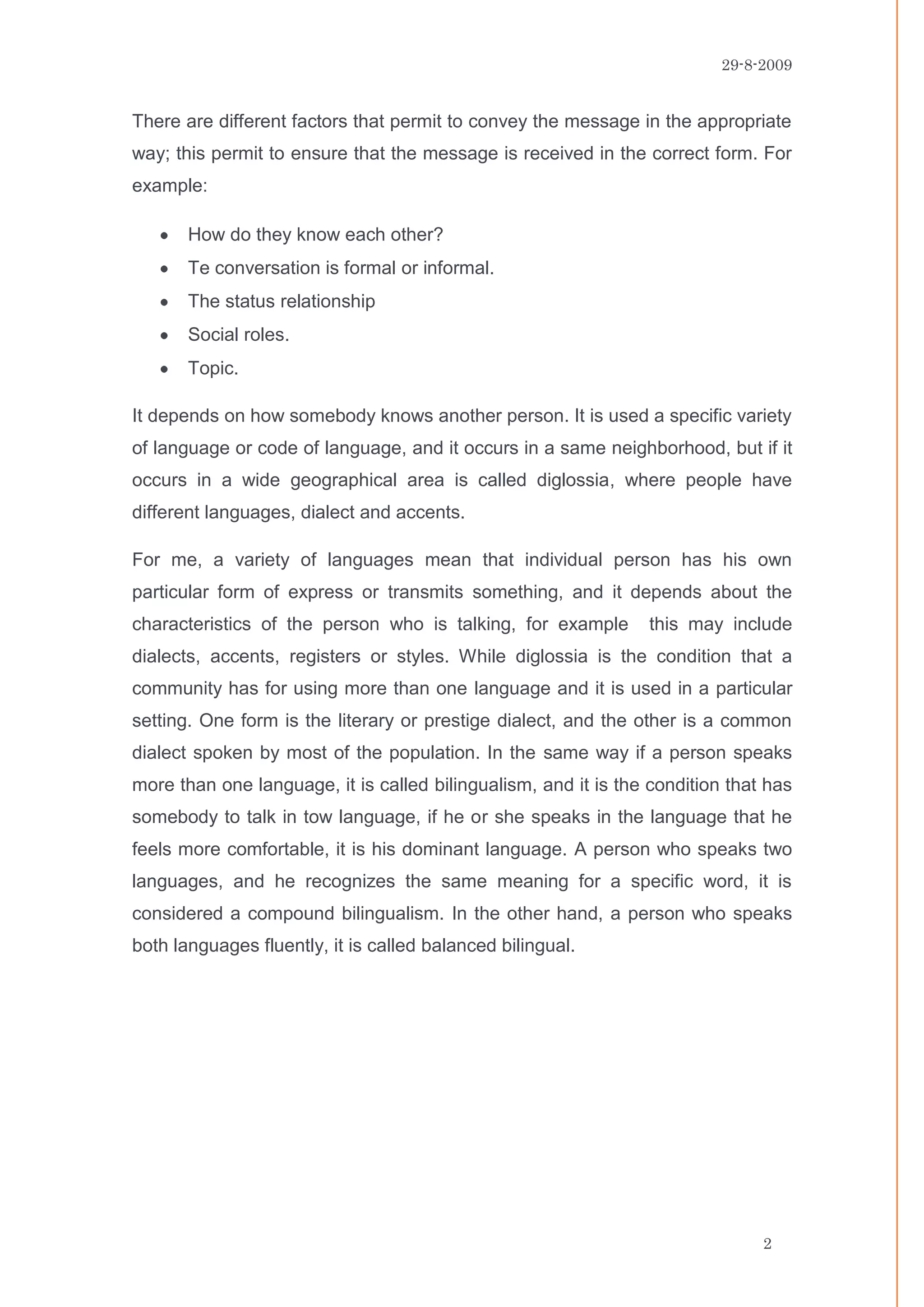
There are different factors that permit to convey the message in the appropriate
way; this permit to ensure that the message is received in the correct form. For
example:

       How do they know each other?
       Te conversation is formal or informal.
       The status relationship
       Social roles.
       Topic.

It depends on how somebody knows another person. It is used a specific variety
of language or code of language, and it occurs in a same neighborhood, but if it
occurs in a wide geographical area is called diglossia, where people have
different languages, dialect and accents.

For me, a variety of languages mean that individual person has his own
particular form of express or transmits something, and it depends about the
characteristics of the person who is talking, for example        this may include
dialects, accents, registers or styles. While diglossia is the condition that a
community has for using more than one language and it is used in a particular
setting. One form is the literary or prestige dialect, and the other is a common
dialect spoken by most of the population. In the same way if a person speaks
more than one language, it is called bilingualism, and it is the condition that has
somebody to talk in tow language, if he or she speaks in the language that he
feels more comfortable, it is his dominant language. A person who speaks two
languages, and he recognizes the same meaning for a specific word, it is
considered a compound bilingualism. In the other hand, a person who speaks
both languages fluently, it is called balanced bilingual.


                                                                               2
29-8-2009


BIBLIOGRAPHY
Brown, S. a. (2000). Understanding language, structre, interaccion, and
variation. Michigan: University of Michigan Press.

Mckay, S. L. (2005). Handbook of Research in Second Language Teaching and
Learning. Mahwah, New Jersey: Lawrence Erlbaum Associates.

Romaine, S. (1994). Language in Society: An Introduction to Sociolinguistics.
Oxford: Oxford University Press.


                                                                               3

Sociolinguistics origins and definitions

  • 1.
    S OCIOLINGUISTICS , ORIGINSAND DEFINITIONS This document explains how and when sociolinguistic become an important area of the language field in relation with society. Eduardo Hernández Rangel 29/08/2009
  • 2.
    29-8-2009 SOCIOLINGUISTICS, ORIGINS AND DEFINITIONS In1960’s the word sociolinguistics was popularized under the general terms, sociolinguistics and sociology of language (2(Mckay, 2005). Both concepts were initially used indistinctly but eventually differences in meaning were assigned. While sociolinguistics involves the relation between languages and society; sociology involves explanations and predictions about the language in society in a group of people. First, sociolinguistics became a very popular field of study and many studies concern fields of language, gender studies, pidgin and creole studies, language planning, policy studies, and linguistics minorities studies (Brown, 2000). Second, sociology is a field of human science which concerns the study of social relations, social stratification, social interaction, culture and deviance. In my opinion, both concepts are almost the same, but sociology pay specific attention on the effect of language on society; however, sociolinguistics focuses on the effect of language on society. The differences between them are not really the concepts; they are about what somebody wants to study, the language or the society in order to focus in sociolinguistics or sociology respectively. According to McKey (2005), sociolinguistics is a field of linguistics that studies the relation between language and social factors and how they are used in different situations. When two speakers establish a conversation, their conversation is influenced by different social factors, for example, age, sex, social class, relationship between one and other. For example, if we consider how a person can request “close the door to another person" Politely, "Could you please close the door?" Less politely, "Why you do not close the door" Rough, "Close the door!" 1
  • 3.
    29-8-2009 There are differentfactors that permit to convey the message in the appropriate way; this permit to ensure that the message is received in the correct form. For example: How do they know each other? Te conversation is formal or informal. The status relationship Social roles. Topic. It depends on how somebody knows another person. It is used a specific variety of language or code of language, and it occurs in a same neighborhood, but if it occurs in a wide geographical area is called diglossia, where people have different languages, dialect and accents. For me, a variety of languages mean that individual person has his own particular form of express or transmits something, and it depends about the characteristics of the person who is talking, for example this may include dialects, accents, registers or styles. While diglossia is the condition that a community has for using more than one language and it is used in a particular setting. One form is the literary or prestige dialect, and the other is a common dialect spoken by most of the population. In the same way if a person speaks more than one language, it is called bilingualism, and it is the condition that has somebody to talk in tow language, if he or she speaks in the language that he feels more comfortable, it is his dominant language. A person who speaks two languages, and he recognizes the same meaning for a specific word, it is considered a compound bilingualism. In the other hand, a person who speaks both languages fluently, it is called balanced bilingual. 2
  • 4.
    29-8-2009 BIBLIOGRAPHY Brown, S. a.(2000). Understanding language, structre, interaccion, and variation. Michigan: University of Michigan Press. Mckay, S. L. (2005). Handbook of Research in Second Language Teaching and Learning. Mahwah, New Jersey: Lawrence Erlbaum Associates. Romaine, S. (1994). Language in Society: An Introduction to Sociolinguistics. Oxford: Oxford University Press. 3