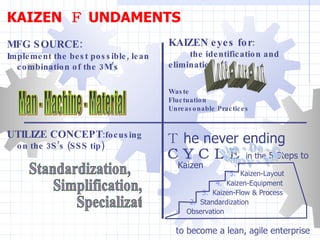
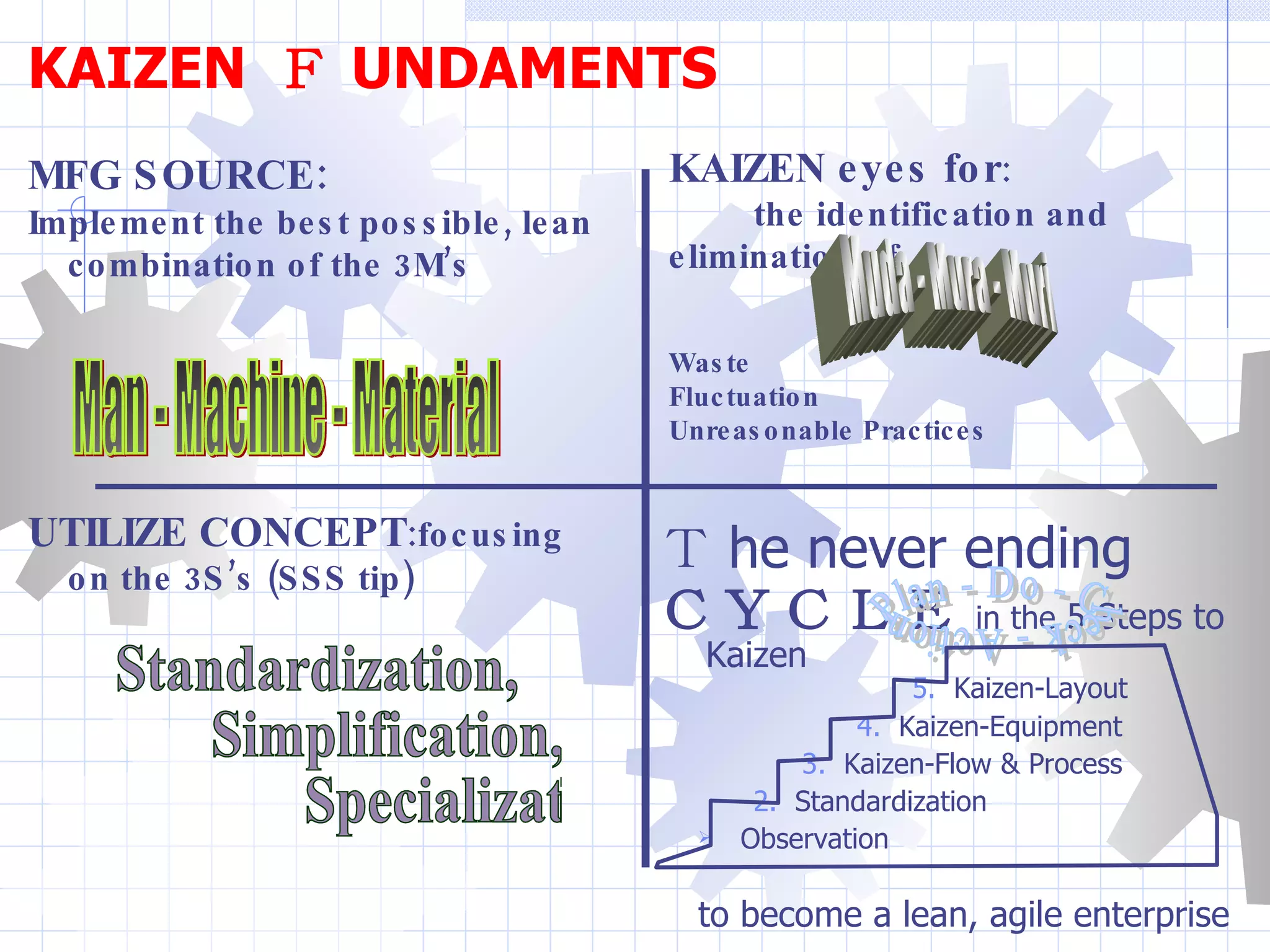
T he never ending  CYCLE in the  5 Steps to Kaizen   5.   Kaizen-Layout 4.   Kaizen-Equipment   3.   Kaizen-Flow & Process 2.   Standardization Observation to become a lean, agile enterprise KAIZEN  F UNDAMENTS KAIZEN eyes for :        the identification and     elimination of Waste  Fluctuation Unreasonable Practices Muda - Mura - Muri Plan - Do - Check - Action- Man - Machine - Material MFG SOURCE:   Implement the best possible, lean combination of the 3M’s UTILIZE CONCEPT :focusing on the 3S’s (SSS tip) Standardization, Simplification,  Specialization
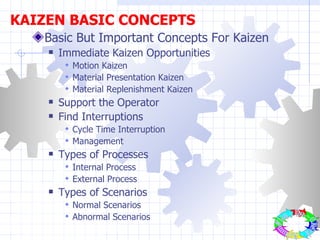
KAIZEN BASIC CONCEPTS Basic But Important Concepts For Kaizen Immediate Kaizen Opportunities Motion Kaizen Material Presentation Kaizen Material Replenishment Kaizen Support the Operator  Find Interruptions  Cycle Time Interruption Management Types of Processes Internal Process External Process Types of Scenarios Normal Scenarios Abnormal Scenarios Plan - Do - Check - Action-
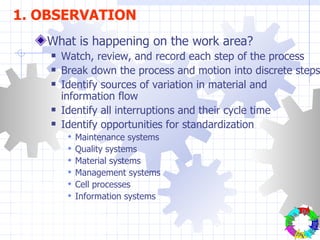
1. OBSERVATION What is happening on the work area? Watch, review, and record each step of the process Break down the process and motion into discrete steps Identify sources of variation in material and information flow Identify all interruptions and their cycle time Identify opportunities for standardization Maintenance systems Quality systems Material systems Management systems Cell processes Information systems Plan - Do - Check - Action-
1. OBSERVATION After an initial observation: Make a process “vision” for each department / area  Track progress using a map based on the 5 kaizen steps Observation – Standardization – Flow – Machine - Layout Plan - Do - Check - Action Review and plan on weekly basis Transfer ownership of lean implementation to area managers Increase overall employee participation in lean implementation Implement countermeasures  Why Standardization, Why Can not? Each activity, motion, method, or process is performed in the same manner,  every time It provides predictability and the values for measuring performance It provides the starting point for Kaizen activity It is everyone’s responsibility to perform but management’s responsibility to enforce Plan - Do - Check - Action-
Interruptions must be standardized and then eliminated, Interruptions are management issues, not operators’ issues Interruptions must be categorized as normal operating interruptions and extra ordinary interruptions Normal interruptions are cyclical and must have countermeasures developed to ensure the material flow continues material replenishment, preventive maintenance, operator support, work place organization, training, etc Management must support the operators and prevent interruptions 2. STANDARDIZATION Plan - Do - Check - Action-
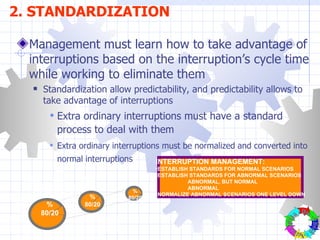
Management must learn how to take advantage of interruptions based on the interruption’s cycle time while working to eliminate them Standardization allow predictability, and predictability allows to take advantage of interruptions Extra ordinary interruptions must have a standard process to deal with them Extra ordinary interruptions must be normalized and converted into normal interruptions 2. STANDARDIZATION % 80/20 Plan - Do - Check - Action- INTERRUPTION MANAGEMENT: ESTABLISH STANDARDS FOR NORMAL SCENARIOS ESTABLISH STANDARDS FOR ABNORMAL SCENARIOS ABNORMAL, BUT NORMAL ABNORMAL NORMALIZE ABNORMAL SCENARIOS ONE LEVEL DOWN % 80/20 % 80/20 % 80/20
Flow & Process Kaizen Improve the material and information flow on or to the work area Re-balance and combine various parts of the baseline process (improve man/machine ratios) Improve all routes (scrap, audit, maintenance, material, rejects) in order to support the operator and the process 3.   KAIZEN-FLOW   & PROCESS Plan - Do - Check - Action-
Equipment /  Tooling / Machine Kaizen All improvements should support the operator Improve fixture placement and / or fixture design Improve machine cycle times Simplify machines and shrink tables / stands Group but do not combine process steps Standardize and simplify health & safety protection devices 4. KAIZEN-EQUIPMENT   Plan - Do - Check - Action-
(Cell) Layout Kaizen Improve the Man-Machine-Material ratios through changes to the overall layout of the cell Scope can be simple rearrangement or complete cell shape/flow re-design 5. KAIZEN-LAYOUT Plan - Do - Check - Action-
LEAN   IMPLEMENTATIO   THROUGH KAIZEN Implementation Method N Focus lean implementation efforts on the  Five Kaizen Steps Utilize standard approach and if necessary worksheets for the five steps Create a process layout “vision” for each work area (3-6 month period) Lean activities progress reviews Review and plan weekly lean activity by area Transfer ownership of lean implementation to area managers Increase overall employee participation in lean implementation Plan - Do - Check - Action-

5 Steps Kaizen

  • 1.
    T he neverending CYCLE in the 5 Steps to Kaizen 5. Kaizen-Layout 4. Kaizen-Equipment 3. Kaizen-Flow & Process 2. Standardization Observation to become a lean, agile enterprise KAIZEN F UNDAMENTS KAIZEN eyes for :        the identification and    elimination of Waste Fluctuation Unreasonable Practices Muda - Mura - Muri Plan - Do - Check - Action- Man - Machine - Material MFG SOURCE: Implement the best possible, lean combination of the 3M’s UTILIZE CONCEPT :focusing on the 3S’s (SSS tip) Standardization, Simplification, Specialization
  • 2.
    KAIZEN BASIC CONCEPTSBasic But Important Concepts For Kaizen Immediate Kaizen Opportunities Motion Kaizen Material Presentation Kaizen Material Replenishment Kaizen Support the Operator Find Interruptions Cycle Time Interruption Management Types of Processes Internal Process External Process Types of Scenarios Normal Scenarios Abnormal Scenarios Plan - Do - Check - Action-
  • 3.
    1. OBSERVATION Whatis happening on the work area? Watch, review, and record each step of the process Break down the process and motion into discrete steps Identify sources of variation in material and information flow Identify all interruptions and their cycle time Identify opportunities for standardization Maintenance systems Quality systems Material systems Management systems Cell processes Information systems Plan - Do - Check - Action-
  • 4.
    1. OBSERVATION Afteran initial observation: Make a process “vision” for each department / area Track progress using a map based on the 5 kaizen steps Observation – Standardization – Flow – Machine - Layout Plan - Do - Check - Action Review and plan on weekly basis Transfer ownership of lean implementation to area managers Increase overall employee participation in lean implementation Implement countermeasures Why Standardization, Why Can not? Each activity, motion, method, or process is performed in the same manner, every time It provides predictability and the values for measuring performance It provides the starting point for Kaizen activity It is everyone’s responsibility to perform but management’s responsibility to enforce Plan - Do - Check - Action-
  • 5.
    Interruptions must bestandardized and then eliminated, Interruptions are management issues, not operators’ issues Interruptions must be categorized as normal operating interruptions and extra ordinary interruptions Normal interruptions are cyclical and must have countermeasures developed to ensure the material flow continues material replenishment, preventive maintenance, operator support, work place organization, training, etc Management must support the operators and prevent interruptions 2. STANDARDIZATION Plan - Do - Check - Action-
  • 6.
    Management must learnhow to take advantage of interruptions based on the interruption’s cycle time while working to eliminate them Standardization allow predictability, and predictability allows to take advantage of interruptions Extra ordinary interruptions must have a standard process to deal with them Extra ordinary interruptions must be normalized and converted into normal interruptions 2. STANDARDIZATION % 80/20 Plan - Do - Check - Action- INTERRUPTION MANAGEMENT: ESTABLISH STANDARDS FOR NORMAL SCENARIOS ESTABLISH STANDARDS FOR ABNORMAL SCENARIOS ABNORMAL, BUT NORMAL ABNORMAL NORMALIZE ABNORMAL SCENARIOS ONE LEVEL DOWN % 80/20 % 80/20 % 80/20
  • 7.
    Flow & ProcessKaizen Improve the material and information flow on or to the work area Re-balance and combine various parts of the baseline process (improve man/machine ratios) Improve all routes (scrap, audit, maintenance, material, rejects) in order to support the operator and the process 3. KAIZEN-FLOW & PROCESS Plan - Do - Check - Action-
  • 8.
    Equipment / Tooling / Machine Kaizen All improvements should support the operator Improve fixture placement and / or fixture design Improve machine cycle times Simplify machines and shrink tables / stands Group but do not combine process steps Standardize and simplify health & safety protection devices 4. KAIZEN-EQUIPMENT Plan - Do - Check - Action-
  • 9.
    (Cell) Layout KaizenImprove the Man-Machine-Material ratios through changes to the overall layout of the cell Scope can be simple rearrangement or complete cell shape/flow re-design 5. KAIZEN-LAYOUT Plan - Do - Check - Action-
  • 10.
    LEAN IMPLEMENTATIO THROUGH KAIZEN Implementation Method N Focus lean implementation efforts on the Five Kaizen Steps Utilize standard approach and if necessary worksheets for the five steps Create a process layout “vision” for each work area (3-6 month period) Lean activities progress reviews Review and plan weekly lean activity by area Transfer ownership of lean implementation to area managers Increase overall employee participation in lean implementation Plan - Do - Check - Action-