KAIZEN 
PRESENTED BY- 
11BIE002 KARAN 
THAKKAR 
11BIE015 MOHIL RADIA 
11BIE025 RAJAT PATEL 
11BIE027 YAGNIK 
SAVALIYA 
11BIE031 RUSHABH
Introduction 
2 
 Masaaki Imai is known as the developer of 
KAIZEN. 
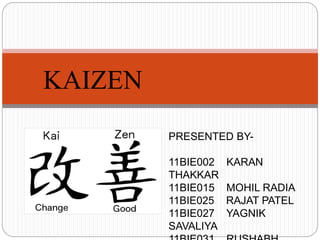
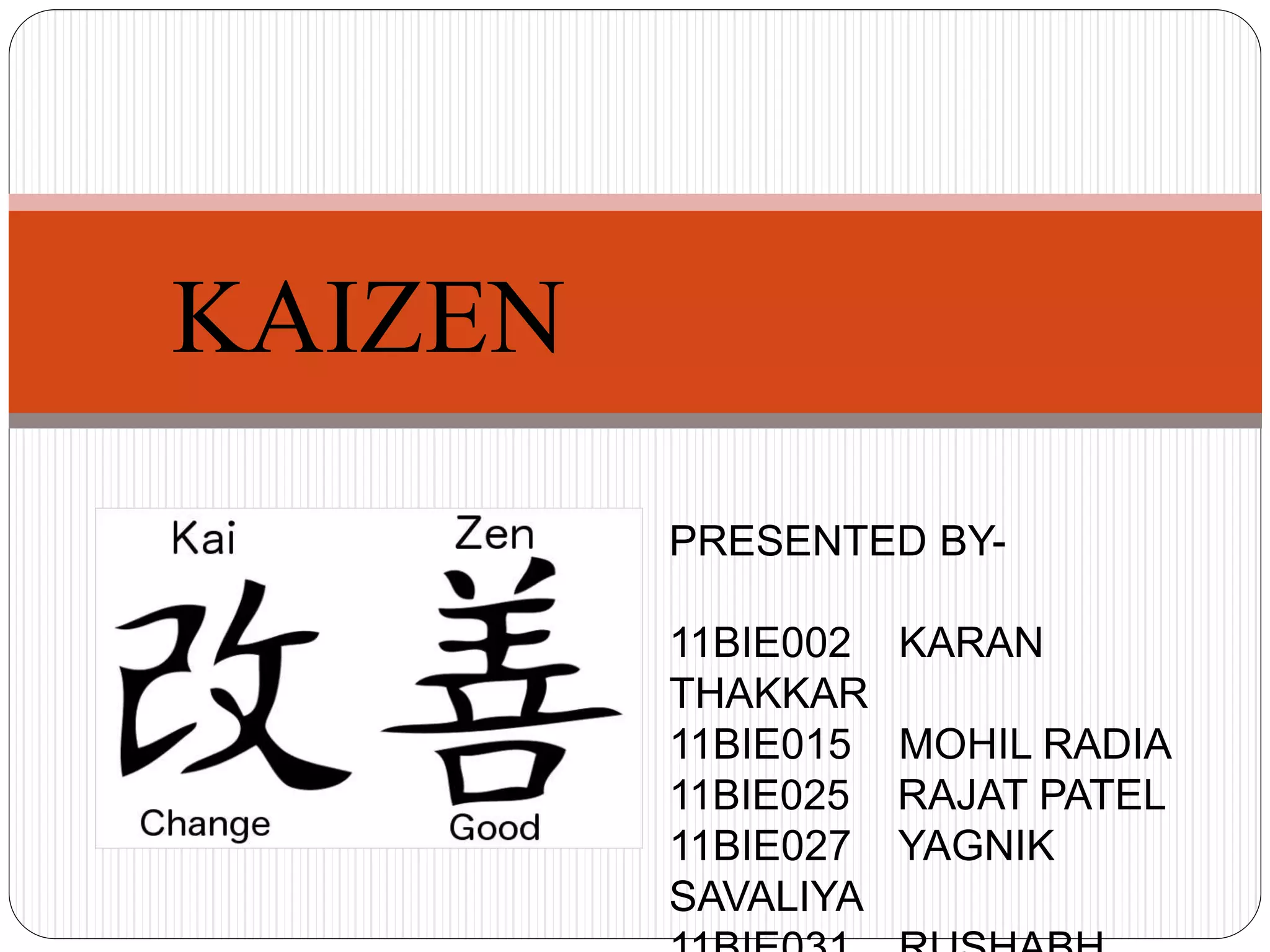
 ‘KAI’ means ‘Change or the action to correct’. 
 ‘ZEN’ means ‘Good’. 
 Kaizen is small incremental changes made for 
improving productivity and minimizing wastes.
3 Main Principles of KAIZEN 
3 
1. Consider the process and the results. 
2. The need to look at the entire process of the 
job at hand and to evaluate the job as to the 
best way to get the job done. 
3. Kaizen must be approached in such a way that 
no one is blamed and that best process is put 
into place.
Features Of Kaizen 
4 
 Widely applicable. 
 Highly effective and result oriented. 
 A learning experience. 
 Team based and cross-functional.
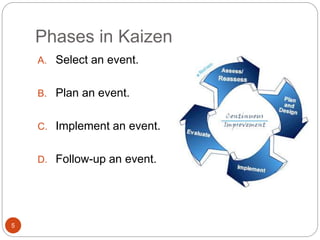
Phases in Kaizen 
5 
A. Select an event. 
B. Plan an event. 
C. Implement an event. 
D. Follow-up an event.
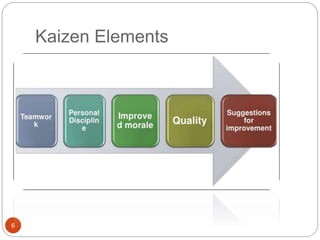
Kaizen Elements 
6
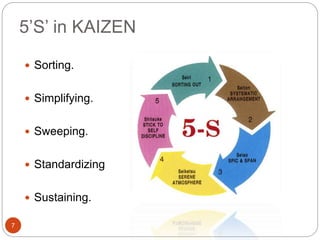
5’S’ in KAIZEN 
7 
 Sorting. 
 Simplifying. 
 Sweeping. 
 Standardizing 
 Sustaining.
Benefits Of Kaizen 
8 
 Kaizen reduces waste - like inventory waste, 
time waste and workers motion. 
 Kaizen improves space utilization and product 
quality. 
 Results in higher employee moral and job 
satisfaction. 
 Teaches workers how to solve everyday 
problems.
Implementation 
9 
The Toyota Production System is known for 
kaizen, where all line personnel are expected to 
stop their moving production line in case of any 
abnormality and, along with their supervisor, 
suggest an improvement to resolve the 
abnormality which may initiate a kaizen.
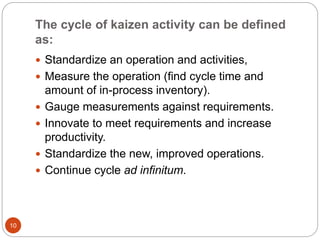
The cycle of kaizen activity can be defined 
as: 
10 
 Standardize an operation and activities, 
 Measure the operation (find cycle time and 
amount of in-process inventory). 
 Gauge measurements against requirements. 
 Innovate to meet requirements and increase 
productivity. 
 Standardize the new, improved operations. 
 Continue cycle ad infinitum.
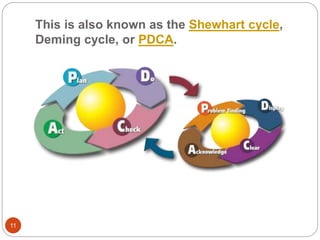
This is also known as the Shewhart cycle, 
Deming cycle, or PDCA. 
11
12 
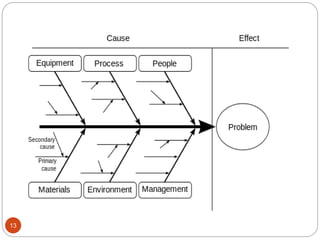
Another technique used in conjunction with 
PDCA is the 5 Whys, which is a form of root 
cause analysis in which the user asks a series of 
5 "why" questions about a failure that has 
occurred, basing each subsequent question on 
the answer to the previous. There are normally a 
series of causes stemming from one root 
cause,and they can be visualized using fishbone 
diagrams or tables.
13
Pit Falls in Kaizen 
14 
 Resistance to change. 
 Lack of proper procedure to implement. 
 Too much suggestion may lead to confusion and 
time wastage. 
 Difficult to implement in large scale process, 
where analyzing requires a lot of time.
KAIZEN HELPS YOU TO …. 
SEE THE WASTE. 
TURN PROBLEMS INTO PROFIT. 
CONSTANTLY CHANGE FOR THE BETTER.. 
15

Kaizen sqc

  • 1.
    KAIZEN PRESENTED BY- 11BIE002 KARAN THAKKAR 11BIE015 MOHIL RADIA 11BIE025 RAJAT PATEL 11BIE027 YAGNIK SAVALIYA 11BIE031 RUSHABH
  • 2.
    Introduction 2 Masaaki Imai is known as the developer of KAIZEN.  ‘KAI’ means ‘Change or the action to correct’.  ‘ZEN’ means ‘Good’.  Kaizen is small incremental changes made for improving productivity and minimizing wastes.
  • 3.
    3 Main Principlesof KAIZEN 3 1. Consider the process and the results. 2. The need to look at the entire process of the job at hand and to evaluate the job as to the best way to get the job done. 3. Kaizen must be approached in such a way that no one is blamed and that best process is put into place.
  • 4.
    Features Of Kaizen 4  Widely applicable.  Highly effective and result oriented.  A learning experience.  Team based and cross-functional.
  • 5.
    Phases in Kaizen 5 A. Select an event. B. Plan an event. C. Implement an event. D. Follow-up an event.
  • 6.
  • 7.
    5’S’ in KAIZEN 7  Sorting.  Simplifying.  Sweeping.  Standardizing  Sustaining.
  • 8.
    Benefits Of Kaizen 8  Kaizen reduces waste - like inventory waste, time waste and workers motion.  Kaizen improves space utilization and product quality.  Results in higher employee moral and job satisfaction.  Teaches workers how to solve everyday problems.
  • 9.
    Implementation 9 TheToyota Production System is known for kaizen, where all line personnel are expected to stop their moving production line in case of any abnormality and, along with their supervisor, suggest an improvement to resolve the abnormality which may initiate a kaizen.
  • 10.
    The cycle ofkaizen activity can be defined as: 10  Standardize an operation and activities,  Measure the operation (find cycle time and amount of in-process inventory).  Gauge measurements against requirements.  Innovate to meet requirements and increase productivity.  Standardize the new, improved operations.  Continue cycle ad infinitum.
  • 11.
    This is alsoknown as the Shewhart cycle, Deming cycle, or PDCA. 11
  • 12.
    12 Another techniqueused in conjunction with PDCA is the 5 Whys, which is a form of root cause analysis in which the user asks a series of 5 "why" questions about a failure that has occurred, basing each subsequent question on the answer to the previous. There are normally a series of causes stemming from one root cause,and they can be visualized using fishbone diagrams or tables.
  • 13.
  • 14.
    Pit Falls inKaizen 14  Resistance to change.  Lack of proper procedure to implement.  Too much suggestion may lead to confusion and time wastage.  Difficult to implement in large scale process, where analyzing requires a lot of time.
  • 15.
    KAIZEN HELPS YOUTO …. SEE THE WASTE. TURN PROBLEMS INTO PROFIT. CONSTANTLY CHANGE FOR THE BETTER.. 15