KAIZEN
Overview Of Kaizen
 Japanese word
 Kai meaning “change” Zen meaning
“better”
 It is a continuous improvement with
involvement of everybody in organization
so as to generate customer value
Kaizen : Key principles
• Teamwork,
• Strong personal discipline,
• Confident about offering suggestions
• Always room for improvement
• Quality circles, worker groups
Kaizen : Implementation Concepts
• Kaizen encompasses many of the components of Japanese
businesses that have been seen as a part of their success.
• Some of these concepts inspired by Kaizen are:
– 5 S
– The Deming or Shewhart Cycle (PDCA)
– Quality circles
– Kanban
– JIT
“5 S” in Kaizen
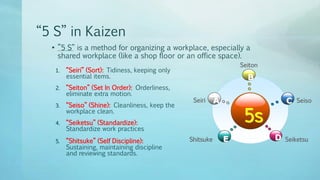
• “5 S” is a method for organizing a workplace, especially a
shared workplace (like a shop floor or an office space).
1. “Seiri” (Sort): Tidiness, keeping only
essential items.
2. “Seiton” (Set In Order): Orderliness,
eliminate extra motion.
3. “Seiso” (Shine): Cleanliness, keep the
workplace clean.
4. “Seiketsu” (Standardize):
Standardize work practices
5. “Shitsuke” (Self Discipline):
Sustaining, maintaining discipline
and reviewing standards.
5s
B
E
C
D
ASeiri
Seiton
Seiso
Shitsuke Seiketsu
The Kaizen cycle
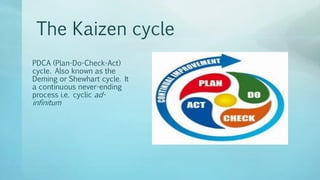
PDCA (Plan-Do-Check-Act)
cycle. Also known as the
Deming or Shewhart cycle. It
a continuous never-ending
process i.e. cyclic ad-
infinitum
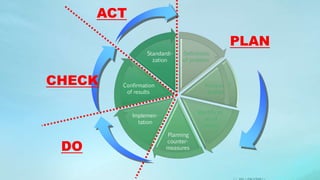
Definitions
of problem
Analysis of
problem
Identificati
on of
causes
Planning
counter-
measures
Implemen-
tation
Confirmation
of results
Standardi-
zation
PLAN
DO
CHECK
ACT
Quality Circles
• A quality circle is a volunteer group composed of employees, who
are trained to identify, analyse and solve work-related problems and
present their solutions to management.
• This improves the performance of the organization, while also
motivating and enriching the work of employees.
• First established in Japan in 1962 in the Nippon Wireless and
Telegraph Company, it quickly became popular and spread to more
than 35 companies in the first year.
QCS
Marketing
Product
planning
Design
Production
preparation
Production
&
Purchasing
Top
management
responsibility :
Strategy &
Planning
Administration
responsibility:
Provide
support
Kanban
• Kanban (meaning “signboard” or “billboard”) is a concept related to lean and just-
in-time (JIT) production.
• The concept got shape when Toyota observed how supermarkets operate.
– The supermarket only stocks what it believes it will sell; Therefore has limited
and only necessary inventory
– Signboards clearly indicate to shoppers where what is stocked; so the customers
can shop efficiently and complete their shopping in time.
• For a lean and efficient system, it is required that the production is determined
according to the actual demand.
• In situations where supply time is lengthy and demand is difficult to forecast, the
best one can do is to respond quickly to observed demand.
• This is where a Kanban system can help: It works as a communication system
which immediately provides information about changed demand through the entire
supply chain.
J
I
T
Shortened lead time
Reduced time spent on non-process work
Reduced inventory
Better balance between different
processes
Problem clarification
BENEFITS OF KAIZEN
Widely
applicable
Highly
effective
&
results
oriented
Cost
Delivery
Moral of
employees
Safety
Higher
operational
efficiency
INNOVATION
Creativity
Individualism
Specialist oriented
Attention to great leaps
Technology oriented
Information: closed, proprietary
Functional (specialist) orientation
Seek new technology
Line + staff
Limited feedback
KAIZEN
Adaptability
Teamwork (system approach)
Generalist-oriented
Attention to details
People oriented
Information: open, shared
Cross functional orientation
Build on existing technology
Cross functional organization
Comprehensive feedback
DIFFERENCE BETWEEN
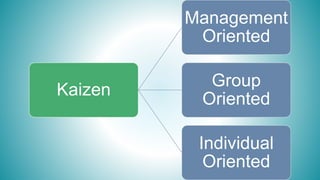
Kaizen
Management
Oriented
Group
Oriented
Individual
Oriented
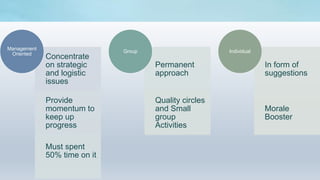
Concentrate
on strategic
and logistic
issues
Provide
momentum to
keep up
progress
Must spent
50% time on it
Management
Oriented
Permanent
approach
Quality circles
and Small
group
Activities
Group
In form of
suggestions
Morale
Booster
Individual
5. Safety
6. New-product development
7. Productivity improvement
8. Supplier management
4. Meeting delivery schedule
3. Meeting production quota
1. Quality assurance
2. Cost reduction
TQM
TQM
MAIN PRENCIPLES OF KAIZEN BY TQM
Muda (Waste)
Muri (Strain)
Mura (Discrepancy)
Manpower
Technique
Method
Time
Facilities
Jigs and tools
Materials
Production volume
Inventory
Place
Way of thinking
// YIS//062709//
Waste of
REJECTS
quality
Waste in
WORK IN
PROGRESS
Waste in
DESIGN
deliverycost
product
Method /
system
resources
moneyfacilitiesmanpower
Waste in
EXPENSES
Waste in
FACILITIES
Waste in
MANPOWER
Waste in
MANAGEMENT
Waste in
MOTION
Waste in
FIRST PHASE OF PRODUCTION
Man ( operator) Machine (facilities) Material Operation Method
Does he follow standard? Does it meet production requirements? Are there any mistakes in volume? Are the work standards adequate?
Is his work efficiency acceptable? Does it meet process capabilities? Are there any mistakes in grade? Is the work standard upgraded?
Is he problem conscious? Is the oiling (greasing) adequate?
Are there any mistakes in the brand
name?
Is it a safe method?
Is he responsible/accountable? Is the inspecction adequate? Are there impurities mixed in?
Is it a method that ensures a good
product?
Is he qualified?
is operation stopped often because of
mechanical trouble?
Is the inventory level adequate? Is it an efficient method?
Is he experienced? Does it meet precision requirements? Is there any waste in material? is the sequence of work adequate?
Is he assigned to the right job? Does it make any unusual noises? Is the handling adequate? Is the setup adequate?
Is he willing to improve? Is the layout adequate? Is the work in process abandoned?
Are the temperature and humidity
adequate?
Does he maintain good human
relations?
Are there enough machines/facilities? Is the layout adequate? Are the lighting and ventilation adequate?
Is he healthy? Is everything in good working order? Is the quality standard adequate?
Is there adequate contact with the previous
and next processes?
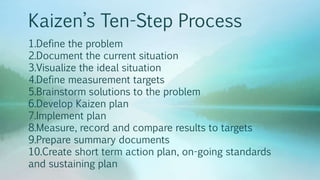
Kaizen’s Ten-Step Process
1.Define the problem
2.Document the current situation
3.Visualize the ideal situation
4.Define measurement targets
5.Brainstorm solutions to the problem
6.Develop Kaizen plan
7.Implement plan
8.Measure, record and compare results to targets
9.Prepare summary documents
10.Create short term action plan, on-going standards
and sustaining plan
Some common themes that may be addressed for
Kaizen:
• Improving customer forms received in good order.
• Improving first time call resolution in a call center.
• Streamlining the order to payment process in purchasing.
• Streamlining the reporting of hours worked to payroll.
• Reducing time to hire and onboard new employees.
• Reducing the submission to completion cycle time for facilities
requests.
• Co-designing forms or content (for a web application) with the
largest single user (this may be an external Kaizen with great
partnering opportunities).
BRANDS ARE USING THIS SYSTEM
Case Study
Kaizen in Toyota
The Toyota Production System is known for it’s use of kaizen.
• After World War II, Taiichi Ohno was charged with setting up machine shops for
Toyota. He studied the Ford production systems. He analyzed the various productive
measures and discrepancies in the system.
• Based on the analysis, he outlined several production strategies for Toyota. These
production strategies later became benchmarks for production practices across the
world.
– Toyota thus became one of the first companies in the world to adopt practices
such as Kaizen. Analysts however feel that Kaizen kept JIT, Kanban, 5 S, The
Deming or Shewhart Cycle (PDCA), Quality circles and other practices working
smoothly as an interlinked strategic operational plan.
Conclusion
Kaizen is an excellent way to formalize some simple improvement
activities that are not always run in an optimal format. Kaizen also avoids
the stigma of a formalized project that may be drawn out over several
weeks or months.
Most importantly, Kaizen provides just-in-time process improvements.
By using the above 10-step methodology, ensuring the relevant parties
are participating and empowered, and that those steps not able to be
completed in the event are completed within 30 days, Kaizen can enable
significant and sustainable improvements to any organization.
Thank you for your
attention!

Kaizen

  • 1.
  • 2.
    Overview Of Kaizen Japanese word  Kai meaning “change” Zen meaning “better”  It is a continuous improvement with involvement of everybody in organization so as to generate customer value
  • 3.
    Kaizen : Keyprinciples • Teamwork, • Strong personal discipline, • Confident about offering suggestions • Always room for improvement • Quality circles, worker groups
  • 4.
    Kaizen : ImplementationConcepts • Kaizen encompasses many of the components of Japanese businesses that have been seen as a part of their success. • Some of these concepts inspired by Kaizen are: – 5 S – The Deming or Shewhart Cycle (PDCA) – Quality circles – Kanban – JIT
  • 5.
    “5 S” inKaizen • “5 S” is a method for organizing a workplace, especially a shared workplace (like a shop floor or an office space). 1. “Seiri” (Sort): Tidiness, keeping only essential items. 2. “Seiton” (Set In Order): Orderliness, eliminate extra motion. 3. “Seiso” (Shine): Cleanliness, keep the workplace clean. 4. “Seiketsu” (Standardize): Standardize work practices 5. “Shitsuke” (Self Discipline): Sustaining, maintaining discipline and reviewing standards. 5s B E C D ASeiri Seiton Seiso Shitsuke Seiketsu
  • 6.
    The Kaizen cycle PDCA(Plan-Do-Check-Act) cycle. Also known as the Deming or Shewhart cycle. It a continuous never-ending process i.e. cyclic ad- infinitum
  • 7.
    Definitions of problem Analysis of problem Identificati onof causes Planning counter- measures Implemen- tation Confirmation of results Standardi- zation PLAN DO CHECK ACT
  • 8.
    Quality Circles • Aquality circle is a volunteer group composed of employees, who are trained to identify, analyse and solve work-related problems and present their solutions to management. • This improves the performance of the organization, while also motivating and enriching the work of employees. • First established in Japan in 1962 in the Nippon Wireless and Telegraph Company, it quickly became popular and spread to more than 35 companies in the first year.
  • 9.
  • 10.
    Kanban • Kanban (meaning“signboard” or “billboard”) is a concept related to lean and just- in-time (JIT) production. • The concept got shape when Toyota observed how supermarkets operate. – The supermarket only stocks what it believes it will sell; Therefore has limited and only necessary inventory – Signboards clearly indicate to shoppers where what is stocked; so the customers can shop efficiently and complete their shopping in time. • For a lean and efficient system, it is required that the production is determined according to the actual demand. • In situations where supply time is lengthy and demand is difficult to forecast, the best one can do is to respond quickly to observed demand. • This is where a Kanban system can help: It works as a communication system which immediately provides information about changed demand through the entire supply chain.
  • 11.
    J I T Shortened lead time Reducedtime spent on non-process work Reduced inventory Better balance between different processes Problem clarification
  • 12.
  • 13.
    INNOVATION Creativity Individualism Specialist oriented Attention togreat leaps Technology oriented Information: closed, proprietary Functional (specialist) orientation Seek new technology Line + staff Limited feedback KAIZEN Adaptability Teamwork (system approach) Generalist-oriented Attention to details People oriented Information: open, shared Cross functional orientation Build on existing technology Cross functional organization Comprehensive feedback DIFFERENCE BETWEEN
  • 14.
  • 15.
    Concentrate on strategic and logistic issues Provide momentumto keep up progress Must spent 50% time on it Management Oriented Permanent approach Quality circles and Small group Activities Group In form of suggestions Morale Booster Individual
  • 16.
    5. Safety 6. New-productdevelopment 7. Productivity improvement 8. Supplier management 4. Meeting delivery schedule 3. Meeting production quota 1. Quality assurance 2. Cost reduction TQM TQM MAIN PRENCIPLES OF KAIZEN BY TQM
  • 17.
    Muda (Waste) Muri (Strain) Mura(Discrepancy) Manpower Technique Method Time Facilities Jigs and tools Materials Production volume Inventory Place Way of thinking
  • 18.
    // YIS//062709// Waste of REJECTS quality Wastein WORK IN PROGRESS Waste in DESIGN deliverycost product Method / system resources moneyfacilitiesmanpower Waste in EXPENSES Waste in FACILITIES Waste in MANPOWER Waste in MANAGEMENT Waste in MOTION Waste in FIRST PHASE OF PRODUCTION
  • 19.
    Man ( operator)Machine (facilities) Material Operation Method Does he follow standard? Does it meet production requirements? Are there any mistakes in volume? Are the work standards adequate? Is his work efficiency acceptable? Does it meet process capabilities? Are there any mistakes in grade? Is the work standard upgraded? Is he problem conscious? Is the oiling (greasing) adequate? Are there any mistakes in the brand name? Is it a safe method? Is he responsible/accountable? Is the inspecction adequate? Are there impurities mixed in? Is it a method that ensures a good product? Is he qualified? is operation stopped often because of mechanical trouble? Is the inventory level adequate? Is it an efficient method? Is he experienced? Does it meet precision requirements? Is there any waste in material? is the sequence of work adequate? Is he assigned to the right job? Does it make any unusual noises? Is the handling adequate? Is the setup adequate? Is he willing to improve? Is the layout adequate? Is the work in process abandoned? Are the temperature and humidity adequate? Does he maintain good human relations? Are there enough machines/facilities? Is the layout adequate? Are the lighting and ventilation adequate? Is he healthy? Is everything in good working order? Is the quality standard adequate? Is there adequate contact with the previous and next processes?
  • 20.
    Kaizen’s Ten-Step Process 1.Definethe problem 2.Document the current situation 3.Visualize the ideal situation 4.Define measurement targets 5.Brainstorm solutions to the problem 6.Develop Kaizen plan 7.Implement plan 8.Measure, record and compare results to targets 9.Prepare summary documents 10.Create short term action plan, on-going standards and sustaining plan
  • 21.
    Some common themesthat may be addressed for Kaizen: • Improving customer forms received in good order. • Improving first time call resolution in a call center. • Streamlining the order to payment process in purchasing. • Streamlining the reporting of hours worked to payroll. • Reducing time to hire and onboard new employees. • Reducing the submission to completion cycle time for facilities requests. • Co-designing forms or content (for a web application) with the largest single user (this may be an external Kaizen with great partnering opportunities).
  • 22.
    BRANDS ARE USINGTHIS SYSTEM
  • 23.
  • 24.
    Kaizen in Toyota TheToyota Production System is known for it’s use of kaizen. • After World War II, Taiichi Ohno was charged with setting up machine shops for Toyota. He studied the Ford production systems. He analyzed the various productive measures and discrepancies in the system. • Based on the analysis, he outlined several production strategies for Toyota. These production strategies later became benchmarks for production practices across the world. – Toyota thus became one of the first companies in the world to adopt practices such as Kaizen. Analysts however feel that Kaizen kept JIT, Kanban, 5 S, The Deming or Shewhart Cycle (PDCA), Quality circles and other practices working smoothly as an interlinked strategic operational plan.
  • 25.
    Conclusion Kaizen is anexcellent way to formalize some simple improvement activities that are not always run in an optimal format. Kaizen also avoids the stigma of a formalized project that may be drawn out over several weeks or months. Most importantly, Kaizen provides just-in-time process improvements. By using the above 10-step methodology, ensuring the relevant parties are participating and empowered, and that those steps not able to be completed in the event are completed within 30 days, Kaizen can enable significant and sustainable improvements to any organization.
  • 26.
    Thank you foryour attention!