KAIZEN
改善
改善
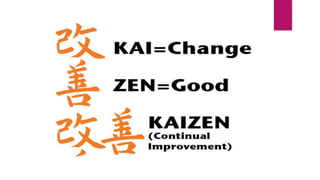
Kaizen, 改善, is Japanese for "improvement". When used in the business
sense and applied to the workplace, kaizen refers to activities
that continuously improve all functions and involve all employees from
the CEO to the assembly line workers. It also applies to processes, such as
purchasing and logistics, that cross organizational boundaries into
the supply chain. It has been applied in healthcare, psychotherapy, life-
coaching, government, banking, fantasy hockey, and other industries.
Dual Nature
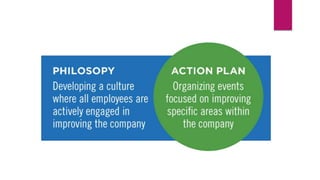
 Kaizen is part action plan and part philosophy.
 As an action plan, Kaizen is about organizing events focused on improving specific
areas within the company. These events involve teams of employees at all levels,
with an especially strong emphasis on involving plant floor employees
 As a philosophy, Kaizen is about building a culture where all employees are
actively engaged in suggesting and implementing improvements to the company.
In truly lean companies, it becomes a natural way of thinking for both managers
and plant floor employees.
Implementation
 The Toyota Production System is known for kaizen, where all line personnel are
expected to stop their moving production line in case of any abnormality and,
along with their supervisor, suggest an improvement to resolve the
abnormality which may initiate a kaizen.
 In the Toyota Way Fieldbook, Liker and Meier discuss the kaizen blitz and
kaizen burst (or kaizen event) approaches to continuous improvement.
 A kaizen blitz, or rapid improvement, is a focused activity on a particular
process or activity.
Implementation
 The basic concept is to identify and quickly remove waste.
 Another approach is that of the kaizen burst, a specific kaizen activity on a
particular process in the value stream.
 Kaizen facilitators generally go through training and certification before
attempting a Kaizen project.
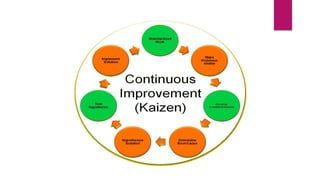
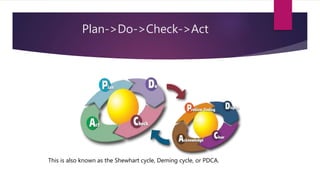
 Plan→Do→Check→Act
Plan->Do->Check->Act
This is also known as the Shewhart cycle, Deming cycle, or PDCA.
How Do You Implement Kaizen?
 It's important to note that kaizen is a way of thinking, not a project to complete.
 To implement it, all employees should receive training on the concept
of kaizen and should have some guidelines in terms of what they need to do
before implementing a change.
 For example, it may be fine for an office worker to change his or her handling of
paperwork without any discussion. A change in the production process, though,
may impact multiple teams and should be discussed with all impacted parties
before implementation.
 In addition, most production steps will be subject to safety regulations and will
have detailed documentation on accurate performance, and these need to be in
place before a change is made.
How Do You Implement Kaizen?
 It's also important that management is trained and be behind the effort.
 Kaizen will result in many more suggestions for improvements and changes and
will take away from a rigid focus on moving items quickly through the existing
production process.
 Management must be ready to accept some time away from current work to
focus on changes with longer-range impact.
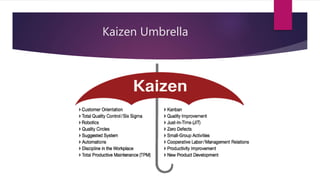
Kaizen Umbrella
THANK YOU

Kaizen

  • 1.
  • 3.
    改善 Kaizen, 改善, isJapanese for "improvement". When used in the business sense and applied to the workplace, kaizen refers to activities that continuously improve all functions and involve all employees from the CEO to the assembly line workers. It also applies to processes, such as purchasing and logistics, that cross organizational boundaries into the supply chain. It has been applied in healthcare, psychotherapy, life- coaching, government, banking, fantasy hockey, and other industries.
  • 5.
    Dual Nature  Kaizenis part action plan and part philosophy.  As an action plan, Kaizen is about organizing events focused on improving specific areas within the company. These events involve teams of employees at all levels, with an especially strong emphasis on involving plant floor employees  As a philosophy, Kaizen is about building a culture where all employees are actively engaged in suggesting and implementing improvements to the company. In truly lean companies, it becomes a natural way of thinking for both managers and plant floor employees.
  • 7.
    Implementation  The ToyotaProduction System is known for kaizen, where all line personnel are expected to stop their moving production line in case of any abnormality and, along with their supervisor, suggest an improvement to resolve the abnormality which may initiate a kaizen.  In the Toyota Way Fieldbook, Liker and Meier discuss the kaizen blitz and kaizen burst (or kaizen event) approaches to continuous improvement.  A kaizen blitz, or rapid improvement, is a focused activity on a particular process or activity.
  • 8.
    Implementation  The basicconcept is to identify and quickly remove waste.  Another approach is that of the kaizen burst, a specific kaizen activity on a particular process in the value stream.  Kaizen facilitators generally go through training and certification before attempting a Kaizen project.  Plan→Do→Check→Act
  • 9.
    Plan->Do->Check->Act This is alsoknown as the Shewhart cycle, Deming cycle, or PDCA.
  • 10.
    How Do YouImplement Kaizen?  It's important to note that kaizen is a way of thinking, not a project to complete.  To implement it, all employees should receive training on the concept of kaizen and should have some guidelines in terms of what they need to do before implementing a change.  For example, it may be fine for an office worker to change his or her handling of paperwork without any discussion. A change in the production process, though, may impact multiple teams and should be discussed with all impacted parties before implementation.  In addition, most production steps will be subject to safety regulations and will have detailed documentation on accurate performance, and these need to be in place before a change is made.
  • 11.
    How Do YouImplement Kaizen?  It's also important that management is trained and be behind the effort.  Kaizen will result in many more suggestions for improvements and changes and will take away from a rigid focus on moving items quickly through the existing production process.  Management must be ready to accept some time away from current work to focus on changes with longer-range impact.
  • 12.
  • 13.